Home Blog Page 118

IN PHOTOS: National Heroes’ Day honor activists, martyrs of Philippine freedom and democracy

0

Progressive groups gathered at Bantayog ng mga Bayani, a memorial for Martial Law martyrs and the survivors who perished later on, on National Heroes’ Day to pay tribute to fallen freedom fighters in current times as the struggle for freedom and democracy continues under the current Rodrigo Duterte administration. Activist killings have persisted despite lockdowns, […]

The post IN PHOTOS: National Heroes’ Day honor activists, martyrs of Philippine freedom and democracy appeared first on Manila Today.

In praise of the community organizer

0

There are several stereotypes of activists but the most uncommon figure is that of the community organizer.

We are familiar with the image of activists raising banners with clenched fists. The grim and determined look of street protesters. The dignified posture of influencer dissenters made more visible on various social media platforms.

Yet the significant contribution of the community organizer often eludes our attention. Maybe because we are often in search of archetypes that will resonate with many. It is also more likely that this is deliberately intended – the community organizer understating his/her presence, shunning popular recognition, and allowing other kasamas to speak and appear more prominently in public.

Community organizers are the activist frontliners performing the most crucial tasks in organizing and political conscientization. They are effective because of their organic ties to the grassroots. They speak the language of the masses, they have incisive knowledge of the political terrain, and they command the respect of the community.

It is often through their initiative and lobbying that an obscure parochial concern is given the spotlight that it deserves. This is made possible because of their persuasive campaigning, painstaking mass work, and almost selfless dedication to serve the community.

But this labor of love is usually underemphasized. What is seen is the public pronouncements of civic leaders, the response of public officials, the entry of interested parties which are welcomed to widen the appeal of the campaign, and the coding of all these actions in mainstream and digital media platforms.

Working tirelessly on the ground are community organizers who turned a particular issue into a political question and mobilized the people to discuss, decide, and determine the proper course of action. They are immersed in full-time political work even if this does not yield any pecuniary benefit.

We understand activism through fiery speeches in daring street actions but the struggle is in the details.

Every slogan is carefully studied, every sentence in manifestos is checked for clarity and sharpness of critique, even the size of placards matters. Political actions entail rigorous planning which involves day-to-day coordination and anticipation of sudden shifts in the political situation.

Those who mock activists for holding too many rallies got it wrong. Rallies are few and far in between but we have too many meetings and study sessions.

A mass campaign is not instantly developed. It is a continuous organized intervention linking several political moments that disrupt the seemingly natural flow of History. It renders judgment about our present and offers an alternative future. It directly confronts the structures of power that dominate society. Therefore, no less than a mass movement is required to make activism possible and withstand the conservative backlash.

Who better to explore the fighting chances of the campaign than the community organizer? Embedded in the thick of the battle, bridging the local with the broader political community, and an authentic voice and representative of the marginalized.

Any success is attributed to the extraordinary intervention of well-meaning individuals. But a snag in the campaign is pinned on the performance of community organizers. Worse, they receive the hardest blows from state-backed reprisals. Supporters and advocates can retreat and offer solidarity from a distance but this is not an easy option for community-based activists who must stay to preserve the dignity of the resistance.

This decision inspires others to keep on fighting in the community even if the price to pay is harsher political persecution. Political organizing has its highs and lows but the backbone of the struggle is kept alive through the meticulous work of community organizers.

Even when public attention subsides, especially if it’s accompanied by an ebbing in local activism, the role of community organizers becomes more crucial in sustaining the vision of a progressive politics. When they are blamed by the people they organized for engaging in a lost battle, they persevere in explaining why advancing the Cause requires not just sacrifice but the right attitude in turning defeats into opportunities to strike bigger victories in the future.

But outsider perspectives can demean and distort local struggles. Malicious commentaries can also affect the course of the struggle and how the public will judge the politics of activists. They are often the handiwork of state-sponsored institutions that could not imagine any response to people’s resistance other than to diminish its credibility. There are also partisan forces pretending to be disinterested which hides their irrelevance by echoing the reactionary slander that activists are acting as a shadowy sect with a sinister agenda.

The justness of the resistance is the best rejoinder to perspectives that disdain the right to protest. And no anti-Left political rhetoric, even if produced in the name of scholarship, can tarnish the political legacy of community activists in the eyes of the masses. Neither will it invalidate the necessity of radical struggle.

Other political forces are desperate to be on the good side of history. We are more interested in creating History. Our prospect is bright because our best revolutionaries are there in the grassroots – studying theory, doing politics, and making history every day under the most challenging situations.

The post In praise of the community organizer appeared first on Bulatlat.

Karapatan urges SC: grant the petition for review of amparo and habeas data amid worsening attacks on rights defenders

0

Human rights watchdog Karapatan called on the Supreme Court anew to grant the petition for review of the petition for the writs of amparo and habeas data as they filed a manifestation today on the assassination of human rights and health worker Zara Alvarez, who was supposed to stand as a witness in the petition, amid the successive threats and worsening attacks against human rights workers. Their legal counsels from the National Union of People’s Lawyers assisted them in the filing of the manifestation.

read more

IN PHOTOS: Groups protest on start of ABS-CBN workers retrenchment due to shutdown

0

Groups Defend Jobs Philippines, Anakbayan NCR, Sining Bugkos and Bagong Alyansang Makabayan (BAYAN) NCR and its chapters protested outside the ABS-CBN Sgt. Esguerra gate on August 31, the start of the retrenchment of many of the network’s workers after Congress rejected ABS-CBN’s franchise bid on July 10. The network was forced off the air on […]

The post IN PHOTOS: Groups protest on start of ABS-CBN workers retrenchment due to shutdown appeared first on Manila Today.

Message on National Heroes Day

0

Today, National Heroes’ Day, we remember the lives of our forebears who helped shape our nation, their bravery to fight for the country’s freedom, independence and democracy, and courage to face tremendous struggles, even treachery and death itself for the sake of these ideals.

We commemorate the heroism of Andres Bonifacio and the Katipunan whose Cry of Pugadlawin sparked the revolution against Spain and the sacrifices made by Jose Rizal, Antonio Luna, Macario Sakay and numerous others.We commemorate our country’s heroes because of the sacrifices they made for their compatriots, for the common good, for their motherland.

What makes a hero? That decision to forego one’s own safety and comfort to act towards a higher cause so that others might live in a better way and reach a better tomorrow. That decision to serve others, especially those who are powerless and voiceless, makes a hero.

Heroes are a product of their times. They responded to the call of their times and made sacrifices accordingly – from the Filipino revolutionaries who took up arms to thwart colonialism and to wage guerilla war against foreign invasion and collaboration to the struggles of the youth and the broad masses against dictatorship and for democratic space. Our country’s history is replete with heroism – we remember our heroes today but more importantly we commit to emulate their lives. They heeded the call of their times, it is our task to respond to the call of ours.

The Educators’ Forum for Development joins Filipino teachers in taking up the challenge to inspire one another and our students to commit to higher ideals and go beyond ourselves and convenience.

We can do this by drawing inspiration from present-day heroes – the health workers and other front liners battling the pandemic, the teachers who brave distances and hardships to help students in far-flung communities, the farmers and workers who continue to turn the wheel of economic production for the common good, the students who use their creativity and resourcefulness to help fellow students and even other sectors and spend their time immersing in communities, and many others.

We can be emboldened by listening to stories of various organizations and groups championing social change and calling for urgent reforms, some of them have even put their lives on the line for the majority’s sake.

Our times call for greater involvement by citizens. Taking up this challenge is our way of making sure the sacrifices of our heroes would live on.

Such a drag: Lockdown takes toll on ‘Golden Gays’

0

By: Fate Colobong – @inquirerdotnet Philippine Daily Inquirer / August 30, 2020

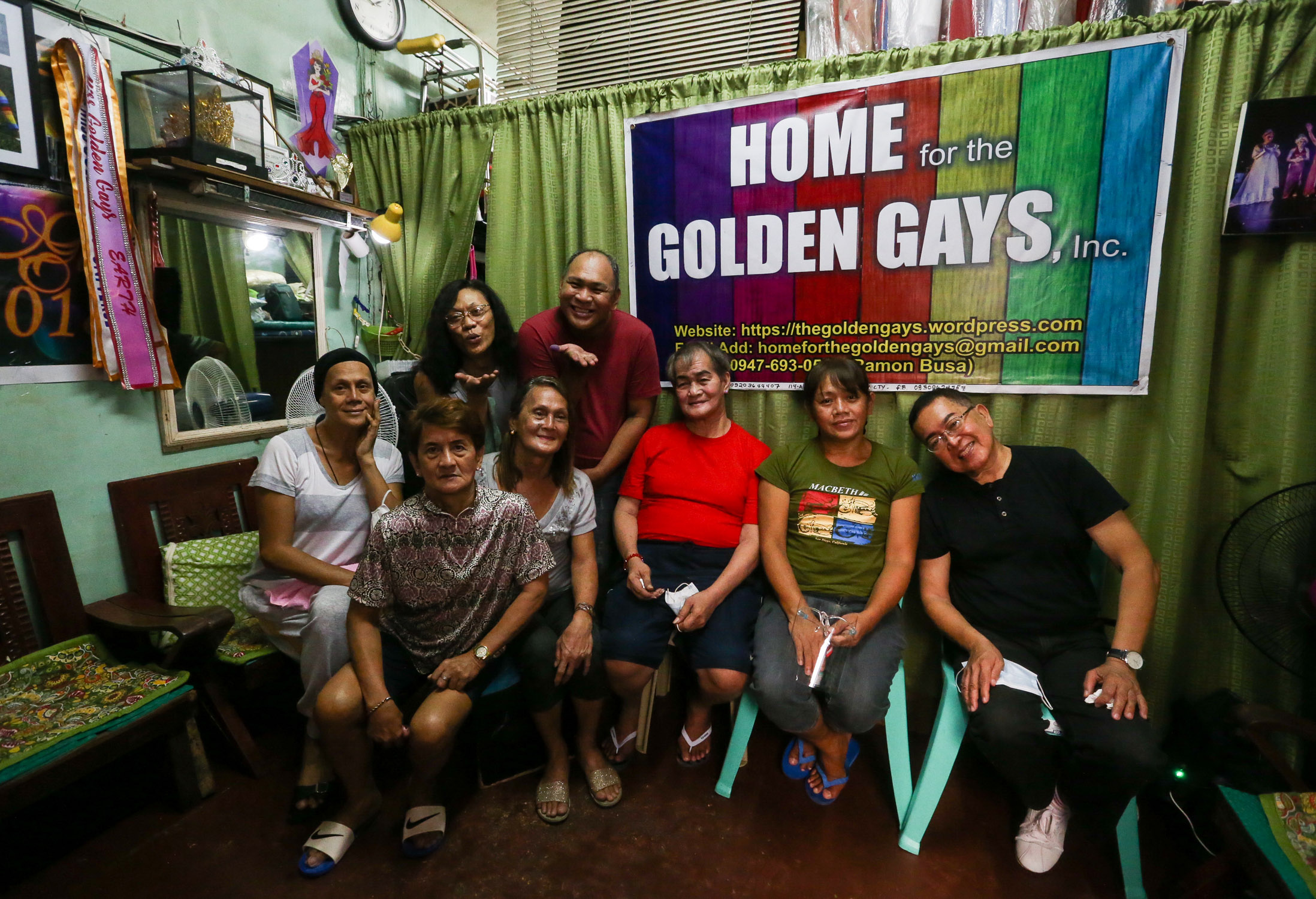
MANILA, Philippines — “Golden” queens are living in a shabby apartment in Pasay City, pining for the drag shows they starred in before the COVID-19 pandemic put everything on hold.

Founded in the mid-1970s, the Home for the Golden Gays shelters “indigent” elderly gay men in Metro Manila. The youngest is 59 years old and the oldest is 87.

When its founder, pioneer LGBTQ rights activist Justo Justo, died in 2012, the nonprofit organization was forcibly closed.

Some of the residents were taken in by their families, but most were left wandering the streets, looking for ways to earn a living.

In time they decided to live together and put up drag shows. The activity allowed them to survive, albeit hand to mouth, from day to day.

Traumatized

But that’s all in the past now. “The shows are on total stop. We cannot perform because there are no venues available and mass gatherings are not allowed,” says Ramon Busa, 69, president of the Home for the Golden Gays.

Busa aka Monique dela Rue says it was “traumatizing” especially during the first two months of the enhanced community quarantine (ECQ) because the “lolas” (grandmothers), as they call themselves, have gotten used to being in the limelight.

“We could not move,” says Busa. “We could not do anything. And the worst part is we do not have income. And even if your lolas want to look for a job, we are not allowed to go out.”

When they were not being drag queens, some of the Golden Gays were makeup artists, or scavengers. But even these “trades” were suspended under the ECQ.

It is only through donations from LGBTQ groups, private companies and organizations that used to book their performances that they have managed to scrape by.

For one, a university group volunteered to pay their monthly rent from June to August, Busa says.

But what is gnawing at the lolas is their inability to perform.

Flor Bien Jr. aka Divine Amparo, who turns 60 in November, says it’s like a piece of him has been taken away. “It was disheartening. I feel jobless. Being a drag queen did not only support me and my family, it’s also part of who I am,” he says.

Bien joined the Golden Gays in 2016, but has been a “performer through and through”—living in Japan as an entertainer and winning gay beauty pageants in the early ’80s.

Goddess

When you’re young, you’re a goddess, says Bien, who impersonated Caucasian celebrities, such as Olivia Newton-John, Marilyn Monroe and Liza Minnelli: “Pag bata ka, dyosang dyosa ang dating mo.”

The same goes for Reynaldo Ramos aka Bangs Garcia, for whom performing drag is a source of strength and good health.

“I feel young, as though I’m in my 20s,” says Ramos, 50. So when the shows were stopped, he says, he felt weakened.

Ramos belongs to the category “Silver Gays,” which are group members age 50 and below.

Performing drag, says anthropologist and Inquirer columnist Michael Tan, is just one of the many activities engaged in by the LGBTQ community, “often for entertainment, but also certainly as a livelihood.”

Exercise

Tan says it is also a form of exercise, which is good for the Golden Gays’ physical and mental well-being.

“The dances—which involve memorizing steps and synchronizing with music—were useful in ‘exercising’ the senior citizens’ cognitive capabilities … [And] with so many months without the dancing, many of the senior citizens may have faced cognitive decline,” Tan says, citing a study by Jacqueline Dominguez, a neurologist and geriatrician who conducts dance classes for elders in urban communities.

But Busa says the Golden Gays live by their motto that getting sick is a no-no (bawal ang magkasakit). In fact, he says, they are not scared that they may be infected by the coronavirus that causes COVID-19.

“Your lolas aren’t afraid of anything,” he declares. “We don’t get scared easily about getting sick because our life expectancy is long. We know what is good for our health and we exercise.”

Moreover, Busa says, the Golden Gays are “resilient” as they are resigned to the reality that no one will help them but themselves: “You must do things beneficial to you. That’s what we always tell ourselves … We welcome challenges as something good. That’s why your lolas are survivalists.”

But in the space between “resilience” and the burden of everyday survival lies the acceptance of not having a choice.

According to Tan, Filipinos often use “resilient” to “refer to the poor, or Westerners to refer to [Filipinos], or the government to refer to citizens, and it’s more often than not a cop-out, to excuse themselves from not doing anything.”

What must be done, he says, is to provide people with resources to have “at least a fighting chance, rather than a ‘no choice’ situation.”

Permanent home

Aside from support in cash and in kind, what the Golden Gays need is a permanent home, Busa says.

The group has 20 active members, eight of whom are staying in the apartment on San Luis Street, their home base. The rest are in two transient houses on David and Leveriza Streets, also in Pasay.

“There’s no other place we can go to,” says Busa. “That’s why I always tell the gay millennials that we (the Golden Gays) have started this. It’s now up to them to help us continue the legacy of providing a home for elderly gay men.”

In that way, he adds, when the original Golden Gays are gone, the rest will have a place to go to, because being gay doesn’t die—“hindi naman namamatay ang kabadingan.”

There has been “zero” assistance from the government, Busa says.

He says the Home for the Golden Gays is registered at the Securities and Exchange Commission but that accreditation at the Department of Social Welfare and Development is bogged down in paperwork.

Busa is working on a new registration under the name “Golden Gays Manila.” He says once it is completed, a business process outsourcing company will provide them permanent shelter, “as promised.”

Prejudice

Until then, life goes on for them even in the face of discrimination.

Prejudice against elderly gay people is inevitable, Ramos says. “There are people who will underestimate you, and you cannot do anything about it. It is best to just ignore them.”

But there is more acceptance toward the LGBTQ community in today’s society, Tan points out. For example, he says, people can now casually introduce their same-sex partner—a thing that “would not have been possible maybe even five years ago.”

Still, he says, much intolerance remains, and it is “stronger against elderly gay people in part because of the stereotypes against dirty old men plus the misconception that gay men are all pedophiles.”

And there is extra prejudice for the Golden Gays because they are poor, Tan says. “No one would dare ostracize an elderly rich gay person. Our class bias is just so strong, and we see it amplified in this pandemic and the lockdown—the poor, whether women or children or LGBTQ, suffer much more.”

For the lolas, performing drag has become a means of escape: “’Pag nag-suot ka ng wig, humihinto ang daigdig,” Busa says.

Mario Caberos, 68, aka Evangeline Pascual, says that when they put on their makeup and “transform,” they don’t care what other people think of them.

For Reynaldo Ravago, 68, and considered the group’s Beyoncé, performing drag brought back the artistry that society has ignored due to his age. “It is a talent no one can ever take away from me. Through drag, I became an artist again.”
More than 500 human rights advocates sign statement calling for a stop to the killings in the Philippines

0

On the occasion of National Heroes Day, more than 500 human rights advocates from here and abroad are calling on the Philippine government to end the spate of killings that has claimed the lives of several activists over the past few months. 

read more

Gov’t troops feed Aeta with human feces, groups report

0

Government soldiers forced an indigenous person to eat human feces during a military operation in San Marcelino, Zambales Province last August 21, groups reported.

The post Gov’t troops feed Aeta with human feces, groups report appeared first on Kodao Productions.