Home Blog Page 120

Paramilitary destroys Lumad school; leader invokes Duterte in attack

0

“The teachers were about to take photos of the incident but were threatened by the ‘Bagani’ leader Lito Gambay, who told them to leave as President (Rodrigo) Duterte will know about this,” the SOS said. Students and community members cried out of frustration as their school was beingdestroyed, the group added.

The post Paramilitary destroys Lumad school; leader invokes Duterte in attack appeared first on Kodao Productions.

Desaparecidos warns of rise in cases of enforced disappearance under terror law, launches protest quilt for justice

0

The Anti-Terrorism Act will serve as a fertile ground for increased cases of enforced disappearance, Desaparecidos, the organization of families of victims of enforced disappearance, warned as they commemorated the International Day of the Disappeared today, August 30.

read more

Health watch

0

DEPARTMENT of Interior and Local Governments (DILG) Secretary Eduardo Ano once again tested positive for COVID-19 less than two weeks ago. That development naturally led to questions on whether other members of the Cabinet, but most specially President Rodrigo Duterte, have also contracted the infection.

Mr. Duterte only this week said one of his ailments could lead to stage one cancer. The state of his health is of course a public issue. But what makes it even more relevant is what his being well or ill can mean to the health of the Republic, which the citizenry should be closely monitoring during the Duterte autocracy.

Unfortunately, the focus of current discourse has entirely been on his partisans’ fears that he has the coronavirus. To allay those fears, Spokesperson Harry Roque said Mr. Duterte was in “perpetual isolation.” What he meant was that the President was under quarantine as the Inter-Agency Task Force for the Management of Emerging Infectious Diseases (IATF) requires of anyone who has been in contact with an infected individual.

No matter. The latest furor over Mr. Duterte’s health is only one instance among several others. But it was nevertheless an opportunity for the media and the public to consider the consequences of his being truly ill and unable to discharge his duties. Instead rumors that Mr. Duterte had flown to Singapore over the weekend of August 15-16 because of a medical emergency flooded both old and new media. To dispel those rumors, Mr. Duterte appeared in his usual late night press conference to declare that while he would not hide his flying off somewhere, he did not owe anyone any explanation even if he did, because that is solely his business. He has also said the same thing about his health— that it is no one else’s concern but his own. His making public the possibility that his Barrett’s disease of the esophagus could lead to cancer was a departure from that declaration.

Mr. Duterte’s health has nevertheless been the subject of rumor and speculation even before he was elected. During his campaign for the Presidency in 2016 he refused to answer a question about his health and instead insulted the journalist who asked it. His reaction provoked questions about why he was so sensitive about it, which in turn led to speculations that he wasn’t in the pink of health, or worse.

The state of health of any candidate for President is not just a matter of idle curiosity. Because whoever wins that post will have power enough to lead the country to either fortune or perdition, his or her physical and mental capacity to govern is a valid public issue.

His election to the Presidency made Mr. Duterte’s health more relevant and of interest to the media as well as that part of the citizenry aware of the immense responsibilities of the President of the Philippines and what the inability of the incumbent to discharge them can mean to this country. Beyond that, however, is the more crucial question of whether, should the incumbent President be incapacitated by health or any other issue, there will be a peaceful transfer of power. The survival of the Republic could depend on it, the alternative being chaos and who knows what else as the many contending forces that already divide the country vie for political supremacy.

In anticipation of such an eventuality, Article VII Section 8 of the Constitution assigns to the Vice President the duty of serving the President’s unexpired term should he or she be unable to discharge the duties of the Office. The Senate President and the Speaker of the House are next in the line of succession should the Vice President not qualify.

But Mr. Duterte has not assured the country that should he resign the Presidency or be incapacitated, what the Constitution provides will prevail. In those times when, contrary to his and his subalterns’ and allies’ claims that he’s perfectly fit for his job, he has openly declared that he might resign rather than wait for the expiration of his term in 2022 because he is “tired,” he has also said that he would prefer someone else other than Maria Leonor “Leni” Robredo, the duly-elected Vice-President of the Philippines, to succeed him.

He has even named Ferdinand “Bongbong” Marcos, Jr., the son of his idol and mentor, the late dictator Ferdinand Sr., as his chosen one. In one more indication of his indifference to the Constitution, he only recently identified other possible government caretakers, among them the Executive Secretary and the Secretary of Defense, none of whom are in the line of succession mandated by the Charter.

It won’t do for the optimistic to believe that Mr. Duterte is just one man among millions whose opinion will not matter if and when the time comes for someone to complete his term. The awful reality is that as incoherent, confused and confusing as they are, his autocratic views on governance are shared by the self-serving big bureaucrats with whom he has surrounded himself. Over the last four years, his and his allies’ occupation of this country’s seats of power has practically dismantled the fragile Constitutional order that has willy-nilly allowed the peaceful transfer of power since 1992, when Corazon Aquino turned the country over to the Fidel Ramos Presidency upon the expiration of her six-year term.

The destruction of that order was not and is not being done solely through the unbridled use of force, the killings and the lawlessness that the regime has enshrined as first and last principles in enforcing its will. Its ruin is also evident in the corruption that has metastasized throughout government, most significantly at its highest levels, where, for example, much of the trillions of pesos in foreign loans and reallocated budget items that could have otherwise built schools and hospitals; provided sustained economic aid to the families of the millions who have lost their jobs because of the pandemic; controlled the transmission of the COVID-19 contagion; and even mitigated if not prevented the economic recession, have ended up in the pockets of a few.

But the consequences of the unprecedented levels of corruption the entire country is witnessing are not limited to their economic and social impact. There is also the worsening culture of impunity, as both the corrupt and the murderous who are firmly entrenched in the regime as enforcers, yes-men, cronies and associates escape retribution for their crimes.

As a result of this troubled state of affairs, should Mr. Duterte be incapacitated by health issues, his minions in the civilian, police and military bureaucracies will very likely oppose the peaceful transfer of power to a Vice President whom they fear will take the post of President seriously enough to end the lawlessness and impunity that have enabled them to amass wealth and power beyond measure.

In anticipation of what to them would be a political and economic disaster, they are reviving the “revolutionary government” scheme that is obviously intended to trash the Constitution and enable someone with the same appetite for unaccountable power to succeed Mr. Duterte, who, by his acts and policies over the last four years, has achieved what no other President has imagined possible. He has made the state of health of one man—himself—crucial to the health as well of what little remains of Philippine democracy and the Republic.

Published in Business World
Aug. 28, 2020

Featured image from RTVM.

The post Health watch appeared first on Bulatlat.

Déjà vu: Stop the Killings campaign given new push

0

MANILA, Philippines — The sustained surge of international condemnations and calls for justice and independent investigations on the extrajudicial killings, this month, of peasant leader and peace consultant Randall Echanis and Negros human rights and health worker Zara Alvarez has sparked anew an urgent demand: Stop the Killings!

The demand recalls, and will most likely reprise, the widespread – national and international – campaign in the mid-2000s against the brutal and bloody two-part counterinsurgency program, dubbed “Oplan Bantay Laya I and II”, during the nine-year presidency of Gloria Macapagal-Arroyo. The government program resulted in the killing of 1,206 individuals and enforced disappearance of 206 others, mostly activists. (The victims included 221 members of five progressive partylist organizations, now grouped under the Makabayan Coalition, 155 of them from Bayan Muna.)

That “Stop the Killings!” campaign had three important achievements:

1) It pressured the Arroyo government to allow the United Nations Special Rapporteur on Extrajudicial Executions, Philip Alston, to visit the Philippines in 2006 and conduct on-the-ground investigations. Alston’s report concluded that state security forces were behind the EJKs and disappearances.

2) It impelled the Supreme Court, led by then Chief Justice Reynato S. Puno, to convene a summit, “A Conspiracy of Hope,” on EJKs and enforced disappearances which produced the judicial institution of the writs of amparo and habeas data, in addition to the writ of habeas corpus.

3) The campaign led to the ground-breaking success – through the efforts of the victims’ parents, friends and human rights lawyers – in prosecuting and sentencing to life imprisonment of Arroyo’s favorite “butcher” general, Jovito Palparan Jr., for the abduction and disappearance in 2006 of former UP students Sherlyn Cadapan and Karen Empeño.

That campaign also caused a sharp drop in the incidences of EJKs, from the peaks of 194 in 2005 and 235 in 2006 to 100 in 2007 and 90 in 2008. However, the number of cases moved up again to 130 in 2009.

In the case of the Duterte government, as of Aug. 17, there have been 328 cases of extrajudicial killings or EJKs documented by the human rights watchdog Karapatan in the past four years. Of this total, 218 were committed before Duterte signed Executive Order 70 in December 2017, and 110 since then.

EO 70 created the National Task Force to End the Local Communist Armed Conflict (NTF-ELCAC), chaired by Duterte with his national security adviser, former AFP chief Hermogenes Esperon Jr., as vice chair. It complements (or has absorbed) “Oplan Kapayapaan” (counterpart of Arroyo’s Oplan Bantay Laya).

NTF-ELCAC has principally steered the campaign of vilification, red-tagging, harassment, filing of trumped-up charges against activists – and could be complicit, if not directly accountable, for the spate of EJKs in the last few years.

Note: Esperon chiefly supervised Arroyo’s Oplan Bantay Laya I and II – described by Karapatan in its 2009 report as a “blueprint for terror and impunity” – as Philippine Army chief (2005-2006) and AFP chief (2006-2008). Now he supervises the implementation of EO 70 through NTF-ELCAC.

Signatures are now being collected in a drive, initiated by Bagong Alyansang Makabayan, to support a statement titled, “Stop the Killings! Justice for the Victims of EJK!” Importantly, it calls for a stop to the “red-tagging and vilification of activists, human rights defenders, and government critics” and independent investigations of the latest killings.

Specifically, it asks President Duterte to “denounce and order a stop to the killings… stop inciting the police, military and even ordinary civilians to commit such horrible acts.” The perpetrators of these killings must be held accountable and punished, it says, concluding: “Only in this way will the reign of tyranny and impunity end,”

There is also an open letter of 62 by civil society organizations to the 47 member-states of the UN Human Rights Council, dated Aug. 27, which expresses “grave concern over ongoing extrajudicial executions and other serious human rights violations [HRVs] in the context of the ‘war on drugs’ in the country.” It urges UNHRC member-states to “actively work” towards adopting a resolution [in its 46th meeting] establishing an independent international mechanism on and other HRVs in the Philippines since 2016 with the view of exacting accountability.

The Aktionsbundnis Menschenrechte-Philippinen (AMP), a group of seven major German church-based agencies and human rights organizations working with the German government and the European Union, urges their government to “speak up for ending impunity in the Philippines within the framework of diplomatic relations… for the continuation of the investigation mechanism in the Philippines in the framework of the UNHRC.”

Likewise, AMP urges the German government to support the human rights advocacies of Philippine CSOs at the EU and UN levels in face of the Duterte government’s “brutal crackdown on human rights defenders and civil society players… under the guise of counter-terrorism.”

A new factor facing the reprised Stop the Killings campaign is that President Duterte has, since 2017, taken a starkly hostile stance vis-à-vis the human rights community, both in the country and abroad – including the United Nations and the International Criminal Court (ICC).

In 2017, after the ICC chief prosecutor, Fatou Bensouda, announced she would conduct an examination of the EJKs related to his “war on drugs,” Duterte rejected the move, then unilaterally withdrew Philippine participation in the ICC. This move, however, hasn’t barred the continuation of the prosecutor’s examination since it was decided on while the Philippines was still in the ICC.

In that same year, Duterte spurned a request (similar to that of Alston in 2006) of UN Special Rapporteur on Extrjudicial Executions Agnes Callamard, who had called out his government on the EJK issue. He even publicly stated he would slap Callamard on the face should she come to the Philippines. After the recent killings, Callamard cried out through Twitter: “What will it take for these killings to stop? How much more sorrow, grief, pain can the [Filipino] people endure?… ENOUGH!”

In their letter to the UNHRC member-states, the CSOs point out that not one UN Special Procedures/Special Rapporteur country visit has been allowed by the Duterte government, “despite 14 outstanding visit requests.” It has not replied to the SP/SR communications since April 2019 — and even refused access into the country of UN Human Rights High Commissioner Michele Bachelet or her representatives; she has a mandate to submit to the UNHRC a comprehensive report on the human rights situation in the country. And after she submitted her report last June, the government rejected her recommendations pertaining to the killings, arbitrary detention, and “crackdown on civic space,” the civil society organizations say.

Despite these hazards, the way is wide open for the Stop the Killing campaign. With the initial encouraging broad response to the signature drive, given Duterte’s appearing overwhelmed and flummoxed by the many serious problems needing urgent solutions amidst the Covid-19 crisis – and with none of his campaign promises showing any sign of fulfillment – the government would be hard put to frustrate the campaign.

* * *

Email: satur.ocampo@gmail.com

Published in Philippine Star
August 29, 2020

The post Déjà vu: Stop the Killings campaign given new push appeared first on Bulatlat.

People’s Initiative for an ABS-CBN franchise gets underway

0

A group of neighbors and friends from Rizal Province were the first ones to submit signatures for the people’s initiative for an ABS-CBN franchise.

The post People’s Initiative for an ABS-CBN franchise gets underway appeared first on Kodao Productions.

As ABS-CBN regionals close, employees, supporters push for people’s initiative

0
Signature booth set up by the National Union of Journalists of the Philippines (NUJP) outside ABS-CBN gate.

“The closure of ABS-CBN’s regional stations also deprives millions upon millions of Filipinos throughout the country of a major source of credible news and information even as the national struggles against the pandemic.”

By ALYSSA MAE CLARIN
Bulatlat.com

MANILA – As ABS-CBN regional stations aired their last newscasts today, Aug. 28, retrenched employees and supporters held protest actions and gathered signatures for the people’s initiative aiming to bring the network back on air.

Following the denial of ABS-CBN franchise renewal by the House Committee last month, thousands of employees were retrenched, with those in the regions the latest to go.

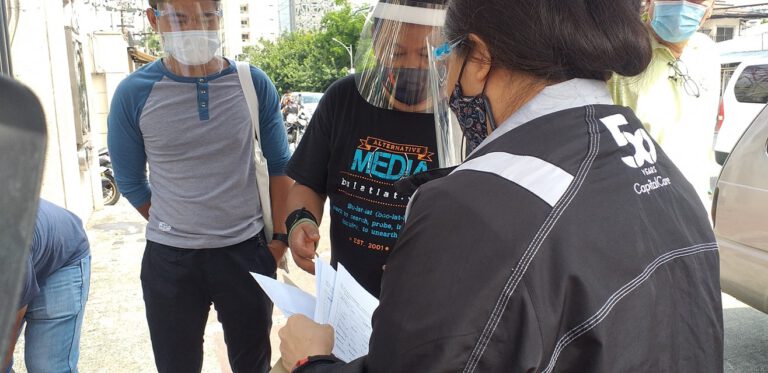
Outside the Esguerra gate of ABS-CBN, the National Union of Journalists of the Philippines (NUJP) set up signature booths where hundreds of employees and supporters submitted their signatures for People’s Initiative for Reforms and Movement for Action or PIRMA Kapamilya.

Launch on July 17, PIRMA Kapamilya is a volunteer-led signature campaign launched by ordinary Filipino people aiming to bring ABS-CBN back on air through the “People’s Initiative.”

People’s Initiative refers to the power given to the people under the 1987 Constitution. Under R.A. 6735 or “The Initiative and Referendum Act,” the people’s initiative grants the citizens the power to directly propose and enact laws.

In order for the initiative to succeed, they would need to gather the signatures of at least ten percent of all registered voters and at least three percent of all registered voters in every legislative district. The campaign would need approximately seven million signatures before proceeding.

After gathering the set number of signatures, the convenors would then file the petition as well as the signatures with the Comelec for verification. Comelec would then conduct a plebiscite where people can vote if they are for or against the proposed law.

During the referendum, at least 50 percent plus one of the votes cast should vote for the enactment of the proposed law. After Comelec certifies the result of the referendum, the law then becomes effective.

In a statement, Altermidya, the national network of alternative media outfits in the country, expressed support to PIRMA Kapamilya.

“The sheer number of signatures needed is not lost on us: indeed this road is painstaking and difficult, an arduous task only aggravated by the ongoing COVID-19 pandemic. Yet at a time when those in power are relentless in eroding our rights – press freedom, our civil liberties, our right to know –we take every instance we have to defend and reclaim these rights with every risk and effort,” Altermidya said.

Democracy under siege

The NUJP, meanwhile, lamented that, …”[h]undreds of our colleagues, among them our members, lose their jobs, joining the thousands more stripped of employment after the legislative lapdogs of a vindictive president shut down the country’s largest network by denying it a new franchise.”

“The closure of ABS-CBN’s regional stations also deprives millions upon millions of Filipinos throughout the country of a major source of credible news and information even as the national struggles against the pandemic,” the group said.

NUJP called on colleagues in the community of independent Filipino journalists and to the Filipino people, to “stand together and resist the continued undermining of our laws, of our rights, of our liberties, by the very institutions supposed to protect these.” (https://www.bulatlat.com)

How to join the signature campaign

First, download the petition drafted by PIRMA Kapamilya (tinyulr.com/PirmaNaKapamilya) and print two copies. Make sure to read and understand the franchise bill. 

Next, sign the form and supply the needed details. Then, submit the two signed copies to PIRMA Kapamilya coordinators in the legislative district.

Make sure that all signatures in the same petition form are registered voters of the same legislative area, or else the signatures would not be included in the count.

The post As ABS-CBN regionals close, employees, supporters push for people’s initiative appeared first on Bulatlat.

Anti-China hysteria drives record 2021 U.S. defense spending

0

Anti-China hysteria has emerged as the central ‘threat’ designed to justify endless U.S. military spending and adventurism in the Asia-Pacific.

By QIAO COLLECTIVE</strong>
Wire/Progressive International
Reposted by Bulatlat.com

From the Soviet Union to the Viet Cong, geopolitical bogeymen have justified wars, invasions, and occupations the world over. Now, the war machine has pivoted towards China as the cornerstone of its military narrative strategy.

The 2021 Department of Defense spending bill has become contested terrain for a progressive wing of Democrats seeking to curtail endless military spending and a Republican-led bipartisan coalition focused on increasing spending to “stay competitive” with ostensible threats from Russia and China.

On July 21, the House passed its version of the Fiscal Year 2021 National Defense Authorization Act (NDAA), with an increase in stipulated defense spending from 2020’s $738 billion to a $740 billion package for 2021. The Senate followed on July 23.

A proposed amendment, raised by Rep. Mark Pocan (D-WI) and Rep. Pramila Jayapal (D-WA) in the House and Senator Bernie Sanders (I-VT) in the Senate, called for a modest ten percent decrease in military spending to fund social programs. Pocan and Jayapal called for Congress to break from its hawkish orthodoxy of “rubber-stamping a skyrocketing Pentagon budget” while slashing social expenditures. For reference: in 2019, the United States spent more money on its military than the next nine countries combined.

The modest progressive amendment was overwhelmed in both chambers by the force of Sinophobia, anti-China hawkishness, and a New Cold War mentality that has bipartisan power in Washington.

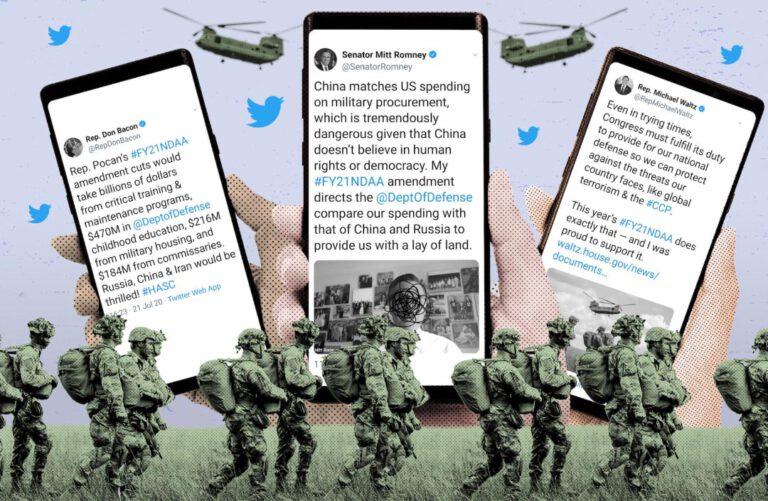
Rep. Don Bacon (R-NE) decried the amendment, tweeting: “Russia, China & Iran would be thrilled!” Similarly, Rep. Steve Womack proudly announced his vote to authorize the record defense budget, calling it an “investment to counter adversaries like China.”

For others, merely rubber-stamping another massive military budget wasn’t enough to prove their anti-China credentials. Rep. Michael Waltz (R-FL) pushed into the bill an amendment that would cut Defense Department funding to universities that house Confucius Institutes or the Chinese Thousand Talent Program—initiatives Waltz claim “have given mainland China’s Communist regime the freedom to take full advantage of our academic openness and steal it.” Not to be outdone, Rep. Ken Buck (R-CO.) called for the Chinese-owned social media app TikTok to be banned from government devices.

Senator Mitt Romney launched similar anti-China attacks on the Sanders amendment in the Senate. While Sanders implored colleagues to “invest in our people here at home” as they struggle with evictions, homelessness, and unemployment exacerbated by the U.S. government’s botched COVID-19 pandemic response, Romney erroneously warned that China matches U.S. spending on military procurement (as of 2019, China’s annual military expenditures totaled $178 billion to the U.S.’s $658 billion). He painted a grim picture of the future under the Communist Party of China’s supposed plan for world domination:

“They intend to put us way in the headlights. Can you imagine the consequences, when a nation that does not believe in human rights, with only one party…when they have the overwhelming military force in the world. That’s where we’re headed.”

—Senator Mitt Romney

The hypocrisy of massive military spending against an imagined China threat while the U.S. roils through its unsolved COVID-19 crisis, refusing spending opportunities to support testing, or emergency stipends, is hard to ignore. A progressive coalition supporting the amendment noted that in 2019, the Center for Disease control budget of $7 billion was less than one percent of the Pentagon budget. Under the cover of the “China threat,” Congress continues to devote bottomless funding to endless war and militarization while neglecting its own people.

The China “containment” program, a recurring archetype in U.S. military strategy in Asia for at least a half-century, once again plays a central role in the fight over 2021’s military spending. A recently released budgetary wish list from the Indo-Pacific Command titled “REGAIN THE ADVANTAGE” seeks to solidify U.S. military hegemony in Asia and the Pacific under the pretenses of an “aggressive” China. The imperialist demand to retain an “asymmetric advantage” against China is in direct opposition to the struggles against U.S. militarism led by the people of Ryukyu (Okinawa), Guam, Hawai‘i (where the U.S. plans to host an international “war games” convening in August), and beyond—all lands on which the plan called for an expansion of missile, radar, and precision-strike networks.

The hypocrisy of massive military spending against an imagined China threat while the U.S. roils through its unsolved COVID-19 crisis is hard to ignore.

Senator Senator Jim Inhofe (R – OK) cited the Indo-Pacific strategy in his justification for the massive military budget, calling the region “our priority, especially as China expands its reach and influence.”

The invented narrative of Chinese aggression and expansionism—in direct contradiction to China’s foreign policy doctrine of multilateral cooperation towards a “shared future for humankind”—has justified the U.S.’s reorientation of U.S. military strategy for the past decade. In 2019, the Department of Defense designated the Pacific its “priority theater.” However, as early as 2012, President Barack Obama and Secretary of State Hillary Clinton had showed their hand, shifting the majority of U.S. military firepower to the Asia-Pacific region and seeking to curtail China’s role in regional trade and security organizations through the so-called “pivot to Asia.” This longer history of military build-up vis a vis China speaks to the fact that the New Cold War strategy has long been a bipartisan effort. In fact, while Republicans led the charge to destroy the House effort, the vote failed in a resounding 93-324 vote, with 139 Democrats joining 185 Republicans in voting no to the ten percent budget cut.

The COVID-19 crisis has demonstrated once again the violent contradictions of neoliberalism: the frailty of the state social welfare is matched only by the ostentatious might of the state’s repressive apparatuses: military, police, and prisons. Cutting a $740 billion check to the military while people across the U.S.—disproportionately Black, indigenous, and immigrant communities—are devastated by the COVID-19 reveals the impossibility of justice and equity at home so long as the priority of the ruling class lies in endless war abroad.

Cutting a $740 billion check to the military while people across the U.S.—disproportionately Black, indigenous, and immigrant communities—are devastated by the COVID-19 reveals the impossibility of justice and equity at home so long as the priority of the ruling class lies in endless war abroad.

The anti-China doctrine has become the cornerstone of the U.S. military agenda, and is likely to define its geopolitical strategy over the next decade. Where China has committed itself to a “peaceful rise” forged in Third World commitments to non-intervention, self-determination, and win-win cooperation first articulated at Bandung in 1955, the U.S. clings to a zero sum vision of inevitable “great power competition.”

The anti-war movement and all so-called progressive movements must understand that resisting the unilateral escalation towards conflict with China is in the interests of domestic fights for a fair wage, affordable housing, health care, and other progressive efforts that could be sponsored many times over through a defunded Pentagon budget. Unfortunately, too many on the left have taken to repeating State Department arguments re: the China ‘threat,’ choosing to “denounce both sides” and uncritically repeat hawkish narratives of supposed Chinese aspirations for hegemony, facts be damned. Those who do so only add fuel to the fire of Sinophobia and perpetual war, and their chauvinism and opportunism ultimately undermines their supposedly progressive commitments.

Since the end of World War II, the United States has justified its de facto military occupation of the world by invoking various enemies. From the Soviet Union to the Viet Cong, the DPRK to the Taliban, various geopolitical foils have proven invaluable as bogeymen to justify several decades of proxy wars, invasions, and occupations the world over. Now, the war machine has pivoted towards China as the cornerstone of its military narrative strategy.

As the narrative crux of its global military occupation, resisting the ‘China threat’ narrative is fundamental to all struggles for peace and an end to U.S. imperialism.

The post Anti-China hysteria drives record 2021 U.S. defense spending appeared first on Bulatlat.

True to himself and others

On August 20, 2020, in an almost bare room in an ordinary house in Dasmarinas, Cavite, a small but brilliant light went out and the world was made more unhappy because of it. On that day, underground street artist, everyday philosopher and activist Pong Para-Atman Spongtanyo died. He was 35 years old.

Heyres aka Pong (From Christine Nierras Cruz’ Facebook post)

Born Gutson A. Heyres, Pong was not part of the section of local Filipino painters and graphic artists who were covered by art magazines or who opened exhibits in shiny galleries with gleaming surfaces and walls.

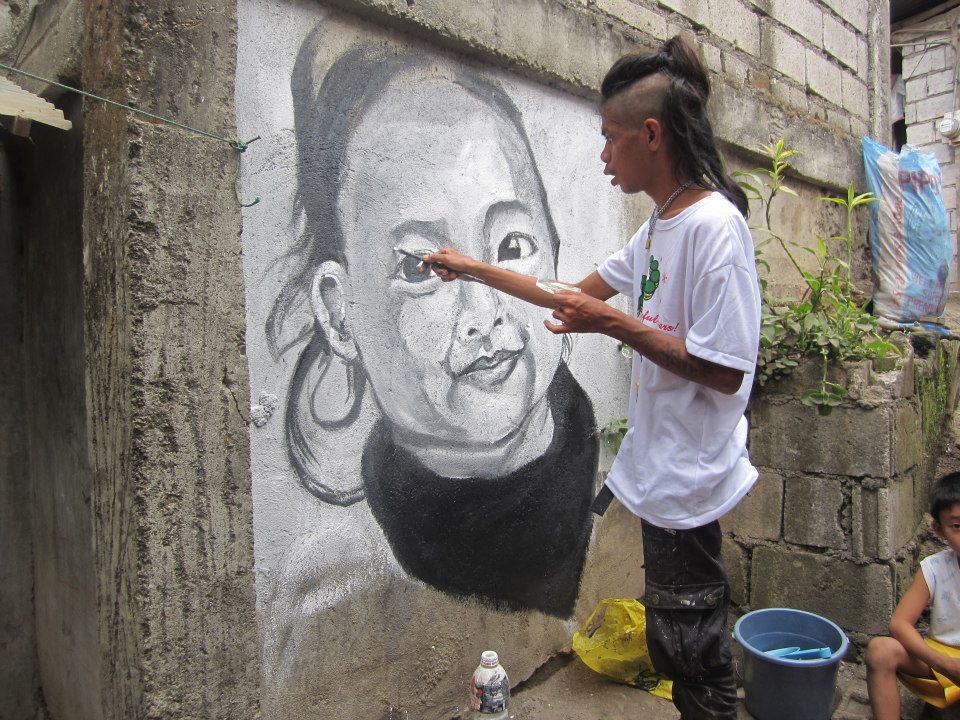
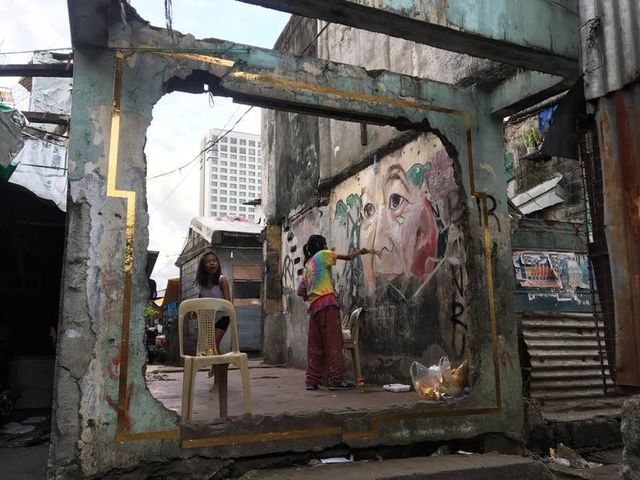
As a street artist and activist, his work found audiences among the urban poor, street children, commuters on the way to and from work. Various dingy or decrepit walls in Cavite, Quezon Province, and Metro Manila have become canvasses for his art, and while some might consider the murals as acts of vandalism, it’s impossible to dismiss them simply as such because of the evident skill and insight that went into their creation.

As a human being, he made many friends and touched countless lives through his generosity with his art, and his time. He was born poor, by all accounts lived simply and with humility; and now in the wake of his passing, the wealth of his kindness is revealed as hundreds express deepest grief.

Lived on the streets, gave back to communities

One of Pong’s works. (From Oblack Herb’s Facebook post)

Like many of the things that shaped his awareness, Pong learned to paint from people he’d met and the different environments he found himself in as he was growing up. This was, as fellow artist Buen Abrigo explained, because Pong practically grew up on the streets.

 “He left home when he was a teenager – he didn’t even finish high school. He came from a poor family, and I guess he felt that the only way to solve the problems he and siblings experienced because of their extreme poverty was to leave and strike out on his own,” he said.

Buen said that when he first met Pong in 2007, the latter was working on a street mural and he was scrawny, dirty-seeming, and sat on a wheelchair. It turned out Pong had just been released from the hospital and was not strong enough to walk.

“But even back then it was impossible not to see how talented he was – the way he wielded that brush, the way the images came out slowly on that wall, it was clear he had a gift. It was very raw skill because he didn’t have any formal art training from school or any institution. He learned from other artists, from craftsmen he made friends with. He believed in the DIY culture, and he was a quick learner,” he said.

Coming from a recipient of the Thirteen Artists Awards by the Cultural Center of the Philippines like Buen, this was real praise.

Buen said that up until that time in 2007 when they first met, Pong had been living in an urban poor community where it was really dirty – no access to running water. “Talagang dugyot,” he said.  Buen theorizes that it was probably there that Pong fell into unhealthy habits, but the kind that no one willingly acquires. Because of  poverty, Pong did not get enough food or nutrients, and the lack of access to basic social services left him with poor health and hygiene.

“He didn’t smoke, he wasn’t much of a drinker, and he certainly didn’t do drugs. He was just generally unhealthy. He was skinny, and through the years he just become thinner.  I think it’s safe to say that many of us – his friends, fellow punks and anarchists he worked with in his group “Food Not Bombs” and the other organizations he connected with – were always concerned about how he was doing health-wise,” he said.  “Parang will na lang talaga niya ang nagpapagaling sa kanya noon.  (“It was his will that helped him recover from his illness.”)

Art as social commentary

Healthy or not, Pong up until the time he died was a very prolific artist, drawing almost non-stop on public walls, on pieces of paper, on cardboard and other found objects. Sometimes he sold his drawings and ketches for a shocking P150 each (“Pambili ng bigas!” was his caption to some of them when he posted pictures on his Facebook page). His most creative work, however, can be found in the magazine (or zine, as the independent, underground movement of alternative artists call them) he regularly produced called “Art-Writist.”

(Photo: Makó Micro-Press)

In Art-Writist, Pong poured out his ideas, emotions, and insight on various issues ranging from urgent social concerns to the mundane. Each page featured scribbles and complete drawings that revealed that the writer and artist the title of the zine can also be said to refer to his arthritis, a condition he had had for the longest time in his short life.

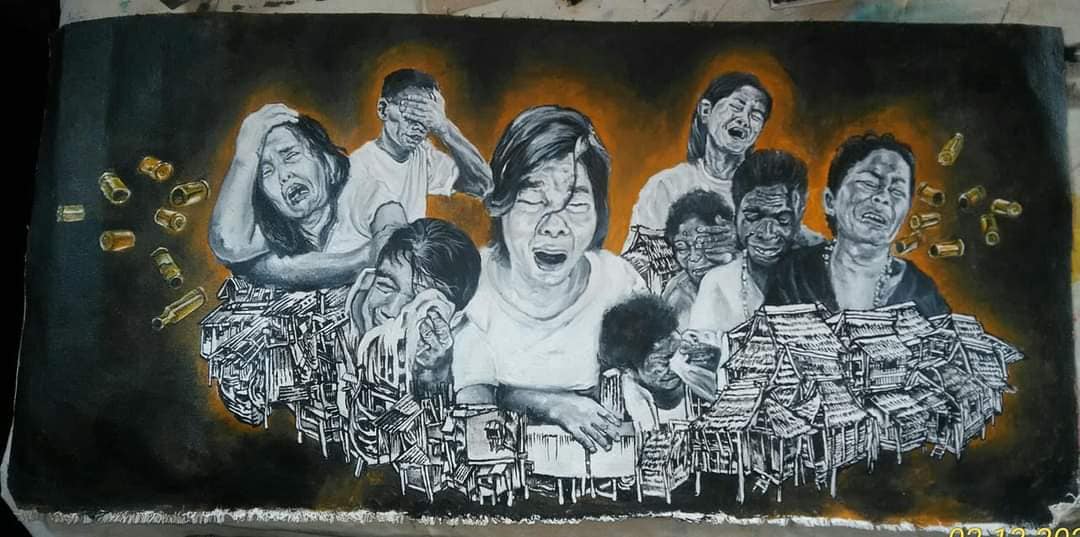
The images Pong drew reflected his views of Philippine society and how he felt about them. Smiling, round-eyed children and the can-barely-be-called-houses of the urban poor are featured prominently in them, as well crows and other carrion birds that can be interpreted as symbolizing the social system that feed off the suffering and the death of others. He also rendered images of grief and despair caused by drug-war connected or deliberate political killings  – bullets raining and falling to the ground then gathered by children in cracked rice bowls; mothers weeping in despair over what has been taken from them (homes, children, husbands, dignity and the right to live in peace).

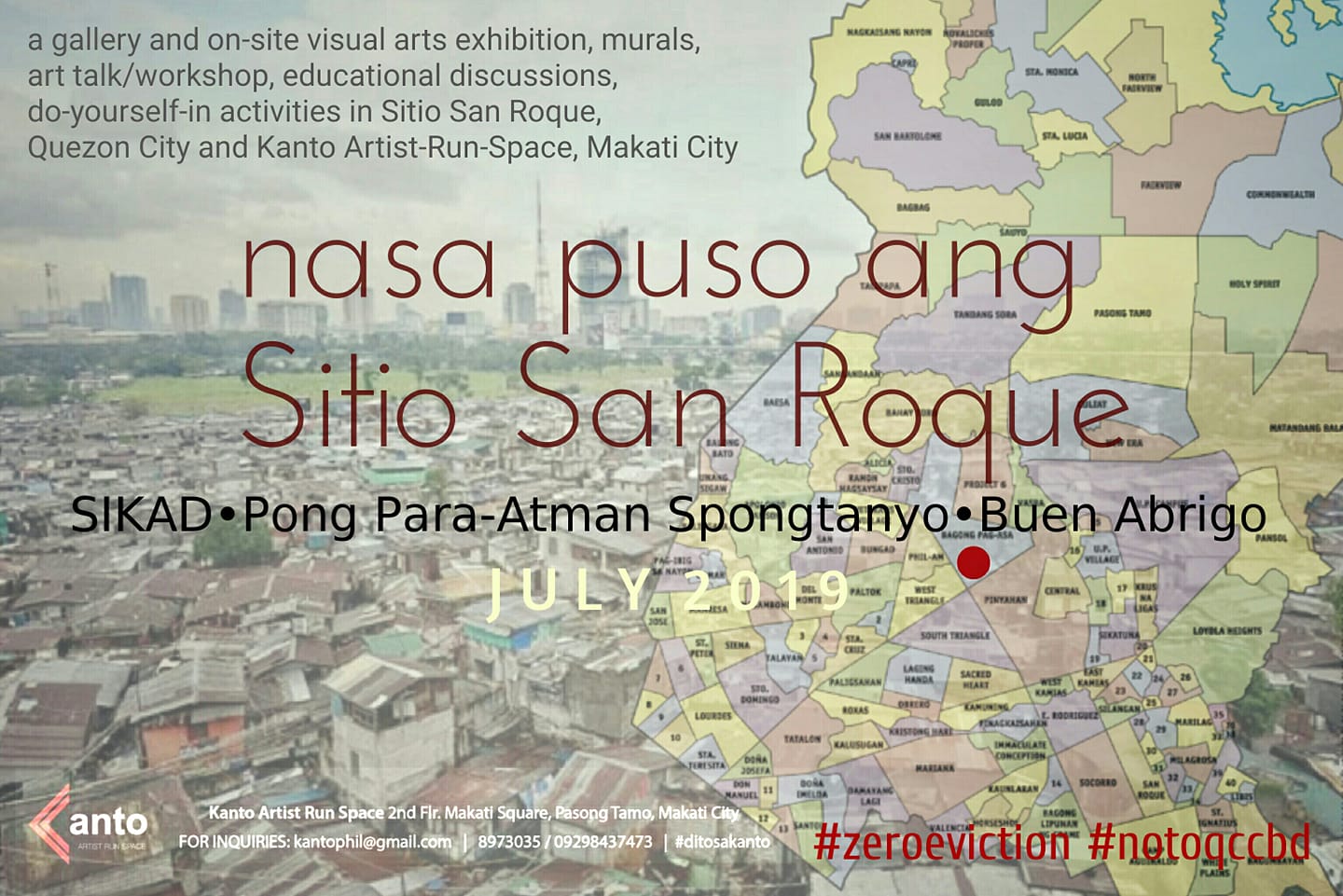
In July of 2019, Pong and Buen had an exhibition in Kanto Artist-Run Space, a small but popular among activist circles gallery in Makati. Along with members of the artist group SIKAD, they promoted the rights of the urban poor to decent housing and social welfare services through their individual and collective pieces titled “Nasa Puso ang Sitio San Roque.” 

Sitio San Roque is a sprawling community of workers, vendors, and informal settlers in Quezon City a stone’s throw away from City Hall. For almost a decade, residents had been fighting attempts of business and commercial interests aided by the local government to have their homes demolished to make way for a condos, malls, and other business establishments.

Through line drawings on bond paper, Pong depicted the life and struggle of the residents both with skill and compassion.

Development aggression was also a theme Pong focused on – images of Lumad women and farmers amidst fallen trees, or mountain ranges and expanses of agricultural fading away or violently crumbling against a backdrop of bulldozers and giant earthmovers.   

As for his writing, his Facebook posts were often comprised of a few lines of pointed social commentary:

In April:

Buong mundo,

“nasyon,”

Sa PPE may kakulangan

Sa bala at bomba

Sobra-sobra

Earlier on March 12, a few days before the whole of the National Capital Region (NCR) and nearby provinces were put under lockdown:

Wala akong kinalaman dyan…

Nakita ko lang…

“Epidemics are more likely to grow in an authoritarian society.”

He criticized the government’s Build-Build-Build program and said that instead of promoting progress, it was “progreed” and was essentially all about “kill-kill-kill”.

And among his last posts was his condemnation of the extrajudicial killing of human rights workers and activists:

“Yung mga tumutugis sa mga naghasik ng lagim,

Pinagbibintangang naghahasik ng lagim,

Kontra-lagim, palpak.”

“Bili na kayo. Panglockdown lang po.”

Finally, Pong also shared and reposted the work of fellow artists and friends, generously endorsing them and their projects. He himself showed no indication of being interested in building a portfolio or having his own work out on display in galleries: he was happy  just creating art. Whenever he got paid, it was often in kind; in one memorable occasion, he exchanged original stencil patches he made for bananas, the saba variety. He drew portraits for friends and neighbors for practically nothing.

What is noticeable, however is that Pong seldom if ever, referred to his own suffering.  Apart from the occasional post written with self-deprecating humor wherein he asked followers to buy his paintings for P150 each (“pambili ng bigas”), Pong did not ask anyone for help, neither did he give a clue as to his own difficulties.   Because of the quarantine, he had means of earning, and without income, he could not feed or take care of himself properly as his health condition needed him to. Instead of posting updates on his own plight, he shared stories of other people needing funds for food or for medical needs.  Even then, during the early days of the pandemic, his health was already beginning to fail. 

A victim of the lockdown

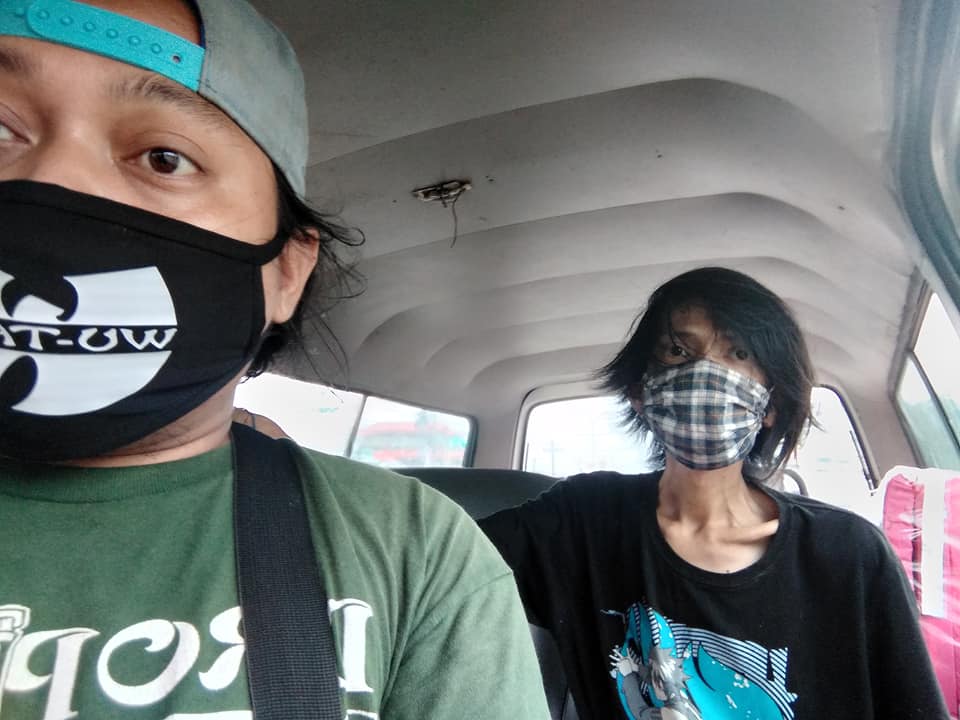
Pong (right) with friend, Italo Ramos Lambito.

By early July when the quarantine lifted and travel became easier, a friend visited him in the second floor of a closed bar in Dasmarinas, Cavite where he had been allowed to stay by other friends when the Covid-19 lockdown started. They took one look at him and immediately launched an online appeal for financial support. Pong, they saw, severely dehydrated and looked emaciated and gaunt. They brought him water and other hydrating liquids. With the money that quickly came in from all over the country, they also got him groceries, vitamins, an electric fan, and an electric stove.  

Fellow Food Not Bombs member Italo Ramos Lambito was among the few who saw Pong in his final days.

“When I was finally able to see him when the quarantine restrictions eased up, he had really fallen ill. His arthritis had always been bad, but during the lockdown it worsened and his potassium levels crashed.  He had extreme difficulty walking, and he became dehydrated.”

“It was hard for us to take better care of him because of the pandemic health and safety restrictions. We took him to a total of five hospitals – but none of them admitted him. The doctors took one look at him and said ‘no’. In one case, the hospital said it would take him in, but he would have to be placed with PUI (persons under investigation for Covid-19) patients even though he didn’t have symptoms of Covid-19. We had no choice but to take him home,” he said.

Because of the travel restrictions – particularly strict in Cavite — it was impossible to have him taken to Manila or transferred to the house of his brother or to his mother’s house in Bagong Pangarap in Dasmarinas. Instead, Italo and other friends found an apartment for him in Cavite and shouldered the rent. They made arrangements among themselves on how they would take care of Pong.

Sadly, it was all too late.

A Lotus Flower on Trash Heap

In a recorded interview with an artist group, Pong himself explained the work he believed in as a member of Food Not Bombs and as activist artist.

“We’re all about taking positive action, organizing people, cooking food, and feeding those who don’t have it,” he said.

Twice a month, the group secured donations and cooked vegetable meals and held art workshops in communities all over Southern Tagalog. Many of those who went were children and out-of-school youth. Pong was as eloquent about the work he believed in as he was passionate.

“We want to show that there’s happiness in sharing and in working for peace, and nothing to be gained from the terror and horrors of war. It’s important to

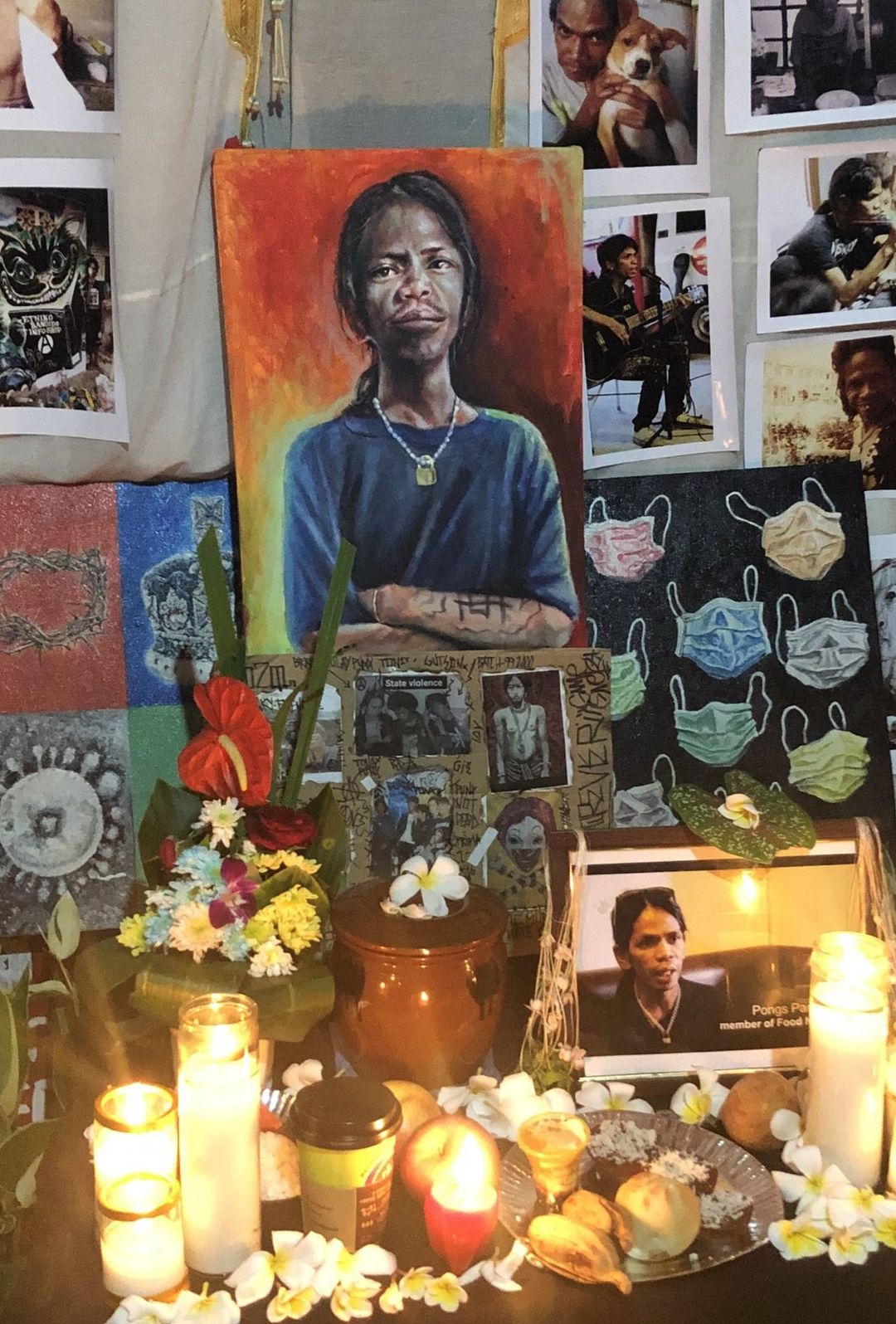
Roman Soleño’s tribute portrait for Pong

spread the values of love and unity, mutual aid, and taking initiative to help others. Equality and social justice are important. We can protest against unjust wars by helping each other,” he said.

In another video, Pong explains why he does street art.

“When people see my work, they will remember that there are so many problems, but they will also realize that are also solutions. They are the ones who are affected by the problems, but they will also benefit from the solutions. This is why they need to be involved in what happens in society, in the lives of others We are all connected to one another,” he said.

It is this and other similar beliefs that earned Pong the respect of people – even those who had just met him.

One of Pong’s friends, Soik Keeh Phrenia, shared that in 2019, he worked for two with Pong painting a studio, and in that in that span of time, he learned so much from the latter – not only about art skills, but about compassion and friendship. Pong, he said, was an insightful person, and kind with his solicited advice.

“Para sa akin, sya ay isang lotus flower na nilagay sa isang tambakan ng basura:  kahit ganun ka-polluted ang syudad, physically at spiritually, busilak pa rin ang puso’t kaluluwa ng kaibigan kong ito. Wala na si Pong, pero di sya mawawala sa puso ko, at sa mga puso ng mga taong nag mamahal sa kanya!”

(“He was like a lotus flower that grew on a garbage heap; despite the city being so polluted and corrupt, my friend remained pure at heart and in spirit. I am so grateful that I met someone like Pong. He’s gone, but he will always be in my heart and in the heart of the people who loved him”).

Italo said that hands down, Pong was a good person. “He always thought of others ahead of himself. He was the one who convinced us to activate the Food Not Bombs chapter here in Cavite. He was one of the pillars of the punk movement in Dasmarinas, and popularized graffiti and street art. Even when he was experiencing health issues, he still went with us to distribute food and fold workshops in communities,” he said.

“Sa buhay ko, nagpapasalamat ako na nakilala ko si Pong. Sya ang naging tatay, kuya, kapatid, guro namin dito. Sya nagbigay ng kulay sa eksena dito sa Cavite. He was a great friend,” Italo said.

Rest in Power, Gutson A. Heyres,  or as he was known and loved to all who knew him using his derived from Sanskrit name – Pong Para-atman Spongtanyo.  You were always true to yourself and others.