Progressive youth groups, organizations, and human rights defenders lit candles on Tuesday evening, August 18, to condemn the killing and seek justice for the slain Bacolod-based community health workers and activist Zara Alvarez. Alvarez was gunned down on August 17, the same day of the burial of peasant leader and peace consultant Randall “Ka Randy” […]
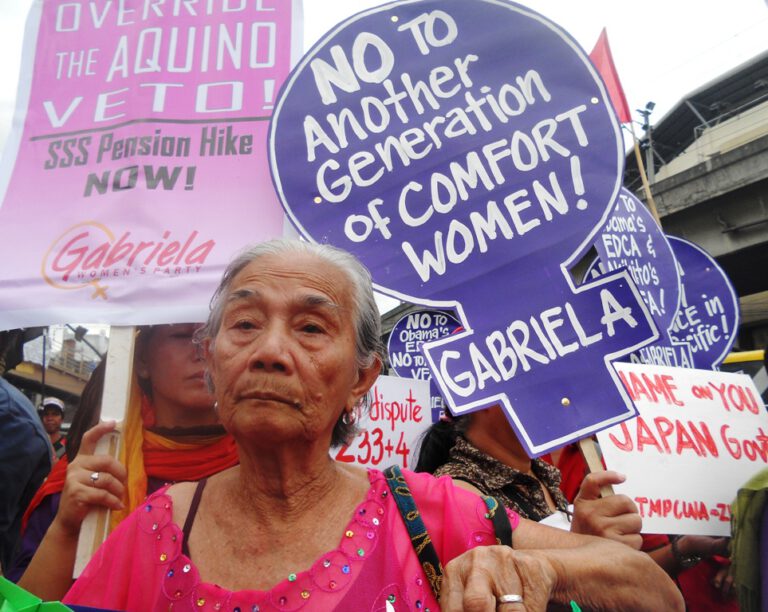
Narcisa Claveria, 85, was one of the comfort women belonging to Lila Pilipina. (Photo by A. Umil/ Bulatlat)
Ginugunita ng mga rehiyon sa Asya ang ika-75 taon ng pagtatapos ng Digmaang Pasipiko. Sa mahahabang mga seremonyas, naging tampok ang mga usapin ng pagkilala sa pangangailangang balikan ang leksyon ng nakaraang digmaang pandaigdig upang hindi na maulit ang mga naganap na trahedya kaugnay nito. Kinakitaan ang pagkamatay ng milyong mga Asyano sa nakaraang digmaan. Ang mga rehiyon sa Silangan at Timog Silangang Asya ang naging teatro ng digmaang kinasangkutan hindi lamang ng mga Hapones at ng mga bansang nasakop nito, kundi ang mga Kanluraning kapangyarihang dating dominante sa rehiyon. Ang Asya rin ang nakaranas ng matinding kapinsalaan dulot ng mga labanan. Hindi na maibabalik muli ang mga nasalantang lungsod ng Maynila, Nanjing, Shanghai, Singapore, sa dati nitong mga kalagayan bago sumambulat ang digmaan. Sa Asya rin naganap, sa pamamagitan ng mga lungsod ng Nagasaki at Hiroshima, ang natatanging karanasan ng sangkatauhan ng pagsabog ng bomba atomika na ginamit upang maging sandata ng digmaan.
Sa mga nakaraang paggunita, muli na namang binabalikan ang mga naganap na mga kahirapan sanhi ng ilang dekada ng pananakop nila sa Korea mula 1910-1946, sa Taiwan mula 1895, at sa mga bansa sa Timog Silangang Asya, sa partikular ang mainit na usapin ng mga pang-aabuso sa mga ginawang comfort women, o mga biktima ng pang-aabusong sekswal ng mga militar ng Hapon sa mga kababaihan. Kagaya ng mga naunang mga paggunita, hindi naman inasahang magbibigay ng mga bagong patakaran at polisyang opisyal ang pamahalaang Hapones ukol sa naganap na responsibilidad nito sa digmaan bunga ng opisyal na tindig nitong natugunan na lahat ng kanyang obligasyon nang pumaloob ang mga bayang kasangkot sa Kasunduan sa San Francisco noong 1951.
Kailangang bigyang pansin na sa kasalukuyang dispensasyon, tila tinatalikuran pa nga ng Hapon ang kanyang mga obligasyon at ang tono ng “pagsisisi” sa ginawa nitong pananakop noong nakaraang digmaan. Kamakailan, nagbibigay ng pahiwatig ang pamahalaang Hapones ng pagtalikod nito sa oryentasyong pangkapayapaan ng kanyang konstitusyon – nakikisangkot na ito sa mga taktikang pagsasanay pangmilitar sa rehiyon na pinamumunuan ng Estados Unidos; lumalaki rin ang badyet nito sa sandatahang lakas; at unti unting nagiging mapangahas sa pagharap sa sinasabi nitong ‘bagong realidad’ ng obligasyong pandaigdigan sa pamamagitan ng pagpapadala ng mga tropa sa ibang bayan.
Maraming dapat gunitain sa pananakop ng mga Hapon kahit na sinasabing dapat na tayong humarap sa kinabukasan nang walang dala-dalang bagahe ng nakaraan. Ilang mga pangyayari sa nakaraan ang kasalukuyang nagiging ugat ng sigalot hindi dahil nakaraan na ito, subalit dahil marami pa ring mga usapin ang hindi nasasarhan ng kasalukuyang henerasyon. Ang tawag ng ilang mga historyador sa Silangang Asya gaya ng Korea, Taiwan at Tsina sa mga usaping ito ay ang Digmaan sa Kasaysayan o History Wars. Tapos na ang digmaan, subalit ang nakaraan ang siyang nagbibigay pa rin ng hindi resolbadong usapin sa kasalukuyang kalagayan.
Ilan dito ang hindi pagkilala sa mga teksbuk sa iba’t ibang bayan sa kung ano talaga ang ugat at pinangyarihan ng nakaraang digmaan. Sa ilang mga teksbuk na Hapones, halimbawa, hindi gaanong binibigyang pansin ang agresyon na kanilang ginawa sa maraming bayan sa Asya. Ang tinitingnan na lamang ay ang pagiging biktima nito sa armas nukleyar sa pagtatapos ng digmaan.
Hindi rin nareresolba ang ilang mga usapin sa teritoryo na may kani-kanilang pahayag ang mga iba’t ibang bayan na kanila ang ilang mga isla at teritoryong pandagat sanhi ng pang-agaw ng mga ito matapos ang digmaan, o sa kaso ng ilan, ang pagbawi sa inagaw na teritoryo sanhi ng kaguluhan ng pakikidigma.
Bukod dito, laging kontrobersya rin ang pananatiling pagbibigay dangal sa mga kriminal pandigma (war criminals) na hanggang ngayon ay itinuturing na bayaning pambayan sa ilang mga shrines sa Hapon, lalo na sa Yasukuni Shrine sa Tokyo kung saan nalibing ang ilang mga heneral na nagsulong ng digmang agresyon ng Ikalawang Digmaang Pandaigdig.
Subalit ang pinakakontrobersyal sa lahat ng di resolbadong usapin ay patungkol sa mga comfort women na bantulot pa ring gawaran ng opisyal na pagkilala hanggang sa kasalukuyan. Maraming magkakapatong na usapin ukol dito. Una, bunga ito ng pananakop ng isang bayan sa isa pang bayan. Maraming mga kababaihan sa Pilipinas, Korea, Taiwan, Tsina, Vietnam, Indonesia at Malaysia ang naging biktima nito sa panahon ng pananakop ng mga Hapon. Usapin ito ng pananakop at bunga ito ng patakarang agresyon.
Ikalawa, usapin din ito ng pagtingin sa mga kababaihan. Salamin ang sistematikong pagkakaroon ng institusyon ng parausan ng mga sundalong lalaki sa mga kababaihan ng nasasakupang bayan sa sistematikong pagtingin na gamit lamang at hindi tao ang turing sa mga nasasakupang mga kababaihan.
Panghuli, salamin ito ng pagkakaroon ng di pagkakapantay-pantay sa mga uring panlipunan na naging biktima ng institusyon ng comfort women. Ang nakararami sa mga kababaihang naging biktima nito ay mga maralitang batang babae – mga anak ng mga magsasaka, manggagawa at maralitang tagalunsod na dinukot at ginawang parausan ng mga Hapones. Mangilan-ngilan lamang, kung mayroon, ang nakaririwasang mga kababaihan na naging bahagi ng institusyonal na panggagahasa na ito.
Maraming mga testimonya ang naisapubliko na simula nang buong tapang na maglabasan ang mga naging biktima nito noong dekada nobenta. Sa Pilipinas, si Maria Rosa Henson ang unang lumantad sa publiko bilang biktima ng ganitong kalagayan. Kilala bilang Lola Rosa, buong tapang niyang kinaharap ang maaaring batikos at pag-alipusta na maaaring sapitin ng mga biktima ng panggagahasa, lalo na at sila ay mga lola na. Dahil kay Lola Rosa, marami pang mga Pilipina ang lumantad at nagsalaysay ng kanilang mapait na karanasan upang magbigay ng paggiit na kilalanin ang kanilang biktimisasyon sa kasaysayan, at makatanggap ng paghingi ng paumanhin at kompensasyon sa danyos na kanilang kinaharap.
Noong 1992, lumabas sa publiko si Lola Rosa. Ito rin ang taon kung kailan nalathala ang kanyang akda, Comfort Woman: A Slave of Destiny, na naglalaman ng kanyang salaysay pati na ang mga guhit ng mga imahen sa kanyang autobiograpiya. Inalala niya ang kanyang karanasan sa mga sumusunod na pananalita
…Without warning, a Japanese soldier entered my room and pointed his bayonet at my chest. I thought he was going to kill me, but he used his bayonet to slash my dress and tear it open. I was too frightened to scream. And then he raped me. When he was done, other soldiers came into my room and they took turns raping me.
Twelve soldiers raped me in quick succession, after which I was given half an hour to rest. Then twelve more soldiers followed. They all lined up outside the room waiting for their turn. I bled so much and was in such pain, I could not even stand up. The next morning, I was too weak to get up. A woman brought me a cup of tea and breakfast of rice and dried fish. I wanted to ask her some questions, but the guard in the hall outside stopped us from saying anything to each other.
I could not eat. I felt much pain and my vagina was swollen. I cried and cried, calling my mother. I could not resist the soldiers because they might kill me. So what else could I do? Every day, from two in the afternoon to ten in the evening, the soldiers lined up outside my room and the rooms of the six other women there. I did not have time to wash after each assault. At the end of the day, I just closed my eyes and cried.
…At two, the soldiers came. My work began, and I lay down as one by one the soldiers raped me. Everyday, anywhere from 12 to over 20 soldiers assaulted me. There were times when there were as many as 30; they came to the garrison in truckloads.” The cruelty towards Rosa and the other girls was unending especially in times when the soldiers were not satisfied after raping them. “Once there was a soldier who was in such a hurry to come that he ejaculated even before he had entered me. He was very angry and he grabbed my hand and forced me to fondle his genitals. Another soldier was waiting for his turn outside the room and started banging on the wall. The man had no choice but to leave, but before going out, he hit my breast and pulled my hair.”
…I was forced to stay at the hospital which they have made as a garrison. I met six women in the garrison after two or three days in the place. The Japanese soldiers were forcing me to have sex with several of their colleagues. Sometimes 12 soldiers would force me to have sex with them and then they would allow me to rest for a while, then about 12 soldiers would have sex with me again.
There was no rest, they had sex with me every minute. That’s why we were very tired. They would allow you to rest only when all of them have already finished. Maybe, because we were seven women in the garrison, there were a fewer number of soldiers for each one of us.
But then, due to my tender age, it was a painful experience for me. I stayed for three months in that place after which I was brought to a rice mill also here in Angeles. It was nighttime when we were fetched to be transferred. When I arrived in the rice mill, the same experience happened to us. Sometimes in the morning and sometimes in the evening… not only 20 times. At times, we would be brought to some quarters or houses of the Japanese. I remembered the Pamintuan Historical House. We were brought there several times. You cannot say no as they will definitely kill you. During the mornings, you have a guard. You are free to roam around the garrison, but you cannot get out. I could not even talk to my fellow women two of whom I believed were Chinese. The others I thought were also from Pampanga. But then, we were not allowed to talk to each other.
Many have asked me whether I am still angry with the Japanese. Maybe it helped that I have faith. I had learned to accept suffering. I also learned to forgive. If Jesus Christ could forgive those who crucified Him, I thought I could also find it in my heart to forgive those who had abused me. Half a century had passed. Maybe my anger and resentment were no longer as fresh. Telling my story has made it easier for me to be reconciled with the past. But I am still hoping to see justice done before I die.
Sa halip na kilalanin bilang opisyal na ginawa ng pamahalaan noong digmaan at humingi ng tawad sa pang-aabuso, ang ginawa ng mga Hapon ay magtatag ng AWF o Asian Women’s Fund na isang pribadong pondo para sa pantulong sa mga comfort women. Marami pang kakulangan sa pagkilala sa mga naranasan ng mga comfort women. Binubura ang kanilang mga alaala sa bawat mga opisyal na pagtanggi ng kanilang pag-iral. Maraming bayan, lalo na sa Hapon, ang hindi nakapaloob ang karanasan ng mga comfort women bilang bahagi ng pagtalakay sa kasaysayan.Ang masaklap pa, ilang mga monumento na gumugunita ng kanilang karanasan ang tinanggal sa paningin ng publiko at ang mga publikong espasyo na magpapahayag ng pakikidalamhati sa kanila ng bayan ay itinatanggi ng mga nasa pamahalaan.
Namatay si Lola Rosa noong 18 Agosto 1997. At hanggang sa kasalukuyan, hindi pa rin nagiging ganap ang pagkilala sa mga gaya niyang comfort woman na biktima ng kasaysayan. Mapait man ang ilang mga karanasan gaya ng karanasan ng mga comfort women, kailangang balik-balikan ito upang higit na maging matatag ang pagharap sa kinabukasan. Maraming mga Lola Rosa ang namayapa nang hindi pa nakakamit ang hustisya. Sa panahong muling nagbabadya ang militarisasyon ng Hapon sa pakikisangkot nito sa ibang bayan; habang patuloy ang dominanteng posisyong militar ng Estados Unidos bilang superpower; at habang nananatili ang pangamba ng maraming bansang Asyano sa pag-angat ng China bilang bagong kapangyarihang maaaaring manakop ng mga lupain sa Asya Pasipiko sa iba’t ibang pamamaraan, naroroon pa rin ang pangambang manumbalik ang panganib na magkaroon na naman ng mabibiktimang kababaihan sa anumang tunggaliang militar ng mga malalakas na bayan.
Marami pang naratibo ang babalikan ng mga mag-aaral upang matiyak na wala nang susunod na henerasyon ng mga kababaihang makakaranas ng mga dinanas ng mga lola naging aliping sekswal ng mga mananakop pangmilitar. Maraming mga Rosa Henson ang naghihintay pa rin ng sapat at angkop na pagkilala sa kasaysayan.
Ref.
Maria Rosa Henson, Comfort Woman: Slave of Destiny. Philippine Center for Investigative Journalism. Manila, 1996, p. 152.
*The author is a professor and former chair of the Department of History, Ateneo de Manila University; former commissioner of the National Historical Commission; convenor of Tanggol Kasaysayan; member of the Alliance of Concerned Teachers. He finished his AB History, MA in History and PhD in Philippine Studies at University of the Philippines Diliman.
The social welfare department has been trying its best to window-dress the slowness and stinginess of government’s Social Amelioration Program (SAP) distribution by diligently updating the public on how much has been distributed to how many households. Somehow it is a relief that it has mobilized finance service providers (FSPs) for swifter distribution. Still there is no guarantee of smooth payout because of various remaining obstacles such as bureaucratic procedures, untransparent validation, recipients’ lack of familiarity with new modes of service, and other technical requirements.
Overall,
the Duterte administration’s SAP in the time of COVID-19 has been
hit as stingy, snail-paced, chaotic, and marred with controversy and
corruption. The promise of providing 18 million poor and low-income
households (plus an additional 5 million wait-listed families) with
emergency aid worth Php5,000 to Php8,000 for two months, has been
broken. Distribution has been long delayed – families have had to
fend for themselves until the first tranche arrived over a month late
in May or June. Then the government started giving out the second
tranche only in July and moving double time only in August.
One
of the weaknesses of SAP that is not underscored enough is how the
government has effectively reduced the number of beneficiaries
despite its acknowledgement that millions remain without work.
Second
tranche recipients reduced
Through
the Department of Social Welfare and Development’s (DSWD) Joint
Memorandum Circular No. 2 Series of 2020 (JMC No. 2-2020), a memo on
second tranche recipients, government declared that only residents of
enhanced community quarantine (ECQ) and modified ECQ (MECQ) areas as
of June are to receive the second wave of aid. The reason was that
there were no more resources for everyone to get “ayuda”. This
spells indifference on the part of government because economic
activity is still just resuming, and jobs and livelihoods remain
precarious in general community quarantine (GCQ) areas.
The
JMC No. 2-2020 effectively reduced the original 17.8 million SAP
beneficiaries—presumably the “18 million” beneficiaries
stipulated in the Bayanihan to Heal as One Act – to only 8.7
million beneficiaries. Then, according to DSWD’s Memorandum
14-2020, of the 5 million additional low-income families categorized
as ‘wait-listed’, only 3.5 million residing in ECQ/MECQ areas
were to get the second tranche. So, after promising emergency relief
to a total of 22.8 million combined original and wait-listed
beneficiaries, only 12.2 million ECQ/MECQ households get the second
tranche. This leaves 10.6 million families to stretch one month’s
worth of aid across several months of lockdown.
The
number of first and second tranche recipients has been reduced
further, however. As a result of the DSWD’s de-duplication and
validation of beneficiaries, the local government units (LGUs)
reportedly registered only a total of 3.2 million additional
low-income families nationwide. This means a 1.8 million reduction of
the much-publicized 5 million wait-listed beneficiaries. Applying
Memo 14-2020, government now targets to give the second wave of aid
to only 2.2 million wait-listed beneficiaries who are ECQ/ MECQ
residents. So now there are only 10.9 million families getting the
second tranche, leaving out 11.9 million families.
How
is it then that government reported that after de-duplication and
validation, there are now 14.1 million families getting the second
tranche? A review of the DSWD dashboard and press releases shows that
the agency has also included in its “SAP2” or second wave of SAP
the now 3.2 million validated wait-listed families nationwide. This
erroneously bloats the number of second tranche beneficiaries with
the number of validated wait-listed beneficiaries who are really just
getting aid for the first time. Still
it will also no longer be a surprise should this number be pared down
further due to the de-duplication and validation process.
Not
just numbers
One
thing that government has repeatedly reminded the public in its
midnight addresses is how there are no more funds. In reducing the
recipients of the second tranche, it abandons millions of low-income
families who fight daily to make ends meet. Skirting hunger is a
feat, but when they get sick, these families may not be able to
afford even a ride to the nearest health facility, whether or not
they are afflicted with COVID. And tests are another expense they
cannot afford. There are reports that some crematoriums are being
overwhelmed by bodies presumed but not confirmed to have been COVID
cases. They were either turned away by overwhelmed hospitals or they
had no money for a check-up.
The
expired Bayanihan Act earmarked Php200 billion for emergency relief
to households. As
of August 15 around
Php175.2
billion has already been distributed for this purpose. The aid
programs through the labor and agriculture departments have also been
shown to be tokenistic, not covering the total population of workers,
informal earners, farmers and farmworkers affected by the lockdowns.
But
those that are no longer targeted by government to receive aid aren’t
just numbers but actual families being left to wriggle out of the
crisis on their own.
Still
not having a comprehensive plan six months into the worst health and
socioeconomic crisis this country has faced unmasks the government’s
long-running deception of having “malasakit” for the people and
motherland. Now that a stimulus and recovery plan has come about, we
have yet to see if it intends to truly save the critically-ill health
system, correct problematic aid for vulnerable families and the
production sector, and build the country’s own long-time capacity
to face future health and economic crises by boosting agriculture and
manufacturing which are the economy’s core.
Saying
that people just have to live with the virus which is here to stay
means survival of the fittest and comes from a high place oblivious
of the daily miseries of the many – they couldn’t care less for the
poor majority of the Filipino people. ###
Late night of August 17, the recorded address of President Rodrigo Duterte to the Filipino people again opened with his explanation about the vaccine as the “only salvation available to humankind at this time of our life.” Not a doctor or scientist at all, he again took it upon himself how a vaccine will work […]
“Just last night, Zara Alvarez took the bullets from her assassin. Those who wanted to silence a woman of dedicated service for the poor, yes, they murdered her,” Bishop Alminaza said.
“I would like to join in condemning the barbaric murder of comrade Randy Echanis and to offer my condolences to his family, comrades and friends. The murder of Ka Randy extends the blood trail drawn in recent months by the massacre of leaders and representatives of the mass movement in Philippines. The blood of Ka Randy and other martyrs/victims fall on the criminal Duterte regime and the imperialists of which it is a servant to,” Arena said in the online tribute.
 Ginugunita ng mga rehiyon sa Asya ang ika-75 taon ng pagtatapos ng Digmaang Pasipiko. Sa mahahabang mga seremonyas, naging tampok ang mga usapin ng pagkilala sa pangangailangang balikan ang leksyon ng nakaraang digmaang pandaigdig upang hindi na maulit ang mga naganap na trahedya kaugnay nito. Kinakitaan ang pagkamatay ng milyong mga Asyano sa nakaraang digmaan. Ang mga rehiyon sa Silangan at Timog Silangang Asya ang naging teatro ng digmaang kinasangkutan hindi lamang ng mga Hapones at ng mga bansang nasakop nito, kundi ang mga Kanluraning kapangyarihang dating dominante sa rehiyon. Ang Asya rin ang nakaranas ng matinding kapinsalaan dulot ng mga labanan. Hindi na maibabalik muli ang mga nasalantang lungsod ng Maynila, Nanjing, Shanghai, Singapore, sa dati nitong mga kalagayan bago sumambulat ang digmaan. Sa Asya rin naganap, sa pamamagitan ng mga lungsod ng Nagasaki at Hiroshima, ang natatanging karanasan ng sangkatauhan ng pagsabog ng bomba atomika na ginamit upang maging sandata ng digmaan.