Home Blog Page 161

8K defy government’s warning against joining protests

Duterte depicted as the virus that inflicts harm on the lives of the Filipino people. (Photo by Carlo Manalansan/Bulatlat)

By RONALYN V. OLEA
Bulatlat.com

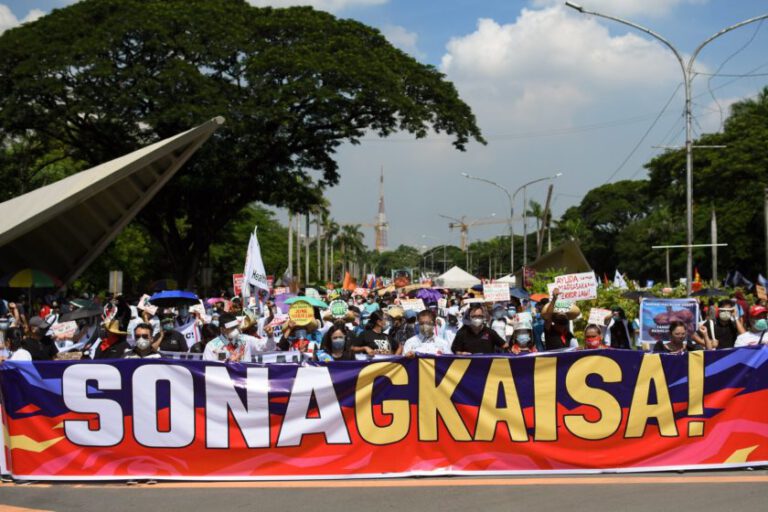
MANILA – Despite warnings from government not to join protests, at least 8,000 went out of their homes and gathered at University Avenue in UP Diliman a few hours before President Rodrigo Duterte delivers his fifth State of the Nation Address.

Dubbed as #SONAgkaisa, groups from different political affiliations showed their unity against the administration’s failed COVID-19 response, against the newly enacted Anti-Terrorism Act of 2020 and against attacks on press freedom and free expression.

Amid the COVID-19 pandemic, the protesters implemented minimum health protocols such as wearing of masks and observance of physical distancing.

Protesters defy government’s warning to #SONAgkaisa protest at UP Diliman this morning, July 27. (Photo by Carlo Manalansan / Bulatlat)

On July 23, the Department of Interior and Local Government (DILG) issued an advisory ordering local government units (LGUs) not to issue rally permits “in accordance with health protocols because of the COVID-19 pandemic.” The agency cited the InterAgency Task Force on the Management of Emerging Infectious Diseases resolution prohibiting “mass gatherings.”

In his speech, Bayan Muna Chairperson Neri Colmenares scoffed at the authorities’ “double standards.” “Kapag mass gathering sa mananita ni Gen. Debold Sinas, okay lang…Nung isang araw lang, 7,500 katao dinagsa nila sa Rizal Memorial Stadium, mass gathering yun…okay lang daw yun. Essential at importante daw yun. Pero kapag protesta natin, di raw pwede kasi mass gathering,” he said.

(If it’s mañanita for Gen. Debold Sinas, a mass gathering, it’s okay…Just the other day, 7,500 were gathered at Rizal Memorial Stadium, another mass gathering, it’s okay. It was essential and important, they claimed. But if it’s our protest, they say mass gathering is not allowed.”

The prohibition on protests, Colmenares said, is not because of COVID-19 but because of the administration’s intolerance toward dissent.

Colmenares said that since Duterte assumed office, he has been relentless in attacking his critics, which include members of the political opposition, Church leaders, activists and even members of the media. The newly enacted Anti-Terrorism Act, he said, would be used to intimidate and harass further those who dare speak out their legitimate grievances.

Failure to curb COVID-19

The SONAgkaisa protest also highlighted the administration’s failure to curb the spread of COVID-19 virus.

In the frontline of the protest this morning were health workers from public and private hospitals.

Maristela Abenojar, president of the Filipino Nurses United, lamented that the government has not prioritized the health sector amid the pandemic. With over 80,000 COVID-19 cases so far, Abenojar said the public health care system is overwhelmed. She said that more than 3,800 health workers have been afflicted by the virus due to lack of protective equipment.

Nurses, she said, work for 12 hours per day and most of them are neither regularly tested for COVID-19 nor allowed to go on quarantine.

“If the government does not care for the caregivers, how are we able to care for the sick?” Abenojar told Bulatlat in an interview.

Theater artist Mae Paner delivered a satirical performance, which also pointed out the government’s inefficiency in fighting the virus. Dressed in swimwear and with inflated dolphin balloons, Paner mimicked President Spokesperson Harry Roque’s speech claiming that the country is winning against COVID.

Hardest hit

Those who have been economically displaced also went out on the streets.

“We are outraged because the government ignores the plight of the workers and the people in this pandemic. It is more interested in suppressing freedom of speech, freedom of the press and freedom of assembly.  It is more concerned with concentrating power through the Anti-Terror Law, and if Duterte wishes so, a charter change,” Kilusang Mayo Uno Chairperson Elmer Labog said.

According to Center for People Empowerment in Governance, 90 percent of the Philippine labor force has been affected by the lockdown in April. Economist Joseph Anthony Lim said that 50 percent had no work and 40 percent of the labor force went from full-time to part-time workers.

The modernization program has left 150,000 drivers, in Metro Manila hungry or almost five months. According to Piston, only less than 10 percent of drivers in the metro have gone back to the roads.

KMU added that amid the worst unemployment crisis in history, Duterte has no blueprint for pro-people economic recovery and job creation.

Meanwhile, Danilo Ramos of Kilusang Magbubukid ng Pilipinas likened Duterte to “a pest.” Ramos said that farmers and the rural poor did not receive sufficient aid in the time of pandemic and those who fight for their land are either killed, or arrested and jailed.

From March to June 2020 alone, nonprofit organization PANAP monitored 16 land-related killings in the Philippines and 46 cases of land-related arrests, detention and legal persecution. The Philippines is listed as the second deadliest country for land rights defenders, next only to Colombia.

To end the people’s suffering, Ramos said Duterte has to go. “Tama na! Sobra na!” (It’s enough!)

The 8,000-strong protesters agreed in chorus. (https://www.bulatlat.com)

The post 8K defy government’s warning against joining protests appeared first on Bulatlat.
With P606B budget for COVID-19 response, aid largely unfelt

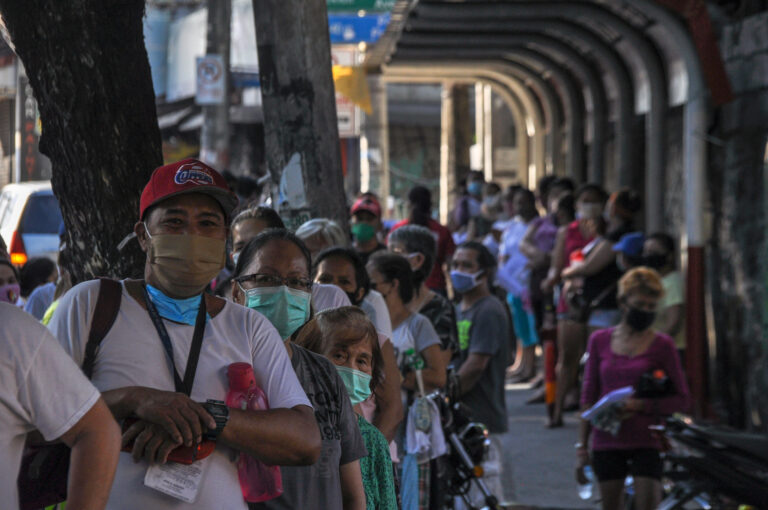
Beneficiaries of social amelioration program lining up to receive aid in Quezon City, May5, 2020. (Photo by PINOY WEEKLY)

“The government have the funds but why not utilize it for aid? They have the machinery but the process has been slow. They (government) prioritized the Anti-Terror Law and term extension than the people’s stomach.”

By ANNE MARXE D. UMIL
Bulatlat.com

MANILA – In almost five months, Filipinos have been confronting not only the deadly coronavirus disease 2019 but also its impact on their livelihood since the government ordered a lockdown.

The Bayanihan to Heal as One Law was enacted and gave President Duterte the power to realign the national budget for COVID-19 response. The government has also acquired billions of loans to augment its resources for COVID-19 response.

As of July 2, the Department of Finance has secured $7.73 billion worth of loans from various lenders as augmentation to COVID-19 response. From this amount, $5.11 billion (P252 billion) has already been disbursed to the government.

The Department of Budget and Management (DBM) on the other hand reported that it has released P353.86 ($7.161 billion) which was sourced out from the funds available in the 2019 and 2020 national budget.

This plus the $5.11 billion (P252 billion) worth of loans already disbursed to the government would mean that there is a total budget of P606 billion ($12.264 billion) allocated for the COVID-19 response.

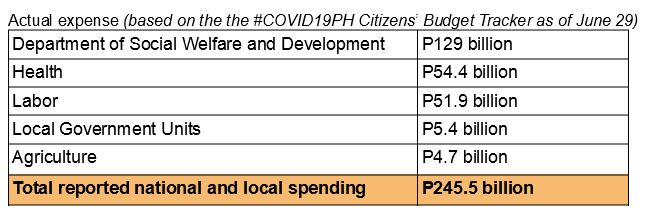
A look into the Citizens’ Budget Tracker would show how the government spent the budget allocated for the COVID-19 response. Based on Duterte’s Report to the Joint Oversight Committee dated June 15, a total of P246 billion ($4.978 billion) was spent for social amelioration program. This also include support for health sector and Bayanihan Grant to Local Governments.


“Where is the money spent?” asked Associate Professor Corazon Jimenez-Tan of the College of Social Work and Community Development, University Philippines-Diliman during the Citizens’ Urgent Response to End COVID-19 (Cure Covid) public briefing on July 22. She said the Duterte administration’s response to the pandemic have been far from participatory and transparent, and lacks accountability mechanisms.

She said government data alone has only left the ordinary people confused and not informed.

“There is no way to find out where the money has been spent. What the people has been experiencing is the lack of support and services on the ground,” she said.

Not spending fast enough’

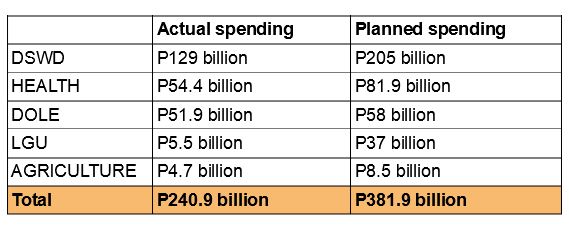
From the study of the Citizens’ Budget Tracker, the government is not spending fast enough to mitigate the people’s hardships brought about by the implementation of lockdown to curb the spread of COVID-19.

Data would also show that the actual spending on services is not yet fully utilized.

For one, the DSWD has only spent P129 billion for its emergency subsidy program or only 63 percent. Actual spending for the Department of Agriculture’s Rice Farmers Financial Assistance Program (RFFA) is only P1.5 billion or 50 percent of P3 billion budget; Financial Subsidy for Rice Farmers Program (FSRF) has spent P2 billion or 69 percent of the P3 billion budget; Expanded Survival and Recovery Aid Project (SURE Aid) has spent P1.117 billion or 45 percent of its P2.5 billion budget.

According to Ibon Foundation beneficiaries of the social amelioration program have waited for at least six to 10 weeks before getting the first monthly tranche of the assistance. They also noted that the emergency relief given to the targeted beneficiaries is inadequate to the duration of lockdown.

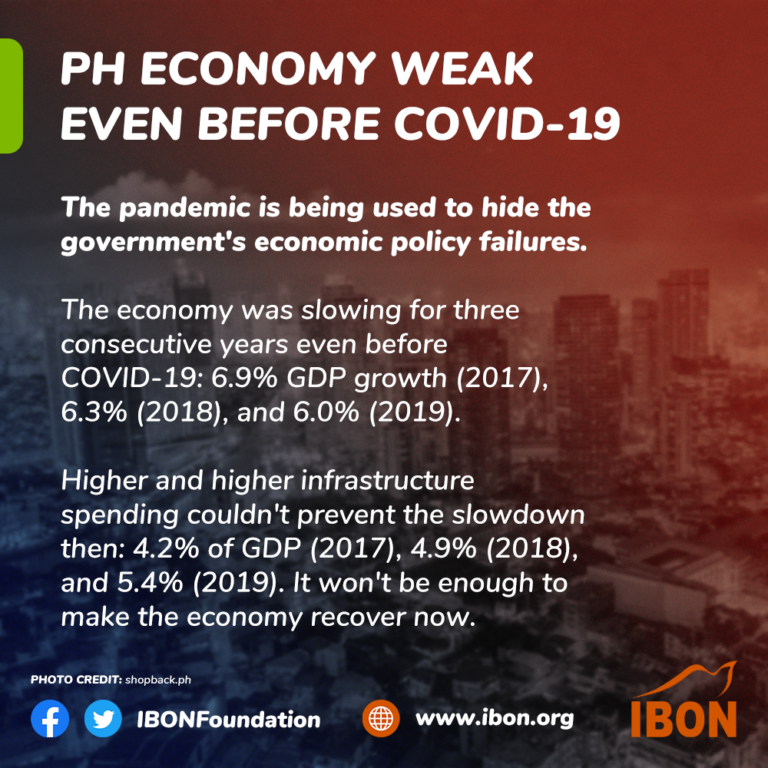
The government announced that beneficiaries of SAP will receive P5,000 to P8,000. But on the average, Ibon said that a beneficiary family only received P5,611. “Over the last four months this comes out to just Php11 per person per day,” Ibon said adding that the government cash assistance is lower than the latest official poverty threshold of P10,727 a month for a family of five.

After the BAHO Law expired, the government announced to give second tranche to 12 million beneficiaries in areas placed under enhanced community quarantine. But as of July 16, only 3.2 million beneficiaries have received the second tranche.

Still, this has not sufficiently covered the population who are in dire need of income in this time of the pandemic. Urban poor group Kadamay lamented that despite the billions of loans, many Filipinos are still suffering from hunger brought exacerbated by the loss of income due to lockdown.

“The government have the funds but why not utilize it for aid? They have the machinery but the process has been slow. They (government) prioritized the Anti-Terror Law and term extension than the people’s stomach,” said Mimi Doringo, Kadamay national spokesperson in a statement.

The recent survey of the Social Weather Station which was conducted on July 3-6 also showed that 20.9 percent or 5.2 million families have experienced involuntary hunger in the past three months. This is the highest hunger rate recorded since September 2014 which is at 22 percent.

Of this number, 15.8 or estimated 3.9 million families experienced moderate hunger and 5.1 percent or estimated 1.3 million families experienced severe hunger.

For ordinary Filipinos, the lockdown has further exposed the insensitivity and inefficiency of the Duterte administration. (https://www.bulatlat.com)

The post With P606B budget for COVID-19 response, aid largely unfelt appeared first on Bulatlat.

Balik-Tanaw | Pentecost: The Parables of the Hidden Treasure and the Pearl


https://www.fisheaters.com/parables7.html

By CHEEKAI DELA CRUZ
National Council of Churches in the Philippines

Ps 119:57,72, 76-77, 127-130
1Kings 3:5, 7-12
Romans 8:28-30
Matt 13:44-52

The Parables of the Hidden Treasure and the Pearl

44 “The kingdom of heaven is like treasure hidden in a field. When a man found it, he hid it again, and then in his joy went and sold all he had and bought that field.

45 “Again, the kingdom of heaven is like a merchant looking for fine pearls.46 When he found one of great value, he went away and sold everything he had and bought it.

The Parable of the Net

47 “Once again, the kingdom of heaven is like a net that was let down into the lake and caught all kinds of fish. 48 When it was full, the fishermen pulled it up on the shore. Then they sat down and collected the good fish in baskets, but threw the bad away. 49 This is how it will be at the end of the age. The angels will come and separate the wicked from the righteous 50 and throw them into the blazing furnace, where there will be weeping and gnashing of teeth.

51 “Have you understood all these things?” Jesus asked.

“Yes,” they replied.

52 He said to them, “Therefore every teacher of the law who has become a disciple in the kingdom of heaven is like the owner of a house who brings out of his storeroom new treasures

===

Treasure hunters

What does it mean to find hidden treasures among the filth of today’s world? It probably means everything. Jesus’ words, in this twin parable speaks volumes of what it takes to get that hidden treasure and exchange everything for it. When you find something of great value, one would do everything to own it. For the Kingdom of heaven is like this: “Go and sell all your possessions and give the money to the poor, and you will have treasure in heaven. Then come, follow me.” Jesus’ challenge to the rich man rings true up to now. You cannot be a follower of Christ if you are being consumed by this world.

But what does hidden treasure mean in today’s context? What does the Kingdom of heaven mean for the people who are constantly suffering under the daily grind of life amid staggering global pandemic? For many believers in Christ, these hidden treasures are those that bring good news to our lives: This means better health system, better socio-economic services to the people, good leadership from the government—all these things are hidden, and seemingly we are at a deadlock of hopelessness and despair in finding these treasures under heaven. But God’s mercy is abundant. And God’s hope never runs out of fashion. The quest for “hidden treasures” that equates to God’s Kingdom drives us to be co-participants in the redemptive work of God. These hidden treasures are meant to be unearthed, if not asserted.

Where do we find these treasures then?

In the thick of things, where our lives are commonly decorated with toxic lockdowns, and characterized with militaristic approach of curbing the pandemic crisis, where do we find our treasures? Where do we find the things that would liberate us from such drudgery and ineptness of the government? Where is hope in all of these? All of these questions compel us toward deep reflection and action. We can rest on the fact that God’s Kingdom is here, it is just hidden. That God’s Kingdom needs to be seen, needs to be found out, needs to be ushered in.

Similar to what the Filipino people experience recently, the denial of franchise of ABS-CBN, was also a denial to the public “treasures”. It seems that the weight of petty angst of politicians is much heavier than the job of the workers, press freedom and the access of public to information.

Now it begs us the question, in looking for treasures, what are the kinds of things that we value? And that we are willing to exchange and lay down to have such treasures? What are our “pearls” that would drive us to pursue it: Is it freedom? Is it health? Is it God’s image in all us? Is it our individual and collective rights? Is it abundant life for all? These beautiful treasures run in contrast to our realities today that they are highly valued, as treasures, as pearls, and that we will do everything to have them. And although the kingdom of heaven may be hidden, it is possible to locate it, and when it is found, its value surpasses that of anything else on earth, and so everything possible should be done to obtain it.

In looking at this, there is that element of active engagement in searching for those treasures. God wants us to “Sell everything”, and go buy the field and buy the pearl. This teaches us a great lesson, that is, if we are willing to seek God’s kingdom, it has a great price of hard work commitment and dedication in pursuant of this. Go sell your possessions, and follow me. Abandon everything, and follow me. Just like how people who are continuously and tirelessly fighting for freedom, for mass testing, for human rights, for junking the Anti-Terror law, seeking God’s kingdom requires the realization of people’s unrequited commitment towards the fulfillment of this.

As Christians, who do God’s work, we are being called to be like treasure hunters–to prioritize the Kingdom of heaven and work for the common good of all persons. God teaches us to focus on the treasures of heaven and earth and what matters most – the dignity of life. May we rest in the hope that the treasure of God’ reign and justice will be dispensed accordingly as we search for God’s eschatology, where abundant life is a real and pulsating reality for all of us. (https://www.bulatlat.com)

Balik-Tanaw is a group blog of Promotion of Church People’s Response. The Lectionary Gospel reflection is an invitation for meditation, contemplation, and action. As we nurture our faith by committing ourselves to journey with the people, we also wish to nourish the perspective coming from the point of view of hope and struggle of the people. It is our constant longing that even as crisis intensifies, the faithful will continue to strengthen their commitment to love God and our neighbor by being one with the people in their dreams and aspirations. The Title of the Lectionary Reflection would be Balik –Tanaw , isang PAGNINILAY . It is about looking back (balik) or revisiting the narratives and stories from the Biblical text and seeing ,reading, and reflecting on these with the current context (tanaw).

The post Balik-Tanaw | Pentecost: The Parables of the Hidden Treasure and the Pearl appeared first on Bulatlat.

Karapatan on Duterte’s 5th SONA: Contagion of fascism can only be cured by solidarity and resistance

0

Despite efforts to “exploit and weaponize quarantine measures to sabotage the staging of mass mobilizations and demonstrations” as President Rodrigo Duterte delivered his fifth State of the Nation Address (SONA) today, July 27, 2020, hundreds and thousands joined protests actions both online and on-ground as well as inside and outside the country, to register resistance to the Duterte administration’s “unbridled fascism” and to hold the regime accountable for its “criminal neglect blatant disregard of people’s welfare” especially amid the ou

read more