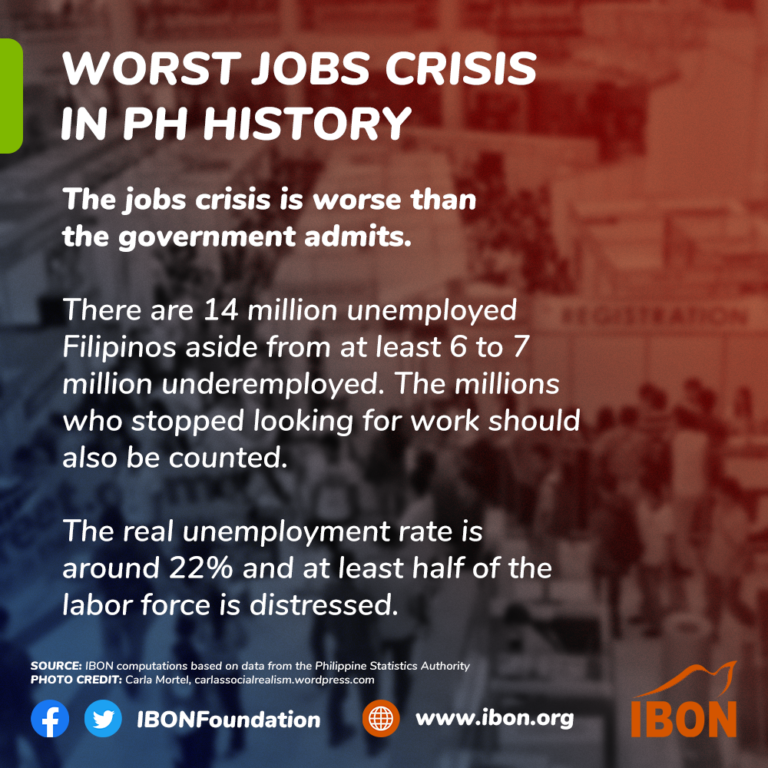
IBON Midyear 2020 Praymer: Sa Ngalan ng Poder
May dalawang taon na lang ang administrasyong Duterte. Subalit tila wala itong balak na lisanin ang poder. Sa nagdaang apat na taon, inasikaso nito ang pagpapayaman ng mga dayuhang mamumuhunan at mga oligarkiya sa ekonomiya, kasama na rin ang sirkulo ng pangulo, gayundin ang pagpapatibay ng kamay-na-bakal sa pamumuno.
Lalo pang namalas ang ganitong direksyon ng gobyernong Duterte sa kung paano nito hinarap ang COVID-19. Tumampok ang maka-dayuhan, maka-negosyo, awtoritaryan at pansariling tunguhin ng kanyang rehimen sa gitna ng pinakamalalang krisis na kinakaharap ng bansa. Tahasan ding ginamit ng gobyerno ang pandemya upang ipagtulakan ang mga batas at patakaran na magsisilbi pa sa kanyang mga layunin.
Malubha ang krisis pang-ekonomiya at ang malawakang ligalig na dulot nito. Lalo lang itong sinasalubong ng administrasyong Duterte ng higit pang panlililang, panunupil at kontrol upang manatili. Lalo lang din lalala ang panlipunang krisis, at ito mismo ang magsisilbing hadlang sa balakin ni Duterte at ng kanyang pangkatin na maghari sa mahabang panahon.
Kometa
…kayo’y naririto pala/kayo’y naririto pa rin/kayo’y mananatili sa alaala/nitong bayang pinag-alayan/ng iyong mga adhikai’t dusa.
The post Kometa appeared first on Kodao Productions.
The Duterte era: A state of nature under attack
By LEON DULCE
A complex array of multiple crises slowly brewing for four years breached the tipping point and inundated the Philippines in just the last four and a half months.
This is the story of our nation as we approach the upcoming State of the Nation Address of President Rodrigo Duterte. The COVID-19 pandemic triggered cascading consequences to long-standing problems in our country that has been hidden from plain sight by the shock and awe antics of President Duterte up to this point.
The environment, in particular, has remained under the radar despite long facing increasing pressures these past four years under President Duterte:
1. We have risen from the fifth spot to fourth in terms of long-term climate vulnerability according to GermanWatch’s climate risk index, with annual average damages brought about by climate-related disasters rising from USD 2.8 billion to 3.1 billion.
2. We have consistently placed second among the top countries with the most air pollution-related deaths in the world, according to the World Health Organization.
3. We have lost an estimated P990.3 billion worth of our sovereign natural resources including annual damages incurred in the West Philippine Sea, wholesale export of minerals to foreign economies, losses to the illegal wildlife trade, and sovereign guarantees in large dam and water projects.
4. The Philippines became the world’s deadliest country for land and environmental defenders for the first time in this time period, with 157 defenders murdered largely by suspected government armed forces—a number 36 percent larger than the total cases recorded during the two previous administrations.
Trapped in extreme poverty by the ‘resource curse’ of imperialism, and rendered vulnerable to contagion and catastrophe, the Philippines was just waiting for a crisis like COVID-19 to happen to make the cookie crumble.
With intact ecosystems dwindling, biodiversity collapsing, pollution worsening, and sources of livelihood depleting, we are extremely susceptible to emerging zoonotic diseases like COVID-19 as our health erodes alongside the planet’s.
But instead of stepping up to the plate, the Duterte administration has abandoned all pretenses of greenwashing.
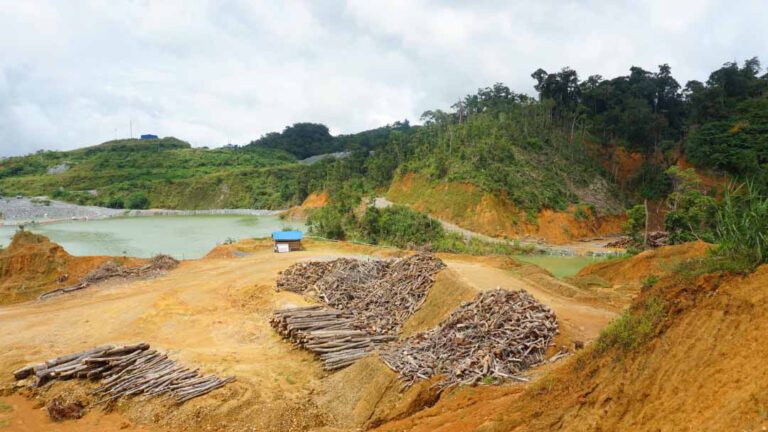
The historic closure of big mines under the late former environment secretary Gina Lopez has been recently announced by current environment secretary and ex-general Roy Cimatu himself as already reversed.
Mining and dredging, apparently, is now considered a strategy for economic recovery in response to COVID-19. Duterte himself recently said that he will “open the borders” to the influx of dirty coal to boost economic activity.
Yet this promise of sacrificing the environment to alleviate the economy does not trickle down to us Filipinos. IBON Foundation points out that the government has only spent P5,617.00 per family—or just P 77.00 per day—for COVID-19 social amelioration.
The Duterte regime has also stepped up its authoritarian rule to suppress the growing criticism and dissent over this widely unpopular policy fast-tracking amid the utter failure to effectively respond to the pandemic.
Instead of pouring thousands of health workers into the streets, we are seeing police and military troops being deployed instead to enforce the world’s longest and harshest COVID-19 lockdown sans real public health solutions.
Duterte’s ‘yes men’ in Congress railroaded the Antiterrorism Law, which legal luminaries have described as ‘worse than martial law’, threatens to further inflame an already atrocious human rights situation faced by Filipino environmental defenders.
Likewise, they have descended upon TV network giant ABS-CBN, also a known champion of environmental causes, by denying the renewal of its franchise for clearly political and self-serving motivations.
We are in such desperate times when nature—and its defenders—are clearly under attack, on this eleventh hour of planetary emergency, climate crisis, and the sixth mass extinction event.
If we do not fight back, no one will be left to fight for us and the future generations. If we do not push back, the world that sustain our very lives will be pushed to the brink by tyrants and demagogues like Duterte.
Indeed, in these dark times under the Duterte era, it is our duty to win back the world from the clutches of tyranny and plunder. It is our duty to resist.
Leon Dulce is the national coordinator of the Kalikasan People’s Network for the Environment. You can reach him at leondulce@protonmail.com.
Kalibutan is a group blog of Kalikasan People’s Network for the Environment. For comments, email secretariat@kalikasan.net. Kalikasan PNE is a convening organization of the Citizens’ Urgent Response to End COVID-19 (CURE COVID), a national people’s initiative of various communities and sectors in response to the pandemic crisis and its impacts on their health and livelihood.
The post The Duterte era: A state of nature under attack appeared first on Bulatlat.
Quezon City councilor files resolution vs ‘terror law’; Mayor also not in favor
Councilor Karl Castelo of the 21st Quezon City (QC) Council passed a resolution last Thursday urging the city government to oppose the Republic Act (RA) 11479 or Anti-Terrorism Act of 2020, commonly referred to as the ‘terror law.’ “The said proposed resolution if passed aims to urge Congress to revisit, review amend or repeal several […]
The post Quezon City councilor files resolution vs ‘terror law’; Mayor also not in favor appeared first on Manila Today.
247 kaso ng COVID-19, 12 pumanaw, 238 na nakarekober at 3,896 naaresto matapos ang isang linggong lockdown sa Navotas
Sa unang pitong araw ng dalawang linggong lockdown sa Navotas ay nakapagtala ang syudad ng dagdag na 237 kumpirmadong kaso ng COVID-19, 238 na nakarekober at 12 ang nasawi. Samantala, sa ulat ng Navotas City Police, umabot na sa 3,896 na ang mga nahuli dahil sa paglabag ng mga patakaran sa lockdown. Geplaatst door […]
The post 247 kaso ng COVID-19, 12 pumanaw, 238 na nakarekober at 3,896 naaresto matapos ang isang linggong lockdown sa Navotas appeared first on Manila Today.
Terror-tagging, protest bans ahead of SONA are acts of cowardice from a fascist regime fearing mass resistance
The proliferation of terror-tagging posters and the issuance of protest bans days leading up to President Rodrigo Duterte’s fifth State of the Nation Address (SONA) are “blatant acts of cowardice from a fascist and tyrannical regime trembling in fear in the face of the people’s mass resistance,” human rights alliance Karapatan stated.
Church leaders join mounting legal opposition vs. terror law
By JANESS ANN J. ELLAO
Bulatlat.com
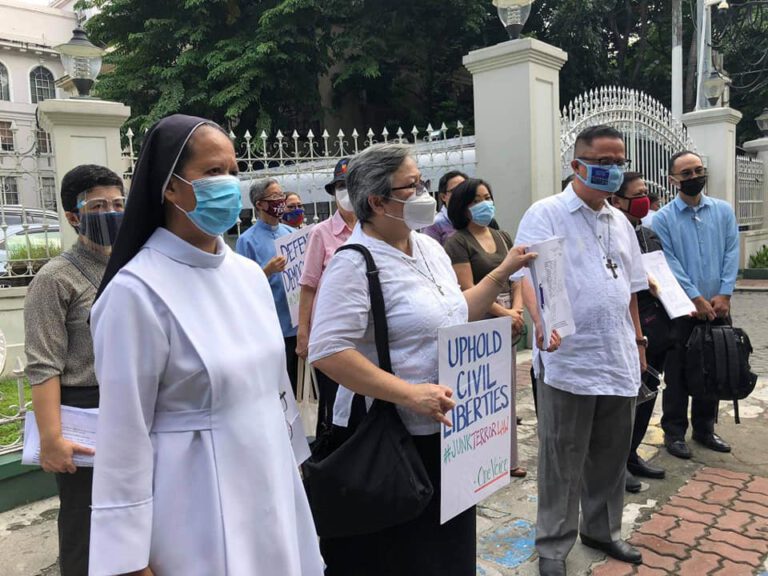
MANILA – Church leaders joined the mounting legal opposition against the controversial Anti-Terror Act of 2020 as they filed their own petition today, July 24, before the Supreme Court. They said that under the new law, their ministries for the poor and the downtrodden may be misconstrued as an act of terror.
Petitioners include Bishop Broderick Pabillo of Archdiocese of Manila, Bishop Gerardo Aliminaza D.D. of the Diocese of San Carlos, Protestant leaders Bishop Rex Reyes Jr. of the Episcopal Church in the Philippines, UCCP Bishop Emergencio Padillo, NCCP general secretary Bishop Reuel Marigza, nuns of the Rural Missionaries of the Philippines, priests, evangelical professors, and church lay people. Also one of the petitioners is former convenor of the Philippine Ecumenical Peace Platform Rey Casambre, who has been detained since 2018 due to trumped up charges.
“Our ministries—with marginalized sectors, the economically poor, and those who struggle at picket lines, with boycotts, and though others forms of legitimate and democratic challenge to oppression and exploitation—can be misconstrued as terrorism, supporting terrorism, or inciting terrorism under the Anti-Terrorism Law,” Alminaza, one of the convenors of the Church people Workers Solidarity, said.
In their petition, church leaders assailed that the vagueness of the Republic Act No. 11479 or the Anti-Terror Act of 2020 will expose them to “credible threat of prosecution” for their ministries and advocacies.
Even before this law, petitioners like the Rural Missionaries of the Philippines have long been in the crosshairs of government. Their bank accounts remain frozen and its former head Sr. Elen Belardo is facing trumped-up charges filed by Presidential Security Adviser Hermogenes Esperon Jr.
The NCCP, too, was red-tagged during a congressional hearing in 2019, along with local and international humanitarian agencies.
Earlier this week, the Catholic Bishops Conference of the Philippines issued a pastoral letter, expressing their disbelief about “the manner in which the contentious Anti-Terror Bill was fast-tracked” amid a pandemic.
“The dissenting voices were strong but they remained unheeded. None of the serious concerns that they expressed about this legislative measure seemed to be of any consequence to them. Alas, the political pressure from above seemed to weigh more heavily on our legislators than the voices from below,” the pastoral letter read.
A government official later claimed it was a violation of the principle of separation of church and state. However, the NCCP seconded the CBCP’s pastoral letter, adding it aims to fulfill church leaders’ prophetic duty to “announce and denounce the ills of society.”
Church leaders were assisted by lawyers from the Public Interest Law Center, July 24.

The post Church leaders join mounting legal opposition vs. terror law appeared first on Bulatlat.