The Lumad group Pasaka denounced another round of false reporting in local news that a third Lumad died in their UCCP Haran sanctuary and was secretly buried in the Wireless Cemetery.
2 of 6 detained jeepney drivers, COVID-19 positive
The situation in jail, according to transport group Piston “gave the jeepney drivers higher risks of contracting the coronavirus disease.”
By AARON MACARAEG
Bulatlat.com
MANILA– Two of the six jeepney drivers arrested and detained for seven to eight days tested positive for coronavirus disease (COVID-19).
Caloocan City 2nd District Representative Egay Erice broke the news in a Facebook post early morning of Wednesday, June 17. The Piston 6 were arrested June 2 while holding a protest action demanding the resumption of their operations. Police claimed they violated the protocol for physical distancing and placed them in a cramped detention cell with 153 inmates. The situation in jail, according to transport group Piston “gave the jeepney drivers higher risks of contracting the coronavirus disease.” The group added that Piston 6 did not have access to clean water while in jail.
In a statement, Piston said they have already initiated health protocols among concerned members of the group. The names of the two COVID-19 positive jeepney drivers is not disclosed.
One of the arrested is 72-yeard-old Elmer Cordero. Erice said, however, that Cordero tested negative of the virus.
Piston reiterated their call for the continuation of their operation. Piston’s online petition has already gathered over 30,000 signatures.A donation drive was also initiated by Piston to help the families of affected jeepney drivers.
The post 2 of 6 detained jeepney drivers, COVID-19 positive appeared first on Bulatlat.
Two Lumad children and father ‘abducted’ on June 12, found to be held in military camp
A day after Independence Day when protests were held in different areas in the country against the anti-terrorism bill, two Lumad students and their father Mongkel Tacalan, 66, was reported last seen accompanied by four police officers in Barangay Kisante, Makilala in North Cotabato. Save Our Schools (SOS) Network announced on June 17 that media […]
The post Two Lumad children and father ‘abducted’ on June 12, found to be held in military camp appeared first on Manila Today.
For Filipino farmers, Danding Cojuangco left a legacy of exploitation and oppression

“Throughout the past regimes, Danding was able to amass great wealth, power, and influence after plundering the coco levy fund collected from small coconut farmers during Martial Law.”
By EMILY VITAL
Bulatlat.com
MANILA – With the death of business tycoon, Marcos crony and landlord Eduardo “Danding” Cojuangco Jr., Filipino farmers could only remember their misery and the long years of injustice they continue to endure.
Zenaida Soriano, national chairperson of women peasant group Amihan, said, “On his death, he left the injustice he committed against poor and landless peasants, and agricultural workers.”
In a statement, Kilusang Magbubukid ng Pilipinas (KMP) said that the P105-billion coco levy fund remains unreturned to its intended beneficiaries — small coconut farmers and their families.
The coco levy refers to taxes or exactions collected during the martial law years from coconut farmers, planters and millers. A known Marcos crony, Danding used the coco levy to purchase the United Coconut Planters Bank (UCPB) six coconut oil mills, 14 holding companies, and San Miguel Corporation.
In 2014, the Supreme Court affirmed its 2012 and 2001 decisions declaring the multi-billion coco levy funds as public funds that should ultimately benefit the coconut farmers from whom the funds originally came.
“Throughout the past regimes, Danding was able to amass great wealth, power, and influence after plundering the coco levy fund collected from small coconut farmers during Martial Law. He acquired San Miguel Corporation (SMC) using the coco levy fund and through enabling the fascist Marcos dictatorship,” KMP Chairperson Danilo Ramos said.
Landlord, union-buster
Amihan added that Danding also masterminded the “corporative scheme,” which evaded actual land disribution to farmer beneficiaries of government’s agrarian reform.The 11 haciendas covers 4,661 hectares in two cities and seven towns of the province.
“Cojuangco systematically opposed land reform by ejecting legitimate agrarian reform beneficiaries (ARBs) and installed his minions to consolidate control over the vast tracts of land. Those who asserted their rights to land faced criminalization of agrarian cases, or being framed up with common crimes as form of harassment,” Soriano said.
KMP added that Danding’s San Miguel Corporation is also the primary initiator of flexible labor policies in the country that promoted contractual labor and laid off tens of thousands of workers across SMC companies.
Amihan lamented that “Cojuangco was never held accountable for his collusion with the Marcos dictatorship, plunder of the multi-billion-peso coconut levy fund and carrying out of anti-worker policies, particularly union-busting at San Miguel Corporation (SMC).”
“Cojuangco leaves no legacy to the country, but of oppression and exploitation…He worshipped amassing wealth at the expense of poor Filipinos,” Soriano said.
Amihan called for the distribution of Danding’s hacienda lands to poor and landless peasants and agricultural workers, as “a means to carry out social justice.”
ALSO READ:
Farmers laud SC order halting privatization of coco levy assets
‘Distribute coco levy, recover Danding’s shares in SMC,’ presidentiables told

The post For Filipino farmers, Danding Cojuangco left a legacy of exploitation and oppression appeared first on Bulatlat.
In lockdown: Kings of the road sidelined
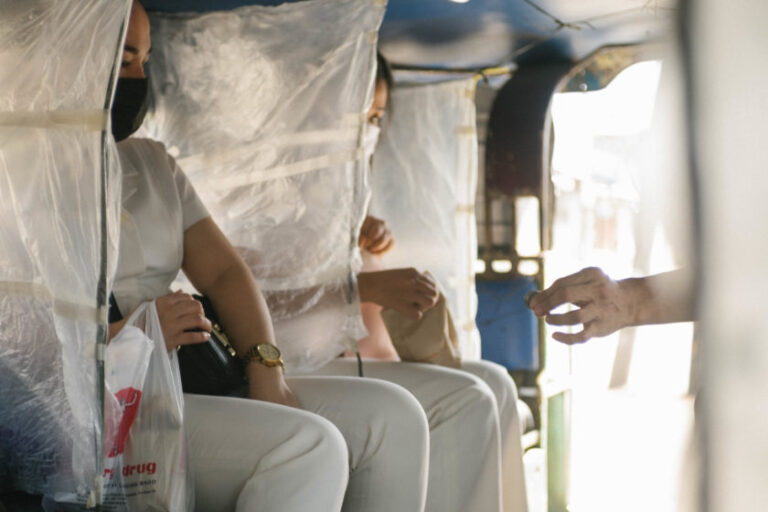
“We don’t want aid, what we need is to get our livelihood back. What can we get from the government’s aid? A few kilos of rice and cans of sardines? Those aren’t even enough to feed our family for a day. Our request is to get our livelihood back, we’re not expecting the government to help us, so can they at least allow us to help ourselves?”
By GEELA GARCIA
Bulatlat.com
ANTIPOLO, Rizal — Quarantine guidelines have been relaxed mid-May in efforts to revive the economy and adjust to the so-called “new normal” that the pandemic demands. Offices have allowed skeletal workforce, parts of malls have been opened, and more restaurants have offered takeout options. And while these adjustments can provide immediate income to daily wage earners, reporting to work has just become more difficult as the majority of the country’s public transportation remains to be suspended.
Trains, tricycles, and taxis have been open for public use but with reduced capacity. However, the cheapest and the most accessible mode of transportation to the public, the jeepneys, have been barred from operations for almost three months now.

In the mountainous province of Rizal, operations of jeepney drivers have gradually resumed last May 16. Compared to small tricycles and air conditioned vehicles, jeepneys can easily move through the province’s steep roads. Jeepneys are also better equipped to transport crops from higher parts of the province, which farmers sell in the city.

A ride under the quarantine

Isidro Daza is a jeepney driver and the cooperative leader of PAGODA (organization of jeepney drivers) from Rizal. Daza has been a jeepney driver for more than half of his life. He started steering the wheels when he was 18 and has not known any other livelihood since then. He gets up at 4 a.m. daily to start his route at Cogeo – Paenaan.
Daza’s jeepney was 11th in line, and with no passengers going to the terminal, there was no chance that his unit would even be the next. After going back and forth from Cogeo – Paenaan and waiting for hours, Daza calls it a day at 4 p.m.

Just like most drivers, he pays half of his earnings for the day to his operator as his “boundary” payment. For the time being, his operator has decided not to collect boundary during the lockdown.
“The operator understands that we can barely give him anything now because there are no passengers. We also think of him, we know he’s also not earning anything,” Daza said in Filipino.
Before the lockdown, Daza was satisfied to earn P700 on a normal day. He said there was at least some money for his family’s needs, now he laughs as he counts the 20-peso bills in his hands.

Pandemic-stricken kings
Daza supports a family of 12. He has seven children, with his eldest son at 20 and his youngest daughter at seven months. Two of his sons have married early, with his daughters-in-law and his grandchild staying under their care. Daza also takes care of his mother.
The lack of income proves to be challenging for the family.
“There was a time I had to play around with food to make sure I could feed the whole family. I experimented with one can of sardines and added flour to make it enough for everyone. We called it our own version of fish balls. My kids liked it, at least,” he said.
Their backyard plants served as an additional source of food. Sometimes, he received messages from friends asking to borrow money, but since he needed it just as much, he could only offer the malunggay at home to help. His wife said that because of the pandemic, they’re now thinking of planting other easy to harvest crops.

Daza said that often, he finds himself in daze.
Already a father to his seven children, Daza also fathers his local jeepney cooperative, where he serves as its vice president. He attends meetings with numerous barangay captains and leaders to plan a new transportation setup. He keeps watch of any alerts should there be any announcements from the LGU and monitors a Facebook group for his members.

Drivers wish to propose fare adjustments once they return to work.
“The fare from a 41 km jeepney ride from Sampaloc – Cogeo costs P65, the drivers are not going to earn enough from their routes because of reduced jeepney capacity. Ideally, the increase in the fare should be 100% for them to earn the same amount they were earning before the lockdown, but we agreed to reduce it to a 50-percent increase instead so that the burden of the changes could be shared by the driver and the passenger,” Daza explained their proposal.
He said it is painful that desperate changes must be raised, but with prices of commodities increasing in the market, they also have to adjust their fares to earn enough for their families.


To provide some aid, Daza and some officials of their jeepney association organized a relief drive for their member drivers and operators. As early as 9 a.m., Daza and his fellow officers were stationed in their meeting point and waited for their members to pick up sacks of rice and instant noodles.
Currently out of work, some of the drivers have signed up as shipping couriers, while others worked as shuttle drivers for BPOs. All the drivers share the same sentiment of wanting to resume driving their jeepney.
Larger threat: jeepney phaseout
 Daza’s wife, Jesselyn, expressed disappointment as she narrated how her family has been looking forward to finally owning the jeep they’ve driven for several years now. She shared that their four-year plan has been ruined by the two-month lockdown.
“If not for the lockdown, the jeepney my husband has been driving could’ve been ours by now. We were three months away from completing the boundary, and have been looking forward to calling the unit ours. For four years, we invested so much on our jeep, from its parts to its maintenance, just so we could have something to pass on to our kids. Now it seems like the government has just taken advantage of the virus, and is using that to expedite the jeepney phase out. Our dream of giving our children a better life is now looking bleak,” Jesselyn lamented.
She added, “We don’t want aid, what we need is to get our livelihood back. What can we get from the government’s aid? A few kilos of rice and cans of sardines? Those aren’t even enough to feed our family for a day. Our request is to get our livelihood back, we’re not expecting the government to help us, so can they at least allow us to help ourselves?”
The decision to allow some jeepneys to operate in Rizal has been recalled with the relaxing of Metro Manila quarantine measures last June 1. Most of the jeepney drivers who had already spent to refurbish their units to fit the new normal went back to their families uncertain on when they will return to work.

Jeepney drivers and operators speculate that the government’s negligence to the calls of the drivers this lockdown will eventually lead to the jeepney phaseout, making the transition to modern jeepneys smoother for the government.
In this time of pandemic, the kings of the road continue to be sidelined as government paves the way for big corporations to take over the city’s roads.
The post In lockdown: Kings of the road sidelined appeared first on Bulatlat.
What we could learn from Capitol Hill
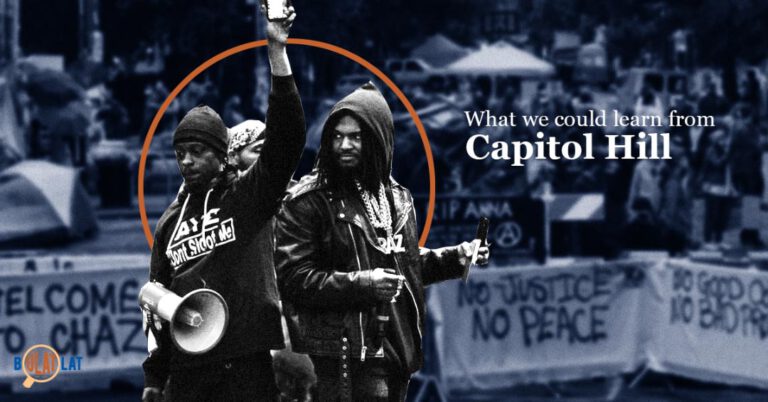
The challenge for American activists and organizers is to now elevate these contradictions towards the primary question of class struggle; something that hasn’t been done since the Black Panther Party of the 1960s.
By JUSTIN UMALI
Bulatlat.com
MANILA — On June 8, thousands of American protesters occupied roughly six blocks in Seattle, Washington, barricaded the streets, and declared themselves autonomous. Today, the Capitol Hill Autonomous Zone has been described as anything from “a block party” to “filthy anarchists,” but one thing is clear – CHAZ is thriving.
The murder of George Floyd in the hands of police was what broke a system built on centuries of racism and capitalist exploitation. Nationwide protests have flared up all over the United States, unified under the call of “Black Lives Matter,” despite a global pandemic and increasing police violence tacitly sanctioned by President Trump himself.
As Filipinos, we tend to look at the BLM protests through an outsider’s lens. Although it is hard for us to grasp how just endemic racism is to American society, we can nonetheless learn a lot of
practical lessons from correctly analyzing the situation.
At the heart of the BLM protests are deeply ingrained contradictions in race relations, which seep to through facets of the American society. Police violence is colored by skin. Policies like redlining and segregation have contributed to racial sentiment and socio-economic inequality, and so on.
The challenge for American activists and organizers is to now elevate these contradictions towards the primary question of class struggle; something that hasn’t been done since the Black Panther Party of the 1960s. It would take a lot of work to regain that level of political maturity. Decades of fierce anti-communism and Cold War politics have reduced the “left” to mean “the Democratic Party,” while reformist social democrats like Bernie Sanders and Elizabeth Warren are considered “radical.” The few grassroots organizers, Marxists, and anarchists that remain are kept on the fringe of mainstream politics, scattered in local groups and internet “organizing.”
But regardless of the state of activism in the United States, something has definitely exploded in the mass consciousness. Thousands of protesters have awoken, painfully conscious of the inequality they face and are waging a spontaneous uprising. Which brings us back to Capitol Hill.
What is CHAZ? Not even the protesters themselves can answer the question.
At the very least, it was established as a safe space in Seattle, free from police or state intervention. There are barricades demarcating the borders of the zone, with volunteers at the post vetting people who want to enter. They have radios and some are carrying firearms.
There is no centralized leadership within CHAZ. Though some people like Raz Simone have risen up, decisions are still largely decentralized. Supplies largely come through donations, and the park serves as a community center for educational discussions and cultural performances.
Despite Trump’s insistence, CHAZ is not an attempt at secession. It’s a microcosm of the BLM protest movement – surviving in the rage of the moment, with so much potential, but without clear leadership. It could only exist because of the political power the protesters have taken for themselves thus far. What CHAZ, and the BLM protests in general, need now is strong leadership to advance the protests towards actual change.
Unlike the American mass movement, we have the benefit of a potent and organized political force. For more than 50 years, Filipino activists and organizers have forged a sense of political maturity through mass organizations, clear campaigns, and collective struggle.
It would do well for us to look at CHAZ and see it for what it is; as the mass movement taking clear shape. It’s not an entirely foreign concept to us – we are well-versed in both the art and the science of the protest camp, the ubiquitous kubol that we call our makeshift home.
The Philippines is in a situation not unlike the United States. The global pandemic has exposed all secondary contradictions in Philippine society: a socio-economic crisis, state abandonment, crises in education, labor, transportation, housing, and so on. Meanwhile, state fascism and terrorism run rampant through the Terror Bill, “counterinsurgency” plans, and press freedom violations.
We have the benefit of being politically mature enough to be able to connect these issues towards the more fundamental ills of Philippine society – imperialism, feudalism, and bureaucrat capitalism. Every day, the poorest Filipinos are being harassed and abused by the state in magnitudes above the fate suffered by George Floyd.
Let us look at CHAZ, and the American mass movement, and inspire ourselves to fight back. Let us invigorate ourselves with the militancy of “No justice, no peace,” and shout back: Makibaka, huwag matakot.
The post What we could learn from Capitol Hill appeared first on Bulatlat.
Terror bill seen to worsen gender-based violence

“It is very alarming that the (Philippine police) continues to fail as a good example of a gender-sensitive institution.”
By JANESS ANN J. ELLAO
Bulatlat.com
MANILA – The looming passage of the anti-terror bill may worsen the already dire conditions of Filipino women. This after the Philippine police posted what critics described as a gender-insensitive remark telling women to dress up modestly to avoid encountering sexual violence.
“It is very alarming that the (Philippine police) continues to fail as a good example of a gender-sensitive institution,” said Amihan chairperson Zen Soriano.
Soriano stressed that with the intensified targeting of critics when the bill is finally signed into law may embolden the ranks of the Philippine police to commit more gender-based violence.
Read: 4 reasons why anti-terror bill should be junked
The now deleted post of the Philippine police has stirred online conversations on the victim-blaming narrative. Filipino celebrities and social media influencers such as artists Frankie Pangilinan and Lauren Young through hashtag #HijaAko voiced out their disgust.
Filipino netizens, too, shared their thoughts and experiences on victim-blaming.
The kids are alright. Fight on, ladies. I hope for the day when you won’t have to. #HijaAko pic.twitter.com/oMXZG82OVE
— Carla (@FlipsideKitchen) June 17, 2020
IT DOESN’T MATTER HOW YOU SEE THEM. YOU DONT HAVE THE PERMISSION TO DO SUCH THINGS AND MAKE THEM FEEL UNCOMFORTABLE BECAUSE OF THE WAY THEY DRESSED UP. AND YOU DON’T HAVE THE RIGHTS TO HARASS THEM. IT IS NOT A JOKE. RAPE IS RAPE! #HijaAko pic.twitter.com/4HDEyXfkCH
— egiwu (@emmanuelbyy) June 14, 2020
TW: Rape, sexual assault
.
.
Back when women wore long skirts and sleeves, they were still r*ped and assaulted. Stop blaming women for what they wore and start holding r*pists accountable! #HijaAko pic.twitter.com/4DCWmjd1f8— the Great Dan(iell)e (@scoliosass) June 14, 2020
This, Soriano said, betrays the Philippine police’s supposed sincerity in upholding women’s welfare, adding that the “victim-blaming blunder” post goes to show how “fake” their training is on violence against women and children.
The Philippine government’s own data, through the Philippine Commission on Women, revealed that a daily average of 51 cases of violence against women (VAW) were reported in 2018 alone. Though there is a decline from the number of VAW cases in the previous two years, Amihan believes there is poor reporting of such cases.
Read: Assistance to rape victims still sorely lacking
Gabriela secretary general Joms Salvador has earlier called out the Philippine police for the post, reiterating that women and their clothes are not at fault but rather patriarchy, capitalism, and those in the corridors of powers that have low regard for women are the “reasons that women experience violence.”
Read: The ceaseless agony of a Filipino comfort woman
Soriano said the Philippine police “promotes gender insensitivity and Duterte’s instrument of violence, thus, the Filipino people especially the women should unite and fight against rights abuses and condemn Duterte’s misogyny and tyrannical rule through pushing for the “Terror Bill.”
The post Terror bill seen to worsen gender-based violence appeared first on Bulatlat.