In response to the tourism crisis brought about by the coronavirus pandemic, governments of the Philippines, Vietnam and Thailand established virtual tours for those who want to explore famous travel locations in Southeast Asia without leaving their homes, and to encourage tourists to visit these places in the future.
Despite his betrayal of Philippine sovereignty in his relations with China, Duterte has gotten far less than the loans that he expected to get from China even at the most onerous terms for his much-touted plan of infrastructure-building. It has become obvious that China has preconditioned most of the loans with demands for the most outright and brazen surrender of Philippine sovereign rights over the West Philippine Sea and its rich oil, gas and marine resources.
Esensyal ang tungkulin ng malayang pamamahayag sa panahong hinaharap ng buong mundo ang pandemya. Gumagampan ng malaking tungkulin ang mga journalist at media organizations sa mas malawak na dissemination ng mahahalagang impormasyong dapat na makatawid sa mamamayan.
Nagiging bukas na daluyan rin ito upang punahin ang mga pagkakamali at kalabisang maaaring gawin ng mga nasa kapangyarihan.Ngunit kakaiba ang nangyayari sa Pilipinas. Gamit ang mga batas at teknikalidad nito, matagumpay na naipasara ang ABS-CBN noong nakaraang buwan.
Bagama’t sinunod ng top management ang proseso at mga rekisitos sa renewal ng kanilang franchise, naging malinaw sa mamamayan at buong daigdig na ang inaatake na ay ang kalayaan sa pamamahayag. Hanggang sa ngayon, nakabinbin sa House of Representatives ang franchise renewal ng broadcast channel.
Matapos ipasara ang ABS-CBN, niratsada naman ang Anti-Terror Bill, isang panukalang batas na may mga probisyong mapanganib at banta sa mga karapatang sibil at politikal ng mamamayan.Ngayong araw, hinatulang guilty sina Maria Ressa at Reynaldo Santos Jr. Ang kaso ay Cyber Libel na sinampa ni Wilfredo Keng, isang negosyante.
Tinatalakay ng artikulo na under surveillance si Keng dahil sa involvement sa illegal drugs at human traffic. Ang batayan ng kaso ay ang Cybercrime Prevention Act ngunit nailathala ang article na nabanggit noong wala pang umiiral na batas tungkol sa cyber libel.
Malinaw ang mensaheng pinaparating sa mga mamamahayag at mamamayan; ang mga pagpuna at pambabatikos sa online ay maaaring ituring na cyber libel. Magkakaroon ng chilling effect ang desisyon na ito sa mga kritiko ng pamahalaan lalo na sa panahong higit nating kailangan ng accountability sa mga hakbangin ng pamahalaan labang sa COVID19.
Magdudulot ito ng takot at pangamba sa mamamayan na punahin at batikusin ang mga abusado at kapalpakan ng pamahalaan.Ang mga sunod-sunod na atake sa kalayaan sa pamamahayag sa porma ng pagpapasara sa ABS-CBN, pagratsada ng Anti-Terror Bill at guilty verdict kina Ressa at Santos ay malinaw na manipestasyon na nais ng pamahalaang patahimikin at takutin ang mamamayang ang sinisigaw ay mga konkretong plano para kalusugan at kabuhayan.
Nais nilang takpan at busalan ang mga katotohanang sinasambulat ng pandemyang ito.Ipahayag natin ang mariing pagtutol sa mga atake sa ating freedom of expression at freedom of the press. Manindigan tayo at labanan ang isang papet, pabaya at pasistang pamahalaang ito!
Research group IBON said that the unemployment crisis is actually even worse than official figures show. The group estimates that the real unemployment rate is likely around 22% and the real number of unemployed around 14 million. The April 2020 Labor Force Survey (LFS) of the Philippine Statistics Authority (PSA) released on June 5 reported […]
“Allowing this administration, the added leeway and greater authority that come with a newer, more oppressive anti-terrorism law would open the floodgates to graver forms of abuses. The dangers that come with the Anti-Terrorism Bill are all too real to be ignored, and we cannot and should not wait until the final nail in the coffin has been hammered down.”
MANILA – On June 17, the Department of Justice (DOJ) is expected to submit its review of the highly criticized anti-terrorism bill to the Office of the President before President Duterte decide on the fate of the proposed measure.
Justice Secretary Menardo Guevarra said the DOJ will review the bill as “independently and objectively as possible.”
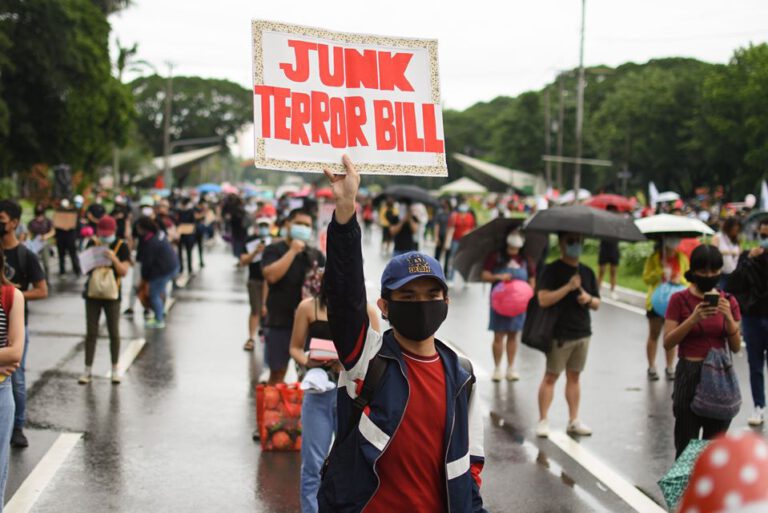
Now that the bill is awaiting Duterte’s signature, human rights lawyers have been calling on Duterte to veto what they labeled as “Terror Law.” Here are their four major arguments:
1) The new anti-terror bill is unconstitutional
The new anti-terror bill disregards the people’s rights guaranteed under the Constitution, according to Bayan Muna Rep. Carlos Zarate.
Section 29 allows arrest without warrant, said Zarate.
The Anti-Terrorism Council (ATC), through a written authority, allows the police and the military to arrest a person suspected of committing terrorist acts. The suspect can be detained up to a maximum of 24 days even while the authorities are still gathering evidence against the suspect.
“This is unacceptable,” Zarate said, citing Article VII, Section 18 of the Constitution which states, “During the suspension of the privilege of the writ, any person this arrested or detained shall be judicially charged within three days, otherwise he shall be released.”
“This is no different to the time of dictator President Ferdinand Marcos where he has powers to issue arrest and seizure order,” said Zarate.
The Concerned Lawyers for Civil Liberties (CLCL) also pointed out that “no law can provide what the Constitution prohibits.”
“Worse, it is unjust to imprison people without charges in court and without giving them the judicial forum to present their evidence and defend themselves,” the CLCL said.
In a separate statement, the National Union of Peoples’ Lawyers (NUPL) also said the provision “diminishes the role of the judiciary into a mere stamp pad of legality and an instrument to the institutionalization of shortcuts, circumventions and even validation of outright violations and abuses.”
Section 34 also restricts the right to travel of a suspect. Zarate said that a person who was not yet found guilty of committing a terror act, a bail will be granted by the court. However, the person’s right to travel is limited only within the municipality or city where he/she resides or where the case is pending.
It is also under this section that a suspect can be placed in house arrest. A suspect’s use of all means of communication shall also be restricted.
Zarate said that Constitution prohibits cruel and unjust punishments as well as incommunicado detention. He said that being in house arrest but not allowed to use communication is also like being held incommunicado.
“It was like the opposite of being innocent until proven guilty beyond reasonable doubt by the court . Here, your are presumed guilty until you have proved your innocence,” he said in an online forum organized by Health Alliance for Democracy last week.
2) The new anti-terror bill punishes the intention, not the criminal acts
In penal law, Zarate said it is the criminal act that is being punished. But under the anti-terror bill, mere intention is being punished.
He said the stages of the commission of the crime such as attempted, frustrated or consummated where gravity of the penalties differs. In this law, acts such as:
– Threat to commit terrorism is punishable by imprisonment of 12 years
– Planning, training, preparing and facilitating the commission of terrorism is punishable by life imprisonment without the benefit of parole.
– Conspiracy to commit terrorism is punishable by life imprisonment without the benefit of parole.
– Proposal to commit terrorism is punishable by imprisonment of 12 years.
– Inciting to commit terrorism is punishable by imprisonment of 12 years
– Recruitment to and membership in a terrorist organization is punishable by life imprisonment without the benefit of parole.
– Foreign terrorist is also punishable by life imprisonment without the benefit of parole.
Zarate also said that it is the law enforcers who shall determine “the intention of the supposed terrorist acts.”
The NUPL also said that a bill that “criminalizes threats to commit, planning to commit, conspiring or proposing to commit, inciting others to commit this rather vague concept of ‘terrorist acts,’ give the security forces, from the top honchos to those on foot patrol, the license to commit rights violations with impunity.”
The CLCL also noted the lack of protective measures against law enforcers who will abuse the law by “not penalizing malicious obtaining of authority from the courts for surveillance or refusal to restore or delay in restoring seized, sequestered and frozen bank deposits, accounts, assets and records.”
It also removed the penalty of P500,000 per day of detention when a person is falsely and wrongly accused of terrorism under the Human Security Act, which the anti-terror bill seeks to amend.
3) The law will be utilized against individuals and organizations who express dissent
Contrary to the claims of the principal authors and the supporters of the anti-terror bill, Zarate maintains that the law will be utilized against critics just as the existing laws are being weaponized against the people.
He cited as an example the recently enacted law, the Bayanihan to Heal as One Act which supposedly is a response to the public health crisis. However, Zarate said, the law was used against ordinary people who did not wear face mask, who had no quarantine pass, who violated the curfew, who went out to find ways to feed their families and those who expressed their grievances because of the inadequate government aid.
He also cited the arrests of humanitarian workers who are extending relief to the communities.
Data showed that as of June 8, more than 193,000 individuals were arrested for violating quarantine protocols. Almost 59,000 were charged and 15,000 were detained.
He said safeguards in the law under Section 4 does not really give assurance that the law will not be used against those who express their grievances against the government.
Section 4 of the Senate Bill No. 1083 states: “Provided, that, terrorism as defined in this Section shall not include advocacy, protest, dissent, stoppage of work, industrial or mass action, and other similar exercises of civil and political rights, which are not intended to cause death or serious physical harm to a person, to endanger a person’s life, or to create a serious risk to public safety.”
Zarate said that while this “sounds good to the ear,” the law gives law enforcers the discretion whether or not the protest or any action like strike of workers are not intended to “commit terrorist acts.”
The CLCL also said the bill “swivels the definition of terrorism from its effects upon the people towards its effect upon government e.g., that the acts are ‘provocation’ or ‘intimidation’ of the government (Section 4).”
“The danger therein lies with how the government can construe legitimate acts of dissent or opposition within these definitions – it gives the government almost free reign in determining who are ‘suspected terrorists’. Even ordinary citizens airing their grievances against government on social media may fall within its ambit,” the CLCL explained.
The International Association of Democratic Lawyers (AIDL), in its open letter, also stressed that the Philippines has ratified the International Covenant on Civil and Political Rights.
It said that Article 19, states that “1. Everyone shall have the right to hold opinions without interference and 2. Everyone shall have the right to freedom of expression; this right shall include the freedom to seek and receive and impart information and ideas of all kinds, regardless of frontiers, either orally, in writing or in print, in the form of art, or through any other media of his choice.”
“The Anti-Terrorism Bill violates all the rights that the Philippines has agreed to guarantee its people,” the group said.
4) The Anti-Terrorism Council is not a court
The anti-terror bill creates the Anti-Terrorism Council (ATC) whose members are Cabinet members. Under the bill, the ATC has the only power to designate a person or a group as terrorist upon finding a probable cause. The proposed measure, Zarate said, also does not indicate the process of whether the suspect can appeal the accusation against him or not.
But Zarate said the ATC is not the court to determine such. He said even in the existing Human Security Act of 2007 (HSA), there is a procedure before a group or an individual can be declared a terrorist.
An example, he said, is the Department of Justice’s motion to declare as terrorist groups the Communist Party of the Philippines and the New People’s Army. The DOJ went to the Manila Regional Trial Court and filed petition seeking to declare the two groups and over 600 individuals as terrorists.
“What’s worse is that when the ATC has designated that a person is a terrorist, your assets can be frozen and you can be arrested without a warrant,” he said.
The CLCL also said that Section 29 of the proposed bill grants the ATC the judicial power to issue “warrants of arrests allowing the detention of a person for at least 14 days without charges.” Therefore, they said, that it violates not only the due process clause of the Constitution but also Article III Section 2 that states “no warrant of arrest shall issue except upon probable cause to be determined personally by the judge.”
The IADL also criticized the creation of the ATC which “expands the powers of the executive.” The IADL pointed out that the ATC, which is “composed of presidential cabinet officials and retired generals serve under pleasure of the President, with the power to declare and proscribe organizations and parties as terrorists or terrorist sympathizers without ample and fair opportunity to be fully heard in a court of law.”
What’s next?
Duterte has 30 days to act on the bill from the day it was transmitted to his office. Zarate said he can sign it right away. After 30 days without any action from the President, the bill automatically becomes a law.
“Or he can veto it if he will listen to the people’s calls,” said Zarate.
If enacted into law, Zarate said civil society groups can question its constitutionality before the Supreme Court. At the House of Representatives, legislators can file a bill to repeal the law just like the repeal of the Anti-Subversion law, he added.
Zarate said he is confident that the people will overcome this challenge because they are on the side of the truth.
Amid the threats on the people’s civil and political rights, Zarate urged the public not to be afraid of voicing out their criticisms.
The NUPL also called on the people to be viligant. “Allowing this administration, the added leeway and greater authority that come with a newer, more oppressive anti-terrorism law would open the floodgates to graver forms of abuses. The dangers that come with the Anti-Terrorism Bill are all too real to be ignored, and we cannot and should not wait until the final nail in the coffin has been hammered down,” the group said.
Today’s cyberlibel conviction of Maria Ressa and Reynaldo Santos, Jr. cannot come in a more inopportune time. The Filipino people saw shutdown of ABS-CBN on May 5, the railroading of the “terror bill” since May 29 (now pending the signature of the president to become law) and a cyber libel conviction today, June 5. All […]
Media groups and other sectors slam the guilty verdict on Rappler’s CEO and Executive Editor Maria Ressa and former staff Rey Santos Jr, calling the decision a further attack of the government on press freedom.