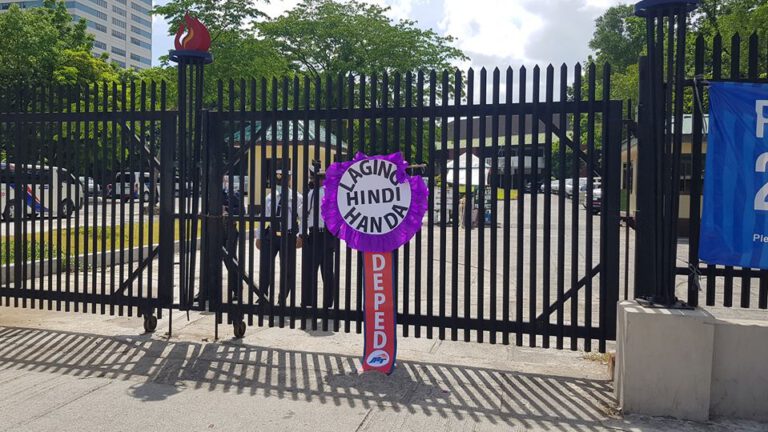
MANILA – Public school teachers’ group stormed Department of Education (DepEd) head office in Pasig City on Tuesday, June 9.
The Alliance of Concerned Teachers (ACT) criticized DepEd for not addressing the widening gap in the education in the new mode of learning delivery in this academic year 2020-2021.
The DepEd maintains that it will proceed with the school year through distance learning, following President Duterte’s statements in his public address against face-to-face classes if vaccine for coronavirus disease 2019 is not yet available to the market.
“The health and economic crisis has further exposed that quality education has always been the privilege of a few Filipinos. Instead of taking the opportunity to close the many gaps in education access and quality, the government opted to widen it by insisting on opening schools remotely without sufficient preparation and support to its constituents—disregarding the still raging pandemic and the worsening socio-economic crisis suffered largely by millions of impoverished families,” said ACT Secretary General Raymond Basilio.
According to ACT, half of the 6.4 million who enrolled in first week of June only came from three largely urbanized regions: Central Luzon with 1.2 million, Metro Manila with 800,000 as of June 8, and Region IV-A with 1.2 million as of June 6 —and thus had relatively better access to remote enrollment.
The group said that the “low turnout in the remaining 14 regions, tells of the ‘severely limited’ access in these areas where ‘economic conditions are harsher.’”
ACT once again reiterated their demands to the Duterte administration: to resolve the country’s health and socio-economic crisis, ensure safe schools, institute an accessible quality education, protect rights and liberties, and heed the people’s urgent calls.
COURAGE national president Santiago Dasmariñas Jr. said as many as 600,000 government employees all over the country, especially job-order and contractual employees, are worried.
Now that Duterte is railroading the draconian Anti-terror bill, human rights defenders, activists, and dissenters should be more digitally safe and secured.
MANILA — Following the recent incident of the massive creation of fake, duplicated Facebook accounts, a digital security expert warned that more information put out in public, the more one becomes vulnerable to surveillance, threats, and other cyber-attacks.
Statistics show that 75 million Filipinos are on Facebook. As we face restrictions on mobility, more and more Filipinos make use of social media to air dissent. And now that Duterte is railroading the draconian anti-terror bill, human rights defenders, activists, and dissenters should be more digitally safe and secured.
Here are some tips on how to secure your Facebook.
1. Use strong passwords
Passwords are your first layer of security. To secure your Facebook account, use strong passwords comprising of phrases or random words. Remember, do not use your birthday, maiden name, or any basic information that can be easily guessed by attackers. There are available password generating apps and vault which you can use like Bitwarden and KeePassXC.
2. Enable two-factor authentication
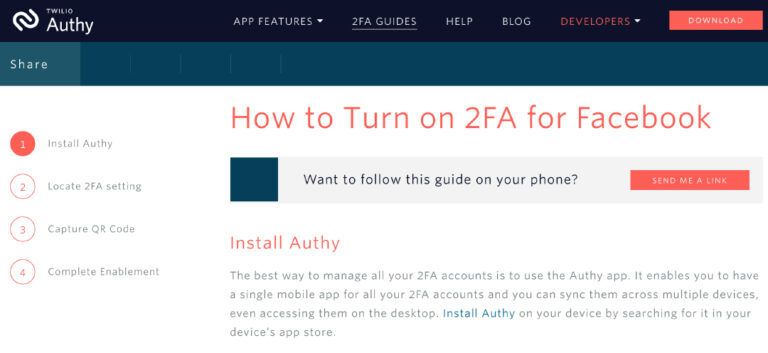
Two-factor authentication is a security feature that helps strengthen the security of your account in addition to your password. If you set up two-factor authentication, you’ll be asked to enter a special login code or confirm your login attempt each time someone tries accessing your account from an unrecognized browser or mobile device. Here’s how:
Scroll down to Use two-factor authentication and click Edit.
Choose the security method you want to add and follow the on-screen instructions.
When you set up two-factor authentication on Facebook, you’ll be asked to choose one of two security methods:
You’ll need to have at least one of these set up to use two-factor authentication. Once you have added either text message (SMS) codes or a third party authentication app on your account, you’ll also be able to set up some of the optional methods below:
Approving your login attempt from a device we recognize
Too much to handle? Worry no more! There is an app called Authy which can help you with authentication!
Most importantly,
3. Log out sessions
Log out your sessions now and then to remove traces of location. It is also important to use a VPN for secured browsing.
4. Change passwords regularly
It is advisable to change passwords every three months
5. Avoid connecting third-party apps or sites to Facebook accounts
Allowing third-party apps to access information through Facebook is as harmful as giving hackers your password.
6. Review Facebook security and privacy settings tools.
Always get control over what people can see on your Facebook profile these with these:
Make your activities and posts limited to friends. Review settings and ensure that your posts are only seen by friends unless intended to be a public post.
Review posts that you are tagged in. Review and filter posts that people tag you.
If all else fails, leave Facebook. Facebook with million users remains one of the largest hoarders of personal data.
MANILA – Human rights lawyers denounced what they described as special privileges accorded to retired Major Gen. Jovito Palparan Jr. inside prison.
In 2018, Palparan was declared guilty of kidnapping University of the Philippines students Karen Empeño and Sherlyn Cadapan. He is the highest military official to be convicted for gross human rights violations. He has been labeled “The Butcher” for many cases of extrajudicial killings perpetrated under his command.
On May 6, Judge Francisco P. Felizmenio, presiding judge of the Regional Trial Court Branch 19 in Malolos, Bulacan denied the motion filed by NUPL seeking the transfer of Palparan to a regular cell at the maximum security facility as well as the termination of all special privileges and treatment he has been accorded.
NUPL President Edre Olalia said the decision is “one injustice over another.”
“With these kinds of special or extraordinary treatment being tolerated or glossed over, even if unwittingly, for the once powerful who have fallen but remain favored, does it not become even tougher for ordinary people to fortify their confidence in our justice and penal system especially at this time that they are being taunted with a parade of impunity and double standard? Lady justice may be blindfolded but should never be blind,” Olalia said in a statement sent to the media.
NUPL said Palparan has been overstaying at the Directorate for Reception and Diagnostics (DRD) where inmates undergo evaluation for not more than 60 days. At the DRD, the group said that Palparan “has been acting as ‘governor’ or ‘mayor de mayores’ to about 1,500 persons deprived of liberty (PDLs).” He is also given “unbridled access to the computer and the internet and many other privileges” which the ordinary inmates don’t enjoy.
Judge Felizmenio said the NUPL petition lacks merit. He added that his court has no jurisdiction over the order of commitment issued by Branch 15 especially that the cases against Palaparan have been elevated to the Court of Appeals.
Branch 19 is presently hearing another case of kidnapping and serious illegal detention filed by victim Raymond Manalo against Palparan. Manalo was the primary eyewitness who testified against
Palaparan in Branch 15 where the latter was convicted.
The order also stated that there was no proof of special treatment of Palparan.
Last year, however, Palparan was interviewed by Overseas Workers Welfare Administration (OWAA) Deputy Administrator Mocha Uson which was aired in her social media platform. Rights groups questioned Uson’s interview with Palparan as a court order is needed to conduct such interview.
Officials from the NBP denied that special privileges were given to Palparan but they also said that “the threat on Palparan’s life can be aggravated if he is mixed with other inmates.”
Twenty lawmakers reportedly withdrew their “yes” votes on the Anti-Terrorism Bill. This is a big and unprecedented number. There is a visible and growing clamor to junk the Anti-Terrorism Bill, and yet the rubber stamp Congress has now sneakily transmitted the bill to Malacañang yesterday, June 9, serving it on a bloody silver platter, just awaiting the president’s signature.
As the world grapples with the continuously unfolding crises in public health, economy, and food security, fishing communities face exacerbated hunger, job insecurity, and uncertainty of survival.
MANILA — Most fishing communities depend on a slew of traditional and modern forecasts to see a storm coming. At the best times, this gives them ample time to secure their boats and houses, get loans to stock up food, and brace themselves for at most a week of skipped meals. And it is not resilience that enables this, it’s survival.
But the COVID 19 pandemic hit their shores with sudden and life-altering impacts from both the pandemic and the lockdowns at its heel, exacerbating their already dire circumstances.
In Andra Pradesh, trawlers were still at sea when the lockdown was announced, docking in an almost empty port – no buyers waiting at the shore, fishmeal processing plants closed.
Today, many fish ports have either scaled down or closed as month-long lockdowns remain in place. In Java, where four-fifths of COVID 19 cases in Indonesia were found, fishers fear of choosing between feeding their families or risking exposure because of poorly equipped harbors. In Tamil Nadu and Kerala, fishing ports have shut down altogether – incurring an estimated monthly loss of US$896 million for the fishing industry. In West Africa and East Asia, fishing activities dropped between 60 to 80 percent.
As the world grapples with the continuously unfolding crises in public health, economy, and food security, fishing communities face exacerbated hunger, job insecurity, and uncertainty of survival.
Trade and tourism collapse
Abrupt supply chain failures and closure of restaurants have also resulted in massive unemployment and insecurity for those working in aquaculture and commercial fishing. Prices for lobster, crab, halibut, and other high value catches dropped so low in the past months that operators would rather stay on the shore than fish at a loss. Aquaculture in the Global South, on the other hand, is highly dependent on both global demand and fish meal imports. In both cases, fish workers and daily earners along the supply chain bear of the brunt of massive unemployment and job insecurity.
Besides, the sharp freeze in tourism revenues has particularly hit coastal economies and many small island developing nations (SIDS). The dangled incentives of the ‘blue economy’ paradigm and declining valuation of small-scale fishing industries have forced many villages to rely increasingly on tourists for income. But with most flights grounded, both community revenues and conservation efforts are in peril.
Around the world, policies of ‘social distancing’ effectively decommissioned hundreds of thousands of small boats used by small-scale fisherfolk. Globally, there are approximately 108 million people directly employed in small-scale fisheries including post-harvest processing and marketing. In Namibia, artisanal fishers were ordered to halt fishing operations altogether as they were not deemed essential to national food security.
Women make up half of the small-scale fishers, up to 70 percent in aquaculture, and at least 80 percent in post-harvest processing and selling. Those in fishmeal plants mostly work in cramped up spaces which may become a “hotspot” for COVID 19 spread. At least 81 percent of artisanal fishers’ catch goes to local consumption so bans in motorcycles and logistics chokepoints mean most women cannot sell the harvests like before.
Pre-existing vulnerabilities
In many fishing villages, fish workers and their families live precariously on daily loans and wages. In a recent study, researchers found that some fish workers in large commercial fishing vessels work in slave-like conditions. Mostly migrants from Indonesia, Cambodia, and Malaysia, some fish workers in the Pacific routinely experience overwork, withholding of wages, debt bondage, and physical and sexual violence. Globally, some 21 million people are trapped in the vicious cycle of transnational slave labor in both legal and illegal fishing boats.
In extreme cases, fish workers are held onboard their ill-equipped ships for weeks before docking, leaving their families to starve. In India, migrants fish workers are stranded inside their boats without adequate food and water. Until last month, tens of thousands are still stranded from several states including Gujarat, Tamil Nadu, Kerala, Karnataka, Maharashtra, and Goa. As the huge majority of them work in monthly contracts, employers are under no obligation to keep them in payrolls when fishing operations cease.
Similarly, small-scale fishers live off their daily catch with little to no access to social services and without safety nets. In a third of countries with a significant fisheries sector, average incomes of artisanal fishers fall below the poverty line. While they contribute up to a third of fish consumed by humans directly, they remain the most poor and vulnerable in developing countries.
Old and new threats resurface
Seafood is a multi-billion-dollar global industry but is riddled with systemic inequalities and exploitation. A recent landmark study found that higher-income countries are responsible for 97 percent of total fishing effort in both the high seas and the global exclusive economic zones (EEZs). To boot, China, Taiwan, and South Korea alone constitute two-thirds of fishing efforts in poor nation’s EEZs in 2017. This is especially devastating for poor fishing villages in West African countries like Equatorial Guinea, Guinea Bissau, Sierra Leone, and Senegal where overfishing takes a toll on poor coastal communities.
In Guinea alone, where 75 percent of people rely on fisheries for protein intake, some 80 percent of industrial fishing effort in the EEZ are being done by Chinese flag-bearing vessels. Earlier studies found that some foreign vessels used the 2018 Ebola scare to encroach in their waters, and fishers are afraid that it’s happening again. Similarly, highly subsidized vessels from European countries like Spain cause overfishing and overexploitation of fish stocks in the region. Massive government contracts and fishing licenses handed over to foreign vessels often displace domestic fishers and put an untethered strain on marine resources.
Decades of neoliberal policies in ocean management, corruption, and historical neglect to small fishers’ rights have entrenched the wide inequity in exploiting this common good.
While many fishing villages remain in lockdown, some governments are renegotiating licenses to foreign vessels and oil exploration companies, pursuing development aggression that displace fishers, and reneging to encroachment from foreign countries. In every aspect, poor fishers and fish workers lose out. Although inequality is a multifaceted phenomenon, it only has one face for the poorest of the poor: hunger. And this is especially true today amid the impacts of the pandemic.
Shifting winds?
The ‘blue growth’ paradigm has failed to protect vulnerable fishing communities and poor nations’ food security but instead concentrated the ocean’s resources to a handful of nations.
Fisheries constitute more than half of protein consumption in non-landlocked countries, and up to 80% in small island developing states and poor countries – playing a huge role in food security. However, recent studies found that fishmeal for wealthier nations’ aquaculture is depriving the poorest communities of nutrient-rich wild fish. Furthermore, the falling catch of artisanal fishers could plunge 850 million more to malnutrition globally.
In India where the fisheries sector contributes approximately one percent of the gross domestic product and employs over 14 million people, massive unemployment in the sector is a double whammy for food security. It’s estimated that half the workforce in the country lost their jobs, mostly informal workers including artisanal fishers and fish workers. More than 85 percent of West Africans forced to stay at home are now either skipping meals or eating less because of the lockdown.
As the globe celebrates World Oceans Day, it’s important to note how this abundant resource is at the center of huge inequalities and exploitation. As with many things, COVID 19 is exposing the unjust and unsustainable systems in place which puts the burden to the poorest communities in times of crisis.
Amid the pandemic, States in the Global South must act swiftly to protect and support small-scale fishers, harvesters, and fish workers through cash aid and production support. Social safety nets must be put in place to shield the blue frontliners against the impacts of the COVID 19 prevention policies.
To fully address the structural inequality in fisheries and safeguard domestic food security, however, radical reforms should be at the top priority. Ownership and control of EEZs must be put back to the hands of domestic fishers, especially small-scale fishers. Just, equitable, and sustainable fisheries must be developed with and for the most vulnerable fishing communities. Similarly, States must guarantee protection for fish workers in commercial fishing vessels against precarious employment and risky working conditions.
Fishers are at the frontlines of ensuring nations’ food security the ocean’s health, and it’s high time the protection of their rights set sail.
*The author is currently a policy advocacy writer for Peoples Coalition on Food Sovereignty. He has been a land and food rights activist for 15 years and has worked with grassroots organizations in the Philippines and elsewhere.
I cannot find the appropriate words to describe how our government is handling the crisis. It is a health issue to begin with. However, the response of the government, noted by its militaristic fashion, appears to be tangential and seemingly unresponsive to the situation.
I thought I was okay until the unlawful arrest of student protesters in Cebu brought back the pain and trauma that was just lying low while on lockdown. Suddenly, I was racked with a deep cry that struggled to surface out as I tried to calm my shaken nerves.