Home Blog Page 222

Independent artists join protest against Anti-Terror Bill

Former IV of Spades frontman Unique Salonga with Poet/song-writer Toni Panagu and Rian Simon Magtaan, writer/film-maker (Photo by Rein Tarinay / Bulatlat)
Lions and Acrobats’ vocalist Icoy Rapadas and She’s Only Sixteen’s vocalist Roberto Seña (Photo by Rein Tarinay / Bulatlat)

By REIN TARINAY
Bulatlat.com

MANILA – Independent artists were among those who took the streets on Thursday, June 3, 2020, to protest the looming passing of the Anti-Terror bill.

“We can be arrested on mere suspicion. That’s the most tragic in that bill. Regardless if you trust the government and its state forces or not, you cannot give them absolute authority on that. You do not want to give them the opportunity to abuse power. It is important that laws have checks and balances,” said Lions and Acrobats’ vocalist Icoy Rapadas in an interview with Bulatlat.

The anti-terror bill has drew flak from artists, who used their respective online platforms to call out the Duterte administration.

Read: More celebrities call for junking of terror bill

As of this writing, the bill is up for President Duterte’s signature.

Rapadas said, “What use is our democracy if we will not speak out? We all have to make our voices heard.” (https://www.bulatlat.com)

The post Independent artists join protest against Anti-Terror Bill appeared first on Bulatlat.

COVID-19: How prepared are we now?

0

After two and a half months of
lockdown, the public healthcare system remains unequipped with the necessary
weapons to fight COVID-19. The Philippine government imposed a total lockdown
dubbed as the “enhanced community quarantine” or ECQ last March 16 after there
was a confirmed local transmission of COVID-19. The announcement was totally
unprecedented and ill-planned. It caused a lot of confusion among Filipino
citizens and even among implementing agencies and local government units.

The basis for this lockdown was to
stall the spread of the coronavirus while preparing the needed facilities to
fight the disease. Ideally it should be the government’s opportunity to equip
the health system with enough facilities and health workers to brace for the
second wave of COVID cases. But has the lockdown been truly beneficial in
preparing the public health system for the worst of the pandemic that is yet to
come?

Under-capacitated

According to a Philippine
Institute for Development Studies (PIDS) discussion paper
released last
April, the country will need a total of 182,000 hospital beds during the peak
month in the best case scenario. But as per a recent Department
of Health (DOH) situationer
, the overall bed capacity of the public health system
is only 13,565 which only covers about 7% of the total hospital beds needed.
Currently, there are only 2,005 mechanical ventilators available, very far from
the estimated 30,000 ventilators that the country will need during the peak of
the disease.

When it comes to the health
workforce needed, the country will require a total of 88,000 doctors and
118,000 nurses for COVID patients. There are just 52,000 doctors and 351,000
nurses available for all diseases and care, and we cannot of course assume that
they should be dedicated to only attend to COVID patients. Again, these
estimates are just for the best-case scenario which will only happen if 70% of
total symptomatic cases will be isolated. This seems unattainable with the
current status or practical non-existence of mass testing and contact tracing.

Unfortunately, the government has failed
to maximize its imposed lockdown to fill the existing gaps.

Mass
arrests instead of mass testing

Instead of acquiring the necessary
equipment and building additional facilities, the government has focused more
on restricting people’s mobility and using military forces in enforcing the
quarantine. The government has not only been slow – it has also made poor
decisions.

Instead of prioritizing mass
testing to identify and isolate affected individuals and infusing funds for
this, government chose to fully restrict economic activity, which has disrupted
people’s livelihoods and incomes.

There was even a time when there
were more individuals apprehended and arrested than tested for COVID. According
to the Coalition for People’s Right to Health, as of May 3 there were a total
of 158,353 quarantine violators, with 42,138 arrests made. Meanwhile, there were
only 106,520 unique individuals and 120,736 tests conducted overall.

Plans for checkpoints are more precise
than plans for mass testing. There are more checkpoints than testing centers.
As of May 29, there were 4,398 quarantine checkpoints
and 115 dedicated checkpoints and the police are still planning to add more. As
of May 31, there were only 38 licensed reverse transcription-polymeraise chain
reaction (RT-PCR) laboratories and 11 licensed GeneExpert laboratories, while
130 laboratory applications are still waiting for approval.

Now as
economic activity is slowly opening after a long period of lockdown, citizens’
call for free mass testing has become even louder. But instead of addressing
this, the government has only played with semantics – clarifying that it would only
conduct “expanded targeted testing” instead of mass testing because it does not
have enough capacity for testing the WHOLE Philippine population. This has sparked
further outrage among the Filipino people hence the louder call for free mass
testing and government accountability.

While government is busy with its vocabulary
enrichment games, the Makabayan bloc in the House of Representatives (HOR) filed
on May 28 House Bill 6848, the “Free Mass Testing Act of 2020”. But the
super-majority Duterte-allied HOR has prioritized the approval of the
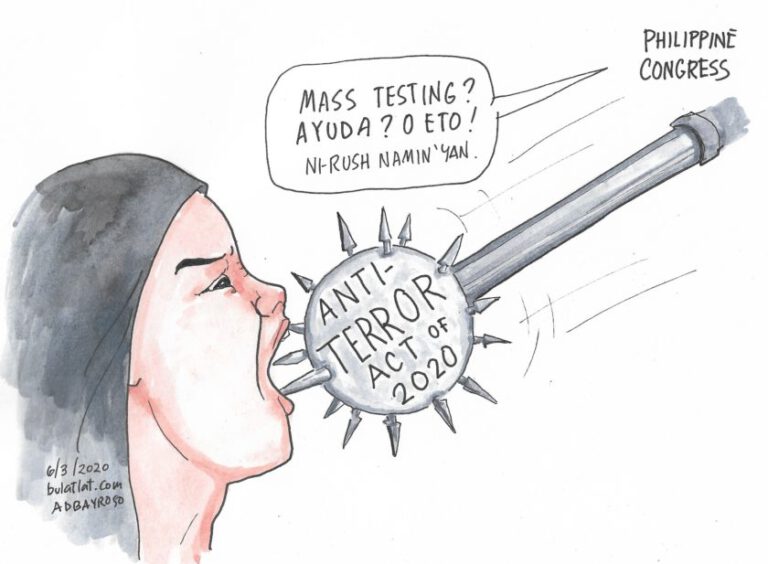
Anti-Terrorism Bill instead of more COVID-urgent legislative proposals. Apparently,
the Duterte government is more concerned now with its critics than the
pandemic.

Forgetting
the frontliners

The government has prioritized arming
the military and weaponizing laws to target activists and critics who have
grown disgusted with the lack of government response to COVID. And it has
practically neglected the medical frontliners.

Protecting health workers and
non-medical frontliners is another area of failure. Massive shortages in personal
protective equipment, mask, and other equipment and facilities at the beginning
of the outbreak resulted in a huge number of our frontliners being infected by
the disease. But now that there are allegedly enough protective covers, the
slow bureaucratic process of distribution (plus a hint of corruption) is unjustly
affecting our frontline medical workers.

As per latest DOH report, there
are 2,606 health workers infected by the disease with 1,172 active cases and a
total of 32 casualties. Recent reports even have it that some health workers
have not received any of the mandated aid to them, and relatives of health
workers who died of COVID have not received the death benefits.

A mere ‘thank you’ will not help
our frontliners. The government should do aggressive mass testing – this is also
for the sake of our frontliners. Our health workers should be the last ones
standing, but what is happening now is without protection they are the ones
being sacrificed in the fight.

Ready
or not?

The government declaration of
lockdown was premature – it lacked a clear plan on how it really intended to
contain the spread of coronavirus. It also lacked foresight on how to address
the socioeconomic impact of such lockdown on the people. Now, businesses all
over the country are pressuring the government to lift the ECQ since the two
months of lockdown have entailed huge profit losses.

But more importantly, the poor cannot
afford the lockdown anymore. The people should not choose between dying from
hunger and dying from the virus – the government must give everything for the
people to live. But the government has not even given enough support. The poor are
going hungry, they have already endured too much, and their rumbling stomachs
are becoming hard to ignore. It is a rumbling social unrest.

On the other hand, the health system was already weak before COVID, but the pandemic only bared how bad the system is. And now that there is urgency to improve it, the government still sticks to its sick policy of relying on the private health system and defaulting on state responsibility. Government action has not only been slow and meager, but the bureaucracy has not prioritized what the people need. And now that the majority of the Filipino working class are getting back to work, government has no clear plan and support on how the workers and low-income earners shall be protected from COVID.

The activists are right after all – we need mass testing, and more so now that economic activity has resumed. It is government responsibility to isolate and treat infected individuals and let the rest of the healthy people be productive. Government should remove the undue stress and anxiety that this disease is giving to the population, let them work with peace of mind that they are fully protected from this disease and from the harsh socioeconomic impact of the lockdown.

Debunking government’s defense of the anti-terror bill

Authors of the anti-terror bill have been trying to defend the proposed measure amid wide condemnation from various groups and individuals.

A senator quipped, “Terrorists or their supporters are the only ones who will be afraid of the bill.”

Do we have the reason to believe the senator accused of plagiarism and apparently oblivious to facts?

In 2018, the Department of Justice filed a petition seeking to declare as terrorists over 600 alleged members of the Communist Party of the Philippines (CPP) and New People’s Army. The list included four former and present United Nations officials, four Catholic priests, a former party-list lawmaker, 36 peace consultants, 17 detained political prisoners, 83 women activists, nine dead, two victims of enforced disappearance, one journalist, and dozens of aliases.

Due to local protests and international pressure, the DOJ later reduced the list to eight.

Under the anti-terror bill, the DOJ, with the authority of the Anti-Terror Council and upon the recommendation of National Intelligence Coordinating Agency (NICA), may file an application to designate any group as terrorist. The Court of Appeals only needs to establish probable cause before issuing preliminary order of proscription within 72 hours from the filing of the said application. This means that an individual or group may initially be declared terrorist without being afforded due process. Human rights lawyers pointed out that probable cause is a relatively low standard of proof considering the grave implications of such a judicial order.

Worse, the summary hearing accorded to the respondent group may be held as far back as six months later. In a span of six months, the suspected terrorist may be subjected to surveillance, arrested and detained, and his or her assets frozen.

Who have been declared “communist-terrorists” by state security forces and the National Task Force to End the Local Communist Armed Conflict? Practically all sectoral organizations advocating for reforms and genuine change. They did not spread terror or cause panic among the public but called on the government to act on legitimate demands of ordinary citizens.

The massive arrests of so-called “quarantine violators” gave us a picture of what might be interpreted as terrorist act. The social media posts of public school teacher Ronnel Mas and of Cebu-based artist Maria Victoria Beltran, for example, may qualify as “terrorist.”

This brings us to the statement of Presidential Spokesperson Harry Roque that critics are “over-interpreting.” Roque said that the Bill of Rights will remain protected by the Constitution.

Again, the last time we checked, free press and free expression are among the rights guaranteed by the Constitution. Still, netizens who posted their criticisms via social media were harassed, intimidated and slapped with ridiculous charges. Just recently, six jeepney drivers were arrested for simply wanting to resume operations so they could feed their families. Yesterday, students and activists who voiced out their opposition to the bill were hounded by heavily armed police forces inside UP Cebu. Seven of them were arrested and detained.

Sen. Panfilo Lacson, main author of Senate Bill No. 1083, or the Anti-Terrorism Act of 2020, claimed that there’s enough safeguards in the law so no one could misuse it.

Lacson said that they’re “duty-bound” to make laws that would meet “international standards” and “fulfill state obligations with the United Nations.”

In the recent report on the Philippines, the UN High Commissioner for Human Rights described as “worrying” the proposed measure.

“The proposed 2020 Anti-Terrorism Act, slated to replace the already problematic Human Security Act, dilutes human rights safeguards, broadens the definition of terrorism and expands the period of detention without warrant from three to 14 days, extendable by another 10 days. The vague definitions in the Anti-Terrorism Act may violate the principle of legality,” the UN report read.

Contrary to Lacson’s claims, the bill deletes in entirety the strongest deterrent for abuses stated in the Human Security Act of 2007. Section 50 of the HSA states, “A person acquitted of charges of terrorism is entitled to damages in the amount of P500,000 for every day of detention without a warrant.”

Two indigenous peoples and one farmer were proven to be wrongfully charged with violation of the HSA, according to the monitoring of human rights alliance Karapatan. Aeta peasant Edgar Candule was detained for more than two years before the court dismissed the charges against him in October 2010. Lumad leader Jomorito Goaynon and peasant organizer Ireneo Udarbe, meanwhile, were arrested on January 28, 2019 and charged with violations of the HSA, among other fabricated cases. The charges were dismissed in August of the same year but Goaynon, remains in detention for trumped-up charges of kidnapping, robbery and arson.

No. We are not “epal” (attention-seeker) and “misinformed” for calling for the junking of the bill that would authorize state-sponsored terrorism.

In the context of growing discontent over how the Duterte administration handles the COVID-19 crisis, it is clear that the tyrant in Malacañang and his minions are afraid of the people’s rage.(https://www.bulatlat.com)

The post Debunking government’s defense of the anti-terror bill appeared first on Bulatlat.

On the Philippine government’s rejection to implement UN OHCHR recommendations

0

The UN Office of the High Commissioner for Human Rights received a staggering 893 written submissions and 793 individually signed template-based letters. It had discussions with government representatives. It has validated the data received from numerous sources. It interviewed victims and witnesses. It has formed its conclusions and recommendations based on its independent and impartial process — and it has concluded that the human rights situation in the Philippines is rapidly deteriorating.

read more

Quarantine Curbs Access to Information

Journalists around the country say both national and local government agencies have either delayed or denied their information requests. Officials, they said, were particularly reluctant to release information that would hold them accountable for their spending.

The post Quarantine Curbs Access to Information appeared first on Kodao Productions.

What the Anti-Terror Bill means to ordinary citizens

Farmers, indigenous peoples and teachers have been tagged as terrorists and subjected to various forms of attack since Duterte assumed office. The Anti-Terror Bill, if enacted into law, would only escalate what they describe as “state terror” and would target ordinary citizens for merely exercising their constitutional rights.

By MENCHANI TILENDO
Bulatlat.com

MANILA — The Philippines is on its way to having a law that rights defenders say would infringe on civil and political rights. The draft Anti-Terrorism Act of 2020 was just railroaded both in Congress and Senate and President Rodrigo Duterte is expected to sign this bill into a law despite the more urgent solutions needed to address the COVID-19 pandemic.

Critics pointed out that the vague and overboard definition of ‘terrorism’ in this bill poses great threats not just to human rights defenders and activists, but also to ordinary citizens who could be merely exercising their constitutional rights. Under the bill, any individual or group could be held guilty of ‘terrorism’ and be faced with lifetime imprisonment if they are “engaging in acts intended to death or serious bodily injury to any person” in order to “create an atmosphere and spread a message of fear.”

Although the bill exempts advocacy, work stoppages, and humanitarian action from the definition of ‘terrorism’, the Anti-Terrorism Council’s interpretation of what constitutes terrorist act undermines these safeguards.

In a report by the United Nations Human Rights office on Thursday, long-standing concerns about state-backed and vigilante violence are said to have worsened in the Philippines under the Duterte administration. Since this government has institutionalized the “drug war” and crackdown against rights defenders, it has drawn wide domestic and international condemnation.

Terrorizing dissenters

Even at a time of a dreadful pandemic, government authorities, including military and police forces, have continued to exercise ‘abuse of power’ over ordinary citizens, humanitarian groups, and critics labeled as ‘quarantine violators’. Thus, the railroading of the Anti-Terrorism Bill amid this crisis has sparked protests from various groups and sectors.

Antonio Flores, 72, was one of the thousands-strong protesters who marched along UP Diliman’s University Avenue Thursday to call for the junking of the Anti-Terrorism Bill. He is the current national chairman Unyon ng mga Manggagawa sa Agrikultura (UMA), and has been an active member of this organization since 1983.

“We decided to join the protest because the government claims that farmers like us could be one of those ‘terrorists’. In fact, we are actually food frontliners who are victims of Duterte’s anti-people policies,” Flores said.

According to UMA, 257 farmers and farm workers have been killed under the Duterte administration.

“We want to register that our rage is not only justified, it is also constitutional. We want to prove that we are fighting under a legal organization, and we are not terrorists,” Flores added.

If the bill finally becomes a law, Flores said that this would have grave implications on their decades-long struggle for genuine agrarian reform. They could be tagged as “land-grabbers” or considered as “inciting terror” for fighting for their rights.

Worsening state-sponsored attacks

Government officials and the president’s allies have been vocal on attempts to malign public outcry by claiming that those who are not ‘terrorists’ should not be afraid of the passage of the bill. This insensitive and oversimplified remark is the same old tune played by the masterminds of Oplan Tokhang, “If you’re not an addict, then you shouldn’t be afraid of the drug war.” The recent UN report pointed out that the so-called campaign against illegal drugs claimed thousands of innocent lives using the worn-out excuse that the victims allegedly fought back.

Like Flores, Lumad volunteer teacher Beverly Gofredo, 20, also fears that the already-existing military threats on their communities will intensify if the Anti-Terrorism Bill is enacted.

“Even before this bill was railroaded, Lumad communities have been consistent targets of military offensives, red-tagging, and intimidation,” Gofredo said.

She said that just last May 22, one of the largest Lumad schools in Mindanao, the Community Technical College of Southeastern Mindanao (CTCSM), received a closure order from the Department of Education.

Lumad schools have always been facing threats of closure not because of compliance issues but because the government has been accusing them of teaching and learning rebellion.

“If they could attack us like this even without the bill, then how much more when it finally becomes a law? All of our schools will be closed down and military groups could easily produce fake ‘NPA surrenderees’ among our ranks,” Gofredo added.

Even teachers and educators who merely exercise academic freedom are not spared from terrorist-tagging. Lakan Umali, 24, is a UP Mindanao Creative Writing professor who also showed solidarity in the #JunkTerrorBill protests.

“The government claims that we are using subversive materials for teaching, and this thinking is against the very principle of academic freedom. Once the Anti-Terrorism Bill is passed into law, the lessons that we teach will definitely be restricted. This is a manifestation of stronger state terror,” Umali said.

More reasons to dissent

Flores, Gofredo and Umali were among the thousand protesters who went out of their homes to register their opposition to the proposed measure.

Cristina Palabay, secretary general of human rights alliance Karapatan, said that the Thursday protest proves that the Filipino people “will not cower in fear in the face of rising dictatorship.”

“The strongest weapon we have [against tyranny] is our unity, our protest actions,” Palabay said.(https://www.bulatlat.com)

The post What the Anti-Terror Bill means to ordinary citizens appeared first on Bulatlat.
Freedom of speech on lockdown

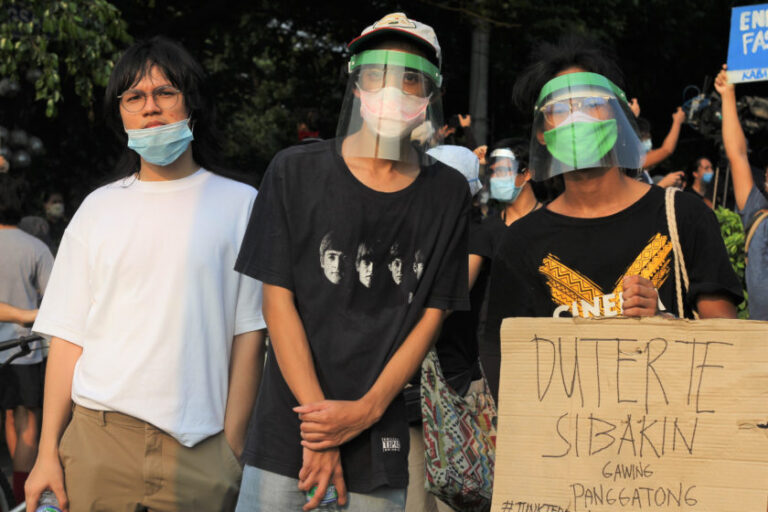
The nationwide lockdown has encroached on many of the people’s freedoms, and along with a strict stay at home order, freedom of speech was put on lockdown as well. From the lack of mass testing, to uneven implementation of laws, the failure to provide aid, and the president’s often erratic and rambling weekly reports, the […]

The post Freedom of speech on lockdown appeared first on Manila Today.

Natural for Lacson to defend Anti-Terrorism Bill as intelligence head during Martial Law – agri group

The Unyon ng mga Manggagawa sa Agrikultura (UMA) said that “it is natural for Senator Panfilo Lacson to fervently defend the Anti-Terrorism Bill (ATB) because of his record of being an officer of the dreaded and notorious Metrocom Intelligence and Security Group (MISG) during the whole period of the US Marcos dictatorship.” According to Antonio […]

The post Natural for Lacson to defend Anti-Terrorism Bill as intelligence head during Martial Law – agri group appeared first on Manila Today.