Home Blog Page 237

Mga Piling Kantang Makabayan ng Mundo

Makinig sa ispesyal na podcast ng mga piling makabayang kanta mula sa iba’t-ibang bahagi ng mundo. Alamin ang kanilang natatanging papel sa pakikibaka ng mamamayan para sa kalayaan at hustisyang panlipunan, kasama sina Prof. Jose Maria Sison, Raymund Villanueva at Kodao Productions.

The post Mga Piling Kantang Makabayan ng Mundo appeared first on Kodao Productions.

MIGRANTE hits resumption of mandatory Philhealth fee for ofws

Filipino migrant leaders hit Duterte’s mandatory Philhealth and premium rate hike due to resume next week. Raised calls for amendments through Makabayan bloc’s House Bill 6698

Five days to go before the full-scale implementation of President Duterte’s mandatory Philhealth membership and premium rate hike under his Universal Healthcare Law, leaders and representatives from different Filipino migrant communities overseas faced the media on Wednesday morning, 27 May, in an online press conference to voice out strong opposition against the imposition of this new state exaction amidst the damaging impacts of the COVID-19 crisis and pandemic. 

Migrante International Chairperson Joanna Concepcion attributed the temporary suspension of the aforestated law’s implementation to the collective actions and resounding protests organized by OFWs. “Our fight is not yet over for what we really demand is the complete abrogation and junking of the unjust mandatory Philhealth requirement and annual premium rate increase,” Concepcion asserted. The OFW advocacy group believes that the temporary suspension was only meant to tranquilize OFWs and avert their indignation. “We will not allow ourselves to be fooled.  The mandatory Philhealth and premium rate increase is rooted from the Universal Healthcare Law enacted in February 2019 which was hastily signed and approved by President Duterte himself,” Concepcion added. 

Marlon Lacsamana, the secretary general of Migrante Europe decried the state abandonment that befell OFWs in the continent. Lacsamana said, “embassies and consulates closed down so we no longer feel their presence that is why we migrants ourselves are helping each other to bring relief to our kababayans affected by the COVID-19 crisis. While there were some embassies and consulates that extended some help, it was not enough and it did not cover all Filipinos across Europe.” Lacsamana likewise  blasted the Duterte regime in its manner of distributing the $200 financial aid from DOLE. “We do not understand why they still have to deduct OWWA’s $25 exaction from the $200 cash assistance.”

According to Chat Dimaano of Migrante Korea, the 60 thousand documented OFWs in South Korea are already covered by the host country’s medical insurance which entitles them to free medical treatment. For Migrante Korea, this itself makes Duterte’s mandatory Philhealth useless and unnecessary. “With the exacerbation of the crisis in South Korea as many workers lose their jobs, this is already too burdensome for us that is why we support Makabayan bloc’s House Bill 6698. Our hard earned money should go directly to our families and not to government agencies like Philhealth which is riddled with corruption,” Dimaano pointed out. 

For Mikee Santos of Migrante Aotearoa (New Zealand), President Duterte’s new state exaction is out of touch with reality and an insult to OFWs. “Many migrant workers who have been residing here for more than two years are already covered by New Zealand’s healthcare system. This mandatory Philhealth and premium rate hike is another addition on top of all the other state exactions already being imposed on us by the Duterte government which did not even bother to check out the real pulse and sentiments of Filipino communities here in New Zealand. ”

Speaking from Washington DC, Jeremias David of Migrante USA said, “This is not beneficial for migrants because Philhealth is not recognized in US hospitals. The Philippine government is robbing us of our hard-earned money which we should be sending back to the Philippines to support our families.” Many Filipino migrants in the US are hit hard by the crisis.  David added, “we have so many J1 visa holders who lost their jobs after the closure of hotels and restaurants here in the US. We demand that the Duterte government extend assistance to Filipino J1 workers. They are really enraged due to the absence of any effort from the government to reach out to them.”

In Saudi Arabia, many OFWs are afflicted by ‘no-work, no-pay’ arrangements. Marlon Gatdula of Migrante KSA related that the costs of goods have gone up due to Saudi Arabia’s imposition of the value added tax and the removal of subsidies to basic commodities. Gatdula also recounted the ruckus that occurred due to the disorganized distribution of food stubs in POLO-Riyadh. “OFWs reject this new Philhealth exaction because employers here in KSA are already obligated under state policy to ensure healthcare for their workers,” Gatdula remarked.

Meanwhile, repatriated OFWs in the Philippines are languishing in quarantine facilities without substantial aid from Duterte’s government agencies. Laorence Castillo, the head coordinator of Migrante Philippines’ Rights and Welfare Assistance Program lamented, “their troubles and anxieties are aggravated by the harsh reality of returning home without any form of livelihood. The entire process from repatriation to swab testing, from their subjection to the prolonged period of quarantine while awaiting for the test results are likened to marching into Calvary. Besides the swab testing, they have not received amelioration from any of Philhealth’s programs.” Castillo likewise revealed that quarantined OFWs like pregnant women, mentally distressed and the elderly  did not receive their required medical attention. 

In addition to the impending 3% premium rate hike on Philhealth contributions, Migrante Philippines also expressed disgust over corruption issues plaguing the government agency. Philhealth is currently embroiled in the public uproar over overpriced test kits aside from the Php 154 Billion lost to overpayments and fraudulent claims. Castillo also scorned Philhealth for the alleged Php 16 million worth of questionable receipts issued by recruitment agencies. “The Duterte government is using the pandemic to rake in more profit from our troubled kababayans.”

Calling on all Filipinos to rise up and oppose President Duterte’s unjust Philhealth scheme, Dolores Balladares Pelaez of Migrante Hong Kong urged all Filipino migrants to unite and continue their protest against extortionate state exactions imposed by the government. “We are not merely asking for a suspension  but the complete scrapping of the mandatory Philhealth and premium rate increase. Right in the midst of the COVID-19 crisis, the Duterte regime abandoned us OFWs and our families as what we’ve seen with the gross ineptitude of the Duterte government in delivering services for stranded OFWs. They closed down many embassies and consulates around the world at a time when we badly needed their help. Instead of giving us relief and protection, the Duterte regime is assaulting us with additional state exactions. Let us unite together as Filipino migrants and reject Duterte’s dreadful policies,” Balladares-Pelaez concluded. 

Dr. Ephraim Orteza

More than two months after the country declared a public health emergency, the country continues to grapple with the COVID-19 pandemic. The highly contagious virus has infected and has claimed the lives of many health care workers, who continue to work in the frontlines against the disease. Dr. Ephraim Neal Orteza died on April 8, […]

The post Dr. Ephraim Orteza appeared first on Manila Today.

Anti-imperialist light bulb in dark times

Solidarity message delivered on behalf of BAYAN International Desk at the International League of Peoples’ Struggle (ILPS)- Philippines Anti-Imperialist Solidarity Program on May 27, 2020 as part of the ILPS Anti-Imperialist Week 2020.

At the height of the fascist Nazi terror, an exiled German playright and poet immersed in Marxist radical thought and practice came out with a collection of poetry entitled Svendborg Poems (1939). This collection opens with Bertolt Brecht’s most famous poem, “Motto”

In the dark times
Will there also be singing?
Yes, there will also be singing
About the dark times.

Brecht’s career was shaped by Nazism and the Cold War, of which he was a target of surveillance by the FBI as an exile in the U.S. Both Nazism and the Cold War are imperialist wars waged against the working and popular classes. These wars were a result of capitalism’s crisis to which imperialists can only respond with renewed and more atrocious techniques of colonial expansion—the continued bleeding of value from colonies and semi-colonies for imperialist centers; and the repression of dissent whether in “developed” or underdveloped nations.

On May 9, 1945, also known as Victory Day, the German-led fascist axis was defeated. Eighty percent of all German casualties were quashed by the Soviet Union’s Red Army. One of the greatest victories that saved humanity from the fascists was accomplished by the Red Army. No other class in history has demonstrated such monumental sacrifice and courage to fight for a proletarian vision. Yet seventy five years after, the Cold War rages on despite a hasty proclamation of its end on the so-called fall of Socialism in 1991.

Yet from 1991 onwards, what we have wintessed is none other than a hieghtened crisis of neoliberalism. Rolled out in the late 70s to solve another wave of capitalist crisis, neoliberalism is a class offensive by the global ruling elite against all working and popular calsses worldwide. It meant an intensified imperialist plunder for semi-colonies like the Philippines and austerity measures for the working people of the Global North.

Throughout this continuing crisis, imperialism dominated the world.

But what if there it weren’t up to imperialist domination? What if it were up to the organizing powers of the people, which is to say that political and social power were in the hands of the people? If what we have is not just democracy in its formal sense but democracy that speaks to social power of the working class, then we would have responded to Covid-19 in terms of producing what is necessary.

This organized action would prioritize health, which is not limited to containing the virus. Beyond infection control, our democratic organization would include the collective production and just distribution of healthy food by the people and for the people.

The drive for profits has fully merged the medical sectory and food production (1). The mystification of Covid-19 as an “invisible enemy” is one of imperialism’s tools in waging a permanent war against the people in behalf of multinational agribusiness monopolies—from where pathogens and microbes evolve to infectious diseases,—and big pharma that controls epedemiological research and the production of drugs.

This is why mass testing, contact tracing and the production of PPEs for medical staff are measures of which the working poor, especially of the Global South, are scandalously and criminally deprived. These measures will certainly add to the science of pandemic, an outcome that is inimical to the accumulation of profit for which big pharma and multinational agribusiness monopolies operate. Multinational agribusiness monopolies and even lage-scale local agri-business ventures have not only caused irreparable damage to the soil, air, and water systems, they are built on farm lands once nurtured by indigneous peoples and local farmers. Agribusiness ventures have forcibly taken these lands away from the tillers or took advantage of governments’ manufactured poverty of the farming sector. (2)

Apart from infection control, our organized action would also expose and oppose the inaccessibility of the medical industrial complex to ordinary people. Its deepening financialization and monopolization has turned it into a killing machine that controls medical research and drug production. (3)

But those are not considerations for a government that is far from undergoing a process of revolutionary transformation. Government leaders cannot see pass daily urgencies, which now includes this pandemic; and long before this, each possible chance for flinging profits from taxes and unequal foreign business deals at themselves.

Without undergoing a revolutionary process, governments in neo-colonies like the Philippines cannot plan. This government will always have to wait for imperialist dictates through neoliberal structural adjustment of the economy and culture. This government has no sense of nation because to think of nation and national sovereignty is to be up against imperialism, which has been the source of political and economic power by rich and corrupt Filipino politicians.

Organizing and social planning spell the undoing of the current crop of politicians. This is why they will never solve Covid-19, they wouldn’t know how and they will not let go of this opportunity to impose a large-scale militaristic control over the people. So many of us concede that we do have a multitude of problems. None of it can be solved by our individual contributions, much less, by compromising our freedoms. So many of us also recognize that our problems are structural and can only be honestly posed and humbly recognized as a problem only by a government that chooses a revolutionary transformation of society, which is the opposite of what we have made up of rich people who can only find each crisis an opportunity to accumulate wealth.

No other revolutionary leader like Vladimir Lenin—who led the Bolsheviks in clinching victory for the first international proletarian revolution in 1917 and who in turn and in full revolutionary splendor defeated the Nazis in 1945— captures the dialectic of imperialist domination and revolutionary resistance as well as Brecht’s “singing about the dark times:”

“Imperialism is forcing the masses into this struggle by sharpening class antagonisms to an immense degree, by worsening the conditions of the masses both economically—trusts and high cost of living, and politically—growth of militarism, frequent wars, increase of reaction, strengthening and extension of national oppression and colonial plunder. Victorious socialism must achieve complete democracy and, consequently, not only bring about the complete equality of nations, but also give effect to the right of oppressed nations to self-determination, i.e., the right to free political secession.” (4)

A joyful anti-imperialist struggle to all comrades worldwide! (https://www.bulatlat.com)

References:

(1) Stan Cox provides a solid research on the capitalist drive for economic growth resulting in the forced intertwining of medicine and food production, a profitable merger that produces ecological destruction in his book Sick Planet:Corporate Food and Medicine. Pluto Press: Ann Arbor, MI, 2008.

(2) For a comprehensive analysis of the neoliberal food production and the adverse cosequences of the same on the ecological chain and the emergence of new viruses, read Rob Wallace’s. Big Farms Make Big Flu:Dispatches on Infectious Disease, Agribusiness, and the Nature of Science. New York: Monthly Review Press, 2016 and Habib Ayeb’s “Relaunching the System: Bees, Covid-19, Tunisia.” Review of African Political Economy, May 12, 2020 http://roape.net/2020/05/12/relaunching-the-system-bees-covid-19-and-tunisia/?fbclid=IwAR06bd-P4RJhLRg5ncs2dpRAEfZVepfPDCHCMf7bt93fhWn0uCenzytLShM

(3)For a robust discussion on the convergene of health care and imperialism, resulting in the privatization of health care and the widening of the gap between bodies in “developed” countries and labor force in the Global South, see Howard Watizkin ed., Health Care Under the Knife: Moving Beyond Capitalism for our Health. New Monthly Review Press: New York, 2018.

(4) In “The Socialist Revolution and the Right of Nations to Self-Determination.” Written in Janaury-February 1916. https://www.marxists.org/archive/lenin/works/1916/jan/x01.htm

Sarah Raymundo is a full-time faculty at the University of the Philippines-Diliman Center for International Studies. She is engaged in activist work in BAYAN (The New Patriotic Alliance), the International League of Peoples’ Struggles, and Chair of the Philippines-Bolivarian Venezuela Friendship Association. She is a member of the Editorial Board of the Journal for Labor and Society (LANDS) and Interface: Journal of/and for Social Movements.

The post Anti-imperialist light bulb in dark times appeared first on Bulatlat.

Undocumented Filipino migrants among the hardest hit amid pandemic

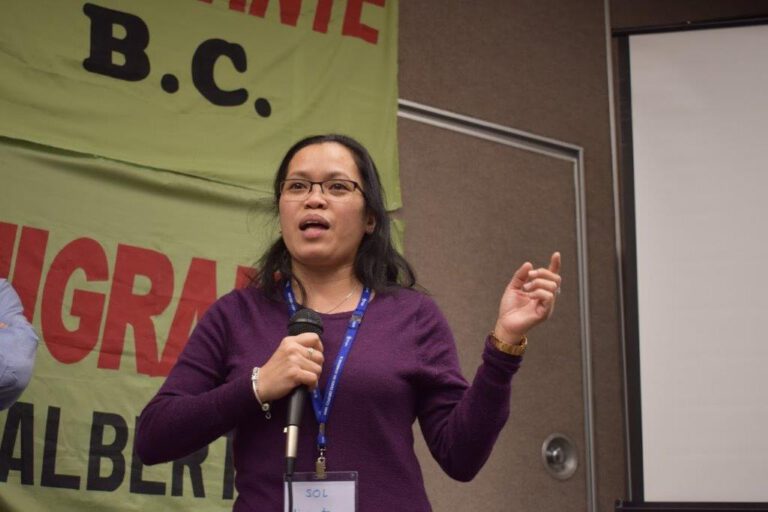
File photo of Maria Sol Pajadura during Migrante Canada’s fourth congress. (Photo courtesy of Migrante Canada)

By JANESS ANN J. ELLAO
Bulatlat.com

MANILA – Filipino migrant leaders in the United Kingdom, Canada, and US revealed that undocumented workers in those countries are the hardest hit with the lack of social protection amid the dreaded pandemic.

In the recent Bulatlatan episode “Far from home: OFWs caught in pandemic,” Phoebe Dimacali, chairperson of the London-based Filipino Domestic Workers Association, said that many undocumented Filipino workers who are working on a “no-work no-pay” basis have lost their jobs.

Dimacali, also a domestic helper based in London, said, “This COVID-19 has greatly affected us and our families.”

Listen on Spotify: Far from home: OFWs caught in pandemic

Garry Martinez, long-time OFW leader and pastoral care head of the All Saint Battersea Filipino Community, added that most of our countrymen are working in the service sector. “They immediately felt the brunt of this pandemic,” he said in the same Bulatlatan episode.

Access to health care

Apart from losing jobs, New York-based Melanie Dulfo of the National Alliance for Filipino Concerns (Nafcon) underscored the lack of access to health care of many undocumented OFWs.

Dulfo, who is a mid-level administrator at a community health center in New York, said in another Bulatlatan episode that health systems in many areas where there is a high concentration of immigrants were easily overwhelmed.

Immigrants, she said, has been bearing the burden of the poor COVID-19 response of the US government. She said that even before the pandemic, undocumented immigrants in the US have been skipping visits to doctors because they do not have health insurance.

Listen on Spotify: Is COVID-19 the ‘endgame’ for US-dictated privatized healthcare?

The US, she said, was forced to confront long-running problems in their fragmented health system due to the COVID-19 pandemic. Access to healthcare in the US, for the longest time, is determined by their health insurance.

Trafficking

Dulfo also said that the pandemic also highlighted the problem with labor trafficking in the United States. She cited that hundreds of Filipino workers with J-1 visas have been terminated from their work-study programs.

The International League of Peoples’ Struggle (ILPS)-USA branded the J-1 visa program as “legalized labor trafficking.” While J-1 is a temporary non-immigrant visa issued by the U.S. embassy for individuals who participate in “work and study exchange visitor programs”, most of the J-1 visa holders work in hotels with meager pay and without benefits.

For many Filipinos with J-1 visa, going home is not an option. Flights are limited and overpriced, not to mention that many of them have yet to repay up to $10,000 in placement fees.

Impact on families here in the Philippines

OFWs also worry about their families back home.

Dimacali said they have to send additional funds amid the pandemic, with the low exchange rates between British pounds and Philippine peso to continue supporting their families here in the Philippines.

Cielo Tillan, vice president and welfare officer of the FDWA, said she also has to send more remittances now, with their families not receiving any government aid. Their families, she said, were not included from the government aid as they have relatives working abroad.

In 2019, Philippines ranked fourth as the largest destination for remittances of overseas workers, per the World Bank.

Poor helping poor

Despite the difficulties they are facing, volunteer-members of the FDWA are providing relief assistance to fellow Filipinos who are in need in London. Faith-based groups, human rights groups, and migrant rights groups immediately set up a support system. They provide basic needs such as food, medicines, and toiletries.

While the FDWA does not have enough financial resources to support fellow Filipinos for their house rent and daily food, Tillan said they have been receiving support for the work they have been doing.

Nafcon, for its part, is also providing relief and other forms of assistance to Filipino J-1 visa holders in the United States.

Apart from providing aid, Tillan said they also educate fellow Filipino migrant workers of their rights in the United Kingdom. (https://www.bulatlat.com)

The post Undocumented Filipino migrants among the hardest hit amid pandemic appeared first on Bulatlat.

Ang 12 diablong katutubo, si Plasencia at ang demonisasyon ng mga Lumad

Isa sa kakaibang pagtingin ng mga mananakop ukol sa mga katutubo pagdating nila sa kapuluan ang patungkol sa kakaibang paniniwala ng mga ito. Dahil hindi tugma sa kanilang kinagisnang Katolisismo sa Europa, laging tinitingnan na higit na mababa, hindi sibilisado at likha ng diablo ang mga paniniwala ng mga katutubo.

Dahil nasa gitna ng diwa ng Reconquista ang pananakop ng mga Espanyol, naging bahagi ng kolonyal na pananakop ang pagpapalawak ng relihiyon. Kapalit nito, lahat ng mga paniniwalang hindi ayon sa Katolisismo ang itinuturing na paniniwala ng mga diablo na dapat supilin, sugpuin, at burahin upang mapalitan ng ‘tamang’ paniniwala.

Sa peninsula ng Iberia nagsimula ang Reconquista. Sa diwa nito, ninais ng mga monarko ng Espanya na bawiin at sakuping muli ang mga lupaing sa tingin nila ay inagaw ng mga hindi Katoliko sa kanilang lupain. Sa simula pa lamang ng pagpapakasal nina Fernando ng Aragon at Isabel ng Castilla upang mabuo ang Espanya bilang bayan, ninais nito na paalisin ang mga Moro sa timog ng peninsula ng Iberia na higit pitundaang taong nakasakop sa kanila, gaya ng mga bayan ng Granada, Cordoba, at iba pang bayan sa katimugan.

Ang mga Muslim at Hudyo na tradisyunal na kalaban ng mga Katoliko ang pinatutungkulan sa kampanyang Reconquista. Ninais ng mga Katolikong Monarko (ang popular na katawagan sa mga monarkong Espanyol dahil sa Reconquista), na maging purong Katoliko ang kanilang lupain. Kailangan nilang isulong ang kampanyang ito bilang bahagi ng Patronato Real na nagsasanib sa kapangyarihan ng simbahan at estado, at tumuturing na ang mga monarko ang mga pangunahing patron ng simbahan sa pagpapalawak ng katolisismo at paglaban sa ibang paniniwala.

Nagkaroon ng ekstensyon ito nang magpalawak ang mga Espanyol sa labas ng Iberia.Nang makarating sila sa Amerika, Afrika at Asya, naging bahagi ng pagpapalawak ng relihiyon ang kanilang pananakop. Ang pagkamasigasig sa pananakop ang gumabay sa pagpapalawak ng relihiyon, at ang pagpapalawak ng relihiyon ang nagpapanatili sa diwa ng pagkamasigasig sa pananakop sa ibang bayan.

Nang dumating ang mga Espanyol sa kapuluan, isa sa kanilang mga inobserbahan ang katutubong paniniwala ng mga lipunang kanilang sasakupin. Itinala nila ang mga katutubong paniniwalang ito upang maipakitang mga diablo ang gumagabay sa kanilang makalumang paniniwala na dapat mapalitan ng Katolisismo.

Isa sa mga naunang talang pang-etnograpikal ang ginawa ng Franciscanong si Juan de Plasencia. Ayon sa kanyang tala (ilang bahagi ang naisalin sa Ingles sa Blair at Robertson, The Philippine Islands, Vol. VII, 185-196. – akin ang pagsasalin FG), mabibigyan ng 12 halimbawa ang gawa at katangian ng mga diablo ng mga katutubo:

Ang mga sumusunod ang mga iba’t ibang mga pari ng diablo: Ang una, maaaring babae o lalaki ang tinatawag na catalonan. Marangal ang kanyang gawain sa mga katutubo, at kalimitang isinasakatuparan ito ng mga taong may mataas na kalagayan sa lipunan, isang kalakarang makikita sa nakararami sa kapuluan.

Ang ikalawa ang tinatawag na manggagauay, o mga bruha, na nagpapanggap na nakakapagpagaling sa mga maysakit. Maaaring magdulot ng sakit ang kanilang mga bisa, na maaari ding ikamatay. Sa ganitong paraan, maaari nilang patayin ang isang tao kung gugustuhin, o maaari nitong pahabain ang buhay ng isang tao sa isa pang taon sa pamamagitan ng pagsinturon sa baywang ng isang ahas, na pinaniniwalaang siyang diablo. Maraming makikitang ganito sa buong kapuluan.

Ang ikatlo ang manyisalat, na katulad din ng manggagauay. May kapangyarihan ang mga paring ito na gumamit ng pampahid sa mga magsing-ibig upang maghiwalay sila o hindi na magtalik. Kung naiwanan ang isang babae sanhi ng ipinahid, magkakasakit ito at duduguin. Makikita rin ang mga ito sa kapuluan.

Ang ikaapat ang mancocolam, na may kakahayang magbuga ng apoy sa gabi, kalimitan minsan bawat buwan. Hindi maaapula ang apoy na ito maliban ng paring naglublob sa putikan at duming nahuhulog sa mga bahay; at magkakasakit mamamatay ang sinumang nakatira sa naturang bahay. Maraming ganito sa kapuluan.

Ang ikalima ang hocloban, na isa na namang uri ng bruha, na may higit na kapangyarihan kaysa manggagauay. Kahit walang anumang ginagamit na gamot, sa pamamagitan lamang ng pagsaludo o pagtaas ng kamay ay maaari na silang makapatay ng sinumang naisin. Subalit kung nais nilang pagalingin ang mga nagkasakit sa kanilang mga anting-anting, maaari nila itong gamitin sa pamamagitan ng ibang agimat. Bukod dito, maaari pa nilang sunugin ang sinumang katutubo na nakaaway nila, nang walang anumang kagamitang gagamitin. Makikita ito sa Catanduanes, sa hilagang bahagi ng Luzon.

Ang ikaanim ang silagan, na maaaring kumuha at kumain ng atay ng sinumang makikitang nakaputi. Makikita rin ito sa Catanduanes. HIndi ito alamat, sapagkat sa Calauan, isang abugadong Espanyol ang nabiyak ang katawan mula puwet hanggang bituka, at inilibing sa Caliraya ni Fray Juan de Merida.

Ang ikapito ang magtatanggal, na naglayong magpakita sa sinuman sa gabi, nang walang ulo o lamanloob. Lumalakad ang diablong ito habang dala o nagpapanggap na dala ang kanyang ulo sa iba ibang lugar, at babalik pagkaumagahan sa kanyang katawan, mananatiling buhay gaya ng dati. Tingin ko ay isang alamat lamang ito bagaman sinasabi ng mga katutubo na totoo ang mga ito na maaaring dahil ipinapaniwala sila ng diablo. Naganap ito sa Catanduanes.

Ang ikawalo ang osuang, na katumbas ng ‘sorcerer’; sinasabing may nakakita na lumilipad ang mga ito, at pumapatay at kumakain ng laman ng tao. Makikita ang mga ito sa Visayas at hindi umiiral sa mga Tagalog.

Ikasiyam ang isang regular na uri ng bruha na tinatawag na manggagayoma. Gumagamit sila ng agimat na gawa sa salita, bato, at kahoy, para sa mga mangingibig upang mapasok ang puso nito ng pag ibig. Ginagawa nila ito upang lokohin ang mga tao, sa pamamagitan ng gawang diablo.

Ikasampu ang tinatawag na sonat, na maaaring katumbas ng tagapagpangaral o predicador. Tinutulungan niya ang mga tao upang mamatay, upang mabigyan niya ng hula ang kaligtasan o kahatulan ng kaluluwa. Kalimitang ginagawa ito ng nakataas sa lipunan, at makikita ito sa buong kapuluan.

Ikalabing isa ang pangatahojan, na nakapanghuhula ng hinaharap. Makikita ang mga ito sa buong kapuluan.

Ang ikalabingdalawa, ang bayoguin, na lalaking kilalang may-ari ng babae.

Dahil ipinakita ng mga mananakop na mga diablo ang mga ito, ipinakilala nila na makukuha ang katubusan ng mga katutubo kung sasamba sa paniniwalang dala ng mga dayuhan. Sa ganitong pamamaraan, kailangang talikuran ng mga katutubo ang mga dating paniniwala at sumamba sa mga Dios na dala ng mga mananakop.

Kakatwa na ilang lipunang Tagalog ang marami sa mga tinatalakay ni Plasencia sa kanyang tala, at hindi mga lipunang lumad na makikita natin sa Mindanao, o mga Mangyan ng Mindoro, at mga katutubo ng Cordillera na nanatili sa dating paniniwala. Hanggang ngayon, itinuring na pambansang minorya ang mga grupong nabanggit dahil ilan sa kanila ang nananatili sa mga paniniwala bago ang pagdating ng mga mananakop.

Ang mga Tagalog, pati na ang ilang mga grupong etnikong naging sakop ng mga Espanyol at ng Katolisismo, tulad ng mga Ilokano, Kapampangan, Bikol, Waray, Hiligaynon at Sugbuhanon – ang bumuo ng kolonyal na mayorya sa isasakatuparang kolonya ng mga Espanyol sa Filipinas. Ang mga lumad, Igorot, Mangyan at iba pang katutubong hindi nasakop ang bumuo ng mga minorya sa pananaw ng mga mananakop.

Subalit kung titingnan ang deskripsyon ni Plasencia noong ikalabing anim na dantaon ukol sa mga katutubong paniniwala ng mga Tagalog, mapapansing malaki ang pagkakahawig nito sa mga paniniwala ng mga Lumad, Igorot, at Mangyan hanggang sa kasalukuyan. Patunay lamang ito na sila ang mga lipunang hindi nalapatan ng Reconquista at Inkisisyon ng kolonyalismo na malaki ang pagkakatulad sa mga dating kalagayan ng mga nasakop.

Bukod dito, mahalaga ring tingnan na kahit kapuna-puna ang pagkiling ni Plasencia laban at mapanlait sa mga katutubo at pumapabor sa kolonyalismo, malinaw ang ilang obserbasyon niya ukol sa pagkakapantay ng mga lalaki at babae ng mga lipunang katutubo sa larangan ng paniniwala, pamamahala at kalagayang panlipunan. Ang diskriminasyon laban sa mga kababaihan, pati na laban sa mga binabae o panggitnang kasarian ang dinala ng kolonyalismo. Malinaw na higit na maluwag sa usaping pangkasarian ang mga lipunang katutubo kaysa sa mga kolonyal na lipunang nagdala ng mga halagahin ng mga Europeo.

Maraming bali-balita ngayon ukol sa pakikihamok ng mga lumad upang maging makatarungan ang pagturing sa kanila ng pamahalaang sentral na nakabatay sa Maynila. Ilang taon na silang naglalakbayan upang ipahayag ang hinaing na mabigyan sila ng pagkakataong makapamuhay nang maalwan nang may paggalang at pagkilala sa kanilang tradisyon at pamumuhay. Ilang ulit na rin silang tinugunan ng maraming nagdaang pamahalaan sa pamamagitan ng karahasan, pananakop, pagkuha ng kanilang lupa at minahan at pagpapaalis sa kanilang lupang ninuno. Pinapasara ang kanilang mga paaralan, ginagawang komersyal na plantasyon o minahan ang kanilang mga lupaing ninuno at inililikas sila sa mga lugar ng kanilang kapanganakan. Ilang lumad ang napilitang magbakwit sa takot at upang makaiwas sa pambobomba sa kanilang lupang ninuno. Ang masamang pagturing sa mga katutubo na tila mga diablo na dapat pagbantaang lipulin kung hindi susunod sa pamahalaan ang nagsasalamin na marami sa kasalukuyan ang makabagong tagapagmana ng Reconquista na hindi nakikitang higit na malaki ang pagkakatulad ng mga katutubo ng kapuluan sa mga sinaunang lipunan bago ito nasakop ng dayuhan. Ilang dantaon nang ipinakikita ng mga mananakop ang demonisasyon ng mga katutubo upang maipakitang lehitimo ang pananakop, pagsasamantala, at pagpapasunod sa mga ito. Ang mga tekstong gaya ng akda ni Plasencia, bagaman kapuna-puna ang tono ng panlalait at pag-aaglahi, ang magpapakita ng pagkakatulad ng mga katutubo mula sa iba’t ibang grupong etniko bago ang pananakop. Ang pagiging mayorya at minorya ng mga lipunan sa Pilipinas ang naging bunga ng kolonyal na pananakop at ng pag-aaglahi sa mga nanatiling malaya, hindi ang gawain ng mga itinuturing na diablo. (https://www.bulatlat.com)

*The author is a professor and former chair of the Department of History, Ateneo de Manila University; former commissioner of the National Historical Commission; convenor of Tanggol Kasaysayan; member of the Alliance of Concerned Teachers. He finished his AB History, MA in History and PhD in Philippine Studies at University of the Philippines Diliman.

The post Ang 12 diablong katutubo, si Plasencia at ang demonisasyon ng mga Lumad appeared first on Bulatlat.


Canada-based groups call for release of Filipino political prisoners amid COVID-19

“This chain of death is precisely the reason which we families of prisoners sought to avert with our petition to release vulnerable prisoners in order to save human life.”

By EMILY VITAL
Bulatlat.com

MANILA – Solidarity groups based in Canada urged President Rodrigo Duterte to release political prisoners amid the worsening outbreak of COVID-19 in the Philippines’ congested prisons.

In a letter addressed to Duterte, Canada-Philippines Solidarity for Human Rights (CPSHR) said, “Punitive measures will do nothing but worsen the crisis.”

The CPHSR urged the Duterte administration “to exert its efforts to formulate and implement comprehensive, people-centered, and rights-based public health responses to avert the pandemic not only nationwide, but also inside the prisons and detention centers.”

The Vancouver and District Labour Council, which has 100 affiliate unions, noted that many countries across the globe have released prisoners in their hundreds or even thousands. “History will judge the Philippine government poorly if it does not follow suit and do all that is within its power to limit the death and human suffering brought about by the pandemic.”

Other groups who expressed support for the campaign to release Filipino political prisoners include United Church of Canada, KAIROS: Canadian Ecumenical Justice Initiatives, the Canadian Union of Public Employees, International Coalition for Human Rights in the Philippines-Canada, Inter Pares, MiningWatch Canada, Development and Peace-Caritas Canada, Po?le E?tudes contemporaines et transdisciplinaires sur l’Asie du Sud-Est – Univ. De Montre?al, Public Service Alliance of Canada, and Gabriela chapter in British Columbia.

Since the pandemic hit the country, the said organizations have stepped up efforts to also lobby the Canadian government as well as the Canadian embassy in the Philippines “to protect the human rights of prisoners throughout the pandemic and to advocate for the release of the most vulnerable non-violent and political prisoners.”

Based on Karapatan data, there are 619 political prisoners as of April 2020, of whom 55 are elderly aged 60 and above, and 97 suffer from illnesses that put them at greater risk from the new coronavirus disease.

Kapatid, an organization of families of political prisoners, welcomed the outpour of support.

Fides Lim, Kapatid spokesperson, lamented that the Supreme Court has yet to act on their urgent petition to release the elderly and sick prisoners on humanitarian grounds.

“As more groups support this call, we ask for speedier action as the deadly disease of COVID-19 spreads rapidly in overcrowded jails where physical distancing and isolation are impossible,” Lim said.

SC urged to release sick, elderly political prisoners amid COVID-19

Kapatid expressed alarm over the reported deaths inside prisons – 60 in March and another 60 in April in the New Bilibid Prison. One political prisoner, Adelaida Macusang, 61, was declared dead on arrival when she was brought to a Tagum hospital from the Compostela Valley Provincial Rehabilitation Center on May 4.

“This chain of death is precisely the reason which we families of prisoners sought to avert with our petition to release vulnerable prisoners in order to save human life,” Lim said.

Kapatid said that out of the nearly 10,000 prisoners ordered released, not one political prisoner has so far been freed.

“We thus hope that the Supreme Court, in the spirit of justice, compassion and humanity, will address this and act now on our petition. NO ONE deserves to die from a virus without even a fighting chance to survive,” Lim said.(https://www.bulatlat.com)

The post Canada-based groups call for release of Filipino political prisoners amid COVID-19 appeared first on Bulatlat.

SPMC increases testing capacity as city tracks COVID-19 in barangays

0

The Southern Philippines Medical Center announced on Monday an increase of their testing capacity for COVID-19 cases with the addition of two Real-Time Polymerase Chain Reaction (RT-PCR) machines and one automated extractor.