Home Blog Page 313

‘Human Security Act amendments, a threat to freedom of expression’

The NUJP said that while it was important to secure the country and the people from the threats of terrorism, the bill would only do more harm than good by pushing the people to surrender their rights and liberties as citizens of a democratic country.

By ALYSSA MAE CLARIN
Bulatlat.com

MANILA — The Senate is pushing the amendments to the Human Security Act or Republic Act 9372 at the resumption of the sessions in Congress after its initial break in February.

Senate President Vicente Sotto III said that unless another bill takes his attention, the bill seeking to amend the Human Security Act of 2007 is expected to be passed before the sessions adjourn in three weeks.

The Senate Bill No. 2204, or the Anti-Terrorism Act of 2019 plans to redefine the acts of terrorism that are punishable by law. While the Senate defines the bill as ‘pro-people measure,’ several human rights groups think otherwise.

Human rights alliance Karapatan expressed concern on the railroading of the HSA amendments along with other “anti-human rights bills” such as the lowering the minimum age of criminal responsibility, mandatory Reserve Officers’ Training Corps (ROTC), among others.

Karapatan Secretary General Cristina Palabay said that it seemed like the administration is hell-bent on passing the policies that would only constrict what little democratic freedom is left in the country.

In an earlier statement, the International Commission of Jurists (ICJ) shares the same view and said that the amended HSA would only give government authorities a license to commit human rights violations.

READ: Proposed amendments to Human Security Act and Duterte’s state terror

Abridging the freedom of expression

The National Union of Journalists of the Philippines (NUJP) has pointed out early on how the proposed amendments endanger the right to free press and free expression.

In a position paper submitted to the Technical Working Group on June 18, 2018, the NUJP enumerated the provisions that may be used against the people’s right to information, the freedom of expression, as well as freedom of the press.

Libel, as defined in Republic Act 10175, or the Cybercrime Law, is to be included as a predicate crime on terrorism.

The NUJP maintained that including libel and the Cybercrime Law a predicate crime to the crime of terrorism would only endanger journalists the most, and as a result would make libel ‘an even stronger law.’

Media groups have in fact been campaigning for the decriminalization of libel for so long now, as it has become a tool of harassment against journalists. They have also opposed the implementation of Cybercrime Law especially now that most media outfits have been migrating online.

The NUJP also questioned the broad definition of the terms under Section 5, particularly the definition of the provision for inciting and glorification of terrorism, as well as using ‘life imprisonment’ as penalty for a lighter offense such as ‘inciting and glorifying’ terrorism.

With such vague definitions, NUJP is concerned that state forces would use the loose definition as a way to harass and incriminate members of the press that would write something about ‘terrorism’ and misconstruct it as a tool of inciting or glorification.

Journalists engage with different sectors, including those who the government would tag as ‘terrorist’, as part of their job to deliver the truth to the general public. With this bill, journalists who refuse to disclose information about these suspected ‘terrorists’ could also be put under fire and tagged as an accomplice or an accessory to terrorism.

Additionally, Section 5 also includes ‘membership of terrorist organizations,’ and said that ‘any person who shall knowingly become a member’ of terrorist groups should suffer the penalty of life imprisonment.

State forces and agents have been tagging legal organizations, including NUJP, as terrorist fronts, and enemies of the state for being vocal critics of the current administration. NUJP said that passing this bill would only make media organizations more vulnerable to harassment.

The bill also has a provision that would allow the authorities to ‘track down, tap, listen to, intercept, and record communications, messages, conversations, discussions, or spoken or written words [of any person suspected of the crime of terrorism].’

The NUJP said this is “a blatant invasion of privacy that would not only endanger the rights of journalists but of the people as well.”

The organization also said that the 30-day period of detention for persons suspected of the crime of terrorism is way too long and opens so many potential abuses of basic human rights. If this is to be passed, journalists especially the known critics, would be the first to be targeted.

Another provision creating the social media section to “counter violent extremism in social media” would, according to the NUJP, only give the Department of Information and Communication Technology the power to incriminate anyone who the department deemed “inimical to national interest.”

“The proposal is one of a number of suggested amendments to the law that pose threats to our civil liberties, including freedom of expression and of the press,” the group said.

The NUJP said that while it was important to secure the country and the people from the threats of terrorism, the bill would only do more harm than good by pushing the people to surrender their rights and liberties as citizens of a democratic country.

The bill, if passed, would make sure that any rally, visual performance, media campaign, and critical writing that shows an ounce of opposition could very well be labeled as a ‘terrorism act,’ abridging the rights of the citizens for expression, assembly and organization.

Let’s Organize for Democracy and Integrity (LODI) Arts and Media Alliance said that the bill is the Duterte administration’s way of showing intolerance to dissent, and would as an effect endanger artists and media workers as well as the citizens exercising their rights to free expression.

“His new policies intend to cultivate fear, silence critics, and punish those who refuse to surrender the right to free expression and the press, and other civil liberties enshrined in our Bill of Rights,” LODI said. (http://bulatlat.com)

The post ‘Human Security Act amendments, a threat to freedom of expression’ appeared first on Bulatlat.
No comfort


By DEE AYROSO
(http://bulatlat.com)

The post No comfort appeared first on Bulatlat.

A second look at the top 10 party-list groups

Four of the top 10 partylist groups are linked to Duterte and his allies. Some of them also spent millions for ads, which means they either have huge funds or are funded by big business.

By JANESS ANN J. ELLAO and RONALYN V. OLEA
Bulatlat.com

MANILA – The country’s party-list system was designed to provide due representation to the marginalized. However, a 2013 Supreme Court ruling has virtually made a mockery out of it by allowing party-list groups that need not be marginalized or underrepresented to run for public office, progressives pointed out.

This ruling served as a backdoor for political dynasties, special business interest groups and those with questionable links and advocacies to dominate the party-list system. Today, as seen in those winning the midterm elections early this month, well-funded party-list groups whose interests and special concerns remain questionable, according to election watchdogs, are among those leading the race.

Since party-list representatives constitute a small but significant percentage of the total number of members of the House of Representatives (HOR), the need to further look into who are behind these groups is important, considering that the Duterte administration is expected to flex its muscle in favor of charter change, federalism, and amendments to various laws such as the anti-terrorism law in his remaining three years.

In this report, Bulatlat looks into the top 10 party-list groups leading the midterm elections.

1. ACT CIS

The Anti-Crime and Terrorism Through Community Involvement and Support (ACT-CIS), topped the party-list race, garnering about 2.6 million votes or about 9.46 percent of the total votes. As its name implies, first nominee Eric Yap said his group will prioritize the strengthening of laws against criminality. The group is also in favor of bringing back death penalty to supposedly curb heinous crimes, which experts have long disputed. Its two other nominees are Jocelyn Tulfo, sister-in-law of Duterte’s special envoy to China Ramon Tulfo, and Rowena Niña Taduran, radio co-host of Raffy Tulfo.

The group, backed by the Tulfo brothers, is among the biggest ad spender, with about P76 million spent from February 12 to April 30 alone, according to a report published by the Philippine Center for Investigative Report (PCIJ).

The Tulfo brothers, known supporter of the Duterte administration, were under fire last year following the controversial P60-million deal between their news magazine “Kilos Pronto” and the Department of Tourism, which was then headed by their sister Wanda Tulfo-Teo. The latter resigned from her post after the Commission on Audit (COA) said she could be liable for corrupt practices. The Tulfo brothers refused to return the money.

2. Bayan Muna

Despite the red-baiting, vilification, harassment campaign launched by the Duterte administration against the Makabayan bloc, Bayan Muna still manage to get second spot in the party-list race.

Established in 1999, Bayan Muna has been winning the party-list elections since 2001, relying mainly on grassroots organizing and support from its allies. It has been consistent in championing human rights, national sovereignty and consumer issues, to name a few.

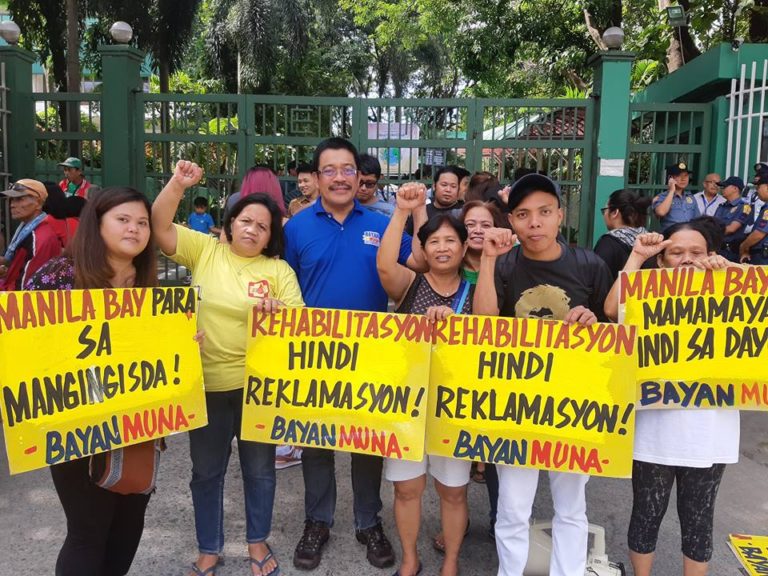
Fisherfolk joined by Bayan Muna Rep. Carlos Zarate demand genuine Manila Bay rehabilitation in a picket in front of DENR. (Contributed photo January 2019)

Bayan Muna authored and supported bills like the Rent Control Act of 2009 or RA 9653, which regulates rent for residential units and provides mechanisms that will encourage the development of low-cost housing for low income brackets. It also pushed for the Tax Relief for Minimum Wage Earners Act of 2008 (RA 9504).

Bayan Muna also authored the Anti-Torture Law or the Republic Act 9745, a law that criminalizes all kinds of torture to include physical, mental, psychological and pharmacological, the Marcos Compensation Law, which mandates compensation for victims of human rights violations under the Marcos dictatorship.

3. Ako Bicol

Ako Bicol Political Party supposedly seeks to represent the people of the Bicol region. During the 2016 presidential elections, Ako Bicol topped the party-list race and earned three congressional seats. This election cycle, Ako Bicol got the third spot.

Election watchdog Kontra Daya said in its study that Ako Bicol is allegedly backed by the family of Elizaldy Co, which is a rich and influential family in Albay. The Co family’s businesses include construction, real estate, malls, mining and aviation.

4. Cibac

The Citizen’s Battle Against Corruption (Cibac) was established in 1997 to fight corruption through the House of Representatives.

Its first nominee is Jesus is Lord founder Eduardo Villanueva, who is also the father of Sen. Joel Villanueva. The remaining nominees Domingo C. Rivera, Lyndon P. Caña, Armi Jane R. Borje, and Stanley Clyde C. Flores are also members of the religious group Jesus is Lord.

In 2016, Joel Villanueva was ordered sacked by the Ombudsman over misuse of P10-million pork barrel while he was still Cibac party-list representative. https://newsinfo.inquirer.net/844010/joel-villanueva-ordered-dismissed-from-public-service-over-pork

In the same PCIJ report, Cibac was named as one of the top election spenders in the party-list race, with over P99 million spent.

5. Ang Probinsyano

Riding on the popularity of a primetime telenovela, with its lead actors as endorsers, Ang Probinsyano has made it to the top 10 winning partylist groups. It received a total of 741,300 votes, based on the unofficial tally with 94 percent election results.

The party-list group supposedly advocates for the upliftment of lives of those residing in the provinces. Its nominees are Alfred Delos Santos, Ronnie Ong, Edward Delos Santos, Ronaldo Tuazon and Eubendino Bitor.

But the success goes beyond being associated with a television series because its deep pockets should also be taken into account. PCIJ noted in its report that Ang Probinsyano spent at least P46 million in political advertisements from February to April 30, 2019.

6. 1Pacman

One Patriotic Coalition of Marginalized Nationals, Inc. or simply 1Pacman supposedly advocates for the welfare of “marginalized nationals” is represented by industrialist Michael Romero who has business interests related to ports and mining.

In a previous Bulatlat report, it was noted that 1Pacman, endorsed by known sports figures, has authored and co-authored over 473 bills but only four of these are considered as a poverty alleviation measure.

1Pacman spent at least P25 million from February to April 30 for political advertisements, according to PCIJ.

7. Marino

Marino Partylist is a newcomer in the party-list race that reportedly aims to give voice to the plight of those belonging to the maritime community in Mindanao. Its first nominee, Carlo Lisandro Gonzales, is the owner of a construction company Ulticon Builders.

An ISO-certified company since 2010, Ulticon, according to its website, will construct the P242-million Cateel-Compostela diversion road project in Davao Oriental.

All the rest of their nominees are from Davao, including Jose Antonio Lopez, who used to work for Duterte’s close ally Dennis Uy, also an industrialist.

8. Probinsyano Ako

Like Ako Bicol, Probinsyano Ako is a region-based party-list group that reportedly aims to serve as the voice of the Ilocos region. However, election watchdogs have earlier criticized it for being backed by a political dynasty and even present government officials.

Its first nominee is Rudys Caesar G. Fariñas I, son of long-time lawmaker Rodolfo Fariñas. Its two other nominees are Lira Fariñas, daughter-in-law of Laoag vice mayor Michael Fariñas, and an incumbent mayor Chevylle Fariñas.

9. Senior Citizens

The group has three sets of nominees. Those listed in the first set are: Francisco G. Datol, Jr., Aurora R. Mojica-Garcia, Erlinda A. Ordanes, Rogelio M. Galman, and Jaime L. Cruz.

In the previous Congress, the Senior Citizens Partylist has pushed for the creation of a National Commission for Senior Citizens.

The party-list group, in its Facebook page, supported and endorsed the senatorial candidacy of Bong Go, a close ally of Duterte.

10. Magsasaka

The Magsasaka Partylist said on its Facebook account that it pushes for progressive agriculture, food security, and human dignity.

While other party-list groups have been subjected to red-baiting during the campaign period, no less than Philippine Army’s Maj. Gen. Rhoderick Parayno said Magsasaka was not in any way related to the New People’s Army.

Parayno even considers Magsasaka as a partner, as it supposedly provides livelihood projects in areas where there are allegedly NPA members.

While it claims to represent the interests of farmers, its first nominee is Dexter Villamin, former pastry chef and currently president and founder of DV Boer Farm, an 11-hectare estate in Lian, Batangas.

Its second nominee, on the other hand, is lawyer Argel Joseph Cabatbat, who last year survived an ambush. The rest of its nominees are: Soliman J. Villamin, Sr., Oliver L. Corbito, Joven F. Santos, and Manolito M. Dacuycoy.

Reforms needed

Four of the top 10 partylist groups are linked to Duterte and his allies. Some of them also spent millions for ads, which means they either have huge funds or are funded by big business.

Except for Bayan Muna, none of the top 10 has a track record of serving the marginalized sectors.

As pointed out by political analyst Dr. Temy Rivera, the party-list system has been dominated by political dynasties, trapos or groups representing vested interests.

In an interview with Bulatlat, Rivera also noted that region-based party-list groups like Ako Bicol and Probinsyano Ako take advantage of vote-rich areas, destroying the spirit of party-list system, where it should have national constituency.

Meanwhile, the three-seat cap encourages fragmentation, allowing parties with small constituencies to be represented in Congress.

Rivera said the minimum threshold to get a seat (two percent of the total votes) is too low and should be raised to at least three percent so that winning groups will have bigger electoral base, and prevent “fly-by-night, opportunistic” party-list groups to get a seat.

Still, reforms are much needed in order to prevent the elite from hijacking the party-list system supposedly for representation of the marginalized. (http://bulatlat.com)

Disclaimer: Bulatlat’s associate editor Danilo Arao is also convenor of election watchdog Kontra Daya.

The post A second look at the top 10 party-list groups appeared first on Bulatlat.

Pagtanggal sa Filipino bilang core subject sa kolehiyo at mandatory ROTC, mga atake sa karapatan ng mamamayan

0
Mahigpit na kinondena ng Karapatan ang desisyon ng Korte Suprema na alisin ang Filipino at Panitikan bilang mga pangunahing asignatura sa kolehiyo. Nakikiisa ang Karapatan sa lahat ng grupong patuloy na naninindigan para igiit ang ating pambansang pagkakakilanlan dahil ito ay mahalang gulugod ng karapatang pantao ng mamamayan.

6 wounded in police “misencounter” in CDO

0

Six persons, including two police officers, were wounded when law enforcers exchanged gunfire during a “misencounter” in Barangay Puerto, this city, Thursday night, police said Friday.

Gov’t, Bangsamoro leaders come together for Brigada Eskwela in Lanao town

0

Setting aside their differences, government, and Bangsamoro officials have come together to help ensure the smooth conduct of Brigada Eskwela in Lanao del Norte as schools open next month.

Stale


By DEE AYROSO
(http://bulatlat.com)

The post Stale appeared first on Bulatlat.

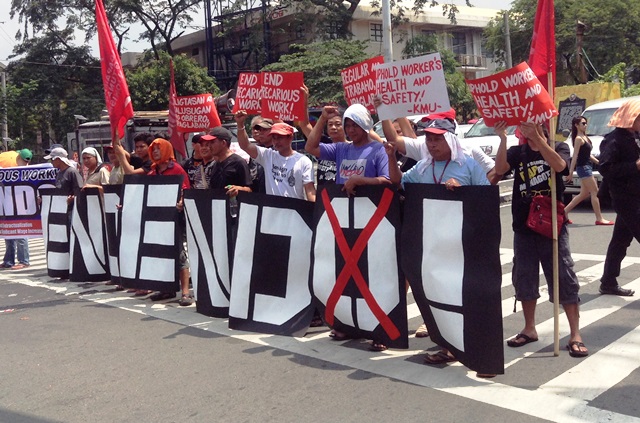
Why ending ‘endo’ remains as Duterte’s unmet campaign promise

Bulatlat file photo

The Congress-approved Senate version does not prohibit fixed-term and multi-layered contracting as demanded by workers. Its provision on penalties and fines on employers and agencies engaged in illegal labor-only contracting is weak.

By MARYA SALAMAT
Bulatlat.com

MANILA — Various labor organizations, except the Trade Union Congress of the Philippines (TUCP), have expressed dissatisfaction with the Congress-approved Security of Tenure Bill passed a few days before the 17th Congress adjourns.All the bill awaits now is President Duterte’ signature for it to become a law.

As ending Endo is a trending campaign promise that helped Duterte secure popularity and votes in 2016, he has been asked by labor groups time and again to produce results.Endo is end of contract or the practice in which employers scrimp on wages and benefits by shuffling workers with work contracts for less than six months.

Duterte promised to end Endo in months. He delayed delivering on it by first requiring the labor groups, through Labor Secretary Silvestre Bello III, to unite and craft their proposed anti-endo policies and mechanisms.But Bello also took proposals from employers’ groups. He came up with Labor Department Order 174 that the labor groups rejected, saying it favored the employers more and merely “improved” the ways in which contractualization could continue.

On Labor Day 2018, Duterte signed the Executive Order (EO) 51 but labor groups, again, found that it would not end Endo because it’s still premised on the same stumbling block embodied in DO 174: it is not prohibiting but still allowing contractualization.

Labor groups Kilusang Mayo Uno (KMU) and Bukluran ng Manggagawang Pilipino said the president, if he had really wanted it, is empowered by Labor Code to end Endo. The same power he and his alter ego, the Labor Secretary, uses to issue oepartment Orders regulating contractualization can just as well be used to ban it. Duterte passed the ball instead to Congress saying that prohibiting Endo requires legislation.

With the Security of Tenure Law, “policies that perpetuate employment through manpower agencies are becoming a full-fledged law,” said Jerome Adonis, secretary general of Kilusang Mayo Uno (KMU).

Labor’s consistently unwanted third party

In all the incarnations of “end-endo” issued by the Labor Department and now by Congress, job contracting through third party agencies is allowed. It brings a wedge between employer-employee relationship that’s at the root of the workers’ complaint about contractualization. Shifting them to manpower agencies who act as their “employer,” they may work for the country’ biggest, most profitable employers for years but they are prevented from bargaining with this employer for improved benefits and retirement.

With such an arrangement, shipyard workers, salesladies, factory workers can die at the workplace and the business owner can still shirk responsibility over them.

Through the years, labor groups note that contractualization policies only changed rules or parameters but allowed the game of contractualization to continue, for example by adopting or revising licensing and other regulatory requirements. All these are easily circumvented by both agencies and employers, Adonis of KMU said.

The Congress-approved Senate version does not prohibit fixed-term and multi-layered contracting as demanded by workers. Adonis of KMU said its provision on penalties and fines on employers and agencies engaged in illegal labor-only contracting is weak. Why so? It did not categorically state the penalties for erring agencies and employers, thus providing room for circumvention, Adonis explained.

Section 3 and other provisions of the bill still allow outsourcing, contracting and subcontracting as a legitimate labor practice and gives DOLE power to regulate contractualization, said the Ecumenical Institute for Labor Education and Research (EILER).

Leody de Guzman of Bukluran ng Manggagawang Pilipino said “it is far from labor’s demand to abolish trilateral work arrangements, which is the basis for the anti-worker scheme of contractualization.”

New parameters to allow contractualization

“We hate to say it but the Security of Tenure bill will not prohibit contractualization,” Gabriela Women Rep. Arlene Brosas said in a statement. She was disappointed she lost the chance to try to improve the bill with the abrupt cancellation of the bicameral conference.

The SoT Bill legalizes contractualization by setting parameters for the licensing of contractors based on revised criteria, which is whether the job or service is ‘directly related to the principal business’ instead of the ‘usually necessary or desirable’ criteria in the Labor Code, Brosas said.

In effect the SoT law revises a crucial part of the Labor Code. Adopting such a parameter “provides big capitalists a huge elbow room to evade regularization of workers by using the core and non-core alibi,” Gabriela said.

“A huge mall chain like SM can conveniently say that it does not employ the vast swathe of contractual workers precisely because its principal business is commercial space rental, not the actual merchandising and selling of products,” Brosas explained.

Only businesses gain from ‘flexible’ labor

Behind the government and employers’ reasoning for why it keeps on legalizing contractualization even when it promises to stop it is the free market argument. The EILER said that the business groups’ free market argument relies on labor flexibilization and deregulation to reap higher profits from contractual workers. It means making it easy to hire and fire workers for quick adjustments to the vagaries of the economy.

“This means guaranteeing that Filipino workers are paid the lowest minimum wages without additional benefits and that they work for longest hours possible. It’s also a direct attack to freedom of association, as contractual workers are prohibited from forming or joining unions,” said Rochelle Porras, EILER executive director.

Earlier, employers’ groups Employers Confederation of the Philippines (Ecop) and Philippine Chamber of Commerce and Industry (PCCI) defended contractualization, but contrary to their claims, said Porras, promoting decent, regular jobs will actually be beneficial for businesses and the poor of the country as regular employment provides access to living wages and series of social protection and welfare programs.

Porras described as rubbish the employers’ groups’ excuse that we need to promote contractualization to attract foreign investors. “The truth is they are protecting their primary interest, which is to reap maximum profits from labor contracting.”

Contractial workers can be found in the services sector such as hotels, restaurants, resorts, repair shops, malls, supermarkets, security agencies, offices, transport, and logistics, in agriculture and manufacturing industries. The SoT Law covers workers in the private sector, but contrctualization is also prevalent among the government employees, said the Confederation for Unity, Recognition and Advancement of Government Employees (COURAGE).

Whether the president signs the SoT Law or not, most of the labor sector is expressing unity at rejecting this version of the SoT bill. Adonis of KMU said they continue to call for the passage of a genuine Security of Tenure Law that will prohibit job contracting through third party agencies, long an instrument of employers in evading the regularization of their workers. (http://bulatlat.com)

The post Why ending ‘endo’ remains as Duterte’s unmet campaign promise appeared first on Bulatlat.