Home Blog Page 318

2019 midterm elections results: Harsher policies ahead

0

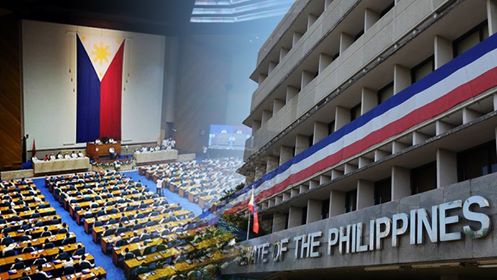
Administration-backed bets dominated the 2019 midterm elections especially in the Senate. The Duterte administration will certainly fast track its priority neoliberal policies as soon as the 18th Congress opens. It already used its super-majority in the 17th Congress to pass socioeconomic measures aggravating the country’s jobs crisis, poverty, and underdevelopment. More and harsher ones loom with many elected officials unlikely to favor any policy reversals from neoliberalism.

Questionable results

The electoral success of administration-backed candidates and party-list groups was controversial. The 2019 midterm elections were marred by massive vote-buying, widespread breakdown of voting machines, and suspicious delays in the transmission of results. The Duterte administration also visibly used public resources not just to support its preferred candidates but also to sabotage the campaigns of its opposition. Progressive candidates, party-list groups, and their supporters were subjected to particularly virulent attack.

Duterte-endorsed Hugpong ng Pagbabago (Faction for Change) candidates took nine of 12 senatorial slots: Cynthia Villar, richest senator and wife of the country’s richest oligarch; Taguig representative Pia Cayetano; reelectionist senator Sonny Angara, son of the late senator Ed Angara; reelectionist and former senate president Koko Pimentel, son of former senator Aquilino Pimentel; Special Assistant to the President Christopher “Bong” Go; former chief of police Ronald “Bato” dela Rosa; Imee Marcos, eldest daughter of ousted dictator Ferdinand Marcos; jailed plunderer former senator Ramon “Bong” Revilla; and former Metro Manila Development Authority (MMDA) chief and presidential political adviser Francis Tolentino.

Many winning party-list groups are either linked with or outrightly backed by the administration: the Sara Duterte-backed Anti-Crime and Terrorism Community Involvement and Support (ACT-CIS) party-list; Duterte ally Gloria Arroyo-backed AKO Bicol Political Party (AKB); richest multi-billionaire congressman Michael Romero’s One Patriotic Coalition of Marginalized Nationals (1 PACMAN); Ilocos Norte warlord Rudy Farinas’ Probinsyano Ako; and Duterte-endorsed Marino, whose nominees are Davao-based businessmen. Election watchdog Kontra Daya described these groups as ”dubious and making a mockery of the party-list system”.

Meanwhile, the Makabayan bloc of progressive party-list groups defied systematic state-sponsored attacks and vilification to take six seats in the 18th Congress, only one less than it got in the last elections. Bayan Muna (BM) obtained over 1.1 million votes to get three seats for the first time since 2007. Gabriela Women’s Party (GWP), ACT Teachers Party, and Kabataan Party-list all won one seat each. The last member of the bloc, Anakpawis, whose farmer- and worker-dominated machinery suffered violent attacks and killings however failed to retain its seat in the House of Representatives (HOR).

The systematic state-sponsored attacks on progressive candidates and groups to prevent them from being elected into government exposes the flawed democracy of Philippine elections. Military, police and local government officials vilified Leftist candidates, sabotaged their campaigns and political alliances, and attacked their party-list machinery. This is another manifestation of government’s intolerance of activists advocating for genuine change and raising public awareness on issues and proposing genuine solutions.

Looming sell-out and repression

The overwhelming number of winning candidates are from the same political parties, political families and elite interests behind the system of anti-people and anti-development laws in the country. They are likely to reprise or keep on with more of the same to the further detriment of the economy.

Among the exclusionary measures passed by the 17th Congress under the Duterte administration is the Tax Reform for Acceleration and Inclusion (TRAIN) law, which lowered personal income, estate, and donor taxes on the rich while burdening the poorest majority with higher consumption taxes. Another measure is the Rice Tariffication Law which liberalized rice trade, making the country over-reliant on a narrow global market for its staple food, amid still merely token production support for millions of rice farmers. There is also the extension of Martial Law in Mindanao, despite the Commission on Human Rights (CHR) already noting rampant human rights violations in the region.

Senate president Vicente Sotto III said that the Senate will take up amendments to the Public Services Act (PSA) and the Human Security Act (HSA) in the closing days of the 17th Congress until June. The amendments to the PSA open critical public utilities such as power, telecommunications, and transportation to excessive foreign ownership and control. This compromises national security and civil defense, on top of making vital public services expensive and inaccessible especially for lower income families.

Amendments to the HSA meanwhile threaten to further restrict civil liberties and human rights. As it is, the Duterte administration is already coming down hard on supposed drug personalities and alleged ‘terrorists’ and supporters in gross disregard of due process and the law. Critics fear that HSA amendments will only give the government freer hand to crack down on the political opposition and other perceived threats to its rule.

The electoral results will also likely embolden the Duterte administration to push for Charter change (Cha-cha) serving its narrow political agenda. Amendments to the 1987 Philippine Constitution focusing on federalism and full economic liberalization remains priority legislation for the Duterte government.

From the time of Fidel Ramos to the current administration, various efforts for Cha-cha were consistent in seeking to lift restrictions on foreign exploitation of natural resources and on foreign ownership of land, public utilities, education institutions, and mass media and advertising . The rationale is that attracting foreign investments will supposedly be the key for economic development.

The same rationale is behind other bills considered important by Malacañang pending in Senate committees, such as the National Land Use Plan, supposed contractualization ban, and the Tax Reform for Attracting Better and Higher Quality Opportunities (TRABAHO). Aside from pushing PSA amendments, the National Economic and Development Authority (NEDA) reportedly also plans to recommend the following to the Legislative-Executive Development Advisory Council (LEDAC): sugar industry liberalization, creating a Department of Water, and exempting government’s line-itemized projects from the election ban.

All these seek to make it easier to do business and profit from public utilities, land and natural resources, and building infrastructure. The TRABAHO bill is also a misnomer because its real focus on lowering corporate taxes and rationalizing incentives may, if anything, actually even squeeze employment and workers’ salaries. Even the supposed law ending contractualization may end up being a smoke-screen that creates the conditions for legitimizing contractual arrangements rather than ending this.

Instead of bringing development, Cha-cha and the rest of the Duterte administration’s priority bills are likely to worsen the effects of the business-biased, neoliberal policies of the past decades. The economy today is characterized by shrinking agriculture and Filipino manufacturing, dismal jobs generation, and chronic poverty. This cannot be cured by further opening up to foreign capital and without the state more actively intervening in the economy for strategic industrial development, redistributing income and wealth, and providing needed social services.

Keeping watch

The executive, legislative, and judicial branches of government are overpopulated by administration allies or otherwise intimidated into passivity. The manufactured results of the midterm polls strengthens the hand of the Duterte administration and its elite supporters to implement self-serving economic and political measures at the expense of the Filipino public.

More than ever, the country’s patrimony and sovereignty and the people’s rights and welfare are at stake.

Also more than ever, the steadfast resistance of organized basic sectors is critical. The decades-strong social movement is the most reliable bulwark against the distortion of the economy to serve narrow elite interests. The progressives in Congress and their allies in government, down to the local level, can help push an alternative economic agenda. Domestic agriculture and Filipino industry can be developed, the environment protected, people’s welfare upheld, and economic independence attained. – With report from Casey Salamanca
Customs stops e-waste from Hong Kong in Mis. Or. port

0

China has joined other countries that dump their garbage to the Philippines following information relayed by the Bureau of Customs in Northern Mindanao (BOC-10) that tons of electronic waste (e-waste) and other forms of trash has entered the local port from the Chinese territory.

JV’s life: a living testimony of faith and ideology reconciled

0

Countless times in the past, has it been proven that even death cannot kill a beautiful mind and a compassionate heart? Witnesses to the truth of this are not a few among people who have been touched by the fine leadership qualities filled with kindness and simplicity of Joel Virador (JV as he was fondly called by family and friends) whose life was offered to the very least and voiceless among workers, peasants, professionals and every struggling Filipinos he had served most of his waking moments.

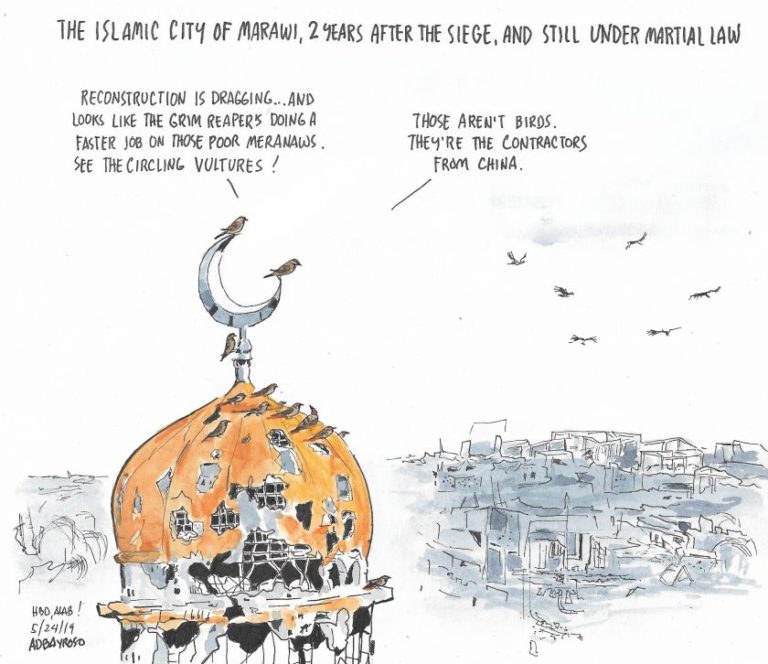
Marawi


By DEE AYROSO
(http://bulatlat.com)

The post Marawi appeared first on Bulatlat.

800,000 rights abuses recorded in 2 years of Martial Law in Mindanao — rights group

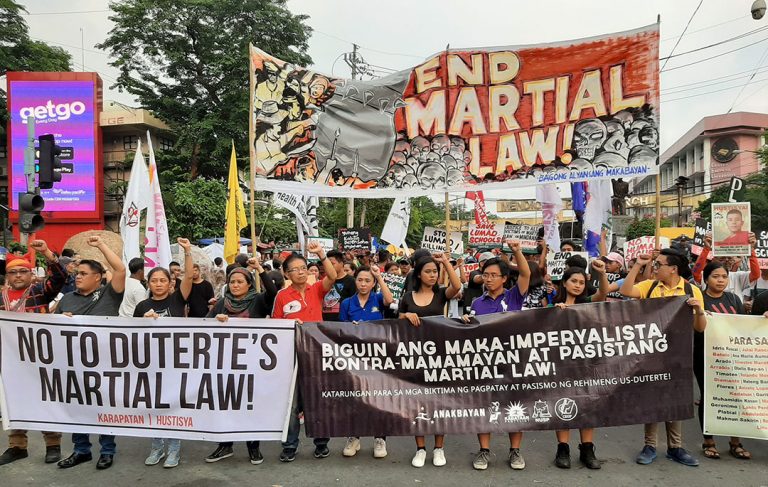
Groups stage Black Friday Protest on the second anniversary of martial law in Mindanao. (Photo by John Aaron Mark Macaraeg / Bulatlat)

Since May 23, 2017, when the entire island was placed under martial law, 93 activists have been killed while 136 have escaped death. More than 1,400 others were arrested and detained. Karapatan revealed there are 815,734 victims of civil and political rights violations.

By JOHN AARON MARK MACARAEG
Bulatlat.com

MANILA – With tubaw on his head and wearing a tribal vest, 43-year-old B’laan leader Kerlan Fanagel marched with fellow Lumad, rights activists and advocates toward the foot of Chino Roces (formerly Mendiola) bridge, May 24. They reiterated their call to end the martial law in Mindanao.

Fanagel, chairperson of Pasaka Confederation of Lumads, is one of those who have sought refuge in Metro Manila for quite some time now. Slapped with kidnapping and illegal detention charges, his face and name included in the military’s “Wanted” posters, Fanagel was forced to leave behind his wife and two children aged 17 and 15.

Lumad leader Kerlan Fanagel holds the Duterte administration accountable for human rights violations in Mindanao. (Photo by John Aaron Mark Macaraeg / Bulatlat)

“Until now I could not go home in Mindanao because the threat of being killed, the threat of being skinned alive remain. It is only just that we hold this administration accountable for all the injustices,” Fanagel said in Filipino.

His fears are not unsubstantiated. Since May 23, 2017, when the entire island was placed under martial law, 93 activists have been killed while 136 have escaped death. More than 1,400 others were arrested and detained, according to human rights alliance Karapatan.

Karapatan revealed there are 815,734 victims of civil and political rights violations since Martial Law took effect.

‘No substantial grounds’

The Duterte administration has not lifted the Proclamation 216, commonly known as Martial Law, in the entirety of Mindanao three years after the Marawi siege has ended.

The Philippine Constitution mandates that in order to proclaim Martial Law, there must be an actual rebellion occuring within the country. And since the military forces already declared “victory” against the rebel Maute Group, many have questioned if the it is truly and legally necessary.

Cristina Palabay, Karapatan secretary general said, “The Duterte government has perpetrated several myths about military rule and has intentionally propagated fear to justify the extension and passage of repressive policies.”

“Martial law did not bring about safety, but rather atrocities such as the Patikul massacre of of 7 youths in September 2018, the Jolo twin bombings, and corruption and abuses among ranks of security forces,” Palabay added.

Protesters light candles for the 93 killed in the past two years of martial law in Mindanao. (Photo by John Aaron Mark Macaraeg / Bulatlat)

For Anakpawis Rep. Ariel Casilao, Duterte “is more terrorist than Maute group” for the gross human rights violations perpetrated against thousands of civilians.

Impact on Lumad students

Among the most affected are the Lumad children.

According to Save Our Schools (SOS) Network, martial law had shut down 79 Lumad schools, affecting 2,728 teachers and students. Three Lumad students were killed by state forces and paramilitary groups.

Speaking at the protest action, Lumad student Rorelyn Mandacawan recalled how her cousin Obillo Bay-ao  was killed and how soldiers fired their guns while they were holding their graduation rites in March 2017.

“We miss our home. We could no longer play with our schoolmates. We could not swim in the river,” Mandacawan said in Filipino.

Rius Valle, SOS Network spokesperson, lamented, “Instead of upholding the rights of Lumad people, the state forces in connivance with various government agencies and officials have been systematically attacking Lumad community schools.”

‘Martial law used to rig the midterm election’

The groups said the presence of state forces in Mindanao only brought intimidation instead of the promised security to the people of Mindanao.

“The red tagging and defamation of progressive personalities, organizations, and partylists instilled fear and a chilling effect among their members, constituents, and supporters,” Amirah Lidasan, a council member of Sandugo Movement of Moro and Indigenous Peoples for Self Determination said.

Rampant distribution of black propaganda materials against Makabayan partylists such as ACT Teachers, Anakpawis, Bayan Muna, Kabataan, and Gabriela Women’s Party was recorded.

“Even the presence of armed soldiers inside the polling precincts intimidated voters. How can they comfortably and freely vote when soldiers with high powered rifles are within sight?”Lidasan asked.

Despite the harassment and threats, the Makabayan bloc won six seats at the House of the Representatives.

Lidasan said, “The martial law and the repression only strengthened the people’s resolve to fight and struggle for a more peaceful nation.” (With reports from Ronalyn V. Olea) (http://bulatlat.com)

The post 800,000 rights abuses recorded in 2 years of Martial Law in Mindanao — rights group appeared first on Bulatlat.

Marawi


By DEE AYROSO
(http://bulatlat.com)

The post Marawi appeared first on Bulatlat.

Media group, workers call for justice for victims of Ampatuan Massacre

Candles lit for the victims of Ampatuan Massacre. (Photo by Alyssa Mae Clarin / Bulatlat)

“It is our way of keeping the fight for justice alive, as well as condemning all violations of human rights. And hopefully, before all our candles run out, justice would be given to all victims.”

By ALYSSA MAE CLARIN
Bulatlat.com

MANILA– Journalists were joined by workers, and artists as they held the monthly commemoration of the Ampatuan Massacre at Liwasang Diokno inside the Commission on Human Rights (CHR) compound in Quezon City, May 23.

Less than six months from now, the Ampatuan Massacre, one of the single most deadliest attack on media, would be reaching its tenth year with no clear justice given to the victims and their families.

Raymund Villanueva, deputy secretary general of the National Union of Journalists of the Philippines (NUJP), recounted how the incident had brought the Philippines to the limelight worldwide.

“That day, on November 23, 2009, [the massacre] was considered as one of the worst case of attacks on media around the world,” he said. The 2009 incident was by far one of the worst cases, with 32 journalists dead in a single night.

According to a study conducted by the International Federation of Journalists (IFJ) last year, the Philippines is among the seven countries in Southeast Asia dubbed as the worst places for journalists because of the looming threats of impunity, intimidation, safety, and censorship.

What’s even more infuriating, according to Villanueva, was the fact that even after almost ten years, families of the victims are still fighting for justice, while some of more than half of the suspects remain at large and out of prison bars.

“You can even see some of the primary suspects attending weddings, and family gatherings,” Villanueva noted pertaining about how primary accused, Zaldy Ampatuan, was able to temporarily leave jail to attend his daughter’s wedding reception last August 21 2018.

“The fight for justice has been way too long,” added Villanueva. He said that if the government can’t provide justice to a case as big as the Ampatuan Massacre, how much more with the killings of farmers in the provinces.

The short event ended with a candle lighting event where media members were joined by workers from Mindanao and youth artists from Panday Sining.

The NUJP, since November 23, 2018, has been doing a monthly commemoration of the massacre. Villanueva said,  “It is our way of keeping the fight for justice alive, as well as condemning all violations of human rights. And hopefully, before all our candles run out, justice would be given to all victims.” (http://bulatlat.com)

The post Media group, workers call for justice for victims of Ampatuan Massacre appeared first on Bulatlat.

Marawi


By DEE AYROSO
(http://bulatlat.com)

The post Marawi appeared first on Bulatlat.