Home Blog Page 331

Text spamming sa eleksiyon

Hindi naman na bago sa mga Pilipino ang iba’t ibang mga pakulo ng mga kandidato para makilala, mula sa tv ads, mga flyer at sasakyang nagpapatugtog ng campaign jingle. Pero nitong nakaraang mga linggo, nababahala na ang ilang botante mula Metro Manila sa natatanggap na election-related messages ngayong panahon ng kampanya.

“Wala namang gan’to nung bumoto ako, 2016,” giit ng isang estudyante mula sa isang unibersidad sa Quezon City, “tapos natakot na ako para sa seguridad ko.”

Spamming

Giit ni Commission on Elections (Comelec) Spokesperson James Jimenez sa kanyang Twitter account, “Walang pagbabawal sa paggamit ng mobile number / SMS sa pangangampanya. Pero maaring pumasok yan sa anti-spamming regulations ng DOTC.”

Pero taong 2016 pa nang paghiwalayin sa dalawang ahensiya ang Department of Transportation and Communications (DOTC), ang Department of Transportation (DOTr) at Department of Information and Communication Technology (DICT).

Marahil ang tinutukoy ni Jimenez ay ang National Telecommunications Commission, na mayroong Memorandum Circular 03-03-2005 na nagsisilbing gabay para sa broadcast messaging, o malawakang pagtetext.

Nakasaad sa circular na “itinuturing na spam messaging ang unsolicited at unwanted promotional advertisements”. Kinakailangan kasing mayroong opt-out ang makakatanggap ng text, o pagkakataong umiwas sa pagtanggap ng parehong message. Kapag hindi nag-reply ang nakatanggap ng text, tinuturing na itong opt-out.

Walang tigil

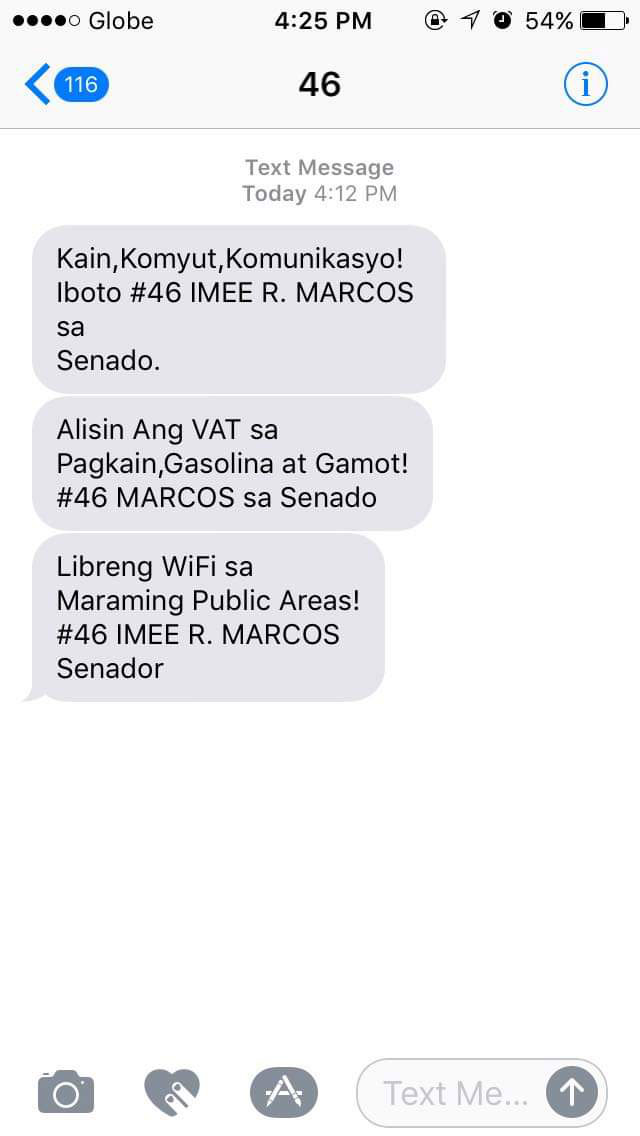
Pero para sa isang guro sa Greenhills, hindi naman tumitila ang paulit-ulit na mensahe ng pangangampanya para sa pambansang mga kandidato tulad nina Imee Marcos, Bong Go, at Dong Mangudadatu.

May naiulat ding pumapasok na mga mensahe na nangungumbinsing bumoto sa iba pang kandidato ng admininstrasyong Duterte, sa ilalim ng Hugpong ng Pagbabago.

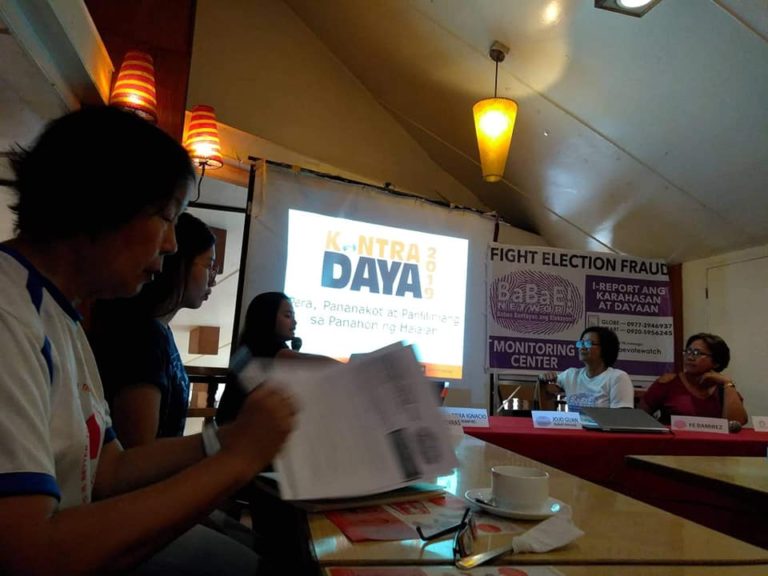
“Kailangang may paraan para hindi na makatanggap ng ganitong mapanghimasok na mga text dahil bordering on invasion of privacy na ito,” giit ng grupong Kontra Daya, isang independiyenteng election watchdog group.

Para sa NTC, walang isyu ng privacy rito. Pero puwede raw itong maituring na spam messaging, giit ni NTC Regulation Branch Administrative Asst. Erwin Cudiamat.

Pero lumalabas na walang pangil ang NTC para matigil ang spamming na ito. Ayon kay Cudiamat, nasa kamay na ng telecommunication companies (telcos) ang pagsasawata rito. Kung lalabag raw ang mga sender, nakadepende na sa telcos ang susunod na hakbang.

Pero nasa interes ng telcos na huwag pigilan ang spamming, kasi kumikita sila rito. Sa Globe Telecom Inc., mayroong Auto SMS Blast Solution, o AdBlast Service kung saan 1) sabay-sabay puwedeng magpadala ng text sa daan o libong tao; 2) puwedeng pumili ng sariling sender ID, tulad ng kay Imee Marcos na 46; at 3) Globe number lamang ang kailangan, kahit walang data.

Makikita sa terms and conditions ng Globe na hindi ibibigay ng Globe ang mismong mga numero ng nakakatanggap sa mga kostumer o sender na gustong gumamit ng AdBlast. Sa pagkakasulat ng artikulong ito, hindi pa sumasagot ang Globe sa pahintulot na makapanayam ukol naman sa pagpili at pagiging kabilang sa database.

Dagdag pa rito, paulit-ulit sa guidelines ng Globe na mahalaga ang pagkakaroon ng opt-out, o STOP code na puwedeng isagot ng nakatanggap para hindi na makatanggap pa ng messages. Ngunit kung titignan ang mga ehemplo na nalikom ng Pinoy Weekly, walang sumusunod sa ganitong panuntunan.

Sa kabila ng sinasabi ng NTC na hindi legal ang spamming at dapat may opt-out na opsiyon ang mga kostumer ng telcos, walang malinaw na pamamaraan ito o anumang ahensiya ng gobyerno para masawata ito.

Sa hayag na pagbali sa mga panuntunan at memorandum circular, ano na lang ang kahihinatnan ng mga botante’t pribadong mamamayan kung walang malinaw na parusa sa mga lumalabag.

Gamit sa paninira

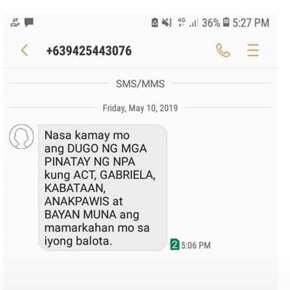
Samantala, nitong huling linggo, nagkaroon ng mas masahol na hitsura ang text spamming: Kumalat sa maraming bilang ng telco customers ang text na paninira o black propaganda kontra sa progresibong mga party-list na Bayan Muna, Gabriela, ACT Teachers, Anakpawis at Kabataan.

Sa text na natanggap ng maraming tao na nagsumbong sa Pinoy Weekly, sinasabing huwag daw bumoto sa naturang mga party-list dahil “nasa kamay” ng botante “ang dugo ng mga pinatay ng NPA (New People’s Army)” kung boboto sa mga ito.

Lumalabas na text blasting muli ang ginamit dito. Muli, walang opt-out na opsiyon para di na makatanggap ng nasabing text message.

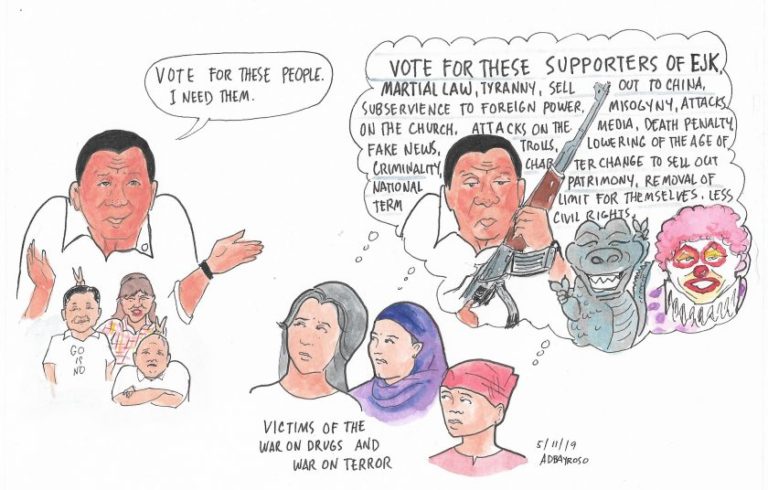
Kung sa naunang ehemplo ng ilegal na text blast, mga kandidato ni Duterte ang nakinabang, sa huling ehemplo sa itaas, mga kalaban o oposisyon naman kay Duterte ang binabanatan.


His candidates


By DEE AYROSO
(http://bulatlat.com)

The post His candidates appeared first on Bulatlat.

Children search for senatorial bets to represent them

Lumad children play at the evacuation center in UCCP Haran, Davao City. (Photo by Abegail Valenzuela of PANAP)

Among the senatorial aspirants who are against the lowering of minimum age of criminal responsibility are Bam Aquino, Neri Colmenares, Sonny Matula, Samira Gutoc, Gary Alejano, Nancy Binay, Romy Macalintal, Grace Poe, Erin Tanada and Florin Hilbay.

By JANESS ANN J. ELLAO
Bulatlat.com

MANILA – They may not be able to cast their votes yet. But children and various groups advocating their rights and welfare are determined not to miss this midterm elections as an opportunity to voice out the concerns and issues confronting them.

In earlier statement, children’s group Salinlahi pointed out the need to elect legislators who can not just represent their voices in Senate but also stand and protect the interests of the people.

Children’s welfare during emergencies

Last year, international children rights advocacy group Save the Children called on those running for public office to prioritize the welfare of children in times of disasters and emergencies.

This, the group said, entails the implementation of Republic Act 10821 or the Children in Emergency and Relief Act of 2016 that aims to address the needs of children before, during, and after a disaster or emergency situation.

Children, the group added, are vulnerable in times of natural and man-made disasters, as seen in the aftermath of the Typhoon Haiyan, one of the strongest typhoons ever to make landfall in recent history, where about six million children were affected.

Many children were also affected by the Marawi crisis, which President Duterte recently refused to fully rehabilitate and has instead sought private companies to do it, to the dismay and outrage of human rights organizations.

Children victims of tokhang

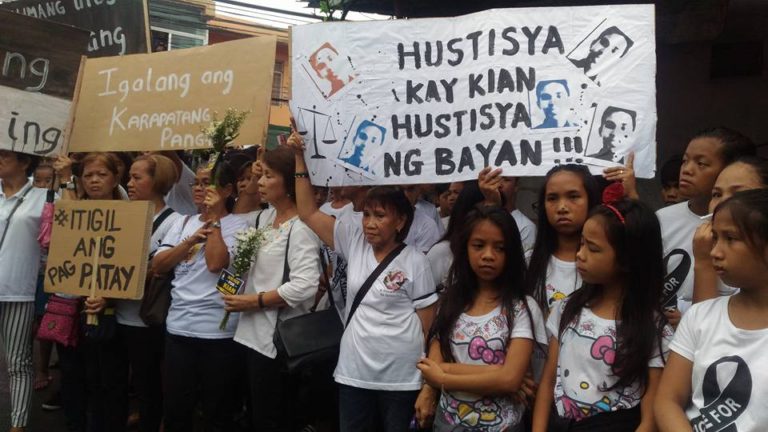
Thousands of sympathizers laid Kian Delos Santos to rest, Aug. 26. (Photo by Kathy Yamzon/ Bulatlat)

Children, too, have unfortunately become victims of Duterte’s war against illegal drugs.

The killing of Kian Delos Santos has brought to fore the evils of the war against illegal drugs, which mainly targets the poor.

The three cops involved in the killing were found guilty by a Caloocan court. However, then Caloocan police chief who was fired after the Kian killing is now head of the police Highway Patrol Group.

While Duterte has already admitted in his speech that his illegal drug drive is a failure even after ordering the deaths of those he called “idiots,” former police chief and now senatorial aspirant Ronald Dela Rosa continues to stand by it, saying that he found it imperfect but not wrong.

Stand on CICL

(Photo courtesy of Salinlahi)

The proposed lowering of the minimum age of criminal responsibility from 15 years old to nine has been raised early this year. This has been met with criticism, saying that this will bring more harm than good to children as proven by scientific and solid studies.

Read: What the proposed lowering of age of criminal liability means to Filipino children

Children rights groups said the proposal reflects state abandonment, most especially of children belonging to poor families who are most vulnerable to crime syndicates or committing petty crimes.

Among the senatorial aspirants who are against the lowering of minimum age of criminal responsibility are Bam Aquino, Neri Colmenares, Sonny Matula, Samira Gutoc, Gary Alejano, Nancy Binay, Romy Macalintal, Grace Poe, Erin Tanada and Florin Hilbay. They also took notice of the state of Bahay Pag-Asa or the rehabilitation centers for children in conflict with the law, saying these must be improved.

On Lumad students

Lumad students and evacuees and other protesters at the Oblation in UP Diliman (Photo courtesy of Salinlahi Alliance for Children’s Concerns)

The plight of Lumad continues under the present administration, with militarization of their communities and the third extension of martial law rule in Mindanao. No less than President Duterte himself threatened to bomb their schools.

Senatorial aspirants Colmenares and Diokno have been very vocal on their stand on the plight of the Lumad and in questioning the martial law rule in Mindanao, which, they said, has resulted in grave human rights violations.

As then Bayan Muna lawmaker, Colmenares has asked the Supreme Court to rule favorably to the petitions they filed, seeking protection for the Lumad under attack. He was also among the first to condemn extrajudicial killings and other rights violations among the Lumad, including the infamous Lianga massacre.

Read: Outraged groups demand justice for Surigao Sur killings

One possible solution to their plight, Diokno said, is to review the Indigenous Peoples’ Rights Act to further call for the protection of the Lumad. (http://bulatlat.com)

The post Children search for senatorial bets to represent them appeared first on Bulatlat.

Where senatoriables stand on human rights

For respecting human rights, senatoriables Neri Colmenares, Chel Diokno, Leody de Guzman, Erin Tañada, and Samira Gutoc got a perfect score of seven. For outright disregard for human rights, Ronaldo Bato dela Rosa, Christopher “Bong” Go, Lito Lapid, Bong Revilla and Jiggy Manicad earned a score of zero. Imee Marcos got two points but had a track record of abuses during his father’s rule.

By RONALYN V. OLEA
Bulatlat.com

MANILA — President Rodrigo Duterte has no qualms about disrespecting human rights. He openly called for the killings of drug suspects and perceived enemies, showed narco lists without an iota of evidence and spewed out invectives against those who criticized his lust for blood.

This midterm elections is a referendum on the Duterte administration. His biggest campaign, the so-called war on drugs, proves to be a failure after three years into the presidency. Bulatlat takes a look at the stance on human rights issues of 27 senatorial candidates from Hugpong ng Pagbabago (HNP), Otso Diretso and some independent candidates.

Seven key human rights issues were identified namely: war on drugs, martial law extension in Mindanao, Marcos’ burial at the Libingan ng mga Bayani, lowering the minimum age of criminal responsibility, mandatory drug testing in colleges, freedom of information (FOI) bill and anti-discrimination or the SOGIE (Sexual Orientation and Gender Identity and Expression) Equality Bill.

For respecting human rights, senatoriables Neri Colmenares, Chel Diokno, Leody de Guzman and Erin Tañada, and Samira Gutoc got a perfect score of seven.

For outright disregard for human rights, Ronaldo Bato dela Rosa, Christopher “Bong” Go, Lito Lapid, Bong Revilla and Jiggy Manicad earned a score of zero. Imee Marcos got two points but had a track record of abuses during his father’s rule.

Tokhang

Thirteen of the 27 senatoriables publicly opposed the “war on drugs.” Most of them are from the opposition. Two of them — Neri Colmenares and Chel Diokno — actively criticized it and took the case to court. Colmenares, president of the National Union of Peoples’ Lawyers, served as one of the legal counsels to the complaint filed by relatives of the victims before the International Criminal Court. Diokno, meanwhile, filed a petition with the Supreme Court seeking to declare the war on drugs unconstitutional. Both lawyers are part of “Manlaban sa EJK,” a coalition of lawyers, legal experts and law school associations that campaigns against extrajudicial killings, threats to freedom of expression and attacks against human rights defenders.

Meanwhile, former Philippine National Police chief Ronaldo “Bato” dela Rosa was at the forefront of the tokhang operations. It was during his stint that Korean businessman Jee Ick-joo was kidnapped and killed and Albuera, Leyte Mayor Rolando Espinosa, was killed inside his detention cell.

Former Special Assistant to the President Christopher Lawrence “Bong” Go is campaigning for the continuation of “war on drugs.” He even said he is willing to go to jail with Duterte. 

Aquilino “Koko” Pimentel III defended “the war on drugs” as part of law enforcement while Jiggy Manicad praised Duterte for “creating fear among drug pushers” even as acknowledged there were cases of extrajudicial killings in the conduct of war on drugs.

The other administration candidates have no public stand on the issue.

Hero’s burial for former dictator Ferdinand Marcos

Twelve of the 27 senatoriables opposed the burial of former dictator Ferdinand Marcos at the Libingan ng mga Bayani. The most vocal against it were Colmenares, Diokno, Leody de Guzman, Serge Osmena and Bam Aquino.

Imee Marcos, daughter of the late dictator, peddled the lie that there was no evidence proving their family’s ill-gotten wealth. She benefited from his father’s reign, acting as chairperson of the Kabataang Barangay and as assemblyman to the Batasang Pambansa. The torture and killing of Archimedes Trajano who then questioned Imee, publicly on her being the national chairman of the Kabataang Barangay, was attributed to her.

“On August 31, 1977, Archimedes Trajano, a 21-year-old student of Mapua Institute of Technology, attended an open forum with Imee Marcos, 21-year-old daughter of the dictator. Her father had appointed her National Chairman of the Kabataang Barangay youth organization. When Trajano questioned her about her appointment, Imee apparently became irritated. Her guards seized Trajano and dragged him away. His body was found hours later: he had been severely tortured and beaten to death,” an account read.

Juan Ponce Enrile, defense minister of Marcos, also lied to his teeth claiming there was only one executed and no one detained during the dictatorship.

Based on Amnesty International’s records, from 1975 to 1985, there were at least 3,200 victims of extrajudicial killings; 77,000 political detainees; 3,500 torture victims; and more than 700 disappearances.

Four other senators approved of the hero’s burial for Marcos namely: Dela Rosa, Go, JV Ejercito and Cynthia Villar. Others have not issued a public stance on the matter.

Other issues

Ten senators are against the extension of martial law in Mindanao. One opposition candidate, Nancy Binay, approved of the extension.

On the proposal to lower the age of criminal responsibility, eight senatoriables are for it. They are Dela Rosa, Ejercito, Go, Manicad and Marcos. Most of the opposition and independent candidates are against it.

On mandatory drug testing in schools, 14 of the 27 either have not issued a public stand or have abstained from voting on the proposal.

Freedom of information, anti-discrimination

Sixteen of the 27 senatoriables have supported the freedom of information (FOI) bill. Grace Poe has been a consistent advocate of FOI since she became a senator.

No one has publicly opposed it although most of them have not issued a public stance on the matter. It should be noted that Revilla and Estrada, for example, have been involved in previous corruption cases while Marcos benefited from ill-gotten wealth.

Seventeen senators said they are supportive of the SOGIE Equality Bill, a good news for the LGBTQ community.

Plus points for Colmenares, Diokno and Tañada

Looking at the track record of senatoriables on the defense and promotion of human rights, Colmenares, Diokno and Tanada stand out from the rest.

As a former Bayan Muna representative, Colmenares authored the Republic Act 10353 or the Anti-Enforced or Involuntary Disappearance Act, co-authored the Human Rights Reparation and Recognition Act, Anti-Torture Act, RA 10366 or the Accessible Polling Places for PWDs and Senior Citizens Act.

Desaparecidos, an organization of families of victims of the disappeared, has endorsed Colmenares’ candidacy for being consistent in supporting their call for justice.

Tañada, meanwhile, authored Republic Act 10368, which created the Human Rights Victims’ Claims Board, and Republic Act 10174, which establishes the People’s Survival Fund to address the problem of climate change. In the 14th Congress, he was chairman of the Committee on Human Rights which acted on several resolutions calling for investigations in aid of legislation on alleged human rights violations.

Diokno, meanwhile, is a long-time member of the Free Legal Assistance Group (FLAG). Among his clients include NBN/ZTE whistleblower Rodolfo “Jun” Lozada, torture victims Raymond and Reynaldo Manalo, where the petition for writ of amparo was granted by the Supreme Court, “Tagaytay 5” activists who were illegally arrested and detained, among others.

In 2001, Diokno was the private prosecutor in the impeachment proceedings against then-President Joseph Estrada.

In an article, Diokno pointed out many similarities between the pattern of oppression during martial law and the situation today. “During martial law, if you were branded as a Communist, if the government said you didn’t have any rights, you were not a human being, and therefore, you can be killed. Even human rights lawyers were branded as Communists at that time. Nowadays, the branding is different. If you are a criminal, drug addict, drug pusher, then you are not human and you don’t deserve human rights,”he said.

Vote for human rights

This Monday, voters should be reminded of the words of former Senator Jose “Pepe” Diokno, “No cause is more worthy than the cause of human rights. They are what makes a man human. Deny them and you deny man’s humanity.”

The people’s votes this May 13 will serve as a verdict to this administration that has caused so many tears and miseries especially to the poor.

References:

Future of FOI Bill in Philippines Remains Up to Aquino
Get to know candidates in #TheFilipinoVotes: Senatorial Forum Part 2
Senate rejects resolution vs Marcos burial
Decades-old Imelda charges show justice is ‘frustrating,’ ‘a victim’
Bato scores Robredo over Marcos burial
Which PH Senatorial Candidate Quiz
Gary Alejano, mutineer and ex-Marine, leads impeach bid vs Duterte
NTG: Sen. Bam Aquino, tutol sa pagpapalibing kay ex-Pres. Marcos sa Libingan ng mga Bayani
FOI advocates to go straight to lawmakers for support, to rely less on Aquino
Senate approves FOI bill on 2nd reading
ARMM to enact own version of FOI
Poe pitches FOI anew
SC ruling on Marcos burial cannot be implemented yet—lawyer
Senator Serge Osmeña on Former President Marcos’ Burial at the Libingan ng mga Bayani
Sen. Revilla Freedom of Information Act stalled in Senate
Mar says LP backing FOI, anti-dynasty bills
‘FM an enemy of heroes’
Ateneo Factcheck Elections 2013

The post Where senatoriables stand on human rights appeared first on Bulatlat.

What can the government do to address the worsening state of Filipino workers?

0

#MalalangEkonomiya #MayMagagawa #PeopleEconomics #BeyondElections2019 #LaborDay2019

WANTED: An Independent Senate

0

By Jose Lorenzo Lim

Midterm elections have always been crucial for any incumbent, as results will either affirm or reject the programs and policies so far of the ruling party. The 2019 midterm elections, however, appears to be different, as it happens at the heels of the Duterte administration’s implementation of harshest neoliberal economic policies and undermining democracy. The Duterte presidency has seemingly consolidated the Executive, Lower House and even the Judiciary under its influence, and the Senate could be the last stronghold of democratic processes.

After weeks of campaigning, the 2019 midterm elections is near. Candidates vying for senatorial posts have traveled around the country seeking to convince Filipinos to vote for them. It remains to be seen whether or not we will have a truly independent senate after the May 2019 elections.

Quick voters scan

Looking at data from the Commission on Elections (COMELEC) shows that there are 61,843,750 voters in the Philippines with an additional 1,822,173 registered overseas voters for the 2019 midterm elections.

A breakdown of the voters shows that Region IV-A has the highest number of voters with 14%, followed by Region III with 11%, and the National Capital Region (NCR) with 11.4 percent. The Cordillera Administrative Region (CAR) has the lowest number of voters with only 1.6% share of the total number of voters. The poorest regions also have a low number of voters. Both Region IX and the Autonomous Region in Muslim Mindanao (ARMM) only have 3.5% of the total number of voters.

For overseas voters, the Middle East and African regions have the highest number of voters with 48.7%, while the European region has the lowest share of voters with only 10.2 percent. 

While the huge number of voters does not automatically translate into voter turnout, in 2016 the country had an 84% voter turnout compared to 2013 with 77.3% and 2010 with 74.9 percent. Unsurprisingly, a high voter turnout can also be an indicator of dubious activities like flying voters.

Finding the right candidate

Instead of dancing around and telling rehearsed jokes repeatedly, what does IBON think candidates should stand for to deserve the Filipinos’ vote in the upcoming elections?

First, candidates should adhere to the advancement of socioeconomic strategies. Filipino industries should be protected and supported instead of allowing foreign companies to dominate the Philippine economy. An example is protecting and promoting the agriculture sector through production and price supports instead of flooding the market with imported agricultural goods, as is the rationale behind the Rice Tariffication Law, to lower inflation.

Candidates interested in genuinely effecting long-term reforms for the country’s production sectors should support genuine agrarian reform. The failure of the Comprehensive Agrarian Reform Program (CARP) to redistribute land to the tillers has only intensified landgrabbing and land use conversions for land market speculation. Department of Agrarian Reform (DAR) records show that as of January 2019, there were still 549,920 hectares that need to be acquired and distributed. From 1988 to 2016, meanwhile, 98,939 hectares of land were approved for conversion while 120,381 hectares were approved for exemption from land reform coverage–but this is a conservative count as the real extent of land conversion may be underreported. After CARP, majority of so-called agrarian reform beneficiaries still do not own the land awarded to them or are in the process of being dispossessed because they are failing to amortize.

Third, candidates should be upholding people’s rights and welfare. Candidates should be firm in ending contractualization. It is still very much in place: Employment data shows that in 2018, 8.5 million workers of private companies and 985,000 workers in government agencies are still non-regular workers.

Additionally, legislating a national minimum wage of Php750 should also be a major agenda. Raising the average daily basic pay (ADBP) of Php401 nationwide to Php750 will in turn add Php7,649 to employees’ monthly income and Php99,432 to their annual income (including 13th month pay). This will cost the 35,835 establishments nationwide just Php465 billion or only 21.5% out of their Php2.16 trillion in profits.

Moreover, Republic Act (RA) 10963 or the Tax Reform for Acceleration and Inclusion (TRAIN) law should be repealed instead of taking out taxes especially from petroleum products which are socially sensitive. TRAIN means less money in the pockets of 8 out of 10 Filipinos as only 5.5 million Filipino families benefit from lower personal income taxes (PIT) while the remaining 17.2 million poorest households do not benefit from PIT but all pay higher consumer taxes.

Candidates should also ensure that basic social services will be accessible to every Filipino. That is why there is a need to build more public schools and public hospitals aside from allotting higher budgets to education and health. But 2019 budget for the Department of Health (DOH) for instance was cut by 8.13% compared to last year.

Lastly, candidates should promote environmental sustainability. For example, a candidate should be firm to stop destructive large-scale mining, as this causes irreparable damage not only to the country’s natural resources but to many indigenous communities. Another part of this is encouraging rational consumption. Our resources are finite – what we produce and consume must only be within our needs. Candidates should also promote an environment-friendly agriculture and industry.

The public has heard the candidates’ stances on various pertinent issues such as the TRAIN Law, Rice Tarrification Law, contractualization, and jobless growth. Now the candidates should bear in mind that whatever promises they made during the campaign period would be remembered by the people, who will hold them accountable when they take their posts this June 2019.

The last stand

The new senate should carry out the task of defending the current constitution against the Duterte administration’s push for federalism, neoliberalism, and self-serving political goals. The most consistent is the intent to fully liberalize the Philippine economy for foreign investors.

Relatedly, pending proposed amendments to the Human Security Act (HSA) aim to prevent critics, thereby putting basic human rights and civil liberties in peril. The HSA could expedite terrorist tagging and linking and subsequent surveillance, arrests, and restricting of legitimate people’s movements. The new senate should stand against this creeping authoritarianism.

The Philippine Senate could be the last democratic institution for the government’s checks and balances, independent of and not beholden to the power ambitions of the presidency and expected to side with the people and defend whatever remains of Philippine democracy, people’s rights and welfare, and the country’s sovereignty.

With all these considered, the 2019 midterm elections could be one of the Filipinos’ last stands for freedom and democracy. Depending on how their favorite candidates have explained these to them, they can now vote wisely.

#Elections2019 | Turn midterm polls into a platform that rejects ‘misogyny, macho-fascist leadership’ – women’s group

Babae Network warns of electoral fraud, violence (Photo courtesy of Babae Network)

Babae Network, whose volunteers recently observed the Commission on Elections’ (Comelec) final testing and sealing, said they found irregularities and long-standing problems of the automated elections such as paper jams, unreadable printouts from the vote counting machines, to name a few.

By JANESS ANN J. ELLAO
Bulatlat.com

MANILA – With only two days to go before the midterm elections, a women’s group is calling on the Filipino people to turn the May 13 elections into a platform to reject the present misogyny and macho-fascist leadership, following President Rodrigo Duterte’s latest sexist remark.

In a campaign sortie in Bohol, President Duterte has once again made sexist remarks when he said he found Mayor Tita Baja-Gallantes beautiful and that if it were him, he will grab and hold on to her panty if she tries to leave and “even until the garter snaps.”

Read: Women’s groups assail Duterte’s insulting remark vs. Bohol mayor

This is not the first time that President Duterte has earned the ire of women’s groups. This has happened from his presidential campaign trail in 2016 up until this very day.

In a statement, Gabriela Women’s Party said the president’s allies who are running for public office “never bat an eye every time the President degrades, humiliates, and sexualizes women.” And as such, they do not deserve to be elected in public office, the group added.

Women’s vote

Members and volunteers of Babae Network, a women-led poll watchdog (Photo courtesy of Babae Network)

But how can one turn their votes to resound a protest against the present misogynistic leadership?

Early this year, women workers came up with their “Womanifesto” to put forward their agenda for change this midterm elections.

Among those they listed are the women workers’ right to regular employment, to organize, to just living wage, to safe working conditions, and for those running for public office to champion the strengthening of policies to finally put an end to violence and discrimination against women.

Recently, the expanded maternity leave has been signed into a law and its implementing rules and regulations have been finalized. While this is a victory for women’s struggle in the country, they have yet to see how this will be implemented and fully benefit women workers on the ground.

Guard your votes

A defective VRVM (Photo courtesy of Babae Network)

But knowing the long-standing problems in the country’s electoral platform, women rights advocacy groups formed an umbrella organization “Babae, Bantayan ang Eleksyon Network” to ensure that the votes will be protected from the 4Gs of elections – guns, goons, gold, and girls.

The 4Gs, the group said, have been used by traditional politicians to remain in power.

“As poll watchdogs, we need to work together and commit to fight electoral fraud and any attempt to disrupt elections,” Center for Women’s Resources Executive Director Mary Joan Guan said.

Babae Network, whose volunteers recently observed the Commission on Elections’ final testing and sealing (FTS), said they found irregularities and long-standing problems of the automated elections such as paper jams, unreadable printouts from the vote counting machines, to name a few.

Their members and volunteers also noted that there were defective Voter Registration Verification Machines during the final testing.

These problems, Babae Network said, may still persist on Monday.

The public may report irregularities or any electoral violence to Babae Network through the following hotlines: (Globe) 0977-2946937 or (Smart) 0920-5956245.

Meanwhile, volunteers are also welcome to join their information and assistance booths in Metro Manila, the group said.

Apart from Babae Network, reports may also be sent to Kontra Daya or by using hashtags #KontraDaya and #VoteReportPH.

Read: Groups stand united vs. election fraud, political repression

Guan said, “If anything, this FTS serves as warning to all of us. There is a high chance that the elections will fail should the problems persist. Let us all be prepared in taking appropriate action to question and protest the results of the elections.” (http://bulatlat.com)

The post #Elections2019 | Turn midterm polls into a platform that rejects ‘misogyny, macho-fascist leadership’ – women’s group appeared first on Bulatlat.

Health groups slam Facebook for ‘condoning red-tagging’

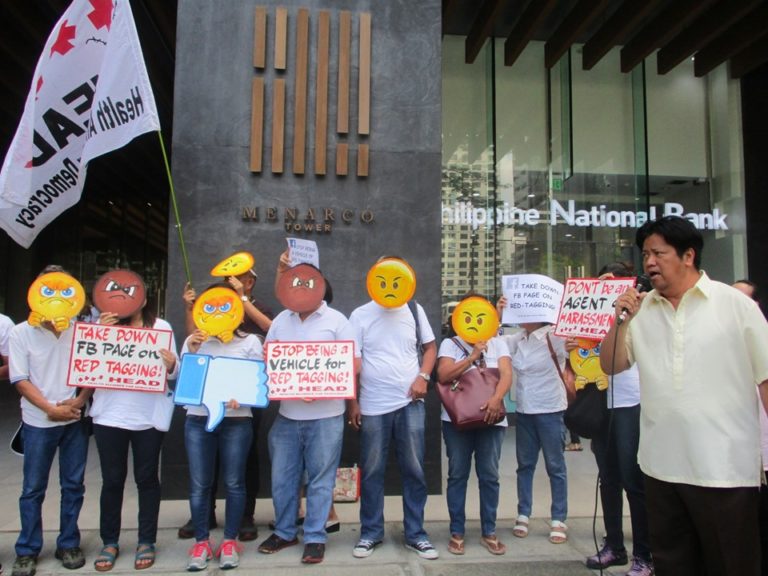
Photo courtesy of Health Alliance of Democracy.

“By deliberately using those photos with the status ‘Communist NPA CPP NDFP supporters’, the lives and security of those persons are placed in danger.”

By ANNE MARXZE D. UMIL
Bulatlat.com

MANILA — Health workers, professionals and advocates held a protest action in front of Facebook Philippines office in BGC Taguig City on Thursday, May 9 for the latter’s inaction on their complaints against certain pages that peddle lies.

In particular, the groups cited Facebook pages which tagged health organizations as supporters of the New People’s Army, Communist Party of the Philippines and National Democratic Front of the Philippines (CPP-NPA-NDF).

In a statement, Dr. Joseph Carabeo, secretary general of Health Alliance for Democracy, raised hell over the use of pictures of their colleagues without their knowledge and consent. “By deliberately using those photos with the status ‘Communist NPA CPP NDFP supporters’, the lives and security of those persons are placed in danger,” said Carabeo.

Photo courtesy of Health Alliance of Democracy.

Carabeo said they have done the necessary measures like reporting the said Facebook pages but there have been no action so far. The Facebook pages remain active because apparently, according to Facebook, the reported pages and posts “do not go against its ‘community standards.’”

Carabeo said they also went to the Facebook Philippines office on March 20 to formally request for an appointment with its representatives but to no avail. They were met by the security guards who explained that no staff or officer can meet them at that moment. The security guards explained that the request for appointment will be responded to by Facebook’s Singapore office. The guards also refused to receive their letter saying that they only receive documents from courts. Carabeo’s group has not received any response from Facebook up to now.

“Our colleagues felt as though Facebook is only interested in raking-in money from its users worldwide but refuse to take action when users report a page that they find offensive or propagates harassment, disinformation, and threat to life and safety,” said Carabeo.

The groups called on Facebook to “seriously take action on posts and pages that perpetuate red-tagging, disinformation and impunity.”

“We are appalled at how Facebook is used by the people behind this page whose motives are obviously malicious, to brazenly attack persons and organizations simply for exercising their right to free expression on issues that are legitimate or valid,” Carabeo said.

Carabeo said that they will exercise all legal remedies to expose the people behind the said Facebook pages.

A few weeks ado, Facebook pages advocating human rights were flagged for allegedly “going against Page Policy, which includes restrictions around sharing distributing or promoting content inauthentically.” The said pages that were flagged are Unyon ng mga Manggagawa sa Agrikultura, Stop Killing Farmers, and Free The Artist. (http://bulatlat.com)

The post Health groups slam Facebook for ‘condoning red-tagging’ appeared first on Bulatlat.