Home Blog Page 337

What Press Freedom’s For

World Press Freedom Day has always been the occasion for responsible journalists to reexamine the state of one of the fundamental needs of ethical practice. This year as in 2018, May 3rd was not so much an occasion for celebration as for alarm. As in many other parts of the world, the independent press is under siege from a government that has made it its life work to harass, restrict, threaten and silence it, and to even arrest practitioners for daring to report the truth.

Filipinos should be asking why every regime from Ferdinand Marcos’ to Rodrigo Duterte’s has looked at independent journalists and media organizations as the enemy. The conventional answer is that governments fear a free press because it can expose official wrongdoing. But journalism is also one of those human enterprises that has the power to either help bring about change if the information it provides is accurate, fair, relevant and complete, or to retard and prevent it if its reports are false, biased for certain interests, irrelevant or just plain incompetent.

Change is this country is publicly accepted as urgent even by those opposed to it. Duterte came to power in 2016 on the wave of the demand for change and even revolution by promising that change is coming, and even Marcos promised to “make this nation great again” in 1965, and to “save the Republic and reform society” when he declared martial law in 1972.

No one in power has ever said they’re against change for obvious reasons. Some 22 million Filipinos are officially considered poor, with some 50 to 60 million more being vulnerable enough for the quality of their lives and those of their families to be at risk when illness, the loss of a job, or the death of a breadwinner, a son or a daughter, or runaway inflation, befall them.

Social unrest and the rise of revolutionary movements are among the consequences of this true state of the nation. But the oligarchs in control of the Philippine state, while claiming to be committed to change, have used various means including violence and force to suppress the social and political consequences of poverty rather than address their causes. The outstanding example so far is the declaration of martial law in 1972. But a repeat of it is increasingly becoming likely in these perilous times — if an undeclared version of it isn’t already here.

It should be more than evident that under these conditions, the primary task of journalism is to provide the information and analysis crucial to mass understanding of the dimensions and roots of, and the possible solutions to, Philippine poverty and its attendant consequences. It is the necessary condition to putting in place the changes so urgently needed in this vale of tears. But as an institution that can flourish and achieve that task only under conditions of freedom not only for itself but also for all, the press is also called upon to combat dictatorship and tyranny and to defend and enhance everyone else’s freedom as well as its own.

The bad news is that, with very rare exceptions, much of the journalism that we see is not doing either. The verbal, physical and supposedly “legal” attacks and pressures against the press are continuing. There is the ban on some reporters’ coverage of Malacañang and the cancellation of online news site Rappler’s registration and the tax evasion cases that have been filed against it.

The same public relations rag that claimed that some independent media organizations are part of a conspiracy to overthrow the Duterte regime has urged its government sponsors to shut down media groups that receive foreign funding. The insults and hate speech directed at critical journalists not only by regime-paid trolls and its old media mercenaries, but even by President Duterte himself have not abated.

Despite these assaults on individual practitioners and media organizations, and the consequent need to be better at describing and explaining what is happening and why, there is little sense of urgency evident in much of the reporting in broadcasting, print and online news sites.

However, despite the threats, the insults, the harassments, and the killings — 164 since 1986, of which 12 happened during the current regime — there are nevertheless journalists in both the corporate and alternative media who’re doing the best they can by getting at the truth, and reporting and interpreting it.

There is indeed corruption in the media, as President Duterte has often said. It is a reality every honest practitioner knows, and which has been amply documented. But it isn’t the Philippine Center for Investigative Journalism (PCIJ) or Rappler he should be accusing of being bought and paid for, but those practitioners and media organizations that daily subject the media audience and social media with false and misleading information in behalf of his government and other interests. Corruption in the media is real enough, but it is mostly the vice of those “journalists” in the pay of government and the media organizations they work for whose interests are closely linked with those of the powerful.

There are journalists in this country who are making the best of a bad situation, who daily risk life, limb and fortune in the service of getting at the truth, and who are therefore competently discharging the fundamental responsibility of providing the media audiences the information they need to make sense of what is happening. But there are also those creatures — one hesitates to call them journalists — who have made a career out of spreading false and distorted information to serve the political and business ends of their patrons as well as of themselves.

What’s even worse, however, is that the vast majority of media practitioners assume that their responsibility ends once they’ve quoted the powerful despite the urgency of combating misinformation and disinformation. Their work mostly consists of “he-said-she-said” reporting, in which the claims, no matter how ridiculous, stupid, tasteless and dangerous of this or that side in any issue, as well as the lies of those whose agenda is to mislead media audiences with false, misleading and distorted information in order to retard change and frustrate the democratization of Philippine society, are quoted without analysis, critical discernment, or context.

This kind of reporting isn’t journalism but stenography, as the Australian film maker and journalist John Pilger warns. The journalist’s task, in the words of Bob Woodward who, together with Carl Bernstein, exposed the conspiracy behind the Watergate break-in that led to the resignation of then US President Richard Nixon, “is getting the full story — and the meaning of that story.”

May 3rd was appropriately the occasion to lament, and to pledge resistance to, the attempts of government to abridge press freedom. But to that should have been added the need for much of the media to re-examine how they have been doing their job, and how their reluctance to go beyond simply quoting what this or that source, specially the powerful, say has contributed to keeping their audiences clueless about the most important issues of our time — and in the process has made a mockery of such democratic exercises as elections.

Journalists must ask a multiplicity of sources the right questions not only to get the facts but also to provide their print, broadcast or online audiences the meaning of events. Freedom of the press is not just about the right to air, say or print anything according to one’s best lights and conscience. Even more urgently does its practice include the duty of creating the informed and engaged audience that is urgently needed in times of peril to both the press as well as the entire nation such as the present.

Luis V. Teodoro is on Facebook and Twitter (@luisteodoro).

www.luisteodoro.com

Published in Business World
May 2, 2019

The post What Press Freedom’s For appeared first on Bulatlat.
March for Science in the Philippines highlights protection of reefs, forests

Scientists, environmentalists and advocates commemorated the #MarchForScience in the Philippines, May 4, at University of the Philippines Diliman in Quezon City.

Photos and text by Ronalyn V. Olea/ Bulatlat

March for Science held in the Philippines


The post March for Science in the Philippines highlights protection of reefs, forests appeared first on Bulatlat.

PHILBEX Davao 2019 marks 5th year with new event highlights

As PHILBEX Davao returns for its 5th year, the highly anticipated trade show introduces new event features that will elevate visitors’ trade experience and pave the way for business-to-business opportunities.

Elections 2019 | Migrant group assails OAV ‘irregularities’

“It’s not like we’re doing this for the first time.“

By ANNE MARXZE D. UMIL
Bulatlat.com

MANILA – A Filipino migrant group expressed indignation over reports of irregularities and problems encountered by overseas Filipino workers in the overseas absentee voting that kicked off last April 13.

Migrante International called the Commission of Elections (Comelec) and the Department of Foreign Affairs (DFA) negligent of their duty over several reports such as delayed arrival of the absentee voting ballots, vote counting machines (VCMs) rejecting ballots and problem with the ballot’s barcode among others, which have reached their chapters abroad.

There are 1.8 million registered Filipino overseas absentee voters who want to exercise their democratic right to vote, said Migrante. They fear that such problems in the overseas absentee voting would deny them of this right.

“Comelec failed to ensure that overseas absentee voters receive all the necessary information and materials to prepare them for the elections even prior to April 13, the first day overseas absentee voters could officially vote,” Migrante said in a statement.

Delayed delivery of ballots

The most common report that reached Migrante is the delay in the delivery of ballots as Comelec did not fund the postage. According to a report, Comelec spokesperson James Jimenez said there is a 2016 “agreement directing consulates and embassies to pay the postage cost for the ballots and the DFA will reimburse thereafter.”

Voters abroad could cast their votes in their homes or workplaces by mailing the ballots directly to them. The voters then send their ballots to their respective voting posts to be counted manually or via automated election system by Comelec-designated officials.

In New Zealand, Migrante Aotearoa chairman Mikee Santos criticized Comelec for the delay in releasing the budget for postage.

29 April 2019#ComelecPalpak: Filipinos in New Zealand Dismayed Over Delayed Delivery of Ballots, Leading to Massive…

Geplaatst door Aroha Migrante op Zondag 28 april 2019

“With only two weeks to go, Comelec’s budget release for postage fees is way too late. Why only now? Comelec’s failure to guarantee earlier delivery of ballots with pre-paid envelopes will surely mean massive voters disenfranchisement again,” said Santos in a statement.

He said Comelec reportedly transferred P55 million ($1.06 million) on April 27 and approved an additional P14 million ($269,729) for payment of postage fees to ensure the delivery of the ballots.

Santos called the last minute release of the budget as “major blunder of Comelec.”

“It exposes how the current government continues to neglect Filipinos abroad. The Philippine economy relies on the billions of dollars of OFW remittances, and yet they always take us for granted. It’s a big, direct punch in the faces of all overseas Filipinos who were hoping to vote, but many will likely be unable to do so due to long delay of sending the ballots with pre-paid envelopes. This is an unforgivable, gross neglect not only of our rights, but the integrity of our election,” Santos said.

Meanwhile in Washington, a report said that ballots were sent out only beginning April 22 or nine days after the voting period started. https://news.abs-cbn.com/overseas/04/27/19/delay-in-oav-ballots-worries-fil-am-voters
Migrante International said this delay is a grave concern.

“The option to vote by mail is critical to thousands of overseas absentee voters who lack access to resources and time to travel to their nearest consulates or voting centers because of the distance from their workplace or home,” the group said.

They added that this is a clear violation of Republic Act 9189, which guarantees that overseas absentee voters will not have to shoulder any costs related to the process of voting.

“Comelec’s admission of lack of financial resources to pay for postage stamps due to the delay in the passage of the national budget is unacceptable, further revealing that protecting the constitutional right of all Philippine citizens to vote is not a priority of this administration,” the group said.

Ballots rejected, vote counting machines breakdown

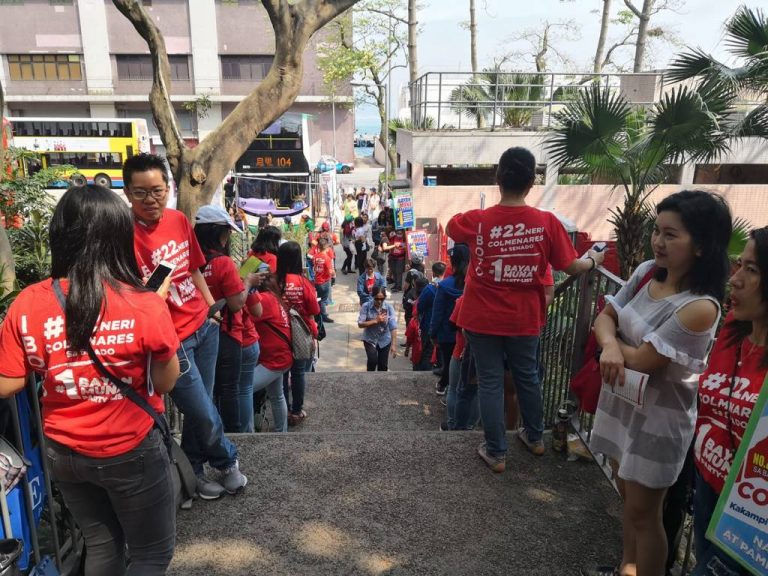
There were also reports of ballots being rejected in five precincts in Hong Kong, according to Kontra Daya. There were also four incidences of VCM breakdowns and inconsistencies between the receipts printed by the VCM and actual votes cast by voters in three precincts.

OFWs line-up during the first day of the overseas absentee voting in Hong Kong. (Photo courtesy of Migrante International)

There were also reports of initial unavailability of the computerized list of voters in Al-Khobar, a VCM with a broken seal in Jeddah, insufficient ballots in Russia, double ballots in Italy, and more than 3,000 voters disenfranchised in Damascus, Tripoli and Baghdad due to the absence of polling centers for Filipino OFWs.

Migrante-Bologna also reported that an OFW got two ballots bearing the same serial number.

The Computer Professionals’ Union (CPU) has pointed out that “countermeasures should have been in place at the get-go to ensure that VCMs don’t malfunction and break down, ballots are in order, and polling precincts are prepared.”

Mac Yanto, CPU deputy coordinator and convener of Kontra Daya said that Comelec has not significantly improved since the first automated election in 2010. He said this is the fourth automated elections held in the country, yet, the same problems were still encountered up to now.

“It’s not like we’re doing this for the first time. By now there should be more stringent systems and counter-measures in place to ensure smooth, transparent, peaceful, and accurate elections,” he said.
‘Voting is not a privilege’

Santos said that “voting is not a privilege but a fundamental right of every Filipino.”

He said Migrante-Aotearoa is holding the Comelec accountable “for this deliberate disregard of OFWs’ right to elect rightful candidates for this year’s election.” (http://bulatlat.com)


The post Elections 2019 | Migrant group assails OAV ‘irregularities’ appeared first on Bulatlat.

Hugpong bets top AdDU Blue Vote survey

Unsurprisingly, Hugpong ng Pagbabago (HNP) local and national candidates dominated the latest Ateneo de Davao University “Blue Vote” Electoral Survey Series for 2019 mid-term elections.

How do the Senatoriables Fare? : Contractualization

#MalalangEkonomiya #MayMagagawa #PeopleEconomics #BeyondElections2019

Malacañang’s enthusiasm on credit rating upgrade unwarranted-IBON

IBON executive director Sonny Africa said that the recent credit rating upgrade is not a sign of economic progress and that Malacañang’s enthusiasm is greatly unwarranted. The credit rating upgrade is most of all an assessment of the government’s ability to repay debt and not of economic development. There would be no such upgrade if development were a concern, he said, because the economic conditions of the people are getting worse.

Big Three credit-rating agency Standard & Poor’s recently gave the Philippines a BBB+ credit rating upgrade, which is only one step away from a single “A” grade. Palace spokesperson Salvador Panelo reacted by praising the economic team for “a splendid job in putting the economic house in order and spearheading bold economic reforms [and] bolstering the domestic economy”.

The Palace’s enthusiasm is however unwarranted, Africa said, because the economy cannot be said to be doing well. The country has been getting credit upgrades for over a decade since March 2009 and has been receiving investment upgrades for over six years since March 2013, yet the economy cannot be said to be in good shape.

If anything, he pointed out, the Duterte watch so far is seeing the worst job creation in nine administrations and six decades. “This looks to get even worse after four straight quarters now of falling employment creation including two quarters of job losses,” said Africa. “As it is, the PSA’s latest January 2019 labor force survey shows 387,000 less employed Filipinos now than in the same period last year.”

The upgrade is then not from any economic progress, Africa pointed out, but largely on the back of the regressive TRAIN law, which since last year has disproportionately burdened the majority poorest Filipinos.

Africa stressed that the importance of the upgrade in stimulating capital inflows shouldn’t be exaggerated as indicating economic progress either already in place or yet to come. The economy is clearly not progressing because jobs are being lost rather than created, he said. This is so because the agricultural and industrial foundations the economy so desperately needs are being neglected for short-term Build, Build, Build infrastructure illusions, Africa explained.

Africa went on to say that more capital flows will also not mean progress if much of this will just go to financial and speculative sectors rather than the real economy. “The supposed easier availability of capital from abroad will be really only be meaningful if the country had solid industrial policy and an agricultural development plan in place, which unfortunately it does not,” he concluded.


SC Issues Writ of Amparo and Habeas Data in Favor of NUPL

0

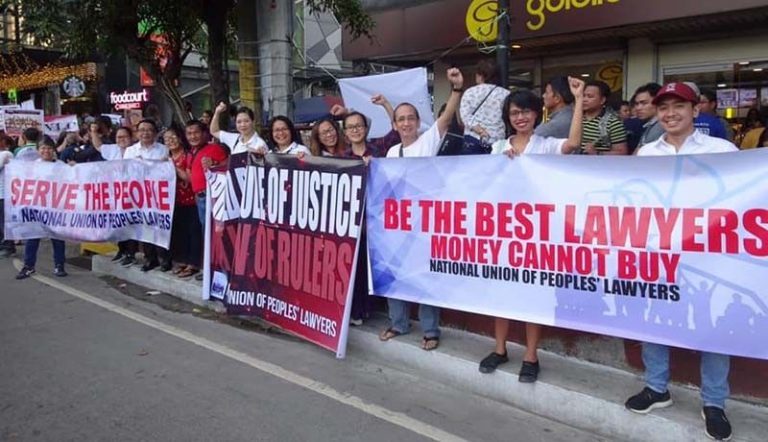
The Supreme Court, in a special En Banc session held on Friday, issued a writ of amparo and habeas data in favor of the National Union of Peoples’ Lawyers (NUPL).  

The Court also referred the petition of NUPL, et al. to the Presiding Justice of the Court of Appeals, who was directed to cause the immediate raffle of the said case among the appellate justices. The CA was further directed to hear the petition on May 14, 2019 and to decide the case within 10 days after submission of the case for decision.

The Court also ordered respondents President Rodrigo Duterte, who was impleaded in his capacity as the Commander-in-Chief of the Armed Forces of the Philippines, National Security Adviser (Ret.) Gen. Hermogenes C. Esperon, Jr., et al. to make a verified return of the writ of amparo and habeas data on or before May 8, 2019, and to comment on NUPL, et al.’s petition before the said date.

In its petition, NUPL, et al. sought for the issuance of the writ of amparo and habeas data for their protection, claiming that their rights to life, liberty and security have been violated and continue to be violated through the persistent threats and harassment and red tagging allegedly done to vilify and intimidate them and prevent them from pursuing their profession as members of the Bar and from practicing their advocacy as peoples’ lawyers serving the poor and the marginalized. They claimed that some NUPL members have died in the line of duty.

The petitioners are likewise asking the Court to compel the respondents, under the writ of habeas data, to provide them with copies of all the facts, information, statements, records, photographs, and other evidence, documentary or otherwise, pertaining to each of them in the respondents’ files and records.

In particular, NUPL alleged that it was branded as an “enemy” by the Philippine Army in 2013. In 2014, NUPL-Vice President Atty. Catherine Salucon allegedly experienced heavy surveillance and harassment and that her paralegal, William Bugatti, was killed hours after they had parted ways after a court hearing. In 2018, NUPL-Negros Secretary General Atty. Benjamin Ramos was killed in Kabankalan, Negros Occidental. They cited other several incidents of threats, harassment and intimidation due to their work and advocacy.

Also named as respondents were National Defense Secretary (Ret.) Gen. Delfin N. Lorenzana, AFP Chief of Staff Gen. Benjamin R. Madrigal, Jr., AFP Deputy Commander for Intelligence Brig. Gen. Fernando T. Trinidad, AFP Intelligence Service of the Philippines (ISAFP) Chief Maj. Gen. Erwin Bernard Neri, Philippine Army Commanding General Lt. Gen. Macairog S. Alberto, and AFP Deputy Chief of Staff for Civil Military Operations Maj. Gen. Antonio G. Parlade, Jr.

We are certainly pleased and somewhat relieved that the High Court has favorably acted upon our petition for protection of the life, liberty and security of NUPL members who are after all, officers of the court.

It came at a propitious time when the 2018 Bar results came out today welcoming our new colleagues in the profession. It gives our new lawyers a veritable food for thought while they rightfully celebrate. 

It also sends a strong and clear signal to the military and government officials alike, as well as their proxies or agents, that there are certain well-defined rules of evidence not incompatible with basic fairness, decency, common sense and logic that must be observed. 

While this is just a start of an intense judicial battle and tedious procedure, we are grateful that the Court heeded our supplication to be given judicial shield and a potential relief from reckless accusations, malicious labelling and vicious attacks in different forms and guises. 

Its subtext is as unequivocal – incessant redtagging, personal mudslinging and contrived narratives will be subjected to judicial restraint and accountability.

Edre Olalia NUPL President Co-Petitioner
3 May 2019