Home Blog Page 374

Humihiwa ang gutom ng tiyan sa Baseco compound

Ni R.B.E. ABIVA

Anong kapit-tigas sa pagkakalapat ang kanilang mga labi;
anong lamlam ng kanilang mga mata
na wari’y tahanang walang laman
o naghihingalong sinag-araw kung dapithapon;
anong higpit ang pagkakasaklot
ng luma’t inaamag na rosaryo
sa kanilang butuhan-payat-tuyong dibdib;
at paglapat ng mabangis na anino
sa suwelo ng mundo’y bumabangis din
ang pagbulwak ng nangangalam-nangangasim
na mga mumurahing tiyan;
ang tikatik ng mga lumang orasan sa dingding
ay waring pagbibilang ng kamatayan
na tahimik-palihim na nagkukubli
sa dilim ng mga eskinita at esterong
siyang paraiso ng mga ipis, uod, at daga;
at kapag muling lumangitngit
ang nagsisiklutan-nagpipiglasang mga laman
sa loob ng tiyang bihira kung maambunan
ng katiting ni mumo ng biyaya’y
nagmimistulang karit ang buwan
tingga at bali-baling krus ang mga bituin
at dagat ng mga kalansay at bungo
ang langit na pinagkukutaan ng mga Diyos;
nagkukulay-kalawang ang buong papawirin
at wari’y singaw na mula sa bunganga ng baril
ang hininga’t samyo ng buong Maynila at sangkatauhan
habang animo’y kuko ng limbas ang paparating na gabi;
hayok-mapanlinlang-mabangis itong iaanak ng Kanluran
at anong siba’t ‘alang awa nitong gugutayin-lalamunin
ang duguang araw sa Silangan.

Ang may-akda ay dating bilanggong politikal. Nagsusulat siya ng tula at maikling kuwento sa wikang Iloko at Filipino. Siya ang awtor ng Tuligsa at iba pang mga tula (Pantas Publishing, Quezon City, 2018). Nalathala na rin ang kanyang mga tula sa Bannawag Magazine, Philippine Collegian ng University of the Philippines-Diliman, Pinoy Weekly, bulatlat.com, Northern Dispatch Weekly at marami pang iba. Nakatakdang ilabas ang kanyang aklat na Bandillo: Limampung Tula Sa Madilim Na Umaga, isang koleksiyon ng mga tulang alay sa martir ng rebolusyon na si Randy Felix Malayao.

Want to read stories like this? Help us keep up continue writing about issues that matter.

The post Humihiwa ang gutom ng tiyan sa Baseco compound appeared first on Bulatlat.

Voters told: ‘Pols behind budget delay have low regard for public service’

“It is sad because they are prioritizing the ‘squabble over the pork-laden budget’ rather than ensuring that government is providing fast and reliable public services.”

By MARYA SALAMAT
Bulatlat.com

MANILA – As the first quarter of the year ends with government employees still not receiving their mandated wage hike, the Confederation for Unity, Recognition and Advancement of Government Employees (COURAGE) called on lawmakers to end the delay in the budget as soon as possible. They also urged the public, particularly voters, to remember the names and party affiliation of politicians and government officials causing the delay.

They said the delay in their salary increase is not just a source of concern to government employees, “it is a reminder that those responsible for the delay are not too overly concerned with the delivery of public service to the people,” said Courage National Council member Erwin Lanuza.

“We are the government machinery for ensuring its functions and services, yet, we ourselves don’t have sufficient pay, and we are experiencing hunger,” Lanuza explained. As president of the association of local government employees, Lanuza sees everyday the way local government employees are discriminated against. Often paid lower than what they decry as the already low wages of other government employees from national agencies and offices, they, too, have to contend with the delay in the wage hike mandated by the Salary Standardization Law 4.

Even the wage hikes mandated under the Salary Standardization Law have failed to correct the disparity in wages of local government in poorer districts. The SSL-4 based their hike on the local government’s classification, meaning the poorer districts get lower budget and correspondingly lower wages.

“This final tranche (of wage hike under SSL-4) like the others before it is a pittance, but the government has up to now failed to start implementing it for employees,” said Manuel Baclagon, national president of employees’ union in the Department of Social Welfare and Development (DSWD).

The COURAGE blames the delay in “the bickering of lawmakers and budget department over the corruption budget.” Aside from the workers’ wages, the delivery of other social services is also adversely affected by the delay.

“It is sad because they are prioritizing the ‘squabble over the pork-laden budget’ rather than ensuring that government is providing fast and reliable public services,” Baclagon said.

Given that key officials of the Duterte administration including the president himself are campaigning for various electoral positions, Courage said the voters should measure their pitch and promises against their concrete actions with regard to budget and government pay.

“Before they can promise voters anything, they should be able to take care of their employees in government and stop the squabble for pork,” Lanuza said of the Duterte administration bets and allies.

‘Changes in DSWD budget emblematic of low regard for public service’

The Department of Social Welfare and Development (DSWD) provides small grants to the poor who exhibited willingness and desire to learn a new trade or engage in a small livelihood project. Unlike a doleout, it expects the recipient to actually improve their economic situation and as such, not everybody can avail of the grant in a snap.

“There are required preparations before the DSWD can decide whether to approve the grant application of those in need or not,” Baclagon told Bulatlat.

This partly explains why the DSWD cannot just easily disburse or spend that part of its budget. But the way the union of its employees explain it, that exercise of due diligence was penalized when the Duterte administration cited it as reason for lowering the budget for this program. From P5-billion in 2018, it proposed only P1.7-billion for this year.

As a result, the budget available for grants decreased, and so did the number of employees the department can pay to work on processing and validating the requests for this grant.

Baclagon said their employees and services connected to this program are caught in a vicious cycle to the detriment of public service. As the budget was lowered, so was the number of employees, resulting in reduced capacities and resulting furthermore to inabilities to disburse the budget. This results to their budget being reduced again.

Baclagon said the grant is more for increasing livelihood-generating activities rather than being a doleout like the Pantawid Pamilya. At the same time, it is not like pork which the lawmakers can dictate or request them to disburse to their favored persons or groups.

Since January this year, the DSWD has been forced to lay off 1,838 employees administering the program. From more than 3,000 employees in they are now down to just over 500 employees.

The officers of Courage appealed to the public to help them rouse the Duterte administration to see the sorry plight of the employees within its own backyard. “While the Duterte administration is being racked by conflicts over who should get bigger pork, the government employees have to continue work and public services. They should also receive help,” Deblois said.

In Congress, Bayan Muna Partylist. has filed  House Bill 7197 proposing a P16,000 national minimum wage in the public sector. At present, the current minimum wage of public sector employees is P10,510, an amount that Courage said is clearly not enough to provide for a decent living. (http://bulatlat.com)

Want to read stories like this? Help us keep writing on issues like this.

The post Voters told: ‘Pols behind budget delay have low regard for public service’ appeared first on Bulatlat.

Mountain tourism in Camiguin seen to attract more visitors

0

Earning its reputation as one of the country’s top tourist destinations, this island has launched another attraction for both outdoor enthusiasts and mountain trekkers.

Parody of democracy

DEBATES between candidates for public office are among the means some media and civil society organizations are using to help voters decide who deserve their support. They’re especially useful in the Philippines, where those running for this or that post are often hardly distinguishable from each other in terms of platforms and programs, if at all they have any.

Despite their potential for enlightening the voters, the Duterte regime candidates for senator have refused to debate with opposition candidates on the argument that they serve no useful purpose. What could be the real reason for their refusal is that unlike in many past campaigns, this year’s is on the issues that confront the nation. The change is due to the opposition candidates, most of whom have anchored their quest for votes on their support for human rights and peace talks; ending the extrajudicial killings of the “war on drugs” that have targeted the poor; enhancing environmental protection; defending Philippine sovereign rights against capitalist China’s military and economic aggression; crafting an anti-poverty program based on fundamental social and economic reforms; and assuring democratic participation in governance, among others.

In contrast, the candidates of the Duterte regime hardly have any program to speak of, unless one can call mindless support for everything the regime does a program. One has admitted he knows nothing about the economy, but is avidly for the restoration of the death penalty and for continuing the murderous “war on drugs” of which he was the enforcer when he was Director General of the Philippine National Police. Another has no visible qualification other than his having been the gofer of President Rodrigo Duterte. Still another is driving her campaign on the claim that she is well-qualified because of her Princeton University and University of the Philippines degrees, which presidential daughter Sara Duterte practically confirmed as fictional when she argued that honesty should not be an election issue because “everyone lies.”

Apparently on the assumption that the support of the 16 million who elected him in 2016 is transferable, while warning government officials not to campaign for any candidate or any party, Mr. Duterte has been endorsing his most favored candidates in violation of his own directive. He has been calling opposition candidates names, and falsely claiming that those running for reelection among them did nothing when they were in Congress. He’s doing these in-between urging his audiences during his public appearances to rob and kill bishops and bragging about his sexual prowess.

But Mr. Duterte’s latest ploy to influence the outcome of the May elections is to release a partial list of politicians he claims to be involved in the drug trade either as drug lords themselves or as their protectors. In one more demonstration of how either unthinking or complicit some media organizations are, despite the ethical responsibility of minimizing the harm a news report can do, several published the names of the so-called “narco politicians” in Mr. Duterte’s list — against whom, his own police say, they have yet to have sufficient evidence.

Some of those in the list have not only avowed their innocence but have also expressed alarm over their inclusion in it. Not only have earlier regime lists turned out to be replete with such inaccuracies as the inclusion of the dead; they have also led to the murder of some who were still with the living. Among the latter was the father of an alleged drug lord who was killed by the police while he was already in prison, because he had miraculously gained access to a gun, and had “fought back” when policemen tried to serve him a warrant of arrest for another crime.

Oddly enough, one regime candidate for senator said the list is “just a statement of fact,” and should prod those in it to prove their innocence. That sterling example of dynastic incompetence has apparently forgotten, or has probably never realized, that it is for the State to prove the guilt of those accused of crimes who, the Constitution declares in Article III Section 14, are presumed innocent until proven guilty in a court of law.

Media complicity and accountability aside, the release of the list was entirely Mr. Duterte’s doing. The Philippine Drug Enforcement Agency (PDEA) has after all announced that he approved the list and its release, and what’s more, that the delisting of anyone in it is entirely his prerogative.

Elections being always local, what’s obvious is that being in Mr. Duterte’s list or being removed from it can depend on whether the local politicians in it, among them three congressmen, are prepared to support or work for the election of the regime’s candidates or not.

In a country where elections are primarily decided by the command votes controlled by the warlords and dynasties in localities the police have declared as “hot spots,” the power his list endows him with can make a difference in the loss or victory of Mr. Duterte’s candidates not only for the Senate, but also for the House of Representatives down to mayors, vice mayors and councilmen and women. That list, together with all the other means, mostly government’s, at the disposal of Mr. Duterte and company, can lead to results in May that will complete the country’s descent into another unchecked and unaccountable authoritarian regime.

As obviously dangerous for everyone as that chilling prospect is, there is little to suggest that the electorate will thwart that scheme by having the courage or the wisdom to vote for opposition candidates.

The antipathy of regime candidates to debating with their opposition counterparts is echoed by voters who shamelessly say they prefer candidates who can sing and dance, make tasteless jokes about rape, and talk about the test of manhood’s being solely about sexual gratification rather than integrity and principle, or even plain decency.

Because most Filipinos are Sunday rather than 24/7 Catholics, neither are Mr. Duterte’s attacks against the Church, religion and God Himself likely to have a negative impact on his candidates. Despite his cursing Pope Francis and his concocting all sorts of stories about priests and saying they’re all homosexuals and stupid, churchgoing Filipinos nevertheless still laugh with, and applaud him during weekdays.

As every election in this benighted land has demonstrated, thanks to the media and its other equally damaged and damaging institutions, the Philippines has a fundamental problem in the uninformed mass of corruptible, mindless voters with low expectations whose idea of democracy is voting according to the say-so of their feudal overlords. The distressing message in the latest surveys is that they are likely to once more elect to the highest posts of the land the clowns, murderers, plunderers, liars and mindless charlatans whose cohorts have been driving this country to irremediable ruin.

The media could prevent it. They could step back, and reexamine how they have been buying into the regime narrative about these elections, and for once provide the public they claim to serve the information and analysis it needs to lift this country out of the abyss of disinformation it has fallen into.

But that would be nothing short of a miracle, and the most opposition candidates can do is to go double-, even triple-time in trying to prevent May 2019 from turning into another catastrophe for this country by reaching out to as many of its unknowing and uncaring people as possible within the time left.

But time is running out; May 13 is less than eight weeks away. Unless something is done to reverse the parody of democracy elections in these isles have become, that date will go down in the Philippines’ troubled history as the 2019 equivalent of September 21, 1972.

Luis V. Teodoro is on Facebook and Twitter (@luisteodoro).
www.luisteodoro.com

Published in Business World
March 21, 2019

The post Parody of democracy appeared first on Bulatlat.
Duterte yields GRP-NDFP peace talks to the military

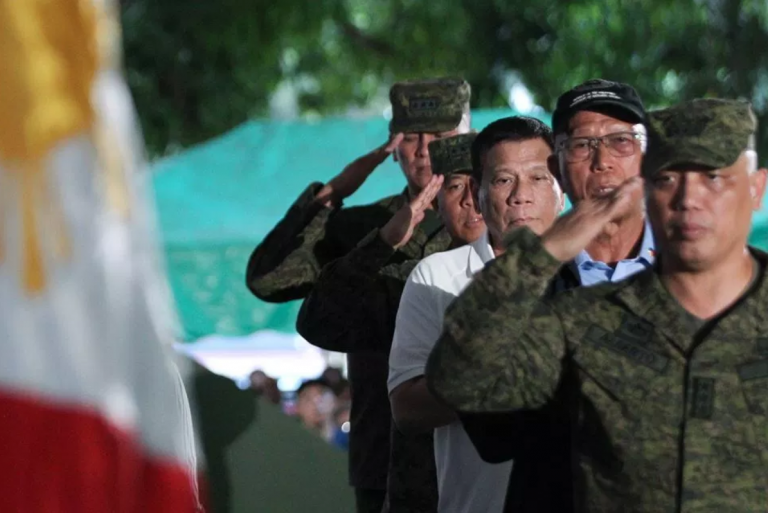
Back-to-back with the controversial withdrawal of the Philippines from the International Criminal Court (ICC) that took effect on March 17, the following day President Duterte dismissed the government panel negotiating peace with the National Democratic Front and, the day after, even said it was a “permanent” termination.

These moves by the president raise big questions and dire scenarios.

For one, the withdrawal from the ICC hasn’t foreclosed the continuation of the ICC prosecutor’s preliminary examination of several complaints of human rights violations attributed to Duterte. The initiation of such examination was what precisely spurred the president to back out of the treaty.

Malacañang obviously worries that the preliminary examination will lead to formal investigation and court proceedings against Duterte for alleged crimes against humanity. The charges pertain to the killings carried out, during the period July 1, 2016 to March 16, 2019, of thousands of Filipinos suspected or mistaken as illegal drug users or pushers. During this time frame, the Philippines was a party to the Rome Statute, the treaty that set up the ICC.

Indicative of its jittery frame of mind, a spate of questionable statements has been spewing out of Malacañang. These have ranged from claiming that the ICC has lost jurisdiction over Duterte; that investigating him will violate our national sovereignty; that if the ICC prosecutor and personnel come to the country to investigate they will be barred or summarily deported; and that if the ICC carries out the investigation outside the country any Filipino citizen who participates will be barred from leaving the country, or his/her passport will be cancelled.

Human rights defenders have promptly disputed all of these statements or denounced them as totally uncalled for.

As regards his peace talks with the NDFP, Duterte announced his disbandment of the GRP peace panel first, and then seemingly as an afterthought, his decision to “permanently” terminate the process (although one cannot be too sure about anything under this administration). The serious implication is that the gains achieved in the four rounds of GRP-NDFP formal negotiations under Duterte’s watch – acknowledged as “unprecedented” by both sides in their joint statements – will no longer be pursued and formalized as binding agreements.

Malacanan photo

Of specific significance are the consensus arrived at on the free distribution of land to landless peasants under genuine agrarian reform and rural development, as well as the other aspects of social and economic reform that constitute the “meat” of the agreement that would end the armed conflict, as both sides have recognized.

Why will these vital prospective agreements be junked? Because, according to Duterte’s current peace adviser, retired AFP chief Gen. Carlito Galvez Jr., what the government should do is to pursue “localized” peace negotiations instead.

What are localized peace negotiations? They focus on inducing surrender by offering a package of incentives to rebels, including cash in exchange for weapons, housing, educational support for children, and livelihood assistance. They are meant to help “those who want to leave and to have a peaceful life,” as explained by resigned presidential peace adviser Jesus Dureza.

This is a stop-gap remedy that does nothing to solve the persistent rural poverty and other deeply embedded problems that lie at the root of the armed revolutionary movement. This is the reason why it is laid down in the Hague Joint Declaration (the foundational agreement signed in 1992), that peace negotiations shall be conducted at the national and not at the local level, as the latter approach is tantamount to a divide-and-rule tactic.

General Galvez however has made clear that he is advocating the military-security establishment’s “whole-of-nation approach” in order“to achieve inclusive and sustainable peace” in dealing with the NDFP.

Moreover, a signal accomplishment during the term of President Fidel V. Ramos, the Comprehensive Agreement on Respect for Human Rights and International Humanitarian Law (CARHRIHL), is in danger of being set aside – unilaterally – by the Duterte government. Signed and approved by the principals of both parties in 1998, the CARHRIHL is the first and only comprehensive agreement painstakingly negotiated, signed and approved in the entire peace process, completing the first of the four-point agenda set under the Hague Joint Declaration.

Notably, the European Parliament has hailed the agreement as a unique landmark peace accord, singling out its provision for compensation to civilians whose rights are proven to have been violated by either side in the course of the 50-year armed conflict.

In the third and fourth rounds of formal negotiations under the Duterte regime (January-April 2017), the two sides completed the requisite guidelines for the implementation of the CARHRIHL and thus agreed to begin carrying out its provisions. Implementing the agreement would have gone a long way in testing the sincerity of both sides, alleviating the human rights violations even as the armed conflict continued, and building up mutual trust and confidence on and off the negotiating table.

As of the moment, Galvez pointed out, the government has “suspended recognition” of previously signed agreements (more than 10 substantive and procedural accords since 1992), pending review by the President. He specifically mentioned the CARHRIHL and the Hague Joint Declaration. As if to spite the NDFP side, arrests continue to be made of persons that Duterte’s authorities identify with it.

Peace advocates are hoping that the Duterte government will think some more about the consequences of its unilateral ”suspension of recognition” of the signed agreements. To any thoughtful observer it’s shortsighted and counterproductive.

This has come about because President Duterte has abandoned his original campaign promise to pursue and complete the GRP-NDFP negotiations, which his former chief peace negotiator Silvestre Bello III had kept saying would be Duterte’s best legacy to the Filipino people.

Instead he has yielded the peace question to the militarists and peace spoilers, such as Galvez who arrogantly declared on Wednesday, “For 32 years, we didn’t gain anything from the peace talks” with an adversary that has managed, still, to survive these many long years.

* * *

Email: satur.ocampo@gmail.com.
Published in Philippine Star
March 23, 2019

The post Duterte yields GRP-NDFP peace talks to the military appeared first on Bulatlat.

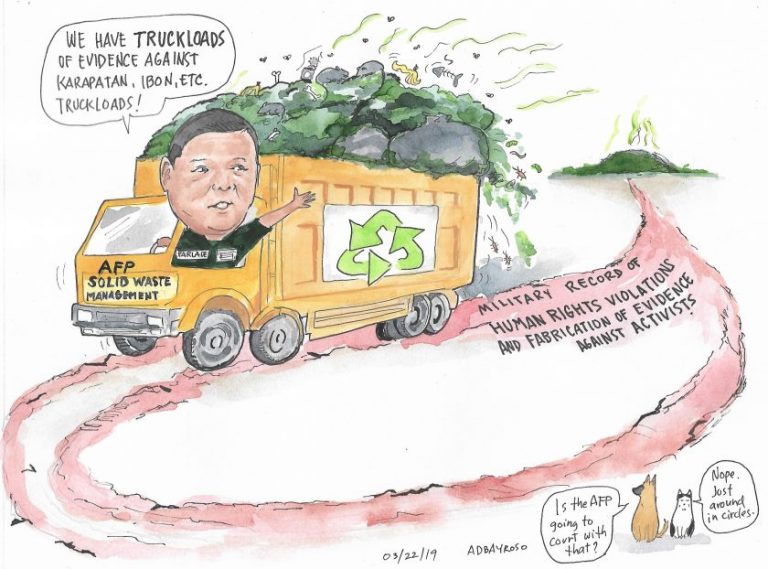
Truckloads of…


By DEE AYROSO
(http://bulatlat.com)

The post Truckloads of… appeared first on Bulatlat.

Angry Marawi women,youth barge through public hearing

0

Nearly two years of never-ending struggle to go back to where their houses once stood, the women and the youth held another show of anger and dismay over the failure of the government to improve the ground zero here, the scene of the heaviest battles of the armed forces and Maute group in 2017.

Why ‘partnerships’ with transnational companies are ‘pests’ to Filipino farmers

This, they said, has only been used to virtually rob them of their lands and turn the supposed “partners” under what appears to be a lopsided deal to a mere employee, receiving pittance.

By ALYSSA MAE CLARIN
Bulatlat.com

MANILA — In a recently-concluded two-day gathering, Filipino farm workers belonging to the Unyon ng mga Manggagawa sa Agrikultura discussed the impact of the supposed partnership deals with transnational agricultural companies to their livelihoods.

Ironically, the very same state-sanctioned policy that would supposedly improve their living conditions are killing their livelihoods instead.

This, they said, has only been used to virtually rob them of their lands and turn the supposed “partners” under what appears to be a lopsided deal to a mere employee, receiving pittance.

What is AVA?

Agribusiness venture arrangement (AVA) is a state policy that enables private investors to enter into partnerships with Agrarian Reform Beneficiaries (ARBs). Under AVA, agricultural lands are used to plant high value crops that are then used for export by big agri-corporations.

The Department of Agrarian Reform (DAR) recognizes AVA and considers it as a way of promoting engagements between private sectors and the ARBs. They also claimed that AVA is a way to utilize awarded lands to be more productive and sustainable by producing high value crops that sell at a higher price on the market, especially as exports.

Local farmers, however, think otherwise. According to most the farmers who gathered in Quezon City for their two-day congress, AVA is a “pest” to their lives.

Under the Comprehensive Agrarian Reform (CARP), guised as a joint business venture that would give prosperity and relief to agricultural workers, AVA is a non-land transfer scheme enabling agri-corporations to grab lands that are supposed to be for the farmers.

According to National Economic Development Authority (NEDA) 1.2 million hectares of land all over the country are under AVA since 2013, majority of the land are from Mindanao where 782,116 hectares are being used as “export crops backyard” by agri-corporations.

A big portion of the land used to be sources of food products such as rice, corn, cassava, and other root crops that local farmers plant for the local market.

Currently, AVA is targeting to venture into Palawan, Bohol, Ilocos, and Negros, a total 1.6 million hectares of agriculture land that would be used for plantation expansions.

How AVA affects farmers

According to UMA, farmers have no control over the lands they have leased under AVA, making them land owners only in paper.

Transnational Corporations (TNC) have been profiting for over 75 years. They decide what happens to the land, leaving the farmers no choice but become mere employees of their agricultural business, instead of business partners as what was agreed upon under AVA.
Almost 350,000 farmers in Mindanao have been robbed of their lands, and according to a study conducted by Kilusang Magbubukid ng Pilipinas (KMP) on 2014, 8 out of 10 farmers are landless.

Moros and Indigenous people have also been greatly affected by AVA. After being pushed out of their ancestral lands; effectively destroying much of their culture and community, Moros and IPs have turned to revolting against landlords, only to be answered by force.

Despite being the “export crops backyard,” 35 percent of the population or a total of 8.86 million people in Mindanao are poor.

The income ARBs receive after selling their crops and leasing their lands are not enough to sustain the farmers and their families. Farmers tied under AVA are forced to find other jobs just to provide decent meals for their families, sometimes even the farmers’ young children are forced into labor in order to produce more.

What do farmers want

Local farmers are continuously asking for the abolishment of AVA, urging the government to give attention to the minority and ancestral lands, and to stop the land-grabbing of agri-corporations that pushes farmers further down to the poverty line.

They also push for their rights for fair wages, job security, and humane working conditions.

What farmers want is true land reform that would not only give them land, but also give them enough support to sustain, maintain, and utilize the lands awarded to them. (http://bulatlat.com)

The post Why ‘partnerships’ with transnational companies are ‘pests’ to Filipino farmers appeared first on Bulatlat.