Home Blog Page 377

Beyond water interruptions: Expensive water and connection woes burden consumers

0

By the Samahan at Ugnayan ng mga Konsyumer para sa Ikauunlad ng Bayan (SUKI)

 The ongoing water shortage is just the latest among water problems that consumers have been struggling with for decades. Despite privatization and its promises, poor consumers across the metropolis still suffer expensive water, erratic connections, and inadequate services. The government and private water firms are still far away from providing cheap, accessible and adequate water for all.

For over a week now, water services have been disrupted in the East Zone concession area of Manila Water. Some six million households in 227 barangays in 8 cities and 9 towns of Metro Manila and Rizal have been affected. The operations of hospitals, schools, and businesses have also been affected. The water firm initially blamed the El Niño phenomenon for low water levels at La Mesa Dam, one of three reservoirs supplying water to Metro Manila, until this was refuted by government water and weather agencies who said this was still too weak to be a factor.

“Water firms invoke a water shortage year in year out, but for us consumers it’s government that has to take control of the situation because no one deserves to be deprived of water,” said Eufemia Doringo, an urban poor leader and co-convenor of the SUKI network.  “This queuing for so long even during the wee hours is another burden on our backs. We were already faced with erratic water supply and increasing bills even before this,” she said.

Urban poor’s pockets bleed

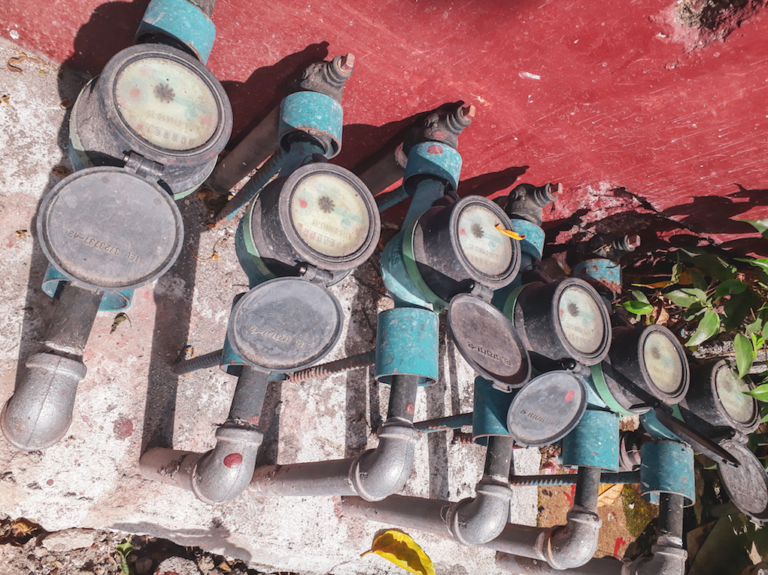
Doringo lives in a Camarin, North Caloocan relocation site of 10 medium-rise buildings housing almost 900 families who source water from a single mother connection. Maynilad, which has the West Zone concession area, cuts their water supply every time the households are unable to pay their bills which reached over Php800,000 in 2018. Many households do have difficulty paying for their water. The families’ incomes from construction work and odd jobs are low and always uncertain, so settling this huge debt on top of the Php1,000-Php2,000 monthly in rent for their units is a constant burden.

Low-income households in Tala, Caloocan City that mostly depend on construction workers and tricycle drivers, like Feliciano Ceno, also feel over-charged for water. Ceno is among 673 families living in 14 National Housing Authority (NHA) low-cost medium-rise buildings that share a single water source. They pay Php42.00 for every cubic meter of water and their Maynilad bill has gone up to as much as Php594,000. Aside from this, each family also shells out Php2.00 every day to pay the Php40,380 monthly salary of the site’s water administrator.

In Barangay San Roque, North Triangle, Quezon City, informal settlers do not have direct water connections and get their water from individuals with Manila Water accounts. The rate for low-income residential or ‘lifeline’ customers consuming not more than 10 cubic meters is only supposed to be Php80-82 but the bills of households averaging 5-6 members can reach as high as Php1,800 monthly. Others who remain unconnected pay as much or even more — “Boysen” pails of water cost Php5.00 each to be filled from faucets or deep wells and households use up to 12 of these daily. These water rates are exorbitant for families whose breadwinners are mostly temporary construction workers or vendors.

Costlier but unstable service

There are increasing reports of water supply becoming more expensive but less regular across the country due to privatization of local water districts. The Water for the People Network (WPN) said that more and more water districts are entering into joint venture agreements with private water firms. At least 37 of these are with the PrimeWater Infrastructure Corporation of former senator and real estate magnate Manuel Villar who recently become the richest Filipino.

Consumers are complaining that water rates have increased from pre-joint venture levels. For instance, the Alliance for Consumer Protection (ACP) of Bulacan said that the water bills of average-sized households in the municipality of San Jose Del Monte, Bulacan, have gone up from Php300 to Php400-500 per month since the local government forced the water district into a joint venture with PrimeWater. The consumer alliance also noted intermittent service interruptions since the joint venture took effect in May 2018 that were not happening before.

In Samal, Bataan, residents used to enjoy free, clean and uninterrupted water supply — until the local water district entered into a joint venture with PrimeWater in 2016. Residents said that the municipality’s old sources of water like pumps and wells started running dry when PrimeWater started operating. This forced them to start buying water from the private firm. The population of mostly poor farmers, fisherfolk and workers suddenly found themselves burdened with a previously unheard of additional expense.

Does it have to be privatized?

WPN said that these cases of more expensive and inaccessible water and, recently, the disruption of water services in Metro Manila are just the tip of the iceberg. Every day brings more and more complaints of expensive connections, costly water rates, and interrupted services especially from low-income consumers who have no choice because water is such an essential basic utility.

Pubic water services are steadily being privatized not just in big cities but also in local water districts of smaller cities and municipalities. The government has apparently not learned its lesson from the failures of Metro Manila water privatization and, if anything, has been accelerating water privatization in recent years. It is abdicating its responsibility to provide water for all – as water is a basic right – and giving this to the private sector to profit from.

The trend of passing public utilities such as water into the hands of profit-oriented private firms has to stop. Lessons can be learned from the successful experience of local government-run water districts that have efficiently delivered affordable and adequate water services to their customers. Beyond this, public water services capacity can also be built at regional and national levels with a responsible government that is transparent and accountable to the people. ###
GRP agents arrest NDFP peace consultant Renante Gamara

0
A National Democratic Front of the Philippines (NDFP) peace consultant was arrested by combined police, military and intelligence agents Wednesday night two days after President Rodrigo Duterte dissolved his government’s negotiating panel with the Left. Renante Gamara, NDFP peace consultant for the National Capital Region, was arrested by the Regional Special Operations Unit of the […]

Farm workers decry plantation expansions

(Photo by J. Ellao / Bulatlat)

By JANESS ANN J. ELLAO
Bulatlat.com

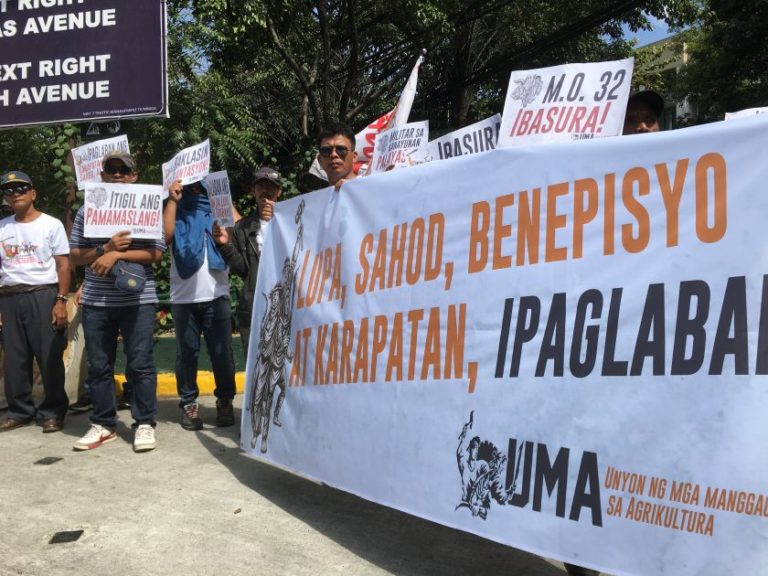
MANILA – A group of farm workers held a protest action today, March 21, in front of the Department of Agrarian Reform in Quezon City to decry the continuing expansion of plantations in the country instead of providing much-needed subsidies for farm inputs.

In what appears to be a virtual landgrabbing, Unyon ng mga Manggagawa sa Agrikultura said in a statement that transnational corporations are able to have “effective control over the lands of farmers and ARBs” referring to agrarian reform beneficiaries, through the so-called Agribusiness Ventures Arrangements (AVA).

AVA is one of the non-land transfer schemes allowed in the government agrarian reform program.

Related story: ‘Farmers are misled, ignored in the Philippines’

(Photo by J. Ellao / Bulatlat)

Representatives of farm workers groups from all over the country gathered for a two-day conference in Quezon City, where they discussed the impacts of the expansion of transnational plantations in the country. (http://bulatlat.com)

Want to read stories like this? Help us keep up continue writing about issues that matter.

The post Farm workers decry plantation expansions appeared first on Bulatlat.

‘Farmers are misled, ignored in the Philippines’

File photo.

“What we have seen so far is that the government is not serious in improving the agricultural industry in the country.”

By ALYSSA MAE CLARIN
Bulatlat.com

MANILA – The irony is not lost to agricultural workers that comprise at least 75 percent of the country total labor force.

This was the prevailing sentiment as agricultural workers under the Unyon ng mga Manggagawa sa Agrikultura (UMA), a national progressive center of unions, federations and organizations of agricultural workers in the Philippines, gathered for the National Conference on the Expansion of Plantations through Agribusiness Venture Arrangements (AVA) on March 20 to discuss their plight these days.

These arrangements dubbed as AVA enables agri-corporations to expand their plantations for export products to the detriment of the farmers.

“What we produce, should be for ourselves,” said Rosario Bella Guzman of Ibon Foundation. said to the farmers gathered.

Farmers are being misled

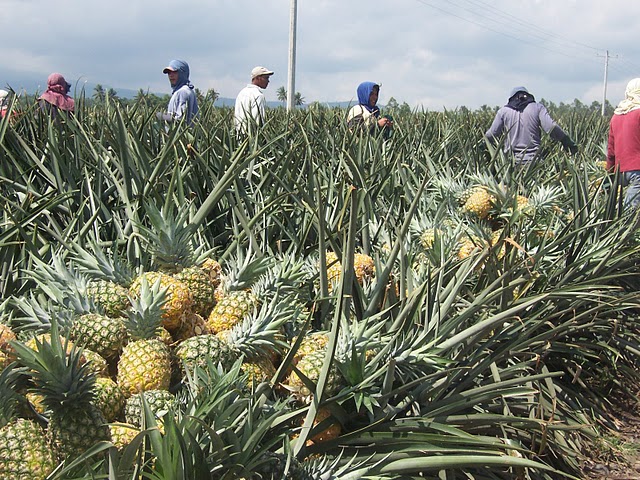
Oscarv Serohijos of the Dolefil Agrarian Reform Beneficiaries and Cooperative (DARBC) expressed his dismay at the current treatment of growers in South Cotabato.

According Serohijos, the cooperative of pineapple growers tending to a more than 7,000-hectare plantation were misled into signing a lopsided contract that decreased their earnings from almost P84,000 ($1,600) per hectare per year to P50,000 ($940) per hectare per year. They, however, still need to deduct the production cost.

Serohijos said their take home pay per hectare per year back in 2015 was only P15,000 ($285). They still need to divide this among 7,534 members. Basically, he added, that they receive a measly P1.50 ($0.028) per hectare per year.

Meanwhile, as farm workers live way below the poverty line, Dolefil has earned and accumulated P61 million as of 2015, according to Serohijos.

“I told them that this is a contract bound to fail. We were already earning that much in the cooperative,” he said in Filipino, “But officials did not utter a single word. They could not deny it. We have a strong basis.”

Serohijos has already filed a petition before the Cooperative president, asking for the abrogation of the contract. He added that farm workers are being misled because those who sit in their cooperative board are puppets of the agri-companies.

“All the progressive leaders were removed,” he said, adding that trumped-up charges were filed against them.

Serohijos believes that they should not be taking this fight alone, urging the government to intervene as this is supposedly part of their agrarian reform program.

Government should take agrarian problems seriously

Farm workers pointed out that the government’s agrarian reform program should not merely distribute land but to also provide subsidiary support to poor local farmers to aid their production.

A farm worker noted that indigenous farmers from the Cordillera region are forced to accept lopsided contracts with agri-companies due to their impoverished living conditions.

He said during the forum, “What we have seen so far is that the government is not serious in improving the agricultural industry in the country. It is only concerned with getting profits from our natural resources.” (http://bulatlat.com)

Want to read stories like this? Help us keep up continue writing about issues that matter.

The post ‘Farmers are misled, ignored in the Philippines’ appeared first on Bulatlat.

Free Renante Gamara! Stop political persecution of peace consultants!

0

Karapatan strongly condemns the illegal arrest of another peace consultant of the National Democratic Front of the Philippines (NDFP) on the evening March 20, 2019. Peace consultant Renante Gamara and his companion, Arturo Balagat, a former priest, were reportedly arrested by combined elements of the Special Action Force (SAF) and the Philippine Army. They were brought to Camp General Pantaleon Garcia in Imus, Cavite at around 10:30PM yesterday, and are now both in NCRPO Bicutan. Both were charged with trumped-up charges of illegal possession of firearms and explosives. 

read more

NUJP condemns harassment of Gumaca radio station

0
The National Union of Journalists of the Philippines condemns the harassment being perpetrated by Gumaca Quezon Mayor Erwin Caralian and his brother, Vice Mayor El Chor Caralian against Radyo Natin Gumaca. Radyo Natin Operations Manager Mitch Hernando complains that despite having complied with all the necessary papers, the station is being denied renewal of the […]

Relatives of human rights victims urge end to attacks against human rights defenders

0

Women human rights defenders Nanette Castillo and Jimmylisa Badayos expressed support for human rights defenders of Karapatan and other rights groups, and called for an end to the attacks against human rights organizations. Castillo lost her son to Duterte’s drug war campaign and has since worked alongside Rise Up for Life and Rights, an organization which supports victims and families of the government’s brutal anti-narcotics drive. Jimmylisa Badayos, on the other hand, is the daughter of woman human rights defender Elisa Badayos. Elisa Badayos was the regional coordinator of Karapatan in the Visayas when she was killed in November 2017 by suspected members of a landlord’s private army, which doubles as a paramilitary group. Both Castillo and Badayos have worked with Karapatan on several campaigns. 

read more

Duterte dissolves GRP peace panel; NDFP not surprised

0
President Rodrigo Duterte dissolved the Government of the Republic of the Philippines (GRP) Negotiating Panel with the Left led by Department of Labor and Employment secretary Silvestre H. Bello III. Along with Bello, panel members Hernani Braganza, Atty. Angela Librado-Trinidad, Atty. Rene Sarmiento and Atty. Antonio Arellano were terminated as of Monday, March 18. In […]