Home Blog Page 379

Lumad student shot dead in Davao del Norte

0

A Lumad student was shot dead by a member of the military auxiliary force Citizens Armed Forces Geographical Unit on Friday, March 15 in Talaingod town, Davao del Norte, the Save Our School Network reported on Monday.
“Priests should be shot” is an order by the President

It is an order from the President Rodrigo Duterte not only for the “abusive” priests, but for all priests.

Duterte once again issued an order to kill the priests after the Roman Catholic Church (RC) had apologized for the “sexual misconduct” committed by a few members of its clergy, but not all clergy. The recent “sexual abuses” that challenged the RC Church gave Duterte the opportunity to continue attacking the Church and its clergy.

Duterte on March 14, 2019 in a “peace and order meeting” in the Joint Armed Forces of the Philippines-Philippine National Police (AFP-PNP) Command Conference at the Arcadia Active Lifestyle Center in Davao City, said:

“Putang-ina kayong pari dapat nga kayo ang pagbabarilin eh…Putangina mamatay na kayong lahat, wala akong pakialam.”

(You sons of bitches, you priests, you should be shot…You sons of bitches, you all should die, I don’t care.)

“Wala akong pakialam kung mamatay kayong lahat, maluwang pa ang ating cemetery. Tangina, making me feel guilty about my – kayo ang nauna,” he added.

(I don’t care if you all die, our cemeteries are still spacious. Sons of bitches, making me feel guilty about my – you started it.)

Before this pronouncement, Duterte insulted the priests as stupid and warned the women not to go near to them. This vilification among the clergy was first made by Duterte and now the command to shot the priests was uttered by the infamous and fascist President himself.

The death threats received by Caloocan Bishop Pablo David and other RC priests were sent through text messages. But Duterte himself is openly ordering to kill the priests. Surely, Duterte’s lapdogs will be busy to find excuses if someday one of these priests will be killed.

The death threats are not only received by the RC clergy, but also received by the clergy of the Iglesia Filipina Independiente or Aglipyan church and other churches. Missionaries of the Rural Missionaries in the Philippines are also persecuted, threatened and detained.

Duterte wants the people to live in fear. If he can threaten the clergy, how much more to the ordinary citizens.


Who are the priests in the Philippines?

It is good to understand the priest and his/her ministry, especially in the context of the Philippine society.

A priest is an ordained person, commissioned to be an intermediary between the people and God. His/her function is basically to represent the people or offer the people to God. The priest stands between God and man/woman. He is God’s representative and ambassador. Priests perform sacred rites, administer the sacraments, preach, make intercession, pronounce absolution, and safeguard sacred buildings and treasures of the Church.

The dignity of a priest is the highest on earth. His/her act of sanctifying the sacraments denotes the highest degree of sacredness. A priest is authorized to pray, bless and convert bread into the Body of Christ by the power of the word and action and can sanctioned to forgive sins.

The honor and respect to a priest or convey to the priest, it is also render to God Himself. To become a priest is a serious decision and a sacred duty to do or actualize it in his/her life. The life of a priest is a calling to serve God and people, especially those in need.

To become a priest entails a lot of sacrifices and dedication to God. Though, most of the priests in the Philippines enjoy a certain level of comfort, luxury and leisure, they are aware of the sufferings and hardships of the people, especially the poor and marginalized, they have served.

The Church canons, in general, enjoin priests to live a simple way of life and avoid living in worldliness. They have to experience living with the poor. They have to have immersion and solidarity among the poor people. Just like other vocations, priesthood is not an easy vocation. Many are called, but few are chosen.

The present context of the mission and ministry of the priests where many people are suffering and living in poverty and want should not be taken lightly. It must be seriously considered by the priests who took a vow of serving God and His people.

The priests’ calling is a challenge.

Priests cannot back out from their calling just because their lives are threatened or they received death threats. They are even prepared to accept sacrifices and death as Jesus had offered his life to redeem the world. They have to face the risks and attacks as part of their mission and ministry.

The order made by Duterte to shot the priests though condemnable and deplorable, must be accepted by the priests who are truly working and preaching the truth, justice and peace. But this does not mean that they will or should not take any measure and precaution. This is a struggle. It is actualizing the theology of the struggle. The Church is a sanctuary, but communities of people, especially in the countryside, are also good sanctuaries.

The calling of the priests in the Philippines is a great challenge. The Philippine is a backward and decadent society. The activists attribute these characteristics to the conditions in a semi-feudal and semi-colonial society. The activists had upheld an analysis that the worsening poverty and continuing suffering of the people in this kind of society are brought about by problems of imperialism, feudalism and bureaucrat capitalism. As a result of these three basic problems, the country is ruled by the comprador-landlord class, the 1% who hold 99% of the country’s wealth.

Christian activists also recognized that the Christian churches in the Philippines is a product of a colonial and feudal history and continue to serve mainly the exploiters and oppressors of this country.

This churches’ present condition is an opposite to the true Christian adherence to the tenet of loving the least of the brethren and accepting the challenge that the Christian faith gives, a challenge to liberation and love, unto death if necessary, so that others may live and live fully.

The need for democratic reform within the Churches is necessary and imperative. The church leaders, church people and Christians in general must think, accept and decide to help re-build the Church of the poor.

Thus, the challenge is not only living and exercising the priestly functions inside the church. The large number of Christians are living and working outside the Church. The priests must go out and participate in the struggle of the people to realize a better world of freedom, justice, progress and peace. By doing it, the Church will eventually be reformed or re-built by the power of the people with the sanctification of the Holy Spirit.

The mission and ministry of the priests and other church people shall support the struggle of the people, especially in raising the consciousness of the people, help them organize and support their mobilizations to advance their struggle.

In fulfilling the mission and ministry of Jesus Christ, priests shall help in giving flesh and blood to the Christian faith. The priests and other church people shall incarnate themselves in the deepest possible way to link to the life and death struggle of the people.

This path is not easy. This is, therefore, a call to sacrifice, up to the shedding of blood as many revolutionary and progressive church people martyrs have offered.

However, this challenge must be filled with realistic hope. The sacrifices and deaths, like those of the people who have laid down their lives, will not be in vain. Others will continue the struggle, in the same way that they carry forward the struggle begun by those before them.

The experience of church people in participating in the mass movement imbues the faith of the church people who carry on the struggle with fresh meaning. They believe that the people are rising up. It is the meaning of the resurrection at present.

Church people, especially the priests, and the people will achieve a common liberation and experience the liberating power of the Christian faith in the realization of the reign of God on earth as it is heaven.

The post “Priests should be shot” is an order by the President appeared first on Manila Today.

Mission finds ‘patterns of state-sanctioned violence’ against Filipino lawyers

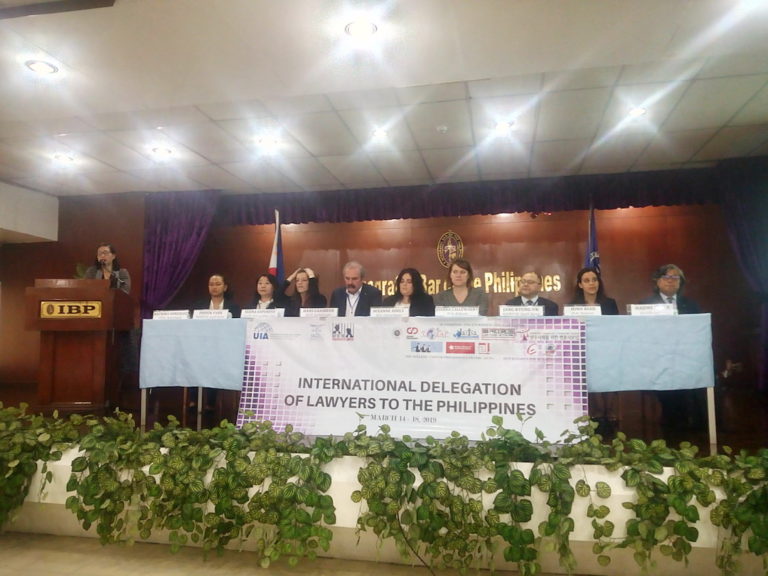
Foreign lawyers underscore the pattern of “state-sanctioned” violence against Filipino lawyers in a press conference, March 18 at the IBP Building. (Photo by Alyssa Mae Clarin / Bulatlat)

“The more serious the crime, the less serious the investigation.”

By ALYSSA MAE CLARIN
Bulatlat.com

MANILA — An international fact-finding mission composed of nine lawyers from different lawyers’ organizations found clear patterns “suggesting a connection between the killings of lawyers and the actions of the Philippine National Police (PNP) and the Armed Forces of the Philippines (AFP).”

At least 37 members of the legal profession in the Philippines have been killed for exercising their duties and profession since the current administration took office in June 2016. Two paralegals of human rights lawyers have been reported as killed and the lawyers’ groups believe the number of others killed is higher.

In a press conference, March 18 at the Integrated Bar of the Philippines building, the delegation noted “recurrent elements” sustaining such connection.

First, they noted several public declarations of President Duterte targeting lawyers. Speaking about his drug war, Duterte already stated in August 2016: “…even their lawyers, I will include them”.

Second, before the killings have taken place, victims were tagged, harassed and surveilled.

Third, the perpetrators were professional, skilled shooters. They were masked killers operating on crowded public streets, and often used 22 caliber guns with silencers and rode on motorbikes.

Fourth, the lack of sufficient investigation is notable. There is no inventory of the used guns; no documented files about the killings linked to the judiciary. There has been a refusal to hear and protect witnesses and there were reported incidents of harassment of witnesses by police or military.

The lawyers’ group believes that the lack of oversight from executive bodies and law enforcement agencies further hampers progress in investigating and prosecuting these cases. This, in turn, supports the culture of impunity in the country.

“The more serious the crime, the less serious the investigation,” said Dutch lawyer Hans Gaasbeek.

Suzanne Adely, the delegation’s spokesperson, said that the biggest hindrance is the lack of witnesses willing to come forward.

“Our conversation was focused on trying to understand how the National Bureau of Investigation has investigated the specific cases they have taken up,” Adely explained. She said the delegation came to a consensus and described the investigations conducted regarding these cases as ‘unsatisfactory.’

The lawyers reported that they attempted to meet with the Philippine National Police and the Armed Forces of the Philippines but up until the time they concluded their schedule, “they did not give us an audience.”

Fifth, the killings targeted lawyers handling political cases and drug cases. The killings often happen in militarized zones. The police know what lawyers are assigned on what cases and when and where they have to appear in court.

From March 14 to March 17, the lawyers conducted interviews and conferences in Metro Manila and Iloilo with victims of rights violations and their families, and rights advocates from non-government offices. The lawyers’ delegation closely reviewed 13 incidents of reported attacks on legal professionals.

The lawyers also asked to meet with the Supreme Court but the Chief Justice designated the Philippine Judges Association president to represent the court. They also met with representatives of the Department of Justice, National Bureau of Investigation, Commission on Human Rights, the Integrated Bar of the Philippines, Manlaban and Karapatan.

The lawyers’ groups also learned that lawyers in the Philippines have been red-tagged for defending human rights, defending political dissidents, and defending victims of human rights violations. They noted that while the practice of red-tagging existed before, it has increased dramatically under the current administration.

Red-baiting is defined (in Zarate vs. Aquino III, by a dissenting Supreme Court Associate Justice) as: “the act of labeling, branding, naming and accusing individuals and/ or organizations of being left-leaning, subversives, communists or terrorists (used as) a strategy…by State agents, particularly law enforcement agencies and the military, against those perceived to be ‘threats’ or ‘enemies of the State’.”

The lawyers’ delegation has experienced for themselves an example of red-tagging. While holding a meeting in Iloilo, a poster appeared red-tagging lawyers and human rights workers. This case alarmed the lawyers’ delegation as they noted that the targeted were also tagged as belonging to a “terrorist syndicate”.

Italian lawyer Elena Esposito of the Giurist Democrati said, “A severe human rights violation, it’s not about the number (of killings) but on the rights that were hampered and threatened.”

The lawyers from Belgium, Italy, Japan, Korea, Netherlands and the U.S. called on President Rodrigo Duterte, who is also a lawyer, to refrain from publicly attacking fellow lawyers and urged him to publicly condemn all attacks against lawyers and other members of the legal profession and to abide by the UN Basic Principles on the Role of Lawyers.

Effect of attacks on PH lawyers

The delegation concluded that the attacks, harassment, intimidation of legal practitioners prevent them from fully and freely exercising their profession.

This is a direct violation of Article 2, paragraph 3 of the International Convention on Civil and Political Rights that ensures the citizens have access to justice and due process, along with Article 8 of the UN that states that everyone has equal rights to an effective judicial remedy.

“If lawyers become afraid to represent the people due to political causes, the ordinary people end up with little to no access to justice and due process,” said Adely.

Not an intervention, but a recommendation

The group put forward a list of initial recommendations in their desire to protect their peers and to ensure the independence of judges and lawyers, and to uphold basic due process for all, including those of critics and dissenters.

“We are professionals in fraternity with other professionals around the world. (The fact-finding) was done more out of concern, and not as an act of intervention (into the government),” Adely clarified. She said that the study was conducted to share awareness among professional lawyers around the world.

The delegation recommended that the government has to stop its practice of red-tagging, as well as publicly disclosing drug lists that endangers the lives of the people involved.

“From what we learned there are no criteria nor minimum evidence required to be named on these lists and names are frequently made public.”

The lawyers group also said the government should put more effort in the protection and safety of lawyers and legal workers, in accordance with the UN Basic Principles on the Role of Lawyers that ensures the safeguarding of practitioners while performing their duties and profession.

The delegation also urged everyone especially the government not to identify the lawyers by the cases they handle. They said that public authorities, including legal practitioners, must come to terms with the fact that these attacks signify a structural problem rather than a mere ‘risk for being in the legal profession.

They recommended assistance and help for the families of the victims and these include legal and financial support.

The lawyers suggested the creation of an independent, credible and partial body, one that is not under the control or influence of the government, composed of members selected exclusively from nominees from lawyer’s organizations, civil society, the church and the like in a transparent way, who are known for their human rights record, independence and integrity.

The lawyers’ delegation said that the cases of human rights violation still have a ‘long way to go’ before it could be put forth to the International Criminal Court. “The government should be the first to take a step in solving this case.”

The lawyers’ delegation is set to release a follow-up full report on their study after finalizing the data they have gathered during their stay in the Philippines.

Organized by the International Association of Democratic Lawyers (IADL), International Association of Lawyers (UIA), and Day of the Endangered Lawyer Foundation (DELF). (http://bulatlat.com)

Want to read stories like this? Help us keep up continue writing about issues that matter.

The post Mission finds ‘patterns of state-sanctioned violence’ against Filipino lawyers appeared first on Bulatlat.

UE student leaders cry harassment from admin over tuition increase issue

College of Arts and Sciences Student Council (CASSC) officers of the University of the East (UE) in Manila have been threatened to be blocked from graduation should they not sign the tuition and other school fees increases documents, according to a text message from a Students Affairs Office employee.

CASSC Vice President Martin Nepomuceno reported to have received threats due to his refusal to sign the documents pertaining to the proposed 5% tuition increase in the university on Monday, March 18. The documents included the minutes of the consultation as well as the approval of the proposal.

In an interview, Nepomuceno claimed that his signature has been sought after by the school administration despite his disagreement with the proposed tuition increase of the school. He claimed that the administration staff even went as far as threatening to block his graduation should he not sign the documents.

“I personally expected that this would happen so I was not that surprised. The administration would really do its best to forward its own interests. On our end, we are doing our best to strengthen our campaign to stop the looming tuition and other fee increase,” said Nepomuceno in Filipino.

Currently, youth organizations and the student body within the university have been part of the continuing signature campaign against the tuition fee increase. The initiative, launched by the Kapit-Bisig Party Alliance, has already gathered hundreds of signatures. The students also planned to reach even the networks of the parents for the campaign. The students aimed to continue raise awareness and build unities against the impending increase.

The Kapit-Bisig Party Alliance won the majority of seats in the University Student Council early this month with their stand against the tuition increase as one of their main campaign issues.

“As student leaders, our mandate does not lie on the administration but on the students. It is clear that students are against the tuition and other school fee increases, that’s why we are forwarding this call. We also condemn the administration’s moves to disregard the students’ voice. We are calling all the students to unite with our campaign against tuition and other school fee increases. Only in our collective action can we champion this struggle.” Nepomuceno said.


Youth groups in solidarity

News about the incident earned the ire of various youth groups.

“This is a clear blatant act of intimidation of student council leaders who genuinely stand against the tuition increase. Nevertheless, this is not an isolated case where student leaders are being intimidated by the administration thus using their power to repress students who are standing and advancing the rights of the students,” said National Union of Students of the Philippines Metro Manila in their statement.

Meanwhile, Kabataan Party-list Metro Manila expressed its concern over the administration’s recent steps to “pressure” student council heads into signing documents important to the fruition of the school’s tuition and other school fees increase. In their statement, the youth group manifested the consequences of such actions especially with the developments of the continuing campaign waged by the student body.

“Adding their signatures would mean their agreement to increasing tuition and other school fees to as high as 5% for A.Y. 2019-2020. Pressuring student council heads into signing the TOFI papers shows the administration’s disregard for the students’ voice in implementing school policies, especially those directly affecting students and parents/guardians. Members of the student body have initially expressed their disapproval versus the TOFI amid lack of a public consultation,” said Kabataan Party-list Metro Manila in a statement.

Kabataan Party-list Metro Manila also extended its solidarity with the students campaign against the continuing increase.

“We stand with all universities asserting their fundamental right to education. We condemn administration-sanctioned repression on an enlightened and empowered student body.”

The post UE student leaders cry harassment from admin over tuition increase issue appeared first on Manila Today.

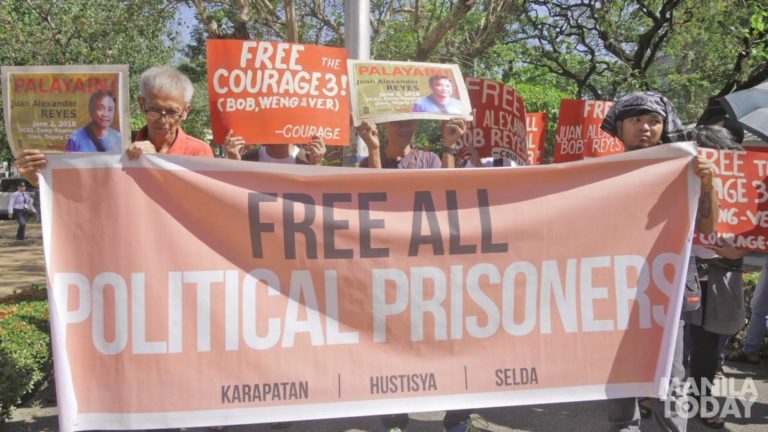
Witnesses in illegal possession of firearms case against political prisoner Bob Reyes, no-shows for third time

The hearing on the illegal possession of firearms charges against Bob Reyes in the Quezon City Regional Trial Court (QC RTC) Branch 95 lasted for around 30 minutes only as the police were not able to present their witnesses. This was the third time that the police witnesses failed to appear for Reyes’ hearing.

Meanwhile, the illegal possession of explosives case against Bob has been pending with the Department of Justice, according to Reyes’ wife Meri. She said their family have been waiting whether this case will be dismissed or it will be sent to the QC RTC as well.

Recently, an additional case was slapped against Bob in Agusan Del Sur. His three cases (of frustrated murder) in Agusan Del Sur became four, with the addition of a charge for syndicated arson.

Meri said Bob has never set foot in Agusan Del Sur. Bob has been slapped with six cases.

“Ibalik ninyo ang tatay ng mga anak ko, tinanggalin nila ng ama ang anak ko. Ibalik nyo ang asawa ko sa amin at tanggalin nyo na ang mga trumped up charges na iyan. Kung ano ang mga issue na pinaglalaban nila harapin ninyo, pakinggan nyo. Kasi ang mga taong ito ay nagpapaalala sa inyo ng mga bagay na kinakalimutan ninyo kaya sila nagproprotesta,” Meri addressed the administration of President Rodrigo Duterte.

[Return their father to my children, they deprived my children of a father. Return my husband to us and dismiss these trumped up charges. The issues they are fighting for must be addressed, must be heard. People like my husband remind government of what they have neglected that’s why they are protesting.]

Reyes, 48, coordinator of Sandigan ng Manggagawa sa Quezon City and a former organizer of government employees was illegally arrested June 2 last year while on his way home from a meeting with workers from Quezon City. He and his companion was forcibly taken in a vehicle by four men. They were blindfolded and a gun and a detonation cord was allegedly planted on his small pouch. His companion was left off on the way with the abductors saying he was not the target. Reyes’ whereabouts were unknown for almost 12 hours until he was surfaced in the Criminal Investigation and Detection Group detention area in Camp Crame.

The Free Bob Reyes Movement trooped to the QC RTC in time for detained unionist Bob Reyes’ hearing this morning. The network consists of Karapatan, Bagong Alyansang Makabayan Quezon City and Sandigan ng Manggagawa sa Quezon City.

The post Witnesses in illegal possession of firearms case against political prisoner Bob Reyes, no-shows for third time appeared first on Manila Today.

Sa ngalan ng tubig

Ang tubig ay buhay, tulad ng pag-agos nito sa iba’t ibang anyong tubig, ng pagdaloy nito sa ating katawan. Sabi nga nila, mawalan na ng kuryente ‘wag lang ng tubig”.

Sa panahong nararanasan ang kawalan ng tubig sa ilang mga lugar sa Pilipinas, hindi maitatanggi ang realidad ng lipunan na puno ng problema na tila walang makapitan at pag-asa na pinagmumulan ng kawalan ng pag-aari ng mamamayan sa sariling likas na yaman ng bayan.

Ang kasalukuyang kalagayan sa tubig ay tulad nang nangyari sa isyu ng bigas, nagkaroon ng rice shortage at ilang buwan lamang ang nakalipas, nagkaroon ng rice tarrification law na mas lalong papatay sa kabuhayan ng uring magsasaka.

Sa nangyayaring kawalan ng tubig ay ang nagsusulputang proyektong iniaalok na pautang ng mga pribado at multinasyonal na kumpanya mula sa ibang bansa lalo ng Tsina para sa paglikha ng bagong dam. Isang solusyon na lumilikha na panibagong problema sapagka’t maaaring makasira sa kalikasan at magpalayas sa libu-libong mga katutubo mula sa kanilang lupang ninuno. Maaaring gamitin ang diumano’y water shortage bilang katwiran upang ituloy ang anti-mamamayan at makadayuhang proyekto.

Isang solusyon—ang pribatisasyon—na inalok na sa atin sa krisis sa tubig tatlong dekada ang nakaraan at ngayo’y tumatambad na wala rin namang tunay na nasolusyunan. Dahil umano hindi episyente ang paggana ng gobyerno, kailangang mga pribadong kumpanya ang magpatakbo ng pagdadala ng tubig sa mga kabahayan—isang batayang serbisyo at pampublikong utilidad na dapat gobyerno ang mamahala upang matiyak ang abot-kayang presyo at kalidad ng serbisyo. Ngayon, negosyo hindi serbisyo ang patubig sa Metro Manila at kalakhan ng bansa; tubo, hindi tao, ang inuuna ng mga negosyong ito.

Ang krisis sa tubig ay problemang dulot ng pribatisasyon.

Sa konteksto ng Pilipinas, monopolyo ng mga pribadong pagmamay-ari o malalaking pribadong kumpanya ang access at kontrol sa pinagmumulan ng tubig. Kung totoo man ang kakulangan sa tubig (water shortage) dahil sa El Niño, binibigyang prayoridad ng mga kumpanyang may kontrol tulad ng Manila Water at Maynilad ang malalaking konsyumer tulad ng mga mayayamang negosyante at ang kanilang negosyo kumpara sa pagbibigay serbisyo sa mga ordinaryong konsyumer.  Hindi rin maitatanggi na ang mga may kontrol sa negosyo ng tubig ay lumilikha ng artipisyal na krisis upang mas higit na makontrol ang access at tuluyang kakuntsaba ng pamahalaan sa kanilang makasariling polisiya. Ilang ulit na rin sinasabi ng ahensya ng gobyerno sa tubig, ang Manila Waterworks and Sewerage System na walang kakulangan sa tubig—ngunit may hatian na 60-40 sa dalawang pribadong kumpanya sa mga tubig na kinukuha nito sa mga mga dam at imbakan ng tubig at dinadala sa mga kabahayan at maaaring hindi absoluto ang hatian sa panahon na mas mataas ang demand sa isang panig.

Samantala, sa paghahanap ng higit pakinabang ng mga pribadong korporasyon, ang mga ordinaryong mamamayan naman ay pinagdurusa bukod sa binibigyan ng kawalang pag-asa at desperasyon upang mapapayag lang sa anumang panibagong solusyong inaalok.

Noon pa nararanasan ang problema sa tubig, hindi lang sa Metro Manila, kundi sa buong bansa. Marami pa ring mga sitio at liblib na lugar sa mga probinsya at maging sa ilang bahagi ng mga siyudad ang kawalang aksesibilidad sa malinis at maayos na sistema ng patubig. Ang ganitong kalagayan ay nagdudulot atrasadong pamumuhay at kabuhayan at pagkakait sa karapatang mamuhay nang marangal.

Ang isyu sa tubig ay isyu ng buhay. Karugtong ng kawalang tubig ang pagkasira sa sistema ng pamumuhay ng isang indibidwal. Manipestasyon din ng kawalang tubig ang bulok na pamamahala ng gobyerno, dahil kahit ang pinakabatayang pangangailangan ng kanyang mamamayan ay hindi maipagkaloob. Matagal nang nagbababala ang mga eksperto at ilang pag-aaral hinggil sa anila’y lumalalang problema sa tubig, laluna sa malinis na inu­ming tubig sa malaking bahagi ng bansa.

Sa pagkakataong ito, panahon na para gumawa ng kagyat na hakbang ang pamahalaan para sa komprehensibong pag-aaral na makamasa at siyentipikong pamamaraan upang hindi na maulit pa sa hinaharap ang matinding diumano’y kakulangan sa tubig. Dapat nang rebisahin ang mga polisiya na tumatapak sa mga batayang karapatan ng mamamayan na mabuhay nang may dignidad—kung ano na ang inabot na kasakiman ng pribatisasyon sa kasalukuyan. Dapat nang isabansa ang mga batayang serbisyo at pampublikong utilidad sa bansa upang tunay na makapagsilbi sa interes ng mamamayan.

The post Sa ngalan ng tubig appeared first on Manila Today.

Chedeng forces 3,000 Davao Oriental residents to evacuate

0

More than 3,000 individuals from three areas in Davao Oriental have to evacuate from their homes due to hours of heavy rains since Monday night due to Tropical Depression Chedeng.

Evacuation ordered hours before Chedeng landfall in Davao

0

Residents in landslide-prone areas in Davao City were advised for pre-emptive evacuation due to heavy rains brought by the Tropical Depression Chedeng.