Home Blog Page 380

Tubig at iba pa

Hindi na kailangang ipaliwanag kung bakit mahalaga ang tubig. Ginagamit ito sa paglilinis, pagluluto at paglalaba. Kung maliligo o magsesepilyo, may tubig pa ring makokonsumo.

Kaya nga napakalaking abala kung mawawalan ng suplay nito, lalo na kung napakahabang oras na walang tubig at natapat pa sa oras ng almusal, tanghalian o hapunan. Makakapagsaing pa kaya ng bigas? Paano na lang ang lulutuin sanang ulam na may sabaw? At kung makahingi ng kahit kaunting tubig sa kapitbahay para makapagluto, makakaya pa kayang hugasan ang pinagkainan?

Para sa pamilyang mahirap, wala nang magagawa sa pagkakataong iyon kundi magtiis at maghintay. Para sa pamilyang mayaman, makakaya nilang kumain na lang sa labas para hindi na problemahin ang kawalan ng tubig sa bahay. Aba, puwede nga silang tumira pansamantala sa isang hotel para matakasan ang diumanong krisis sa tubig.

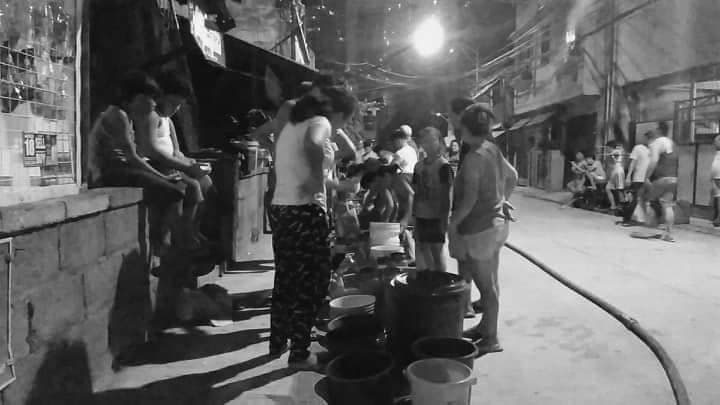
Teka lang. Ano ba ang angkop na termino? Krisis sa tubig (water crisis) o kakulangan sa tubig (water shortage)? Anuman ang gamitin natin, hindi maikakaila ang problemang kinakaharap ng 23 siyudad at munisipyo sa East Zone ng Metro Manila at Rizal na nakapailalim sa Manila Water Company, Inc. (MWCI) na pag-aari ng mga Ayala. Karga-karga ang walang-lamang balde sa labas ng bahay para sana’y makapag-igib kung saan man, malinaw na umiikli ang pasensya habang humahaba ang pila.

Opo, nakapila tulad ng inaasahan sina Nanay, Tatay, Ate at Kuya (minsan pa nga’y pati ang kawawang Lolo at Lola). Sila yung mahihirap na nagtitiis at naghihintay na sana’y may tubig pang natitira sa trak na inaasahang daraan tulad ng ipinangako ng MWCI. Pero tulad ng mga anunsyo nito ng iskedyul ng kawalan ng tubig na hindi nasusunod, hindi na sila masyadong umaasa pa.

Kumusta naman ang pamilyang mayaman? Tuloy pa rin ang paglalamyerda na akala mo’y nasa pinahabang bakasyon. May restaurant na makakainan, may hotel na pansamantalang tutuluyan. Sadyang hindi ramdam masyado kung walang tubig sa bahay dahil kayang kayang tapatan ng pera ang ninanais na ginhawa.

Luha para sa mahirap, luho para sa mayaman. Naniniwala ka bang “great equalizer” ang nangyayari magmula pa noong Marso 6? Sa tingin mo ba’y parehas ang pinagdaraanan ng pamilyang mahirap at mayaman?

Kung mayroong pansamantalang itinago (kahit na hindi sinasadya) ang kawalan ng tubig sa bahay, ito ay ang iba pang problemang kinakaharap ng ordinaryong mamamayan. Huwag nating kalimutang nagmimistulang sardinas ang mga sumasakay sa pampublikong transportasyon. Sakit ng ulo pa rin ang pagtaas ng presyo ng mga bilihin, lalo na ng bigas at langis. Wala pa ring kaseguruhan sa trabaho at patuloy pa ring mababa ang suweldo. Bagama’t libre ang edukasyon sa mga pampublikong paaralan, siyempre’y problema pa rin ang baon at iba pang gastusin ng estudyanteng pilit na itinataguyod ng magulang ang pag-aaral.

Para sa pamilyang mahirap, tila normal na ang araw-araw na paghihirap para itaguyod ang pamilya. Dagdag na pasanin “lang” ang pag-iigib ng tubig sa umaga bago makipagsiksikan sa dyip, bus o tren para makarating sa pagawaang mababa ang suweldo at kulang sa benepisyo (kung mayroon man). Sa kanyang pag-uwi ng bahay, daraan muna siya sa palengke at mapapailing na lang sa kakaunting perang hawak kumpara sa nakasulat na nagtataasang presyo. Pasensiya na lang at siguradong walang pasalubong si Bunso!

Samantala, nariyan pa rin ang ginhawa para sa mayayaman. Apektado man sila ng kakulangan ng tubig, kayang kayang makaagapay dahil hindi hamak na nakatataas sa buhay. May magarang sasakyan para makarating sa pupuntahan, may mataas na suweldo at maraming benepisyo, kayang makabili ng anumang gusto, pati na ang sobra-sobrang pasalubong para kay Bunso.

Sa mga susunod na araw, linggo o buwan, baka bumalik na sa “normal” ang suplay ng tubig pero huwag sanang kalimutang hindi pa rin normal ang ating kalagayan. May mahihirap na patuloy na pinagkakaitan. Hindi tayo dapat masanay sa araw-araw na kalbaryo.

Para makipag-ugnayan sa awtor, pumunta sa https://risingsun.dannyarao.com

Maruming balak sa ‘krisis’ sa tubig

Umaabot na raw sa P7,000 ang bentahan ng isang tangke ng tubig. Tiba-tiba ang mga nagsasamantala sa nagaganap na “krisis” sa tubig, o kakulangan daw ng suplay ng tubig sa kanlurang bahagi ng Kamaynilaan.

Ibinunyag ang modus na ito ni Bayan Muna Rep. Carlos Zarate, sa kanilang piket sa harap ng tanggapan ng Manila Water sa Balara, Quezon City kamakailan.

Bawat araw umanong lumilipas na walang tubig, lalong nagiging desperado ang mga tao. Mayroong higit 52,000 pamilya ang mag-iisang linggo nang walang tubig sa kanlurang bahagi ng Kamaynilaan (sa pagkakasulat ng artikulong ito).

Sa kabila nito, hindi pa rin maayos na inililinaw ng Manila Water ang puno’t dulo ng kaguluhang ito, na sumabay pa sa pagpasok ng matinding tag-init. May ibinabato itong paliwanag, pero lalo lang nagpapalabo sa problema. Samantala, kahit ang pag-aanunsiyo ng kawalan ng tubig, hindi nito maayos na nagagawa.

Di pinaghandaan

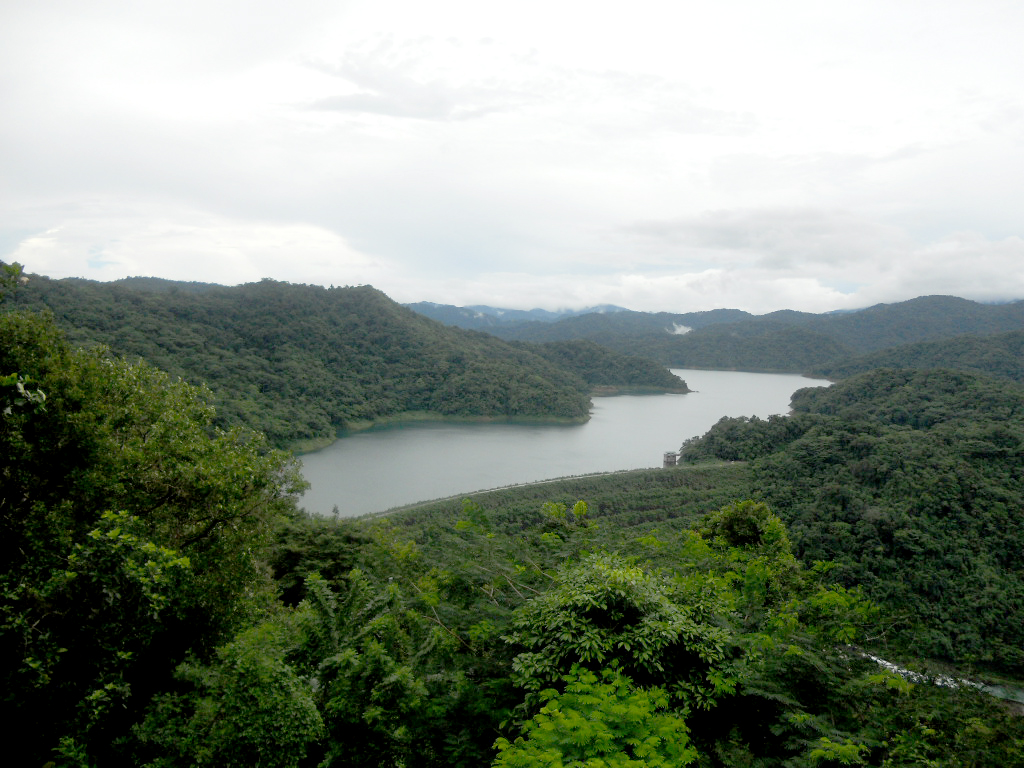
Ayon sa Manila Water, “penomenong El Niño” (o pagpasok ng matinding tagtuyot) ang dapat sisihin sa matinding kakulangan ng suplay ng tubig sa kanlurang bahagi ng National Capital Region. Sinundan pa ito ng pahayag ng Philippine Atmospheric Geophysical, and Astronomical Services (Pagasa) na maaari pang tumagal hanggang buong tag-init o bakasyon ang krisis sa tubig. Ang dahilan nila: ang bumababang lebel ng La Mesa Dam.

Sa panahong isinisi na ng lahat sa lumalalang klima sa bansa, nagduda na ang Bayan Muna Party-list sa paulit-ulit na problemang ito na hindi napaghahandaan ng mga kompanya.

“Hindi naman talaga ito biglaang nangyayari. Madali itong matukoy at dapat napaghahandaan ng water concessionaires (tulad ng Manila Water at Maynilad),” sabi ni Zarate, sa panayam sa CNN Philippines.

Binatikos naman ng mga kandidato sa pagkasenador sa ilalim ng “Otso Diretso” ang administrasyong Duterte na di umano handa sa kakulangan ng tubig sa Kamaynilaan. “Nalulungkot ako. Masyado akong nasaktan na di tayo preparado,” sabi ni Samira Gutoc, kandidato sa pagkasenador ng naturang grupo.

Habang abala pa umano ang rehimen sa pagpapatuloy sa madugong giyera kontra droga, mistulang pinatay na naman nito ang mga tao sa hindi paghanda sa krisis sa tubig.

Pero may mga pahayag naman ang Pagasa at Metropolitan Waterworks and Sewerage System (MWSS), na lalong nagtatanim ng duda sa isip ng mga tao kaugnay ng mga dahilan ng Manila Water sa krisis.

Samantalang pinagkuku-nan nga ng tubig ng Manila Water ang La Mesa Dam, umaabot sa 96 porsiyento ng pinagkukunan nito at ng Maynilad ay hindi sa La Mesa nagmumula  kundi sa Angat Dam. At ang antas ng tubig sa Angat, samantalang bumaba rin, ay sapat pa rin para maserbisyuhan ang buong Kamaynilaan sa buong panahon ng tag-araw.

“Mataas pa rin ang lebel ng tubig sa Angat (Dam). Naniniwala kaming sapat ang tubig sa Angat para sa buong Metro Manila,” giit ni Reynaldo Velasco, administrador ng MWSS.

Ang La Mesa Dam, ayon sa MWSS, ay reserba lang, kaya hindi nila maintindihan kung bakit pilit itong dinadahilan ng Manila Water.

Ayon naman sa isang opisyal mula sa Pagasa, kung totoo ngang dahil sa matinding tag-init at tagtuyot at kakulangan sa suplay ng tubig, dapat naaapektuhan nito ang iba pang dam bukod sa La Mesa, ngunit hindi naman ito nangyayari.

Panggigipit

Noong Marso 10, naglabas ang Manila Water ng anunsiyo sa Facebook kung kailan mawawala ang tubig sa piling mga lungsod sa Kamaynilaan, bilang tugon sa mababang suplay umano ng tubig.

“Kinakailangan tayo magbawas ng presyur o rotational na water-no water situation para ang ultimate objective kasi natin wala pong lugar na mawawalan ng tubig ng 24 hours,” sabi ni Jeric Sevilla, corporate communications officer ng Manila Water, sa DZMM.

Maraming Facebook users ang galit na galit na sumagot sa anunsiyo ng Manila Water. Ayon sa kanila, halos linggo na ang magdaan simula nang huli silang magkaroon ng suplay ng tubig. Naglipana rin sa balita ang mga litrato ng mga karaniwang Pilipinong hirap sa sitwasyon.

Sa kabila nito, insensitibo pa rin o pabirong nagkokomento ang Malakanyang hinggil sa sitwasyon. Sabi ng tagapagsalita ng Palasyo na si Salvador Panelo, “ang problema yata eh ang tubig eh manggagaling sa langit; walang ulan,’pag walang ulan, papa’no baka mag-antay tayo.”

Ipinagtataka ng Bayan Muna kung bakit ganun na lang kapalpak ang serbisyo ng Manila Water. “Biro ninyo, kakataas lang nila ng singil sa tubig noong Oktubre tapos ganito ang serbisyo nila. Dapat magpaliwanag at maging tapat ang Manila Water sa tunay na rason bakit walang tubig ang kanilang mga kostumer. Huwag nilang sisihin ang El Niño kung sila naman ang may kasalanan,” ani Neri Colmenares, kandidato sa pagkasenador ng Makabayan at tagapangulo ng Bayan Muna.

Nagsumite na ng resolusyon ang Bayan Muna sa Kamara para imbestigahan ang naturang “krisis sa tubig” ng Manila Water.

“Nakakatanggap kami ng mga ulat na ang mga pagkawala ng tubig na ito ay itinutulak ng paghiling (ng Manila Water) na muling itaas ang singil sa tubig o ng pagbibigay-katwiran sa paggawa ng mapanirang mga dam na (muling) magpapalayas sa mga katutubong mamamayan,” sabi ni Zarate.

Para sa dam ng China

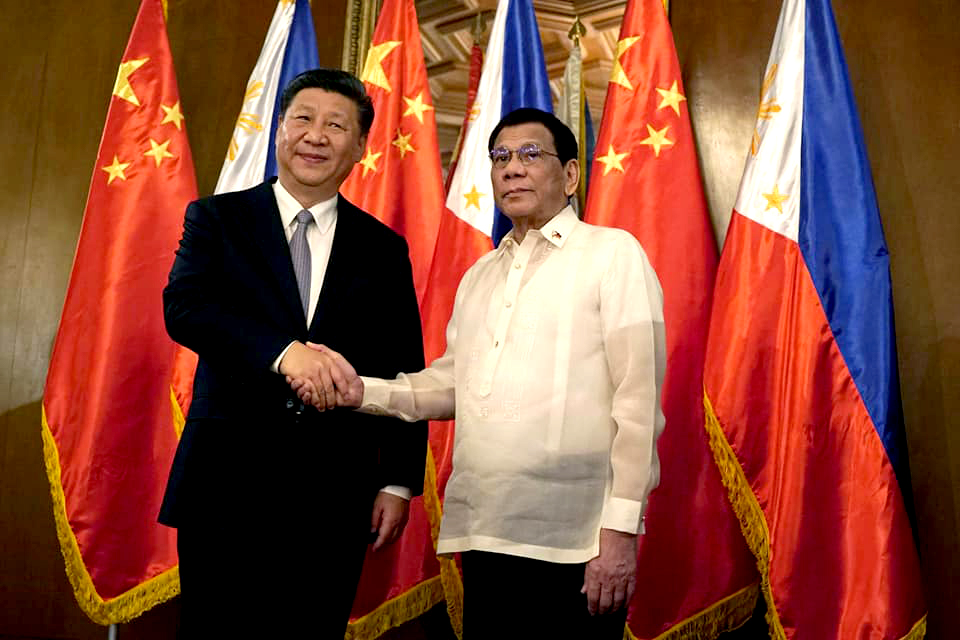
Totoo ngang itinutulak ng rehimeng Duterte ang pagtayo ng Kaliwa Dam. Matatandaang noong Nobyembre 2018, bumisita ang pangulo ng China, si Xi Jinping, sa Pilipinas, at isa sa mga nilagdaan niya at ni Duterte ang kontrata para sa pagtatayo ng New Centennial Water Source-Kaliwa Dam sa probinsiya ng Quezon.

Nagkakahalagang P12.2-Bilyon ang proyekto, at popondohan diumano ng China ang 84 porsiyento ng Kaliwa Dam bilang official development assistance o ODA (ibig sabihin, utang) nito sa Pilipinas. Kilala ang China sa pagbibigay ng malulupit na kondisyon sa mga pautang nito sa ibang bansa. Kabilang na kadalasang kapalit ng di pagbayad sa utang ang pagkuha o pag-ilit ng China sa mga rekurso at teritoryo ng bansa.

(Matatandaang ibinunyag din ni Colmenares at ng Bayan Muna noong nakaraang buwan ang kuwestiyonableng proyektong Chico River Pump Irrigation na gagawin din ng China bilang utang, sa ilalim ng programang Build, Build, Build! ng rehimeng Duterte. Kuwestiyonable umano ang mataas na interes, gayundin ang iba pang probisyon sa kontrata, tulad ng probisyon na nagsasabing wala sa saklaw ng batas ng Pilipinas ang proyektong ito at maaari lang kuwestiyunin sa China International Economic and Trade Arbitration Commission kung may di-pagkakaintindihan ang dalawang panig.)

Nagprotesta na ang grupong Sandugo, alyansa ng mga grupo ng pambansang minorya, sa embahada ng China noong Marso 14, na itinuturing na International Day of Action for Rivers and Against Large Dams. Apektado at malamang na mapapalayas ang libu-libong katutubong Dumagat sa Quezon sa pagtatayo ng Kaliwa Dam.

Dahil sa pagsasapribado

Anu’t anuman, sinabi ni Zarate na pinapakita lang ng kapalpakan ng Manila Water na hindi mabuti ang idinudulat ng pagsasapribado ng serbisyong panlipunan (tulad ng serbisyo sa tubig) o pagpasa sa malalaking kapitalista sa pagbibigay ng serbisyo ng tubig. Noong 1997, isinapribado ng gobyerno ang pagseserbisyo ng tubig sa Kamaynilaan. Pumasok ang Manila Water (pag-aari ng mga Ayala) at Maynilad (dating pag-aari ng mga Lopez) sa serbisyo sa tubig na dating trabaho ng gobyerno sa pamamagitan ng MWSS.

Ayon sa Confederation for Unity, Recognition and Advancement of Government Employees (Courage), lumalabas na nagkaroon ng 984 hanggang 1,546 porsiyentong pagtaas sa presyo ng tubig mula 1997 hanggang ngayon.

Samantala, sa kabila ng malinaw na masamang epekto ng pagturing sa tubig bilang negosyo, mukhang ibinubukas na rin ng rehimeng Duterte ang iba pang pampublikong mga water district sa mga probinsiya labas ng Kamaynilaan para isapribado.

Isa sa pinaka-gumaganansiya sa pagsasapribado ng water districts ang kompanyang Prime Water na pag-aari ng pamilya Villar. Hanggang katapusan ng 2018, agresibo nang ibinenta ng gobyerno sa Prime Water ang water districts sa Lemery, Batangas; San Pedro, Laguna; San Jose del Monte, Bulacan; Batangas City; Rosario, Batangas; Daraga, Albay; at marami pang iba.

Featured image: Larawan ng pila ng mga balde sa Mandaluyong. (Alona Joy Batuigas)
Baseco clean-up drive opposes Manila Bay reclamation

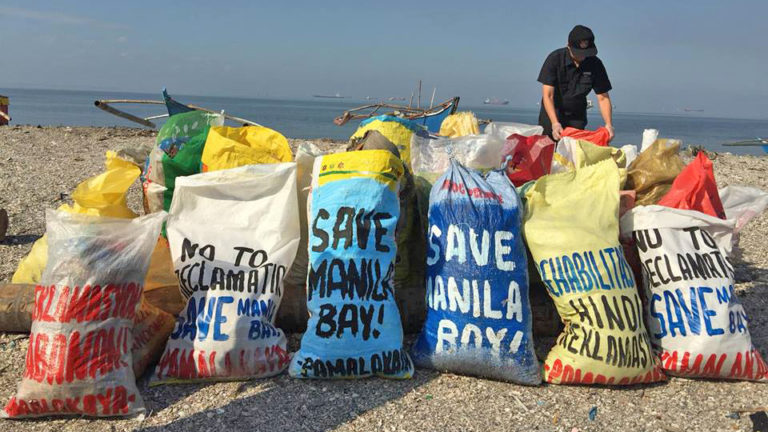
More than 200 volunteers and marine environmentalists belonging to fisherfolk group Pambansang Lakas ng Kilusang Mamamalakaya ng Pilipinas (PAMALAKAYA), Baseco People’s Alliance, Earth Island Institute (EII), Nilad Metro Manila, Reef Check Philippines, held a whole day “People’s Clean-up Action Vs. Reclamation” along Baseco bayside of Manila Bay, as part of the campaign for genuine rehabilitation and against reclamation projects.

Photo credits to Defend Job Philippines, Pamalakaya – Pilipinas and Nilad

“The clean-up serves as a protest against reclamation in Manila Bay. The groups are calling for a genuine rehabilitation, not the facade bannered by the Duterte government for reclamation projects. Fishing and urban poor communities are advocates of restoring the bay to its pristine condition,” said Fernando Hicap, PAMALAKAYA National Chairperson and a fisherman of Manila Bay, during the clean-up.

“These projects are totally destructive, foreign-dictated, and undemocratic. These are in the name of giant profits at the cost of destroying communities and livelihood,” the fisherfolk leader added.

Photo credits to Defend Job Philippines, Pamalakaya – Pilipinas and Nilad

The groups who joined the clean-up drive also expressed concern over the rehabilitation efforts of the government, which they said are being used to hide the real agenda of implementing reclamation projects that will destroy the environment, livelihood, shelter and lives of poor Filipino workers and families.

Around 547 hectares of Manila Bay will be reclaimed for ports expansion and mixed-use projects.

Communities in Manila would be affected by the 50-ha. expansion project of Manila Harbour Center by the R-II Builders, Inc., the 50-ha. project of Baseco Rehabilitation and Dev’t., Inc. (Bradi), the 40-has. PRA reclamation project, and the biggest 407-ha. City of Pearl project, proposed by a Chinese firm UAA Kinming Dev’t. Corp.

These big-ticket projects were already approved by the local government of Manila and would affect residents of Baseco, Parola, Tondo Foreshoreland and Malate.

Groups of urban poor residents in Manila opposed the reclamation projects as they estimated 100,000 residents in Manila will be affected.

Celebrities Ria Atayde and Enchong Dee joined the clean-up drive.

Photo credits to Defend Job Philippines, Pamalakaya – Pilipinas and Nilad

The post Baseco clean-up drive opposes Manila Bay reclamation appeared first on Manila Today.

Alert raised over Davao region, nearby provinces as Chedeng enters PAR

0

Tropical depression Chedeng has slowly weakened as it moves towards Mindanao, the Philippine Atmospheric Geophysical and Astronomical Services Administration (PAGASA) said at its 11:00 a.m. bulletin on Monday, March 18.

ARID LAND

0

The continuing dry spell has completely dried up this farmland in La Fortuna, M’lang, North Cotabato owned by Lita Concepcion, 72, who complained that they were not able to plant again since the El Niño struck in the area in the middle of December last year. North Cotabato is already under the state of calamity as damage to agricultural crops is already placed at P670 million. (Mara S. Genotiva/ davaotoday.com)

Ang Simbahan, ang Diyos at si Digong

0
Nag-rali at nagdasal ang daan-daang taong simbahan sa Liwasang Rajah Sulayman noong hapon ng Enero 25 sa Maynila sa aktibidad na tinawag nilang “One Faith, One Nation, One Voice Prayer Rally” na may panawagang “katotohan, hustisya, kalayaan at kapayapaan.” Dumalo ang mga Obispo, pari, madre’t layko, gayundin ang mga mag-aaral ng mga eskwelahang pinapatakbo ng […]

Karapatan to AFP’s Parlade: Your defense of a murderous gov’t betrays your ignorance of human rights principles

0

Let us school Parlade about a very basic concept of human rights. The primary duty-bearer in the defense, protection, and promotion of human rights is the government and all its agencies, which includes the military. Human rights organizations such as Karapatan have their mandate centered on State-perpetrated human rights violations particularly because of this basic principle. The government has trillions of dollars at its disposal, funds that are being used to commit atrocities instead of being channeled to social services and mechanisms to promote and advance human rights. Remember the Commission on Human Rights? It was created after the Marcos’ martial law regime, precisely because of the recognition that the government has the propensity to train its guns against civilians and civil society. We are emphasizing this for Parlade and his crew’s enlightenment.


read more

Business As Usual

The most pressing issue we face at present as a species that is the irreversible destruction of the natural environment which threatens our very existence is– unsurprisingly– of secondary importance to our politicians and business leaders alike that there is hardly a debate or substantial discussion not even a passing remark in the media. Worse, when politicians and business leaders alike talk about the general situation of the world, we hear nothing but worn-out assumptions, dreary slogans, and speculations carried to the point of outrageousness.

One example is the interview conducted by Esquire magazine with politician and business tycoon Manny Villar back in 2015 which has been republished online in celebration of the release “of the latest Forbes list of the wealthiest people in the Philippines” which the interviewed “now finds himself rising to the #2 spot––after tripling his net worth to US$5 billion from $1.65 billion in 2017.”

It is a habit of lifestyle and entertainment magazines ruled by the values of glamour and publicity to magnify billionaires and the rich as exemplary romantic figures. Thus, in the course of the interview the interviewer asks the interviewed, “what else can you teach us?”

 A great deal of the interview shows the excessively productive business life of Mr. Villar, and since the correspondence touches almost exclusively on business matters the question of the economic situation in the country is inevitable.

His thoughts on the “widening gap between the rich and the poor” are straightforwardly that of a businessman: dry, evasive, and not very enlightening:

“Yes, I think the gap is widening. For those below the gap, there’s no real wealth creation. Just a higher cost of living–their lifestyle goes up, they pay for more things.”

Those below the gap, the working class, the peasantry, and the Third-World countries are historically, economically, realistically the creators of wealth. For what is wealth or “capital” if not the product of human labour? But according to Mr. Villar “there’s no real wealth creation” which seems to contradict the Forbes report. Beneath the billions of dollars of the Forbes candidate are the countless, faceless people who laboured day and night to procure such wealth. As to the unstable wealth creation below which Mr. Villar alludes for the widening gap is quite misleading. In a study conducted by the sociologist and feminist Maria Mies remarked that the widening gap between the rich and the poor “is not as a result of ‘natural’ lagging behind but the direct consequence of the overdevelopment of the rich industrial countries who exploit the so-called periphery in Africa, South America and Asia. Mies continues:

“The relationship between these overdeveloped centres or metropoles and the underdeveloped peripheries is a colonial one. Today, a similar colonial relationship exists between Man and Nature, between men and women, between urban and rural areas… In order to maintain such relationships [the widening gap between the rich and the poor] force and violence are always essential.”

The high cost of living is first and foremost not the making of those below the gap but of the class to which Mr. Villar belongs and the government that allows and tolerates in a parasitic fashion that class. And the lifestyle in which they have to pay more for things which they can hardly afford to sustain it is not solely of their own choosing.

This picture of vulgar logic is intended to excuse the class of Mr. Villar in their responsibility in creating the dreadful gap. It underlies the idea of putting the blame on the victim allowing justification for the rich to admonish the poor: sipag at tiyaga (industriousness and persistence).

One is astonished at the sweeping adroitness of a politician and a businessman of the likes of Mr. Villar when he states that there is no wealth creation for those below. There is wealth. The problem is that the very wealth created by those below did not, in neoliberal terms, “trickle down”, instead it trickled UP to enrich the already rich on top. The question of the widening gap between the rich and the poor can be restated as an issue of wealth distribution; of implementing laws that will bar the rich from monopolization and accumulation of more wealth; of raising the minimum wage; of increase taxation on the rich; of approving agrarian reform; and of a critique and of replacement of the present economic system.

On the subject of “growth” the opinion of Mr. Villar is equally misleading and shortsighted:

“I think we could have grown faster if our citizens had been entrepreneurs. The bulk of the population is working––they’re not entrepreneurial. I’m of the firm belief that poverty can only be reduced through business. Wealth creation is the way forward. We’re not entrepreneurial enough. I think this is the reason for the gap.”

There is very little proof (and a specious one if there is) that the Philippines would have grown faster if we all had been entrepreneurs, and that poverty “can only be reduced through business.” We, the readers, are left thirsty for evidence and persuasion. We are given none but the sweeping assumptions of a businessman inconspicuously arguing for more Villar properties and estates: “wealth creation is the way forward.”

If unlimited growth and development to Mr. Villar means increase of capital and GNP, an overwhelming body of evidence and studies enough to fill the private estates of the tycoon shows that unlimited growth has “led to an increasing deterioration in the environment, and subsequently the quality of life.” One only has to open one’s eyes and ears to the massive destruction perpetuated by growth and development embodied by multinational corporations on the natural environment and indigenous communities around the world.

The imputation that we’re not entrepreneurial enough seems to be utterly foolish in light of the imminent danger posed to our survival by the staggering rate of environmental destruction (mankind has annihilated 60% of mammals, birds, fish and reptiles since 1970) due to the unquestioned methods and practices of our present economic system (corporate capitalism). Perhaps what should concern us all is not that we are not entrepreneurs in the image of Mr. Villar or the country is not “growing” enough–besides, the world would be insufferably boring and colorless if we were all businessmen and we talked nothing but business–but to think and act on ways as to reverse or slow down the rapid destruction of nature on which our life depends. One not insignificant way is to rethink the dominant concept of growth and development.

The paradigm of unlimited growth that the Third-World countries have embraced as imposed by the developed countries “involved the reproduction of not only a particular form of wealth creation, but also of the associated creation of poverty and dispossession,” argued the physicist and activist Vandana Shiva.

“Dams, mines, energy plants, military bases –– these are the temples of the new religion called ‘development’, a religion that provides the rationale for the modernizing state, its bureaucracies and technocracies. What is sacrificed at the altar of this religion is nature’s life and people’s life. The sacraments of development are made of the ruins and desecration of other sacreds, especially sacred soils. They are based on the dismantling of society and community, on the uprooting of peoples and cultures.”

The belief that poverty can only be reduced through business is analogous to, in this crucial state of our times, the belief that slaves can only be freed through slavery. Firstly, the claim hinges on what poverty is. Shiva dismantles development’s misleading perception of poverty: 

“The conventional paradigm of development perceives poverty only in terms of an absence of Western consumption patterns, or in terms of cash incomes and therefore is unable to grapple with self-provisioning economies, or to include the poverty created by their destruction through development. . . Culturally perceived poverty is not necessarily real material poverty: subsistence economies that satisfy basic needs through self-provisioning are not poor in the sense of deprivation. . . Subsistence, as culturally perceived poverty, does not necessarily imply a low material quality of life.”

What for Mr. Villar is the solution is in all accounts the real problem. The present economic model and its attendant culture of passive destructive consumption has cultivated and encouraged in us a business sensibility which has reduced us to mindless consumers and producers unaccountable for the social and environmental risks involved. Mies concludes:

 “If more and more people buy this commodity the GDP grows. But what also grows at the same time is the erosion of community, the isolation and loneliness of individuals, the indifference and atomization of the society… market forces destroy communities.”

It is the present epidemic of growth and development which is the reason for the misery of the people below, particularly of the indigenous communities, and the unforgivable degradation of the natural environment. To ignore the realities of the environmental crisis is to admit the inevitability of social (global) suicide. Wealth creation is not the way forward, it is the way to self-destruction.

Carlo Rey Lacsamana is a Filipino, born and raised in Manila, Philippines. Since 2005, he has been living and working in the Tuscan town of Lucca, Italy.

The post Business As Usual appeared first on Manila Today.