If the Philippine government’s factually dubious, legally anomalous and politically self-serving withdrawal from the Rome Statute takes effect tomorrow, it will lamentably exclude from the coverage of the ICC & therefore deprive the people of an international venue for legal accountability all future post-withdrawal crimes vs humanity, war crimes & genocide.
Hence, victims will again be deprived of an alternative arena for redress — despite the ICC’s limitations and weaknesses — & will embolden violators who are otherwise insulated, protected or immune from domestic legal accountability.
Nevertheless, reversal of the withdrawal can be explored in the future or a special tribunal can be formed or sanctioned by the UN in lieu of the ICC. Or the people can continue to establish accountability through people’s tribunals whose cumulative moral suasion in conjunction with other non-legal efforts campaigns and actions can change the legal equation over time.#
Students held a commemoration and protest activity within the halls of the University of the Philippines Manila (UPM) College of Arts and Sciences on Friday, March 15, to commemorate the 6th year death anniversary of Kristel Tejada.
Kristel Tejada was a first year BA Behavioral Sciences student from the College of Arts and Sciences. Unable to pay for the P10,000 matriculation fee, she was pushed to file for a forced leave of absence and surrender her student ID. Tejada’s name was also taken off in the class lists and seat plans despite her attendance in classes. She went home one day and drank silver cleaner. She was 16.
Remembering Kristel
The protest was attended by several youth organizations within and outside UPM, such as the League of Filipino Students UPM, Sulong UPM allied organizations and Kabataan Party-list Metro Manila. Tejada’s family was also present.
“Nag-appeal po kami. Noong time na ‘yun walang-wala na talaga kami. Ginagapang lang namin ang kanyang pag-aaral. Pamasahe pa lang po namomroblema na kami. Kaya namin pinili ang UP–dahil nakapasa rin siya ng UST–mas pinili namin ang UP dahil may scholarship. Ang akala namin ay makakakuha kami ng Bracket E2 dahil sa kalagayan namin. Pero hindi po nangyari, nagkamali ng bracketing. Hindi kami nakabayad. Nangyari ang pinakahuli, hindi na in-accept ang pakiusap namin, pinag-forced leave of absence siya. That was March 13. Sinubmit niya ang ID niya. Sinubmit ang kanyang mga letter. Masama sa kanyang loob na iwan ang UP Manila. Ang UP Manila na ang nakikita niyang huling pag-asa. ‘Yung mga panahong iyon nagdarahop talaga kami. Ang kanyang pag-aaral ang nagpa-survive para manatili kami sa Maynila, dahil balak na sana naming umuwi ng probinsya. Pero dahil nakita namin ang determinasyon niya, ang kanyang adhikain na makapagtapos at makatulong sa pamilya, ay ninais na rin po namin na manatili sa Maynila dahil naniniwala kami sa kanyang kakayahan bilang mag-aaral,” recalled Christopher Tejada, the father of Kristel.
[“We appealed. That time we really had nothing. We were making ends meet to provide for her studies. We even had problems providing her fare. We chose UP–she also passed in UST–because of the scholarship. We thought we would avail the Bracket E2 due to our situation. We were placed in the wrong bracket. We weren’t able to pay. What happened last was our pleas have been unheard. She was forced to file a leave of absence. That was March 13. She had to submit her ID. She had to submit her letters. She had to leave UP Manila with a heavy heart. She saw it as her last hope. Those were the times that we were really poor. Her studying was the only thing that made us stay in Manila, because we were planning to go back to the province. Yet we saw her determination, her hope to finish her studies and help our family, and we decided to stay in Manila because we believe in her capabilities,”]
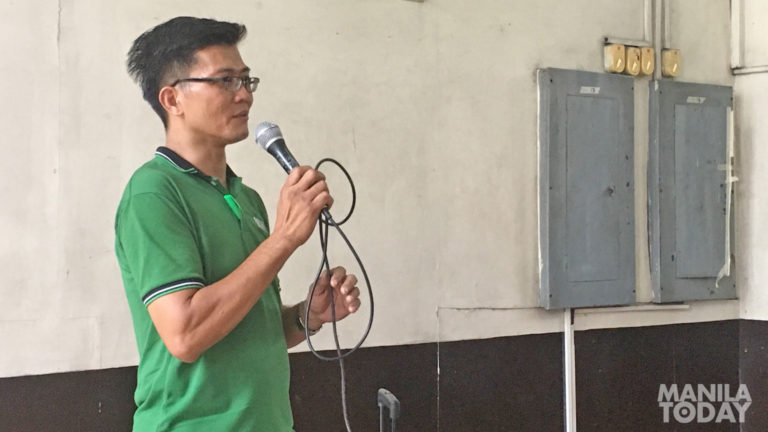
Christopher Tejada, father of Kristel, spoke before UP Manila students. Photo by Jade Dela Cuadra
“Naaalala natin si Ate Kristel, hindi lamang sa kanyang hinarap. Nakikita natin na ang sitwasyon niya ay manipestasyon ng bulok na sistema ng edukasyon na kayang kumitil ng pangarap at buhay. Naaalala dapat natin siya sa bawat isyung kinakaharap ng mga estudyante. Sa bawat presyong ipinapataw sa ating edukasyon. Sa bawat pagsingil sa ating organisasyon ng bayad upang makagamit ng pasilidad sa pamantasan. Ilan ito sa mga manipestasyon na itong libreng edukasyong ito ay hindi pa rin ibinibigay nang buo sa mga estudyante. ‘Yung batas, bagaman sinasabing free education na ay hindi pa rin naibibigay sa atin,” said Pat Cierva, the Chairperson of Kabataan Partylist Metro Manila.
[“We remember Ate Kristel and not only her struggles. We also see that her situation is a manifestation of the current rotten system of education that kills dreams and takes lives. We should remember her in every issue that we face as students. In every price added to our education. In every fee collection done by our student organizations just to use the school’s facilities. These are some of the manifestations that this education is not free and not given to the students. This law (Free Tuition Policy), even if it states that education is free already, is not yet fully felt by the students.”]
Cierva explained that while the Free Tuition Policy is already implemented since 2017, UP Manila still suffered from low budget that led to poor and inadequate facilities in the premier health sciences university in the country, exorbitant rental fees for organizations, and most especially, the payback scheme of the Return Service Agreement (RSA) that is implemented in six of seven colleges in the university campus.
The RSA is a contract signed by incoming first year students in the field of Health Sciences. Students from the College of Allied Medical Professions (CAMP), College of Dentistry (CD), College of Nursing (CN), College of Medicine (CM), College of Pharmacy (CP) and College of Public Health (CPH) are covered by the agreement. The agreement stated that students who reached 60 units enrolled in the university must render stay and work in the country for a minimum of two years. Those who breach the contract due to being unable to complete the return service program must render payment as an option.
In the last semester, the university has started to implement the rule that students who signed the RSA contract opting to shift out of their program for various reasons must render payment amounting to P 600,000 to P 1.2 million depending on their socialized tuition scheme bracket and amount of tuition paid, due to ‘breach of contract’.
The payback scheme is equal to twice the cost of education plus interests and donation, according to RSA documents in the RSA amendments workshop in May 2018.
This new ‘aggressive payback scheme’ has caused several students to remain in their degree programs despite failing or lacking interest, to enrol less than the regular load per semester to avoid reaching the 60 units limit or drop out of school completely, said Anakbayan UP Manila of the cases they have profiled since last semester.
Various youth groups within the university called this as a new and extreme form of commercialization, citing that the existence of this policy defeats the rationale of the free tuition policy.
Paco Perez, spokesperson of Anakbayan Metro Manila elaborated that the state of education within the University is far from free as it shows itself to be if these policies still exist. Perez also hit the university and government policies, which has pushed Kristel Tejada to her death, and now that that the socialized tuition has escalated into something more sinister with the RSA.
“Ang pagkamatay ni Kristel ay sana hindi makalimutan. Nagsisilbi itong alaala kung saan isang mag-aaral mula sa isang state university ay nagpakamatay dahil sa matrikula. Isang kabalintunaan ito. Bakit sa isang pampublikong pamantasan may nagpapakamatay? Nagpapakamatay, hindi na lamang hirap na hirap dahil sa acads. Pero dinadagdagan pa ito ng iba’t ibang polisiyang lalong nagpapahirap sa mga estudyante na kung saan itinutulak nito ang mga estudyante sa rurok ng kanilang kakayanan hanggang sa kitilin ang sariling buhay. Walang kasing sahol iyon! Walang kasing bulok ang sistema ng edukasyon. Galit na galit tayo sa 5% na tuition fee increase sa mga pribadong unibersidad pero dito sa UP, may sinisingil ng milyon! Pambansang unibersidad. Pag-asa ng bayan. Pero ang sistema ng edukasyon, ang ating administrasyon, ang ating gobyerno ang pumapatay sa atin! Karapatan ng kabataan ang edukasyon,” Perez exclaimed.
[“Kristel’s death will never be forgotten. This also serves as a reminder wherein a student from a state university took her own life due to matriculation fees. It’s an irony. Why did a student studying in a public university thought to end her life? Students are thinking to kill themselves, not only because of the academic load but also because of the policies which burden and push the students to the edge of their capabilities until they begin to think to end their lives. Such gruesome circumstance! This education system is rotten. This day is not just a commemoration. We are angered by the 5% tuition increase of private universities but here in UP, somebody is forced to pay millions! A premiere state university for the youth, the future hope of the nation but the educational system, the school administration, and the State itself pushes us to our deaths! Education is our right!”]
UP Manila students remembered Kristel. Photo by Jade Dela Cuadra.
Faye Arguson, UP Manila University Student Council councilor and a student from CAMP shared that she herself is affected by the issue of RSA and the payback scheme.
“Isa ako sa mga estudyanteng naaapektuhan ng RSA. Ikaapat na taon ko na sa kolehiyo nang mapagdisesyunan kong lumipat ng kurso: isang napakahirap na disesyon para sa isang estudyanteng pinipilit ang sarili na gustuhin ang kurso niya sa health sciences dahil sa pampinansyal na seguridad. I am diagnosed with MDD and anxiety, at malaking hakbang sa akin ang magdesisyong umalis sa kurso kong patuloy lang na pinapalala ang mental health ko. Alam kong hindi lang ako ang nakaranas nito. Pero pinipigilan ako ng RSA. Pinagbabayad ako ng malaking halaga kapalit ng desisyon kong lumipat sa kursong gusto ko talaga. Maghihintay pa ba tayo ng isang estudyanteng kailangan mamatay dahil sa isang kontratang pinipilit sila magbayad “as a last option”? Maghihintay pa ba tayo ng isa pang Kristel Tejada?” Arguson spoked emotionally at the protest.
[“I am one of the students affected by the RSA. On my fourth year in college, I have decided to switch degree programs: a hard decision to undertake especially for a student who forces herself to love her program in the Health Sciences due to financial security. I am diagnosed with Major Depressive Disorder and Anxiety, and this a huge step for me to decide to get out of a degree program that exacerbates my mental health condition. I know I’m not the only one who experiences this, but RSA hinders me. I am forced to pay a large amount of money in exchange for my decision to switch to a program that I really like. Must we wait for another student to die because of a contract that forces them to pay “as a last option”? Must we wait for another Kristel Tejada?”]
For the youth and student groups present in the protest, the continuing collection of fees for organizations to use facilities and the existence of RSA despite the implementation of the free tuition policy prove that genuine free education is still far from coming into fruition.
Residents of Baseco Compound in Manila gathered on the morning of March 16 to form the Baseco People’s Agenda led by Baseco People’s Alliance and Manila Urban Poor Network. The groups’ leaders believe that jobs, money and developments would not be the result of reclamation in their area as the Malacañang Palace claimed, but instead would immediately bring eviction and displacement to the urban poor residents of Baseco.
The groups called for the junking of the reclamation project and for stopping the demolition of the homes of the poor in the city of Manila.
The Philippine Reclamation Authority (PRA) is processing a total of 22 reclamation projects are planned along Manila Bay that the agency said in a House of Representatives’ Metro Manila development committee hearing will affect and likely pollute Manila Bay. Once approved, the projects would cover 22,000 ha or about 11 percent of the bay’s 1,994-square-kilometer area.
Three of these projects have been approved in principle by the PRA—the 360-ha Pasay reclamation project, the 140-ha Solar City project, and the Navotas Boulevard Business Park. Around 547 hectares of Manila Bay will be reclaimed for ports expansion and mixed-use projects.
Communities in Manila would be affected by the 50-ha. expansion project of Manila Harbour Center by the R-II Builders, Inc., the 50-ha. project of Baseco Rehabilitation and Dev’t., Inc. (Bradi), the 40-has. PRA reclamation project, and the biggest 407-ha. City of Pearl project, proposed by a Chinese firm UAA Kinming Dev’t. Corp. These big-ticket projects were already approved by the local government of Manila and would affect residents of Baseco, Parola, Tondo Foreshoreland and Malate.
Manila Urban Poor Network estimated at 100,000 the number of residents in Manila who will be affected by the reclamation project. Baseco alone has a population of 59,847 tallied in the Philippine Census in 2015.
Baseco is Barangay 649 Zone 68 of the City of Manila. It is a reclaimed section of the Port Area of Manila. It is under the jurisdiction of the Philippines Ports Authority. It has 56 hectares, as indicated in the Ordinance No. 7931, which is a property of the National Government.
Opposition to reclamation
In the meeting, former Anakpawis Representative Rafael ‘Ka Paeng’ Mariano shared the resolution and bill that Anakpawis and the Makabayan bloc filed the Lower House of Congress asking for “genuine rehabilitation” of Manila Bay.
Former Anakpawis Rep. Rafael Mariano shared the House resolution and bill introduced by Makabayan to declare Manila Bay as ‘reclamation-free’ as method for ‘genuine rehabilitation.’ Photo by Jade Dela Cuadra
The Makabayan bloc on January 29 filed House Resolution 2452, urging the government to postpone the rehabilitation of the polluted Manila Bay over concerns in how the government plans to resettle an estimated 300,000 informal settlers until an assessment on the socio-economic impact on poor sectors and a genuine and democratic masterplan has been carried out.
Makabayan also labeled the Manila Bay Rehabilitation program as fake because reclamation projects or business deals that are destructive to the said bay are being approved by various government units such as:
the 148-hectare joint-venture “Solar City” reclamation project of Tieng family’s Manila Goldcoast Development Corp. and local government unit of the city of Manila;
the 360-hectare joint-venture “SM project” reclamation of SM Prime Holdings, Inc. and local government unit of Pasay City;
and the 265-hectare joint-venture “Pasay Harbor City” of a consortium involving Davao-based businessman Dennis Uy and the local government of Pasay City
On February 7, Anakpawis and Makabayan lawmakers filed House Bill No. 9067, declaring Manila Bay as Reclamation-Free Zone. The move was pushed to cater the broader demand for the urgent rehabilitation of Manila Bay, and emphasized on declaring the bay as “reclamation-free.” The progressive lawmakers also wanted to reiterate that rehabilitation of Manila Bay does not equate to reclamation and called for “genuine rehabilitation” of the historic waters.
The lawmakers accused Malacañang Palace of using rehabilitation as a vehicle for reclamation. Aside from environmental damages, the reclamation projects are big profit infrastructure projects for big private corporations that would also build and serve businesses at the expense of the dislocation of 1 to 1.5 million Filipinos across all Manila Bay reclamation projects.
The local groups in Manila also called for the junking of Manila City Ordinance Number 8119 that allowed the conversion of residential use lands to commercial/industrial use and paved the way for big projects such as the Manila Bay reclamation.
President has last say on reclamation
On January 15, 2019, Department of Interior and Local Government Eduardo Año announced that around 220,000 informal settler families will be relocated to Central Luzon and Calabarzon regions.
On February 4, President Rodrigo Duterte signed Executive Order No. 74 (EO 74) delegating the authority to approve reclamation projects to the PRA. He also placed the agency under the Office of the President, instead of the DENR.
“It has been shed to light, that the Duterte government has been using the Manila Bay rehabilitation program as a trojan horse for reclamation projects, especially when the president took over authority of the PRA, along with approval of such projects via the EO 74,” Anakpawis Party-list Representative Ariel “Ka Ayik” Casilao said of the PRA’s transfer to the Office of the President.
He said that this move stinks of crony capitalism or graft, especially when his allies, such as businessman Dennis Uy is involved, particularly on the 265-has. Pasay Harbour City consortium project and Chinese firms on the City of Pearl project.
The 22 reclamation projects being processed by the PRA included the following:
944 hectares in Bacoor, Cavite, by Frabelle Fishing Corp and Aboitiz;
1,332 has. in Cavite, Century Peak Corp.;
40 has. in Baseco, Manila, by PRA UAA Kinning Group Development Corp.;
200 has., Baseco Rehabilitation and Development Inc (BRADI);
407 has., Manila, Kinning Group Development Corp.;
50 has., Manila North Harbor expansion project, R-II Builders;
419 has., Manila, Jbros Construction Corp.;
635 has. in Las Pińas and Parańaque cities, Altech Construction Inc.;
7 has. in Cavite, Coastal Road Corp.;
318 has., Waterfront Manila Premiere Corp.;
140 has., Asian Seas Resources and Relty Corp.;
148 has., Manila Goldcoast Development Corp.;
577 and 73 has. in Navotas, Argonbay Construction Company Inc.;
300 has. in Pasay City, SM Prime Holdings Inc.;
265 has., Pasay City, Harbour Center Consortium., 265 hectares
360 has., SM Prime Holdings Inc.;
30 has., Philippine Navy;
1,900 has., Cavite provincial gov’t.;
2,500 has., Bulacan, the P735.6 billion Aerotropolis project.
The PRA has listed 43 reclamation projects in Manila Bay, included in its National Reclamation Plan. There are 120 reclamation projects in the country, the PRA said.
Dabawenyos happily endured the scorching heat of the sun that reached up to 32 degrees Celsius on Saturday, March 16, to witness the “Parada Dabawenyo”, one of the most anticipated highlights of the celebration of Araw ng Dabaw.
“The Duterte government is run by pathological liars and militarists who are corrupt to the core, able to subvert laws and mechanisms to evade accountability.”
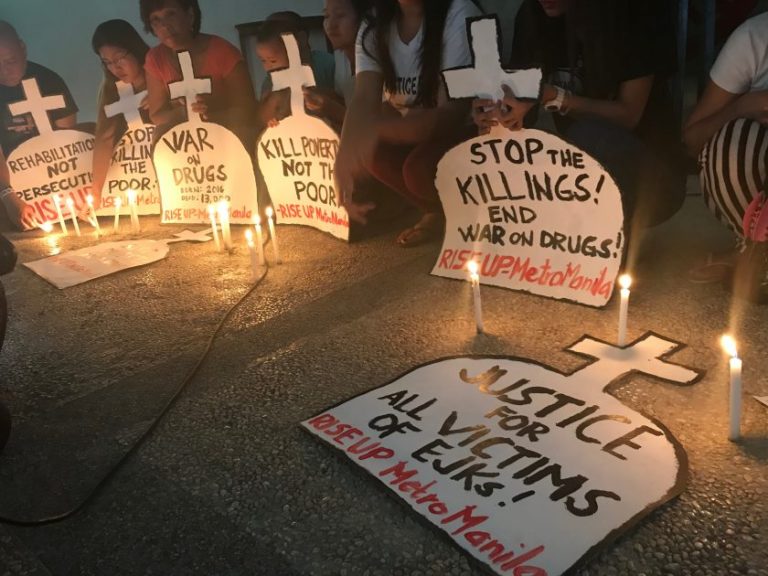
MANILA — As the Philippines withdrawal from the International Criminal Court takes effect today, rights groups warned of escalating human rights abuses and further impunity.
Senatorial candidate and long-time human rights lawyer Neri Colmenares slammed President Rodrigo Duterte’s “self-serving” move. In his speech March 14 at the Integrated Bar of the Philippines (IBP), Colmenares said Duterte intends to evade accountability for his crimes against poor Filipinos.
The ICC has the jurisdiction to prosecute individuals for the crimes of genocide, crimes against humanity, war crimes, and crimes of aggression.
Duterte announced the country’s exit from the ICC after the tribunal started its preliminary examination of the charge of crimes against humanity filed against the President. Two complaints were filed against Duterte — one by Jude Sabio, lawyer of self-confessed Davao Death Squad member Edgar Matobato, and another by the National Union of Peoples’ Lawyers, counsel of families of victims of extrajudicial killings.
Still, Colmenares explained that the withdrawal has no impact on the pending complaints filed against Duterte.
He cited Article 127 Rome Statute of the ICC stating that “a State shall not be discharged, by reason of its withdrawal, from the obligations arising from this Statute while it was a Party to the Statute.” The Rome Statute further states that a State’s withdrawal shall not affect any criminal investigations and proceedings which were commenced prior to the date on which the withdrawal became effective, nor shall it prejudice in any way the continued consideration of any matter which was already under consideration by the Court prior to the date on which the withdrawal became effective.”
Colmenares said the ICC has jurisdiction over Duterte because domestic laws provide the Philippine president immunity from suit.
For its part, human rights alliance Karapatan underscored Duterte’s “double-talk” with regard to the ICC.
“Duterte previously denied ordering extrajudicial killings, only to admit to it in several live telecast. He has also expressed willingness to subject himself to investigation under the ICC, but withdrew the country from the Rome Statute. This government has denied perpetrating human rights violations while persecuting human rights advocates and silencing the voices of victims and their kin who counter the State’s repeated denials,” Roneo Clamor, Karapatan deputy secretary general, said in a statement.
“The Duterte government is run by pathological liars and militarists who are corrupt to the core, able to subvert laws and mechanisms to evade accountability,” Clamor said.
In a separate statement, NUPL President Edre Olalia said that with the Philippines’ exit from the ICC, “victims will again be deprived of an alternative arena for redress.”
In lieu of the ICC, Olalia said other means of exacting accountability could be explored, such as the creation of a special tribunal sanctioned by the United Nations or through people’s tribunals.
Want to read stories like this? Help us keep up continue writing about issues that matter.
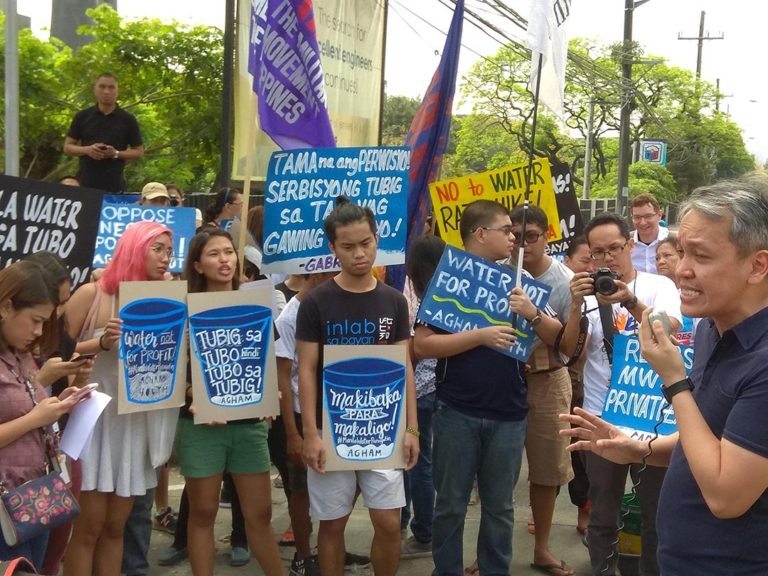
Protesters call for an end to privatization of water services.
Focusing on just Manila Water diverts the issue away from privatization as the central issue in, and underlying reason behind, the artificial shortage. As such, it also has the effect of absolving government of responsibility when in fact, the biggest accountability in all this lies with government for abandoning its duty to ensure water for the people.
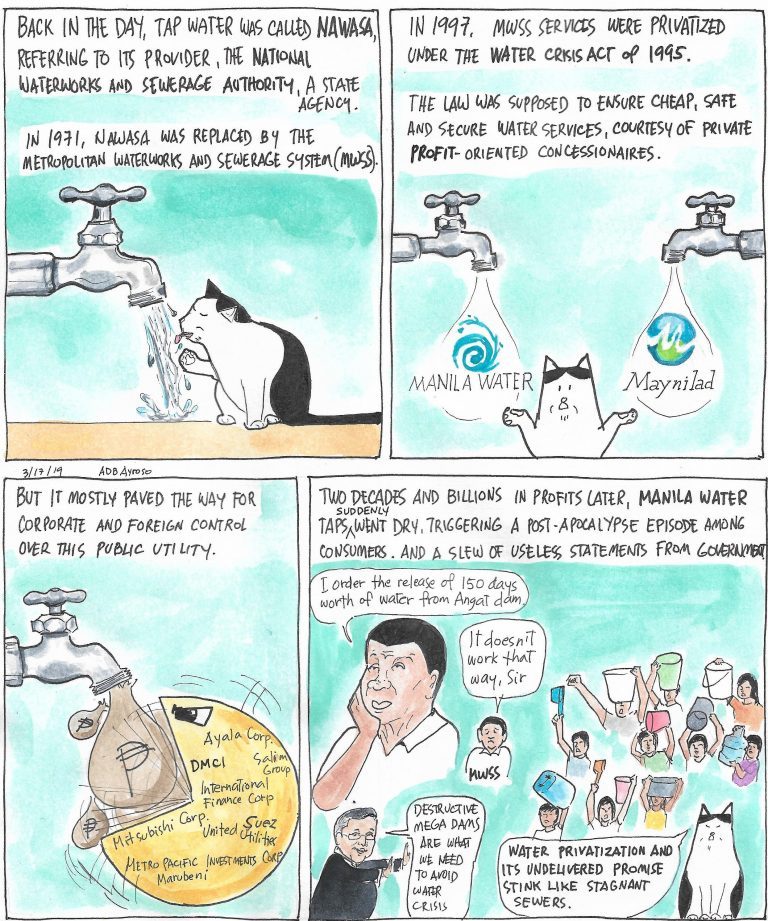
MANILA — Metro Manila’s supposed water crisis is one that is not caused by lack of supply and new water sources, or as some would argue, by lack of foresight and preparations by regulators and Manila Water. Rather, it is caused by lack of effective state control over water resources after government allowed the privatization of Metro Manila’s water system 22 years ago.
There lies the artificial water shortage.
By official accounts, the available supply for Metro Manila’s water needs is still enough. But instead of taking on the role of ensuring that this water reaches the people for their basic domestic use, government has deferred to two separate private companies (Manila Water and Maynilad), each with their own profit motives and considerations, in determining how water reaches the end-consumers through their separate distribution networks.
Worse, these private concessionaires have not improved the infrastructure enough to maximize existing water supply despite massive increases in their rates (and profits) for the past two decades. Imagine this – every day, about 1,177 million liters of water are lost due mainly to defective infrastructure. That’s equivalent to almost eight times of the supposed deficit in water supply that Manila Water is grappling with.
As it is, according to the concessionaires’ own performance reports, almost 300,000 people in their service areas are already without 24-hour water supply even before the current supply issues began early this month. That is the “normal” situation for these people under the regime of privatized water. The actual figures could be higher, as government regulators do not seem to verify – or do not have the capacity to check – the performance of the concessionaires.
Both Manila Water and Maynilad source the water they distribute from Angat dam that based on official pronouncements still holds enough water to supply the needs of the capital region and nearby areas. Angat dam supplies 4,000 million liters per day (MLD) or 96 percent of Metro Manila’s water (the rest come from Laguna Lake, three percent and deep wells, one percent).
But while Manila Water has a deficit, Maynilad has surplus supply. How did that happen? When the Ramos government privatized the Metropolitan Waterworks and Sewerage System (MWSS) in 1997, its service area was divided into two and then bid out to private companies. The east zone was won by Manila Water and the west zone, by Maynilad.
As part of the concession agreement, Maynilad will get 60 percent of Angat’s raw water and Manila Water the remaining 40 percent. That translates to 2,400 MLD for Maynilad and 1,600 MLD for Manila Water. The said sharing arrangement was based on the population size of the concession areas awarded to them by government. At present, Maynilad services around 9.5 million people in the west zone and Manila Water, 6.8 million in the east zone.
The 150-million liter per day challenge
Manila Water claims that its 1,600 MLD from Angat is no longer enough as its requirements already rose to as high as 1,750 MLD. The 150-MLD deficit is being blamed for the water supply interruptions that have been affecting some half a million people in the east zone.
Consumers say water should not be for profit.
This reported increased demand from Manila Water’s customers could have been easily met if the government were in charge of water management and distribution. Under the present privatized setup, water that flows to Metro Manila is divided to the concession areas of Manila Water and Maynilad, and this creates unnecessary challenges for an effective and responsive mechanism in water allocation and distribution.
The water flows between the concessionaires are connected through cross-border pipes. As one of the stop gap measures to help address the supposed 150-MLD shortage in the east zone, Maynilad agreed to open some of these cross-border pipes so that 50 MLD of water allocated for the west zone could be directed to Manila Water’s concession areas.
If the MWSS were in charge of water distribution from the start, such option could have been resorted to much earlier and in a manner that is less complicated and bureaucratic (e.g., asking Maynilad’s permission first); more effective (e.g., redirecting more than 50 MLD, if needed); and much faster (e.g., under privatization, most of the cross-border pipes have been already cut and will need time to restore) to avoid the supply woes that tens of thousands of households are being forced to bear today.
Aside from the cross-border pipe arrangement with Maynilad, Manila Water is also expecting to have another 50 MLD from its new treatment plant in Cardona, Rizal (with a maximum capacity of 100 MLD when completed) and a further 100 MLD from existing deep wells.
Missing water
What is not highlighted amid all the frenzy in securing additional supply is the more than a billion liters of water wasted daily, mostly from leakages in the existing distribution infrastructure of Maynilad and Manila Water, or what the water industry calls non-revenue water (NRW).
At present, by MWSS’s own account, the NRW of Manila Water is at 11 percent while that of Maynilad is at 39 percent. Looking at the volume of water that flows through their respective systems, water losses in Manila Water’s concession area is around 176 MLD and about 1,001 MLD in Maynilad’s for a total of 1,177 MLD.
On its website, Maynilad claims that as of 2018, its NRW is 27.1 percent. On the other hand, Manila Water’s own website claims they deliver 1.3 billion liters out of their 1.6 billion Angat dam allocation, or an NRW of 12 percent. Using these figures, the total volume of water losses from both concessionaires is still huge at 888 MLD.
Based on the original targets when MWSS was privatized, the volume of water losses should have already been reduced to less than a billion liters a day (around 732 to 976 MLD) as early as 2001 or 18 years ago. Instead of the promised reduction, the volume of water losses has increased (per MWSS’s NRW estimates) amid a growing service area that has expanded by about five million people in the past two decades. This even as present all-in rates (i.e., basic charge plus other charges, supposedly to recover investments used to improve water supply) have grown about 3-4 times of their 1997 level in real terms.
Note that Maynilad still has a surplus supply despite wasting more than a billion liters of water per day, while Manila Water, which has a much lower reported NRW than its west zone counterpart suffers a deficit. This further underscores the inefficiency and wastefulness of water resource management and the artificiality of water shortage under MWSS privatization.
The combined water losses of both Manila Water and Maynilad is more than 28 percent of the estimated current water supply of 4,167 MLD from the Angat dam, Laguna Lake and active deep wells. The MWSS is saying that the international standard is 20 percent while other studies suggest that the apparent economically reasonable NRW is between 10 and 12 percent.
In any case, halving the current total NRW (as estimated by MWSS) could produce an additional 588 MLD in water supply. It is interesting to note that the controversial P12.2-billion Chinese-funded Kaliwa dam (which government, using the metro water shortage as pretext, wants rushed amid unmet environmental compliance) has a projected capacity of 600 MLD. In other words, addressing the issue of water losses substantially lessens the pressure of building new dams and avoiding the unnecessary environmental, social and economic costs they entail.
Finding accountability
To be sure, urgent demands to make Manila Water and their operator led by the Ayala group and their foreign partners accountable for the current water woes in Metro Manila are justified and legitimate. But they should be made to account outside the narrow framework of their commitments under the concession agreement (or privatization contract), and instead be held liable in the context of the assertion of people’s rights to water and reversing MWSS privatization.
The privatization contract, by design, heavily favors the private concessionaires. When the World Bank (through the International Finance Corp. or IFC) crafted the concession agreement in 1997, it ensured that the private concessionaires will be able to operate profitably in order to pay back the World Bank and other foreign creditors the hundreds of millions of dollars in debts that MWSS owes them. The IFC itself, as the World Bank’s private investment arm, is an investor in the MWSS privatization through Manila Water. Thus, from the onset, MWSS privatization was never about the provision of water services but the collection of private profits for foreign investors and creditors and their local partners.
The MWSS itself, for instance, is saying that it appears there is nothing in the concession agreement that they can use to penalize Manila Water for causing the current water supply problems in its service area. Regulators claim that they can use the concession agreement’s rate rebasing exercise (when concessionaires ask for higher basic charges) but that will not happen until 2022. There is also no assurance of accountability as Manila Water (as well as Maynilad) could always question and reverse the decision of regulators through an international arbitration mechanism provided under the privatization contract.
Focusing on just Manila Water absolves Maynilad and its operators led by Manny Pangilinan’s group and its Indonesian backers (Salim group) and Japanese investors (Marubeni) of accountability, and reinforces the wrong notion that the issue is simply mismanagement on the part of Manila Water. The prevailing impression today is that Maynilad customers are “fortunate” when in reality, Maynilad’s very high NRW deprives all consumers in Metro Manila and nearby areas of valuable water supply.
Most importantly, it diverts the issue away from privatization as the central issue in, and underlying reason behind, the artificial shortage. As such, it also has the effect of absolving government of responsibility when in fact, the biggest accountability in all this lies with government for abandoning its duty to ensure water for the people.
As long as water remains in the hands of unaccountable, profit-oriented private and foreign interests, the people of Metro Manila and adjacent provinces will continue to face insecurity in supply amid ever skyrocketing rates. This is the real water crisis that we face, and one that is permanent – El Niño or not – as long as there is no policy shift in the way that water resources are managed.
Want to read stories like this? Bulatlat is not controlled by corporations that have business interests in water and other utilities. In issues like this, truth always comes out.
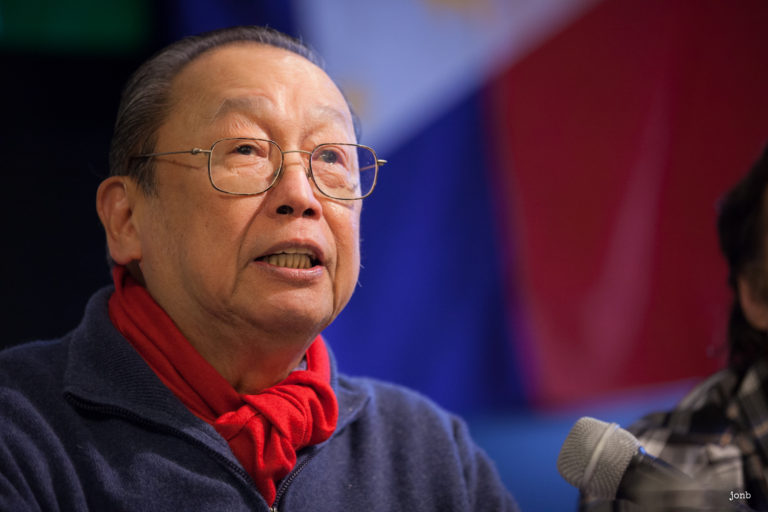
By Prof. Jose Maria Sison Chairperson, International League of People’s Struggle 17 March 2019
In his 74-page manifesto, the Australian mass murderer Brendan Tarrant raves about the “great replacement” of white people by non-white peoples and blames the liberals for advocating mass migration, white displacement and cultural diversity in the same perverted way that the Norwegian mass murderer Anders Brevik blames “cultural Marxism”.
The hysterical fear of white genocide drove Tarrant to commit the massacre of at least 49 Muslim worshipers in a mosque in Christchurch, New Zealand. The victims came from various underdeveloped countries as well as from war-torn countries. The white victim complex and the hysterical assertion of white supremacy are two sides of the same coin that leads to the atrocity.
White people in the developed countries are themselves victimized by the monopoly bourgeoisie but are misled by the demagogues of the capitalist system to believe that the migrants, especially the Muslims, are to blame for the erosion of the wage and living conditions of the white working class and middle class.
The neoliberal strategists, think tanks, academe and mass media of the monopoly bourgeoisie obscure the fact that economic and social conditions are becoming worse for the working class and even for the middle class because of the crisis of overproduction and the unsustainable abuse of credit.
Neoliberalism and the adoption of higher technology have pressed down wages, eroded social benefits and services and have increased unemployment and poverty among the whites and non-whites. Those few whites turned hysterical and murderous by a combination of white-victim complex and white supremacy do not think much beyond their personal and national egoism.
They are kept ignorant of the fact that the mass migration from the underdeveloped to the developed countries is the result of the policies of the monopoly bourgeoisie to avail of cheap labor, to keep the underdeveloped countries more underdeveloped and to wage wars of aggression to put down anti-imperialist governments and popular movements asserting national independence and demanding broader democracy, social justice and industrial development.
As a result of decolonization due to the direct and indirect effects of armed national liberation movements, the imperialist countries have used mass migration towards them since the 1970s to make up for the loss of colonies and semicolonies. To make up for the tendency of the profit rate to fall in their own home grounds, they have also utilized neocolonialism to cause the further underdevelopment of former colonies and semicolonies to maximize profits. The widening mass unemployment and poverty drive the people to emigrate.
And whenever certain governments and revolutionary movements arise and assert national sovereignty, nationalize the economy and promote industrial development, the imperialist countries unleash campaigns of destabilization for regime change and wars of aggression, which are the biggest and worst form of terrorism. Thus, the imperialist countries themselves have been culpable for the increasing number of both political and economic refugees since the 1980s, especially from the war-torn countries in Asia, Africa and Latin America.
Whenever the monopoly bourgeoisie finds it too difficult or is frustrated in using liberal democracy or social democracy to disarm and sedate the working class, it resorts to the outright use of the most reactionary ideas and sentiments to obscure the roots of the crisis of monopoly capitalism, to mislead the broad masses of the people and the use the grossest form of violence and deception to suppress the anti-imperialist and democratic mass movements which aim for national liberation, people’s democracy and socialism.
We are living today in a crisis-stricken world capitalist system in which only one percent of the population, the top circle of the monopoly bourgeoisie, own 50 percent of the world’s wealth and only 10 percent own 75 percent. The gross social inequality means the increasing polarization of all societies and the intensification of the anti-imperialist and class struggle.
Under these circumstances the monopoly bourgeoisie unleashes all kinds of monsters and atrocities, including state terrorism and private terrorism of white supremacists, in order to counter the rise of revolutionary consciousness and movements among the proletariat and people in every country and on a global scale.
More than ever, it is necessary for the revolutionary parties of the proletariat to arise and strengthen themselves in order to promote proletarian internationalism among the workers of the world as well as international solidarity among the broad masses of the people of the world in order to overcome and defeat all the strategies and tactics of the monopoly bourgeoisie to divide the white and non-white workers and peoples of the world with the use of chauvinism, xenophobia, racism and fascism. ###