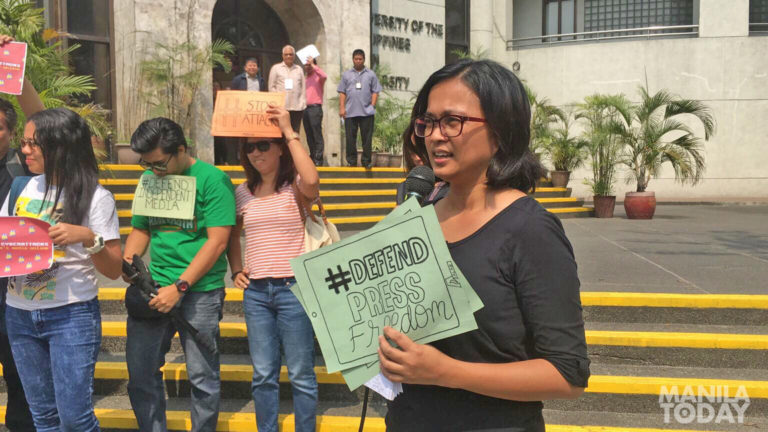
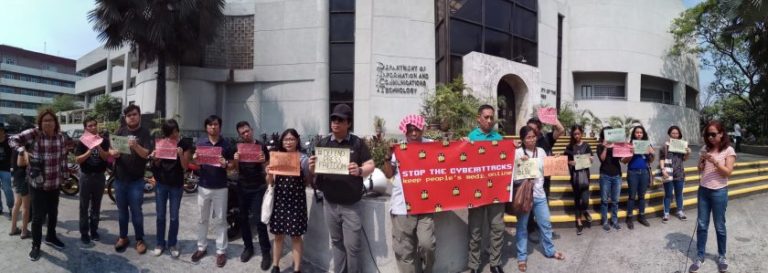
Alternative media groups held a picket protest in front of the National Computer Emergency Response Team office of the Department of Information and Communications Technology at CP Garcia in Quezon City this morning.
The groups decried the agency’s inaction amid cyber attacks experienced by the groups since December of last year.
Some independent media site such as Bulatlat have suffered severe distributed denial of service attacks that shut down their website for days up in several weeks.
Present in the protest were Altermidya People’s Media Network, Kodao Productions, Pinoy Weekly, Bulatlat, Tudla Productions and human rights group Karapatan.
The protest was held in conjunction with the World Day Against Cyber Censorship.
The groups also called for a social media rally at 7-8pm today and will use the hashtags:
Department of Interior and Local Government in Davao Region (DILG-11) has reminded local officials to conduct their Barangay Assembly or State of Barangay Address (SOBA) starting March 2019.
On March 12, 2019, Karapatan, Rural Missionaries of the Philippines (RMP) and Kabataan Partylist filed complaints at the Commission on Human Rights (CHR) with regard to the red-tagging and terrorist-labelling of said organizations.
MANILA — Filipino journalists marked the World Day Against Cyber-Censorship with a protest action assailing the insidious and well-funded cyber-attacks against independent and alternative media outfits in the Philippines.
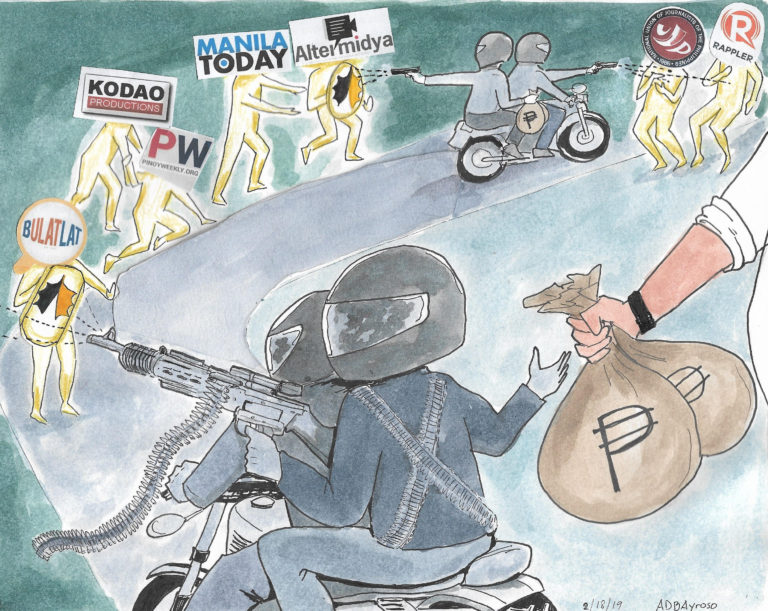
“We have reason to believe that the Duterte administration has orchestrated this cyber attack on websites of critical and independent media as part of its efforts to silence criticism and dissent against it,” said Ronalyn Olea, managing editor of Bulatlat.
In a protest action in front of the National Computer Emergency Response Team’s office in Quezon City, journalists challenged the government agency to look into the widely reported cyber-attacks in the form of Distributed Denial of Service (DDoS) attacks.
NCERT, a division under Cybersecurity Bureau of the Department of Information and Communications Technology, is “responsible in receiving, reviewing, and responding to computer security incident reports and activities.”
Sweden-based Qurium Media Foundation, a non-profit organization assisting threatened media worldwide, has repeatedly reached out to NCERT over the said incidents.
Websites of Bulatlat, Kodao Productions and Pinoy Weekly, as well as Altermidya – People’s Alternative Media Network, and other advocacy websites, have been targeted for distributed denial of service attacks (DDoS) since late December 2018 and continues until today.
Olea said “cyber-attacks are in conjunction with the overall attacks on press freedom that include threats against news site Rappler and even dominant media networks like ABS-CBN.”
Later tonight, at 7 – 8 p.m., a Twitter rally will be held. Hashtags #KeepUsOnline #StopCyberAttacks #DefendPressFreedom and #DefendIndependentMedia will be used. Bulatlat.com
MANILA – Alona Sotto, a mother of two, celebrates her 38th birthday today (March 11) far from her family and home in Compostela Valley.
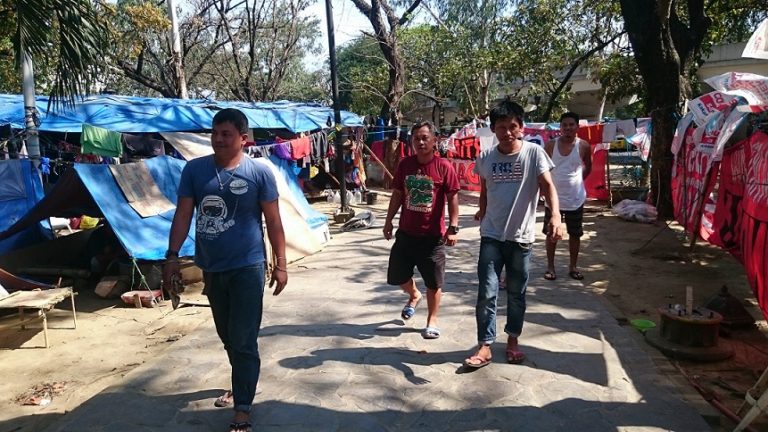
She is among the hundreds of unionists whose strike has been met by violence since October 2018. Unable to continue their strike in Mindanao following the military operations against their unarmed picket line, the unionists set up instead their protest camp starting December 2018 in Manila.
At the Liwasang Bonifacio, they have built and protected their picket line against threats of demolition by the local government. “We are here to pressure the Department of Labor and Employment (DOLE) to act swiftly on our regularization and the issues of our strike,” Sotto said in Filipino.
The unionists have been in Manila for roughly four months now. After their picket line in Compostela Valley was burned down and demolished by the military, they pitched their tent at Mendiola Bridge near Malacañang before the Human Rights Day celebration last December 10. They then transferred to the Liwasang Bonifacio and, from time to time, moved in front of the nearby DOLE headquarters. They have defended their protest camp from at least four instances of attempted demolition.
Sumifru unionist Alona Sotto, 38, marks birthday at protest camp in Liwasang Bonifacio with the wish they would come home soon as regular workers with mandatory benefits and security of tenure. (Photo by M. Salamat / Bulatlat)
Life at the protest camp is especially difficult for women. “It’s very hot in here, and in the evening we have only the street light nearby to light our way,” Sotto said.
There is no ready source of water. They would go elsewhere to take a bath. They have set up a centralized kitchen but sourcing their food is another “struggle” altogether. They are more exposed to summer’s heat and occasional rains. Back home their family is increasingly worried and asking for their return. Their children are expectedly crying since their parents are far away. Some couples, Sotto said, are having long-distance arguments. Parents obviously worry about their children left behind. Errol Tan, a member of the union’s board of directors, said they are also finding it harder to respond to their kids’ needs for schooling. “We’re all heavily in debt now.”
But they all say they have to pursue this struggle. “In the end, this is also for our family.”
A long, dangerous struggle for regularization on the job
The union is demanding the workers’ regularization in the packing plants of Sumitomo Fruit (Sumifru) Corporation in Compostela Valley.
Since December 2010 after a lengthy legal battle they won their case in the Supreme Court. The latter issued a decision saying the longtime Sumifru workers under the union Nagkahiusang Mamumo sa Suyapa Farm (NAMASUFA) are to be considered as regular workers.
But the Japanese fruit exporter filed a motion asking the Supreme Court to reconsider and reverse its decision. While the high court has not decided yet as of this writing, the union launched various actions to induce Sumifru to abide by the court decision. Most of the more than 3,000 workers of Sumifru remain as contractuals according to the striking workers, despite the still unchanged Supreme Court decision calling for their regularization.
Contractuals in Sumifru do not enjoy security of tenure or any benefits in case they get sick or when the women workers get pregnant, except for what they can get from the Social Security System and Philhealth, the unionists said. Work contract typically lasts three months before it is renewed.
Late last year, the struggle for regularization drove the workers to launch a strike. They had successfully launched strikes before. This time though, they were up against not only the management of Sumifru and their guards but also martial law in Mindanao.
Although they are unarmed and holding a strike is part of the workers’ rights, the military and the local government of Compostela Valley are misrepresenting unionism and strike as “terrorism,” the workers said.
The Sumifru workers during their strike in Compostela Valley
Along with accusing the workers of being members of the New People’s Army, the military conducted house-to-house visits warning the civilian community against the unionists and the strikers.
Union board member Errol Tan told Bulatlat that the military has killed one of their fellow unionists and attempted to kill two others. Adding to their difficulties in Compostela valley, he said, are the military actions such as spreading baseless accusations about the unionists.
“Every union in Compostela Valley is under military threat,” Tan said.
In fact, every union in the Philippines opposing contractualization or allied with the labor center Kilusang Mayo Uno (KMU) seem to be under military threat. On March 11, members of KMU staged a protest action in front of the Department of Labor and Employment (DOLE) headquarters to slam the “NICA Orientation for Government Executives on the Communist Terrorist Group Problem” called by the DOLE for its executives.
KMU denounces what it describes as “relentless vilification campaign” by the AFP and intelligence agencies. “Our member unions are legitimate organizations of workers who are advancing legitimate struggles and grievances. Unionism is not terrorism,” said KMU chairperson Elmer Labog.
A typical example of workers advancing such legitimate struggles are Sotto and Tan of NAMASUFA. Both have worked for nearly two decades in Sumifru yet remained contractual up to the time of their strike in late 2018.
In 2017 their daily wage amounted to only P291 for every eight hours of work. Yet, this amount had already been increased bit by bit through the campaigns of the union.
“No regularization on the job, no benefits” — this is how simple the equation is to Gloria Delantes, 60, a contractual for half her life at first in Dole Philippines and then in Sumifru for 19 years.
While encamped in Manila, the NAMASUFA is following up on the SC decision regarding the implementation of their regularization. At the same time, they are calling on Labor Secretary Silvestre Bello to act on behalf of the workers toward implementing the SC decision and concluding the issues of their strike calling for regularization.
Kailan pa naging kalokohan ang kalakaran? Para mo na ring tinanong kung may natitira pa bang katinuan ang mga nasa kapangyarihan.
Sabi ng isang kandidato sa pagka-Senador, hindi raw mahalaga ang debate dahil mas gusto raw ng botanteng masiyahan sa mga sayaw at kanta kaysa malinawan sa mga datos at pagsusuri. Sabi naman ng isang lokal na opisyal, hindi na raw dapat ginagawang batayan ang katapatan (honesty) ng mga iboboto sa Mayo dahil lahat naman daw ay nagsisinungaling.
Walang panahon para maghanda sa debate, pero may oras para mag-ensayo sa magiging sayaw at kanta sa pangangampanya. At para sa mga kandidatong parehong kaliwa ang paa o pinagwelgahan ng nota ang boses, mahabang panahon naman ang ginugugol nila para pumasok sa larangan ng komedya. Panay ang patawa kahit na sila lang ang tumatawa. Biro lang daw ang pagpapababa sa dangal ng kababaihan. Huwag daw seryosohin ang birong ang mga hindi pumapalakpak sa kandidato ay matotokhang.
Kung sabagay, bakit nga naman seseryosohin ang mga biro? Kung pabirong nabanggit na kailangang halikan sa labi ang isang probinsyana para matutuhan ang lokal na wika niya, mainam nga kayang huwag na lang pansinin ito? Kung nabanggit na papatayin ang sinumang hindi susunod sa kagustuhan ng kandidato, tama nga kayang hayaan na lang ito? Malabo naman daw kasing mangyari ang mga ito.
Teka lang. Hindi ba’t nagiging normal na ang pambabastos sa kababaihan? Aba, si Pangulong Rodrigo Duterte mismo ang nagsabi noong Pebrero 2018 na dapat barilin sa alam-mo-na ang mga babaeng miyembro ng New People’s Army (NPA) para hindi na raw manganak. Bago pa man siya naging Pangulo, binanggit ni Duterte noong Abril 2016 na sana’y siya ang nauna nang ginahasa ang isang Australyanang misyonero na na-hostage noong 1989. May insidente naman ng catcalling sa isang babaeng peryodista noong Hunyo 2016. Marami ka pang maiisip na pagkakataong nalagay sa alanganin ang mga babae.
At kung tila normal na ang pambabastos sa kababaihan, paano naman ang kalakaran ng tokhang? Kung paniniwalaan ang pahayag ng isang senador na nasa oposisyon, umaabot na raw sa 20,000 ang napapatay dahil sa giyera ng gobyerno kontra droga. Tulad ng inaasahan, mas mababa ang bilang ng Philippine National Police (PNP) hinggil sa mga namatay sa tinaguriang “war on drugs” ng administrasyong Duterte. Ayon kasi sa PNP, 5,104 “lang” daw na drug personalities ang namatay sa mga operasyon kontra-droga mula Hunyo 2016 hanggang Disyembre 2018. Pero hindi pa rin maikakaila ang libo-libong nawalan ng buhay, may batayan man para sa mga nasa kapangyarihan o repleksyon ng kawalan ng pakundangan para sa mga pinagkaitan.
Paumanhin sa ilang tumatakbong kandidato, pero sadyang hindi biro ang kalagayan ng ating lipunan. Nananatili itong patriyarkal dahil sa mga patutsadang patuloy na hinuhubaran ng dangal ang kababaihan. Nakokompromiso rin ang ating demokrasya sa sitwasyong patuloy ang malawakang pagpatay at paglabag sa karapatang pantao, at lalong napapalakas ng mga opisyal na pahayag ng mismong Pangulo ang ganitong kalakaran kahit na sabihing biro lang ang mga ito. Lahat ng binabanggit ng Pangulo, maging ng iba pang matataas na opisyal, ay tinitingnang opisyal na polisiyang kailangang sundin. At sa usapin ng pagsunod, may susing papel ang pulisya at kailangang tandaang armado sila!
Sa ganitong konteksto dapat maging maingat ang mga kandidato. Sa panahong nagkakatotoo ang dapat ay masamang panaginip, hindi na simpleng biro ang magbiro. Puwede sigurong magpatawa para batikusin ang isang walang-batayang polisiya pero hindi dapat gawing katawa-tawa ang sitwasyon ng kababaihan at ng lipunan sa pangkalahatan. Sama-sama nating hamunin ang mga kandidato para pataasin ang antas ng diskurso.
Kailan pa naging kalokohan ang kalakaran? Mas mainam sigurong itanong kung sino-sino ang patuloy na nagpapababa sa pamantayan!
(PAGLILINAW: Personal na opinyon lang ng awtor ang mga punto tungkol sa eleksiyon at walang kinalaman sa grupong Kontra Daya na isa siya sa mga convenor.)
Election time in the Philippines is a festival for politicians and voters. The Filipino people despite how frustrated they are with the results after elections, still during election day they will go out and vote.
Whatever the reasons for voting candidates in elections, there are truths, however, that cannot be denied, such as:
1. Elections in the Philippines are dominated by country’s elite families who are competing for political power. The wealthiest clans contest national, congressional and provincial offices. The families of lesser wealth are competing for municipal offices. The families of rich peasant or not so poor contest for the barangay offices.
2. From 1935 until 1972, Philippine elections were directed by the agents of the United States. Generally, the will of the people was usually acceptable though there were flaws like miscounts, instances of vote-buying or election-related violence but these were considered normal.
3. During Martial Law, Ferdinand Marcos controlled all election processes. Elected public officials were the people who were Marcos allies and minions. In the snap election of 1986, Marcos supporters tried every trick to win but the people manning the counting discontinued to work. Corazon Aquino called for civil disobedience and People Power ousted Marcos, his cronies and supporters. But Marcos loyalists were not really dismantled. They just changed colors and party-loyalty.
4. After Marcos, the Philippine elections still marred by violence, fraud and irregularities. Vote-buying is rampant. Voting precincts are usually run out of ballots and ink or ballot boxes were switched. The names of legitimate voters were not be located. The names of the dead people remain on lists. There were voters who can vote twice. Election results were manipulated. Though, there were changes in the manner of voting and counting through computerizations but still irregularities happened.
6. Election monitoring bodies or watch groups like National Citizens’ Movement for Free Elections (NAMFREL), Parish Pastoral Council for Responsible Voting (PPCRV), Kontra Daya, and the likes are good only in information and education campaigns but they are powerless in correcting vote-buying and terrorism.
With these realities, the people will still go out and vote.
They are even aware of the electoral situation and problems, but they will participate in the elections. They will participate as if this is their sacred duty.
Most of the people who voted during election believed that it is an opportunity for a change. Basically, many people think of a change of people who are leading the government either in local government units or in the national level. At the same time, people think that changing people goes along with the changing of political platforms and programs.
Thus, progressive organizations and Churches will also participate. Their task is to guide the people. The people should be guided in voting. This is one of the tasks of Christians, especially church people. The Makabayan guidelines in choosing or supporting candidates may be a big help or can be considered. The Roman Catholic Church has issued also some guidelines for their members.
The Makabayan Coalition will campaign for candidates who would stand on some issues, which are the following:
Pagsuspinde o repeal ng probisyon sa excise tax ng TRAIN Law;
Paglaban sa Charter Change at mga katulad na makasarili at kontra-Pilipinong amyenda sa Konstitusyon;
Pagtaguyod ng karapatang pantao at due process para sa lahat;
Pag-giit ng ating soberanya at karapatan sa West Philippine Sea;
Pagpapatuloy ng usapang pangkapayapaan sa pagitan ng gobyerno at National Democratic Front of the Philippines.
The Catholic Bishops’ Conference of the Philippines (CBCP) had already issued a pastoral statement: “Seek the Common Good.”
This means “pursuit of the common good; promotion of justice; a spirit of service; option for the poor; and the empowerment of people.”
Archbishop of Cagayan de Oro Antonio J. Ledesma, SJ revealed that the Laity of the Roman Catholic Church must “be actively involved during the election campaign period.”
Archbishop Ledesma called on the faithful to vote for the candidates who are qualified for the five C criteria: conscience, competence, compassion, companions and commitment.
These five Cs are defined in the following:
The candidate is a person of conscience, a person of moral integrity. It means that he or she is God-fearing (maka-Dios); will respect human rights; transparent and accountable for his/her actions and no charges of corruption in his public record.
The candidate is a competent person. He/she has the educational background; good record of service, either in government or in private life; and in good health.
The candidate has a compassion or concern for the poor and marginalized; work for social justice; protect the rights of minorities and work for the empowerment of the poor.
The candidate’ companions must have reputation and integrity; must not work for personal interest; and not a member of political dynasty.
The candidate has a commitment. He/she holds “on to key principles – e.g., maka-tao, maka-bayan, maka-kalikasan… stand on key issues, such as peace-building in Mindanao and peace negotiations with insurgent groups, protection of the environment, anti-poverty measures foreign relations.”
Before the statement of Archbishop Ledesma, Archbishop Socrates Villegas of Dagupan had released a video clip that called the people to See, Judge, Act. Archbishop Villegas explained that voting is the power of the people. It is sacred because it is an expression of preaching the will of God for the country.
Thus, the people must See the important problems in the society. They must Judge the candidates which should have commitment, competence and character. The people must Act to vote rightly and bravely.
Balanga Bishop Ruperto C. Santos has, earlier, urged his flock “to vote only candidates who have a good track record and with the common good and interest in mind.”
Borongan, Samar Bishop Crispin Vasquez urged the electorate to use their votes wisely and to start correcting distorted values that hinder the election of good candidates.
“It is high time to demand for real change. These coming elections, choose good candidates,” Bishop Vasquez said.
Archbishop Ledesma suggested “three challenges for the Catholic laity to be actively involved during the election campaign period.”
These are the following:
To form circles of discernment. This may be actualized through Basic Ecclesial Communities, clusters of household heads among religious lay organizations, or any grouping of concerned citizens. Group discernment should be more enriching and enlightening instead of relying on one’s solitary perceptions.
For lay faithful to engage in principled partisan politics. “Principled” in the sense that Christians should be guided by moral values and first principles. “Partisan” in the sense that ultimately every voter has to choose a particular candidate representing a particular party. And “politics” in the sense that the winner in a political contest is given the legitimacy and power of decision-making for the community. Hence, the entire community are stakeholders in the choice of their leaders.
For Catholics is the reminder that it is their right and their duty to vote for candidates who work for the common good. Hence, candidates should be elected not on the basis of personal favors given to the voter but on the candidate’s record of public service and commitment to work for the common good.
Other institutions and Churches, like the National Council of Churches in the Philippines (NCCP), Iglesia Filipina Independiente (IFI), United Church of Christ in the Philippines (UCCP), United Methodist Church (UMC), Episcopal Church in the Philippines (ECP), and the Evangelical and Pentecostal Churches, may also issue pastoral statements on elections for their faithful to vote for the right, honest and servant candidates.
However, there are more challenges for Christians to work and actualize the guidelines presented by the bishops. One of the challenges is to help build unity, solidarity, network and alliance among Churches and Christians.
Furthermore, the Philippine Churches in order to be able to gather the supports of the people of their rightful candidates in this coming May election, they must ensure to gain and win over the people and court the people’s vote. The people’s vote is the vote of the Filipino masses. They should convince the people that the voice of the people is the voice of God. It means that Church vote is the people’s vote. The people must obey and follow the call of the Churches. After all, Churches serve the people.
The task of progressive church people organizations is to help the Churches overcome sectarianism and chauvinism. It means that biases and distrust must be disregarded. They must also unite against fraud, especially vote-buying, and terrorism. Working for the common good is working for the Filipino people. The Filipino people are the people of God.