Home Blog Page 389

Reading in the age of distraction

Metro Manila’s insane traffic congestion is an opportunity to read books. Reading is more productive and relaxing instead of cursing at drivers, enforcers, and pedestrians. It’s less risky than using a smartphone inside jeepneys, UV Express vans, and trains. It’s a matter of adjusting our perspectives. For example, a three-hour ride from Quezon City to Makati during the morning rush can be viewed as a precious time to catch up on our reading goals. When we scan the news or play a game on phones, we absorb visual images which is also a form of reading. Why not instead turn to the traditional way of reading as an alternative to mobile entertainment. Our minds are more focused when reading a book compared to surfing the Internet which bombards us with too much bytes of useless information, mindless distractions, and overrated tasks which can be done at home or work. We cannot eat or drink inside public transport vehicles but we can certainly feed our minds.

Because of inefficient services, we often spend several hours waiting in line. Reading can instantly convert the wasted time into something useful, educational, and even fun. Imagine being trapped in a room without WiFi and there is a long waiting time. Worse, the use of mobile phones is restricted. Reading a book of your choice is more pleasurable than constantly looking at the wall clock. It is better than being forced to watch silly infotainment TV ads. When your name or number is called, you move forward with a positive thought that you spent time wisely by choosing to enrich your knowledge of life and the world. This too has a calming effect which could hopefully prevent you from blaming overworked workers for bureaucratic deficiencies.

Reading in a public place is a nice feeling to experience. No, it won’t make you look lovably smart. People tend to see book readers as geeks. Two decades ago, those who tinker with gadgets in public are viewed as techie nerds. Today, those who hang out in public without a phone in hand are treated with suspicion.

But back to reading, it can enhance your attachment to a place. It can bind your memories of a particular nook to the scenes, characters, and ideas in the book you are reading. A book can make you remember of the smell of an obscure café, the surprising comfort of a wooden park bench, the retro music at the train station, or the cold temperature inside a provincial bus. You recall these impressions not because you read them somewhere but because you experienced them while reading a book. When you take a selfie with a book, it makes visible your intent to read something but it is more meaningful if you both read the book while sensing the reality of the reading moment.

What a delight to claim a space and declare it a reading territory. Marking a spot in public as a designated hub for reading. Think of malls, churches, schools, government buildings, and parks that can be targeted by readers. Smokers can no longer pollute the air with impunity that’s why book readers should inhabit the abandoned smoking corners and transform them into a reading place.

But we are also aware of the diminishing incentives to read. Infrastructures are designed in favor of money-making activities. Unfortunately, reading is not considered as a public activity that can yield significant returns. Thus the need for more aggressive readers to hype the act of reading, inspire others to do the same, and counter the use of smartphones as the ubiquitous way of exhibiting literacy in the 21st century.

This is a huge challenge given the immense popularity of Internet streaming to watch movies, play games, or lurk on social media. Our role is to demonstrate that reading is more fun and healthier than bingeing on Netflix. It takes several hours a day or week to complete a TV series whose storyline is stretched to lure more viewers. We are lulled into thinking that the repackaging of formula fiction is modern entertainment. Indeed, nostalgia works.

There are shows deserving our praise but do we really need to devour dozens of episodes in one sitting just to understand and appreciate impressive plotlines? Each Netflix series we finished watching is equivalent to how many books in terms of hours spent? We think Netflix is more satisfying to consume but books provide the same if not greater amount of drama, better description of people and landscapes, and original stories.

Perhaps e-books represent a wise option. Content downloaded from the cyberspace and is meant to be read. It is viable and increasingly made accessible but if our aim is to achieve some level of work-life balance, reading a printed book offers instant relief from the madness of virtual reality. A few hours of digital detox to soothe our Internet-addicted bodies.

Despite our fast-paced lifestyle, we could still set aside some time to read what’s trending on social media. If this is feasible, there’s more reason to find time for reading books. Motivate others to read. Discuss these books in public. Reading should not be relegated into mere academic pursuit.

Perhaps some are wary of making bad choices when reading books. It’s a risk but less harmful than what is peddled by Hollywood and Netflix. What we can do is persuade readers to be critical of the text they are reading. Yet we do not demand the same thing when people discuss the movies, TV shows, songs, and games they scavenge on the Internet. We assume that books ‘indoctrinate’ so therefore we have to be careful with our selection; but we can be eclectic with our online posting of movies and TV series? There are passive readers and Netflix subscribers but only the former are required to be intelligent and politically-correct about their decisions.

We are back to the basics. Threatened by armies of disinformation, our best weapon is the truth. Reading the truth, deciphering the truth, fighting for the truth. In the age of ephemeral attention, reading is an act we can pursue, promote, and steer towards our other political endeavors. (http://bulatlat.com)

Mong Palatino is a Filipino activist and former legislator. Email: mongpalatino@gmail.com

The post Reading in the age of distraction appeared first on Bulatlat.
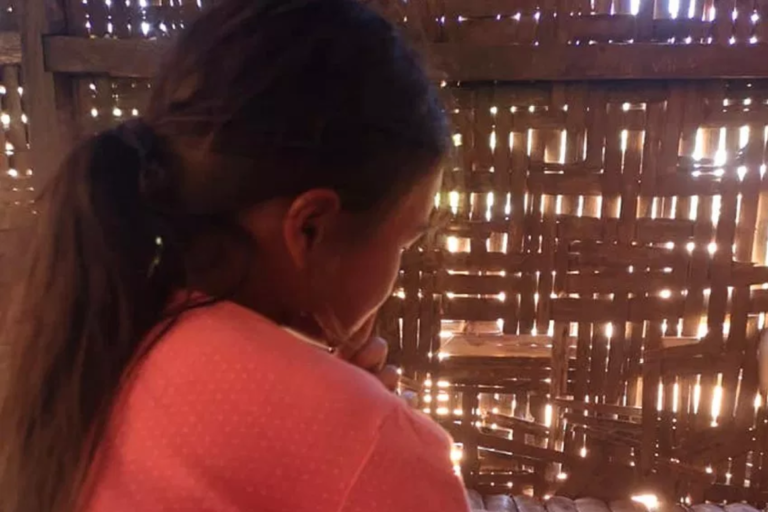
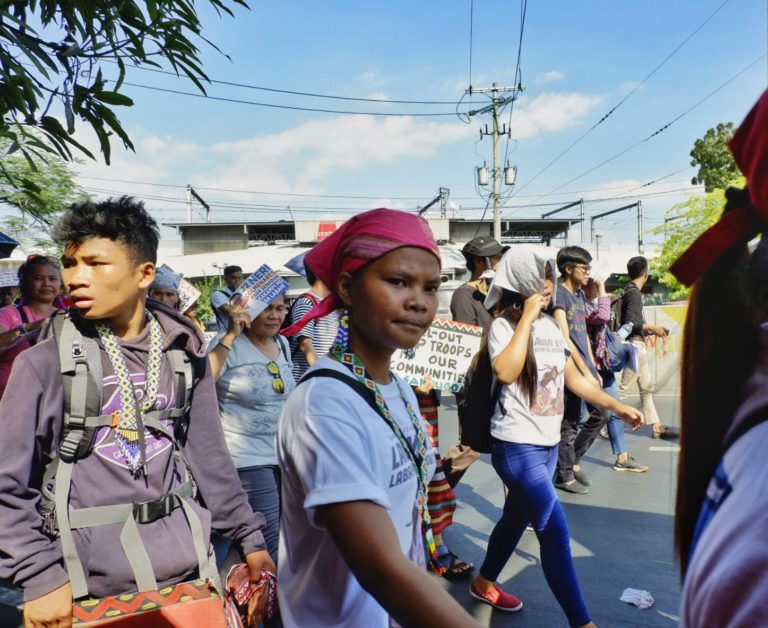
Lumad girls held incommunicado by soldiers tell of horrors in captivity

Rina (not her real name) in an interview with human rights group Karapatan. (Photo courtesy of Karapatan Southern Mindanao Region)

By MARA S. GENOTIVA
Davao Today

DAVAO CITY, Philippines – “They were forced to hold a piece of paper which bore their names, age, and address, while soldiers took pictures of them and forced them to sign a document without explaining what was written on it.”

As narrated by Jay Apiag, secretary-general of Karapatan-Southern Mindanao, on behalf of the two Lumad minors who were held by the military in Barangay Sinuda, Kitaotao town in Bukidnon province last month.

Based on the narratives reported by Karapatan, Rina, 11, and her cousin Ellah, 17, (real names withheld) were about to gather Rattan locally known as Uway or Agsam and Bocawe, a local variety of Bamboo, in the morning of February 18 when they were accosted by seven soldiers.

The group identified the soldiers under the Army’s 88th Infantry Battalion.

“They were later grimly interrogated and accused of having been directed by the New People’s Army (NPA) to trace the military’s whereabouts,” said Apiag.

The two repeatedly denied the soldiers’ accusation, saying they were only gathering materials to make indigenous accessories and pleaded to leave for they still have classes the next day.

The soldiers told the girls that they will be sent home when their companions arrive.

“Ellah even heard some of the armed men’s conversation that should the minors be transported on the military’s 6×6 truck, the children might shout and create commotion,” Apiag added.

They stayed in the place from 11 a.m. until 7 p.m. until they left heading to a nearby sitio (village). At 10 p.m., they arrived at Cabalansihan cemetery and were told to take a nap while waiting for their companions. After an hour, a white pick-up truck arrived.

“The military then forced the minors to board the vehicle, despite the children’s refusal and pleadings,” said Apiag.

They agreed to board the vehicle when the soldiers assured that they will be sent home.

“Later, they were transferred to a military truck and brought to the unit’s camp based in Maramag town in Bukidnon at around 12:00 midnight,” Apiag continued.

The two spent the night inside the military camp.

After being served with bread and coffee without sugar for breakfast on the morning of February 19, the two were subjected to another round of interrogation.

At 9 a.m., the girls were brought to a hut, where 15 individuals who introduced themselves as Lumad and NPA surrenderees, were waiting. All took turns talking to Rina and Ellah for an hour.

They were later brought to another room inside the camp, which Ellah thought was an office.

There, they were forced to sign a document without any explanation, Apiag added.

At 2 p.m., the two were transported to a hospital for a check-up and brought back to the military camp.

According to Rina and Ellah, Apiag added, soldiers took photos as they received eight kilos of rice.

A soldier told the girls, “Ayaw mo og tug-an ha? Sorry kaayo (Please don’t tell. We’re very sorry).”

Rina and Ellah were released late in the afternoon of February 19.

Karapatan condemned the incident that they believe to be a clear case of abduction and an attack against Lumad communities in the countryside.

“This incident only proves that there is no let-up in the Armed Forces of the Philippines’ shameless exhibition of its brutal reign in lumad communities. Unquestionably infuriating, the traumatic episode exacerbates the escalating attacks against innocent civilians who frequently fall prey to Duterte’s implementation of martial law,” said Apiag.

Karapatan demands justice and for the responsible Army unit be held accountable.

Apiag also urged President Rodrigo Duterte to lift the martial law declaration in Mindanao as this “afford” state forces to commit abuses against civilians.

The Mindanao-wide human rights group, Barug Katungod, has recorded 153 cases of political killings, 59 cases of extrajudicial killings, forced evacuations affecting 488,759 individuals, 686 trumped-up cases, 1,411 fake and forced surrenderees since martial law was declared in Mindanao.

The human rights group concluded: “Under the government’s all-out war, certainly, no one is being spared. In fact, children glaringly turn out to be one of its most direct targets.” (davaotoday.com) Reposted by (http://bulatlat.com)

The post Lumad girls held incommunicado by soldiers tell of horrors in captivity appeared first on Bulatlat.

Duterte and Trump

The Chinese embassy in Manila had earlier demolished Duterte spokesperson Salvador Panelo’s tale that should the government deport Chinese nationals illegally working in the Philippines, the Ambassador had threatened to do the same to Filipinos in China.

The Embassy said the Chinese government would do no such thing because it “respects” Philippine laws. But there was Panelo again last Saturday (March 2) with another story. This time it was about visiting US Secretary of State Mike Pompeo’s supposedly telling President Rodrigo Duterte that he is just like US President Donald Trump in that he (Duterte) too is “frank, does not favor anyone and can go against everyone.”

Hardly containing his glee, Panelo went on to say that Pompeo was “very fond” of Mr. Duterte, implying thereby that Trump is similarly disposed. Whether Panelo was telling the truth or not, he apparently believes that being like Trump is something most Filipinos in this pro-US country would consider a virtue.

Trump has indeed demonstrated his affection for Duterte by saying that he’s doing an excellent job in his “war on drugs,” and even said it should be replicated in the US. But he also knows how important the country is to US strategic interests in Asia: he described the Philippines at one point as “a prime piece of real estate.”

Panelo’s point in recalling that alleged incident was clear enough, however: Pompeo likes Mr. Duterte because he is just like Trump. Unfortunately that’s not as flattering to his patron as he thinks. There’s an emerging consensus among academics, the press, business, women’s groups, people of color and even conservatives in the US that Trump is one of the worst presidents the US has ever had. All the opinion polls are united in their findings that he has one of the lowest approval ratings of any US president after only two years in power.

Public approval of Trump is declining even in the US Midwest. It was at a low 40 percent this February, with nearly 60 percent disapproving of Trump in the same month. Like the Midwest, the South was also a Trump stronghold in 2016, but his approval rating has also declined in the southern states from around 60 percent in July 2018 to 44 percent last February. (Mr. Duterte’s approval ratings are of course much higher. Although they fell to 75 percent in September 2018, they were at 81 percent by year-end.)

Trump is currently under siege from a variety of accusations ranging from treason to dishonesty, racism, and disrespect for women and gays. Mr. Duterte’s critics could say that he does have these in common with Trump, although his forays into racist rhetoric have been relatively few, among them his dismissing the International Criminal Court’s (ICC) prosecutor as “that black woman.” But the word “treason” has also been used to describe his bending over backwards to accommodate not only the military interests of China by doing nothing about that country’s intrusion into the West Philippine Sea, but also his entering into onerous agreements with it and his encouraging the influx into the country of tens of thousands of Chinese workers while Filipinos are forced to leave the country for jobs abroad.

Mr. Duterte shares with Trump his widely known misogyny and disrespect for women, even as his so-called campaign against corruption has failed to convince anyone that honesty in government is really a regime policy.

Neither of them can stand criticism, an independent press, and free expression. Trump routinely condemns the critical US press for supposedly disseminating “fake news.” He has even described the media as “the enemy of the people,” and incited violence against journalists. If that sounds familiar, it is because Mr. Duterte has been doing the same thing to the independent press in the Philippines and frequently incites violence against regime critics.

What separates him from Trump are the drug-related killings under his watch, which, even if pegged at “only” 4,500 as the Philippine National Police (PNP) claims, is such a flagrantly unacceptable policy Trump has never again repeated the idea of his replicating in the US the Duterte policy that makes the killings inevitable.

Like Mr. Duterte, however, Trump has no coherent ideology or philosophy of government. It helps explain the confusion over what both were really up to during their first months in office. In Trump’s case, what has been established is that he isn’t really for anything beyond his personal interest in wealth and power. That’s according to his former “fixer,” Michael Cohen, who in his testimony before the US House of Representatives last February 28 called Trump a “racist, a con man and a cheat.”

Whatever he may be, as president of the lone remaining superpower on the planet, Trump has the political, economic, and military means to compel other countries, including the Philippines, to bow to US wishes. Mr. Duterte has neither the capacity nor the will to even defend Philippine sovereignty. Despite the seeming love fest between him and Trump, by visiting the Philippines at this time and reiterating the imperatives of the “special relations” between his country and the Philippines, the US Secretary of State was in fact sending Mr. Duterte and his Chinese patrons a message that should be clear enough even to the most intellectually challenged.

Pompeo’s declaration that China’s occupation of the West Philippine Sea is against Philippine interests, and his reaffirmation of the US’ commitment to defend the Philippines under the terms of the Mutual Defense Treaty (MDT) if it is attacked were a warning to China as well as to the current regime. His statements were made in the context of the government’s failure to even protest Chinese aggression and its morphing into a Chinese dependency. The US regards both as offensive to its policy of containing the one country that is seriously challenging its dominance in Asia and elsewhere in the globe.

Malacañang is supposedly contemplating a review of the MDT. The US is likely to interpret that act as one more indication of Mr. Duterte’s pro-China policy, and can be expected to do all it can to prevent it, or to at least make sure that if it does happen, will only re-affirm the country’s need for the US’ security umbrella. As the US’ most reliably subservient client institution, the Philippine military will not support any attempt to rescind the treaty, a certainty that will prevent the regime’s doing so despite Mr. Duterte’s anti-US bluster.

Will the supposed friendship between Mr. Duterte and Donald Trump matter should the US conclude that the former has become a liability? Trump is unlikely to risk his own interest in keeping his all-white and chauvinist constituency intact in preparation for the US presidential elections in 2020. That constituency is as likely to condemn any sign of US weakness in Asia in the same way that it condemned his inability to get the funding for the construction of his promised $5.7 billion wall along the US-Mexico border. There is also the fact that the US presidency is only one among several centers of power in that country. The US Congress, and the military-industrial complex among others, are power centers that do make their preferences felt in the framing and implementation of US domestic and foreign policies.

Mr. Duterte and Trump do have certain things in common. But they won’t be enough to make a difference once the US is convinced that Mr. Duterte’s pivot to China is real enough and hostile to US interests. And from all indications, particularly his often repeated claim that the US Central Intelligence Agency (CIA) “wants to kill (him),” Mr. Duterte knows it.

Luis V. Teodoro is on Facebook and Twitter (@luisteodoro).

www.luisteodoro.com

Published in Business World
March 7, 2019

Featured image courtesy of Presidential Communication (Government of the Philippines) Facebook page.

The post Duterte and Trump appeared first on Bulatlat.

Gender equality: Big gains under law but not enough

Ten years ago, no country in the world gave women and men equal legal rights.

Today (or since June 2017) six out of 187 nations have enshrined gender equality in their laws, specifically those affecting employment and entrepreneurship, according to a decade-long study made public by the World Bank, ahead of the observance of International Women’s Day yesterday.

These are Belgium, Denmark, France, Latvia, Luxembourg, and Sweden. But even as these countries have instituted the needed legal reforms, it does not automatically mean that, at ground level, there’s 100 percent gender equality, the study emphasizes.

For instance, in Sweden – where women now represent 46 percent of the members of Parliament and hold 50 percent of the Cabinet seats – women still earn 5 percent less than their male peers. Unequal pay has been a major stumbling block, the study notes, calculating that if women earned as much as men, the global economy could be enriched by about $160 trillion.

The study, titled “Women, Business and the Law 2019: a Decade of Reform,” examined 10 years of data using an index “structured around the economic decisions women made as they went through their working lives.” It measured gender discrimination and tracked legal hindrances to women in either employment or entrepreneurship.

The data show “great progress” toward legal gender equality over the past 10 years:

• In 131 countries 274 reforms to laws and regulations have been adopted to reduce gender discrimination; 35 nations implemented laws on “workplace sexual environment,” protecting nearly two billion more women than a decade ago.

• 39 countries scored 90 or above (the six leading nations each got the full score of 100); 26 of the 39 are high-income, 8 are in Europe and Central Asia, 2 (Paraguay and Peru) in Latin America and the Caribbean, and one (Taiwan) in East Asia-Pacific.

• Globally, the 187 nations’ average score on gender equality rose from 70 to 74.71 over 10 years, indicating that a typical economy/government now gives women three-fourths (3/4) of the rights of men in the areas of activities measured through the index.

• Over the past two years, 65 countries have made 87 legal reforms in favor of women. The issue, however, is when and how these reforms will be implemented. Dozens of studies do show however that in cases where these reforms are really carried out, they have significantly enhanced women’s earning power and agency.

• Among the regional groupings, South Asia (8 countries) has registered the biggest improvement, from a score of 50 to 58.36; East Asia and the Pacific (where the Philippines belongs), has moved up from 64.80 to 70.73, while Sub-Sahara Africa’s (28 nations) score has risen from 64.04 to 69.63. The Middle East and North Africa (22 nations) has made the least progress, its score rising only by 2.86 from 44.49 to 47.37.

On the negative side, the data show the following conditions:

• Only 76 countries mandate equal pay for work of equal value.

• In 104 countries, women are barred from working at night, or taking jobs in manufacturing, construction, energy, and agriculture; this has adversely affected more than 2.7 billion women.

• 45 countries do not have laws on domestic violence.

• 59 nations have no laws on sexual harassment in the workplace. The study notes that women are more likely to own their own businesses in countries where there is legal protection against harassment and abuse.

• 21 countries (many in Sub-Sahara Africa, the Middle East and North Africa) score zero on protecting women from violence.

• 37 countries have no laws protecting working women from dismissal once they get pregnant.

Sarah Iqbal, World Bank program manager of the women, business and law project, observed:

“Unfortunately, laws are a straight line for men and a maze for many women around the world, and that needs to be changed.” “There is no reason,” she added, “to keep women out of certain jobs or prevent them from owning a business. Our message is simple: no women, no growth.”

World Bank senior director for development economics Shanta Devarajan predicted that with developments such as the #MeToo Movement building momentum in the developing world, there would be more progress in laws protecting women from sexual harassment.

All in all, Devarajan pointed out, giving women equal opportunity “is a moral and economic imperative and rescinding discriminatory laws is an important first step.”

It must be noted that the interim president of the World Bank, who wrote the foreword to the study, is a woman: Kristalina Georgieva (she took over after Jim Yong Kim resigned last year). Another woman, Christine Lagarde, heads the International Monetary Fund (IMF). Thus two women now steer the tandem multilateral institutions, the IMF-WB, that have greatly influenced – both positively and negatively — the monetary/financial and development policies of nations since the end of World War II.

“Gender equality is a critical component of economic growth,” Georgieva states in the study’s foreword. “Women are half of the world’s population and we have our role to play in creating a more prosperous world. But we won’t succeed in playing it if the laws are holding us back.”

“We know that achieving gender equality requires more than just changes to laws,” she points out. “The laws need to be meaningfully implemented – and this requires sustained political will, leadership from women and men across societies, and changes to ingrained cultural norms and attitudes.”

She appeals to governments to guarantee the free and equal participation of women in economic and social development. “After all,” she concludes, “the world is better off when it draws upon the talents of all the people.”

However, the WB executive board has issued a caveat. Describing the study as a “product of the (WB) staff with external contributions,” the governing body states that the “findings, interpretations, and conclusions do not necessarily reflect the views of the WB, its board of executive directors, or the governments they represent.” But it allows its reproduction with proper attribution, in whole or in part, for noncommercial purposes because the WB “encourages dissemination of its knowledge.”

* * *

Email: satur.ocampo@gmail.com

Published in Philippine Star
March 9, 2019

The post Gender equality: Big gains under law but not enough appeared first on Bulatlat.

Duterte’s misogyny and its effect on women slammed

0

In President Rodrigo Duterte’s hometown and in time with the celebration of International Women’s Day on Friday, women rights advocates unite for a call to end the ‘macho fascist government’ of Duterte.

NBI-10 official: IPR charges to be filed vs maker, seller of ‘fake’ cigarettes

0

The National Bureau of Investigation-10 (NBI-10) said Friday it is set to file charges against individuals who they believed are behind the proliferation of illegally made and illegally sold cigarettes in Northern Mindanao.