Home Blog Page 394

Drug reformation center opens in Samal Island

0

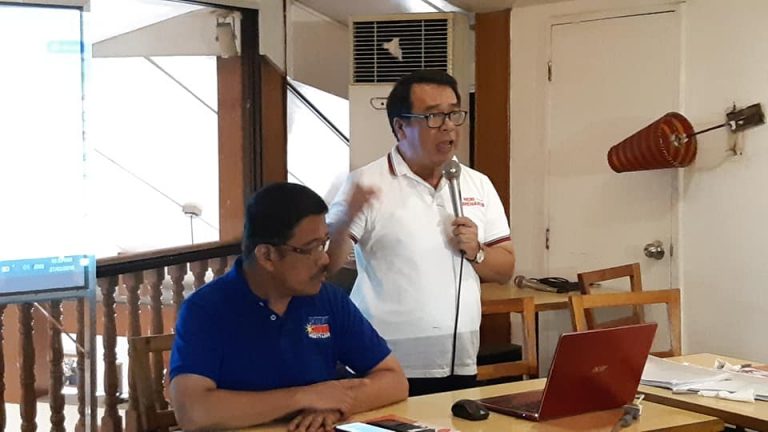
The Philippine Drug Enforcement Agency in region 11 (PDEA-11), together with different local government units (LGUs) led the launching of the first drug reformation center called Balay Silangan in Davao del Norte on Friday, March 1 at the Island Garden City of Samal (IGACOS).

Manila bookstores to visit after Big Bad Wolf says goodbye

Yes, we share the sentiments. It is very saddening that the Big Bad Wolf book sale will end on March 4, especially for folks who didn’t get the time and luxury to go to Pasay City.

The good news is there are several independent bookshops Metro Manila offering low-priced yet high quality books.

Below are some of the must-visit bookshops after the Big Bad Wolf run ends:

Books From Underground

Photo grabbed from Book from Underground Facebook page

This shop is situated along the Lagusnilad underpass beside Manila City Hall. The shop started to operate in the late 2000’s. They have a wide selection – cookbooks, history, theory, literature, magazines, periodicals, and journals of all sorts. Some are even book-signed.

Usually, they sell mass-market paperbacks from PHP 50 to PHP 200, trade paperbacks and hard bounds from PHP 100 and up, depending on the title’s rarity and demand.

Opening from afternoon until late evening, it became a hang-out for its customers with varying literary tastes, ideologies, and political affiliations. One of its proprietors joke that ‘Underground’ is “the place where the Left and the Right meet.”

Visit Books from Undergound Facebook page for more information.

The Common Ground

Photo grabbed from The Common Ground Facebook page

What is the usual and ideal partner of a good book? Coffee and/or tea. That’s why The Common Ground (TCG) took it to the next level. Aside from selling books, their shop doubles as a cafe.

Located on Leon Guinto Street, Malate, TCG induces 80’s and 90’s nostalgia, with its vinyl records and cassette tapes available for customers to play while enjoying their coffee and reading. It became a hang-out place for students from different schools in Taft Avenue.

TCG also hosts activities related to literature, history, politics, among others. It hosted the Baybayin writing workshop of Nawaya, a cultural group. They also provided the venue for the launching of a poetry compilation written by on-strike women workers of Sumifru which was released by Gantala Press, a local feminist publisher. Solidarity events for peasants organized by Sama-samang Artista para sa Kilusang Agraryo or SAKA were also held at TCG.

Unlike major bookstores, TCG encourages zine production and DIY (do-it-yourself) publications – they even have a special shelf for self-published writers and artists.

Visit their Facebook page for more information.

Roel’s Bookshop

Before opening a physical shop on Maginhawa St., Quezon City, Davao-based Roel’s Bookshop was known for selling books online. With an extensive selection of fair-priced humanities and social sciences titles, they gained regular customers from different parts of the country. Their shop is open from 1pm to 11pm every day.

Visit their Facebook page for more information.

Yumi Thrift Shop

Photo grabbed from Yumi Thriftshop

What’s remarkable about this book store is that they sell used books in mint condition. The first thing that will catch your attention is their shelf full of classics printed by different publishers. It is now located on B. Serrano St. Cor P. Jacinto St., Caloocan City.

Visit their Facebook page for more information.

Popular Bookstore

Photo grabbed from Popular Bookstore Facebook page

Known during the early 90’s for selling proletarian literature for proletarian prices, this bookshop is popular (pun intended) among activists and Left-leaning readers. Its original location is on Doroteo Jose Street, Santa Cruz, Manila. In the mid-2010’s, they moved to Tomas Morato, Quezon City. It boasts an extensive selection of Filipiniana titles and now has a special section for used books. It also became the top distributor of activist writers in different fields – may it be history, literature, politics, and/or economics.

Visit their Facebook page for more information.

There are other great bookstores in Metro Manila such as Uno Morato in Quezon City; Tradewinds Bookstore in Intramuros, Manila; and, Solidaridad Bookshop owned by National Artist for Literature F. Sionil Jose in Padre Faura among others.

Booksale is always there, with hard-to-find titles hidden inside every shelf. But for the hardcore anti-establishment, stalls and ‘latag’ vendors along Claro M. Recto Avenue is the best source. From out-of-print Filipiniana literature to 19th century literature, Greek philosophers to postmodernists, theory and literature—they have it.

It is a good thing that despite the cultural trap of the cyber age, books still gain appreciation and interest among the Filipino youth.

The post Manila bookstores to visit after Big Bad Wolf says goodbye appeared first on Manila Today.

MAKABAYAN endorses 9 opposition and independent senatoriables for Halalan 2019

The Makabayang Koalisyon ng Mamamayan (MAKABAYAN) officially endorsed its bets for the upcoming 2019 midterm polls in its proclamation rally held at the Quezon City Sports Club on Sunday morning, March 3.

Along with Makabayan sole bet Neri Colmenares, the progressive coalition endorsed independent re-electionist Senator Grace Poe represented by son Brian Poe Llamanzares, opposition Senator Nancy Binay represented by Atty. Danton Lucinario, and Senator Bam Aquino represented by wife Timi Aquino, former congressman Erin Tañada, former senator Serge Osmeña, and newcomers Atty. Chel Diokno, Atty. Florin Hilbay, and Samira Gutoc.

Makabayan president Satur Ocampo manifested the importance of championing the senatoriables that would not be afraid to push for a pro-people Senate.

“In these times of escalating efforts to stifle dissent and a rising threat of dictatorship, where impunity reigns and the  system of checks and balances among the Executive, Judiciary and Legislative branches of government is in peril, we need an independent Senate.

The upcoming elections gives us the opportunity to elect to the Senate men and women of proven competence and integrity who can assert the Senate’s independence and push for laws that favor our people. Candidates who have a proven track record of public service and a fighting chance to win.” Makabayan said in their statement.

“Napakalakas ng administrasyon, pero ito ang masasabi natin: ngayon ang taumbayan ay nagtatanong beyond political parties, beyond promises. Tumitingin sa track record at posisyon ng mga kandidato sa isyu. Kaya napakalaki ng chance ng mga independienteng kandidato dahil ang administrasyon hindi kayang sagutin ang tanong at issue ng mga mamamayan.” said Neri Colmenares, the sole bet of Makabayan.

[“The administration is strong, but this is what we have to say: the people are asking beyond political parties, beyond promises. (They are) looking at the track records and position of the candidates on various issues. This is why independent candidates have a big chance. The administration cannot answer the questions and issues of the people.”]

The progressive coalition is hopeful to work with the nine candidates especially in pushing for the repeal of the TRAIN Law, campaigning of the opposition to the current Charter Change, standing up for the sovereignty of the Philippines, upholding of human rights and due process, as well as pushing for the resumption of peace talks between the Government of the Republic of the Philippines (GRP) and the National Democratic Front of the Philippines (NDFP).

The post MAKABAYAN endorses 9 opposition and independent senatoriables for Halalan 2019 appeared first on Manila Today.

Colmenares hits lopsided PH loan agreement with China

Senatoriable Neri Colmenares and Bayan Muna Rep. Carlos Zarate during the press conference exposing Philippines’ loan agreement with China. (Photo courtesy of Bayan Muna Party-list Facebook page.)

By MARA S. GENOTIVA
Davao Today

DAVAO CITY, Philippines – Bayan Muna Party-list raised alarm over “highly unusual” loan agreement between the Philippines and China saying it is a “threat to national security.”

Neri Colmenares, Makabayan’s senatorial bet, was referring to the P3.6 billion loan agreement for the Chico River River Pump Irrigation Project.

It was signed by Ambassador Extraordinary and Plenipotentiary of China Zhao Jianhua on behalf of the Export-Import Bank of China and Department of Finance Secretary Carlos Dominguez last April 10, 2018.

Colmenares warned that the said agreement is highly unusual as it allows China to “take over” the country’s ports, airports, and even energy resources “in case of default.

Section 8.1 of the agreement, particularly on “Waiver of Immunity” states that the Philippines “irrevocably waives any immunity” of its patrimonial assets and assets which are for commercial use.

“This means that government properties such as the Batangas ports or any of our ports for that matter, or energy assets of the Power Sector Assets and Liabilities Management Corporation (PSALM) or Napocor (National Power Corporation), even the LRT and MRT, can be taken over by China in case we fail to pay these hundreds of billions in Chinese loans,” Colmenares said.

Colmenares recalled the case of Sri Lanka in 2017 when it turned over Hambantota port for a 99-year lease to China Merchants Port Holdings Company, a government-owned company, after struggling to pay its debt amounting to more than $8 billion.

He added that this provision cannot be found in loan agreements of the Philippines with other countries.

“China, which has been gobbling up our territories in the West Philippine Sea (WPS) is now being allowed by our very own government to gobble up our territories and public facilities in the mainland. This very unusual agreement violates our Constitution, is a threat to national security and must be voided.”

Another red flag, Colmenares noted, is the requirement being asked from the Department of (DOJ) for the issuance of a certification stipulating that the agreement is constitutional.

With such certification, he pointed out that no one could question the constitutionality of the said agreement in Philippine courts.

He added that the Department of Finance (DOF) has also agreed that any dispute related to the agreement will be filed in a Chinese arbitration body in Beijing using China’s law.

This is contrary to the loan agreements the country has entered into with other countries where both parties agree to follow the international arbitration rules.

“Sa ilalim ng loan agreement na ito, pag may dispute tayo with China dun tayo mag file sa arbitration court nila kung saan malamang talo tayo,pero yung panalo natin sa international arbitral tribunal on the West Philippine Sea ay binabale wala nila. Katusuhan yon kasi gusto ng China lagi silang panalo,” he added.

DOF Assistant Secretary Antonio Lambino shrugged off Bayan Muna’s claims saying the agreement was carefully evaluated by the Investment Coordination Committee (ICC), which is composed of the Department of Justice, the Bangko Sentral ng Pilipinas (BSP) and the DOF.

In response to Lambino, Colmenares noted: “If the agreement was really vetted as the DOF claims, why did it sign an agreement so lopsided in favor of China containing conditions which are not imposed by other creditor countries and institutions?”

Bayan Muna Rep. Carlos Zarate also questioned the confidentiality clause of the agreement which deprived the public of information about the said loan.

Section 8.8 of the agreement states that the Philippines “shall keep all the terms, conditions and the standard fees hereunder or in connection with this Agreement.”

“Tayo ang magbabayad ng loan na ito, bakit itatatago sa atin? Our loans with ADB are posted on their website while China’s loans cannot be accessed by the people who will pay for it. This is a deviation from standard international practice,” said Zarate.

Colmenares also slammed DOF’s statement as mere justification to cover up the onerous nature of the said loan agreement.

“The main issue here is that the Philippine government has allowed China to dictate the terms of these loans,” Colmenares said. Reposted by (http://bulatlat.com)

The post Colmenares hits lopsided PH loan agreement with China appeared first on Bulatlat.

Blaming EDSA

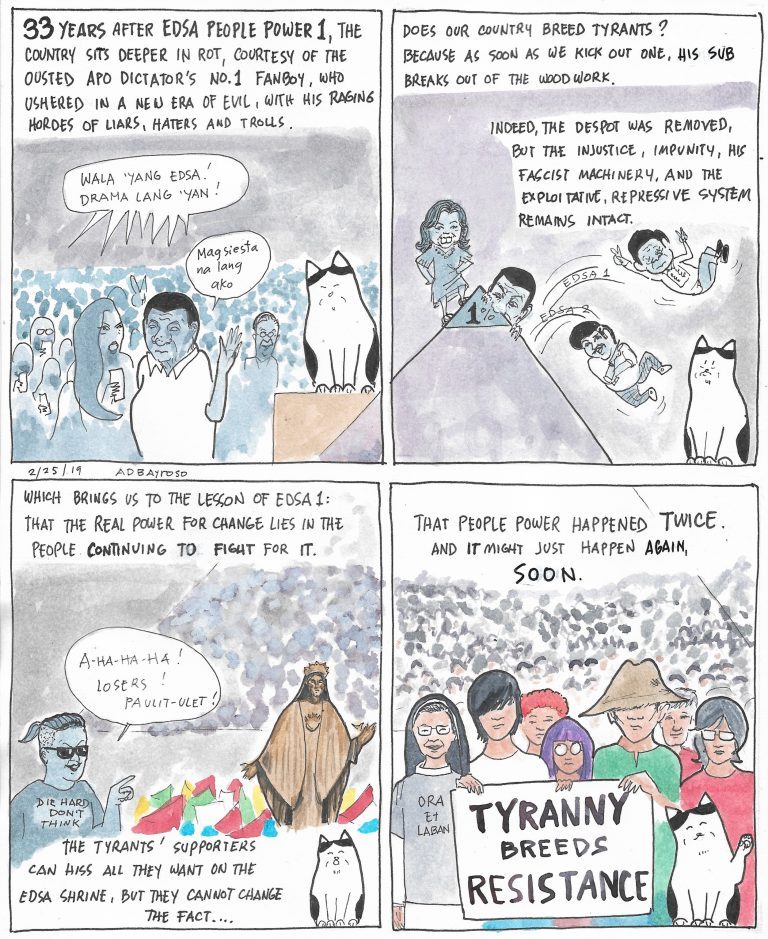
His spokesperson Salvador Panelo insisted that it wasn’t because President Rodrigo Duterte thinks that the 1986 civilian-military mutiny at EDSA isn’t important; it’s just that he has a lot of things to do.

Panelo announced Mr. Duterte’s non-attendance at the February 25 official commemoration of the 33rd anniversary of that event days earlier. That made the claim that “he has a lot of things to do” sound like one more lame excuse in the Palace’s lengthening list of such other excuses as “he was tired,” to explain his absence in a meeting of ASEAN heads of states; that he was “resting” during the three days he didn’t attend any official function; or that he suddenly flew to Hong Kong “to go shopping.” But what made it really look like a deliberate snub is that he has never graced that occasion, his failure to do so this year being his third since 2017.

One can only conclude that Mr. Duterte has a dim view of the February 22-25 events at EDSA, most probably because they led to the overthrow of the Marcos kleptocracy. Like his mercenary keyboard army of trolls and hacks in print and broadcast, he probably thinks that only the Aquinos gained anything from EDSA 1, and that it removed from power a decisive man of action whose clever use of the police and military to advance his and his family’s political and economic interests deserves emulation rather than history’s condemnation.

Mr. Duterte has not only expressed his admiration for this country’s first and hopefully last tin-horn version of Adolf Hitler (whose “decisiveness” in murdering six million Jews he once admitted he admires). He has also demonstrated it in at least three ways. There was his decision to allow the burial of the earthly remains of the far from heroic Ferdinand Marcos, Sr. in the country’s Libingan ng mga Bayani. (Heroes’ Cemetery). There is also his ill-concealed support for Ferdinand “Bongbong” Marcos, Jr.’s electoral protest. Add to that his outright declaration that despite the Constitution, he prefers Marcos, Jr. over Vice-President Leni Robredo to succeed him should he resign the presidency.

To explain Mr. Duterte’s unashamed pandering to Marcos interests, some observers say it’s because Ilocos Norte Governor Imee Marcos, who’s currently running for senator, was one of the few local government officials to support his candidacy for president of this unfortunate Republic. But it’s likely to be due not only to the Marcoses’ financial and other forms of support in 2016. What’s even more disturbing is that it might be because of his own belief that he’s entitled to the same unaccountable abuse of power that Marcos exercised by declaring martial law in 1972.

Once a petty provincial despot whose powers were so unchecked they included, by his own admission, support for, if not command over a death squad, Mr. Duterte has since demonstrated his contempt for the system of checks and balances mandated by the Constitution as well as for free expression and the independent press vital to democratic governance.

As distressing as that may already be, the opinion polls have since found that many Filipinos share, if not Mr. Duterte’s sense of entitlement, at least his fascination with dictatorship as the path to the solution of this country’s legions of problems.

That fascination is founded as much on the obvious failures of what passes for democracy in these isles of illusions as on the far too common and totally baseless, fact-challenged belief that the Marcos dictatorship was a period of peace and prosperity.

By encouraging EDSA 1’s being labeled a “revolution,” with all the promise in that description of political and economic democratization and of ending the poverty, social inequality and mass misery that have long haunted this country’s long-suffering people, the leading figures of EDSA 1 — Corazon Aquino, Jaime Cardinal Sin, Fidel Ramos, Juan Ponce Enrile — were at least partly responsible for the perception that what had replaced the Marcos tyranny was democratic rule.

It was no such thing. EDSA 1 made possible the return to power of the wing of the political class that Marcos had targeted for exclusion through Presidential Decree 1081. It reestablished the limited, elite democracy that had been in place since Commonwealth days, rather than install a government run by the majority. EDSA enabled the land-based faction of the ruling political elite to overthrow one-man rule, and to repeal Marcos’s most repressive laws. Both were necessary for the country to move forward, but that was about all it did.

Restored by EDSA 1, the rule of the land-based, old-rich was saddled with such remnants of the past regime as Enrile and Ramos, who eventually gained even more power and in fact allowed the return of the Marcoses and their allies not only to the country in a literal sense, but also to government.

Not only in the ensuing years after EDSA 1 were the promises of that “revolution” unfulfilled. Very early on, for example, despite such sound advice as that of the United States Agency for International Development’s (USAID) Roy Prosterman for President Corazon Cojuangco Aquino to use her legislative powers to decisively address the land issue before Congress reconvened, or else risk civil war, the latter balked and relied on the landlord-dominated Congress to later pass a land reform law so full of loopholes it became practically meaningless.

Mrs. Aquino’s reluctance to outrightly abolish the Philippines’ centuries-old land tenancy system — “the worst on the planet,” according to Prosterman — wasn’t entirely due to her fears of abusing her pre-1987 “revolutionary” powers. Subsequent versions of land reform allowed the conversion of agricultural lands into industrial estates, which is what the Cojuangcos did to their own Hacienda Luisita.

The twin imperatives of authentic land reform and industrial development — policies at the heart of the development of Japan, China, Korea, Taiwan among others — succeeding regimes belittled and ignored, and at one point even described (during the Benigno Aquino III administration) as “old hat.” Instead, it is the decades-long policy of encouraging foreign investments that has remained in place despite its demonstrated shortcomings.

The consequences are there for all to see: the persistence of poverty and hunger despite economic growth and, consequently, the desperate search for a solution among the country’s impoverished and powerless millions. Every election period, they are nevertheless deceived into electing to office the same dynasts and their allies whose only program is to advance their self, familial and class interests and to kowtow to whatever foreign power is willing to support their continuing dominance over the politics and government of this neo-colony..

What is outrageous is that it is those very dynasts who are responsible for the country’s being the basket case of Southeast Asia. Their incompetent, corrupt, and self-aggrandizing governance has been a total failure. But they blame the democracy they’ve been sabotaging for decades for the consequences of their benighted rule..

EDSA 1’s failure to deliver on its implicit promises of peace, prosperity, freedom, independence and democracy, for which the political dynasties are as responsible, does not justify the return of another dictatorship. But it is nevertheless another fallacy the hucksters and demagogues in and out of government are currently selling in their attempt to excuse the country’s descent into another tyranny.

Luis V. Teodoro is on Facebook and Twitter (@luisteodoro).

www.luisteodoro.com

Published in Business World
Feb. 28, 2019

The post Blaming EDSA appeared first on Bulatlat.