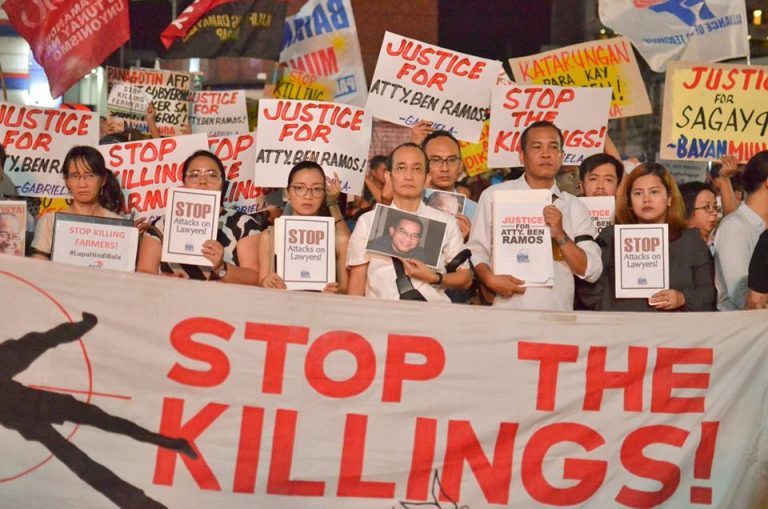
Putting to work its National Task Force to End Local Communist Armed Conflict, the Duterte government since last month has ramped up its red-tagging campaign against human rights defenders, militant people’s organizations and alliances, and left-leaning candidates in the May 13 elections.
Instantly the ripostes were vigorous – denials, condemnations – from a broad range of personalities and organizations here and overseas, including from the Commission on Human Rights. The CHR has denounced the “harassment and vilification of lawyers” as a “new trend of attacking progressive rights groups.” It called on the government to ensure the protection specifically of members of the Union of People’s Lawyers of Mindanao (UPLM) and the National Union of People’s Lawyers (NUPL).
The National Task Force (NTF) was formed through Executive Order No. 70, which President Duterte signed on Dec. 4, 2018. Headed by Duterte as chair and his national security adviser Hermogenes Esperon Jr. as vice chair, the NTF is mandated to ensure the effective implementation of a “whole-of-nation” approach aimed at ending the 50-year-old armed revolutionary movement, led by the Communist Party of the Philippines-New People’s Army (CPP-NPA).
On Feb. 14, a NTF-initiated government delegation was sent to the meeting of the United Nations Working Group on Enforced or Involuntary Disappearances (UN WGEID) in Bosnia-Herzegovina. Its purpose: to ask the UN WGEID to delist 625 cases of enforced disappearances in the Philippines, mostly attributed to state security forces, documented by human rights organizations from 1975 (under Marcos’ martial law dictatorship) to 2012 (first two years of the P-Noy Aquino administration).
The delegation claimed that the Philippine government had already put in place a “strong legal framework and institutional mechanisms” to deal with the enforced disappearances issue. However, human rights groups led by Karapatan urged the UN body to reject the government request and its arguments for the delisting. Karapatan asserted that the two laws invoked by the Duterte administration – the Anti-Enforced Disappearance Act of 2012 (RA 10353) and the Human Rights Violations Recognition and Reparations Act of 2013 (RA 10368) were not state-initiated. These were enacted, it pointed out, mainly due to the efforts of the people, relatives of the victims, human rights groups, and concerned legislators.
Most pointedly, Karapatan told the UN that, to this day, the government has continually denied any role in enforced disappearances, such as the widely publicized case of Jonas Burgos in 2007 and most recently (September 2018), the case of Joey Torres Jr., Bayan Muna coordinator in Nueva Ecija.
Piggy-backing on the UN WGEID meeting, the NTF sent a team to visit diplomatic offices of various countries and aid organizations in Europe, campaigning for the withdrawal or denial of funding and other forms of support to human rights organizations and defenders in the Philippines, tagging the latter as “fronts” of the CPP-NPA. Two officials of the Presidential Communications Operations Office were with the NTF team, PCOO chief Martin Andanar acknowledged.
Among others, here are other instances of red-tagging in the month of February alone:
On Feb. 23, Iglesia Filipina Independiente (IFI) Obispo Maximo (Supreme Bishop) Rhee Timbang issued a pastoral letter strongly denouncing a flyer distributed in Cagayan de Oro City and Northern Mindanao. The flyer “maliciously and irresponsibly red-tagg(ed) our clergy,” the pastoral letter states, naming IFI bishops Felixberto Calang and Antonio Ablon, priests Rolando Abejo, Khen Apus and Chris Ablon, and “some prominent partners of the IFI in its work.”
“We again cry foul to these baseless accusations and condemn in the strongest terms the continuing attacks on our clergy and the IFI itself,” the letter says, along with the Alliance of Concerned Teachers (ACT), (UPLM), and (NUPL), which are “partners in the IFI’s work of prophetic witness, social advocacy and solidarity and engagements with the peasants, fisherfolk, workers, urban poor, lumad communities, and the Moro people.”
All these activities, the pastoral letter adds, “are in consonance with (IFI’s) mission and fidelity to its history enriched by the bold, courageous and fearless witnesses of Apo [Gregorio] Aglipay and Don Belong [Isabelo delos Reyes] and other heroes of the Filipino church in the nationalist and revolutionary tradition of the Filipino people.”
Addressing President Duterte, the IFI pastoral letter warns that the red-tagging “serves as green light for the neutralization and termination” of all those the state security forces mark “wrongly as terrorists,” thus endangering the lives of IFI clergy and partners. It urges Duterte to “make history by standing for his people, by directing the GRP peace panel to resume peace talks [with the NDFP] and resolve the basic problems of our society that breed insurgency.”
Human rights and labor lawyer Beverly Selim-Musni, who with her two lawyer-daughters are tagged in the flyer along with the IFI clergy, spoke loud and clear: “The bias of my daughters for the poor and the oppressed is distinct, much more [it’s] my pride, since they have inherited my compassion.” Their father, Oscar Musni, she pointed out, was a member of the Free Legal Assistance Group (FLAG) and a political detainee under the Marcos dictatorship.
“The attacks against lawyers under the administration of President Duterte, a lawyer himself, are not new and not only in Northern Mindanao,” Selim-Musni noted. “Moreover, the attacks against the brave lawyers who have chosen the hard battle of fighting repressive state mechanisms is consistent with the history of our country’s repressive governments.”
The courageous stand taken by progressive lawyers since the time of Marcos has led to the sacrifice of the lives and liberty of many of them. After the slaying of human rights lawyer Benjamin Ramos in Negros Occidental last November, the CHR called for steps to prevent another killing. At least 78 lawyers have signed a petition asking the Supreme Court to ensure a “thorough, prompt, impartial, and independent investigation” into the killings of 34 lawyers so far under the Duterte administration.
The red-tagging has also formed part of the Duterte regime’s avowed campaign to prevent progressive candidates from winning in the May 13 mid-term elections. On Feb. 28, copies of a leaflet bearing the face of Makabayan Coalition senatorial bet Neri Colmenares began circulating in Manila. It depicts Colmenares, with a red hammer-and-sickle sign on his forehead, as allegedly making statements maligning the Liberal Party’s Otso Diretso senatorial slate.
There is of course absolutely no truth to this despicable stunt, as we shall see in the next two days.
IBON Executive Editor Rosario Bella Guzman said that non-quota tariff rice importation undermines the food security principles of supply stability and affordability. She said that in face of world market volatility, a fluctuating peso-dollar exchange rate and impending El Nino, government should seek to stabilize prices and the economy.
Government will soon release the implementing rules and regulations of the new Rice Tariffication Law, which it expects to bolster local rice supply and produce revenues to enhance the rice industry.
Guzman said that rice tariffication will affect local rice farmers who will not be able to compete with cheap subsidized imports. “Government says it will cull Php10 billion a year from tariff revenues to support the local rice industry. But that’s only US$190 million versus Vietnam’s US$1 billion and Thailand’s US$7 billion in annual subsidies to their rice farmers,” said Guzman.
She also noted that the small Php170 billion agriculture budget, that is just 4% of the national budget, shows low prioritization of the sector. “Government is pushing us to just rely on imports,” she said.
Guzman also stressed that while rice tariffication will make more rice available in the local market, stable supply is in question because only 10% or less of the world’s total rice production is sold by rice-producing countries to other nations. Also, she pointed out, the government of Thailand has decided not to export rice to prioritize its own population this year.
Rice may become increasingly unaffordable amid stagnant wages, Guzman added. Local retail rice prices may jump from the Php27 per kilo to Php44 per kilo given a landed cost of Php37. With government phasing NFA’s rice price control functions out yet unable to stop cartels, rice prices are bound to hike further. Heavy importation amid a weak peso-dollar exchange rate is also a factor In higher prices, Guzman explained.
“While we cannot say if the forthcoming El Nino will be worse than the 2014-2016 drought, we are already in a grave agricultural crisis as it is,” Guzman further said. Agriculture grew by only 0.8%, while palay production fell by 1.1%. She said that this is not even due to the weather but to government policies that allow production to be hit and importation to be monopolized.
“We don’t need a worsening crisis in agriculture. Government needs to stabilize the entire economy to be able to eventually stabilize prices,” Guzman said. This includes adopting policies that will strengthen and regulate the local rice industry to ensure Philippine food security such as distributive land reform, substantial farm subsidies and strict government control of the market, said Guzman.
MANILA – National Democratic Front of the Philippines (NDFP) chairperson Fidel Agcaoili has set the record straight amid allegations that he is part of the National Union of People’s Lawyers (NUPL) to cover up the “legal complaints filed against the New People’s Army.”
Agcaoili released a statement after a group called No to Communist Terrorist Group Coalition (NCTGC) accused him of “handling” the legal affairs of the NUPL which the group also accused as front organization of the Communist Party of the Philippines (CPP).
Mario Laude, the coalition’s spokesperson, said that NUPL is under Agcaoili’s command to “use it as the shield of the Party against complaints of human rights abuses, legal complaints filed in courts so that top level officials of the CTG (communist terrorist group) could be spared of.” He added that Agcaoili should be held accountable to what they call as “criminal acts” of the revolutionary forces.
“For the record, I am not a lawyer, never had the ambition to be one despite coming from a family of lawyers,” Agcaoili said adding that he has nothing to do with the lawyers’ group.
He said some NUPL lawyers are legal consultants of the NDFP Negotiating Panel and also serve as legal counsels of the detained NDFP consultants and political prisoners. However, Agcaoili said, this does not mean that the NUPL is a so-called front of the CPP or its lawyers are members of the Party.
“In accordance with due process, it is for any court of law, be it revolutionary or reactionary, to determine the truth of such allegations through competent and admissible evidence and not through manufactured witnesses or planted evidence like what is brazenly happening now,” he said in a statement.
Agcoaili meanwhile warned that such red-tagging of the people’s lawyers is “meant to set them up for the kill.”
National Democratic Front of the Philippines chief negotiator Fidel Agcaoili. (Photo by Kodao Productions)
“But red-tagging has a more sinister objective. It is meant to smear any organization or individual to set them up for the kill, as has been shown in many cases in the past such as those of NDFP consultant Randy Malayao and NUPL lawyer Benjamin Ramos,” he said.
Intensified attacks against people’s lawyers
The NUPL also cried foul over the allegation of Laude and the recent red tagging of lawyers and organizations affiliated with the NUPL. For the past two weeks, the group said, their members have been consistently red-tagged and labeled as members of the underground group Communist Party of the Philippines (CPP) – New People’s Army (NPA)-National Democratic Front of the Philippines (NDFP).
Last week, Feb. 22, a list was circulated around Cagayan de Oro in Mindanao tagging NUPL, its affiliate Union of Peoples’ Lawyers in Mindanao (UPLM) and three women lawyers; Beverly Ann Musni Yr. and her two daughters, Czarina and Beverly Musni as members of the CPP-NDFP-NPA.
With the three women lawyers, 19 individuals and four organizations were tagged as communists. The Musnis are actively involved in human rights cases and public interest advocacies.
The Daily Tribune publisher Ninez Cacho-Olivares also blatantly tagged the NUPL and NUPL Secretary General Edre Olalia as leftists and “commies” in her column also published on Feb. 22, where she wrote about the Supreme Court’s recent decision to the third extension of martial law in Mindanao. Olivares hit the NUPL for criticizing the SC in its decision to uphold the constitutionality of the extension of martial law.
NUPL represented the Makabayan bloc in the petition against martial law.
And recently, Laude accused NUPL as CPP front organization. “Aside from this ridiculous and baseless link, the shady group is inciting reprisal,” Olalia said.
“This series of attacks, bigoted and fantastic as they are, is not only disturbing but can be ominous of even worse things to come. It remains a challenge and clarion call though for human rights and public interest lawyers to stay the course and serve those who have less in life who have even lesser in law,” Olalia added.
Under President Duterte there were already 36 lawyers, judges and prosecutors who have been killed, said Olalia.
The most recent was the killing of Ramos, a human rights lawyer killed on Nov. 6, 2018 by two unidentified men in Kabankalan City, Negros Occidental. He was the secretary-general of NUPL-Negros Island chapter.
They were also not spared from trumped up charges for assisting their poor clients. Another NUPL lawyer Kathy Panguban, head of the NUPL Women and Children Committee was charged with kidnapping for assisting a mother in getting custody of her minor son in Sagay.
“Red-tagging may be viewed as a badge of honor for those who appreciate the value and role of being lawyers for the people. But in the real world out there, it is a stampmark that one can be fair game for vicious attacks from the intolerant, bigoted and despotic,” Olalia said.
On this gracious occasion wherein we fifteen Awardees are showered with tribute and praises as Creators of Cebuano Literature, no greater feeling cradles us than this surge of grateful joy overflowing from the core of our interiority. Our hearts sing.
Since December, Bulatlat and several alternative media outfits have been experiencing a series of Distributed Denial of Service (DDoS) attacks, where the server of a website is maliciously being overloaded to shut it down.
By ALYSSA MAE CLARIN Bulatlat.com
MANILA — It is time to fight back to defend press freedom.
This was the overall message during the recently-held forum by National Union of Peoples’ Lawyers and online news Bulatlat dubbed as ‘Cyber-attacks on Critical media and Legal Remedies’ as cyber-attacks against alternative media outfits and websites of progressive organizations continue to intensify.
Frank Lloyd Tiongson of the NUPL said those behind the attackers may be held to account as provided in the controversial Cybercrime Prevention Act, which covers offenses that compromise the confidentiality, integrity and availability of computer systems.
Since December, Bulatlat and several alternative media outfits have been experiencing a series of Distributed Denial of Service (DDoS) attacks, where the server of a website is maliciously being overloaded to shut it down. Sweden-based Qurium Media Foundation, which has been helping Bulatlat and several others to fend off attacks, has documented the same attack signature.
Bulatlat associate editor and University of the Philippines professor Danilo Arao said that while Bulatlat may not share the heavy traffic of that of the dominant media, the motives behind the attack could be its content. As such, these well-funded attacks prove to be state-sponsored.
Tiongson said that the attacks could fall under ‘system interference’ or intentional hindering with the functioning of a computer network by inputting, damaging, altering, or suppressing the computer program. Perpetrators, once identified and found guilty, may be sent behind bars with a fine between P200,000 to P10 million, depending if it is carried out by an individual or corporation, and if it is done deliberately or not.
However, since the process of filing charges for the violation of the Cybercrime Prevention Act is quite invasive as provided in the so-called “warrants,” media that are currently under cyber-attacks may still seek civil damages.
“That’s what a lot of governments and a lot of dictatorial regimes tend to misrecognize. When they suppress freedom of expression, they actually expose themselves to more pressure,” said Tiongson discussing the many legal boundaries being made to stifle press freedom.
Decriminalize libel
In the same vein, veteran journalist Inday Espina-Varona noted that it is high time to once again call for the decriminalization of libel, which carries a heavier penalty under the Cybercrime Prevention Act.
The law itself, she added, is “very very oppressive” as journalists have the burden of proving that their reports were written without malice. Varona said this deters journalists from truth-telling.
The Philippine’s criminal sanction for libel has been written off as ‘excessive’ by the United Nations Human Rights Committee (UNHRC) on October 2011 saying, “It is impermissible for a State party to indict a person for criminal defamation but then not to proceed to trial expeditiously – such a practice has a chilling effect that may unduly restrict the exercise of freedom of expression of the person concerned and others.”
UNHR believes that although it is only right for individuals to be protected from unethical journalism, the application of the criminal law should only be allowed for the most serious of cases, and that imprisonment is never an appropriate penalty. (Bulatlat.com)
This is one of the reports in a series produced by Bulatlat.com with the Asia-Pacific Forum on Women, Law and Development (APWLD) Media Fellowship. The series aims to report on linkages between gender, ecological conflicts and climate change.
What is common in the stories of the residents in various coastal sitios of Bulacan is that the “news” about their impending displacement is coming to them in trickles of information packaged in a threat.
MANILA — Until April of last year, the fisherfolk communities in coastal Bulacan were hearing only unconfirmed talk about the San Miguel Corporation’s 2,500-hectare aerotropolis and new city project. The news about the proposed reclamation affecting the island-communities along Manila Bay in Bulacan formally broke out in April 2018, when the National Economic and Development Authority (NEDA) Board approved the San Miguel Corporation’s proposal. But the buying spree of former salt farms along the rivers and mangroves has been happening for years already, the residents said. Some said they have been told they have to leave the area soon.
“Hindi kami hinaharap ni Mayor. ‘Hindi namin alam yan.’” (The town mayor of Bulakan, Bulacan) won’t talk to us. If asked about the SMC project, he’d reply, ‘We don’t know about that.’) For one and a half years this is how the Bulacan fisherfolk say they have been treated, until they mounted protest actions, said a UP professor who conducted a series of research among the Bulakan fisherfolk since last year.
In the village of Capol which directly faces hectares of former salt farms turned to fishponds, the residents have been seeing land surveyors wading into the shallow pool.
In another sitio called Camansi, Flor Salvador, 77, said she first heard about some developers’ plans for Taliptip three years ago. They have been told also they will have to go.
She said that in her heart she refuses to believe that someday, as they were being told informally, they will be forced to leave the place to give way to these “developments.” When Bulatlat interviewed her, she was still tending to her small yard. Her house faces hectares of former saltbeds turned into fishponds. At the time the fish had just been harvested and the water drained out to the Manila Bay.
Old fisherwoman and former saltfarmer shows the recently drained fishpond (former saltfarms) beside her family home in Taliptip, Bulakan. (Photo by M. Salamat / Bulatlat)
She arrived here in 1969, Salvador said. Like many here, she worked at the salt farms before her family turned to full-time fishing. In her old age, she has found work watching over someone else’s fishponds and planting stringbeans on the soil embankment.
But she hasn’t heard yet of relocation for “fishpond caretakers.”
What sounded common in the stories of the residents in various sitios is that the “news” about their impending displacement is coming to them in trickles of information packaged in a threat. Other residents told Bulatlat, on condition of anonymity, that they were being castigated by the mayor, some by the village captain, if they were seen joining meetings with supporters from “outside.”
Though they have lived and worked as tenants in Bulakan salt farms for decades until most of it stopped operating and were sold off to developers, they remained deprived of land tenure for lack of land reform or other tenurial support from the government. Now, the resulting poverty and landlessness is being used against them to speed up their forcible displacement.
Without tenurial rights over the land or the fishing grounds, the communities of fisherfolk have been automatically denied a say in land use and planning concerning their river-and-bay-based livelihood.
It took the residents various pickets, requests for dialogue with the local government and agencies, with representatives of San Miguel Corporation, with the Department of Environment and Natural Resources, among others, before they were told bits and pieces about the reclamation project. And before some vague “relocation” was floated. Even when the local government executives in Bulacan had already welcomed the plan of SMC, confirming what they had long avoided saying to their enquiring constituents, the residents were still kept blind as to who and where the project will directly hit.
Some residents interviewed by Bulatlat said they were getting warnings against joining protest actions or meetings. They were told they will receive no aid or no chance at this unnamed relocation.
When two representatives of San Miguel Corporation (SMC) met with church people and women leaders of Bulacan fisherfolk in Malolos City November last year, they avoided mentioning “reclamation”. They refused to answer questions regarding where or how their proposed aerotropolis will be built, considering there are fishing communities in the (then) rumored proposed site.
“You are not likely to build a hanging airport over rivers and mangroves, right?” a woman from Taliptip asked.
On February 4, the fisherfolk finally heard the first concrete plans through an SMC contractor. In a “public hearing” held at an evacuation center in Bulakan, Bulacan, representatives of SMC contractor, Silvertides Holdings Corporation, confirmed the company had acquired a total of 2,375 hectares of titled “fishponds” in the coastal villages of Bambang and Taliptip in Bulakan, Bulacan. This contractor’s job is to perform the reclamation.
This is where San Miguel Corporation (SMC) proposes to build an international airport and new city over fishponds, rivers and mangroves populated by fisherfolk communities. The map below zooms closer to the Bulacan coasts.L to R: Bambang (dark red, left on circled portion of map) and Taliptip (red, right on circled portion of map), are the villages/areas to be “direct hit” of planned reclamation to pave way for San Miguel Corporations’ airport, real estate, infrastructure projects (map lifted from Silvertides’ presentation during a “public hearing” in an evacuation center in Bulakan, Feb 4, 2018.)
The Feb 4 hearing is second to the last requirement for the SMC contractor to get an Environmental Compliance Certificate (ECC) that would pave the way to reclamation.
The report Silvertides presented to the fisherfolk bears also the mark of the Environment Management Bureau (EMB) in Region 3.
Silvertides confirmed that the fisherfolk in Taliptip and Bambang are at the “direct hit areas” while the villages two to three kilometers surrounding it are the “indirect hit” of the reclamation project.
The SMC contractor said they will “backfill” the 2,375 hectares of fishponds by at least 3 meters. This is estimated to require 205 million cubic meters of fill materials that they may source from Pampanga.
“Why did the government just approve such a proposal without even thinking of us?” asked Taliptip fisherwoman Monica Anastacio, 63, one of the spokespersons of the Network Opposed to Reclamation and Aerotropolis in Bulacan.
The “public hearing” last February 4 centered on the contractor stressing the mechanics of the reclamation and mitigating measures for those who would be adversely affected. It was not about the communities having a say in whether the reclamation will push through or not. Rather, it was about notifying those who will be affected and informing them there are other livelihood opportunities. It mentioned there will likely be aid for those qualified to receive it.
A resident looks over the fishponds where they have seen surveyors taking measurements in Capol, Taliptip. It turned out the surveyors came from a company subcontracted by SMC to prepare requirements for its planned reclamation. (Photo by M. Salamat / Bulatlat.com)
To compile the report they presented to the “public hearing,” Silvertides said they held scoping and fieldwork from October to November last year. That’s the same period some fisherfolk in the villages of Bulakan and Obando convened the Network Opposed to Reclamation and Aerotropolis in Bulacan.
The SMC contractor submitted their draft Environmental Impact Assessment (EIA) to EMB Region 3 in December last year. They held the “public hearing” as part of a “review process” from which they will submit an assessment report to the EMB Region 3. The EMB Region 3 will then decide on their application for ECC.
Some of the Bulacan fisherfolk, environmentalists who convened a network opposed to reclamation in Bulacan coasts along Manila Bay October 2018 (Photo by M. Salamat / Bulatlat)
An estimated 5,000 fisherfolk stand to lose livelihood and homes in SMC’s $14-million plus airport project. Others more stand to lose their fishing grounds given the volume of backfilling that will be carried by barges and heavy machineries to the coastline.
To questions whether the fisherfolk could maintain their livelihood, the SMC representatives representatives said thy can avail of retraining, livelihood opportunities and priority employment. A copy of Silvertide’s presentation mentions relocation for “fishpond caretakers”.
But in the same way that not everyone in the “direct hit areas” are “fishpond caretakers” and thus qualified for relocation, not all of the mangroves in the direct hit areas seem safe.
Silvertide’s presentation pointed to just two “patches of mangroves” closest to the Manila Bay that they say they will “incorporate in the design.” They leave out the patches of mangroves along the river to Taliptip and Bambang.
Planned reclamation contrary to calls for rehabilitation
As early as January this year the group Kalikasan People’s Network for the Environment has warned against the dangerous haste of the Department of Environment and Natural Resources (DENR) in ordering the removal of informal settlers as if doing so is the main answer to Manila Bay pollution. In reality, the government has much to answer for, not the poor. Kalikasan and Pamalakaya have both cited as bigger culprit the government failure in providing sufficient waste management facilities, including its support to problematic positioning of waste diversion facilities themselves.
Kalikasan cited the data from National Solid Waste Management Commission that says only 32 percent of villages across the country are serviced by a Materials Recovery Facility, and only 24 percent of local government units have access to Sanitary Landfills as of September 2018.
PAMALAKAYA cited as example the Obando sanitary landfill located in Obando, Bulacan owned by Ecoshield Development Corp. (EDC) and supported by the government. It has polluted not only the waters of Obando but brought its stench to residents of nearby Navotas City and Malabon City in Manila. Other waste disposal facilities operated in Manila Bay, Pamalakaya said. This includes the landfill in Pier 18 in Tondo, Manila that had been reported before for dumping toxic wastes in Manila Bay.
The destruction of mangrove, seagrass, and other coastal and marine ecosystems that serve as the natural pollution filters of Manila Bay is also a major culprit in its worsening pollution, Kalikasan said in a statement. Not only this, the environmentalists and urban poor in Manila Bay have long noted the disastrous effects of reclamation not just on fish catch but also in helping to break the fury of storms. Various independent and scientific studies on reclamation in Panglao, Bohol, Cordova (of Cebu) and in the Manila Bay have extensively demonstrated how it resulted in reduced productivity and biodiversity, disrupted vital ecosystem functions, increased vulnerability to floods, and displaced and dislocated thousands of families dependent on the affected environments for their livelihood.
At least 28,647 hectares of currently approved reclamation projects are clearly overlapped on the remaining mangrove expanses and seagrass beds along the whole stretch of Manila. A part of it is in Bulacan, 2,500- hectares as announced by the San Miguel Corporation, but the contractor set to conduct the reclamation says the areas two to three kilometers surrounding the 2,500 hectares will also be affected.
The fisherfolk interviewed by Bulatlat cannot imagine life away from their banca and fishing. “Every move we make is on the river,” a fisherman who grew up in Taliptip said. His sentiment is echoed by his neighbors.
A Taliptip fisherman putting some of his catch on ‘standby’ before bringing it to a fishport. (Photo by M. Salamat / Bulatlat)
The fish and seafood produced from the rich brackish waters for reclamation in SMC drawing board are currently being sold on fish ports of Navotas, Malabon and other towns, said the survey itself of SMC contractor Silvertides.
“We are really dependent for our livelihood on these rivers and on these mud,” the second-generation fisherman in Taliptip said. His now senior citizen parents also cannot think of life away from the river.
As of this writing the fisherfolk communities are gearing up to hold assemblies in defense of the river and the bay.
Labor group Kilusang Mayo Uno (KMU) condemned the abduction of three union leaders from Pantukan, Compostela Valley by suspected military agents on Wednesday, February 27.