Peryodismo. Iisang propesyon, iba’t ibang depenisyon.
Teka, may mga nagsasabing hindi akmang salita ang “propesyon” kung ipapaliwanag ang konsepto ng peryodismo. Ang isang katangian daw kasi ng propesyon ay ang pagiging bayad na okupasyon (paid occupation). Hindi naman daw sumusuweldo ang lahat ng peryodista.
Totoo ba ito? Talaga bang may mga peryodistang hindi nababayaran sa kanilang pagtatrabaho? Opo.
Sila ang mga nagtatrabaho sa tinatawag na alternatibong midya. Kadalasang hindi masyadong kilala ang mga organisasyong ito dahil limitado ang naaabot ng kanilang mga ulat. Pinapatakbo sila ng ilang indibidwal na ang tanging hangarin ay gamitin ang peryodismo para maiparating sa publiko ang kanilang pagsusuri sa nangyayari sa lipunan. Bakit alternatibo? Palibhasa, progresibo!
At dahil medyo partikular tayo sa akmang salita, siguradong may mga taga-alternatibong midya na magsasabing hindi sila gumagampan ng trabaho kundi ng gawain. Ano pa nga ba ang matatawag mo sa pag-uulat para sa isang alternatibong organisasyong pang-midya (alternative media organization) na nakapaloob sa normatibong pamantayan ng peryodismo pero labas naman ng balangkas ng suwelduhang propesyonal?
Sa halip na buwanang suweldo, nabibigyan naman ang alternatibong peryodista ng paminsan-minsang subsidyo (kung may badyet ang organisasyon). Siyempre, kailangan din niya ng pamasahe’t pambili ng pagkain. At dahil sumusunod siya sa mataas na pamantayan ng peryodismo, asahan nating hinding hindi siya hihingi ng pera sa mga iniinterbyu niya at handa niyang tiisin ang mahabang paglalakad kung sakaling wala nang mabunot sa bulsa.
Hindi trabaho kundi gawain. Hindi suweldo kundi subsidyo. At kung sa tingin ng alternatibong peryodista ay hindi propesyon ang peryodismo, ano ito?
Mainam sigurong ipaliwanag muna kung ano ang peryodismo sa konteksto ng alternatibong midya. Kung normatibong pamantayan ang pag-uusapan, sumusunod ang alternatibong peryodista sa itinakdang code of ethics. Alam niya ang nilalaman ng The Philippine Journalist’s Code of Ethics o kahit na yung mula sa ibang bansa tulad ng Society of Professional Journalists’ (SPJ’s) Code of Ethics. Bahagi ng kanyang mga pagsasanay (training) ang pagbabasa ng mga sanggunian (references) tungkol sa peryodismo na mula sa mga lokal at dayuhang awtor. Siyempre pa, pinag-aaralan din niya ang epektibong pag-uulat sa wikang naiintindihan ng ordinaryong mamamayan, sa loob o labas man ng bansa.
Kumpara sa mga peryodistang nasa dominanteng midya (dominant media, minsa’y tinatawag ding corporate media), mapapansin ang kakaibang perspektiba ng alternatibong peryodista. Dahil mas akma para sa kanya ang terminong gawain sa halip na trabaho, mas binibigyang-halaga niya ang bawat isyung kinokober. Hindi lang simpleng pag-uulat ang ginagawa niya dahil metikoloso ang pag-uungkat. At mula sa mabusising pag-uungkat, nagagampanan ang malalimang pagmumulat ng sinumang interesadong basahin, pakinggan o panoorin ang ulat niya.
Paano niya nagagawa ito? Bahagi ng kanyang tuloy-tuloy na pag-aaral ang pagsusuri sa pambansang kalagayan para malalim na maisakonteksto ang partikular na isyu sa pangkalahatang kaayusan. Minsan pa nga’y nagsisimula ang lingguhang pagpaplano ng alternatibong organisasyon pang-midya sa isang diskusyon kung ano ang nangyayari sa bansa, pati na ang ilang pandaigdigang isyung may implikasyon sa buhay at kabuhayan ng mamamayan. Marami-raming oras ang inilalaan kung ano-anong isyu ang kailangang mapatampok, pati na ang mga taong dapat lapitan at mga dokumentong dapat pag-aralan. Dahil may pagkakaisa na sa pagsusuri sa nangyayari sa lipunan, hindi problema ang interpretasyon ng mga datos. At dahil nakikita ang kahalagahan ng gawain, asahan ang agarang pagsusumite ng mga ulat.
Pero may problema ring kinakaharap ang alternatibong peryodista at organisasyong pang-midyang kinabibilangan niya. Pera!
Halimbawa, kailangang isakripisyo ang pag-uulat ng mahalagang isyu, lalo na ang nangyayari sa malayong komunidad, dahil walang pamasahe para makapunta roon. Sa sitwasyong ito, sinusubukan ng alternatibong peryodistang makiusap sa kakilalang residente ng komunidad, kung mayroon man, na siya na lang ang magbigay ng mahahalgang datos na gagamitin sa pag-uulat. O kung may kakayahan ang residenteng siya mismo ang mag-ulat, bibigyan siya ng espasyo ng alternatibong organisasyong pang-midya para gawin ito.
Minsan naman, magkakaroon ng mapanlikhang desisyon hindi lang ang isa kundi ang maraming alternatibong organisasyong pang-midya. Mag-aambag sila mula sa kanilang limitadong pondo para ipadala ang isa lang sa kanila sa ikokober na komunidad. At ang mga datos na makukuha niya ang siyang gagamitin ng mga nag-ambag na organisasyon para sa ulat na ilalabas. Posibleng pare-pareho ang datos at pagsusuri, pero asahan natin na kanya-kanya ang paraan ng pag-uulat.
Peryodismo. Para sa alternatibong peryodista, malalim ang depenisyon nito. Dahil hindi ito suwelduhang trabaho, iba ang antas ng paggampan sa tungkulin. Wala siyang bagahe ng isang peryodista ng dominanteng midya na minsa’y nag-iingat na magalit ang mga bossing dahil sa “tapang” ng kanyang ulat. Hinahayaan kasi ang alternatibong peryodistang palalimin ang kanyang pagsusuri basta’t umaangkop sa datos na nakalap, pati na sa interes ng mga pinagkakaitan sa lipunan.
Ulitin natin ang tanong: Kung hindi propesyon ang peryodismo, ano ito? Sa progresibong pamantayan, ang peryodismo ay adbokasiya.
Para makipag-ugnayan sa awtor, pumunta sa phttps://risingsun.dannyarao.com
“…if traditional politicians will be here to stay, then this will be no different from the past attempts to build an autonomous region.”
By JANESS ANN J. ELLAO
bulatlat.com
MANILA — With the recent swearing in of the Bangsamoro Transition Authority that will assume interim leadership in the villages and cities now confirmed part of the Bangsamoro Autonomous Region in Muslim Mindanao (BARMM), questions on the future of the Moro people – their struggles and aspirations – have once again been brought to the fore.
Provinces in the formerly-known Autonomous Region of Muslim Mindanao, Cotabato City, and 63 other villages of North Cotabato will now constitute the BARMM. The new region, under the Bangsamoro Organic Law, will be governed by an 80-member transition body until its first regular elections in 2022.
But critics are skeptical over what appears to be a focus on the structural changes that the implementation of the Bangsamoro Organic Law may bring to the Moro people.
Structural changes
On its face, the BARMM will introduce structural changes to the Moro people’s political sphere, arriving at a parliament form of governance after the national government has, in the past, introduced many “experiments” to address what they referred to as an ethno-struggle.
Professor Julkipli Wadi of the University of the Philippines Institute of Islamic Studies said the MILF hopes to bring their struggle to another level, parliamentary politics, to attain their right to self-determination.
(Photo courtesy of Kodao Productions)
Wadi noted that the added and new factor under the Bangsamoro Organic Law is that their “former enemies” are now their “partners” in governing the Moro people. This, he added, may result to an “identity crisis” among the MILF leadership.
Wadi, however, noted that the organic law has lost its “venom” and “teeth” as it may one day be easily amended according to the whims of those seating in Congress.
Meanwhile, Suara Bangsamoro’s Amira Lidasan pointed out that the development plan for the BARMM will practically remain the same, most especially how natural resources will be utilized.
“We always rank as ‘first honor’ in inflation and poverty incidence. What will happen if the same development plan will be used?” she said
Holding the line
The ARMM experience, Wadi said, showed how there was never really genuine decentralization as only those that had the blessings of the national government could run and consequently win the gubernatorial post during elections.
He added that “imperial Manila” will not allow the genuine fulfillment of the Moro people’s right to self-determination. As such, they will need traditional local politicians to be their lackeys.
Wadi explained that there will now be a new relationship between the national government and the parliament. But if traditional politicians will be here to stay, then this will be no different from the past attempts to build an autonomous region.
Lidasan said that instead of the Moro people’s genuine representatives, they are hearing reports from the ground that politicians and Duterte himself who are seemingly having the upper hand in the transition body.
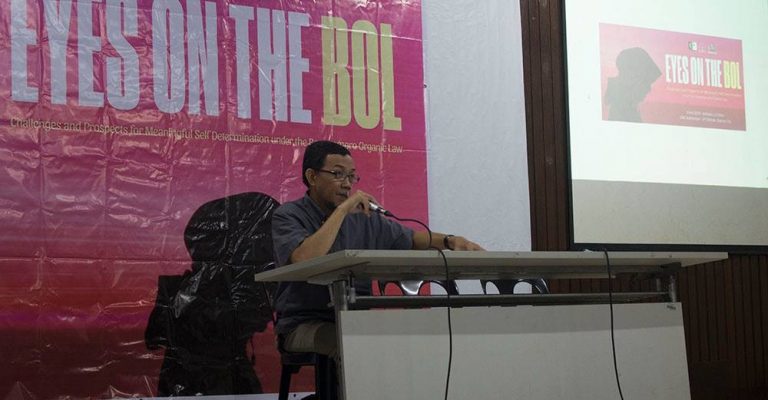
“They have hi-jacked the Moro people’s struggle,” she said during a forum in the University of the Philippines dubbed as “Eyes on the BOL,” adding that their right to self-determination should not be treated as mere adornments
Meanwhile, during the open forum, former lawmaker Satur Ocampo shared that the total disarmament among the ranks of the MILF will create a lopsided political scenario as the national government is doing too little steps to disband private armies.
Like Ampatuan all over again
Lidasan pointed out that the heavy deployment of state security forces in BARMM and the discrepancies pointed out during the BOL plebiscites remind the public of the Ampatuan era during the 2007 elections, referring to the 12-0 votes in favor of then re-electionist Gloria Macapagal Arroyo’s senatorial slate in areas that are bailiwick of the Ampatuan clan.
“They say it was a mere clerical error. But under martial law, can truth ever be set free?” Lidasan asked.
Martial law, she pointed out, played a big part in the referendum as more than 20,000 soldiers and police officers have been deployed.
Political vacuum
Wadi said the MILF stands to lose support from the ground as a result of a possible identity crisis among its leadership.
Wadi said the mainstreaming of the armed revolution being waged by the Moro people as a result of the Bangsamoro Organic Law may leave a vacuum both in their territories and in their ideology.
“Will transitional justice be enough? Reparation? Social fund?” asked Wadi.
The UP professor said this will become a “fertile ground” for new forms of struggle.
(bulatlat.com)
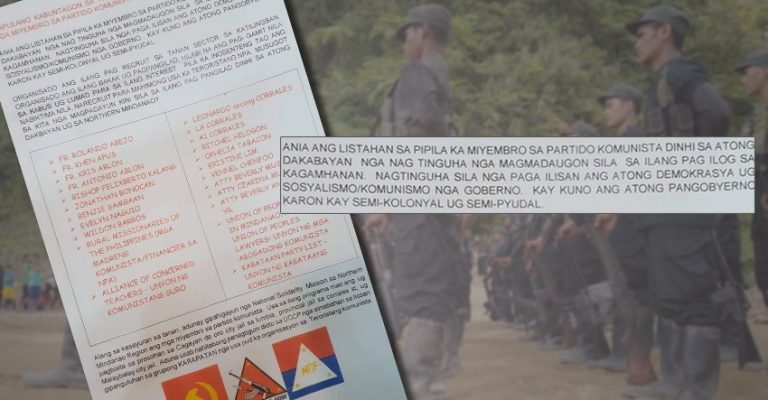
The flyers being distributed in Cagayan de Oro City tagged local church workers, lawyers, rights advocates and a journalist as “terrorist members of the New People’s Army and Communist Party of the Philippines.” (davaotoday.com)
DAVAO CITY, Philippines – Human rights group Karapatan raised a red flag over the malicious flyers being distributed in Cagayan de Oro City red-tagging personalities, which they describe as a “military hitlist.”
The flyers tagged local church workers, lawyers, rights advocates and a journalist as “terrorist members of the New People’s Army and Communist Party of the Philippines.”
The group reported that the flyers were discovered by delegates attending the assembly and launching of Hustisya-Northern Mindanao on Friday morning at Philtown Hotel in Cagayan de Oro City.
A suspected military agent approached the security guard of the said hotel and handed him two brown envelopes with each contained 13 copies of the flyers, it added.
The flyer reads: “Ania ang listahan sa pipila ka miyembro sa Partido Komunista dinhi sa atong dakbayan nga nag tinguha nga magmadaugon sila sa ilang pag-ilog sa kagamhanan (Here’s the list of few members of the Communist Party of the Philippines in the city who aim to cease the power from the government).”
Included among the list are Iglesia Filipino Independiente Bishop Felixberto Calang, Fr. Rolando Abejo of Movement Against Tyranny-Northern Mindanao, Karapatan Northern Mindanao spokesperson Fr. Khen Apus, human rights lawyers Beverly Musni, Czarina Musni, and Beverly Ann Musni, and journalist Cong Corrales and his family.
“Such notorious lists have further endangered the already perilous situation of human rights defenders. We have repeatedly raised how these arbitrary and baseless accusations incite threats to the lives and security of named individuals, the worst of which is that they become victims of extrajudicial killings,” said Karapatan Secretary General Cristina Palabay in a statement.
Also written on the flyer is a warning that members of the CPP visit jails in the cities of Cagayan de Oro and Malaybalay in a National Solidarity Mission. It mentioned that Karapatan conducts meeting inside the United Church of Christ in the Philippines located at Licoan, Cagayan de Oro City.
The mission held on February 21 and 22, Palabay said, aimed to assist the families of victims of human rights violations in the region and to “look into the situation” of arrested progressive leaders Datu Jomorito Guaynon of IP group Kalumbay, KMP leader Ireneo Udarbe, and four members of the Misamis Oriental Farmers Association and that of evacuees from Lagonglong, Misamis Oriental.
Karapatan, IP and Moro group Sandugo, and peasant group Kilusang Magbubukid ng Pilipinas led the said mission and engaged with the Commission on Human Rights-Region 10 (CHR-10) to call for their release.
Palabay calls on the CHR and local government unit address the incident and “protect the rights defenders and make accountable those who continue to put their lives at risk.”
“Activists and everyone is being wrongly tagged as terrorists. The anti-terror law is being arbitrarily used against activists like Guaynon and Udarbe. This situation is made worse by the continuing implementation of martial law in Mindanao,” Palabay said.
A similar red-tagging incident also happened in Davao City last week where posters tagging progressive party lists like ACT Teachers, Anakpawis, Bayan Muna, Gabriela, and Kabataan as “protectors of the CPP-NPA-NDF terrorists.”
Which was denounced by Anakpawis Rep. Ariel Casilao as it endangers the lives of its members making them as “open targets to extra-judicial killings, threats, harassment, and prosecution.” (davaotoday.com) Reposted by
The government should prioritize hiring unemployed Filipinos, said opposition solon after President Rodrigo Duterte made a statement that he would rather allow illegal Chinese workers to stay in the country.
This is one of the reports in a series produced by Bulatlat.com with the Asia-Pacific Forum on Women, Law and Development (APWLD) Media Fellowship. The series aims to report on linkages between gender, ecological conflicts and climate change.
MANILA – If there are groups of Filipinos whose daily life confronts the most immediate impact of climate change, the fisherfolk are among those at the forefront. Their families live by the sea, on the banks of rivers and on islets that shrink or expand with the tide.
They are the first to face the consequences of sea levels rising more than usual, when the typhoons that brew from the seas are more disastrous, or when currents are hitting the land more brutally after some natural guards or breaks had been defaced. For example, after 600-plus old-growth mangroves were cut in April last year, there were changes in the water and they felt it immediately in their reduced catch.
How the poor fisherfolk cope with changing climate
In the coastal communities fronting Manila Bay in Bulacan, “climate change” is not a household word but they grapple with coping solutions in their daily life. One ready example, they have to more frequently repair and raise their embankment or their “waterwalk”.
Project Walkway
Living on narrow strips of land above water, dry space is scarce and to extend the living areas they build houses on stilts, connected by walkways fashioned from strung-together poles of bamboos. Less than a meter in width, the walkway loops around their island-homes, their collectively-built adjustment to the fact that the island is not wide enough.
From another sitio or sub-village, in a separate interview, an elderly woman recalled how, years earlier, they had more earthen embankments. The sitios were connected by more levees unlike today. “We could walk from one sitio to another in those days,” said Flor P. Salvador, 77, a resident of Taliptip since 1969. Now they have to ride a banca just to visit neighboring sitios.
In the bigger island-village of Binuangan, Obando, the walkway is more easily worn out not just by the trudging feet but by the higher water levels and stronger currents. Similar to what they have to do with their houses, they have to raise it by piling more wood or bamboo on top of the old parts.
New floor on top of weakened or wrecked floor – a fisherman’s house is a statement in coping. (Bulatlat photo)
In coastal communities of Bulakan, some families rebuilt their home using concrete and cement. It protects them better during storms. “Our houses don’t just get swept away or destroyed,” an old fisherman told Bulatlat.
But such a house on islands barely above water can also sink faster if the ground underneath it is liquefying faster than its neighbors.’
In coastal parts of Bulakan, Bulacan, the island-communities are scattered over rivers and shallow loam soil narrower than Salambao or Binuangan of Obando.
Despite all these, the people here have adjusted to living with the river and the bay. They are proud to say they are feeding themselves and their families, sending their children to school without asking much from the government. They contribute to the country’s need for relatively affordable fresh fish, shells and crabs.
Taliptip and Bambang in Bulakan, along Manila Bay, are just 0 to 1 meter above sea level. (Photo from Google Map, February 2019)Zooming into a part of Bulakan, Bulacan coastal communities on Google Map, one will find communities of fisherfolk along the river or in the mangroves.
They are in position to raise the alarm when the precarious balance of this ecosystem of rivers, islets and the bay was tinkered with, like when about a hectare of mangroves was felled in April last year. In the following visits of typhoons, they reported its worrisome results. Various sitios of Bulakan, Bulacan suffered unprecedented flooding and soil erosion.
Compounding problems
Years before, these fisherfolk had fought to stop the privately owned but government-backed “sanitary landfill” from operating by the coasts of Manila Bay in Obando. It was a fierce struggle that older residents now say only the reign of terror of former army major Jovito Palparan under the former Gloria Macapagal-Arroyo administration enabled its forced operation. Some fisherfolk leaders and organizers in the area had been reportedly abducted, tortured and killed. The residents petitioned against it in court but in 2014 the Court of Appeals junked their petition and allowed the dumpsite to continue.
Kimberley Lazaro, 31, a resident of coastal Obando since birth, said that since the dumpsite was allowed, their fish catch has dwindled. They lost the mussels and crabs that used to abound at the muddy banks of the river. For a fisherwoman like her, it means spending more to go farther out on the river or the bay itself to catch fish.
Fishing for her daughter, Kimverly wants a genuinely rehabilitated Manila Bay including the rivers draining to it. (Bulatlat Photo)
“If you didn’t start out living around here, you could not endure the stench and the flies. You will eat under a mosquito netting,” she told her fellow fisherfolk as they convened the network opposed to the planned reclamation in Bulakan.
A lesson they have learned through years of forced landfills and reclamation along Manila Bay: this exacts a price and some are not as predictable as worsening pollution and dwindling fish catch. Their part of the coast in Obando now stinks, the river is more polluted, their communities are more vulnerable to flooding, erosion, and subsidence. Worse, these same poor fisherfolk are frequently the government’s scapegoat whenever they seek to push their brand of development of the bay.
Now the coastal communities’ initial efforts to cope, by themselves, with direct impact of climate change and worsening pollution while they shore up their communities and sources of livelihood are coming into conflict with government thrusts concerning the bay.
Ironically, while the government is riding on the popular call for cleanup of Manila Bay and harnessing free labor of volunteers for fishing out thrash that washed up in Manila Bay, it is, on the other hand, disproportionately blaming the poor and seeking their demolition in favor of reclamation plans and other real estate development.
Environmentalists Kalikasan PNE and national fisherfolk group Pamalakaya cited the study of Ocean Conservancy in 2015 that 74 percent of plastics that ended up in the sea came from previously collected garbage. Another cause of pollution in Manila Bay, they said, is the failure of government itself to provide a significant water and solid waste treatment and management.
Environmentalists and fisherfolk decry the seeming duplicity of dubbing the battle for Manila Bay as for rehabilitation when the government is pushing for projects such as massive reclamation and commercial developments of the Manila Bay. Toward this, the government seems to be facilitating the rapid, forced displacement of the fisherfolk settlers in the Manila Bay.
In the coastal areas and rivers in Bulacan, there are 23,051 “informal settler families (ISF),” said the Manila Bay Coordinating Office (MBCO) of DENR in Central Luzon during a scheduled Manila Bay cleanup held in Obando.
But the DENR has been silent about the National Economic Development Authority (NEDA)-approved proposal of diversifying giant, San Miguel Corporation, to build an international airport on rivers, fishponds and mangroves in Bulacan along Manila Bay. This is more massive than the trash or the presence of ISF. It means burying the coast under million cubic meters of engineered soil and rock-cement. It means bringing in machinery for mega-construction and reclamation after the fisherfolk communities have been driven away.
A typical narrow island-community, river on the right, fishponds on the left, under threat of being ‘cleared’ for Manila Bay rehabilitation. Only to be backfilled, cemented over and turned to a new city or airport. Fisherfolk say that is not and cannot be ‘rehabilitation’. (Photo by M. Salamat / Bulatlat)
It is not clear if the fisherfolk targeted for displacement by SMC’s reclamation project are also among the ISF complained by the MBCO in Region 3. What is clear is that since the locals began hearing about the San Miguel Corporation projects, the government and SMC have all but ignored their demands for information and a say in the future of the fishing grounds and the bay.
The locals say they would hear warnings that the SMC has a deep pocket and that they couldn’t win their demand to retain the fishing grounds as such. From October to November last year, a contractor company of SMC called Silvertides conducted surveys and interviews in coastal villages of Taliptip and Bambang. Around the same period, the locals were being told by this or that local government executive that they shouldn’t join groups criticizing the project.
The locals would only learn this February that the surveys and interviews of 30 “fishpond caretakers” Silvertides said they conducted were requirements for the SMC contractor to get the DENR nod for reclamation.
Despite the fact that the fisherfolk were receiving news affecting their future only in trickles, in October some of them braved it out to establish the Network Opposed to Reclamation/Aerotropolis.
In November, fisherfolk, church workers, and environmental activists from Bulacan to Cavite gathered at the Department of Environment and Natural Resources (DENR) to file a Manila Bay-wide complaint calling on the Duterte government. They asked the DENR to deny erring land reclamation projects their environmental compliance certificates (ECC) and area clearance permits.
The river is the main thoroughfare for fisherfolk families living in coastal parts of Bulakan (Photo by M. Salamat)
In a statement, Leon Dulce, national coordinator of the Kalikasan People’s Network for the Environment (Kalikasan PNE), said, “not one of these reclamation projects have passed key international human rights guidelines such as the UN Guiding Principles on Business and Human Rights and the OECD Guidelines.”
These guidelines for businesses include compliance to civil, political, and socio-economic rights policies in the Philippines, adopting internal human rights policies and contributing to the implementation and development of State policies, conducting due diligence in assessing and addressing rights concerns, and cooperating with legal remedy mechanisms.
Gauging from reports of affected locals from Cavite to Manila to Bulacan, the reclamation projects, said Dulce, have apparently grossly bastardized the public participation mechanisms and environmental regulations of the Environmental Impact Assessment process. The group also blasted the reports that critics of reclamation were being harassed.
Asking the DENR to side with the fisherfolk against reclamation, they reiterated that “There is no reason not to respect democratic procedures, even for the aerotropolis that is an unsolicited proposal not yet governed by the formal regulatory process of the State.”
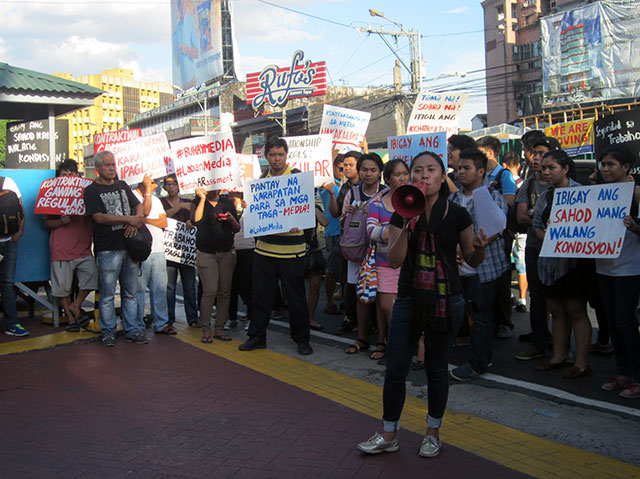
Bulatlat file photo | GMA 7 talents stage a protest action in front of GMA Network Inc. compound, June 5, 2015. (Photo by Ronalyn V. Olea / Bulatlat.com)
“Truly, without their work, petitioner GMA would have nothing to air, hence the private respondents’ services in the former’s television program were unquestionably necessary and essential.”
MANILA — The Court of Appeals upheld the decisions of the National Labor Relations Commission (NLRC) declaring more than a hundred talents of broadcasting firm GMA 7 as regular employees.
In a 19-page decision dated Feb. 20, the CA’s Special 14th Division junked the petition for certiorari filed by GMA 7 management, saying it lacks merit.
Penned by Associate Justice Zenaida Galapate-Laguilles, the appellate court ruled that the talents are regular employees and they are part of production crew who, were undoubtedly performing functions necessary and essential to petitioner GMA’s business of broadcasting television.
“Truly, without their work, petitioner GMA would have nothing to air, hence the private respondents’ services in the former’s television program were unquestionably necessary and essential,” the decision read.
The CA further said that even if the talents’ employment contracts were for a fixed term, these contracts have been renewed from one, three, or six months, or for one or five years. The successive renewals of these contracts, said the CA, indicated the necessity and desirability of their (talents’) work in the usual course of GMA.
The appellate court further asserted that the four -fold test to determine the existence of an employer-employee relationship was duly established in the said case. These are: the selection and engagement of the employee; the payment of wages; the power of dismissal; and the power to control the employee’s conduct.
The Talents Association of GMA (TAG) welcomed the decision.
Shao Masula, TAG vice president, told Bulatlat, “Waiting for Court of Appeals decision was sort of a torture — because the five years of blood, sweat, and tears that was shed for this fight might all go to waste.”
Masula, who has been with GMA for the past 15 years, recalled being mocked by colleagues for staging a street protest in front of GMA premises in June 2015. She said that some even called them ingrates for “biting the hands that feed us.”
Some of the TAG members were dismissed for participating in the rally.
“TAG members would ironically feel being ridiculed for standing for truth and for fighting for what is right,” Masula said.
In a statement, TAG said the purpose of their case was always clear — “to shine the light on a prevalent issue that affects millions of Filipinos and to increase the pressure on companies and the government, to stop this unjust, inhumane and illegal labor treatment.”
“This win in the CA is an affirmation for our cause,” Masula said.
While TAG recognizes that GMA 7 can still appeal to the Supreme Court, Masula is hopeful more than ever that the law is on the side of Filipino workers.
“They have the vast resources to fight us out in court, but we believe that what we lack in money and connections, we make up for by our best asset — the truth,” TAG said in a statement.
In a statement, the National Union of Journalists of the Philippines (NUJP) congratulated TAG in its victory. “Your unity and determination is an inspiration to us and all media workers seeking to improve their working conditions and economic welfare,” NUJP said.
The group also called on the owners and managers of GMA Network to immediately implement the CA decision. It also urged all other media companies to end the onerous policy of contractualization.