On the 33rd anniversary of People Power Revolution, the Save Our Schools (SOS) Network revisited Martial Law under the late President Ferdinand Marcos in a lecture titled “Martial Law Noon at Ngayon: Kwento ng pag-abuso at paglaban.”
“I realized that there is no difference with Martial law before and now. In Marcos’ administration, there were a lot of people who fought against his tyrannical rule that is why he declared martial law. While in Duterte’s administration, he is scared of our [lumad students] voice and resistance, because our school teaches us how to defend our ancestral lands and value our right to self-determination.” said Catherine Dalon, a Grade 10 student from Mindanao Interfaith Services Foundation, Inc.
Because of Martial Law in Mindanao, Lumads were forced to evacuate their community.
Lumad students were also forced to stop their studies in their community schools and continue it in evacuation centers through “bakwit school.”
“The bakwit school is a form of our resistance against the attacks on our schools and our commitment to continue our education. We have long been deprived of education by the state and now that we already have a school that let’s us learn beyond the four walls of our classroom, we will take our classes lightly,” she said.
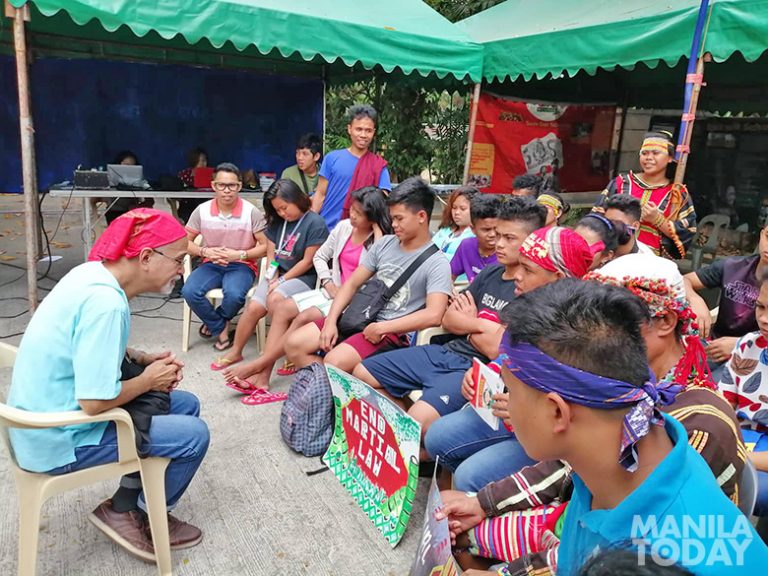
Today, as part of their History subject, Satur Ocampo, and Bonifacio Ilagan, survivors of Martial Law under Marcos administration visited their class and exchanged experiences.
Martial Law survivor filmmaker and writer Bonifacio Ilagan shares stories with Lumad ‘bakwit school’ students. Photo by Kevin Paul Aguayon.
“For us lumad students, cowering is not the answer to the intensifying threats of the state, we will collectively face the attacks on our community, because we know that our resistance is just, like the Edsa revolution.” she said.
Attack on Lumad Schools
SOS Network cited various human rights violations (HRVs) under Martial Law in Mindanao. They recorded 535 attacks on schools; 111 trumped-up charges against teachers, parents and Lumad leaders; 73 schools forcibly shut down; 11,500 Lumads displaced; 10 extra-judicial killings; and 8,000 Lumad and farmers forcibly paraded as New People’s Army (NPA) surrenders.
According to Geming Alonzo, executive director of Center for Lumad Advocacy, Networking, and Services, Inc. (CLANS), these recorded data of HRVs are “very alarming” especially after Duterte extended Martial law in Mindanao for the third time.
“Duterte maintains that the extension of Martial law in Mindanao is the solution and keeps on disregarding our call to lift Martial law. This only shows how he never listened and is not interested to resolve the issues that lumad communities are facing,” said Alonzo.
She also added that regardless Duterte’s “lack of response” about the issues that the Lumads are facing, they are determined to “rattle the state to take action and make the perpetrators accountable.”
Members of Talents Association of GMA Network (TAG) welcomed the Court of Appeals (CA) Special 14th Division decision to uphold the earlier decisions of the National Labor Relations Commission (NLRC) that declared them as regular employees of media giant GMA Network, Inc (GMA).
“Our group has been through a lot after five years, including in June 2015 when we staged a rally in front of GMA’s premises to call for the end of contractualization across the industries. As a consequence, some of our members were fired, and some were ridiculed or “biting the hand that feeds them”,” said TAG in their statement.
In July 2015, GMA sacked 11 members of TAG in a new round of layoffs, only a month after a favorable ruling by the NLRC. The terminated members of TAG came from GMA’s award-winning shows Imbestigador and Reporter’s Notebook, including TAG President Christian Cabaluna.
The CA decision dismissing GMA’s Petition for Certiorari was promulgated on February 20, 2019. TAG said they are aware this is not the end of their struggle.
“We are aware that this is not the end. GMA has a recourse to file a motion for reconsideration and take it all the way to the Supreme Court. They have the vast resources to fight us out in court, but we believe that what we lack in money and connections, we make up for by our best asset — the truth,” said the group.
TAG said they hoped that their battle for regularization would be beneficial to other workers.
“Hopefully along the way, we can set a legal precedent that will give all Filipino workers the treatment and protection we have always deserved,” ended TAG.
TAG filed a regularization complaint against GMA with the NLRC on June 4, 2014. The NLRC found that TAG members are regular employees of GMA and as such are entitled to security of tenure and all benefits and rights as regular employees on June 22 and September 30, 2015 and on January 5, 2016, after GMA appealed the NLRC decision several times before taking the case to the CA.
An official of the Catholic Bishops Conference of the Philippines (CBCP), Executive Secretary Rev. Fr. Jerome R. Secillano, has responded to the inquiry made by Ted Failon, on February 26, 2019, about the “sexual misconduct” besetting the Roman Catholic Church, on how this issue happened and can be given remedy in the Philippine context?
This issue of “sexual misconduct” was recently discussed in Vatican in its Bishops summit. In that radio interview, Fr. Secillano humbly admitted that the “sexual malady” has been happening in the Roman Catholic Church. Thus the Church as an institution should undergo a “reform.”
Reforming the Church as institution is not only good for the Roman Catholic Church. Reforming the Philippe Churches (Roman Catholic, Protestant Churches, Evangelical Churches, including Episcopal Church, Aglipyan Church, Methodist Church, United of Church Christ and other denominations) must be the concern of all Church leaders, church people and Christians as a whole.
Reforming the Church must be a continuing endeavor of the Churches. It is a process of renewing the Church not only the persons but its theology, liturgy, canons, mission, ministry, tradition and practices.
Reform is an act of changing, improving, correcting and rehabilitating a social order, a law and an institution. When someone undergoes a reform, he/she shall stop doing things that are not acceptable by the society or the public in general. Reforming the institution is not for its own welfare, but for the interest of all people and society.
The Reformation in 16th-century was a religious and political challenge to papal authority. It was started with Martin Luther, followed by King Henry VIII and others. It led to the Thirty Years War and the Counter-Reformation within the Western Church. The reformation was not only a process of correcting maladies of the practices but a revolution within the Christian Church. Many Christian Church dominations emerged, established and founded afterwards.
In the Philippines, Christianity has its own unique history and experiences.
Speaking of reforming the Church as institution, reformers must recognize:
That Christianity, basically the Western church, was brought in the Philippines by the Spanish colonizers and was used to subjugate the Philippine island
That Filipino Christians, including clergy, after 300 years of suffering because of the abuses of their Spanish taskmasters, participated in a reformation movement and eventually became a revolution in 1896
That the hope for a reformed Philippine Church was seen in 1899 Philippine republic led by Emilio Aguinaldo, Apolinario Mabini and Fr. Gregorio Aglipay and his comrade revolutionary clergy.
That the US colonizers stopped the reform movement of the Philippine Church initiated by the Filipino clergy when the American forces emerged victorious over the Filipino-American war in 1899
That the US colonial government instituted a policy of “religious freedom” by maintaining the Roman Catholic Church, supporting the influx on missionary Protestant Churches and Episcopal Church, while it also ‘permitted’ the establishment of Iglesia Filipina Independiente, Iglesia ni Cristo and other independent “protestant” Churches
That “religious millenarian groups” and “religious fanatical groups” under the influence of some politicians and “religious leaders” are being tolerated as long as they will not run counter to the purpose and interest of the US colonial government
That after the Second World War, many evangelical missionaries came in the Philippines to evangelize ad “save” the Christians in the Philippines
That ecumenism was propagated in the Philippines in 1960s, however, it is only limited to the establishment of the National Council of Churches in the Philippines (NCCP) which has membership comprising the mainstream protestant and independent churches
That in 1980s the New Religious Movement came in the Philippines as part of the US Counter-insurgency program which can be seen and recognized as Christian fellowships, campus crusades and Christian movements.
That these church denominations exist at present which have its respective instituted system, laws and practices.
That on February 17, 1972, the Christians for National Liberation (CNL), a revolutionary organization of church people and lay people was founded to participate in the new democratic revolution led by the Communist Party of the Philippines (CPP) which has a program of reforming the Philippine Church as part of its seven-points program
That the Philippine Churches had celebrated the 500 years of Reformation in October 2017 and in 2021, the Philippine Churches will definitely celebrate the 500 years of Christianity in the Philippines
The call to reform the Church is timely and relevant in the context of the continuing struggle of the Filipino people for a just and lasting peace. So far, a document that will help the Church reformers is the “Pilipinas” of the Christians for National Liberation.
Number 6 of the 7-point program of the Christians for National Liberation (CNL) states: “Struggle for democratic reforms within the churches in support of the new democratic revolution.”
CNL logo
This program was explained in the following 5 paragraphs.
The reactionary character of Christian churches prevents the full participation of church people in the revolutionary mass movement. The struggle for democratic reforms in support of the new democratic revolution within the churches therefore is necessary and a legitimate interest of CNL. However, CNL has no illusions that the churches can be transformed to fully transcend their reactionary character and become “national democratic churches”.
CNL supports moves for democratic practices and structures within the churches. It calls for greater co-responsibility of the laity and equal participation of men and women in the life and decision-making processes of the churches. It encourages greater responsiveness and accountability of the leadership to the community. It is against the continuation of all existing forms of feudal and colonial relations in the churches.
CNL must ensure that progressive and democratic church people, who are supportive of, or sympathetic to the new democratic revolution, are in the leadership and other responsible positions in the churches. Their role in turning the churches to the side of the revolution and in bringing about the desired renewal of the churches is indispensable.
In this struggle for democratic reforms within the churches, CNL encourages the development of progressive theology and pastoral programs. Worship, the understanding and proclamation of faith, and Christian service must be rooted in the life and struggles of the people, and must enhance and support them. Church programs must aim at eradicating the individualism and the sense of fatalism in the prevalent religious culture, and strive for the true empowerment of the people both in church and society.
At the same time, we must consciously link the various struggles – participation in decision making, equitable sharing of resources, relevant training and formation, self-organization, participation in the people’s struggles – to the overall revolutionary mass movement.
To support the continuing struggle for this program, number 5 of the same CNL Program shall be undertaken: “Wage a struggle against a colonial, feudal and fascist culture, and promote a national, scientific, mass culture.” The explanation are stated below.
The people’s war can advance only if there is a general awakening of the broad masses of the people and there is a revolution in all aspects of life, including the field of culture.
This is so because our enemies use not only armed strength against the people; they also use cultural weapons including religion to keep the people docile and submissive. They use a colonial, feudal and fascist culture to keep the people passive, confused and divided. This oppressive culture teaches them to submit themselves to some foreign power or powerful leader, or rely solely on some mysterious power.
CNL must help raise the people’s awareness that will impel them to fight and overthrow their oppressors and, in the process, give birth to a national, scientific and mass culture and replace the colonial, feudal and anti-people culture that now prevails.
We must propagate a revolutionary national culture in order to combat colonial mentality and subservience, and uphold the dignity and independence of the Filipino notion. A scientific culture must be fostered to oppose the feudal thinking, superstitions and ideas which keep the people in a world of ignorance, unfounded beliefs and prejudices rendering them resistant to revolutionary change. We must promote a mass culture expressive of the heroic struggles and aspirations of the toiling masses. We must support the struggle against national oppression and combat Christian chauvinism and discrimination to the culture and customs of the national minorities.
More so CNL has the responsibility to lead the struggle in the religious sphere for, in a special way, religious culture is being used by the state to mystify and domesticate the people.
Religious culture is exploited by the elite to maintain their rule over the people. Thus, we must carefully study and oppose the imperialist use of religion, both in its own heartland and in its neocolonies and the fascist use of popular religiosity and religious fanaticism for counter revolution. We must also fight against the phenomenal spread of religious fundamentalism among the masses.
Recognizing that the church is the bastion and purveyor of a patriarchal culture, the Christians for National Liberation is also one with the struggle for women’s liberation against male oppression and patriarchy. We also recognize the right to individual sexual preferences. We oppose all forms of discrimination based on sexual and gender differences.
We share this task in waging a struggle against a colonial, feudal and fascist culture, and promote a national, scientific, mass culture with all national democrats using all possible forms: arts and science, literature, visual arts, music, theater, film, and dance.
This is not just a fight over concepts and symbols. It is a struggle over cultural institutions: religious, educational and media to promote a progressive, liberating and transforming culture in line with the new democratic revolution.
Thus, CNL actively promotes solidarity with the poor and liberation theology as its own distinct contribution to the advancement of revolutionary practice and theory.
Reforming the Church as an institution? Then consider the programs of CNL for correct guidance.
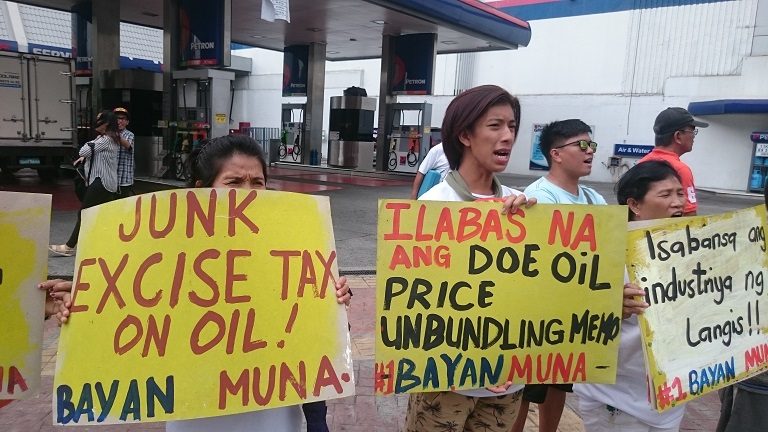
Bayan Muna members protesting oil price hikes (Bulatlat photo)
“The latest round of price hikes will definitely hurt consumers including low to middle-income earners and especially poor sectors like farmers, fisherfolk and urban poor.”
MANILA – Picket protests in different places across the Philippines greeted today’s hike in oil prices. On Feb 26, gasoline and diesel prices increased by Php1.45 per liter, kerosene by P1.35 per liter.
In three weeks of oil price hikes, the cumulative fuel price hikes as of this month is P6 for diesel, Php5 for gasoline and P4 to P5 per liter of kerosene.
Unlike the prices of other products, any hike in oil prices exerts a domino effect on prices of other products, said Bayan Muna candidate for Senator Neri Colmenares who led one of the picket protests in front of a Petron gas station in Timog Avenue, Quezon City.
During the protest, Colmenares chided the Department of Energy (DoE) for delaying the release of a circular that would order the unbundling of oil prices.
He said the rates of electricity and water have been unbundled as presented to the consumers, yet the price of oil remains a mystery to consumers.
“How can the Department of Energy do its job of ensuring that oil companies are not overcharging the consumers if it cannot even see the break-down or how the oil companies have been arriving at their prices of oil?” Colmenares asked.
He said unbundling is not the solution per se to the problem of oil price hikes and inflation – there is the oil deregulation law giving the oil companies freedom to increase prices; the TRAIN law that imposed an additional P2 as excise tax on every liter of oil products; and there are the other government policies that contribute to high prices of basic goods.
“It’s not true the government can’t do something to address the oil price hikes and its pressure on inflation,” Colmenares said.
To reduce the prices of oil products, Colmenares said, the government must suspend the excise tax imposed on oil products because of the implementation of the TRAIN (Tax Reform for Acceleration and Inclusion) Law. He urged the Duterte government to remove also the Value Added Tax (VAT) imposed on oil products.
“With VAT on oil products, the government is benefiting from every spike in oil prices and adding to the misery of poor consumers,” Colmenares said.
Higher inflation amid stagnant wages means greater misery
Given the P4 to P6 per liter cumulative price hikes in the last three weeks, transport groups are now pushing for a P1-fare hike.
The prices of basic goods, meanwhile, have already increased from 1 to 5 percent, canned goods by P0.40 to P1.30, some vegetable items by P10 to P40 per kilo, bangus by P40, beef by P25, and even condiments, Anakpawis Rep. Ariel Casilao said in another statement.
“The latest round of price hikes will definitely hurt consumers including low to middle-income earners and especially poor sectors like farmers, fisherfolk and urban poor,” the Kilusang Magbubukid ng Pilipinas said. Contrary to common estimates that mostly the drivers feel the pinch of oil price hikes, the agricultural sector also reels from it, according to KMP. Farmers use diesel in agricultural production and kerosene in their households.
Jovy Torres, a peasant woman leader and a mother of two, said farmers like her can no longer afford to pay for other needs after buying the most essentials. “We make do with just rice, salt and a little to eat it with. But even the price of salt has lately increased.”
Torres earns only an average of P300 to P400 after selling her family’s farm produce like bananas and root crops. Other low-income sectors such as the fisherfolk and urban poor are expected to reel from the effects of price hikes.
At the Mendiola Peace Arch near Malacañang, youth groups burned during a protest rally some LPG-shaped effigies to dramatize the “stark condemnation and the resulting explosion of mass unrest.” They blamed the Duterte administration’s policies and called for Duterte’s ouster.
Oil prices as election issue
Considering that it is currently the campaign period for midterm elections, Senatorial candidate Neri Colmenares urged the public to scrutinize the candidates and quiz them for their position on oil deregulation, Value-Added taxes, TRAIN law and other policies that are contributing to the people’s poverty and misery.
“This should be a period of winning the people’s hearts and minds,” Anakpawis Rep. Casilao said. He criticized the administration candidates saying their loyalty to President Duterte, who is carrying out the very policies that sow poverty and misery across the country, will alienate them from the populace.
The women’s group Gabriela, meanwhile, blasted the Duterte government for using as excuse in implementing “tax reforms” the need to fund free college education, wage hike for teachers and government employees , pension, free medicines and other public services.
“The government shouldn’t run the interest and welfare of the people against its responsibility to provide for the rights of the majority,” said Joms Salvador, secretary general of women’s group Gabriela. She urged the public to take Duterte to task as “Duterte is saying all these while the legislators continue to relish their pork barrel and billions of public funds are being lost to corruption.”
To bring change or actual reforms that will benefit the people or even just give them a breather, Casilao of Anakpawis Partylist called for support for House Bill No. 7653 repealing the Train law, HB 3676 to regulate the oil sector, and HB 1760 to re-nationalize Petron. Lawmakers under the Makabayan bloc filed these bills.
To survive the shrinking household incomes, the progressive lawmakers also urged the Filipino workers and marginalized sectors to support the HB 7787 or the P750 National Minimum Wage and HB 556 Anti-Contractualization Bill.
Casilao appealed to the people “to stand against the fatal mixture of anti-people economics and traditional politics, which keeps the majority of Filipinos poor and miserable, and bars genuine national development.”
The Court of Appeals Special 14th Division has decided that the Talents Association of GMA Network (TAG) are regular employees of media giant GMA Network, Inc. (GMA), upholding an earlier decision by the National Labor Relations Commission (NLRC). In a decision promulgated on February 20, 2019, the CA dismissed the Petition for Certiorari filed by GMA.
This decision came three years after the Final Entry of Judgment by the NLRC declaring members of TAG as regular employees of GMA.
The 96 employees included in the decision worked with GMA for six months to 15 years as production assistants, researchers, transcriber, camera man, writer/producer, head writer, graphic designer, production designer, team head, segment producers, associate producer, supervising producers, executive producers, editor and other roles necessary and desirable in GMA’s course of business.
GMA filed a Petition for Certiorari ascribing grave abuse of discretion on the part of the NLRC when it affirmed the decision to regularize members of TAG.
The CA found the petition “unmeritorious,” because in this case “it is not shown that the NLRC exercised its judgment whimsically, arbitrarily or despotically by reason of passion and hostility considering that its findings are supported by substantial evidence.”
Regular employees
“The presumption is that when the work done is an integral part of the regular business of the employer and when the worker, relative to the employer, does not furnish an independent business or professional service, such work is a regular employment of such employee and not an independent contractor,” the CA said in the 19-page decision written by Associate Justice Zenaida Galapate-Laguilles, concurred by Associate Justices Mario Lopez and Gabriel Robeniol.
“Truly, without their work, petitioner GMA would have nothing to air, hence the private respondents’ services in the former’s television program were unquestionably necessary and essential,” the ruling added.
In its decision, the CA cited the “four-fold test” to determine employer-employee relationship.
“To determine the existence of an employer-employee relationship, case law has consistently applied the four-fold test, to wit: (a) the selection and engagement of the employee; (b) the payment of wages; (c) the power of dismissal; and (d) the employer’s power to control the employee on the means and methods by which the work is accomplished. Of these criteria, the so-called “control test” is generally regarded as the most crucial and determinative indicator of the presence or absence of an employer-employee relationship. Under this test, an employer-employee relationship is said to exist where the person for whom the services are performed reserves the right to control not only the end result but also the manner and means utilized to achieve the same,” the CA decision said.
GMA insisted that “TAG members are independent contractors since they rendered services for the company because of their talents, skills, training and expertise in performing their respective tasks as well as the high talent fees including the circumstances on how it is given to them,” as described in the ruling.
GMA issued a memorandum dated April 14, 2014 requiring its talents to register with the Bureau of Internal Revenue as independent contractors and issue receipts for the talent fees being paid to them.
The CA said that the “four-fold test” to determine employer-employee relationship, such as selection and engagement of the employee, the payment of wages, the power of dismissal, and the power to control the employee’s conduct, was duly established in the case.
Long battle
TAG filed a regularization complaint against GMA with the NLRC on June 4, 2014.
On June 22, 2015, the NLRC found that TAG members are regular employees of GMA and as such are entitled to security of tenure and all benefits and rights as regular employees.
In July 2015, GMA sacked 11 members of TAG in a new round of layoffs, despite a favorable ruling by the NLRC.
GMA appealed the decision but the NLRC again ruled in favor of TAG members on September 30, 2015, deciding that the remaining 97 complainants of TAG are regular employees of the network and eight complainants who submitted letters of resignation were considered regular employees only up to the date preceding their resignation.
The network company, however, assigned year 1 of regularization as 2016, which TAG members contested in a motion for clarification filed also at the CA. Some of the respondents have worked with the company for as long as 15 years.
On January 5, 2016, the NLRC upheld its September 30, 2015 decision on the regularization complaint filed by TAG.
Progressive youth groups Anakbayan Metro Manila and Kabataan Partylist Metro Manila slammed the Philippine National Police (PNP) over red-baiting and vilification of youth groups and other partylists in a local forum in Pamantasang Lungsod ng Marikina on Thursday, February 21.
The forum, organized by the Marikina CPS-SCADU, aimed to raise awareness on the ‘anti-terrorism’ campaign launched by the current administration. Among those who attended were students taking up degrees in criminology, hotel and restaurant management and education.
In an interview, one student who attended the forum shared her reaction regarding the event.
“Sa loob ng halos isang oras na pagsasalita ni PNP PO1 Joel L. Lapuz ay puro panghihikayat sa mga estudyante na huwag sumali sa mga progresibong grupo dahil ito ay makakasama lamang sa kanila. Paulit-ulit niya ring binabanggit ang masamang dulot ng pagrarally sa mga estudyante at hindi dapat kami lumalaban sa gobyerno dahil ito raw ang nagpapaaral sa amin. Sa kabuuan, pinipigilan nito ang estudyanteng gaya ko na maging kritikal sa ating gobyerno at maging sa iba pang aspeto na apektado ang mga mag-aaral at ang aming pamilya.”
[“The almost one hour of PNP PO1 Joel L. Lapuz’s talk was only full of persuading the students to not join progressive groups because he said that it will now be beneficial for us. He repeatedly mentioned the grave consequences of students joining protests and that we should not fight the government because it provides us the means to study. All in all, they are only trying to stop us from becoming critical of our government and even in other aspects where our fellow students and families are affected.”]
The student further manifested that Marikina Police PO1 Lapuz introduced himself as a former youth activist. He also named several progressive youth organizations such as Anakbayan and League of Filipino Students as recruiters of NPA and warned that their organization of street protests as part of their ‘communist-terrorist activities’.
Lapuz also warned the students against voting for progressive partylists such as Kabataan, Bayan Muna Party-list, ACT Teachers and other partylists of the Makabayan Bloc, citing that these groups serve as sources of funding of the CPP-NPA.
Students speak out
The forum drew mixed responses from the student body, with one student inquiring why the police are discouraging students to protest when this is a constitutionally-guaranteed right.
One student reacted by saying that protests have contributed significantly to attaining socio-economic reforms like the Free Tuition Policy, and that it is not the government who is funding state scholars’ tuition but the people’s taxes.
One student said in the forum that it is incorrect and harmful to link Kabataan Partylist with terrorist activities.
Another student challenged the veracity of Lapuz’ statement that activists are members of the NPA and are recruiting students to the armed group.
The Marikina Philippine National Police (PNP) is said to make rounds in various Marikina schools with discussions focusing on ‘anti-terrorism’, with the forum at the Marikina Polytechnic College (MPC) held on February 20.
Tagged groups condemn PNP forum
In an online statement, progressive youth group Anakbayan Metro Manila denounced the recent allegations thrown by the PNP.
“The red-tagging and malicious accusations against youth organizations and progressive partylists show the desperate efforts of the US-Duterte regime to silence the growing dissent of the students and the people. The government spreads fake news and engages in terror tagging, while at the same time they fail to provide concrete solutions to land reform, contractualization, low wages, and price hikes of basic commodities and dismal social services,” said the group.
Anakbayan Metro Manila scored the Duterte administration for intimidating the youth and the people from exercising their basic human rights.
“These measures are meant to divert people’s attention from the crisis they experience, deny the sufferings of the people from anti-poor policies in Duterte’s three years and to frighten people away from exercising their basic rights to expression, organization, assembly, dissent, and even to rebel as a last resort against tyranny and oppression,” said the group.
Meanwhile, Kabataan Partylist Metro Manila also released a statement condemning the event. The group assailed the terrorist funder tag of the PNP in the forum.
“Being the sole youth representation in Congress, Kabataan Partylist has been in the forefront of the youth legislative agenda. In the 17th Congress alone, Kabataan has proposed more than 400 bills and resolutions, including the Free Tuition Policy which Pres. Duterte signed into law in 2017. Kabataan Partylist Rep. Sarah Elago and the partylist’s nominees continually face baseless accusations from paid pro-government trolls and even elements of the police and military, naming these youth leaders as NPA guerrillas,” said the group in its statement.
The group also stated that terrorist tagging does not bode well for activists alone, but also for ordinary citizens.
“Terror tagging is not an attack against activists and progressive partylists only—this is an attack against constitutionally-enshrined basic civil liberties of every Filipino citizen. If we are to be led to believe that people who have dissenting views and those who sought to organize themselves to collectively push for their rights and welfare are terrorists, then it will be easy for the government to deprive anyone of their basic human rights especially when the time comes the government agenda becomes inimical to their interests,” said the group.
Systematic, nationwide red-tagging
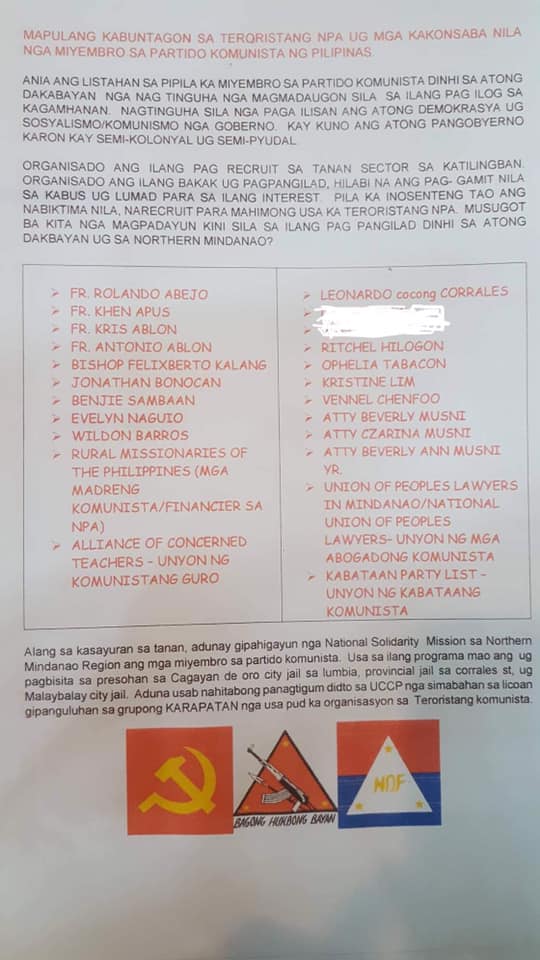
The progressive groups furthered that this incident is not only isolated in Metro Manila. News about the Bulacan police red-tagging students from Bulacan State University (BulSU) also made rounds in social media sites, while a ‘terrorist list’ containing names of various progressive party-lists, mass organizations, religious leaders, and even a journalist is being disseminated in Northern Mindanao.
Photo from Tinay Palabay Facebook page
The list included Kabataan Partylist third nominee Vennel Chenfoo.
National Youth Commission (NYC) Chair Ronald Cardema also made rounds in the news for tagging various organizations, as well as suggesting denial of scholarships for students who attend protests. The suggestion was met with criticism by the solons and even by the Palace itself. Cardema was forced to update his statement to say that only those who already joined the New People’s Army (NPA) should lose scholarships. Many netizens retorted that NPAs are no longer enrolled students.
Anakbayan Metro Manila slammed the continued harassment, citing that these state-sponsored attacks will not deter them from fighting for the rights of the people.
“We call on our fellow youth to exercise vigilance on all state-sponsored activities within our universities, such as police and military presence and resist the militarization in our schools. We have to be united in forwarding our right to education, while this regime fails to serve the students and the youth. We should expose the rotten political system that this regime continues to perpetuate. We have to strive harder to fight and ultimately end all tyrannical attacks against the youth and the people.” the group ended.
“The testimonies of the victims and their communities, as well as their steadfast commitment to fight for justice are enough bases to overcome the lies of this administration.”
MANILA – “Stop whining and address the issue,” Karapatan secretary general Cristina Palabay told the government after it once again tagged the group as front organization of the Communist Party of the Philippines, the New People’s Army and the National Democratic Front of the Philippines.
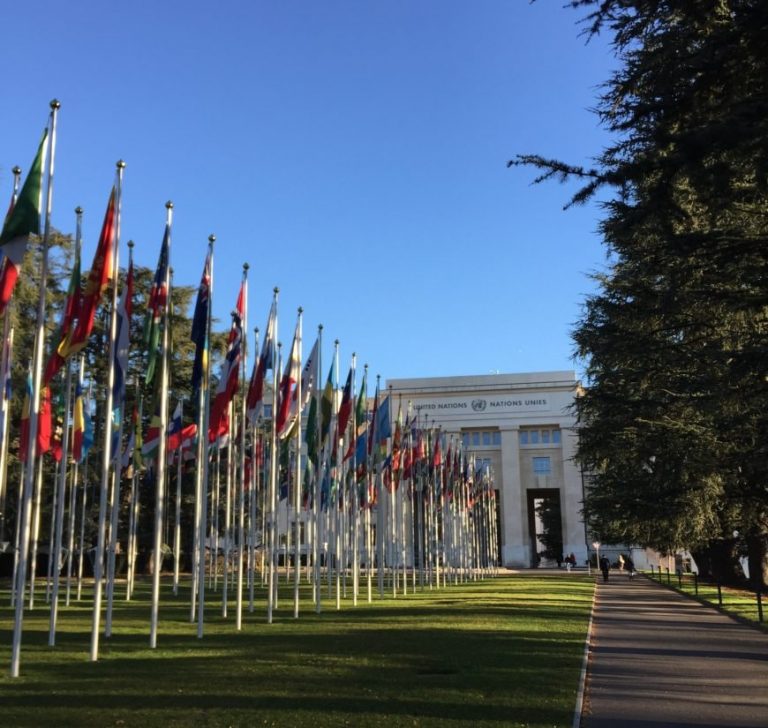
According to a report, the Duterte government sent a delegation to the United Nations in Geneva, Switzerland to formally file a complaint against the alleged atrocities and human rights abuses committed by the NPA.
In the complaint, the government tagged the human rights group Karapatan, church group Rural Missionaries of the Philippines, think-tank Ibon Foundation, and the Mindanao Interfaith Service Foundation, Inc. as front organizations of the CPP-NPA-NDFP.
Palabay reminded the Duterte government that the “State is the primary duty-bearer in the promotion, protection and advancement of human rights.”
“You might have already forgotten [the government’s responsibility],” she added.
The United Nations is another arena where cases of human rights violations are filed by groups or individuals after it has exhausted all legal remedies available in the country. Karapatan, as well as other cause oriented groups, has filed several complaints of human rights violations committed by the State to the UN body including the killing of campus journalist Benjaline “Beng” Hernandez.
The government also formally moved for the delisting of 625 cases of enforced disappearances that took place from 1975 to 2012 with the UN Working Group on Enforced and Involuntary Disappearance (UN WGEID).
Palabay said such moves made by the government were a “desperate move to deodorize its notorious human rights record and to evade accountability for its crimes and tyrannical acts.”
“Together with other human rights and civil society organizations, and even international human rights experts and UN officials, we have been repeatedly maligned in the government’s vicious terrorist-labeling campaign and have faced reprisals due to our work exposing State-perpetrated human rights violations and demanding for justice and accountability,” said Palabay.
(BULATLAT FILE PHOTO) Cristina Palabay, secretary general of Karapatan, presents the trends in the human rights situation under the Aquino administration in a press conference, Nov. 5. (Photo by Ronalyn V. Olea/ Bulatlat.com)
Palabay also added that the government has constantly rejected calls for independent investigations by human rights experts and “has barely responded substantially to communications sent by UN offices regarding cases of rights violations.”
“Through a national task force composed of militarists and mercenary hacks, it is promoting a most unbelievable lie – that government is correct and everyone else is wrong. What is however apparent is its elaborative effort to hide the injustices apparent in the country,” Palabay said.
Palabay also said that red tagging organizations, as well as journalists, who are exposing issues such as human rights violations committed by the state “will not erase the atrocious crimes already committed and are continuously being committed by state security forces.”
Karapatan and the Rural Missionaries of the Philippines including lawyers, bishops, priests and Mindanao-based journalists were also listed as front organizations of the CPP-NPA-NDFP. The list was being circulated in Cagayan De Oro in Mindanao.
Palabay reiterated the dangers of being tagged as members of CPP-NPA-NDFP like being vulnerable to attacks such as “killing, criminalization of their work and beliefs and illegal detention, torture and other violations of the people’s right to uphold and defend rights, to form organizations and to conduct human rights work.”
She also criticized the “audacity of the Philippine government in shamelessly claiming efforts of civil society and human rights organizations, passing it off as their sincere effort to advance and protect human rights, while altogether dismissing the deteriorating rights situation and outrightly denying recognition of the victims.”
“The testimonies of the victims and their communities, as well as their steadfast commitment to fight for justice are enough bases to overcome the lies of this administration,” Palabay said.
Law enforcement agents are now trying to locate the person believed to be behind an alleged investment scam in Mindanao after a local court issued an arrest warrant against the firm’s founder.