Home Blog Page 407

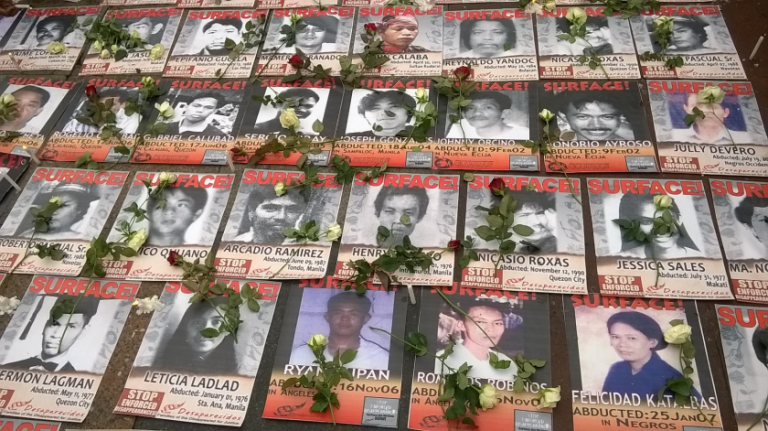
Kin insulted by gov’t move to delist enforced disappearances cases from UN records

0
(Photo by Dee Ayroso/Bulatlat)

MANILA — The family and friends of missing activist Jonas Burgos said they have been insulted by the Philippine government’s motion to remove from official international records 625 cases of enforced disappearances.

On Feb. 14, the Presidential Human Rights Committee formally moved for the delisting of the cases during a meeting with the United Nations Working Group on Enforced and Involuntary Disappearances in Sarajevo, according to a press release by the Department of Foreign Affairs.

The list includes the disappearance of Jonas Burgos, who was abducted by suspected state security forces on April 28, 2007 in Quezon City.

In a statement, Free Jonas Burgos Movement said, “This proposed delisting is an insult. It is disrespectful: totally disregarding and dismissing the suffering of the families of all the missing. It is an attack against all of us who continue to be uncertain about the fate and whereabouts of our relatives.”

The family has this message for the Philippine government, “You took Jonas away from us. Now, you want the history of Jonas’ own abduction and disappearance erased from history. Stop abducting your own citizens. The ones who should be made to pay for the violations are the very criminals within your ranks.”

Secretariat of the PHRC Undersecretary Severo Catura reasoned out that domestic mechanisms are being implemented to resolve the cases, citing the Anti-Enforced or Involuntary Disappearance Law of 2012 (R.A. 10353) and Administrative Order 35, or the creation of Inter-agency Committee on Extra-legal Killings, Enforced Disappearances, torture and other grave violations of the right to life, liberty and security of persons.

In reaction, Free Jonas Burgos Movement said, “These are total lies. If these mechanisms indeed work, why has the Duterte regime promoted General Eduardo Año – one of the suspects in Jonas’ abduction—to a prominent Cabinet position as the current Secretary of the Department of Interior and Local Government? Are the so-called mechanisms designed to reward, exalt, and promote the abductors and masterminds instead of bringing them to justice?”

RELATED STORY: Burgos kin, rights advocates slam appointment of Año as military chief

The Jonas Burgos case, one of the high-profile cases of enforced disappearances, resulted in the acquittal of all the military suspects named in the complaint. On Oct. 12, 2017, the Army major identified by witnesses in the abduction was absolved by the court.

Jonas’s family is asking the UN Working Group on Enforced or Involuntary Disappearances to visit the country and investigate the cases.

“We went to your office because all legal remedies inside the country have failed. We want you to intervene in the search for justice for these crimes against the Filipino people. Heed our plea: listen to the agony of the victims’ call for justice,” they said.

They added that enforced disappearances and other cases of human rights violations continue to happen under the Duterte administration.

The Burgos family vowed not to stop until justice is served and Jonas is brought back home.

The post Kin insulted by gov’t move to delist enforced disappearances cases from UN records appeared first on Bulatlat.

Farmers slam Duterte for ‘sealing death of PH rice industry’ with tariffication law

0

Farmers denounced President Rodrigo Duterte for signing the rice tariffication bill into law last Feb. 15.The law removes the quantitative restrictions on the importation of rice and imposes tariffs on rice imports.

The Kilusang Magbubukid ng Pilipinas (KMP)  said the law “is equivalent to a death sentence for the local rice industry and rice farmers.” 

KMP said the law will directly affect 13.5 million palay farmers and their families, 17.5 million farm workers, and more than 10 million Filipinos dependent on NFA rice, 20,000 rice retailers and 55,000 rice mill workers. 

Under the law, National Food Authority will no longer supply low-priced rice to the local market. Government’s rice buffer stock will only be for emergency and disaster relief. The average volume of NFA rice for disaster relief operations is about 30,000 metric tons or 600,000 bags a year.

Furthermore, the NFA will no longer maintain stock for stabilization of supply and price at the consumer level especially during lean months.

Danilo Ramos, KMP chairperson, said in a statement, “It’s the beginning of the end of the local rice industry. Even with the rice industry enhancement fund, the local rice industry do not stand a chance with massive rice imports.”

Ramos said the country’s decades of experience under the World Trade Organization proved that rice importation policy was never a guarantee of sufficient rice supply and lower rice prices.  

According to Ibon Foundation, from 2008 to 2010, the country imported an annual average of 2.2 million metric tons of rice but the price continued to increase at an annual average of P1.20 per kilo until 2016.

In a separate statement, rice watch group Bantay Bigas and the peasant women group Amihan or the National Federation of Peasant women said the law will destroy the country’s self-sufficiency and self-reliance for food.

Meanwhile, Anakpawis Partylist Rep. Ariel Casilao vowed to file a bill for the repeal of the law on the date it shall take effect.

Relying on rice imports, he said, is contrary to food security.

“The law is a tombstone for the Philippine rice industry, and will be buried to death, the livelihood and welfare of 2.4 million rice farmers and more farm workers…” Casilao said.
 
He added that the law will undermine the P350 billion – 19 million metric ton – palay sector. “This is clearly betrayal of the people’s and national interest,” he said.

Casilao warned that Duterte will earn the fury of tens of millions of rice stakeholders, including the poor consumers.

“Hunger, poverty, death, will be the only legacies the poor will remember about this regime,” he said.

Casilao has been pushing for “an authentic rice industry development program” to solve the chronic rice crisis in the country. He is the author of the House Bill No. 8512 Rice Industry Development Act bill and HB 555 Genuine Agrarian Reform Bill (GARB).

The post Farmers slam Duterte for ‘sealing death of PH rice industry’ with tariffication law appeared first on Bulatlat.

Newly-weds join One Billion Rising

0
Newly-weds join OBR (By C. Maningat)

A newly-married couple joined the One Billion Rising yesterday, Feb. 16, at the Rajah Sulayman Park in Manila.

In a Facebook post, activist Carlos Maningat said the couple chanced upon the gathering led by theater actress and OBR Global Director Monique Wilson and women’s group Gabriela.

Maningat wished them well, adding that the couple should remember this moment when “they once danced to raise awareness on violence against women.”

Photo by Carlos Maningat
Text by Janess Ann J. Ellao
Bulatlat.com

The post Newly-weds join One Billion Rising appeared first on Bulatlat.

Kabataan, mga binhing sumisibol

0
Lumad school learners of Alternative Learning Center for Agricultural and Livelihood Development, Inc. take part in their daily collective farm work towards sustainable agriculture and consumption. (Photo by Kenneth Cadiang)

By KENNETH CADIANG
(http://bulatlat.com)

The post Kabataan, mga binhing sumisibol appeared first on Bulatlat.

Representing themselves

0

On July 23, 2016, President Rodrigo Duterte signed Executive Order No. 2 mandating public access to information held by the agencies and offices of the executive branch. The nongovernmental organizations that had been campaigning for a freedom of information (FOI) act for decades welcomed it with cautious optimism. The Executive Order (EO) encouraged the legislature and judiciary to do the same, but the FOI advocates nevertheless pointed out the need for a law that would cover all three branches of government.

Access to information is both a public right as well as an indispensable means of checking corruption by enabling citizen monitoring of government. But the Benigno Aquino III administration and its allies in the House of Representatives resisted the enactment of any FOI law during its entire six-year watch (2010-2016).

Mr. Aquino III said at one point that the press was already “too powerful” and did not need an FOI act. He was mistaken in assuming that it would serve only the media. Such a law would benefit the citizenry most by making readily accessible information on what government is doing and plans to do as a means of uncovering and checking wrongdoing and corruption.

A Senate version passed that chamber, and several FOI bills were filed in the House during the past administration. But most of the latter contained so many exemptions to what information could be accessed that if passed they would have limited rather than enhanced the public’s capacity to obtain government-held information. Other versions not as flawed were prevented from being passed by such obviously contrived barriers as lack of quorum, and some congressmen’s introducing unacceptable riders in the bills, among them right of reply provisions.

FOI advocates initially welcomed the Duterte EO as an indication of the regime’s departure from the Aquino III administration’s opposition to a freedom of information act. Within months after the signing of EO No. 2, however, hope had turned into disappointment.

Not only was there no indication that the House would ever pass an FOI bill into law, the Duterte EO itself also made it even more difficult to obtain information from the agencies and offices of the executive branch. Requests for information from the media were either rejected outright because the requested information was among those that Malacañang had decreed may not be released, or they were given the run-around with the argument that the information being requested was in this or that office rather than in the custody of the agency where the request was originally filed. Some offices also devised complicated processes that made getting information from them extremely difficult.

The long and the short of it is that the Duterte regime, despite EO No. 2 and Mr. Duterte’s repeated claims of a commitment to reducing, if not ending, government corruption, eventually demonstrated that it is as opposed to freedom of information as its predecessor.

Make that even more opposed. Instead of an FOI bill, Mr. Duterte’s House allies passed on Jan. 30 a resolution making it nearly impossible for the public and the media to access their Statements of Assets, Liabilities and Net Worth (SALN), which contain information crucial to monitoring corruption among members of the House of Representatives.

House Resolution 2467 pays lip service to the Constitution by citing that document’s requiring every government official and employee to file a SALN on or before April 30 every year, but in reality violates it by undermining the people’s right to information.

The resolution imposes severe restrictions on accessing the SALNs of the so-called representatives of the people. The restrictions were put together by the SALN Review and Compliance Committee that Speaker Gloria Macapagal-Arroyo created, with some of her closest accomplices in that body as members.

Its most obviously repressive provision is Rule V, Section 14, which makes the release of information on any congressman or woman’s SALN possible only with the approval of the House plenary — meaning the majority of its current membership of over 200.

The congressman or woman whose SALN has been requested can also object to its being released. Only copies of the latest SALNs can be provided. Requests for previous statements will be granted only if considered “justifiable” by the SALN committee and the House Secretary General. Comparing the past and present SALNs of a government official is of course one way of establishing by how much his or her assets have grown and whether they can be explained or not.

The requesting party is also required to submit a form containing personal and employment information, the purpose of the request, and why copies of previous SALNs are being requested. It specifically mentions the media, and imposes additional requirements on any media person’s request, among them proof of his or her media affiliation and the media organization’s accreditation to establish the legitimacy of the media practitioner.

The same resolution imposes a number of other conditions and threatens the requesting party with criminal, civil and administrative liability in case he or she violates any of them.

Once a request is approved, copies of the SALN will cost P300 each — which means that a request for several SALNs can be costly. But in addition, the copies will be released only after they have been edited by the House’s Director of Records Management, specifically by blacking out the address of the SALN declarant, the names of his unmarried children below 18, the locations of his real estate properties, the names and addresses of his business and financial connections and those of his relatives in government, and other data.

These restrictions do not only make it difficult, they make it practically impossible to get a copy of the SALN of any member of the House because of the requirement that it be approved by the plenary and its release allowed by the subject concerned. But even if a request is granted, the SALN copies would be practically useless, since they have been redacted prior to their release.

Meanwhile, the provision that requires a media person to provide proof of his or her media affiliation effectively prevents freelance journalists from even filing a request for a copy of a House member’s SALN.

Equally disturbing is the SALN Review and Compliance Committee’s being empowered to question and evaluate the purpose of the request. A journalist who is doing research to determine if there was a suspiciously huge increase in a House member’s assets, which may prove that he or she may have personally benefitted from, say, the construction of a bridge or roadwork by a company owned by a relative, would be prevented from getting that information by the restrictions imposed by HR 2467.

What is glaringly evident is that the resolution is meant to conceal wrongdoing by preventing the information to which citizens are entitled from getting to them either through their own efforts or the media’s.

Those responsible for this latest outrage — almost the entire House membership passed it — against good and honest governance are not representatives of the people. Like their co-conspirators in the executive and judicial branches of government, they represent only themselves and their personal, familial, and class interests to the detriment of the people’s own. That is the message HR 2467 is loudly and clearly sending to the entire citizenry.

Luis V. Teodoro is on Facebook and Twitter (@luisteodoro).

www.luisteodoro.com

Published in Business World
Feb. 14, 2019

The post Representing themselves appeared first on Bulatlat.

Higher social pension for poor senior citizens

0

This week I had interesting interactions with senior citizens in some barangays of Quezon City, Manila, and the cities of Caloocan and Malabon. These were public forums that had been organized to encourage voter participation in the mid-term elections to be held on May 13.

They were visibly very poor: and physically their communities haven’t changed much since I began visiting in 2001. Two places I visited in Manila and Malabon consisted mostly of shanties with very little, if any, spaces in between: scraggly structures made of discarded wood and cardboard boxes, recycled plastic sheets and old tarpaulin signs. In fact, the dwellings have become even more crowded than when our party-list group Bayan Muna (of which I’m president) first began inquiring into their lives and organizing around their everyday concerns.

How can they even begin to take a step forward? For nearly 30 years now, the people in some areas of Catmon (in Malabon City), have been struggling to defend their flimsy homes against the demolition attempts of private parties claiming ownership of the lots they occupy. Armed goons have been harassing them, and one community leader has been killed while another escaped an armed attack on his home.

At least two families, who challenged the ownership claims in the lower courts, have won their initial legal fights through the free legal aid of human-rights lawyers. How far they still have to go, and their neighbors too, we don’t know. For now they’re trying to find a bit of satisfaction in these little victories.

But when I met with the community leaders, they were in combative mood and high spirits.

And definitely, when we began talking about the possibility of pushing for a social pension for them, their faces lighted up. They were interested to be updated about the pending legislation in the House of Representatives, which seeks to increase to at least P1,000 the measly P500 monthly social pension or stipend provided to certain indigent senior citizens by the current law.

In fact, many of them had already joined march-rallies at the gate of the Batasang Pambansa in support of the proposed legislation, which there are eight versions. At public hearings held by the House committee on population and family relations, they have shown keen interest in Bayan Muna’s version of the bill, filed on Oct. 4, 2016, which would raise the social pension to P2,000 and remove the restrictive qualifications for indigent senior citizens to receive the aid.

The eight versions of the proposed legislation, which the House committee has consolidated in one bill, all aim to amend the provision pertaining to social pension under Republic Act 9994 (the Expanded Senior Citizens Act of 2010). The law has already been amended twice. Section 2 of RA 9994 states:

“Indigent senior citizen refers to any elderly who is frail, sickly, or with disability and without pension or permanent source of income, compensation or financial assistance from his/her relatives for support [in] his/her basic needs, as determined by the Department of Social Work and Development (DSWD) in consultation with the National Coordinating and Monitoring Board.”

The consolidated bill is now going through the legislative mill. The amendments it proposes are as follows:

• The social pension – or the “monthly stipend or monetary grant from the government to augment the daily subsistence and other medical needs of senior citizens” – shall not be less than P1,000.

The qualifying phrase, “who are frail, sickly or with disability,” has been deleted. The deletion, which Bayan Muna explicitly espoused, has been roundly welcomed by the poor senior citizens.

• All senior citizens without pension and who are receiving pension amounting to P3,500 and lower from the Government Service Insurance System or GSIS (retired government employees), the Social Security System or SSS (retired private sector workers), and the Pension and Gratuity Management Center (PGMC) shall be entitled to a monthly stipend of at least P1,000.

• Congress shall review the amount of the pension every two years, in consultation with the Commission on Senior Citizens (an entity proposed in a separate legislation), or in its absence, the DSWD, taking into account the national inflation rate and other relevant economic indicators.

• Any senior citizen may opt not to receive the monthly social pension and instead donate it to the Office for Senior Citizens Affairs (OSCA) or to any government-accredited nongovernmental organization (NGO) for senior citizens operating in the congressional district where the donor resides. The donation shall be used to augment the medical needs of senior citizens in the district.

For too long a time, the welfare of senior citizens and retirees has been poorly given attention and appropriate action by the government. For a broader and deeper perspective on this issue, here are some relevant data.

Statistics available at the Philippine Statistics Authority (PSA) show how the number of senior citizens has been increasing through the years. In 1995, there were 3.7 million (5.4 percent of the population). The number had increased to 5.8 million, or 6.5 percent of the population, by 2010. The latest PSA data show that senior citizens number 7.8 million, or 16.2 percent of the population.

A study by the Coalition of Services of the Elderly (Cose) showed only 17 percent of senior citizens receive the mandatory P500 monthly social pension, according to IBON Foundation.

Among the pensioners under the SSS program, 2.2 million retirees (27 percent of the elderly) receive at least the minimum P1,200 monthly pension; the average SSS pension is P3,200/month. Under the GSIS program, 272,000 retirees (3.5 percent of the elderly) are receiving at least the minimum P5,000 monthly pension.

Altogether, only 3.4 million, or 42.9 percent of all senior citizens, receive pensions from the SSS, the GSIS, and the Expanded Senior Citizens Law. The majority of 4.5 million (57 percent) are not covered by any program and don’t receive any pension at all.

Indeed, the P1,000 additional social pension now pending in the House, though clearly inadequate to meet the elderly’s needs, must be urgently approved. And much more needs to be done, even in the cases of the SSS and the GSIS. This is where public awareness and social organizing need to focus.

* * *

Email: satur.ocampo@gmail.com

Published in Philippine Star
Feb. 16, 2019

The post Higher social pension for poor senior citizens appeared first on Bulatlat.
Filipinos rise vs. misogyny, tyranny

0
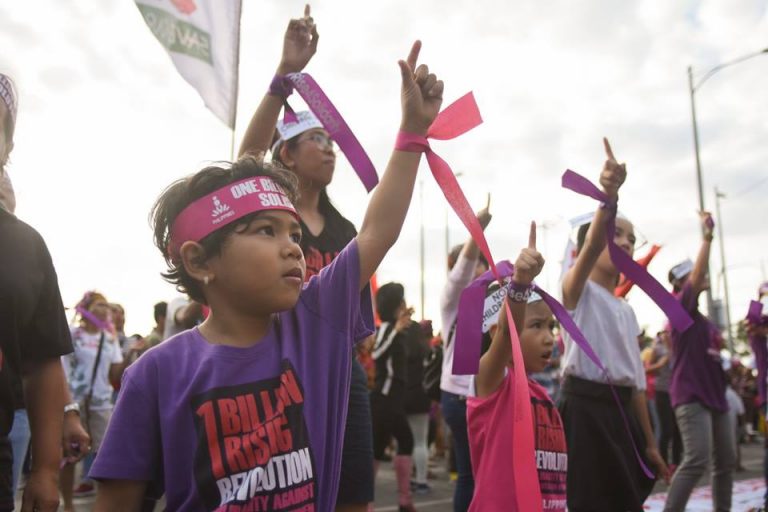
One Billion Rising (Photo by Carlo Manalansan / Bulatlat.com)

By JANESS ANN J. ELLAO
Bulatlat.com

MANILA — Now on its seventh year, Filipino women’s rights advocates once again took the streets of Manila to dance and protest the misogyny and rising tyranny in the country.

“We gather today, not just to dance as part of the successful OBR (One Billion Rising) global campaign to raise awareness and to stop violence against women, but also to show solidarity with women from all around the world who, in their own country are rising and raging against all forms of violence, especially those perpetrated by the state,” said Joms Salvador, women’s group Gabriela secretary general.

One Billion Rising (OBR) is an annual event that aims to raise awareness and rise above the exploitation and assaults to women and their rights.

President Rodrigo Duterte continues to be unpopular women’s rights advocates with his rape jokes and other misogynistic statements. In her solidarity speech today at the Rajah Sulayman Park, nun and rights advocate Sr. Mary John Mananzan said she has had enough of this “vulgar” and “bad-mouthed” president.

This week, several schools and organizations “rose” to drumbeat today’s gathering. Among those who earlier “rose” as part of the OBR campaign are church people led by the Ecumenical Women’s Forum and the National Council of Churches in the Philippines.

“As women of faith, we will continue to affirm life by defending it, crying and calling out the many attacks that are being experienced by our people. We do it by shaking (resisting) the systemic curtailment of the rights of the women, and the rest of the poor majority. This is our solidarious act to the most vulnerable sectors of our communities,” said Minnie Anne Mata-Calub, NCCP acting general secretary.

Rape cases, attacks vs. people’s rights

One Billion Rising (Photo by Carlo Manalansan / Bulatlat.com

In a statement, Center for Women’s Resources said the attacks against women have not only continued but has also worsened.

According to the think-tank, 20 women are being raped per day, citing police reports from January to May 2018 with 2,962 cases of rape in the country.

They also noted that 45 of the 540 political prisoners are women.

“We condemn the audacity of this government to commit these grave abuses and get away unpunished. The culture of impunity has transformed into its worst form under this administration as the rich and powerful continue to get away with plunder, murder, and corruption,” the CWR said in a statement.

Manila bay reclamation

The OBR also assailed the planned rehabilitation and reclamation of the Manila Bay, concluding the program with a human chain along Roxas Boulevard.

Many grassroots and environmental organizations have been calling out the government for its impact on the environment and the displacement of urban poor families.

Salvador said these policies are masked as ‘development projects’ to deceive people into agreement and to vilify those who oppose such projects. She said that many studies conducted by experts conclude that such ‘developmental projects’ do not actually benefit the people and the environment.

One Billion Rising (Photo by Carlo Manalansan / Bulatlat.com

While in human chain, OBR protesters lit their candles as they sang “I Am Rising.” (http://bulatlat.com)

The post Filipinos rise vs. misogyny, tyranny appeared first on Bulatlat.

4 soldiers killed after NPAs seized firearms, raided military camp in Bukidnon

0

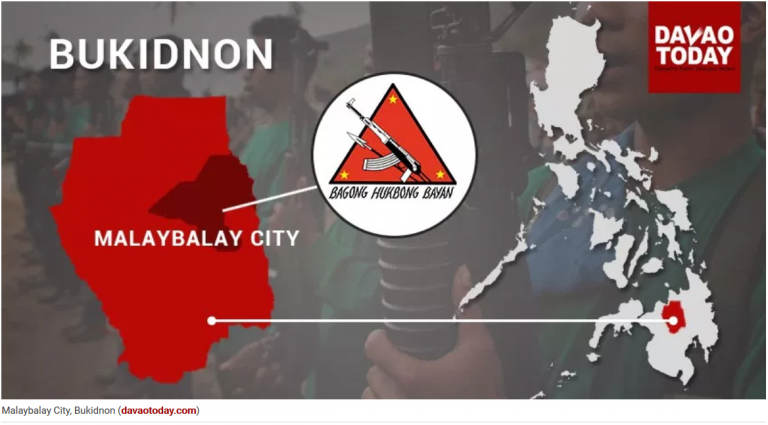
DAVAO CITY, Philippines — Four soldiers were killed after communist rebels in Bukidnon successfully took over a paramilitary camp of the Army’s 1st Special Forces Civilian Active Auxiliary Patrol Base located in Green Valley, Barangay Dalwangan, Malaybalay City on Thursday, February 14.

Ka Malem Mabini, spokesperson of the New People’s Army in Northern Mindanao, said that communist rebels raided the military detachment on Thursday at around 9:00 p.m.

The communist rebels seized 7 firearms and ammunition including 1 M203, 3 BB M16, 1 M16 long, 1 M14, and 1 Garan. Four soldiers were killed while three NPA guerillas were wounded in Valentine’s Day attack, according to Mabini.

“In this military action, it was confirmed that two officers of the Special Forces were killed-in-action while one soldier was wounded-in-action. The Red armies also seized seven (7) different high-powered rifles from the soldiers,” Mabini said. (davaotoday.com)

The post 4 soldiers killed after NPAs seized firearms, raided military camp in Bukidnon appeared first on Bulatlat.