Health officials in Davao region reported that the number of measles cases this year has decreased compared to the same period last year.
Duterte is PH’s ‘chief political agent of landlords, big corporations’ – Joma Sison
President Rodrigo Duterte is the “chief political agent and hatchet man of the landlords and the agri-corporations not only in Davao but in the entire country.”
Election watchdog tells bets: Stop using gov’t funds, resources to woe votes
Political hopefuls should stop using government funds and resources to woe votes, a poll watchdog said on Tuesday as the campaign period for senators and party-list groups officially started today, February 12 with political bets on a campaign trail to woe votes from voters across the country.
Groups blast military for ‘illegally’ detaining 2 women HR workers
A militant human rights group on Monday lambasted the Armed Forces of the Philippines (AFP) for allegedly detaining two women who were human rights workers in Cagayan de Oro City, in what they described as a sweeping crackdown against groups critical to the Duterte administration.
Include Sumifru workers’ woes in Japanese official’s agenda, Duterte told
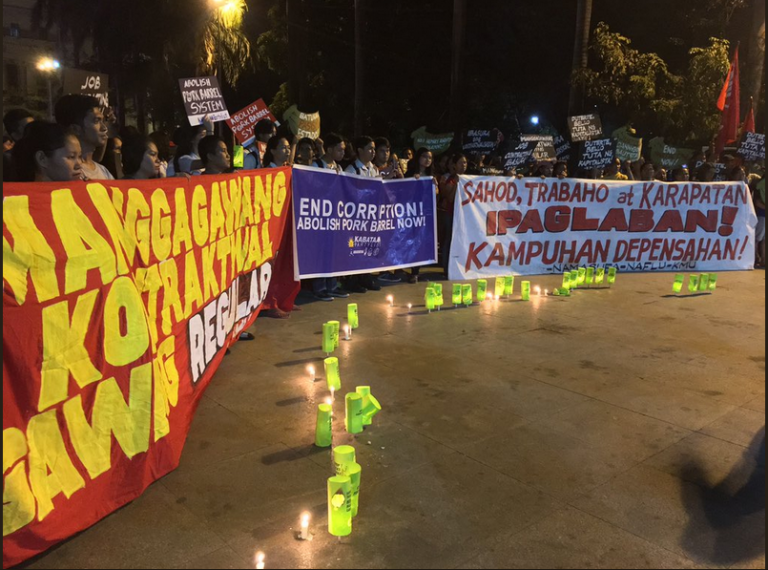
candlelight vigil Friday night (Feb. 8) to defend the workers’ camp in Liwasang Bonifacio
against demolition threats from city government of Manila. (Contributed Photo / Bulatlat)
MANILA – A non-government organization serving the Filipino workers urged the Duterte administration to raise the issue of Sumifru workers to the visiting top diplomat of Japan.
Japanese Foreign Minister Taro Kono made a courtesy call to President Rodrigo Duterte in Davao last Saturday, February 9. The Japanese diplomat’s official three-day visit (from February 9 to 11) had been scheduled on the sidelines of the Association of Southeast Asian Nations (ASEAN) Foreign Ministers’ Meeting (AMM) and Related Meetings held at the Philippine International Convention Center in Pasay City on August 8, 2017.
During Kono’s visit in the Philippines he attended to the inauguration ceremony of the Japanese Consulate General in Davao. But absent in the list of his concerns in this visit was the issue of the striking workers of the Japanese company Sumifru (Sumitomo Fruits).
When this three-day visit was scheduled, his agenda as announced included Japan’s support in the Philippines’ fight against terrorism in Mindanao, Japanese assistance on infrastructure development, measures against illegal drugs, public safety and counter-terrorism, and other matters concerning the Korean peninsula.
“Minister Kono affirmed Japan’s support for peace and stability in region, but was silent on the labor rights violations, red-tagging, violent dispersals and murder of banana plantation worker Danny Boy Bautista in connection with Japanese multinational company, Sumifru Corporation,” said Rochelle Porras, Executive Director of labor NGO EILER, Inc.
The labor NGO lamented Kono’s silence on Sumifru Corporation’s “serious damages to workers’ communities” in Mindanao and his visit’s “palpable lack of empathy” with the case of Nagkahiusang Mamumo sa Suyapa Farm (NAMASUFA) workers union.
As of this writing the Namasufa union members are holding a peaceful campout at Liwasang Bonifacio. They went on strike late last year, but their picketline in Compostela Valley was violently demolished, the residence of their union officers and their union office ransacked and some were burned down.
The labor NGO emphasized that the right to strike is a fundamental human and trade union right protected by laws and international conventions particularly ILO Conventions 87 and 98 both ratified by the Philippines in 1953, and Japan in 1965 and 1953 respectively.
The workers’ union in Sumifru has protested the Japanese fruit giant’s treatment of workers, the extensive contractualization, and the way martial law in Mindanao is being used to crush legitimate workers’ protests and strikes. Prior to the violent demolition of their October 2018 strike, the Sumifru workers had launched victorious strikes. The giant Japanese company has a record of union-busting attempts which the workers said are meant to allow it to continue its profitable use of low-paid contractuals.
Bringing the issue of their current strike in Manila, where there is no declared martial law, they continue to receive threats from the city government about demolishing their campout. The Manila city government eventually relented and allowed the campout in Liwasang Bonifacio up to February 25.
“President Duterte and Minister Kono did not discuss the accountability of both governments, DOLE, Davao region LGUs and Sumifru Corporation in recognizing the collective bargaining and trade union rights of Sumifru workers. Worse, they turn a blind eye on human rights violations in the business operations of the exporting giant,” Rochelle Porras said.
The Sumifru workers launched a strike to demand their regularization on the job and living wages.
“Minister Kono said that Japan supports efforts to revitalize economic activities in the region. He should also underscore the protection of the workers, who are the life and driving force of the region’s economy,” Porras said.
Sumifru Corporation controls 30 percent of the banana supply in Japan. EILER said that steady supply of bananas would not have been possible without the blood and sweat of more than 18,100 Filipino workers producing 19,000 boxes of banana daily.
Sumifru reportedly earns P19 million gross daily income but it pays its workers only P365 per day, an amount that is not even close to the company’s capacity nor to the amount needed for a family of five to live decently.
The post Include Sumifru workers’ woes in Japanese official’s agenda, Duterte told appeared first on Bulatlat.
Solon tells NBI to dismantle ‘Kapa’ scam
A lawmaker has called on the National Bureau of Investigation (NBI) to step up efforts in dismantling the operations of KAPA Community Ministry International, Inc that is involved in what he termed as “large-scale investment fraud” in key cities in Mindanao, luring investors with a promise of bigger earnings.
Poverty, lack of health services account for measles outbreak – health group
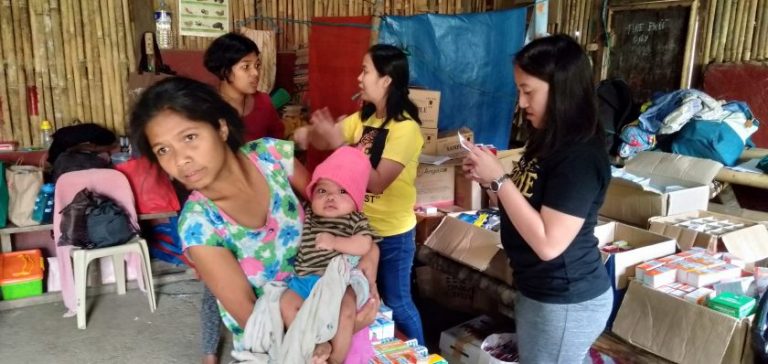
Still, P14 billion has been slashed from the 2019 budget of the Department of Health, its secretary Francisco Duque confirmed in news reports.
By JANESS ANN J. ELLAO
Bulatlat.com
MANILA — 60 children dead in one hospital alone.
This is the current situation now as the measles outbreak here in the Philippines continues to spread. But how did it come to this?
A group of health workers, the Coalition for People’s Right to Health, pointed out that the lack of health services in communities is “the more significant cause for the increasing cases of measles.”
In fact, data from the Department of Health revealed that the percentage of fully immunized children has been below 70 percent over the past few years, a far cry from its 95 percent target “needed to assure herd immunity, or the protection of society against these communicable illnesses,” said the Coalition for People’s Right to Health in a statement.
Gloria Arellano of Kadamay told Bulatlat that the poor will be affected the most, given the lack of social services they are receiving. This, she added, should serve as a wake up call to provide much-needed services.
Still, P14 billion has been slashed from the 2019 budget of the Department of Health, its secretary Francisco Duque confirmed in news reports.
Plight of IPs
The Coalition for People’s Right to Health also called on the attention of government officials to communities of indigenous peoples who are long deprived of social services. They pointed out that Dumagat communities in Tanay, Rizal and General Nakar, Quezon reported increased cases of measles last year.
“Although parents from these indigenous people communities wanted to have their children vaccinated and access health services as soon as they become sick, the reality is that the health workers only visit once or twice a year,” said Dr. Joshua L. San Pedro, CPRH co-convener.
Piya Malayao of tribal group Katribu told Bulatlat that at least 50 were documented dead in 2018 among the Dumagats and Blaans, indigenous peoples group residing in the provinces of Rizal and Sarangani, respectively. Among those dead, she added, are aged 0 to 16.
She said the lack of social services provided to tribal communities is worsened with the intensifying threats and harassments they are being subjected to as they continue to defend their ancestral lands. .
San Pedro said, “we know that Dengvaxia is but one of the many failings of the government in providing for the people’s health. Therefore, we have to look at the broader situation while also seeking accountability for such failings.”
Dengvaxia scare
It did not help, critics said, that the Sanofi’s brouhaha was turned into an apparent mass hysteria when the Public Attorney’s Office chief Persida Acosta led autopsies of children who supposedly died due to the dengue vaccine.
A television news report recently aired a health worker assuring residents that the vaccines they are giving out are “not Dengvaxia.” While there were parents who agreed, there were still some who refused to have their children vaccinated for measles.
“While it cannot be denied that deaths attributed to Dengvaxia sowed fear among parents and children and made them wary of other vaccines, the absence or lack of health workers and services in many of our communities still account among the main reasons why preventable and curable diseases like measles continue to increase,” said San Pedro. (bulatlat.com)
The post Poverty, lack of health services account for measles outbreak – health group appeared first on Bulatlat.