Children and advocates to protest Martial Law and proposed extension on Children’s Day
Save our Schools Network (SOS) held a press conference in the College of Education, University of the Philippines in Quezon City on November 15 to protest the ongoing Martial law in Mindanao and any proposals for a third extension as the deadline at the end of 2018 draws near.
The group called on child’s rights advocates to join them to protest Martial Law in Mindanao on Universal Children’s Day celebration this November 20 in UP Diliman.
The group said direct attacks on children rights worsened especially in Mindanao due to the implementation of Martial Law and the president’s open threat to bomb lumad schools last year.
“Despite the fact that the Philippine government ratified UNCRC in 1990, children’s rights are continuously violated and neglected especially under the current government,” said Rius Valle, SOS spokesperson.
According to the United Nation (UN), November 20 is an important date in 1959 when the UN General Assembly adopted the Declaration of the Rights of the Child. Also, in 1989, the UN General Assembly adopted the Convention on the Rights of the Child.
“Children from different sectors suffer from worsening poverty, child labor, child trafficking and became victims of Oplan Tokhang,” Valle said.
Valle also said that the Children’s Day Celebration, will not be happy for the children especially in Mindanao where the Martial law has been in force since May 2017.
In the press conference, Mayla Gantangan, 13 yrs old student of CLANS Lumad Community School said that President Duterte should respect their right to live and their right to education.
“Our families and communities are under threat because of Martial Law. The bombing in our school disrupt our education. We are displaced from our own land because of the military operation,” Gantangan added.
Martial law extension threat to children, human rights violations
SOS Network strongly oppose the possible extension of Martial Law in Mindanao for 2019 that they say will cause more human rights violations against the Lumad.
Gantangan said they do not want another Martial Law extension in their communities so they can return to cultivate their own lands and to continue their education.
Based on the group’s records, 535 cases of attacks on Lumad schools were registered since the Martial law was declared last 2017. This has affected 2,460 Lumad students, teachers and parents.
“These cases refute the statement of Interior Secretary Eduardo Año that there are no abuses by the military and police during Martial Law in Mindanao,” Valle added.
The group also reiterated the killings of two Lumad students and eight members of parent-teachers-community associations (PTCA) of schools.
Added to this were the 111 cases of trumped up charges and illegal arrest of teachers and PTCA members and the 2,400 cases of Lumad students and teachers being forced by the Armed Forces of the Philippines (AFP) to surrender as members of the New Peoples’ Army.
“These communities and schools have been attacked by AFP and paramilitary on the basis of Martial Law. They have suffered unfounded claims of red tagging these schools as communist fronts. This has deprived children and Lumad of their rights and freedoms,” Valled said.
Valle said the motive of extending Martial Law is not peace and order, but pacifying and clearing out communities for the expansion of large scale mining and agri-plantations in Mindanao.
“President Duterte is pushing for business over services, foreigners over the Filipino and Lumad. We should not blindly accept these lies and fake scenario of building peace. We should resist another Martial Law extension and push for the restoration of peace for the Lumad communities,” he said.
The post Children and advocates to protest Martial Law and proposed extension on Children’s Day appeared first on Manila Today.
P25 wage increase, abuse and cruel deed
From the present P512 minimum wage rate in the National Capital Region (NCR), the Regional Tripartite Wages and Productivity Board-National Capital Region (RTWPB-NCR) approved an additional P25 to increase the wage to P 537.
The P25 wage increase is an abuse of authority and a cruel deed of the oppressors against the workers in the NCR and even nationwide. What would a person buy or spend with P25 pesos?
Ibon foundation says the cost of living for a family of six amounts to P1,168. This only includes expenses on basic needs and does not cover education, health, housing, etc. Given the P537 wage in NCR (the highest in the country), if there are two workers in a family receiving the law-mandated minimum wage will find it hard to make ends meet. The sadder truth behind the low minimum wage in the country is that 80% of workers in Metro Manila are contractual, and contractual workers receive lower than the minimum wage that should be received by regular workers and possibly no benefits.
How much a worker ought to receive a day for a living? The Kilusang Mayo Uno calls for a wage increase of P750 wage increase across the board nationwide, a freeze on oil prices, and a uniform minimum wage nationwide. The P 25 increase is inconsequential, especially as the government prepares for more tax increases in the following year. Increases of taxes mean increases also of the basic commodities and public service fees.
NCR National Wages and Productivity Commission (NWPC) Executive director Criselda Sy’s statement that “the wage board considered the points raised by both employers and employees” is mendacious.
What are “the points raised”? Who raise “the points”?
The workers had already attested that they are suffering from low wages and lack of benefits because of contructualization. The suffering of the workers had worsened because of the inflation rate and excessive taxes on basic commodities wrought about by the TRAIN Law, and now the fare increase.
The wage increase is “measly” or small according to Roman Catholic Bishops Honesto Ongtioco of Cubao and Broderick Pabillo of Manila. But the two bishops cannot also tell how much a worker ought to receive a day. It is positive that Bishop Ongtioco recognized that “ordinary workers deserve to receive more,” to “cover the cost of the rise of prices,” as Bishop Pabillo had asserted. They are still praying that the government will reconsider increasing worker’s wage. If the Duterte administration will listen to the prayers of the Bishops, then miracles are still working even today.
But how can a government that favors the employers will listen to the cry of the poor workers?
The Catholic Catechism on Labor defined Human dignity as:
“All of us enjoy an equal dignity for we are all created in the image of one God”
(Catechism of the Catholic Church, 1934).
“Factory workers, farm workers, jeepney drivers, tricycle drivers, vendors, all have equal dignity with business owners, land owners, managers, and government leaders. As human persons, whatever our work, we have ―rights and duties which are universal and inviolable… and must have ready access to all that is necessary for living a genuinely human life: for example, food, clothing, housing, … the right to education, and work…”
(Gaudium et Spes, 26).
The Duterte regime continues to fail to apply these social teachings. President Rodrigo Duterte continues to demonstrate that he has no moral authority to lead this country. He is already judged by the injustices, abuses and cruelties amid the suffering of the Filipino people.
The post P25 wage increase, abuse and cruel deed appeared first on Manila Today.
Youth and artist groups use art to assail decision to remove Filipino language in college curriculum
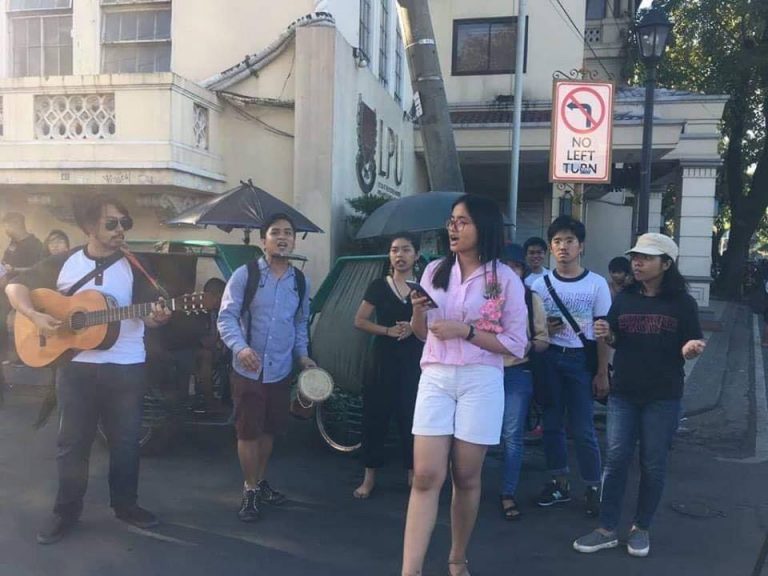
“Ang sariling wika ang magpapalaya sa gapos ng tanikala,” said regional cultural alliance Sining Bugkos and Kabataan Party-list Metro Manila in their cultural caravan that visited various universities in Metro Manila on Wednesday, November 14, to assail the recent Supreme Court decision.
The Supreme Court (SC) decision upheld the removal of Filipino and history subjects in the college curriculum as per stated in the Commission on Higher Education’s (CHED) memorandum order 20, Series of 2013.
Art as protest
The removal of Filipino language and history subjects in the college curriculum is a direct attack to the culture and education of the Filipino youth, according to youth group Kabataan Party-list Metro Manila.
“The Supreme Court’s decision to uphold CMO 20 series of 2013 manifests its inclination to uphold the colonial orientation of the current system of education. It is an utter disregard to our culture and sends out a message that indicates that our country would rather focus on prioritizing other languages than nurture our own,” said the group’s regional spokesperson Pat Cierva.
A cultural caravan geared to protest the impending implementation of the memorandum order, WIKAravan, was launched today in various universities. The caravan visited University of the Philippines Manila, Mapua University, and Far Eastern University.
Sining Bugkos said they hoped to impart a message on the importance of language and culture as a weapon for continued struggle and resistance.
Drastic implications
In a statement, youth writers’ group Liga ng Kabataang Propagandista (LKP), a group affiliated with Sining Bugkos, blasted the SC decision, citing that “the decision is traitorous and geared to favor only the State and foreign investors.”
“Wika ang pangunahing salamin at pagkakakilanlan ng kultura ng bawat lahi. Walang anumang wika ang makapagpapa-unlad sa ating bayan kundi ang sarili nitong wika. Dapat hubugin at linangin ang kaalamang makabayan at magpakadalubhasa sa ating wika at gamitin ito sa paglinang sa ating isipan para ikauunlad ng bayan,” LKP stated.
(“Language serves as a primary reflection and identity of the culture of the people. There is no other language which could develop our country besides our own native tongue. As such, it must be molded and enrich patriotism. We must be skilled in our own language and use it to nourish our minds for the development of our own nation.”)
“Bukod dito, hindi lamang ang mga estudyante ng hinaharap ang makararanas ng pait sa desisyong ito kundi maging ang mga guro sa kasalukuyan na nangangambang mawalan ng hanap-buhay dahil dito. Ang pagtindig ng Korte Suprema sa CHED MEMO 20 ay pagkitil nito sa ating pakakakilanlan. Tinanggalan tayo ng ating kultura at pilit isinusubo sa ating mga bibig ang wika ng ibang bayan,” LKP continued.
(“Students are not the only casualties in this decision for it will also affect the educators who are on the brink of losing their source of livelihood. SC’s stance on CHED Memo 20 is killing our identity. It eradicates our culture and forces us to imbibe the language of other countries.”)
Teachers’ protest
Meanwhile, according to Tanggol Wika, the alliance of educators and advocates of the Filipino language who filed the Temporary Restraining Order (TRO) on CMO 20 in 2015, manifested that 10,000 teachers were bound to lose their jobs or face reduced teaching loads due to the decision, a sentiment that is shared by the youth and cultural groups behind WIKAravan.
“The youth, along with the cultural workers, the educators, and the larger groups of masses shall continue to wage campaigns to drumbeat this issue. We will not be silenced by this attempt to further bastardize our education and our future. We shall continue to unite with other people who share our causes. This decision, a product of our colonial education, will only serve as our fuel to advocate for an education that is nationalist, scientific, and mass-oriented. One that is geared to develop the nation and not to paralyze it into submission to other dominant foreign countries.” Cierva ended.
The post Youth and artist groups use art to assail decision to remove Filipino language in college curriculum appeared first on Manila Today.
PH is world’s top 2 rice importer next to China
NEWS RELEASE | November 15, 2018
Approval of rice tariffication ‘terrifies’ farmers
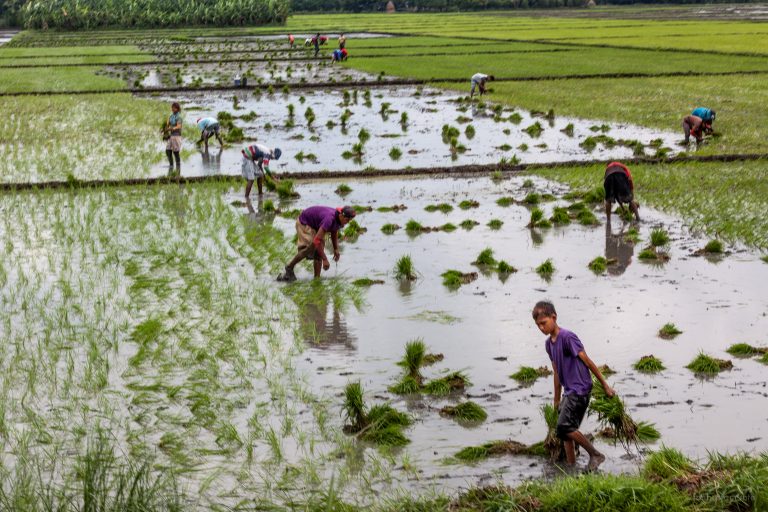
The Kilusang Magbubukid ng Pilipinas (KMP) today lambasted the Senate of the Philippines’ approval on third and final reading of the rice tariffication bill or Senate Bill 1998 that would impose tariffication on 35 to 50% tariff on rice imports in lieu of quantitative restrictions. “Next to China, the Philippines is now the world’s top 2 rice importer. Rice tariffication is the end of local rice industry as we know it, unless we fight and take the power back into the hands of farmers and food producers.”
“Despite the strong opposition of rice farmers and stakeholders in the local rice industry and agriculture, the government still signed the death warrant of the Philippine rice industry that is the rice tariffication proposal. We mourn for the Philippine rice industry, the millions of Filipino rice farmers and rice consumers that will face a mountain load of burden with the ultimate approval and implementation of rice tariffication,” says Danilo Ramos, chairperson of KMP.
“This government indeed has no regard for its people. Instead of improving and giving full support to the local rice industry and Filipino food producers, the government continue to allow the massive, unabated and unregulated importation of chemical and pesticides-laden rice imports from Thailand, Vietnam, India and other rice exporting countries. Rice tariffication will slowly kill us all. Pakakainin tayo ng gobyerno ng napakamahal na imported bigas na puno ng lason at mga kemikal,” Ramos said.
“Contrary to the government’s deceptive justification of the rice tariffication policy, imported rice supply is not necessarily cheap and safe. The expected tariffied landed cost of imported rice amounting to P36 per kilo will only be slightly lower than the prevailing local rice prices. However, if the global prices reach US$600 per metric ton, the tariffied landed cost would be P43 per kilo not including the hauling and transportation charges that will be added by traders and passed on consumers.
Take the power back through collective and organic farming
“Without state subsidy and support, Filipino rice producers stand no chance from cheap rice imports. The only way to fight back this government-sponsored rice tariffication and importation is through the strengthening of farmers’ organizations that will launch collective and organic farming activities,” Ramos said.
“Farmers must build and consolidate efforts, strengthen local peasant organizations and launch more collective farming that supports sustainable agriculture and organic rice production. We must assert Bungkalan, consolidate, defend and expand the scope of collective land cultivations. There are more than 2,000 traditional and farmer-bred rice varieties that do not need chemical-based fertilizers and pesticides from foreign agrocorporations. The production of hybrid rice that uses high-level of fertilizers and pesticides through the Green Revolution in the 1960s increased the cost of palay production and buried rice farmers in debt. It is high time that farmers do away with that vicious cycle,” the KMP leader said.
Imported rice are low quality, full of chemicals
“The rice imports being dumped into the Philippines by Vietnam traders are high-yielding but low quality, broken rice that was produced with more fertilizers and pesticides than the allowed levels. Such rice imports from Vietnam failed to meet international standards and were actually rejected by more demanding markets like China, US and EU but were accepted by ‘easy markets’ like the Philippines. By the end of 2018, Vietnam rice imports to PH will reach an estimate of 800,000 MT according to the Vietnamese Food Association. ###
Reference: KMP Chairperson Danilo Ramos, 0933-4646963
Statements of Bärbel Kofler, Jean Asselborn and Romain Schneider on the killing of Atty. Ben Ramos
Dear friends,
We are sharing with you the statement of Barbel Kofler, German Federal Government Commissioner for Human Rights and Policy and Humanitarian Aid, and that of Luxembourg ministers Jean Asselborn, Minister of Foreign Affairs, and Romain Schneider, Minister for Development Cooperation and Humanitarian Affairs, on the killing of Atty. Benjamin “Ben” Ramos.