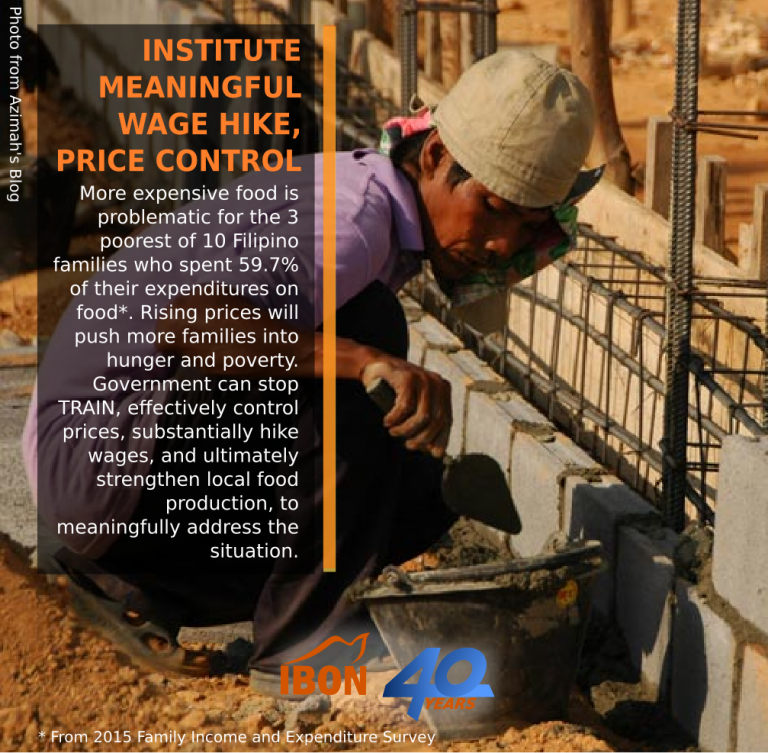
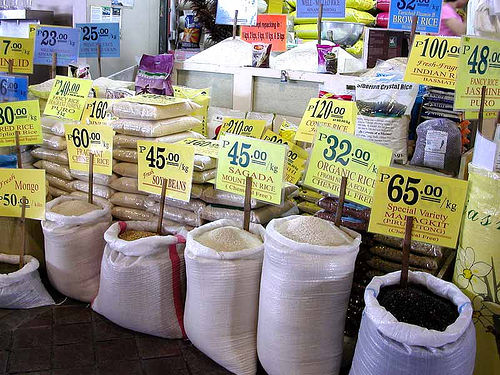
Accelerating inflation is becoming worrisome for tens of millions of low-income Filipino families. Since the Tax Reform for Acceleration and Inclusion (TRAIN) kicked off early this year, the prices of goods and services have climbed incessantly. Rice inflation itself accelerated from just 1.5% in the beginning of 2018 to a 5% high in July. Inflation during the first half of 2018 has made 60 million poorest Filipinos – including farmers and fisherfolk – in deeper poverty.
Purportedly to lower the price of rice with high supply through unlimited importation, the Duterte administration’s economic managers recommended the passage of the Rice Tariffication law. The legislation stipulates pushing up farm productivity with tariff revenues, projected to be Php20 billion after six years, to be channelled to the Rice Competitiveness Enhancement Fund (RCEF).
It turns out however that rice tariffication will not necessarily bring the price of rice down. The Philippine government is not on top of rice production, pricing and even importation – and has not ensured rice price stability for many years. Consistent with its commitment to the World Trade Organization (WTO), the government has taken its hands off rice production and pricing, and is geared to import unlimited rice with tariffs, thus relying on an external and volatile world market for rice supply.
Rice imported at the current rate of US$400 per metric ton (MT) or Php21.2/ kilo with 35% tax costs around Php29/ kilo. Add to this the NFA,’s Php4.00 overhead and the new rice price of Php33/ kilo would indeed be lower than the dominant retail price of Php40 per kilo.
The final price of rice is however not as simply determined. Rice price hikes loom despite rice tariffication due to the following:
1) Global market prices are volatile and can affect the stability of local rice prices. The price of rice in the global market has been unsteady for the past three decades, with spikes not returning to previous levels. Should the landed cost reach US$500/MT, the Php36/kilo tariffied landed cost will only be slightly less than the dominant local price. Should the global price become US$600/MT, the new tariffied landed cost Php43 will have exceeded the dominant local price. These computations do not yet include hauling charges added on by traders. Trends have it that the price oimported rice may no longer go lower than the current US$400.
Should the country totally rely on importation, per direction of global trade agreements, global prices will likely pull the local price up. This could be further affected by peso depreciation which also influences the cost of importation.
Global rice supply is also unsteady. Note that only six percent of global rice production is sold in the world market, while 94% is consumed by the producing countries. Rice-exporting countries, meanwhile, occasionally issue export bans to ensure their local supply. Government chooses to rely on this volatile market forthe Filipino staple.
Additionally, rice prices have continued to rise amid importation. For example, the country has been importing an annual average of 1.8 million MT of rice for three years prior to the unprecedented Php7.99/kilo rice price spike in 2008. From 2008-2010, the country imported an annual average of 2.2 million MT, but the price of rice continued to increase on an annual average of Php1.20 until 2016.
2) Government has no control over the price of imported rice when sold at the local market. For the past three decades, the local price of rice did not always follow the movement of the global price of rice. The price of rice in the world market was generally falling from 2008 until 2012, but local prices generally increased. This shows that local pricing of rice has its own dynamics that government has no control over.
3) Government has no control over the prices of goods and services in general. The Duterte administration has even imposed TRAIN, which added excise and value added tax to each liter of oil, particularly diesel. The latter is particularly vital in producing, processing and transporting rice. Diesel price hikes translate to rice price increase.
The NFA is supposed to stabilize the price of rice by procuring at least 10% of local palay production. But its procurement price of Php17/ kilo has not increased since 2007. Because of deregulation, the government has also not increased subsidies for the NFA. Worse, the agency relied on imported rice to ensure a rice buffer stock instead of procuring from local farmers. The Commission on Audit (COA) reports that the NFA accomplished only 18.6% of its target in 2017 and instead diverted its Php5.1 billion Food Security Program budget to pay maturing debts.
Under the WTO, government has clipped NFA’s role in regulating the price of rice and demoted it to simply monitoring private sector importation, or even importing on behalf of private traders. From 2009-2012, the NFA lent its tax exemption subsidy to private importers, which led to a Php12-billion revenue loss supposedly from tariffs.
4) Government has no control or means of policing rice cartels, which control rice trade. Without specific government rules and regulations to curb them, rice cartels control 45% of procurement and 85% of sales and distribution. These primarily dictate the peculiar dynamics of local rice pricing, including that of marketing cost and milling cost. Traders are able to impose a large overhead on farm input and high interest on farmers’ credit. Yet they can procure farmers’ products at very cheap rates then impose high marketing cost.
Dark clouds hang over rice supply. Rice tariffication will result in complete liberalization such that the NFA will lose any capacity to maintain the buffer stock. As long as imported rice is cheap, traders will be active. But should there be global rice spikes or rice shortages, the Philippine government will be compelled to order bilaterally with other countries. Without sufficient subsidy, government will be compelled to borrow.
The Philippines should not have to go through rice importation to ensure local supply and stabilize the price of rice. It can get out of unfair agreements such as the WTO and be sovereign in boosting an independent rice industry, which when strengthened can have the bargaining power in trading rice as necessary for the country. Government can earmark substantial allocation from the national budget for a long-term program that focuses on increasing agricultural production through swift and free land distribution and substantial agricultural support. This will not only raise farmers’ and farmeworkers’ incomes, but yield more stable and affordable rice prices. To ensure producer and consumer protection, it will be important for government to institute efficient price setting and regulation.