Home Blog Page 538

Karapatan: Duterte’s statement on human rights during 3rd SONA reveals his ignorance

0

Karapatan chided Duterte in his speech referring to human rights issues during his 3rd State of the Nation as “mere rhetoric, meant to appease public outrage over rights violations.” 

“Duterte’s take on human rights vis-à-vis human lives just emphasized how oblivious he is on the subject. This is expected from someone infamous for rights violations and for enabling more butchers in the police and military. It baffles us how someone who backed and directed the killing of thousands of Filipinos can muster the audacity to claim that he’s fighting for human lives. He’s utterly shameless,” said Karapatan Secretary General Cristina Palabay. 

read more

FULL TEXT | 2018 State of the Nation Address of President Rodrigo Duterte

0

State of the Nation Address of President Rodrigo Duterte delivered at the Session Hall of the House of Representatives, Batasang Pambansa Complex, Quezon City on July 24, 2018

Group refutes government’s defense of TRAIN

0

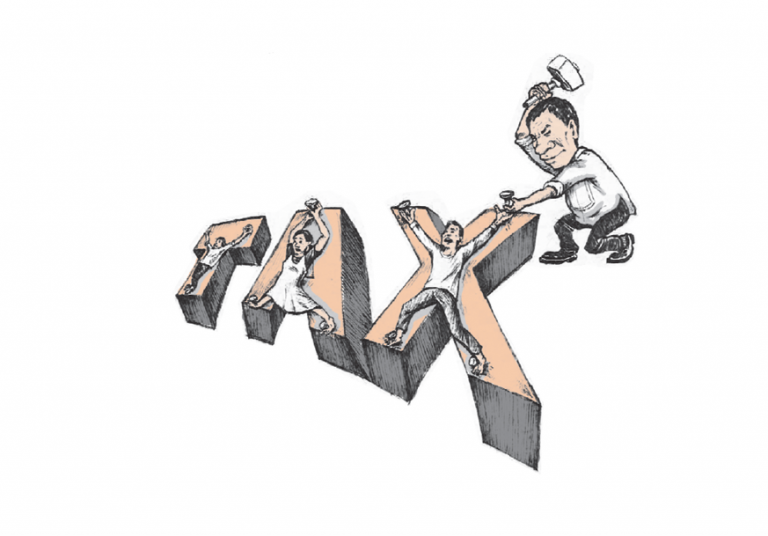
In a consumer forum held in anticipation of the third State of the Nation Address, research group IBON debunked the Duterte administration’s avid defense of the Tax Reform for Acceleration and Inclusion (TRAIN) Law. The group said that contrary to government’s pronouncements, the tax program is not beneficial to the poor majority of Filipinos and should be halted.

Government’s economic managers have repeatedly boasted that TRAIN puts more money in people’s pockets. The economic managers insist that TRAIN’s impact on inflation is negligible and that the poor are even further protected by TRAIN’s unconditional cash transfers (UCT). TRAIN also purportedly funds infrastructure projects and social mitigating measures that will benefit the people.

“On the contrary,” IBON executive director Sonny Africa said, “TRAIN only puts more money in the pockets of at most 5.5 million Filipino families gaining from the law’s personal income tax cuts. The country’s poorest 17.2 million households do not benefit from lower personal income taxes but all pay higher consumer taxes. This means less money in the pockets of the poorest 8 out of 10 Filipinos (76%).”

“The provision of the temporary UCT is actually an admission of TRAIN’s impact on the poor”, said Africa, “and its benefits should not be overstated because the UCT will end in 2020 yet the higher prices due to TRAIN will remain and continue to burden the poor.” As it is, over six months into TRAIN’s implementation, the Department of Finance (DOF) can only report 3.8 million out of the l0 million poor families targeted having been reached. Africa added: “The temporary UCTs are in stark contrast with the personal income tax cuts on higher income groups which not only remain but become even bigger in 2023.”

While noting that changes in global oil prices and foreign exchange impact on inflation, Africa pointed out that the Duterte administration cannot pretend that these are unexpected because global oil prices have been steadily rising since 2016 and the peso has been steadily depreciating for even longer since 2013. “The Duterte administration and its economic managers were grossly insensitive in pushing the TRAIN Law despite these trends and are thus directly accountable for the TRAIN-driven price increases of commodities,” he stressed. “Government’s imposition of consumption taxes, including excise taxes on oil and sweetened beverages, greatly aggravated the current inflation,” Africa said.

Africa also pointed out that while the TRAIN law lists transport and military infrastructure, sports facilities and potable drinking water supply to be funded by TRAIN, official records show that 94% of the value of government’s 75 flagship projects under the Build, Build, Build program are transport-related. Of these, 52.1% are railways, 27.3% are bridges and roads, 8% are airports, 5.2% are mass transit, and 1.6% are seaports. “These big-ticket projects are lucrative endeavors that will profit big-time firms,” said Africa.

The growing clamor against the TRAIN law because of the onslaught of rising prices of basic goods and commodities shows that consumers are not buying the government’s repeated hype about TRAIN, Africa said.

“TRAIN’s Package One is the government’s first big step towards creating a regressive tax system that is biased for the rich while heavily burdening the poor. It will be followed by Package Two which reduces the corporate income tax in the same way that Package One reduced the personal income tax. These clearly illustrate how biased the Duterte administration’s programs are against the poor,” Africa concluded. ###
Media groups reject media regulation

0
Media groups reject a proposal to regulate mass media through a so-called Magna Carta for journalists, as announced by a Malacañan official Friday. The National Union of Journalists of the Philippines (NUJP), the College Editors’ Guild of the Philippines (CEGP) and the Philippine Press Institute (PPI) rejected outright the proposal of the Presidential Task Force […]

‘Mas maraming human rights violation’

0
“Sa pagtalikod ni Duterte sa usapang pangkapayapaan sa CPP at NDF ay mas lalong nagkakaroon ng kalayaan ang mga State Security Forces para magkomit ng samu’t-saring human rights violation.”—Joms Salvador, Secretary General, Gabriela

Political prisoners to Duterte: Those in power are the real criminals, terrorists

0
On Duterte’s 3rd State of the Nation Address (SONA), political prisoners (PPs) from various jails across the country joined their voices to call for justice and demand accountability for the crimes and rights violations perpetrated by the Duterte regime.
As of June 2018, Karapatan documented 509 political prisoners in the country. Of this number, 179 were arrested under Duterte, 118 are sickly, 46 are women, 39 are elderly, 5 are minors, and 6 are consultants of the National Democratic Front of the Philippines (NDFP). Most of the political detainees come from peasant and indigenous communities who were charged with trumped-up criminal charges.  

read more

On Duterte’s 3rd State of the Nation Address: Stop the attacks against the Filipino people!

0
“In line with its counterinsurgency program, the Duterte regime kills 2 per week and arrests 20 individuals in the same period – many of the victims are farmers and indigenous peoples. No doubt this figure will be whitewashed to give way to the administration’s conjured version of an imagined state of the nation. The reality of the country under Duterte is tainted with the blood and sufferings of the poor, denied of their rights and continuously being burdened by the government’s repressive and anti-people policies,” said Karapatan secretary general Cristina Palabay.

UGATLahi: Art in times of crisis

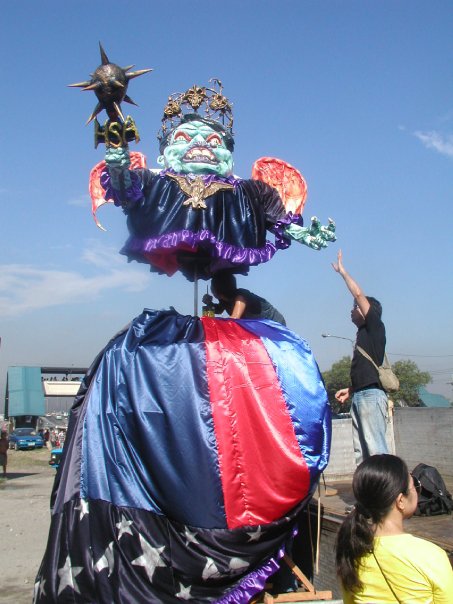
For the longest time, burning of effigies and other cultural performances have been initiated during the annual State of the Nation Address (SONA) demonstrations. Having garnered enough fame to be a most-awaited feature of every mobilization, UGATLahi Artist Collective or UGATLahi stood out with its highly publicized initiatives on producing protest effigies that consisted mostly of depictions of presidents and the political situation under their regimes.

UGATLahi, known for their Rody’s Cube and the Trump Fascist Spinner in the past year that became social media and online news fodder as netizens, local media and even international TV shows talked about and featured their creations. The group was formed as a cultural organization of artists seeking for social justice and social change. This organization has been at the forefront of forging artists unities for ‘art for the people’ and making artworks for SONA and other political events. They believe that it is necessary to change the society as a part of development of culture. The group started at the University of Santo Tomas in 1992.

The organization started making effigies in 1998.

Some of the previous works of UGATLahi

Gloria Manananggal, 2007

A depiction of Gloria Macapagal Arroyo as a mythcal blood-sucking monster witch resembled the president’s vampire-like greed for wealth.

Gloria Kapit-tuko, 2005

UGATLahi depicted President Macapagal Arroyo as “Gloriang Tuko”. This gigantic lizard clinging greedily at a replica of Malacañang Palace. The effigy stood 9 ft high and 15-ft long. This represented the voracious and relentless will of PGMA for power.

Erapzilla, 2000

While Godzilla was showing in cinemas, UGATLahi Artist Collective made one of its earliest effigies alike. During the peak of the protest against former President Joseph ‘ERAP’ Estrada, Erapzilla was created.

The making of an effigy

The burning of an effigy takes only a few minutes; the process of making one takes weeks.

It takes more than skill and passion to build a remarkable effigy that will bring forth the message. Patience, creativity, and teamwork will play a huge role on making this complex structure.

The making of an effigy starts with a concept and a theme.

I interviewed Max Santiago of UGATLahi to tell us more about their craftsmanship and this year’s effigy. According to him, they developed a concept in coordination with the Bagong Alyansang Makabayan (BAYAN).

The artists meet to brainstorm the image and then come up with studies. A final study will be chosen for the actual production.

Carpenters play a major role on building the intricate framework of the effigy. Mang Naldo is the group’s ever-reliable carpenter and has been recognized as an honorary UGATLahi member.

After the completion of the framework, painting and aesthetics will be taken care by the artists, giving it the finesse look that will make the message clear through the visual content implied by the effigy. The production of the effigy will take at least about a week to finish.

This year’s effigy is dubbed Dutertrain—a play on Duterte’s TRAIN Law policy that has been in the center of protests and the ire of the public. Visually, it is not only about the TRAIN Law, but also Duterte’s “three wars” – war on drugs, Martial Law in Mindanao and militarization in the countryside – as one tram will depict extrajudicial killings and fascism and the other the trampling of our sovereignty with US and China’s incursions in the country.

But why are effigies burned after every program?

According to Max, burning the effigies is a symbolic action for the hate and condemnation of protesters. Aside from tradition, burning of the images signifies the resolve of the people to put an end to an unjust regime.

It is important to hear at the end of this article the role of artists in the people’s struggle. Jaime Calma, head of this year’s effigy production for UGATLahi had this to say:

Through Ugatlahi, the skills and talents of every artists are used to emancipate the people from the dehumanizing chains of oppression in our society. They become instruments of social awareness and weapons against injustice in times of crisis. If you are interested to join UGATLahi, you can check their Facebook account for more details and see more of their artworks.

The Dutertrain will be seen at the United People’s SONA mobilization on July 23. Rally starts at the University Avenue of UP Diliman at 12nn.

The Dutertrain will be seen at the United People’s SONA mobilization on July 23. Rally starts at the University Avenue of UP Diliman at 12nn.

The post UGATLahi: Art in times of crisis appeared first on Manila Today.