Home Blog Page 563

#NutriAsiaWorkersStrike | All-around worker

Lagpas isang dekada nang manggagawa ng NutriAsia ang 40 anyos na si Benjie Nolasco.

Ngunit hanggang sa kasalukuyan ay nanatili pa rin siyang “casual worker” sa ilalim ng isang ahensya.

Pilit na pinagkakasya ng kanyang tatlong anak at asawa ang P 380 na kinikita niya sa loob ng walong oras bilang “all-around worker.”

Kung suswertehin naman daw at makapag-overtime ay nakauuwi sila ng mas malaki pa kaysa sa P380 ngunit madalas ay hindi rin nabibigay ang sahod para sa sobrang oras ng paggawa.

Isa sa nakapag-udyok sa kanyang makiisa sa protesta ay matapos ang tanggalan sa 70 manggagawang opisyal ng unyon at mga nakiisa sa ‘clap protest’ sa pabrika. Ang alam din ni Benjie, tinanggal ang mga manggagawa dahil nga sa pagbubuo nila ng unyon. Hindi man siya kasama sa mga tinanggal, ngunit ramdam niya na kailangan niyang kumilos.

Mula nang pumutok ang welga ay tatlong linggo na ring tigil ang produksyon sa loob ng pagawaan.

Nagkaisa ang mga manggagawa na wala na munang magtatrabaho upang madaling dinggin ng NutriAsia ang kanilang panawagan.

Para makaampat sa pangangailangan ng pamilya, nagtatrabaho muna siya sa junkshop sa umaga at pagsapit naman ng gabi ay nasa welga.

Sinabi rin ni Benjie hindi nila maaasahan ang kapulisan sa pagrespeto sa karapatan ng mga manggagawang magprotesta at si Pangulong Rodrigo Duterte sa kahilingan nilang gawing regular, dahil ang kapulisan at si Duterte ay parehong pumapanig sa interes ng kapitalista. Ang tanging inaasahan nilang makapagpapabago ng sistema sa pabrika ay ang kanilang pagkilos na ito.

Sabi pa niya, “Hindi kailangan paisa-isa ang reklamo dahil tinatanggal, dapat sama-sama. Laban pa uli!”

The post #NutriAsiaWorkersStrike | All-around worker appeared first on Manila Today.

Labor groups urge Duterte to prosecute erring employers and companies instead of ‘tambays’

Kilusang Mayo Uno (KMU) Metro Manila, Alyansa ng mga Manggagawa Laban sa Kontraktwalisayon (ALMA Kontraktwal) and Defend Job Philippines expressed their strong opposition against “Oplan Tambay” implemented by the Philippine National Police (PNP) during their press conference in Manila today. The group insisted that the said operations is a clear attack against the poor and the unemployed Filipinos.

The groups challenged President Rodrigo Duterte to prosecute employers and companies that are still practicing contractualization or endo (end of contract) schemes, instead of arresting tambays (loiterers or vagrants).

The group said the president must look into companies terminating workers in bulk to avoid recent Department of Labor and Employment (DOLE) orders to regularize them or to circumvent laws that require workers to be regularized.

KMU Metro Manila, ALMA Kontraktwal and Defend Job Philippines also demand justice for the death Genesis “Tisoy” Argoncillo, 22, from Quezon City who was believed to be the first casualty of the PNP’s anti-loitering operations nationwide. Instead of tambays getting killed, it is contractualization and joblessness that the government should arrest and kill, said the group.

“For the longest time, contractualization has proven itself to be the main reason for employers to hugely terminate its workers. Such dismissals have been the primary reason why numbers of tambays increased and unemployment rate in the country worsened,” said Ed Cubelo, KMU Metro Manila chairperson.

Cubelo added, “Instead of going after tambays, Duterte must fully realize its promise to end contractualization, higher wages, better working conditions to workers and immediately provide employment and livelihood to poor Filipinos. The government must stop pointing guns against the poor and unemployed.”


Worst country to work in

Labor unions facing struggles against massive terminations like Jollibee Foods Corporation (JFC), Pepsi Cola Philippines, Slord Development Corporation (makers of Uni Pak sardines), Liga ng mga Manggagawa sa Valenzuela City, Unioil Philippines, Jolly Plastics, Manila Harbour Centre and other workers’ groups joined the press con today.

The groups present agreed with findings of the International Trade Union Confederation (ITUC) that “the Philippines is one of the worst country to work in.”

Defend Job Philippines said thousands of workers have been displaced with employers trying to circumvent different Department of Labor and Employment (DOLE) compliance orders and even using Duterte’s Executive Order 51 on contractualization to avoid regularizing workers with the primary company they engage work for.

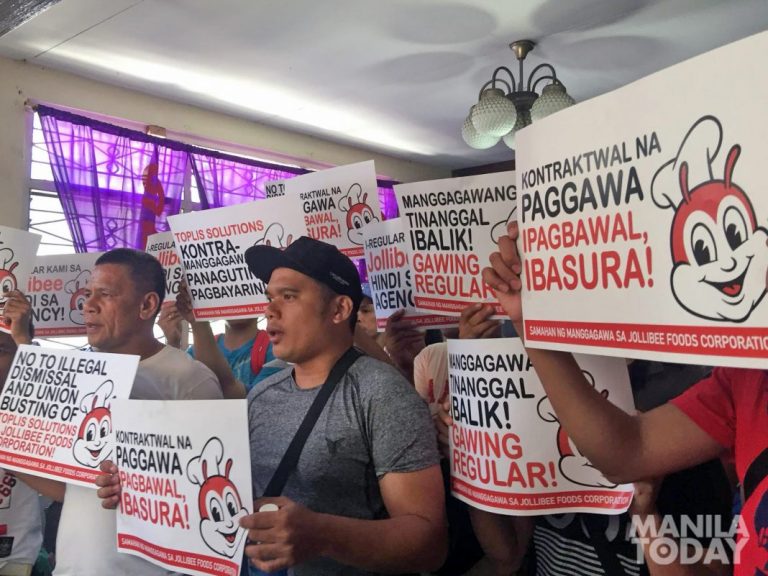
On June 18, JFC terminated its contracts with  Toplis Solution and Staff Search Asia Cooperative, two of its agencies in the main commissary and warehouse in Parañaque City, leaving hundreds of workers jobless. DOLE named JFC the top corporation engaged in illegal labor-only contracting and initially ordered JFC to regularize 6,482 workers.

“With the continuing refusal and disregard of JFC to the DOLE and its order, the fastfood giant management is clearly showing that it is not really serious in providing regular employment to its almost 29,000 contractual workers,” Rogelio Magistrado of Samahan ng Mangagawa sa JFC said.

Jollibee workers demand regularization. Photo by Kathy Yamzon.

Menawhile, Uni-Pak Sardines workers employed by Slord Development Corporation in Navotas Fish Port Complex said some 44 workers were dismissed last month following their efforts to demand regular employment and at least be given the P512 minimum wage in the National Capital Region. Uni-Pak workers have been receiving an average daily salary of P350 to P370 and have been serving the company for around three decades but have remained contractual up to their termination on May 11.

The dismissed workers started a month-long protest camp-out at the Navotas Fish Port Complex gate on June 19 to call for their management to increase their wages, reinstate them and regularize all its workers.

On June 2, workers from NutriAsia, Inc., condiments producer and distributor, launched their strike following the dismissal of the officers of the workers’ labor union and other workers who joined a ‘clap protest’ inside the factory, leaving 70 jobless. This was despite a February DOLE order to regularize 914 workers in NutriAsia’s Marilao, Bulacan plant.

On June 11, more than 1,000 contractual workers from the Pepsi-Cola Products Philippines, Inc. in Muntinlupa lost their jobs after the company implemented the long-delayed shutdown of its deep-well reserve. Dismissed contractual workers have been serving the company for as long as a few decades.

Labor groups vowed to continue the series of protests in various factories across the country in a lead-up to a big protest rally of workers near Malacañang Palace before Duterte’s third State of the Nation Address in July.

Maristel Garcia, spokesperson of ALMA Kontraktwal said, “We will not stop in holding series of mass actions in the days to come until he does nothing for the best interests of Filipino workers, unemployed and poor Filipinos.”

The post Labor groups urge Duterte to prosecute erring employers and companies instead of ‘tambays’ appeared first on Manila Today.

#LupangRamos | Minsan sa may sakahan

Hindi madali ang magdesisyon na tumungo sa isang lugar na sariwa pa ang mga basyo ng balang naiwan matapos ang isang karahasan.

Hindi lamang ulan ang ikinababahala ng bawat isa sa amin na bumagsak, nariyan din ang mga pangamba at bala. Mahirap lumusot sa pagkakaipit sa pagitan ng tutuloy pa ba o huwag na muna, ngunit hinila kami ng bawat sigaw ng mga magsasaka na: ang lupa ay buhay.

Sa tarangkahan pa lang sumalubong na sa amin ang mainit na pagbati ng mga nanay na magsasaka sa lupain. Ngingitian ka nila na para bang hindi mo mababakas ang ipinupukol na dahas sa kanila ng estado. Hinatid nila kami sa kubol na tinayo kasabay ng iisa ring layunin na matatag na tumindig sa kanilang laban.

Sumasabay sa buhos ng ulan ang tahimik na pag-iyak ng mga panawagang hindi dinidinig ng pamahalaan. Ramdam sa bawat patak ng ulan ang hikbi ng mga magsasakang hindi pa natutuyo ang luha sa mga pinagdaraanan nila.

Naglalaho lang ang mga ngiting nakapinta sa kanilang mga mukha sa tuwing kakausapin namin sila tungkol sa danas nila doon. Mayroong galit sa bawat sasabihin nilang pinagkakaitan sila ng karapatan. Mayroong lungkot sa tuwing isasalaysay ang mapait na karanasan sa kabila ng simpleng kahilingan na magkaroon ng lupa. Mayroon din namang pag-asa sa tuwing ibibigay namin ang pahayag ng suporta.

Hindi naman mahirap makiisa. Bagaman hindi mo danas ang danas nila’y hindi mahirap makita ang katwiran ng kanilang pinaglalaban—lalo kung ang pinag-uusapan na lang ay pagkain, bahay, buhay, kinabukasan. Walang anumang karangyaan o kaluwagan, pero ang mabuhay. Parang karangyaan pa ang dignidad sa mahihirap kung minsan. O madalas. Hindi na kailangang maranasan pa ang nararanasan nila para makapagpasyang makiisa.

Higit sa anumang porma ng suporta’t pakikiisa, pinakamahalaga at walang kapalit ang pagtungo sa hanay ng masa. Kaya dakila silang nag-alay ng buong panahon sa piling ng mga masang api upang tumulong na itaguyod ang kanilang laban—isang laban para mabuhay!

Hindi na namin halos naramdaman ang lamig ng panahon dahil sa mainit na pagyakap sa amin ng masa. Kinukupkop kami na parang bagong aning palay. Iniingatan kami katulad ng lupang kanilang pinaglalaban.

Kung anuman ang mga balakid sa paglalakbay tungo sa Lupang Ramos, mas mahirap ang naging desisyon namin nang kami ay lilisan. Bitbit ang agam-agam na babalik na kami sa tahanan, ngunit paano naman ang kalagayan nila doon? Bitbit din ang kuwentong nagbibigay sa amin ng dahilan upang patuloy pang manindigan para sa karapatan ng bawat mamamayan. Lalo yung pinabayaan na’t inaapi pa.

Ito ang ‘di malilimutang karanasan nang minsan kaming bumisita sa isang sakahan.

The post #LupangRamos | Minsan sa may sakahan appeared first on Manila Today.

‘There’s no such thing as tambay culture’

0
“There is no such thing as a tambay culture. That practice is a result of workers’ ways of dealing with precarious work, it’s how the jobless deal with joblessness, and joblessness as we all know is a result of a backward non-industrial economy based on export orientation and import-dependence.” —Prof. Sarah Raymundo, sociologist

Duterte insincere on talks – peace groups

0
By April Burcer June 21 should have been the day “Stand Down Agreement” between the government and the National Democratic Front of the Philippines (NDFP) is signed, but the ceasefire did not push through because of the government’s decision to cancel formal talks between the parties. In the “Are GRP-NDFP Peace Talks Still Possible with […]

Makatwirang laban sa NutriAsia

Habang sinusulat ang artikulong ito, patuloy ang tensiyon sa piketlayn ng mga manggagawa ng NutriAsia Marilao Plant. Ginigiit ng mga manggagawa ang karapatan nila. Pinakatan naman sila ng mga pulis mula sa Marilao at Provincial Police.

Pumuwesto ang mahigit 50 pulis sa paligid ng pabrika. Nagtatag din sila ng mga tsekpoint sa mga daanan papunta roon. Pinipigilan kahit ang mga mamamahayag at tagasuporta ng mga manggagawa na makalapit sa piketlayn.

Mismong hepe ng Marilao Police, isang PSupt. Ricardo Pangan, ang nanguna sa pag-atake sa mga manggagawang nakawelga, alas-11 ng gabi noong Hunyo 3. Tatlong manggagawa ang nasaktan. Nanutok pa ng baril sa mga manggagawa si Pangan.

Samantala, tuloy ang pagbuhos ng mga tagasuporta sa piketlayn. Katuwang sila sa paggiit ng mga manggagawa sa kanilang karapatan sa seguridad sa trabaho.

Katarungang panlipunan

Kilala ang NutriAsia bilang kompanyang lumilikha ng mga pampalasa ng pagkain gaya ng Datu Puti suka at toyo, Mang Tomas All-Around Sarsa, Golden Fiesta at Happy Fiesta Cooking Oil, at iba pa.

Ginagawa ang mga ito sa pinkamalaking planta sa Marilao, Bulacan. Tinatayang P27-Milyon kada araw ang kinikita ng kompanya. Sa 1,500 manggagawa, umaabot sa 100 lang ang regular at lagpas kalahati naman ang kababaihang manggagawa sa loob ng pabrika. Kalahok sila sa produksiyon ng bottling, packing at operation ng mga makina.

“Kagaya ng maraming pabrika ngayon, halos 90 porsiyento ng mga manggagawa sa Marilao Plant ng NutriAsia ay kontraktuwal at dumaranas ng matinding kondisyon sa paggawa,” pahayag ng Nagkakaisang Manggagawa ng NutriAsia, Inc.

Sa pamamagitan umano ng mga ahensiya, naipagkakait sa kanila ang tamang pasahod, seguridad sa trabaho at mga benepisyo. “Hindi pa rin kami regular at nagtitiis pa rin ng minimum na sahod o P380 kada walong oras. Marami sa mga kasamahan namin na naaksidente sa loob ng pabrika ay tinatanggal nang walang nakukuha para palitawing ‘zero accident’ ang rekord ng kompanya,” ayon pa sa naturang samahan.

Dahil sa mismong mga pang-aaping ito kaya natulak ang mga manggagawa na magkaisa sa isang samahan. Nagsampa ang unyon ng petisyon sa Department of Labor and Employment para inspeksiyunin ang naturang planta ng NutriAsia. At totoo nga: nagpag-alaman ng DOLE na ilegal na nag-eempleyo ng mga kontraktuwal ang
kompanya.

“Pero imbis na kilalanin ng unyon, tinanggal ang lima sa aming opisyales habang patuloy ang pananakot na tatanggalin ang lahat ng kasali,” sabi pa nila. “Ginagawang krimen ng NutriAsia ang pag-uunyon, samantalang isa itong karapatan na naaayon sa Saligang Batas at Labor Code.”

Dahil sa mga banta sa kanilang unyon, nagpaputok ng welga ang mga manggagawa noong Hunyo 2. Ang mitsa: imbis na ipatupad ang utos ng DOLE, nagawa pa ng kompanya na magtanggal ng 50 manggagawang miyembro ng unyon.

Magmula noon hanggang sa pagkakasulat ng artikulo, tuluy-tuloy ang pagdeploy ng pulisya para takutin ang mga manggagawa. “Ito’y matapos matagumpay na maparalisa ang produksiyon at distribusyon ng kompanya,” ayon sa unyon.

Hinihiling ng mga manggagawa ang suporta ng mga kapwa nila manggagawa, at ng mga mamamayang nagnanais ng katarungang panlipunan.


Sagasa sa maralita

May anim na anak si Thelma Mendez, 62, na sa kanyang pagtitinda. Manggagawa sa konstruksiyon ang kanyang asawang si John na pana-panahon lang nakakakuha ng trabaho. Tuwing kumikita ang asawa niya ng P2,500 sa trabaho, kailangang maglaan si Thelma ng P1,500 para sa paninda. Ang tira, pambili nila ng pagkain.

“Malaking bagay ang aming pagtitinda. Dito na namin nakukuha ang pangangailangan sa pagkain ng buong pamilya. Gamumo o barya-barya lang ang kinikita sa pagtitinda pero para sa aming mahirap malaking bagay na rin,” kuwento ni Thelma.

Pagpataw ng bagong buwis sa ilalim ng Tax Reform for Acceleration and Inclusion (Train) Law nitong 2018, naranasan ng pamilya ni Thelma sunud-sunod na pagtaas ng presyo ng mga bilihin para sa kanilang karinderya. “Lagi na lang tayo ang biktima, lalo na nang ipinatupad ang Train na yan,” ani Thelma.

Kamakailan, nagpasya na si Thelma na isara na ang kanyang sari-sari store at karinderya. At ngayong panahon ng pasukan, hirap sila sa mga pag-aaral ng mga bata.

Matinding epekto sa langis

Itinatanggi ng administrasyong Duterte na may kinalaman ang Train sa taas-presyo ng mga bilihin. Pero ang malinaw, may malaking kinalaman ang pagtaas ng presyo ng mga produktong petrolyo. Minamaliit ng gobyerno na may kinalaman ang Train dito.

Para sa Ibon Foundation, maling mali ang administrasyong Duterte sa pagmamaliit sa epekto ng Train sa sunud-sunod na taas-presyo ng mga bilihin, lalo na ng langis.

Mula noong katapusan ng taong 2017 hanggang ngayon, tumaas na ang presyo ng krudo ng P10.20 kada litro. Ang presyo ng gasolina, tumaas nang P15.14 kada litro, habang P11.41 kada litro naman ang itinaas sa presyo ng gaas. Kasama na sa mga presyong ito ang excise tax at valueadded tax na ipinapataw sa mga produktong langis.

Ang katwiran ng gobyerno, tumaas ang presyo ng pandaigdigang merkado kaya tumaas ang presyo ng langis sa bansa. Totoo naman ito, ayon sa Ibon. Tumaas ang presyo ng mga produktong petrolyo sa Mean of Platts Singapore (MOPS) nang US$7.91 kada bariles ng gasolina at US$5.92 kada bariles sa krudo. Ayon sa gobyerno, tumataas nang piso kada litro ang presyo ng gasolina sa Pilipinas sa bawat US$3 kada bariles na itinataas nito sa pandaigdigang merkado.

Ang ibig sabihin nito, dapat na tumaas lang nang P2.93 o halos tatlong piso lang kada litro ang dapat itinaas ng presyo ng gasolina. Kaya bakit P15.14 kada litro ang itinaas nito—kung talagang taas-presyo lang sa pandaigdigang
merkado ang dahilan? Ayon sa Ibon, malinaw na nagkaepekto na ang Train sa presyo ng gasolina, gayundin ang iba pang produkto.

Ayon kay Sonny Africa, executive director ng Ibon, lumalabas na nagpapataw ang Train ng P2.50 kada litro na excise tax sa krudo, samantalang P3 kada litro naman sa gaas. Itinas naman nito ang excise tax sa gasolina nang P1.65-P2.65, hanggang P7.00. Suma tutal, dahil pinatawan din ng 12 porsiyentong VAT ang tumaas nang presyo ng langis, nakadagdag ng P2.8 (sa krudo), P3.36 (sa gaas), at P1.85-2.97 (sa gasolina). “Ibig sabihin, Train ang dahilan ng isang kapat ng taas-presyo ng krudo at gasolina,” paliwanag si Africa.

Inaasahan ng Ibon na pagtuntong ng taong 2020, tataas nang P6.72 kada litro ang presyo ng krudo, P5.60 kada litro ang presyo ng gaas, at P6.33 kada litro ang presyo ng gasolina dahil sa Train.

Grabeng pahirap

Ramdam na ramdam ng mga magulang ngayong pasukan ang taas-presyo ng mga bilihin na dulot ng taas-presyo ng langis.

Inaaral ng Alliance of Concerned Teachers (ACT) ang mga produktong pangeskuwela na binebenta ngayon sa Divisoria. Napag-alaman nila na may dagdag-presyong P1 hanggang P5 sa mga produktong pangeskuwela.
“Kung isasama ang taas-presyo sa mga uniporme sa eskuwela, sapatos at bag, tumataas ang kailangang badyet ng mga pamilya para sa pasukan mula P2,000 tungong P2,500 kada batang nag-aaral sa pampublikong eskuwela,” sabi ni Benjie Valbuena, presidente ng ACT.

Idinadaing din ng mga guro ang nagtataasang presyo ng mga bilihin. Sa programang Brigada Eskwela ng Department of Education, matindi ang presyur sa mga guro na gumastos nang malaki sa pagsasaayos at pagpapaganda ng mga klasrum. Natutulak din ang maraming guro na presyurin ang mga magulang na dumagdag sa gastos sa mga klasrum—kahit pa hirap na nga ang mga magulang na ito sa taas-presyo ng mga bilihin, ayon kay Valbuena.Sa pagbagsak ng kabuhayan ng mga magulang na tulad ni Thelma, inaasahang apektado pati ang pagpasok sa eskuwela ng mga bata. Idagdag pa rito ang posibleng pagtaas ng singil sa mga pamasahe sa pampublikong mga sasakyan.

“Isa lang ang nasa isip ko ngayon: Hindi talaga prayoridad ng gobyerno ang mahihirap. Sa panahon ng kagipitan, wala kang ibang kakampi kundi ang kapwa mo rin mahihirap,” ani Thelma. Nakikiisa siya sa lumalawak ngayong paglaban sa Train. May ulat ni HD de Chavez

Featured image: Larawan ni Kathy Yamzon

Raising the bar: Demanding for a decent minimum wage nationwide

0

Before being retrenched for protesting condiments manufacturer NutriAsia for its various labor rights violations, Alvin Lascano, a machine operator, used to receive Central Luzon’s (Region III) minimum wage of Php380.00. According to the government, wages are necessarily rationalized across the nation depending on the varying costs of living in the regions.

“Pero hindi naman nagkakalayo ang presyo ng mga bilihin sa Maynila at sa Bulacan,” Alvin said. Asked what items in Bulacan are almost the same as in Metro Manila, he answered, “Gasolina, delata, bigas, noodles, tinapay, softdrinks, kape, asukal, sabong panlaba at panligo – lahat naman po (Gasoline, canned goods, rice, noodles, bread, softdrinks, coffee, sugar, laundry and bath soaps – everything actually).”

Alvin remains a contractual worker at NutriAsia even after serving the company for 10 years. His take-home pay depends on the number of days that he is called to work, averaging 20 days per month, erratically-renumerated overtime work, and how much the company deducts in terms of Social Security System (SSS) and Pag-ibig Mutual Development Fund (Pag-ibig) benefits. The amount, which he combines with the small income of his parents from fishing, averages on a little over Php500 per day.

“Hanggang pagkain, tubig, kuryente at pang-upa lang ang pilit namin pinagkakasya (We have to stretch our budget to cover food, water, electricity and rent),” Alvin said. Also providing for 7 siblings going to school, Alvin said that they barely have anything left to spend on maintenance medicines for their mother who recently had a stroke.

Not unlike the experience of millions of low- and even no- income households, spiraling prices with oil price spikes and additional Tax Reform for Acceleration and Inclusion (TRAIN) levies are only making things more difficult for workers like Alvin. His family’s plight points to the imperative for a substantial wage hike nationwide, among other calls in the assertion of Filipino workers’ rights.

Necessary

A substantial wage hike – and not an increase of a few pesos only – is much-needed for workers and their families to be able to cope with the rising cost of goods and services.

The currently highest minimum wage of Php512 in the National Capital Region (NCR) is not even half of the Php1,168 per day family living wage (FLW) or the amount needed by a family of six as of May 2018 per IBON estimates.

Moreover, the real value of the minimum wage has been eroding. Inflation has reached a five-year high at 4.6% last month. Yet the real value of the minimum wage has eroded by Php16.25 since the last wage hike in October 2017 to Php447.94 in April 2018. Since President Rodrigo Duterte was sworn into office, the real value of the minimum wage has eroded by Php18.79.

Not all wage and salary workers receive the minimum wage. According to latest available data, only 24.6% of over 26 million wage and salary Filipino workers receive the minimum wage, while 29.4% receive more than the minimum wage. A huge 46.1% of wage and salary workers get less than the minimum in wages.

Possible

Firms and the economy as a whole have more than enough profits to support a substantial minimum wage. A government determined to take the necessary steps for the people to be able to cope with rising prices should be able to wield its authority for employers to comply.

First off, a considerable amount of wealth is being produced by Filipino workers. In fact, their contribution to total gross domestic product (GDP) has been rising. According to the Philippine Statistics Authority (PSA), the contribution of each worker to total GDP increased from Php196,179 in 2015 to Php198,215 in 2016, bringing the average daily contribution of each worker to the economy to some Php759.44 per day.

Secondly, computations show that a substantial wage hike is doable.

The 2015 Annual Survey of Philippine Business and Industry (ASPBI) of the PSA shows that the 34,740 establishments employing 20 or more have Php1.7 million in total profits and 4.5 million employees.

Raising the average daily basic pay of wage and salary workers to, say, Php750, as demanded by labor groups, transfers just Php473.2 billion to workers’ pockets.

This is only a 28.3% decrease in profits – and should not affect business operations. This should not drive up inflation as long as employers agree to trim their fat profits instead of passing on the higher costs of production entirely to consumers.

In particular, the country’s largest corporations and the wealthiest families owning these can easily absorb the abovementioned substantial wage hike. Smaller producers in micro, small and medium enterprises (MSMEs) will also be able to afford the wage hike with government support such as cheap and easy credit, marketing support, nurturing locally-integrated supply chains, and improving their scientific and technological capabilities. MSMEs will also benefit from increased worker demand for their goods and services in the domestic market.

Beneficial

A substantial wage hike can be beneficial not only to workers and their families, but to the Philippine economy. For instance, setting a Php750 minimum wage across all regions will raise the Filipino worker’s take-home pay by Php8,076 per month. Though it may still fall short of the FLW, raising the minimum wage to Php750 nationwide will inarguably increase workers’ purchasing power.

In turn, workers and their families’ increased demand for goods and services can necessitate a higher level of production, thus stimulating more economic activity.

Additionally, a substantial wage hike can ease inequality as specific amounts of wealth, otherwise concentrated in the hands of a rich few, are transferred directly to workers and their families.

Instituting a meaningful national minimum wage can also help address the high levels of poverty incidence across the regions.

Couple with long-term reforms

As for the claim of employers and government’s economic managers that raising wages will shun foreign investors and make the country less globally competitive, studies show that lower wages do not necessarily attract more investments. Rich countries that have among the world’s highest minimum wages have attracted more foreign direct investments (FDI).

According to the Organisation for Economic Cooperation and Development (OECD), among the top recipients of FDI globally in 2017 were the United States (US$287 billion), the Netherlands (US$58 billion), France (US$50 billion) and Australia (US$49 billion). In the same period, these countries also reportedly had among the highest minimum wages in the world: $7.25 per hour in the US, Eu9.11 per hour in the Netherlands, Eu9.88 per hour in France, and $18.29 per hour in Australia.

This is not to say that increasing FDI in the Philippines has ever solved joblessness and underdevelopment under a business-biased—instead of people-centered—policy environment. If anything, the need for the country to develop internally instead of relying on external hence shallow sources of growth—such as investments, debt, overseas workers’ remittances and business process outsourcing—is underscored.

The clamored Php750 minimum wage nationwide can be a measure towards the reversal of market-oriented policies including wage rationalization, and labor flexibilization and contractualization, that have kept the Filipino working people poor and the nation underdeveloped. It needs to be accompanied by the strengthening of local sources of progress such as agriculture. These can fuel the country’s own light and heavy industries that will be the base of quality, secure, and decent-paying jobs.