Home Blog Page 76

COVID-19 pandemic: Latest situation in the Philippines – April 2021

0

Updated Apr 11, 2021, Rappler.com

Philippines’ COVID-19 deaths near 15,000

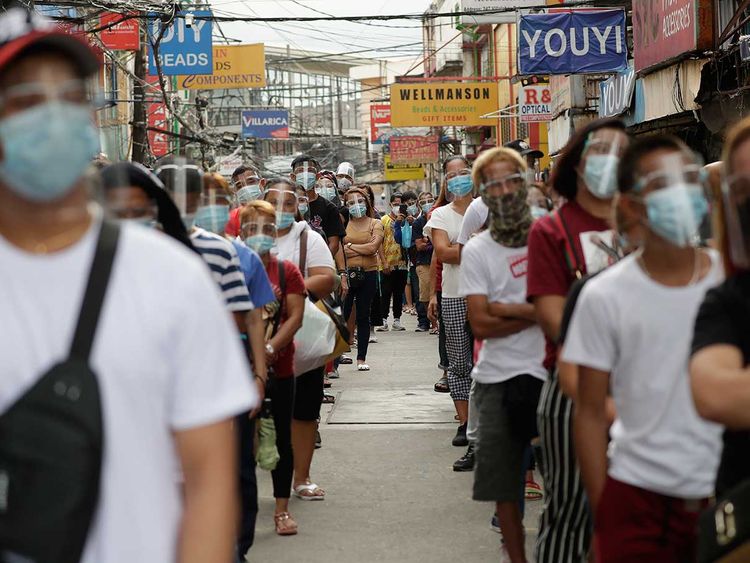
The Philippines now has 864,868 confirmed COVID-19 cases after the Department of Health (DOH) reported 11,681 new cases on Sunday, April 11. This is the 5th highest one-day tally for new cases so far.

The DOH reported 201 new deaths due to the coronavirus disease, bringing the death toll to 14,945.

Meanwhile, the recoveries are up by 55,204, the highest one-day reported tally yet. This raises total recoveries to 703,404.

The high number of recoveries every Sunday is mostly due to the DOH’s weekly time-based tagging of mild and asymptomatic cases as recoveries.

Of the total cases, 146,519 are active.

Norwegian PM fined by police over coronavirus rules violation

0

Apr 9, 2021, Reuters

OSLO, Norway

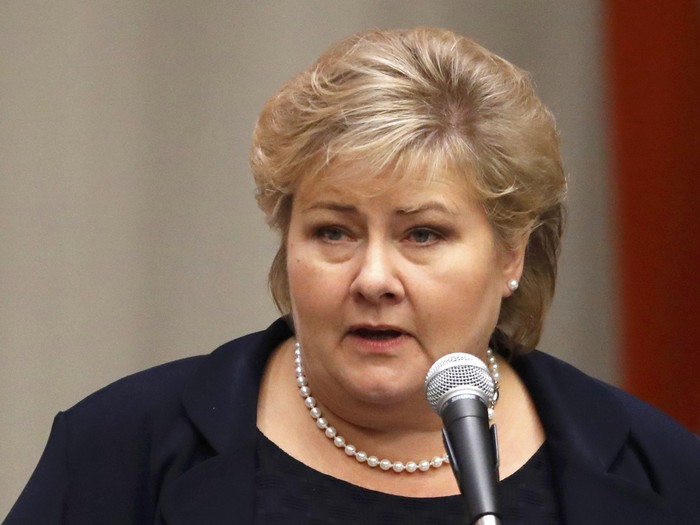
Prime Minister Erna Solberg has apologized several times for organizing the event for her 60th birthday with 13 relatives at a mountain resort in late February

Norwegian police said on Friday, April 9, they have fined Prime Minister Erna Solberg for breaking COVID-19 social-distancing rules when she organized a family gathering to celebrate her birthday.

The fine is for 20,000 Norwegian crowns ($2,352), police chief Ole Saeverud told a news conference.

The matter came to light in a report by Norway’s public broadcaster NRK, which triggered the police investigation.

The two-term premier has apologized several times for organizing the event for her 60th birthday with 13 relatives at a mountain resort in late February, despite a government ban on gatherings of more than 10 people.

On Friday, Solberg said she would pay the fine.

“I’d like to say again that I’m sorry for breaking the coronavirus rules,” she told Norway’s TV2 News.

“I will accept the fine, and pay it.”

While police would not have issued a fine in most such cases, they said the prime minister has been at the forefront of the government’s work to impose restrictions.

“Though the law is the same for all, all are not equal in front of the law,” said Saeverud, justifying the fine. “It is therefore correct to issue a fine in order to uphold the general public’s trust in the rules on social restrictions.”

Police said Solberg and her husband, Sindre Finnes, made the decision together to hold a celebration and picked the restaurant, with Finnes taking care of the practical arrangements.

Though police said he had broken the law as well, he was not fined. The restaurant where the celebration took place was also found to have violated the law but not penalized.

“Solberg is the country’s leader and she has been at the forefront of the restrictions imposed to limit the spread of the virus,” said Saeverud.

Solberg, who faces elections for parliament in September, has championed strict rules to curb the spread of the coronavirus, resulting in some of Europe’s lowest rates of infection and deaths.

But Norway saw a rapid rise in infections in the first quarter of 2021, led by more contagious variants of the virus, forcing the government to tighten restrictions in late March. – Rappler.com

$1 = 8.5029 Norwegian crowns

Rodrigo Duterte Is Using One of the World’s Longest COVID-19 Lockdowns to Strengthen His Grip on the Philippines

0

By Aie Balagtas See / Manila March 15, 2021, Time Magazine online

Edd Gumban sleeps on a foldout bed in an office in central Manila. The 57-year-old photojournalist has a wife and a home in Bulacan, part of the commuter belt 14 miles north of the Philippine capital, but he is too afraid to go there. The Philippines began imposing stay-at-home orders last March, in a bid to halt the spread of COVID-19. There are confusing variations in rules from locality to locality, however. The armed police that man checkpoints have also, at times, been encouraged by President Rodrigo Duterte to shoot lockdown violators dead.

At the very least, Gumban risks being detained, or even beaten, if he finds himself in the wrong place at the wrong time. So rather than commute each day, he only risks the journey every few weeks, when he needs to pick up some things or grab new clothes. The rest of the time, home is a corner of the press office of the Manila Police District. But even there, it seems, he can get no clarity.

“Everything is confusing,” Gumban tells TIME. “There are no clear cut policies to follow. The national government says one thing and local governments impose another.”

Such is life in what must now be one of the world’s longest and strictest lockdowns. The first community quarantine, as it is locally called, was imposed on the island of Luzon on Mar. 16, 2020, when its 53.3 million people—including the capital’s 12.8 million residents—were ordered to stay at home. Since then, community quarantine orders of varying severity have been rolled out across the other islands of the Philippine archipelago.

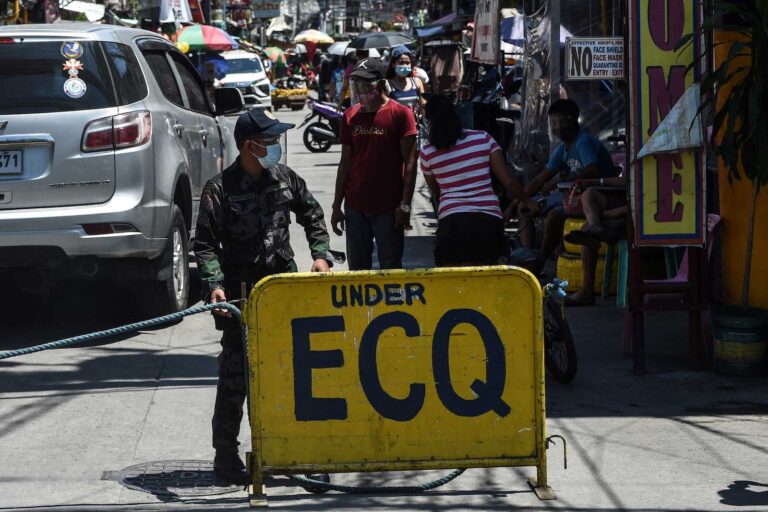
Under the highest tier, so-called Enhanced Community Quarantine, residents must stay indoors unless they can produce a pass that enables them to go out and buy essential items. Non-essential businesses close and there are curbs on transport. Under lower tiers, certain businesses are allowed to open, but some groups—such as the elderly and the very young—must remain indoors at all times. Bewilderingly, local districts, known as barangay, can apply variations in lockdown rules to an individual street or block.

To Duterte’s critics, these lockdowns appear to be more than a public health measure. They say that the pandemic has fulfilled the strongman’s dream of placing the country under armed rule and point to the worryingly high proportion of senior military figures now advising the president on managing the pandemic. Human rights, already threatened by Duterte’s bloody war on drugs, appear to have worsened further, say experts. Under the cover of coronavirus, says rights lawyer Jose Manuel Diokno, “There is a clear effort from some quarters in the government to shrink the democratic space and free discussion that is essential to a democracy.”

In the meantime, the livelihoods and personal lives of many ordinary Filipinos are deteriorating. “I have to endure the pain of living far from my family,” Gumban says. “At some point, you’ll cry it out in one corner, and say ‘Please, Lord, enough already.’”

Human Rights in the Philippines Under COVID-19

With its weak public health system, COVID-19 has presented a major challenge to the Philippines. The country logged over 616,611 coronavirus cases and more than 12,750 fatalities from the beginning of 2020 to Mar. 13, 2021 —the second-highest figures in Southeast Asia. Undoubtedly, lockdowns have prevented Philippine hospitals from being overwhelmed. But they also constitute what the United Nations High Commissioner for Human Rights Michelle Bachelet described as a “highly militarised response” to the pandemic.

William Hartung, the director of the arms and security program at the Washington D.C.-based Center for International Policy, says the approach is eerily similar to Duterte’s much criticized war on drugs, with its emphasis on armed enforcement and punitive measures. “The regime has more tools now to crack down on people than when it started,” he tells TIME. “Now, they’ve got a crisis that allows them to tighten its grip on power.”

The climate of fear is undeniable. TV operators in the Philippines used to reserve late-night slots for crime tales and horror shows. These days, they allocate the time to equally grim fare: weekly COVID-19 “updates” from Duterte, shown at the head of a table of military top brass.

The broadcasts have become a pulpit for the president’s verbal attacks against those who disagree with him. In a recent tirade, Duterte wished death upon Leni Robredo, the country’s vice-president (who, under the Philippine system, is chosen in a separate election and may come from a different party). Robredo had called out the country’s delayed vaccination program—held up, critics say, by the administration’s lack of urgency and foresight.

During another, he ordered police, military and local officials to arrest unruly quarantine violators after hungry protesters demanded food. “If they fight you,” he said, “shoot them dead.” At other times, Duterte rambles incoherently, or advocates unsafe practices, such as encouraging people to disinfect face masks with gasoline.

On the streets, emboldened local authorities appear to have free rein. There have been reports from rights groups of children stuffed inside coffins for violating curfew and other regulations. Adults have been beaten up or thrown into jail, some in dog cages.

Against this backdrop, Duterte and his henchmen have moved against longstanding political enemies. Last July, with the country grappling with a dearth of accurate information on the coronavirus, Duterte’s allies in Congress refused to renew the franchise of the ABS-CBN television network, which had earned the president’s ire for its critical reporting. The Philippines’ biggest broadcaster was simply forced off air.

In June, a Manila court convicted prominent journalist and editor Maria Ressa, one of TIME’s 2018 Persons of the Year, of “cyber libel,” sending more shivers through the media establishment. Ressa continues to face a slew of tax evasion and other suits that she says are vexatious.

Philippine social media has also become fraught. A new law has criminalized the spreading of “false information” with up to two months in prison and a fine of one million pesos ($19,600)—a fortune to ordinary Filipinos—and at least 17 people have been subpoenaed by the National Bureau of Investigation for expressing discontent online.

In November, Lt. General Antonio Parlade, the head of a military task force against the country’s ongoing communist insurgency, made attacks on Facebook against Filipina actresses Angel Locsin and Liza Soberano, and against Miss Universe 2018, the Filipina-Australian Catriona Gray. The three women are vocal on social and political issues. Parlade discouraged them from having links with leftist groups and warned that this could cost them their lives.

The lawyer Diokno, who chairs a team of legal professionals offering pro bono services, and who himself as been attacked in one of Duterte’s televised harangues, describes the situation as unprecedented. People “are afraid. They don’t know what to do,” he says. “It seems that the long arm of the law is reaching out to them.”

Read more: Duterte Is Assassinating Opponents Under the Cover of the Drugs War, Rights Groups Say

The centerpiece of Duterte’s new machinery of repression is a sweeping Anti-Terrorism Act, rushed through Congress last June. The measure is the most contested law in the country’s recent history, the subject of 37 separate petitions filed before the Philippine Supreme Court asking for it to be struck down. It allows for detention without warrant for 24 days and gives the executive vast powers to interrogate and detain anyone it deems a terrorist. Opposition leaders, rights groups, church groups and former government officials say the measure violates the constitution and warn that it will open the door for more abuses.

Their fears appeared to be realized on Mar. 7, when nine activists were shot dead by security forces in raids around Manila. Authorities say the nine were hiding caches of arms and killed because they resisted arrest, but many are skeptical. In a statement Monday, Vice-President Robredo described the events as a “massacre.” The killings came days after Duterte reportedly appeared on television saying “I’ve told the military and the police, if they find themselves in an encounter with the communist rebels and you see them armed, kill them.”

Says Hartung: “The United States shouldn’t be arming this regime at this point.”

Washington is one the major exporters of arms to the Philippines, its oldest military ally in Asia. Back in November, Manila took delivery of $30 million worth of weapons from the States. More recently, in January, the Philippine Air Force acquired two Lockheed C-130 aircraft. Continuing to sell arms to Duterte, Hartung says, “would be a kind of stain on U.S. foreign policy.”

Ela Atienza, a political science professor at the University of the Philippines, warns that Duterte’s continued reliance on the armed forces sets a dangerous precedent. “When you have a president who feels they need to get the support of the military and the police to impose their preferred policies,” she says, “that further encourages certain people in the military to exert their authority and their influence.”

Filipinos Are Struggling in the Pandemic

Despite its mounting case numbers, the Philippines has been the last country in the region to start a vaccination program, rolling out Chinese-made CoronaVac jabs only at the beginning of March. Limited investment in labs, equipment and manpower has also hampered the expansion of contact tracing and mass testing. That continues to leave lockdowns as the government’s main tool in fighting the pandemic.

The hardship faced by Filipinos, undergoing their country’s worst economic contraction since World War II, has meanwhile been exacerbated by the chaotic distribution of food and financial subsidies. People have been forced to violate lockdowns in order to provide for themselves and their families.

In Manila, 56-year-old Dolores Rivera, whose name has been changed to protect her identity, routinely dodges the cops to pick up laundry from neighbors. The meager income from washing clothes makes her the sole breadwinner in her family, where there are 12 grandchildren to feed. Waiting for government aid is not an option. “We would die of hunger,” she says.

Duterte’s war on drugs has claimed the lives of two of her sons and the loss has made Rivera deeply distrustful of the authorities. Ironically, she doesn’t believe in the existence of COVID-19, regarding it as a government ploy to starve the population into total submission.

Professor Atienza explains that there has been hardly any effort to educate people about coronavirus. The priority, she says “is more on people having to obey lockdown procedures instead of [ensuring] that people will be healthy or health will be protected. People should be educated why they need to stay at home and why certain facilities have to close down.”

That’s easier said than done. When health workers went public over mounting patient numbers that were forcing hospitals to choose which patients should be put on ventilators and which should be left to fend without, Duterte was furious. He used his television soapbox to accuse doctors of fomenting revolution.

Physician Tony Leachon, who used to be part of Duterte’s team of medical advisers until he blasted the administration for its incompetence, says medical workers are simply too afraid to speak out. “I am really frustrated,” he says. “If your opinions run contrary [to the government’s], you will be assaulted verbally … you will cower in fear.”

For now, Filipinos continue to endure the political uncertainty, harsh restrictions and unprecedented social isolation that comes from their government’s draconian response to COVID-19.

Afraid that he might spread the virus on one of his infrequent visits home, the photojournalist Gumban only meets his wife outside his front gate, where they exchange bags. These days, he adds, even his dogs have become suspicious.

“They used to greet me with wagging tails,” Gumban says. “Now, they just bark as if I’m a stranger.”
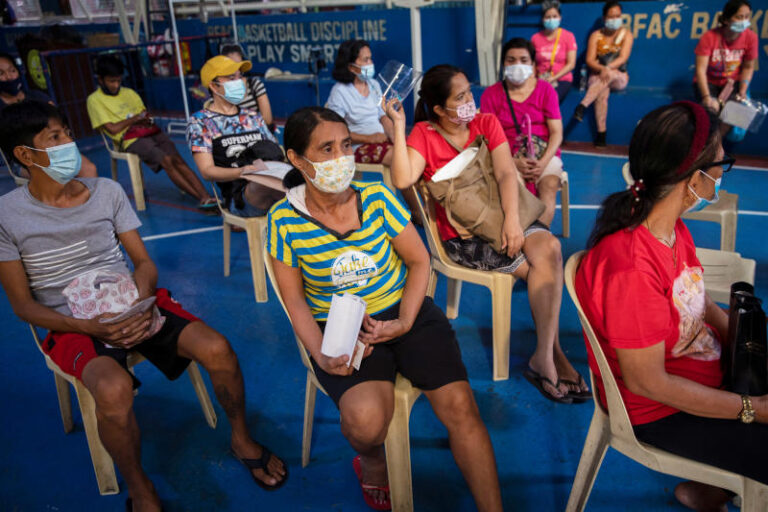
Lack of cash aid may force people to leave homes despite ECQ

0

Apr 5, 2021 Ralf Rivas

MANILA, Philippines

People being left with no choice but to go out ‘could stifle efforts’ to stop the COVID-19 surge, says ING Bank Manila senior economist Nicholas Mapa

Economists warned the government that meager and delayed cash aid to poor households could force people to go out and look for work, defeating the purpose of a hard lockdown.

ING Bank Manila senior economist Nicholas Mapa told Rappler on Monday, April 5, that authorities should act fast and give out financial assistance if they want COVID-19 infections to slow down.

“Lockdowns with little cash aid may result in low compliance, with citizens likely leaving their homes in search of food, a development which could stifle efforts to slow the spread of the disease,” Mapa said.

The government is giving only P1,000 in cash or in kind per person.

The aid, to be given out around the second week of April, will be sourced from unused funds under the Bayanihan to Recover as One Act. The 2021 budget does not have line items for cash assistance in case of another enhanced community quarantine (ECQ), the strictest lockdown category.

President Rodrigo Duterte’s economic team has rushed to reopen the ailing economy despite rising coronavirus cases. But economists warned that public health and the economy are intertwined, with the COVID-19 crisis badly needing to be addressed first.

“The longer we delay stamping out the virus, the higher the probability of a return to ECQ and a quick revert to reopen the economy may backfire once more and result in a third installment of the ECQ series,” Mapa said.

Ateneo de Manila University economist Alvin Ang noted that the ECQ, in effect in Metro Manila, Bulacan, Rizal, Laguna, and Cavite, will “affect the recovery and make it slower than what most anticipated.”

A study by the Asian Development Bank Institute showed that if Filipino households lose their income amid the coronavirus pandemic, around half of them would have enough resources to cover necessary expenses for only up to two weeks.

Cost of lockdowns

Economists have yet to determine the cost of the ECQ per day of implementation.

Mapa and Ang said that while the current lockdown is not as heavy-handed as the one in 2020, growth will likely be affected.

The National Economic and Development Authority earlier said that for every week of ECQ in Metro Manila and adjacent regions, around P2.1 billion in wages is lost per day.

During general community quarantine, a looser form of lockdown, the amount is P700 million a day.

The ECQ in 2020 shut down 75% of the economy, resulting in huge losses in jobs and income. – Rappler.com

Why Easter is called Easter, and other little-known facts about the holiday

0

Apr 4, 2021 The Conversation Brent Landau

A scholar explains the rich historical roots of Easter and how it has evolved over the centuries

As published by The Conversation

The date of Easter, when the resurrection of Jesus is said to have taken place, changes from year to year.

The reason for this variation is that Easter always falls on the first Sunday after the first full moon following the spring equinox.

I am a religious studies scholar specializing in early Christianity, and my research shows that this dating of Easter goes back to the complicated origins of this holiday and how it has evolved over the centuries.

Easter is quite similar to other major holidays like Christmas and Halloween, which have evolved over the last 200 years or so. In all of these holidays, Christian and non-Christian (pagan) elements have continued to blend together.

Easter as a rite of spring

Most major holidays have some connection to the changing of seasons. This is especially obvious in the case of Christmas. The New Testament gives no information about what time of year Jesus was born. Many scholars believe, however, that the main reason Jesus’ birth came to be celebrated on December 25 is because that was the date of the winter solstice according to the Roman calendar.

Since the days following the winter solstice gradually become longer and less dark, it was ideal symbolism for the birth of “the light of the world” as stated in the New Testament’s Gospel of John.

Similar was the case with Easter, which falls in close proximity to another key point in the solar year: the vernal equinox (around March 20), when there are equal periods of light and darkness. For those in northern latitudes, the coming of spring is often met with excitement, as it means an end to the cold days of winter.

Spring also means the coming back to life of plants and trees that have been dormant for winter, as well as the birth of new life in the animal world. Given the symbolism of new life and rebirth, it was only natural to celebrate the resurrection of Jesus at this time of the year.

The naming of the celebration as “Easter” seems to go back to the name of a pre-Christian goddess in England, Eostre, who was celebrated at beginning of spring. The only reference to this goddess comes from the writings of the Venerable Bede, a British monk who lived in the late seventh and early eighth century. As religious studies scholar Bruce Forbes summarizes:

“Bede wrote that the month in which English Christians were celebrating the resurrection of Jesus had been called Eosturmonath in Old English, referring to a goddess named Eostre. And even though Christians had begun affirming the Christian meaning of the celebration, they continued to use the name of the goddess to designate the season.”

Bede was so influential for later Christians that the name stuck, and hence Easter remains the name by which the English, Germans and Americans refer to the festival of Jesus’ resurrection.

The connection with Jewish Passover

It is important to point out that while the name “Easter” is used in the English-speaking world, many more cultures refer to it by terms best translated as “Passover” (for instance, “Pascha” in Greek) – a reference, indeed, to the Jewish festival of Passover.

In the Hebrew Bible, Passover is a festival that commemorates the liberation of the Jewish people from slavery in Egypt, as narrated in the Book of Exodus. It was and continues to be the most important Jewish seasonal festival, celebrated on the first full moon after the vernal equinox.

At the time of Jesus, Passover had special significance, as the Jewish people were again under the dominance of foreign powers (namely, the Romans). Jewish pilgrims streamed into Jerusalem every year in the hope that God’s chosen people (as they believed themselves to be) would soon be liberated once more.

On one Passover, Jesus traveled to Jerusalem with his disciples to celebrate the festival. He entered Jerusalem in a triumphal procession and created a disturbance in the Jerusalem Temple. It seems that both of these actions attracted the attention of the Romans, and that as a result Jesus was executed around the year A.D. 30.

Some of Jesus’ followers, however, believed that they saw him alive after his death, experiences that gave birth to the Christian religion. As Jesus died during the Passover festival and his followers believed he was resurrected from the dead 3 days later, it was logical to commemorate these events in close proximity.

Some early Christians chose to celebrate the resurrection of Christ on the same date as the Jewish Passover, which fell around day 14 of the month of Nisan, in March or April. These Christians were known as Quartodecimans (the name means “Fourteeners”).

By choosing this date, they put the focus on when Jesus died and also emphasized continuity with the Judaism out of which Christianity emerged. Some others instead preferred to hold the festival on a Sunday, since that was when Jesus’ tomb was believed to have been found.

In A.D. 325, the Emperor Constantine, who favored Christianity, convened a meeting of Christian leaders to resolve important disputes at the Council of Nicaea. The most fateful of its decisions was about the status of Christ, whom the council recognized as “fully human and fully divine.” This council also resolved that Easter should be fixed on a Sunday, not on day 14 of Nisan. As a result, Easter is now celebrated on the first Sunday after the first full moon of the vernal equinox.

The Easter bunny and Easter eggs

In early America, the Easter festival was far more popular among Catholics than Protestants. For instance, the New England Puritans regarded both Easter and Christmas as too tainted by non-Christian influences to be appropriate to celebrate. Such festivals also tended to be opportunities for heavy drinking and merrymaking.

The fortunes of both holidays changed in the 19th century, when they became occasions to be spent with one’s family. This was done partly out of a desire to make the celebration of these holidays less rowdy.

But Easter and Christmas also became reshaped as domestic holidays because understandings of children were changing. Prior to the 17th century, children were rarely the center of attention. As historian Stephen Nissenbaum writes,

“…children were lumped together with other members of the lower orders in general, especially servants and apprentices – who, not coincidentally, were generally young people themselves.”

From the 17th century onward, there was an increasing recognition of childhood as as time of life that should be joyous, not simply as preparatory for adulthood. This “discovery of childhood” and the doting upon children had profound effects on how Easter was celebrated.

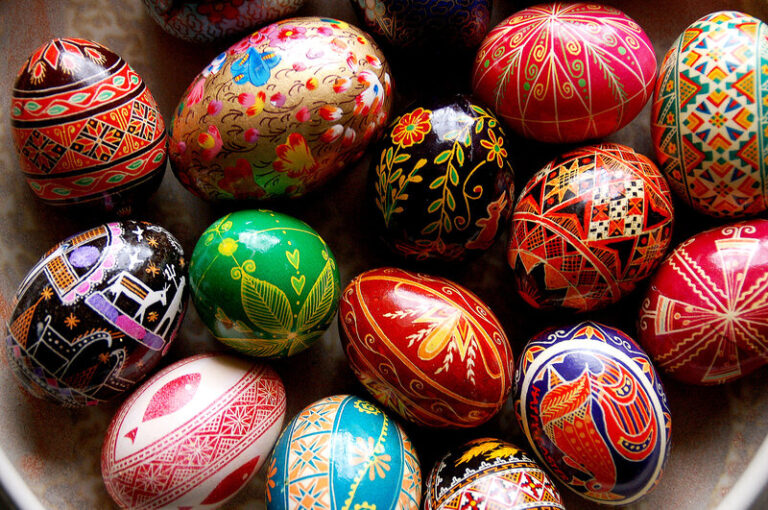
It is at this point in the holiday’s development that Easter eggs and the Easter bunny become especially important. Decorated eggs had been part of the Easter festival at least since medieval times, given the obvious symbolism of new life. A vast amount of folklore surrounds Easter eggs, and in a number of Eastern European countries, the process of decorating them is extremely elaborate. Several Eastern European legends describe eggs turning red (a favorite color for Easter eggs) in connection with the events surrounding Jesus’ death and resurrection.

Yet it was only in the 17th century that a German tradition of an “Easter hare” bringing eggs to good children came to be known. Hares and rabbits had a long association with spring seasonal rituals because of their amazing powers of fertility.

When German immigrants settled in Pennsylvania in the 18th and 19th centuries, they brought this tradition with them. The wild hare also became supplanted by the more docile and domestic rabbit, in another indication of how the focus moved toward children.

As Christians celebrate the festival this spring in commemoration of Jesus’ resurrection, the familiar sights of the Easter bunny and Easter eggs serve as a reminder of the holiday’s very ancient origins outside of the Christian tradition. – The Conversation|Rappler.com

This is an updated version of a piece published on March 21, 2018.

Brent Landau is a lecturer in the Department of Religious Studies, The University of Texas at Austin College of Liberal Arts.

This article is republished from The Conversation under a Creative Commons license. Read the original article.

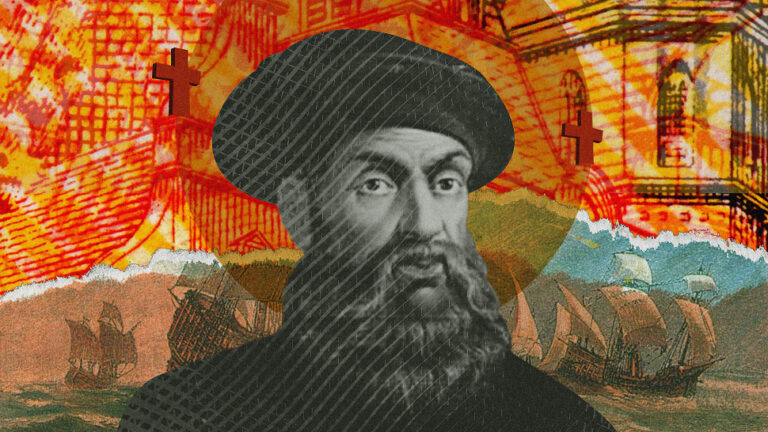
Why We Should Revisit the Meaning of Magellan’s Arrival in Our History

0

Justin Umali, Esquire Philippines, March 31, 2021

A colonialist lens paints Magellan’s arrival 500 years ago as the start of Philippine history when it was just another chapter in our country’s rich historical tapestry.

In Philippine history classes, students are usually taught about March 1521 as one of the most important events of our shared past. The story of Ferdinand Magellan’s “discovery” of the Philippines while in search of another route to nearby Moluccas and his subsequent death at the hands of Lapu-Lapu is treated as a landmark event of Philippine history: the true “beginning” of our Filipino consciousness, so to speak.

This year marks 500 years since that very event, and the question has since revolved around whether or not we should celebrate the fact. Some people, like Pope Francis, see Magellan’s arrival in the Philippines as the beginning of 500 years of Christianity in the country. Others are not so kind, choosing to remember Magellan’s arrival as the beginning of colonial subjugation in the Philippines.

In Philippine history classes, students are usually taught about March 1521 as one of the most important events of our shared past. The story of Ferdinand Magellan’s “discovery” of the Philippines while in search of another route to nearby Moluccas and his subsequent death at the hands of Lapu-Lapu is treated as a landmark event of Philippine history: the true “beginning” of our Filipino consciousness, so to speak.

This year marks 500 years since that very event, and the question has since revolved around whether or not we should celebrate the fact. Some people, like Pope Francis, see Magellan’s arrival in the Philippines as the beginning of 500 years of Christianity in the country. Others are not so kind, choosing to remember Magellan’s arrival as the beginning of colonial subjugation in the Philippines.

Both points raise very important questions about our past. But more than looking back on our past, perhaps we should take the time to ask ourselves how we look at Philippine history in the first place.

In Philippine history classes, students are usually taught about March 1521 as one of the most important events of our shared past. The story of Ferdinand Magellan’s “discovery” of the Philippines while in search of another route to nearby Moluccas and his subsequent death at the hands of Lapu-Lapu is treated as a landmark event of Philippine history: the true “beginning” of our Filipino consciousness, so to speak.

This year marks 500 years since that very event, and the question has since revolved around whether or not we should celebrate the fact. Some people, like Pope Francis, see Magellan’s arrival in the Philippines as the beginning of 500 years of Christianity in the country. Others are not so kind, choosing to remember Magellan’s arrival as the beginning of colonial subjugation in the Philippines.

Both points raise very important questions about our past. But more than looking back on our past, perhaps we should take the time to ask ourselves how we look at Philippine history in the first place.

The Colonialist Narrative in Philippine History 

Under American colonialism, the public education system saw massive reforms that saw more and more Filipinos gaining access to a systematized form of basic education. Public schools became the norm and have become an enduring feature of the Philippine education system.

Beyond standardization, American education brought with it the education of American-friendly values. As Renato Constantino puts it in The Miseducation of the Filipino:

“The education of the Filipino under American sovereignty was an instrument of colonial policy. The Filipino has to be educated as a good colonial. Young minds had to be shaped to conform to American ideas. Indigenous Filipino ideals were slowly eroded in order to remove the last vestiges of resistance. Education served to attract the people to the new masters and at the same time to dilute their nationalism which had just succeeded in overthrowing a foreign power. The introduction of the American educational system was a means of defeating a triumphant nationalism.”

For decades, Philippine history was discussed through a colonialist narrative. It downplayed the efforts of the Filipino people while portraying Spanish and American colonization efforts as “civilizing” and integral to the Filipino consciousness.

This began to change in the 1960s, when nationalist historians like Renato Constantino and Teodoro Agoncillo began to challenge the tired narrative. Buoyed by nationalist fervor led by figures like Senator Claro M. Recto, academics and students alike sought to break tradition from old notions of our own history and began to look at things from a Filipino perspective. 

Works like History of the Filipino People and Revolt of the Masses were instrumental in portraying our own history from a nationalist perspective. In 1971, Jose Maria Sison wrote Philippine Society and Revolution, a landmark text that sought to apply class analysis to Philippine history.

This tradition continues to this day. Historians, academics, and students are challenging normalized historical narratives; in essence, taking back our own sense of history. Outside the academe, workers and peasants all over the country also get a sense of historical agency through community discussions and other forms of engagement.

Suffice to say, we’ve come a long way in terms of understanding our past. It seems, at times, like our eyes have been opened for the first time. But most important, revisiting the way our past is framed informs how we see ourselves in our own nation—not as products of colonial aggression but as protagonists in our own story.

The Meaning of Magellan’s Arrival in Pre-Colonial History

Let us circle back to the beginning of Spanish advent. Far from being a simple historical event, Ferdinand Magellan’s arrival to the Philippines was indeed a landmark event. It is only fair that we as Filipinos take a deeper look into what this event means to us as a nation.

There is an important point to be made, however. Arguments revolving around the 500th anniversary of Magellan’s arrival in the Philippines representing Christianity or colonialism both stem from the same idea—the idea that this was the event that began Philippine history. By putting Magellan’s arrival on such a pedestal, we are essentially reaffirming the fact that our history, and our national consciousness along with it, are tied to our shared colonial past.

But when we look at March 1521 within the greater scope of our pre-colonial history, we start to see that Magellan’s arrival is hardly the “first contact” that conventional history would have us believe. On the contrary, the Philippines has been an important regional center for the past 600 years prior to Ferdinand Magellan’s arrival.

The century prior to Magellan’s arrival, in particular, saw an increase of involvement from the Sultanate of BruneiMing China, and Muslims from Malacca and Johore across the country. Multiple states vied for regional control by associating themselves with regional powers, as with Tondo and Brunei or Maynila and China.

Spanish arrival in the Philippines was hardly a world-changing event for the Filipinos who experienced it. It would be more proper to draw conclusions based on how figures like Humabon and Lapu-Lapu reacted. There is strong evidence that Rajah Humabon used Magellan in his feud against Lapu-Lapu as a proxy. His conversion to Christianity was an unintended consequence. 

A Chapter in Our Already Rich History

At the end of the day, Magellan’s arrival in the Philippines was simply another episode in our historical tapestry. Magellan became a victim of political intrigue and a local feud between two warring leaders, while also contributing to the country’s eclectic religious make-up.

If anything, Magellan’s arrival is notable because it exposed the inherent weakness of the various Philippine states that existed at the time. Less than 50 years later, Miguel Lopez de Legazpi would arrive in the Philippines and use divide-and-conquer tactics to pit ruling lords against each other, ultimately coming up on top.

There is no doubt that we should recognize Magellan’s arrival in the Philippines as a notable event. But it is not something to be revered. Let us remember it for what it truly is: a chapter in a storied history book, marking the end of one era and the beginning of another.

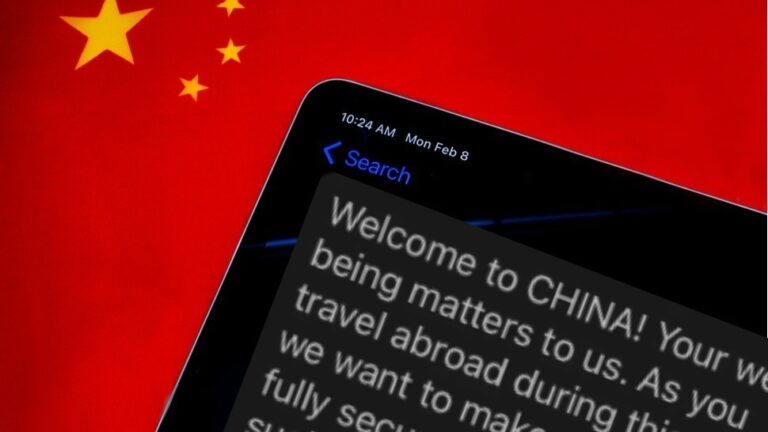
‘Welcome to CHINA!’ Chiara Zambrano Receives Text As She Flies Over Philippine Reefs

0

By Mario Alvaro Limos, Esquire Philippines, March 31, 2021

ABS-CBN journalist and reporter Chiara Zambrano was visiting the West Philippine Sea when an automated text blast was sent to her phone. 

“Welcome to CHINA!” it read. 

ABS-CBN journalist and reporter Chiara Zambrano was visiting the West Philippine Sea when an automated text blast was sent to her phone. 

“Welcome to CHINA!” it read. 

“Your well-being matters to us. As you travel abroad during this time, we want to make sure you are fully secure and connected. As such, we have made data roaming even more accessible through our wide range of roam surf offers.”

The text message was received as Zambrano was flying over Calderon Reef (aka Cuarteron), Johnson Reef (close to Julian Felipe), and Mischief Reef (close to Ayungin Shoal), which are all in the West Philippine Sea. The reefs have been militarized by China since 2015. 

“I’ve flown over some of the artificial islands of China when they were still being built. So see them now, completed, is both chilling and sobering,” wrote Zambrano on her Facebook page. 

Why China Sends Text Messages in the West Philippine Sea

The simple act of sending text messages through Philippine airwaves from the Chinese government may sound innocent, but it is a clever move aimed at chipping away at the legitimate claim the Philippines has over the West Philippine Sea.

To China, sending text messages over the West Philippine Sea legitimizes its alleged ownership of the area. It proves it has control not only over the airspace and waterspace, but also over the airwaves claimed by the Philippines. 

This is just one of the ways China is normalizing its presence in the West Philippine Sea, in the hope that, over time, the international community would accept it. 

In December 2020, Chinese ambassador Huang Xilian reiterated China does not recognize the 2016 victory of the Philippines at the international arbitral court. 

“In 2016, our two presidents reached an important consensus on properly handling the arbitration case, which served as an important foundation for the turnaround of the bilateral relations. China’s position on the arbitration case is consistent and clear. We will not accept and participate in the arbitration, nor will accept or recognize the so-called ruling,” Huang said.

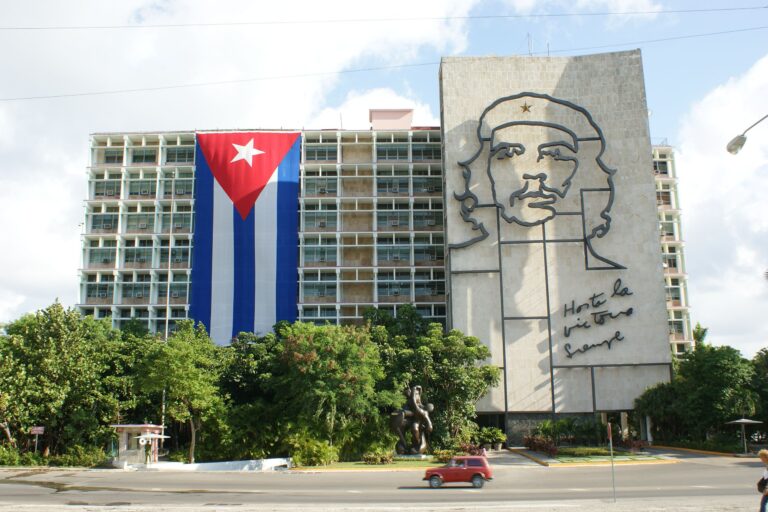
Cuba Libre to be COVID-Libre: Five Vaccines and Counting…

0

by Helen Yaffe, March 30, 2021, Counterpunch.org

On 23 March 2021, British Prime Minister Boris Johnson told a group of Conservative Party backbenchers: ‘The reason we have the vaccine success is because of capitalism, because of greed, my friends.’ Johnson was articulating the dogma that the pursuit of private profit through capitalist free markets leads to efficient outcomes. In reality, however, Britain’s accomplishments in developing the Oxford AstraZeneca vaccine and in the national vaccination rollout have more to do with state investments than the market mechanism. Government money subsidised the vaccine development at the University of Oxford, and it is the state-funded National Health Service that has carried out the vaccination programme. Johnson did not admit that it is due to capitalism and greed that Britain now has the fifth worst Covid-19 mortality rate in the world with over 126,500 deaths (almost 1,857 per million people in the population) and counting.

The British government, like most neoliberal regimes, refused to take the measures necessary to slow and halt community transmission, it failed early on to provide health care and social care workers with adequate PPE and other resources which could have saved the lives of hundreds of frontline staff who died as a result. It contracted private businesses to carry out essential activities, most with little or no relevant experience, for example, instead of equipping the community-based GP system of the National Health Service to take charge of ‘track and trace’, the government dished out £37 billion to Serco to manage part of the system. In public health terms it has been disastrous; but measured by Boris Johnson’s celebrated standards of capitalism and greed it is has indeed excelled. The greatest beneficiaries of Britain’s response to the pandemic have been the private corporations making huge profits. Around 2,500 Accenture, Deloitte and McKinsey consultants are on an average daily rate of £1,000, with some paid £6,624 a day.

Johnson has now laid out a road map for reopening the economy. As a result, even the most optimistic scenario predicts a third wave between September 2021 and January 2022 resulting in at least 30,000 additional deaths in Britain. These deaths are preventable. But it precisely because the British government is driven by the capitalism and greed that it insists that we have to learn to ‘live with the virus’ so that the business of business can continue.

Contrary to Johnson’s claims, this pandemic has affirmed that public healthcare needs cannot be adequately met under a profit-based system. Indeed, it is the absence of the capitalist profit motive which underlies the outstanding domestic and international response to Covid-19 by socialist Cuba, which now has five vaccines in clinical trials and is set to be among the first nations to vaccinate its entire population.

By reacting quickly and decisively, by mobilising its public healthcare system and world-leading biotech sector, Cuba has kept contagion and fatalities low. In 2020 Cuba confirmed a total of 12,225 coronavirus cases and 146 deaths in a population of 11.2 million, among the lowest rates in the Western Hemisphere. In November 2020, the airports were opened, leading to a surge with more infections in January 2021 than the whole of the previous year. By 24 March 2021, Cuba had registered fewer than 70,000 cases and 408 deaths. The death rate was 35 per million and the fatality rate was just 0.59% (2.2% worldwide; 2.9% in Britain). Within one year, 57 brigades of medical specialists from Cuba’s Henry Reeve International Contingent had treated 1.26 million Covid-19 patients in 40 countries; they joined 28,000 Cuban healthcare professionals already working in 66 countries. Cuba’s accomplishments are more extraordinary given that from 2017 onwards, the Trump administration punitively unleashed 240 new sanctions, actions and measures to tighten the 60-year blockade of Cuba, including nearly 50 additional measures during the pandemic which cost the health sector alone over $200 million.

Cuba has gone on the offensive against Covid-19, mobilising the prevention-focussed, community based public healthcare system to carry out daily house visits to actively detect and treat cases and channelling the medical science sector to adapt and produce new treatments for patients and Covid-19 specific vaccines. These advances bring hope not just for Cuba, but for the world.

What is special about Cuba’s vaccines?

Some 200 Covid vaccines are being developed worldwide; by 25 March 2021, 23 candidates had advanced to phase III clinical trials. Two of those were Cuban (Soberana 2 and Abdala). No other Latin American country has developed its own vaccine at this stage. Cuba has three more vaccine candidates in earlier stage trials (Soberana 1, Soberana Plus and an intranasal, needle-free vaccine called Mambisa). How do we explain this accomplishment? Cuba’s biotech sector is unique; entirely state-funded and owned, free from private interests, profits are not sought domestically, and innovation is channelled to meet public health needs. Dozens of research and development institutions collaborate, sharing resources and knowledge, instead of competing, which facilitates a fast track from research and innovation to trials and application. Cuba has the capacity to produce 60-70% of the medicines it consumes domestically, an imperative due to the US blockade and the cost of medicines in the international market. There is also fluidity between universities, research centres, and the public health system. These elements have proven vital in the development of Cuba’s Covid-19 vaccines.

There are five types of Covid-19 vaccines being developed globally:

+ Viral vector vaccines, which inject an unrelated harmless virus modified to deliver SARS-CoV-2 genetic material (Oxford AstraZeneca, Gamaleya and SputnikV);

+ Genetic vaccines containing a segment of SARS-CoV-2 virus genetic material (Pfizer, Moderna);

+ Inactivated vaccines containing disactivated SARS-CoV-2 virus (Sinovac,/Butantan, SinoPharm, Bharat Biotec);

+ Attenuated vaccines containing weakened SARS-CoV-2 virus (Codagenix);

+ Protein vaccines containing proteins from the virus which trigger an immune response (Novavax, Sanofi/GSK).

The five Cuban vaccines under clinical trials are all protein vaccines; they carry the portion of the virus spike protein which binds to human cells; it generates neutralising antibodies to block the binding process. Dr Marlene Ramirez Gonzalez explains that they are, ‘subunit vaccines, one of the most economical approaches and the type for which Cuba has the greatest know-how and infrastructure. From protein S – the antigen or part of the SARS-CoV2 virus that all Covid vaccines target because it induces the strongest immune response in humans – Cuban candidates are based only on the part that is involved in contact with the cell’s receptor: the RBD (receptor-binding domain) which is also the one that induces the greatest amount of neutralizing antibodies. This strategy is not exclusive to Cuban vaccines. But Soberana 02 does distinguish itself from the rest of the world’s candidates as the only “conjugate vaccine”. Currently in phase III clinical trials, it combines RBD with tetanus toxoid, which enhances the immune response…Cuba had already developed another vaccine with this principle. It is Quimi-Hib, “the first of its kind to be approved in Latin America and the second in the world”, against Haemophilus influenzae type b, coccobacilli responsible for diseases such as meningitis, pneumonia and epiglottitis.’[1]

Idania Caballero, a pharmaceutical scientist at BioCubaFarma points out that the vaccines build on decades of medical science and work on infectious diseases. ‘The mortality rate in Cuba due to infectious diseases, even in times of Covid, is less than 1%. Cuba today vaccinates against 13 diseases with 11 vaccines, eight of which are produced in Cuba. Six diseases have been eliminated as a result of vaccination schedules. The vaccines produced with these technologies have been administered even to children in the first months of life.’[2]

The Soberana vaccines are produced by the Finlay Institute in partnership with the Centre for Molecular Immunology (CIM) and the Centre of Biopreparados. Soberana means ‘sovereign’, reflecting its economic and political importance; without a domestic product, Cuba would struggle to access foreign vaccines either due to the US blockade or to the cost. Soberana vaccines insert genetic information into superior mammalian cells. Soberana Plus is a the world’s first vaccine for Covid-19 convalescent patients to reach clinical trials.

The other vaccines, Abdala and Mambisa, names which also pay tribute to Cuba’s struggle for independence, are produced by the Centre of Genetic Engineering and Biotechnology (CIGB). These vaccines insert genetic information in a less evolved organism, a unicellular microorganism (the yeast Pichia Pastoris). They build on the CIGB’s extraordinary record, including its Hepatitis B vaccines, used in Cuba for 25 years.

By developing different vaccine platforms, those institutions avoid competing for resources. Caballero explains that: ‘Cuba has the capacity to produce two independent vaccine chains, with over 90 million vaccines annually, while maintaining the required production of other products for the domestic market and for export.’ The Cuban vaccines require three doses and, because they are stable at temperatures of between 2 and 8 degrees, do not require costly special refrigeration equipment.

Phase III trials and ‘interventional studies’

By late March, phase III trials were underway for Soberana 2 and Abdala, each incorporating over 44,000 volunteers over 19 years old in regions with high incidence of Covid-19. Soberana 2 is being administered in Havana and Abdala in Santiago de Cuba and Guantanamo. Analysis and follow-up for phase III trial patients will continue until January 2022 to investigate whether they prevent transmission, how long immunity lasts, and other questions that no vaccine producers can yet answer. However, an additional 150,000 healthcare workers in Havana are receiving Soberana 2 shots, as part of an ‘interventional study’, a form of clinical trial that can be authorised after drug safety has been demonstrated in phase II. Intervention studies do not involve double blind testing or placebos. Another 120,000 healthcare workers in western Cuba will receive Abdala in the next few weeks. Other interventional studies in the capital will see 1.7 million people in Havana, most of the adult population, vaccinated by the end of May 2021, meaning that 2 million Cubans will have been fully vaccinated.

Assuming satisfactory results, in June the real national vaccination campaign will begin, prioritising groups according to risk factors and starting with over 60-year-olds. By the end of August 2021, six million Cubans, over half the population, will have been covered and by the end of the year, Cuba will be among the world’s first countries to fully vaccinate its entire population.

Cuban medical scientists are confident that they have the capacity and experience to adapt their vaccine formulations, technologies and action protocols to tackle new variants. The next steps are for Soberana 1 and Soberana Plus to enter phase II trials and a new study involving 5 to 18 year olds will be launched.

Cuba and China team up on Pan-Corona

Cuba’s CIGB have teamed up with colleagues in China to work on a new vaccine called Pan-Corona, designed to be effective on different strains of the coronavirus. It will use parts of the virus that are conserved, not exposed to variation, to generate antibodies, combined with parts directed at cellular responses. The Cubans contribute the experience and personnel, while the Chinese provide equipment and resources. The research will take place at the Yongzhou Joint Biotechnology Innovation Center, in China’s Hunan Province, which was established last year with equipment and laboratories designed by Cuban specialists. Gerardo Guillen, director of biomedical science at CIGB said the approach: ‘could protect against epidemiological emergencies of new strains of coronavirus that may exist in the future’. The project builds on nearly two decades of medical science collaboration between Cuba and China, including five joint ventures in the biotech sector.

A vaccine for the global south

Cuban professionals have received ten gold medals from the World Intellectual Property Organisation (WIPO) over 26 years; their biotech products were exported to 49 countries prior to the pandemic, including vaccines used in childhood immunisation programmes in Latin America. Cuba has stated that its Covid-19 vaccines will be exported to other countries. This brings hope to low- and middle-income nations that simply cannot afford to vaccinate their populations at high prices (between $10 and $30 per dose) demanded by big pharma. In February 2021, the Bureau of Investigative Journalism reported that US company Pfizer has been ‘bullying’ Latin American countries into putting up sovereign assets, such as embassy buildings and military bases, as guarantees against the cost of any future legal cases in relation to their Covid-19 vaccines.[3]

Through an agreement with Iran’s Pasteur Institute, 100,000 Iranians will take part in the phase III clinical trials for Soberana 2 and another 60,000 people will participate in Venezuela. Other countries including Mexico, Jamaica, Vietnam, Pakistan, and India, have stated their interest in receiving the Cuban vaccines, as has the African Union, which represents all 55 nations in Africa. It is likely that Cuba will apply a sliding scale to its Covid-19 vaccine exports, as it does with the export of medical professionals, so what it charges reflects the countries’ ability to pay.

What Cuba has achieved is remarkable, but as Caballero states: ‘without the unjust US blockade, Cuba could have more and better results’. Cuba has become a world-leader in biotechnology because it has a socialist state with a centrally planned economy, that has invested in science and technology and puts human welfare before profit; that is, with the absence of capitalism and greed that British Prime Minister Johnson celebrates.

Notes.

[1]Rapid response’ letter in The BMJ, 1 March 2021,

[2] Email correspondence, 9 March 2021.

[3] ‘“Held to ransom”: Pfizer demands governments gamble with state assets to secure vaccine deal’, Bureau of Investigative Journalism, 23 February 2021.

A version of this essay was published in in Fight Racism! Fight Imperialism! No. 280, April/May 2021.

Helen Yaffe is a lecturer in Economic and Social History at the University of Glasgow, specialising in Cuban and Latin American development. Her new book We Are Cuba! How a Revolutionary People have survived in a Post-Soviet World has just been published by Yale University Press. She is also the author of Che Guevara: The Economics of Revolution and co-author with Gavin Brown of Youth Activism and Solidarity: the Non-Stop Picket against Apartheid, Rouledge, 2017.