Home Blog Page 111

(Panama Papers) Germany issues arrest warrants for founders of Panama Papers firm – report

0

Oct 20, 2020, Agence France-Presse

BERLIN, Germany

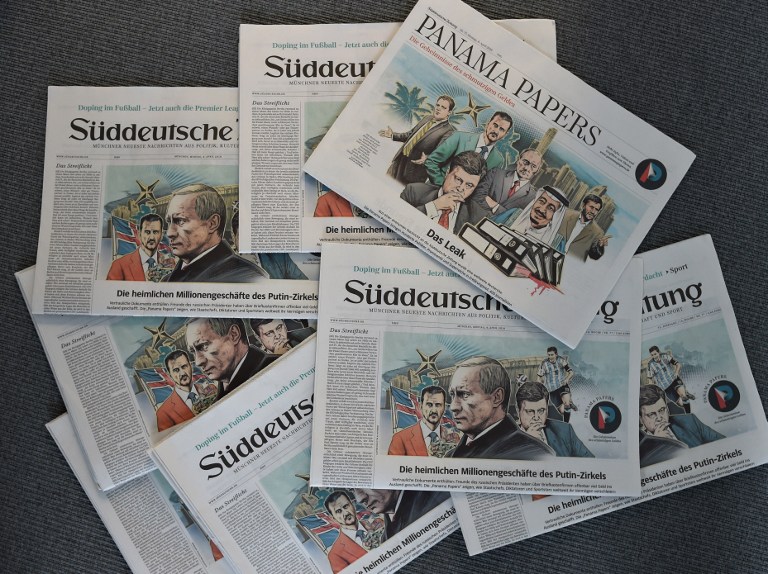
Mossack Fonseca founders Juergen Mossack and Ramon Fonseca, suspected of tax evasion and associating with criminals, will be arrested if they enter the European Union, German newspaper Sueddeutsche Zeitung reports

Germany has issued international arrest warrants for the two founders of the firm at the center of the tax haven scandal exposed by the Panama Papers data leak, German media reported.

Mossack Fonseca founders Juergen Mossack and Ramon Fonseca, suspected of tax evasion and associating with criminals, will be arrested if they enter the European Union, German newspaper Sueddeutsche Zeitung reported late Monday, October 19.

The two men hold Panamanian passports and are currently in the Caribbean archipelago which does not have any extradition treaties, the newspaper said.

However investigators hope that Mossack, who has family in Germany, may surrender to officials in order to negotiate a reduced sentence and avoid US charges.

The Panama Papers

The Panama Papers, a massive data leak in April 2016, exposed widespread tax avoidance and evasion using complex structures of offshore shell companies and caused an international outcry.

At least 150 investigations have been opened in 79 countries to examine potential tax evasion or money laundering, according to the American Center for Public Integrity.

In 2018, Mossack Fonseca said it would close due to “irreparable damage” to its reputation. Panama’s government meanwhile continues to petition the international community to remove it from several tax haven blacklists. – Rappler.com

Pfizer to seek vaccine approval in November

0

Agence France Presse, 16 Oct 2020

US drugmaker will seek go-ahead for emergency use after reaching ‘safety milestone’

WASHINGTON” The US pharmaceutical giant Pfizer expects to file for emergency use authorisation for its Covid-19 vaccine in late November, around two weeks after the Nov 3 US presidential election, it said on Friday.

The company said it hopes to move ahead with the vaccine after safety data is available in the third week of November, immediately lifting the company’s shares two percent in the US.

“So let me be clear, assuming positive data, Pfizer will apply for Emergency Authorisation Use in the US soon after the safety milestone is achieved in the third week of November,” the company’s chairman and CEO Albert Bourla said in an open letter.

The announcement means the United States could have two vaccines ready by the end of the year, with the Massachussetts biotech firm Moderna aiming for Nov 25 to seek authorisation.

The Food and Drug Administration (FDA), which authorises pharmaceuticals for distribution in the US, asked vaccine developers last week to spend two months monitoring for serious side effects after the second dose is given to trial participants.

The FDA will require the vaccine to prove effective and safe, while Pfizer will have to demonstrate it is capable of producing large-scale production. Pfizer is partnering with the German company BioNTech on the research.

Pfizer and Moderna, both with funding assistance from the US government, launched Phase 3 of their clinical trials at the end of July, and both have started production of doses. They aim to be in a position to deliver tens of millions of doses to the US by the end of the year.

Bourla said the Pfizer trial, involving 30,000 participants, might produce results on the vaccine’s efficacy within the next two weeks.

“I’ve said before, we are operating at the speed of science. This means we may know whether or not our vaccine is effective by the end of October,” he said. (Bangkok Post)

‘Their voice is vital’ – Thai celebs break silence on democracy protests

0

Bangkok Post, 18 Oct 2020

A K-pop superstar, beauty queens and TV personalities are among a growing wave of celebrities backing Thailand’s pro-democracy movement, sending out messages of support to millions of followers on social media.

Political statements are unusual from Thai celebs, whose lucrative endorsements rely on the billionaire clans that are a pillar of the country’s establishment. But some prominent figures broke cover after police fired water cannon at peaceful protesters in Bangkok on Friday.

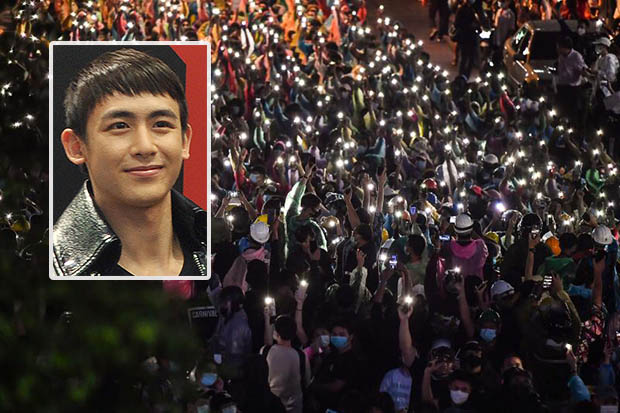
Thai-American K-Pop idol Nichkhun, better known as the “Thai Prince”, told his 6.9 million Twitter followers he cannot “stand idly by” after Friday’s scenes, an escalation after months of student-led protests.

“The use of violence is something I cannot watch and stand idly by,” said Nichkhun, a member of ultra-popular South Korean boy band 2PM, in a message that was retweeted by tens of thousands within hours.

“Violence has never helped anything. I hope everyone stays safe… and take care of yourselves.”

Friday’s showdown was the first such use of force against the protesters, who are calling for the resignation of Premier Prayut Chan-o-cha, a former military chief brought to power in a 2014 coup, and demanding reforms to the powerful monarchy.

It followed a tense week in the Thai capital when protesters defied a ban on demonstrations, and the arrests of scores of leading activists, to return to the streets in their tens of thousands.

Nichkhun wasn’t the only celebrity to speak up. Amanda Obdam, the newly crowned Miss Universe Thailand, took to Instagram with pictures of a lone protester pushing against riot police wielding their shields.

“A picture says a thousand words,” the Thai-Canadian model wrote. “Your job is to protect the people not harm them.”

– ‘Abuse of power’ –

Previously, many stars have remained conspicuously silent on hot-button issues in celebrity-obsessed Thailand, where their careers and income are closely tied to product endorsements.

Alienating potential employers may be a reason — especially in a kingdom where every sector hums along under the oversight of the multi-billion-dollar business empires, traditional supporters of the ultra-wealthy royal family.

But business student Min, who arrived at Saturday’s protest with a helmet and a gas mask, said celebrities have a moral obligation to speak up.

“They are in the elite alongside the government,” the 18-year-old told AFP. “Their voice is vital.”

That voice grew louder this week. Another former beauty queen, TV personality Maria Poonlertlarp, said in a video on Facebook that the treatment of protesters was “completely unjust”.

She had grown more vocal since the July disappearance of Thai pro-democracy activist Wanchalearm Satsaksit, who was kidnapped off the streets of Cambodia where he lived in self-exile.

“People have been silenced from speaking up about the double standards and the abuse of power,” she said in tears, switching between Thai and English.

“We’ve had a lot of injustice going on in Thailand for decades, fighting against our government for democracy,” she added.

Seated next to Maria in the video was her partner Wannasingh Prasertkul, a television presenter whose parents were part of a student movement that saw a massacre in 1976 by royalist forces in Bangkok.

– ‘Ignorant people are silent’ –

Even some celebrities who have mixed with Thailand’s leaders have spoken out. Popular girl band BNK48 visited Gen Prayut at Government House in 2018, where officially released photos showed the normally gruff premier chatting cheerfully with the group.

The visit drew ire from critics who saw it as an attempt to soften the image of the former army chief, who masterminded the 2014 coup and retained power in controversial elections last year.

But BNK48 member Milin “Namneung” Dokthian left no room for doubt about her feelings in a message urging protesters to “stay safe” this week.

“We wouldn’t have to say ‘be safe’ if we had a true democracy,” she wrote on Facebook, in a post shared by fellow band-members.

The support from some celebrities, and silence from others, are not lost on the young protesters. Juggling goggles and a helmet at Saturday’s protest, 25-year-old Aim scoffed at those who refuse to speak up.

“Perhaps they are out of touch and have grown up in a (privileged) situation,” she told AFP, adding that the fans are paying attention.

“We will abandon them because they are ignorant people and are silent.”

Thousands of Thai protesters return to streets after police clashes

0

Oct 18, 2020, Agence France-Presse

BANGKOK, Thailand

(UPDATED) Across the Chao Phraya river, nearly a thousand rallied in the western Wongwian Yai district chanting ‘Long live the people, down with dictatorship!’

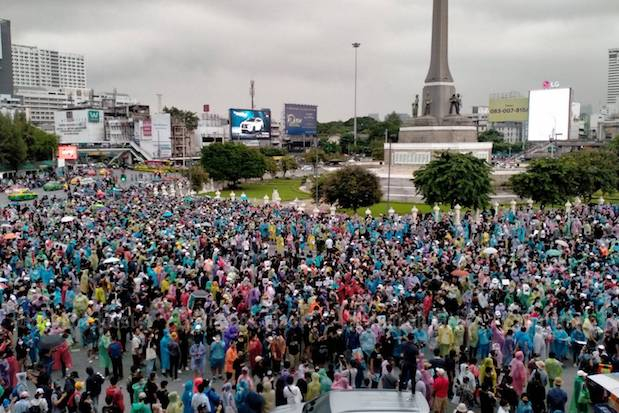
Thousands of Thai pro-democracy protesters massed in multiple locations across Bangkok Saturday, October 17, defying an emergency decree banning gatherings for the third consecutive day after confrontations saw riot police use water cannon on peaceful demonstrators.

Officers dispersed thousands of protestors on Friday night by spraying water laced with blue dye and a chemical agent to mark participants for future legal action.

But the escalation in police tactics has not cowed the burgeoning youth-led protest movement, which is demanding the resignation of a premier first brought to power in a military coup and reform of the kingdom’s powerful monarchy.

One of the pro-democracy movement’s main organizing groups called on its supporters to return to the streets on Saturday afternoon.

“Be prepared both physically and mentally for the demonstration and to cope with a crackdown if it happens,” the online post from Free Youth said.

An hour before the scheduled 4:00 pm (0900 GMT) protest start, the group announced 3 different locations for rallies – outsmarting authorities that had closed roads to two suspected venues that ended up not being the meeting points.

In the city’s northern Lat Phrao district, hundreds gathered in the middle of a street with helmets and gas masks ready, raising a three-finger salute adopted from the “Hunger Games” films as a symbol by the pro-democracy movement.

Across the Chao Phraya river, nearly a thousand rallied in the western Wongwian Yai district chanting “Long live the people, down with dictatorship!”, while in southeastern Udomsuk a similar show of force brought busy traffic to a standstill.

Operators of both the Skytrain and underground rail networks had shut down services city-wide to prevent protesters from joining.

Prime Minister Prayut Chan-O-Cha extended an emergency decree banning gatherings of more than 4 people by another month on Friday.

The former army chief, who masterminded a coup in 2014 before being voted into power last year in an election protesters say was rigged in his favor, also rebuffed calls for his resignation.

‘You’re a tyrant’

At least 65 prominent protesters have been arrested since Tuesday, Thai Lawyers for Human Rights told AFP on Saturday, as authorities escalated a crackdown on months of slowly building unrest.

Eight have since been released, including activist Tattep “Ford” Ruangprapaikitseree, who was bailed on Saturday after his detention the previous night. 

He was quick to go live on Facebook to denounce the use of violence against unarmed protesters.

“The government is no longer legitimate. Prayut Chan-O-Cha, you’re a tyrant,” he said.

Two other activists were arrested on Friday under a rarely used law banning “violence against the queen” after they joined a group Wednesday that surrounded a royal motorcade carrying Queen Suthida, flashing a pro-democracy salute as the car drove by.

Both men could face life in prison if convicted.

At least 3 protesters sustained slight injuries and 5 officers were admitted to the police hospital in Friday’s clashes, authorities said.

The government insisted the use of force had been lawful to stop those trying to “create divisions” in the country.

“There was no victory or defeat for either side. It’s a defeat for all Thais,” government spokesman Anucha Burapanchaisri said in a statement.

Royal reminder

The pro-democracy movement is making an unprecedented challenge to the kingdom’s powerful monarchy.

Protesters are demanding the abolition of a strict royal defamation law, which carries jail sentences of up to 15 years per charge, and for the monarchy to stay out of politics.

The institution currently wields enormous influence and is flanked by an arch-royalist military and billionaire clans.

King Maha Vajiralongkorn sits at the apex of power.

Since ascending the throne in 2016, he has taken personal control of the palace’s vast fortune – worth an estimated $60 billion – and moved two army units under his direct command.

The king has yet to address the civil unrest directly, but during a ceremony broadcast on Friday, he told his subjects that Thailand “needs people who love the country, people who love the institution of the monarchy.”

The government insists the reforms to the royal family are off-limits, but this position was becoming untenable, said International Crisis Group analyst Matthew Wheeler.

“The degree of repression necessary to effectively reinstate the prohibition, including online, would tarnish both the government and the monarchy.” – Rappler.com

[EDITORIAL] Pollsters: Truth- tellers or myth-builders?

0

Oct 12, 2020, Rappler.com

Pulse Asia President Ronald Holmes himself admits it’s “shocking, unbelievable.” 

He’s talking about their survey that says 92% of Filipinos believe that President Rodrigo Duterte has “done well” in preventing the spread of the coronavirus in the Philippines. 

But that’s only half of it. Duterte’s performance rating rose to 91%, getting the highest boost from the poorest Filipinos, in the first major nationwide survey during the COVID-19 pandemic.

Experts tell us expectations are so low – being the worst performing country in Asia in the fight versus COVID-19 and 18th worldwide in total number of cases – could not, would not, dent the esteem of Filipinos for their President.

In an online forum sponsored by the Foreign Correspondents of the Philippines, analysts called this a “reference bias” – when things are so bad worldwide, we feel better off, or so we’d like to think. It’s better than thinking the situation is hopeless. It’s a coping mechanism for this pandemic where we give the leader of the land a get-out-of-jail card. (LISTEN: [PODCAST] 4 reasons why Duterte’s survey ratings are still high)

The analysts think it’s the cash dole outs that did the trick. Forget that it was barely enough, especially for the dirt poor. Forget that the last tranche was in July, or 3 months ago. It’s incredible that Filipinos remember that, or do they?

That’s the sort of well-meaning recalibration of the yardstick that analysts do so well. But there are other ways to look at this survey.

In an interview with Leloy Claudio on Rappler’s Basagan ng Trip, Holmes defended the professionalism and integrity of his survey group. We don’t doubt that. Neither do we doubt that the survey was done in accordance with the established practices of random sampling.

It’s in the interpretation where we beg to disagree. We’d rather see it from the lens of power dynamics and in the context of the constant gaslighting of a people. 

Politics of fear

Analyst Richard Heydarian attributes part of Duterte’s appeal to “performative politics.” But it’s more than that. Heydarian also notes that “the climate of fear cannot be taken out as a factor.”

The constant cursing, the threats of “shoot them dead,” jailing political enemies like Senator Leila de Lima, persecuting critics like ABS-CBN, Rappler and Maria Ressa, cursing God, telling soldiers to shoot rebel women in the vagina – these have taken their toll on our national psyche.

UP Sociologist Randy David said it best in his column in the Inquirer: “One need not go to the country’s remotest barangays to find people who would readily give “safe” answers than say something that could expose them to unwanted drug raids or to being denied “ayuda.” To people who have felt vulnerable and powerless all their lives – and they are the majority in our country – nothing could be more dangerous than expressing their true opinion about their leaders at the wrong time.”

In defending his data, Dr Holmes assures us the people they interviewed weren’t lying – he says Pulse Asia’s pollsters are trained to spot liars. We don’t contest that. But Pulse Asia pollsters aren’t trained to spot people who’ve convinced themselves about the truthfulness of a lie. 

When we face those pollsters, we don’t have to lie, we simply tell them about our altered reality. 

Indeed, the worst lies are the lies we tell ourselves.

Disinformation – the game-changer

What’s our altered reality? We’ve taught ourselves to block out thoughts of an estimated 27,000 slaughtered in dark alleys in slum areas, even if they are 17-year-olds who dutifully tend to the family sari-sari store. We tell ourselves that’s an obscene number so it can’t be true.

That blurring of reality is enabled by disinformation and an intimidated media. The police have rolled back the numbers of extrajudicial killings, now called “homicides under investigation” to 2016 levels or 5,000-plus. The decreasing dead body count – belied by the booming funeral parlor business – is part of the disinformation landscape.

In the face of an unseen coronavirus enemy, we retreat into our homes and our mental panic rooms – the nameless, faceless victims of extrajudicial killings are out of sight and out of mind.

As we try to cope with an overload of bad news, we are constantly bombarded by manufactured facts. How can we resist?

Media tells us there’s mounting evidence of government incompetence in dealing with the coronavirus. What mounting evidence? In an information landscape littered with lies, how can we believe anything?

In this war zone, Duterte’s late Monday night ramblings become reassuring. He’s dependable in his bluster. He’s savage but authentic. We’re masa. He’s masa and we get him.

But Holmes discounts disinformation/misinformation as the root cause of this national blindness by saying “only a few” are exposed to it. He says while roughly 61% are on social media, only 1/3 of them get their news from social media (even as he says the 61% are all on Facebook).

Can we really say a citizenry addicted to Facebook is not (dis)informed by it?

If social media influence were not so powerful, how could dark horse Duterte have won in 2016? How could he have harnessed OFWs disgruntled by the glaring blunders of Noynoy Aquino and Mamasapano? How could he have electrified the nation by his “change is here” rhetoric without Facebook?

Holmes says Pulse Asia numbers show the dominant source of news is still TV, hence there’s minimal exposure to disinformation. But can Pulse Asia interviewees actually tell what news is beyond TV Patrol or 24 Oras?

The other reputable pollster in the country, Social Weather Stations, came out with this report in June 2019 (pre-pandemic) that says more Filipinos get news from Facebook than from radio and newspapers combined. But like Pulse Asia, SWS also reported that television remains king in the Philippines, with 60% of Filipinos consuming news daily through the traditional media platform.

The latest January numbers from Hootsuite show 73 million (67% penetration) use the internet in the Philippines. But here’s the clincher: 64% said they increased their use of social media because of COVID-19 – the highest in the world. India follows at 59% and South Africa comes in third at 55%.

The landscape has drastically shifted under the pandemic. The country’s largest network ABS-CBN was shut down last May. There is no denying the source of real news and credible information has shrunk even further.

The “TV is king” mindset skews Pulse Asia and other survey groups’ ability to appreciate the magnitude of disinformation. New studies say Filipinos naively pick up information, not just on social media, but more and more in chat groups, where they implicitly believe a relative or a friend.

In fact, there’s increasing evidence that the disinformation machinery has shifted operations to closed chat groups. (READ: 5 tips to shield your group chat from misinformation)

Neutral science?

In particle physics, there’s such a thing as the observer effect. Somehow the act of observing something to understand its nature essentially changes its true nature as the observer becomes part of the system.

Science is supposed to be morally neutral but even pollsters inevitably fall on one side or the other: they can be truth-tellers or become part of the myth-building apparatus.

In their desire to compare survey results across time, the “impartial” observers may be trapped by their own methodologies and templates – perhaps lacking the agility to factor in new variables like social media and the effects of disinformation on public temperament.  

As election year 2022 nears, we pray hard that the pollsters do not become unwitting instruments in perpetuating a national delusion. – Rappler.com 
US politics through Filipino eyes

By: Isabel Escoda, Philippine Daily Inquirer, September 20, 2020
With news going around the globe in nanoseconds, it’s easy to follow what goes on in the United States, particularly the frenetic presidential campaign. Filipinos at home and resident in the United States have been watching the spectacle of how a democratic country elects its leaders. The fascination is surely because there now are 4.1 million Pinoy immigrants in that country. What’s ironic is that most have traditionally leaned toward the Republican Party whose illiberal policies don’t favor immigrants. Latinos, Chinese, and other Asians are seen to be overwhelming the white majority, adding to the long festering racism against blacks that has changed the demographics in what has long prided itself as a white Christian nation.

Events in the United States are so fraught, with Americans polarized over major issues affecting their country, that one could rightfully call the nation the DSA, “Disunited States of America.” A sad commentary on what is arguably the largest melting-pot country on the planet.
There’s no doubt that Donald Trump has hastened America’s decline. Losing that country’s leadership role as well as the respect of the rest of the world seems not to faze him or his followers. His hijacking of democratic values and engaging in jingoistic flag-waving make one wonder how many of his citizens can admire such demagoguery. Equally, there are many who loathe his unscrupulous character, which has placed power over principles.

A European analyst on the US situation under Trump has concluded that “the lunatics are running the asylum.” One could say the same about the Philippines.

Comparing President Duterte with Trump is an easy exercise. The latter has had two wives before acquiring the present one, called Americans taken prisoners in foreign wars “losers,” built a wall on the US border to thwart Mexicans he called “rapists,” termed Haiti a “shithole,” ignored the climate crisis by rescinding existing laws to mitigate it, and engaged in unconscionable misdemeanors. Asked by a reporter during a recent press conference how many lies he has told so far, he simply ignored the man.

No Filipino journalist would dare do the same at a press conference of Mr. Duterte’s, especially since he’d issued a grim warning in 2016: “Just because you’re a journalist, you’re not exempted from assassination if you are a son of a bitch. Freedom of expression cannot help you if you have done something wrong.” The international agency Reporters Without Borders has a press freedom index listing the countries unsafe for journalists that includes the Philippines.

Mr. Duterte recently engaged in histrionics by kissing the ground of a bomb site in Jolo. Similarly he made a big show after winning the election of keening over his mother’s tomb, crying “Tabanga ko (help me), Ma!”

There’s nothing more cringe-making than watching Mr. Duterte ramble on during his speeches, peppering his language with “p_tang ina,” calling mothers whores. Surely Filipino women should counter by saying “y-wang ama mo,” since quite a number of Pinoy men are devils like crooks, bent politicians, pedophiles, killers, and other scoundrels.

New York Times writer Michelle Goldberg has said about Trump: “The most powerful country in the world is being run by a sundowning demagogue whose oceanic ignorance is matched only by his gargantuan ego.”

Mr. Duterte himself seems to have a wobbly ego, especially since he once told a group of Chinese-Filipino businessmen, “If you want, just make us a province, like Fujian.” Whether this was said in jest is uncertain, but his spokesperson scrambled to say it was. Shedding all pretense of nationalism, Mr. Duterte has allowed China to have its way on our sovereign territory, permitted their businessmen to set up shop in the country, and, worst of all, has been lax on the vigilance required to ensure that COVID-19 was not being brought into the country by Chinese visitors. His longtime factotum turned senator may be his Machiavelli, but the lack of scruples is distinctly Mr. Duterte’s own.

The late British writer Christopher Hitchens once described former president George W. Bush as “unusually incurious, abnormally unintelligent, amazingly inarticulate, extraordinarily uneducated — and apparently proud of those things.” Such a definition fits our own President perfectly.
The Inquirer recently ran a Young Blood piece by Paul David Cruz called “So what if I don’t want to be a Filipino anymore?” Cruz is a 29-year-old professional who articulated what many Pinoys found shocking for what seemed his lack of patriotism. But he made salient points that cannot be denied by many who share his sentiments and hanker to flee from the land of their birth. A sad commentary indeed.

* * *

Isabel Escoda has been writing for the Inquirer since the late 1980s.

Swiss Guard with Filipino blood sworn in to protect Pope Francis

By: Katrina Hallare – Reporter, October 10, 2020, Philippine Daily Inquiirer
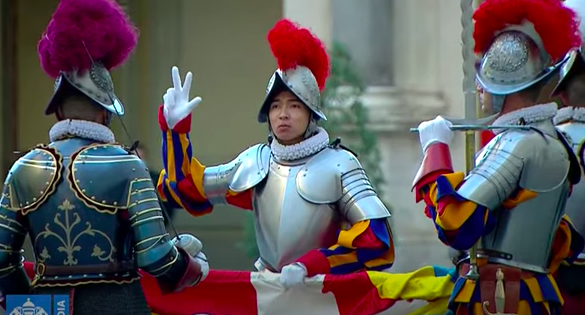
MANILA, Philippines — A Swiss national with Filipino blood was sworn in at the Vatican to join the Pontifical Swiss Guard, an elite military unit tasked to protect the pope.

An article by CBCP News on Friday said 22-year-old Vincent Lüthi became one of the 38 new members of the elite corps who took an oath before Pope Francis on Sunday, Oct. 4.

According to the report, Lüthi is the only child of a Swiss and a Filipina from Sante Fe in Bantayan Island, Cebu. Lüthi was raised in Cugy, Switzerland.

The oath-taking ceremony was set to take place in May but was later postponed in October due to COVID-19 restrictions. The event was also held behind closed doors.

The Pontifical Swiss Guard was established in 1506 with the duty is protect the Vatican, the Apostolic Palace, and the pope.

To earn a spot in the ranks of the Swiss Guards, one must be an unmarried Swiss male, a Catholic and should be “top-notch,” according to the report.

/MUF

Tech whiz Carlo Acutis beatified by Catholic Church

Metro Manila (CNN Philippines, October 11) — Italian computer whiz Carlo Acutis is the first millennial proclaimed “Blessed”, after he was beatified by the Catholic Church Saturday in Assisi, Italy.

The teenager, who devoted his life spreading the faith on the internet before dying of leukemia at the age of 15, was beatified in a Mass at the Basilica of St. Francis of Assisi.

Citing a report from the Catholic News Agency, the Catholic Bishops’ Conference of the Philippines said in its news website that Cardinal Agostino Vallini, the pontifical legate for the Basilica, celebrated the Mass for the beatification ceremony.

Acutis’ heart, which now serves as a relic, was placed near the altar of the church.

Pope Francis also read an apostolic letter declaring October 12 as Acutis’ feast day, to commemorate his death in Milan in 2006.

In his homily, Cardinal Vallini hailed Acutis for using the internet “in service of the Gospel, to reach as many people as possible.”

Before his death, Acutis used his computer programming skills to create a website archiving Eucharistic miracles.

He was designated “Venerable” after the Pope approved a miracle involving the healing of a Brazilian boy who suffered a rare pancreatic disease.

Acutis’ body, dressed in casual clothes which he wore in daily life, is currently displayed in a glass tomb in Assisi’s Sanctuary of the Spoliation in the Church of St. Mary Major until October 17 for veneration, the report added.

Another verified miracle will be needed before Acutis becomes formally hailed as the “patron saint of the internet.” (CNN Philippine Staff, Oct. 11, 2020)