Threats vs rights defenders intensify as military pushes to regulate social media under terror law
“Straight from the horse’s mouth: the military’s proposal to ‘regulate’ social media under the Anti-Terrorism Act clearly isn’t about countering terrorism: they’ll use it to censor dissent and go after legal organizations they have long vilified as ‘terrorists,’” human rights watchdog Karapatan asserted, as the group slammed Southern Luzon Command Chief Lieutenant General Antonio Parlade Jr., also an official of the National Task Force to End Local Communist Armed Conflict (NTF-ELCAC), for expressing support for such proposals yesterday,
Manila is burning: Drag queens get political and they have some things to say
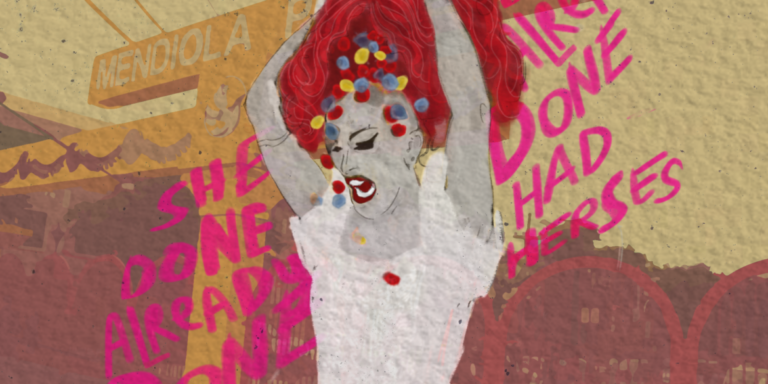
By: Renzo Acosta, INQUIRER.net / June 21, 2020
MANILA, Philippines — Manila is burning. Hell, the world is burning!
Conflicts, violence, and COVID-19 pandemic continue to alter everyday life across the world. Yet, in spite of it all, drag queens remain a constant source of respite and a sense of belonging.
From the iconic films of drag legend Divine to the campy classics The Adventures of Priscilla, Queen of the Desert, and To Wong Foo, Thanks for Everything! Julie Newmar; the essential documentary Paris Is Burning to the groundbreaking TV series Pose; and, of course, the popular herstory-making franchise of RuPaul’s Drag Race. There’s a plethora of content from drag culture that can comfort the weary during these confusing times.
Drag, in its basic sense, is about transformation. It’s a reaction to society’s standards and expectations. However, albeit entertaining at first glance, drag, like any other art form, has always been political. From half a century ago’s queens of Stonewall riots to today’s digital queens, drag has always fought for the downtrodden – all the while wearing seven-inch rhinestone-studded heels.
In celebration of Pride Month, INQUIRER.net talked to six of the country’s fiercest queens about the importance of drag in this period of turmoil.
The art of drag
I always knew I like creating things, whether it’s dressing up our Christmas tree or dressing up for Halloween. When I first transformed in drag, it was like an epiphany. I knew this is something I would do for a long time. It was love at first drag…
As much as the pandemic has taken away the physical interaction that we used to enjoy during our parties, it also opened up more opportunities for the art of drag to be seen and appreciated. In the past, local drag queens and performers can only be seen inside nightclubs and LGBTQ establishments, and a lot of enthusiasts and artists don’t have access to such places, especially minors and those living in the provinces.
Nowadays, I still get to do drag, but more on hosting and co-producing online shows and parties. In doing so, I’m able to gather people and provide platforms for other drag artists to be seen and perform. So far, the reception has been good, especially since online e-numan is slowly becoming the new normal for our patrons in the clubs…
Drag is dynamic, evolving, and very diverse. Here in the Philippines, most people are familiar with drag through impersonators and our trans sisters donned in impeccable gowns. But there are also drag artists with occult or alternative aesthetics, or unpolished makeup skills, or garbage as part of their brand, and those who tell stories onstage that some may not like.
I, for one, am a storyteller. What I do is I incorporate current events or matters of public interest in the songs I perform. By carefully listening to the lyrics of a song, I weave its meaning to my stand on social issues. People may say it’s a political agenda, or that I’m biased or off-putting, but that’s what art does. It’s meant to provoke and challenge ideologies…
Human rights should never be a collateral damage. It is not the law itself that puts the people at risk. It’s the integrity and morality of those enforcing it that predisposes people to danger and makes them fear for their lives. Why would we trust such absolute power to this government?
— Eva Le Queen
Mascots of the LGBT community
I started doing drag as an escape from reality. Just like any other art form, it’s a vehicle for the expression of my alter ego. My drag persona is an extension of who I am as a person.
I see it more as a hobby than work. I tell myself that I will stop doing drag once it starts to feel like work. During this pandemic, it’s so heartwarming to see all these queens, young and old, come together during these hard times…
There’s a Chicago drag queen named TRex who said, “As drag queens, we are the mascots of the LGBT community.” That resonated with me because we have a responsibility to amplify the voices of our community. Just because we’re entertainers doesn’t mean we don’t have a say on political issues.
In this country, those who criticize the government get silenced. That’s why as part of a community of outcasts in a society that conforms deeply to tradition, we make it a point to speak out without fear or reservations. Because at the end of the day, we have to be echoes that will remind our countrymen that we are the generation that never forgets…
It’s crazy. “I am the law.” That’s what’s happening in our country right now. It’s no longer about the law of the state. That’s why the Terror Bill is wrong. If the government can abuse the law against journalists who are only doing their job, they can surely do it to anyone.
The problem is, supporters of politicians act like fandoms. It shouldn’t be that way. They hold their positions because the people put them there. But, really, what can we expect from this government? You elect a clown, expect a circus.
—ØV CÜNT
Disturbing the comfortable
Drag is a matter of creating your own reality, and in creating your identity, you get to choose the traits that you want to embody. I believe that it’s a melting pot of everything I’ve learned in life, especially from theater and the arts.
As drag queens, we get to break the social norms, and we do it with more power and confidence than we ever thought we had.
Drag is art, and art in general is meant to comfort the disturbed and disturb the comfortable. It’s a fun way of looking at what’s happening in our society and of doing checks and balances. Drag queens have always been integral in the LGBT movement, and removing politics from a drag queen is the same as removing that person’s identity…
Ever since the lockdown, more newbies have joined the scene, and they even get to perform with the more veteran queens. People aren’t that busy so we get to interact with each other. Queens from different clubs and cities finally get the chance to collaborate. Everyone gets a level playing field.
At the same time, it’s also challenging because it’s still a live show, so you still have to put in the effort. There’s no assurance of a talent fee, and the attention span of netizens is so short, especially with so many things competing for their attention online. It’s a different stage, too. We’re constricted to the screens of other people’s devices…
I always try to make my drag fun, but it depends on the mood, the sound, and the message. Same with crafting any other performance, there has to be a story. You should get the audience hooked and there has to be an escalation and climax. Whether you make it subtle or literal, the message always has to come across.
For me, the message is often about coming together as so-called deviants and telling people who we are and demanding what is ours, or telling people that we are not a sin and that being ourselves is good enough.
—Mrs. Tan
Drag is unbreakable
I did drag for the first time by joining Drag Cartel back in November 2017. It’s a competition for aspiring drag queens. Category for the night was “Disney On Ice,” so I came as Prince Charming in drag. That night, I won, and from there, my love for drag just bloomed.
I do it because it makes me do things that I’d normally just fantasize about. It’s a realization of the things that give me inspiration. The look, the makeup, the attitude. Even though it takes a lot of time, effort, and money, and even though my face breaks out and I get physically hurt while performing, living that fantasy is still the best feeling…
“Keep drag alive” is what we always say, and that goes for togetherness. For drag queens, drag enthusiasts, and drag lovers to maximize the power of social media and uplift queer artists to keep pushing, and to show that this pandemic is not a reason to stop doing what you love…
Drag is a middle finger to all forms of hatred, homophobia, discrimination, social injustice, and stigma…
What’s going on in our country is so overwhelming that I’m often left speechless. Every day I scroll through my feed and I see one issue after another, and it makes me feel sick. I’m disgusted by the people responsible for all this mess.
I just hope people will take note of those in power who haven’t done anything good for this country. I hope that come election season, the people will remember what’s going on now and who’s responsible. I hope they vote for the right people. That’s all we can do as Filipinos.
—PRINCE
An image of hope
I started doing drag April of 2019 when I met a few drag queens (now my drag sisters and best friends) who helped me build my drag persona. I have always been very flamboyant and effeminate growing up, and drag opened up the possibilities for me to express those traits even further. Before, I was just doing it for self-discovery, but now, it’s for the community as well.
Drag is about finding the courage to create an image of hope and fulfilment for yourself that could later on affect other people’s lives…
The local scene has been very resilient when it comes to this pandemic. This is a living proof that drag is possible even without clubs and big venues. Just like wild grass, it’s bound to find a way to grow on its own no matter what…
Drag has always been political, and expressing my thoughts on socio-political issues through performances, public posts, online protests, and family and peer conversations is a way for me to maximize my drag as a political medium.
With everything that we’re facing right now, I think a lot of people are scared for their own safety more than ever. Aside from the unresolved coronavirus crisis, it’s really frightening to witness the recent displays of abuse of power and the questionable decisions of this government.
As a member of a community that has long been experiencing inequality, discrimination, and unlawful acts, I am deeply saddened with how all of this misconduct diminishes my hopes for a country free from oppression.
—Marina Summers
On the right side of history
Drag is my art, my craft, and my passion. Without it, I’m incomplete. It’s an alternative persona but it’s also part of my identity. It is the Juliet to my Romeo.
My interest in drag started after I saw the film To Wong Foo, Thanks for Everything! Julie Newmar. The glitz and glamour was so fascinating, and I immediately wanted to be part of that world.
People may see us as glamorous toads with a million rhinestones in 7-inch heels but, girl, it’s not as easy as it looks. Drag is not just crossdressing. It’s a transformation.
Drag queens are probably the most resilient and most creative people I know. Drag is thriving even on lockdown. There are a lot of online shows for all to see. We figured out a new way of showcasing our chops. We will survive this…
Drag is political. It was, it is, and it always will be. Periodt. I am a full-grown adult man dressed up to the nines, looking like Joan Crawford after losing the Oscars. It’s a big middle-finger to toxic masculinity and misogyny.
I like to think I have a considerable amount of following, which means I have a platform. I always have a choice, just like everybody else. One can choose to stay quiet, which effectively means choosing the side of the oppressors. Or I, a drag queen, can choose to be part of a positive change and help inspire a new generation of people who are not afraid to express themselves, political or otherwise.
I want to end on the right side of history. As a drag queen, I believe I can do that.
—Dee Dee Holliday
(Editor’s note: Sources’ statements in this article have been translated and edited for brevity and clarity, as some remarks were conveyed in mixed Filipino and English, but remain truthful to the context of their respective ideas or points of view.)
KGA
GOD SAVE THE QUEENS Support your local drag queens by checking them out on social media. DragPlayhouse PH, a Filipino drag-related content and events group, hosts virtual balls, podcasts, and parties for all. Don’t forget to tip!
Remittances in peril
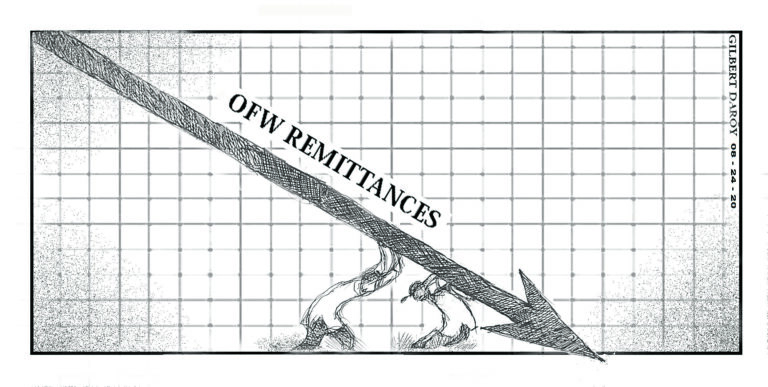
Philippine Daily Inquirer / 04:08 AM August 24, 2020
How bad has been the downturn in the remittances of overseas Filipino workers (OFWs), long a lifeline of the Philippine economy but which have been battered by the worldwide pandemic as tens of thousands of OFWs have lost their jobs and are streaming home?
For three straight months starting last March, OFW remittances contracted. In March, the inflows declined by 5.2 percent year-on-year to $2.65 billion. The Bangko Sentral ng Pilipinas (BSP) attributed this chiefly to labor cutbacks in the oil industry of the Middle East following the collapse in crude prices.
In April, remittances fell sharply by 16.1 percent to $2.28 billion, which the BSP blamed on the layoff of OFWs in countries heavily affected by the pandemic and the temporary closure during the lockdown of some banks that provide money transfer services. In May, the decline worsened to 19.2 percent to $2.34 billion, as global economic activity, especially travel and employment, reeled from the pandemic, resulting in massive job losses or the deferred hiring of many OFWs.
An uptick was recorded in June, but the increase in the amount of dollars sent home that month by Filipinos abroad is by no means an indication that the lot of migrant workers—and our consumer-driven economy for that matter—has turned the corner. The global economic recession is expected to linger as countries struggle to contain the pandemic. Like the Philippines, many other nations both developing and advanced are suffering unprecedented economic declines. Japan, for instance, reported a 27.8-percent contraction in the second quarter. The US economy shrank by a bigger 32.9 percent.
Household consumption accounts for two-thirds of the Philippine economy. This consumption, in turn, is partly driven by the dollars sent home by the more than 10 million Filipinos working abroad. Last year, they remitted $33.5 billion (about P168 billion at current exchange rates) to their families here, or the equivalent of 9.3 percent of the country’s gross domestic product (GDP). These remittances have for decades fueled domestic consumption and cushioned the economy against external shocks. It is estimated that about 12 percent of Philippine households depend on the remittances that OFWs send.
However, such cash inflows have now considerably slowed down with the COVID-19-induced recession. Data from the Department of Labor and Employment (DOLE) showed that the number of OFWs seeking assistance due to the effects of the pandemic had surged to more than 600,000 as of Aug. 15, of which less than half or 272,000 had been approved.
Of those seeking assistance, 349,977 are workers displaced and stranded overseas, while 254,426 are repatriated land- and sea-based OFWs. The DOLE provides a one-time $200 or P10,000 assistance to migrant workers affected by the pandemic. As of Aug. 15, more than half (146,658) of the OFWs who arrived in Manila have been transported back to their home provinces.
It is now a given that in 2020, remittances will shrink for the first time since 2001, when inflows from OFWs were down by 0.3 percent. The government expects remittances this year to contract by about 20 percent. That’s $7 billion less inflows into the pockets of millions of Filipino families, many of whom are struggling as the country internally staggers from the impact of the pandemic.
For years, the availability of cash from such remittances allowed the Filipino populace to spend readily and fuel the boom in the country’s consumer-driven economy. But the flush times are over, at least for now. OFWs are forecast to be particularly hit hard as COVID-19 shutdowns worldwide continue to affect sectors employing migrants, in particular restaurants and tourism services, and retail and wholesale trade.
As it is, while these modern-day heroes have lost their jobs, many continue to suffer upon returning home because the government can’t seem to cope with the extent of the crisis. No comprehensive plan is in place to address the plight of displaced OFWs. With thousands of them still stranded in Metro Manila and even abroad, the administration needs to tap, as an immediate measure, the private sector in carrying out the testing and quarantine of returning OFWs in the capital, ferrying them to their home provinces, and finding livelihood for them and their families. Part of the government’s stimulus package must also go to helping these displaced OFWs.
What has become clear at this point is that OFW remittances, on which the Philippine economy has depended for far too long, are also not insulated from economic crises. The long-term challenge for this administration, and succeeding ones, is how to make the economy less vulnerable to such disruptions by weaning the country away from its long-staying labor-export policy that has spawned the Filipino diaspora, and building a truly self-sufficient national economy with jobs for all.
There is more to graffiti than ‘making a mess,’ activists say
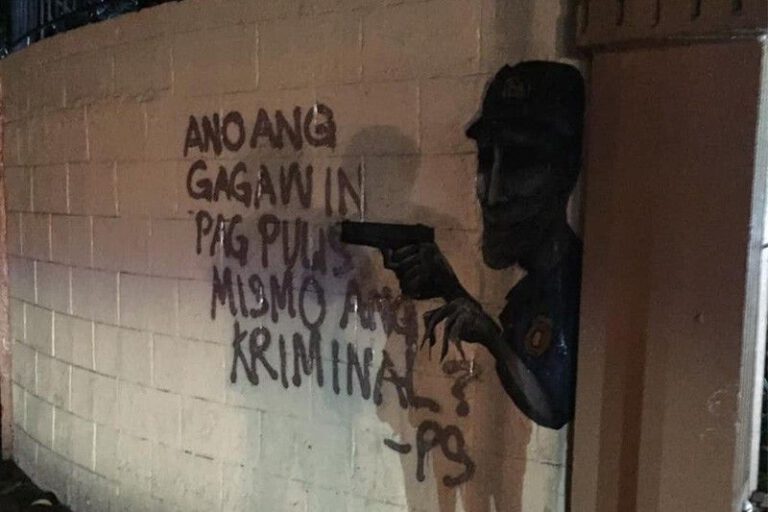
Ratziel San Juan (Philstar.com) – November 13, 2019
MANILA, Philippines — Progressive artist group Panday Sining has been under fire for painting protest slogans such as “Presyo, Ibaba! Sahod, Itaas!” and “US-China Layas!” at the Lagusnilad underpass in Manila.
The city’s Department of Engineering and Public Works has since led the repainting of the affected portions of the underpass near the city hall, but Mayor Isko Moreno’s message remains: “Kapag nahuli ko kayo, ipadidila ko sa inyo ito.” (If I catch you, I will make you wipe that off with your tongue.)
“Ang ganda ganda na eh. Ang linis na. (It’s already beautiful. It’s now clean.) It took 15 years for that underpass to be attended. Nobody attended to that underpass,” Moreno, who led clearing operations in the underpass in July, said.
“Kayo ang nambababoy eh. Hindi makatwiran ‘yan. (You’re the one who made a mess. That’s not reasonable.) We don’t deserve this. The people of Manila don’t deserve this.”
The Manila City government reminded the public through social media that its anti-vandalism ordinance—Ordinance No. 7971—prohibits any person from defacing public and private property.
Panday Sining, however, maintained that its reasons for tagging the underpass are valid.
“To the public: sorry for the inconvenience, but the matter and issues at hand are urgent. Left and right, ordinary people are being killed or jailed for criticizing this corrupt and fascist government,” Panday Sining said in a Tuesday post.
“The space for peaceful and democratic speech is already being compromised by the regime…That is why Panday Sining, a cultural organization of the youth, conducted its Graffiesta as a response to these worsening economic and political state of the nation.”
Panday Sining asserted that what the government calls vandalism, it sees as protest art.
What is protest art, anyway?
The late art critic and UP professor Alice Guillermo wrote that protest art—also termed revolutionary or progressive art—breaks down the academic and elitist notions associated with traditional forms that rely on inaccessible media like oil on canvas.
Protest art may take the form of posters, illustrations, comic books, graffiti, street murals, and other popular media less likely to alienate the audience. The important thing is that they are “infused with meaningful political content.”
Simple to make while still applying universal standards of aesthetics, protest art is designed to have a broad appeal fit to deliver the most important part of the piece: its message.
“Instead of the ideal of the masterpiece, revolutionary art is responsive to issues and creates attitudes with respect to daily events. Therefore, its value lies in its flexibility, its sensitivity to issues, and its quickness to respond,” Guillermo wrote in 1993.
“Likewise, instead of the ideal of permanence, much of art done in the midst of struggle, because of the necessity for quick campaigns along with the risks involved, is transitory, like graffiti and instant street murals, but always fresh, renewable, and inexhaustible.”
In the local setting, creating progressive art means understanding the cultural situation of the Philippines and its people. It also entails learning from and directly addressing different classes and sectors like farmers and workers.
Contemporary art scientist Alain Colombini wrote that while graffiti exists across many societies with different cultural contexts, a common motivation exists.
“Modes of expression are mainly related to visibility, notoriety, choice of venue, transgression, and are often a mean to react and protest while remaining anonymous, by illegally introducing messages in the public space,” Colombini wrote in 2018.
The resulting debate is if graffiti (text-based) and street art (image-based) constitute as art or a mere act of vandalism.
Why do people resort to protest art?
Donna Miranda of SAKA (Sama-samang Artista para sa Kilusang Agraryo), a group of artists and peasant advocates, told Philstar.com that even under the legal framework, there is no nationwide law that prohibits vandalism.
Miranda said that while ordinances penalize graffiti and street art in cities like Manila, it can be argued that national and constitutionally-guaranteed rights should have more weight.
“Napakahalagang mensahe no’n (Panday Sining graffiti) para sa masang Pilipino. Sinasabi no’n protektahan ang ating soberanya. At binura ‘yun ng LGU ng Manila.”
(The Panday Sining graffiti has an important message for the Filipino people. It says that we should defend our sovereignty. And the Manila local government unity erased that.)
“May malaking sinasabi ‘yun sa panunupil ng ating karapatan, hindi lang magpahayag pero ng ating assertion ng ating karapatan for self-determination and sovereignty.”
(That says a lot about how our rights are repressed, not just to freedom of expression but also our assertion of our right to self-determination and sovereignty.)
‘Street art accepted abroad’
Miranda also said that street art itself is not controversial and has already been accepted in the field of art as a legitimate form, citing murals, commissioned and otherwise, that have become popular locally and abroad.
“‘Yung street art makikita na natin siya in a way halos tinanggap na siya nung art institution, lalong lalo na yung mga sikat na artists katulad nina Banksy…[at sa] BGC, maging sa ibang lugar kunwari Singapore at sa Melbourne — halos tourist areas yung mga lugar na punong puno ng street art.”
(Street art is virtually accepted by the art institution, especially with famous artists like Banksy…and in places like Bonifacio Global City, Singapore, and Melbourne — street-art filled locations have practically become tourist areas.)
Street and protest art are featured in documentaries like “Exit Through the Gift Shop” (2010) and books such as “Trespass: A History Of Uncommissioned Urban Art” (2010).
The message and not the form of protest art, Miranda says, is what polarizes, since these usually depict underreported issues only heard of in activist circles.
“[S]omehow, ‘pag yung graffiti ay nagpapahayag ng mga panawagan tulad ng ‘itaas ang sahod’ o protektahan ang soberanya ng isang bansa, hindi na ito katanggap tanggap.”
(Somehow, if the graffiti calls for rights like ‘raise wages’ or to protect the sovereignty of a nation, it becomes unacceptable.)
“Yung mismong cities pag ang nagko-commision, pero pag nagapanawagan ka ng tunay na reporma sa lupa…bakit sinusupil ‘yun?”
(Cities themselves commission street art, but when the works call for genuine agrarian reform, why is it censored?)
Vandalism in plain sight
Iconic street artist Banksy himself has weighed in on negative sentiments against street art and the not-so-controversial presence of advertising in our lives.
“To some people breaking into property and painting it might seem a little inconsiderate, but in reality, the 30 square centimeters of your brain are trespassed upon every day by teams of marketing experts,” iconic street artist Banksy said.
“Graffiti is a perfectly proportionate response to being sold unattainable goals by a society obsessed with status and infamy. Graffiti is the sight of an unregulated free market getting the kind of art it deserves.” PA
Rep. Castro ng Makabayan Bloc, nagsalita hinggil sa revolutionary government
Nagbigay-pahayag si Rep. France Castro ng Makabayan Bloc kaugnay ng nilulutong ‘revolutionary government’ ng mga taga-suporta ni Pangulong Duterte nitong nakalipas na linggo.
The post Rep. Castro ng Makabayan Bloc, nagsalita hinggil sa revolutionary government appeared first on Kodao Productions.
Negros rights group disputes AFP claim of ‘encounter’ in killing of civilian
Guihulngan City – Human rights group HUSTISYA Guihilngan refutes the AFP’s claim of an encounter with the New People’s Army (NPA) on August 14 that killed a civilian in Guihulngan City.
In a statement, the group said that there was no encounter, and that the 62nd Infantry Battalion did not kill an NPA fighter but a civilian. Government troops also harassed other residents in Sitio Maluy-a in Brgy. Sandayao, the group said.
HUSTISYA reported that 24-year-old Reken Remasog was shot dead and was found with his legs amputated and with other signs of physical violence. His younger brother, 17-year-old Reniel Remasog, was arrested together with two other minors Meriam, 17 and Mary Ann, 15, who were in the area only because they were charging their phones and hoping to get a better phone signal.
The arrested youth were reportedly brought to a CAFGU detachment in Brgy. Sandayao. HUSTISYA and child rights group Children’s Rehabilitation Center have called for the immediate release of the three minors.
Other cases of harassment had been reported in the barangay. HUSTISYA Guihulngan spokesperson Lea Nellis said that government troops ransacked the house of Delia Carahasan Tenianu, a 55-year-old farmer. After rummaging through her clothes and corn harvest, the soldiers reportedly fired a gun near her ear, leaving her traumatized.
Nellis also shared the group’s findings on the case of the Remasog siblings: “Base sa gilunsad nga pagpang-usisa sa HUSTISYA sa mao nga lugar, si Rekem ug Reniel Remasog mga residente sang brgy. Luz, Guihulngan City, bag-o nibalhin og puyo sa Sitio Maluy-a tungod sa grabe nga kahadlok sa gihimo sa ilaha sa ilang lugar nga gigikanan. Niadtong bulan sa Marso gipatawag sila sa 62nd IBPA sa balay sa ilang kapitan sa baryo ug giimbistiga sa nahitabong ambush niadtong Marso 3, 2020, 2 ka adlaw human sa pagpatawag kanila, dunay unom ka tawo nga nisaka sa ilang balay nga nakabonet ug wala nailhan sa ilang mga silingan, pagkabulan sa Mayo, gisunog ang ilang balay sa mga gisupetsuhan nga mga katapu sa 62nd IBPA uban sa ilang mga asset sakop sa Brgy. Luz nga nailhan sa mga lumulupyo. Kini amo ang hinungdan nga nibalhin sila og puyo sa Sitio Maluy-a tungod sa tuman nga kahadlok.”
(Based on HUSTISYA’s fact-finding report, Rekem and Reniel Remasog used to be residents of Brgy. Luz before they transferred to Sito Maluy-a out of extreme fear from incidents in their last residence. In March 2020, they were summoned by the 62nd IBPA to the house of the barangay captain to investigate a supposed “March 3 ambush”. Two days after they were called, around 6 unidentified people with bonnets came to their house. In May, their house was burned by suspected elements of 62nd IBPA together with some of their “assets” in Brgy. Luz. They were all identified by the residents. This is the reason why the family transferred to Sitio Maluy-a.)
The AFP earlier reported the statement of 303rd Brigade Commander Col. Inocencio Pasaporte, who said that the military responded to an information of NPA presence in Brgy. Sandayao.
But the Leonardo Panaligan Command-Negros Guerilla Front on its website explained that the AFP attack was a retaliation against citizens, and denounced the AFP’s “fake encounter”. It added that the AFP’s claim that military paraphernalia was retrieved in the area was also fake. Ka JB Regalado, spokesperson of the LPC-NPA, said that “the NPA ambushed the AFP in Sitio Tabago (around 2 kilometers away from Sitio Maluy-A which takes 1 hour on foot) in the same barangay, leaving at least 10 troops killed-in-action while the NPA safely maneuvered away from the encounter site, with no casualty. The arrival of helicopters was in fact an affirmation that they were rushing to cover-up the fatalities.”
“The AFP’s retaliatory acts are being vented out against innocent civilians, prompting even more to join the armed struggle for a just and lasting peace,” the statement read.
HUSTISYA Central Negros called on the Commission on Human Rights to investigate the human rights violations in Guihulngan City and to take action on the elements of the military involved in these crimes. The group also appealed to various sectors and groups to show their support for the victims.
The post Negros rights group disputes AFP claim of ‘encounter’ in killing of civilian appeared first on AlterMidya.
Carlito Badion’s infectious courage
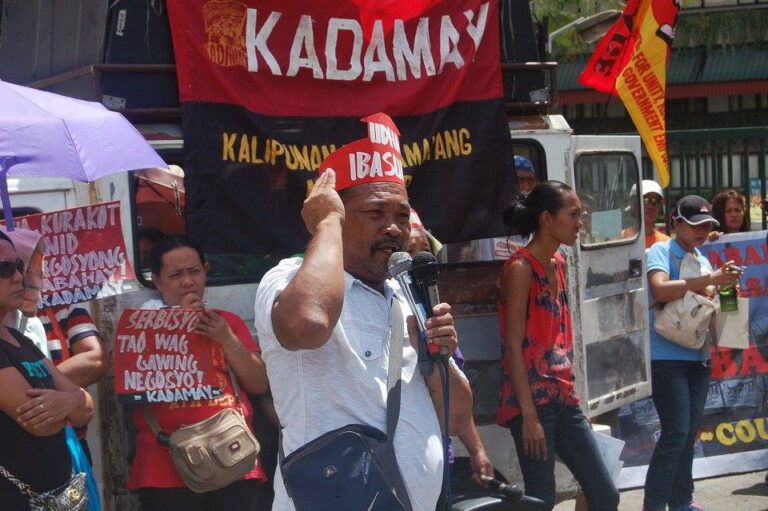
Carlito Badion, known for his indubitable courage, was an effective urban poor leader because he knew poverty like the palm of his hand.
By RONALYN V. OLEA
Bulatlat.com
MANILA – “Retreat first,” Carlito Badion told the ground commander of the Philippine National Police during one of the demolition attempts at sitio San Roque in Quezon City some years ago.
This was how Chester Arcilla, an academic who was doing his immersion in urban poor communities for his research, remembered the late Kadamay secretary general.
In a gathering of Kadamay members and allies Saturday afternoon at the Commission on Human Rights, Arcilla said he was amused as Badion, the command of the barricade, faced the phalanx of policemen with shields and batons. Badion, who limped and leaned to one side while walking due to polio, led the residents in defending their right to stay in their shanties amid threats of eviction.
“I asked myself where did his courage come from. His courage came from his belief that the masses can stand up to police violence,” Arcilla said.
That kind of courage he spread and grew in the cities’ slums.
Estrelita Bagasbas, one of the known leaders of San Roque, said she was mentored by Badion, whom they fondly called Ka Karletz.
During Badion’s early visits to their community, Bagasbas admitted she would hide from him.
“He would always scold me for being hesitant and shy. He would tell us, ‘I will stop going here so you’ll learn how to stand up and fight even without me,’” Bagasbas said. “It is you, residents of San Roque, who should be staunchest in defending your community,” Bagasbas recalled Badion as saying.
And Badion did what he said. Bagasbas and the others were compelled to step up. Today, Bagasbas proudly proclaimed that they established new Kadamay chapters.
“There are now many Karletz,” she said, teary-eyed.
Protesters light candles in honor of Badion & as a symbol of their call for justice pic.twitter.com/fRPZSbUqt2
— Bulatlat (@bulatlat) August 22, 2020
Badion was found dead near the Pagsanga-an River in Ormoc City on May 28. For years, Badion eluded suspected state agents tailing him. At the height of the occupy idle government housing campaign in Pandi, Bulacan, no less than President Duterte said that should the urban poor decide to do it again, “my order is for government forces to drive you away. Either they will strike you with clubs, or if you resist, I will have them shoot you down.”
Lea Maralit of Kadamay-Bulacan recalled four men looking for Badion in Pandi, where idle housing units were occupied by urban poor. She said Badion, whom she called Tatay, bid them goodbye one day, saying he had to take security precautions.
Like Bagasbas, Maralit learned the ropes from Badion. She recalled first seeing him in August 2016, while they were campaigning for access to water and electricity for the relocation site in Pandi.
“I was drawn to him because he was such a good speaker,” Maralit said. “We had been ignored by various government agencies. He accompanied us to the municipal hall and I did not realize I was already joining my first rally,” she said, smiling.
Badion was also the one who pushed Maralit to become a good leader. “He would always tell me to speak from the heart, to speak from my own experiences,” Maralit said.
Badion’s being easy-going endeared him even more to those he organized.
Maralit described Badion as “kengkoy” (funny) to the point of making fun out of his being limp. “He would exaggerate his difficulty in walking properly and insisted on going to that hilly part in Pandi,” Maralit said.
Arcilla recalled that even in tense situations like demolition, Badion would still manage to crack a joke.
True leader of the masses
Badion was an effective Kadamay leader because he knew poverty like the palm of his hand.
Badion was a worker at a garments factory. He survived the Payatas tragedy, or the incident on July 10, 2000 when a mountain of garbage collapsed in barangay Lupang Pangako in Payatas dump, burying alive more than 300 residents.
He was among those who relocated in Montalban (now Rodriguez), Rizal. The miserable situation there made him join campaigns for the assertion of their rights and welfare. It was here when he became an active member of Kadamay.
ATM. Kadamay pays tribute to urban poor leader Carlito Badion who was gunned down on May 26. pic.twitter.com/LeZryRjmsL
— Bulatlat (@bulatlat) August 22, 2020
Years later, in 2012, Badion was elected Kadamay secretary general. He was instrumental in the formation of Alyansa Kontra Demolisyon, which led barikadang bayan (people’s barricade) in communities.
Pandong Rubis said the Plastikan community in Commonwealth was able to weather demolition threats due to Badion’s guidance. The community literally lives on plastic materials, which they collect and sell to junk shops.
“He taught us that even though we’re poor, we have rights, too,” Pandong said during the tribute to Badion.
Good husband, doting father
His commitment to the cause of the poor made him a target of different forms of harassment by state security forces. His wife Marites was dead worried about his security.
“It was what he wanted to do, to serve the people,” Marites said, adding she still could not accept that her husband is gone.
His daughter Esther Ann misses her Papa so much she still cries every night. “I’m really my Papa’s girl. I know how much he loved me,” she said.
No matter how busy he was, Badion would always attend to the needs of his only child. Badion personally sewed Esther Ann’s pink gown for her debut. They had a simple celebration at the Kadamay office.
“He would have wanted to accompany me on stage for my graduation,” Esther Ann, who expects to finish her course this year, said. “That won’t happen anymore.”
Still, Esther Ann said she knows that her Papa wants her to be strong.
Inspiration
For Maralit, Bagasbas and Rubis, Badion’s life is a shining example they wish to emulate.
Now that the Pandi community is confronted with heightened harassment from state security forces, Maralit admitted she also feels afraid. “I draw inspiration from Tatay, who would always tell me to trust in the masses, that there is nothing we could not win if we are united.”
Badion’s courage is supplanted in communities, never to be extinguished by the enemies of the downtrodden.

The post Carlito Badion’s infectious courage appeared first on Bulatlat.