It has been over 130 days since the start of COVID-19 lockdowns,
yet government help for families most affected by the crisis remains
snail-paced, measly, and even much less than promised.
The inadequacy of the Social Amelioration Program (SAP)
underscores the government’s failure to address the plight of the most
vulnerable Filipinos in the time of COVID-19. The Duterte administration’s hype
that it is close to completing the distribution of the second tranche of SAP
also conceals how many Filipinos will not get aid that they still badly need.
Lockdowns have been extended in many areas because COVID-19
continues to spread so economic activity is resuming unevenly. However, too little
is being done to protect millions of families from the prolonged joblessness
and loss of incomes.
The Bayanihan to Heal as One law promised to give emergency
cash subsidies to 18 million low-income families from vulnerable sectors whose
jobs and incomes were disrupted by the COVID-19 lockdown. The SAP was supposed
to give Php5,000-8,000 per month for two months. The number of target
beneficiary households was originally identified at 17,741,405 by the
Department of Social Welfare and Development (DSWD). Its Memorandum 14-2020
later added another five million needy families to receive aid – also called
wait-listed families – which brought the total number of SAP beneficiaries to
22.7 million.
Broken promise. The burst of generosity was not as
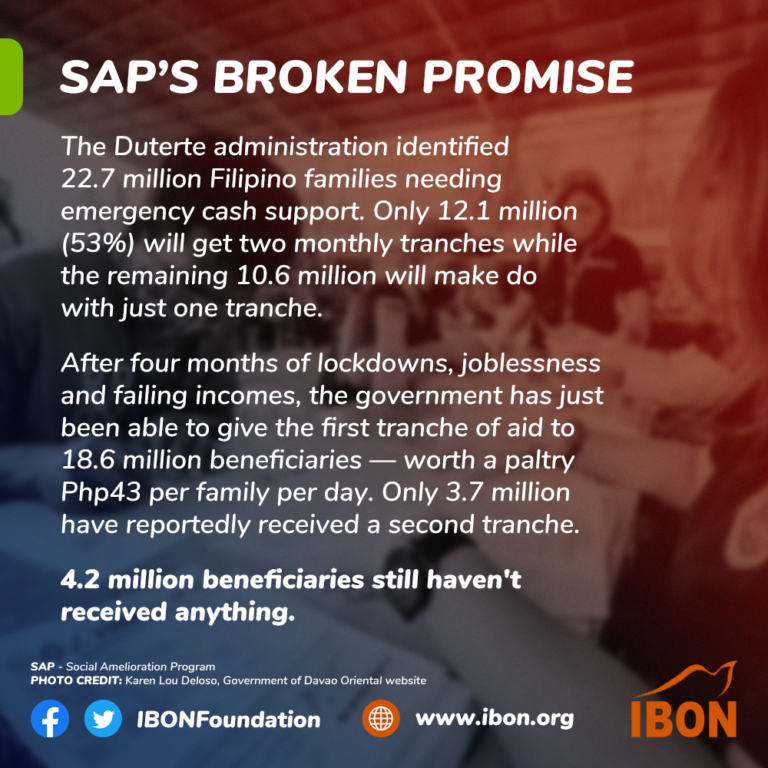
it seemed. As it turns out, 10.6 million or almost half (47%) of the 22.7
million beneficiaries will only get one of the two promised tranches. The
government backtracked and eventually said that residents of areas declared
under general community quarantine (GCQ) or modified GCQ as of June 15 would
not be getting the second wave of aid after all.
Consequently, only 12.1 million or a little over half (53%) of SAP
beneficiaries residing in enhanced/modified enhanced community quarantine
(ECQ/MECQ) areas will get both tranches. This includes 8.6 million households
in Region 3 (except Aurora), National Capital Region (NCR), Calabarzon,
Benguet, Pangasinan, Ilo-ilo, Cebu province, Bacolod City, Davao City,
Albay province, and Zamboanga City. Also, only 3.5 million of the wait-listed
families are covered.
The government is supposed to have already spent Php374.9 billion
for COVID-19 response of which Php200.9 billion went to the DSWD, Php12.5
billion to the Department of Labor and Employment (DOLE), and Php11 billion to the
Department of Agriculture (DA). Has everyone in need been helped?
Overdue. Aid is actually very slow in coming, according to data as of July 22. Although some 17.45 million beneficiaries were able to get their first tranche the majority had to wait at least 6-10 weeks for this.
Of these, 3.7 million or 31% of the target 12.1 million reportedly
also already received their second SAP tranche. Malacañang said that 80% of
those supposed to receive a second tranche will get the amount before the end
of July. This is very late though. Beneficiaries presumably should have gotten
their first tranche around mid-April, or a month into the lockdowns, and the
second tranche correspondingly by mid-May. Receiving the second tranche only
now is over two months late.
But these late recipients are actually the lucky ones. As of July
22 or over four months of lockdowns, around 4.18 million still haven’t received
anything – 288,637 from the initial 17.7 million target beneficiaries, and
based on reports, 3.9 million of the five million wait-listed families. This
sadly includes 62,509 Pantawid Pamilyang Pilipino Program (4Ps)
beneficiaries who are among the poorest of the poor in the country.
Inadequate. And it is not as if the aid being
given is substantial. The Php98.5 billion distributed to 17.45 million
household for the first tranche averages to Php5,645 per family. This amounts
to just Php43 daily per family when spread over the 130 days since the lockdown
was imposed. Those receiving a second tranche may double this but, still, Php86
is a paltry amount to stretch over four months of having no, low, or unstable
incomes. Expenses for food, rent, utilities and even debt continued or, at
best, were only momentarily delayed by the lockdowns.
Too many families will not get the “Php5,000-8,000” monthly
promised. This is because the actual cash subsidies disbursed per household
depends on the minimum wage of the region where the beneficiary resides, as per
the DSWD’s Joint Memorandum Circular No. 2 Series of 2020 (JMC No. 2-2020). The
maximum subsidy per family is: Php5,000 in Regions 5, 8, 9, 12, CARAGA and
ARMM; Php5,500 in CAR and Regions 1 and 2; Php6,000 in Regions 6, 7, 10 and 11;
and Php6,500 in Regions 3 and 4A. The Php8,000 maximum subsidy is only given in
the NCR.
Moreover, those already receiving 4Ps, DOLE and DA assistance will
have these equivalent amounts deducted from the maximum regional subsidy. As it
turns out, the DSWD does not necessarily give the emergency cash subsidy in its
entirety and in many cases just tops up existing amounts received from other
programs.
The biggest subsidy is supposedly in NCR. Even assuming that
households here all get their second tranche by end July, their cash aid only
amounts to Php118 per family if spread across 136 days (March 16-July 30). This
may buy a family of five a kilo of rice and viand for a day but does not leave
much for any other essential needs.
Social welfare advocates say there should even be a third and
fourth tranche especially because the lockdown extended beyond the two months
stipulated in the Bayanihan law. Unfortunately, even as the lockdowns were just
starting, the Duterte administration already insisted that it was running low
on funds and that not everyone can get “ayuda”.
Chaotic. The SAP is not just limited and stingy by design – it has also
been implemented poorly. Distribution of the first tranche was marred with
controversy and reportedly even corruption. This includes authorities dividing
a single pay-out into several parts for different households, beneficiaries
receiving very small amounts or receiving the maximum subsidy twice, and
low-income households not receiving aid at all while better-off households do.
Other irregularities include ineligible beneficiaries in GCQ areas
still receiving a second tranche, wait-listed beneficiaries already lined up to
get a second tranche, and confusing monitoring of the second tranche and the
wait-listed beneficiaries.
The DSWD also explains delays in proceeding with pay-outs as due
to its “de-duplicating” and certifying all the other non-4Ps names submitted by
the local government units (LGUs). This process will cover the original 17.7
million beneficiaries as well as the additional five million wait-listed
beneficiaries. It says that 81,000 duplications have so far been discovered.
All these bureaucratic inefficiencies are delaying completion of
the first and second tranche payouts, and government’s lack of will to resolve
them is just making the public suffer even more.
Falling short. The administration boasts of
giving SAP to millions of families, but it is silent on how millions affected
by the pandemic lockdown are still left behind.
IBON estimates some 15.9 million formal and informal workers
displaced by the lockdown. Yet DOLE’s COVID-19 Adjustment Measures Program
(CAMP) and Tulong Panghanapbuhay sa Ating Disadvantaged/Displaced Workers
(TUPAD) beneficiaries numbered only 557,924.
The livelihoods of around 9.7 million farmers and fisherfolk were
also disrupted, but only 1.2 million were targeted as beneficiaries of DA’s
Rice Farmers Financial Assistance (RFFA) and Financial Subsidy to Rice Farmers
(FSRF) programs.
The 10.6 million families who were in ECQ/MECQ areas won’t be
getting their promised second tranche because this took so long in coming and
the aid was not given out before lockdown restrictions were relaxed. They are
expected to now fend for themselves even as livelihoods remain unstable and
millions are still without jobs.
Transform SAP. All these SAP troubles are preventing
much-needed help from reaching all of the poorest Filipinos grappling with the
COVID-19 crisis. It is far behind schedule, grossly insufficient, and leaves
behind millions who are still reeling from joblessness and falling incomes. Yet
it is very much possible to give sufficient aid swiftly and efficiently.
The Philippines can draw lessons from cash transfer systems in
Vietnam and Fiji during disasters. When tropical Cyclone Winston hit Fiji in
2015, the government gave its unconditional cash voucher assistance (CVA) to
needy coastal citizens’ mainly through their mobile phones. The United Nations
Office for Disaster Risk Reduction said Fiji “was able to reduce the impact of
the disaster on the poorest by more than 20 percent”. When Typhoon Ketsana struck
Vietnam in 2015, the government, humanitarian organizations and affected
communities worked closely together to ensure timely and transparent delivery
of financial assistance.
There are also positive local practices to build on closer to
home. Some NCR LGUs ensured funding to provide financial assistance to all
households under their jurisdiction. Better-off families waived their share in
the spirit of ensuring that there would be enough for those in need. Other LGUs
used their pre-COVID database of constituents and channeled cash transfers
unconditionally to each adult resident through financial service providers
(FSP).
The SAP difficulties highlight the limitations of the country’s social protection systems, not just during disasters but in the course of daily underdevelopment. A genuinely compassionate government would not just fix the system of SAP to ensure expedient socioeconomic relief alongside boosting public health capacity as the people’s supposed shield against the pandemic.
A genuinely compassionate government would also fix the Philippine economy to be ready when the next pandemics and crises strike. This means building strong local agricultural and industrial sectors providing stable jobs and incomes and also the facilities and infrastructure for meeting the people’s and the nation’s basic essential and development needs.