Home Blog Page 160

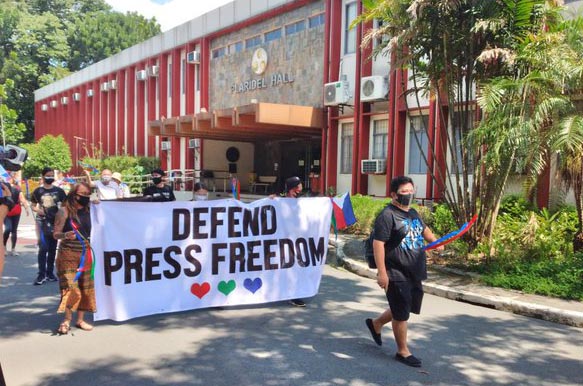
Journalists urge public to defend press freedom

ABS-CBN employees and supporters join #SONAgkaisa protest, July 27. (Photo by Aaron Macaraeg/Bulatlat)

“Never since the late unlamented Marcos dictatorship has a president ever deigned to shut down the independent media and stifle criticism and dissent.”

By ALYSSA MAE CLARIN
Bulatlat.com

MANILA– For the first time, former ABS-CBN senior correspondent Ces Drilon went to a protest not to cover the event but to speak before the crowd.

With her voice shaking, the veteran journalist read her prepared speech in Filipino. “I am standing here as a representative of the Filipino people who should have been enjoying freedom of the press,” she said.

“Freedom of the press is an important foundation of our democracy,” Drilon told thousands who gathered at the University of the Philippines in Diliman, Quezon City hours before President Rodrigo Duterte delivered his fifth State of the Nation Address. “It is a right of every Filipino, and it is not a privilege, as said by our president.”

Drilon said the media serves as the voice of the ordinary citizens, whose pleas are continuously ignored by government. The media, according to Drilon, also has the duty of uncovering the abuse and corruption of those in office.

She spoke as one of the media workers who lost her job after broadcasting company ABS-CBN’s franchise bid was rejected by the Committee on Legislative Franchises last July 10. Many of them also joined the protest dubbed as #SONAgkaisa, waving red, blue and green ribbons.

“I am not the spokesperson of ABS-CBN. I am also not the spokesperson for the thousands who have lost their jobs. But we are united in our knowledge that we are all victims of an oppressive administration,” Drilon said.

Drilon dismissed claims that the ABS-CBN closure is not an attack on press freedom as the company’s digital channels are still open. “While that is true, this option will only be possible for people who have an internet connection,” said Drilon. “What about the almost 70 million Filipinos who only have the radio and the television as their sources of information? They can no longer hear our reports.”

Drillon also expressed her worry that media companies would be afraid to report the truth after what happened to ABS-CBN. “What happened to us is a message: report and you might suffer the same fate,” she said.

To the Filipino people, she appealed, “Do not believe social media posts that say the closure of ABS-CBN is not a denial of our right to press freedom. Defend press freedom.”

Before the program at UP Diliman, ABS-CBN workers and supporters gathered once more in front of the gates of ABS-CBN in Sgt. Esguerra Avenue. The Association of Major Religious Superiors in the Philippines (AMRSP) held a short program.

At least 40 vehicles took part in the motorcade from ABS-CBN to UP Diliman.

In a separate statement, the National Union of Journalists of the Philippines said that the media remains under siege during Duterte’s fifth year.

The group cited the rejection of ABS-CBN’s franchise, the legal assault on Rappler, red tagging of journalists and the recent seizure of thousands of copies of Pinoy Weekly by Pandi police.

“Never since the late unlamented Marcos dictatorship has a president ever deigned to shut down the independent media and stifle criticism and dissent,” said the group.

“But this is not the time to succumb to fear. This is not the time to surrender to the lies. This is the time to do what we in the profession of truth do best, be journalists,” NUJP said. (https://www.bulatlat.com)

The post Journalists urge public to defend press freedom appeared first on Bulatlat.
Duterte’s SONA is a pack of boasts and lies – Filipinos in Asia Pacific

0

Filipino migrants in Asia-Pacific will not be silenced as Pres. Rodrigo Duterte’s trumpets boasts and lies in his fourth State of the Nation Address (SoNA).

The situation of migrants has always been miserable, but it is worse now due to COVID-19 and the Philippine government’s ineptitude. And now that more and more people are clamoring for better social services, wiser spending of government funds, punishment of government officials violating the lockdown, the anti-terror act (ATA) was enacted. With the anti-terror act in place, it will embolden government officials in attacking just about anyone who even merely complains about government services. We remember the case of Taiwan OFW Elanel Egot Ordidor, expressing her frustration with the government’s services, faced a cyber-libel case. The government eventually backed down due to public outcry.

Hence, the Asia-Pacific Filipino migrants refuse to be silenced. We, along with the rest of the Filipino people, live the reality of having a Duterte regime: Hungry, miserable, but angry! Enough with the sweet lies. Migrant Filipinos, let us Speak Out Na! Let us oust Duterte now!

The post Duterte’s SONA is a pack of boasts and lies – Filipinos in Asia Pacific appeared first on Kodao Productions.

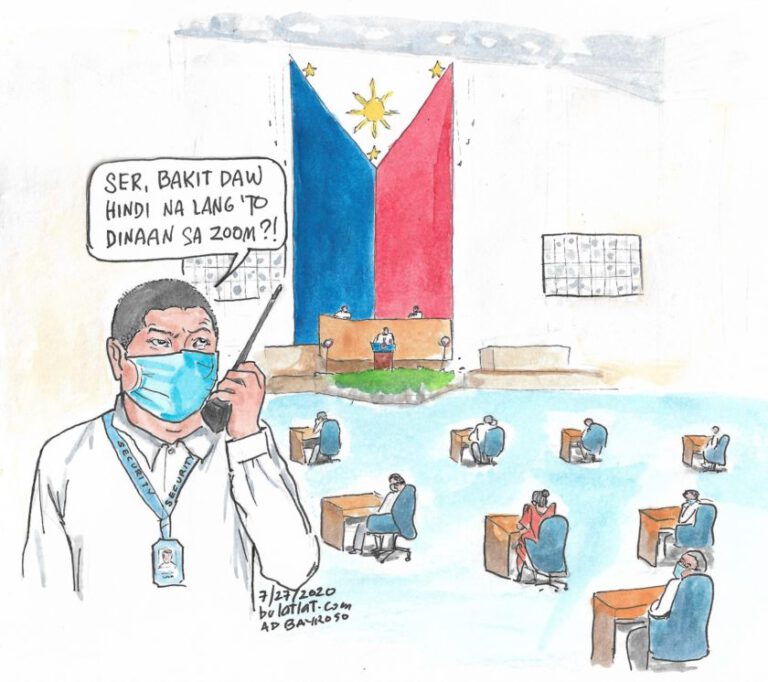
Much ado about nothing

By DEE AYROSO
(http://bulatlat.com)

The post Much ado about nothing appeared first on Bulatlat.

Karapatan’s initial reaction on President Rodrigo Duterte’s 5th SONA

0

Mr. President, if indeed you do not evade your human rights obligations, why opt out of the Rome Statute when investigation on your alleged crimes against humanity was initiated? Why do you continue to malign and undermine United Nations Special Procedures who seek to visit and investigate the rights violations in the Philippines? Why did you not allow United Nations High Commissioner Bachelet to come in the country to directly talk to victims? 

read more

IN PHOTOS: Several groups joined #SONAgKAISA

On the day of President Duterte’s 5th State of the Nation Address, July 27, thousands of protesters from various multi-sectoral organizations joined #SONAgkaisa in UP Diliman. As the Philippines recorded more than 80,000 cases of Covid19, the groups called for the failed government response on education, health, labor, mass transport, landlesness, among others. Further, they […]

The post IN PHOTOS: Several groups joined #SONAgKAISA appeared first on Manila Today.

Dismantling the oligarchy

An oligarchy is governed by a few families and individuals. While wealth is indeed among its members’ more obvious attributes, wealth alone does not make an oligarch. The capacity to influence or control government and governance does.

An oligarch is therefore someone who, by virtue of birth, wealth, religious affiliation, or control over the coercive powers of the state (the police, military, and judiciary) is able to influence government or even rule it in furtherance of his or her individual, family, and class interests, as well as those of his or her associates. If their failure to convince or influence Congress into renewing the ABS-CBN franchise is any indication, the Lopezes, as wealthy as they are, hardly qualify as oligarchs.

During the Martial Law period (1972-1986), Ferdinand Marcos’ cohorts were aptly known as cronies — those individuals who were more than the dictator’s and his family’s friends. They were also his most trusted accomplices and collaborators, who were able to amass wealth because of their closeness to him.

But neither the oligarchy nor cronyism were Marcos creations. The Philippines has always been ruled by a few — the handful of families whose sons and daughters, other kin and in-laws have monopolized political power in this country since the Commonwealth period. Some of these families do fade into obscurity, but they are soon replaced by others — by upstarts such as Marcos was, who have gained enough means to run for public office and to use it to recover the resources they spent campaigning for it, and to accumulate even more. The term “oligarchs” aptly describes them, although some prefer to call them “bureaucrat capitalists.”

What’s wrong with an oligarchy is quite simply it’s being no more than the control by a few over governance, and therefore their capacity to decide and shape the present and future of a country’s population, rather than the majority of that population’s deciding its own fate by delegating their sovereign power to do so through its chosen, duly- and wisely-elected representatives. An oligarchy is antithetical to democracy, which in contrast means the rule of the many.

Though they may not know it, the dismantling of the oligarchy — the rule of the few — is in the interest of the millions in the Philippines who are mired in poverty, injustice, ignorance, and misery that the political dynasties and their foreign overlords have been inflicting on them for decades.

In one of his most recent speeches, President Rodrigo Duterte claims to have done exactly that — to have demolished the oligarchy. The Presidential Communications Operations Office (PCOO) edited out of the transcript of his speech in Jolo before the military his admission — no, his boast — that he achieved this earthshaking feat by quite simply shutting down the free TV and radio operations of ABS-CBN network. Those present, including journalists, heard it, and audio recordings from various non-government media organizations prove he did say something to the effect that because the network offended him, he had vowed to demolish the oligarchy if he wins the Presidency — and that that is exactly what he did, without, he crowed, declaring martial law.

Mr. Duterte’s boast that the ABS-CBN shutdown is his doing came barely a week after the House Legislative Franchises Committee rejected by a vote of 70 to 11 to renew the network’s franchise. Before the committee vote, the House leadership had repeatedly assured the public that the House, being an independent body, its committee would vote according to the merits of ABS-CBN’s case. Mr. Duterte’s spokesperson also declared that he is neutral on the issue.

Few believed either. Mr. Duterte had been threatening to do all he can to stop the renewal of the ABS-CBN franchise since he came to power in 2016. His last declaration about it was in December last year, when he vowed to see to it that it would be “out,” and also suggested that the Lopezes should just sell the network.

The significance of Mr. Duterte’s admission goes beyond merely confirming once again his power over a supposedly co-equal and independent body of government. It re-affirms as well that Philippine governance is in the control of a few and that, rather than demolishing the oligarchy, government is itself still the oligarchy that it has always been since Commonwealth days.

Additionally, however, because Mr. Duterte’s iron hold on the three branches of government is a reprise of Ferdinand Marcos’ total control over government during the Martial Law period, it also raises the question of how far the systematic destruction of the Republic has proceeded since 2016.

The fundamentals of that Republic after all include the system of checks and balances that’s premised on the independence of the legislative, judicial, and executive branches of government from each other, as well as representative government’s reflecting and heeding the wishes of its constituents.

The latter principle was of no moment to Mr. Duterte and his House cohort. They ignored the widespread call among the citizenry for the renewal of the ABS-CBN franchise, which a Social Weather Stations poll established is at 75%. And as if to further add to the suspicion that it wasn’t to demolish the oligarchy but to further strengthen it that ABS-CBN has been denied a franchise, one of Mr. Duterte’s House allies echoed his December proposal for the Lopezes to sell the network, and said that he would then support the grant of a franchise to the new owners.

Both the suggestion and the statement imply that what the regime wants is not only to get the Lopezes “out,” but also to transfer ownership of the network to someone or some group that’s “friendlier” and more acceptable to it — and who or which will transform ABS-CBN from a news provider into just another public relations flack of government like the PCOO and the state media system it controls.

And then there’s also Mr. Duterte’s saying while he was in Sulu last week that he would be more than happy should those friends of his who have been “helpful” to him grow even richer, adding that they would have to sit down and talk with him “because there is so much that we can do business” (sic).

His spokesperson, who at one point had falsely claimed that the denial of the ABS-CBN franchise was “the decision of the Filipino people,” was quick to deny it. But the only term that best describes Mr. Duterte’s encouraging those close to power to benefit from government by further enriching themselves, and his saying that they (Mr. Duterte and friends) “can do business” is — cronyism.

No one should be under the illusion that the shutdown of ABS-CBN has put an end to the oligarchy. On the contrary. It has widened the field of choice for Mr. Duterte’s friends, whoever they are, not only to enrich themselves further by adding the network to their billions in investments, but also to influence and shape public opinion through the facilities of the largest, most watched, heard, and most influential broadcast complex in the country of our despair.

To dismantle the oligarchy and make democratic rule a reality in these isles of fear, the real oligarchs and their cronies will have to start with themselves. But as this country’s decades-long experience and the failure of any anti-dynasty bill to make it in Congress has shown, that’s about as unlikely to happen as the return of civility and some sense in government.

Luis V. Teodoro is on Facebook and Twitter (@luisteodoro).
www.luisteodoro.com

Published in Business World
July 23, 2020

The post Dismantling the oligarchy appeared first on Bulatlat.

Anti-terror law alarms a wide range of groups

As of last Thursday, at least 16 petitions had already been filed before the Supreme Court, asking it to strike down the new Anti-Terrorism Act (RA 11479) – either in its entirety or several of its provisions assailed for their “vagueness” and “overbreadth/over-reach” – for violating the Constitution.

The law, passage of which was railroaded through Congress amid the COVID-19 pandemic, was signed by President Duterte on July 3. It took effect last July 18, per the department of justice.

Cited foremost as being violated by the ATA is Article III (Bill of Rights), Section 4 of the 1987 Constitution, It provides: “No law shall be passed abridging the freedom of speech, of expression, or of the press, or the right of the people peaceably to assemble and petition the government for redress of grievances.”

The new law violates or curtails other rights as well, according to the complainants, including the following: the rights to due process, to association, to privacy of communication and correspondence, to public information, to presumption of innocence, to bail; the right against isolated or incommunicado detention, against unreasonable searches and seizures, and not to be subjected to a law with retroactive effect (legally termed a bill of attainder).

The first nine petitions were filed soon after Duterte signed RA 11479 and before it was deemed to have taken effect (on July 4, 7, 10, and 13); the rest were filed on July 19, 22, and 23.

Of these petitions, three included as respondent President Duterte (although supposedly he can’t be sued while in office). These were the ones filed by the Makabayan Coalition of progressive partylist groups; by 44 other progressive groups and individuals, led by the multisectoral alliance Bagong Alyansang Makabayan (Bayan) and the human rights watchdog Karapatan; and by the Sanlakas partylist group.

Notable among the personalities who led other public individuals in filing separate petitions are retired Supreme Court Senior Associate Justice Antonio T. Carpio and retired Associate Justice Conchita Carpio Morales, who once served as Ombudsman; and four members of the 1986-87 Constitutional Commission: Christian Monsod and Felicitas Aquino-Arroyo (who filed their petition along with the Ateneo Human Rights Center on July 10), and Florangel Rosario-Braid and Edmundo Garcia, who along with Senators Francis Pangilinan and Leila de Lima and the Free Legal Assistance Group sought SC intervention on July 23.

At this point it’s not clear how the Supreme Court will handle the 16 petitions (the number may still increase). Thus far, the tribunal has directed the consolidation of the two batches of petitions filed before the effectivity of the law, calling on the respondents to submit their comments on the issues raised.

It may interest the readers, meantime, to learn how some of the petitioners see the ATA as negatively, if not dangerously, affecting them. Based on news reports, here are some situations of concern made known:

• Petitioners Carpio, Carpio-Morales, and Jay Batongbacal, UP law associate dean and maritime affairs institute director, said that their published criticisms of the Duterte administration’s inability to defend the country’s maritime rights in the West Philippine Sea may be deemed by the ATA implementors as “inciting to commit terrorism,” thus exposing them to possible prosecution under the new law.

They pointed out, for instance, that without intending so Carpio’s “impassioned activism may convey in the mind of the hearer the message that to preserve the (WPS) for the country, the people must withdraw support from the Duterte administration by means drastic, violent or terroristic, if need be.”

Further, the petition mentions the fact that the President’s son, Davao City Rep. and deputy speaker Paolo Duterte, has accused Carpio of being part of a supposed plot to oust his father, and that national security adviser Hermogenes Esperon Jr., Anti-Terrorism Council vice chair, has called Carpio a “warmonger.”

• On the part of the journalists, writers, artists, and other cultural workers (led in their petition by national artist for literature Bienvenido Lumbera), they stated the context of their stand against the ATA.

Even before the enactment of the ATA, they said, state officials and security forces have long committed acts that violate their exercise of the freedom of expression. The new law “gives authorities legitimacy in further committing similar violations,” they pointed out, referring to the sustained red-tagging, threats and harassments from state authorities in their lines of work.

They singled out the National Task Force to End the Local Communist Armed Conflict (NTF-ELCAC), created under Executive Order 70, that “regularly tag journalists and artists not only as supporters of ‘communist terrorists’ but as active members of the Communist Party of the Philippines or the New People’s Army.” They also cited several statements of the NTF-ELCAC accusing journalists – even the ABS-CBN owners, executives, and employees – as part of the alleged propaganda machinery of the CPP, and tagging the organization Concerned Artists of the Philippines as the “open sectoral organization of the Leftist underground movement of artists.”

• The cause-oriented and human rights defenders group led by Bayan and Karapatan has voiced out similar complaints, including vilification by the NTF-ELCAC throughout the country and abroad.

• The 16 groups representing the Filipino youth (including student councils and various organizations at UP-Diliman, Ateneo de Manila University, De La Salle University, and University of Sto. Tomas) specifically called attention to the detrimental impact on their right to dissent of the vagueness of the ATA’s Section 4 (defining terrorism) and Section 9 (inciting to commit terrorism).

While any form of speech may possibly be punished in connection with the crime of terrorism as defined, the youth petitioners said, “nowhere in the (law) does it provide any example or metric by which any person may reasonably calibrate the tendency of speech or speech-related conduct to create a serious risk.”

• The 16th petition, filed by four Bangsamoro lawyers, complained that the Muslims and natives of Mindanao have been “at the heart of the struggle against terrorism” as “we are most affected by it,” yet they they have been practically ignored in the crafting of the ATA.

Citing historical and current prejudice against the Muslims – that “SC jurisprudence dating back to the colonial era referred to the Moro people as having ‘barbarous and savage customs’ and an ‘absolute lack of education and culture’” – they point out that Muslims are at bigger risk of being accused of terrorism-related crimes under the ATA or suffering detention without charges for up to 24 days.

* * *

Email: satur.ocampo@gmail.com

Published in Philippine Star
July 25, 2020

The post Anti-terror law alarms a wide range of groups appeared first on Bulatlat.

Pinoy Weekly copies seized by police in Pandi, Bulacan

“At around 10am this morning (July 26) the Bulacan Police Provincial Office confiscated copies of Pinoy Weekly from the office of Kalipunan ng Damayang Mahihirap (KADAMAY) in Pandi, Bulacan claiming our publication is illegal and teaches people to fight the government. This Police operation follows the arrest of a local leader of Kadamay in the […]

The post Pinoy Weekly copies seized by police in Pandi, Bulacan appeared first on Manila Today.