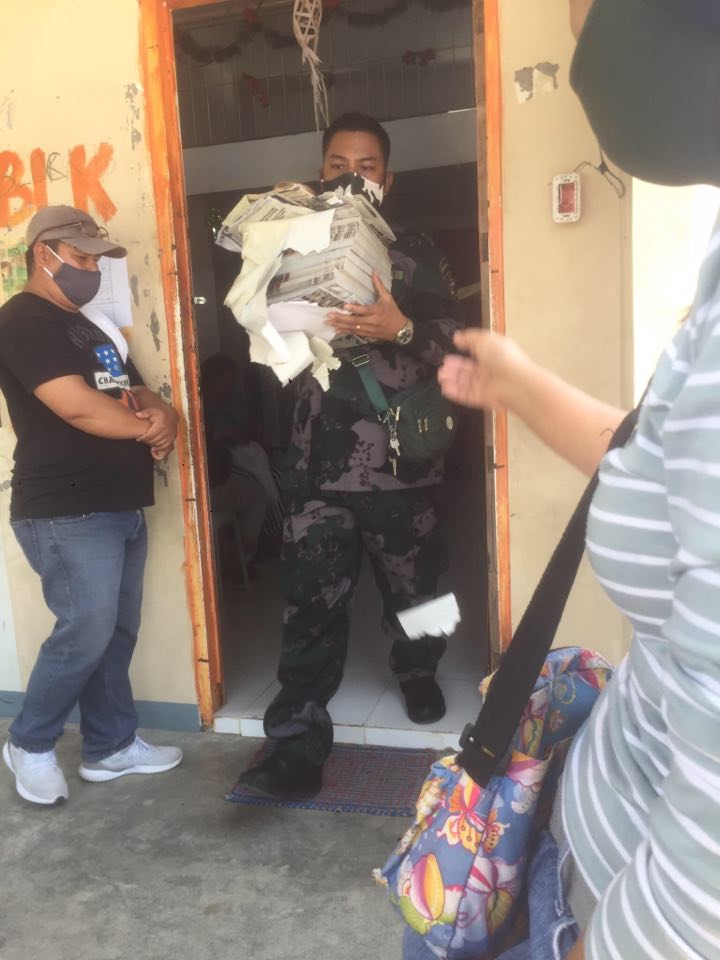
MANILA– Pandi local police raided the local office of urban group Kadamay today, July 26, arrested one of its members and confiscated thousands of copies of alternative media magazine Pinoy Weekly.
According to a statement released by Pinoy Weekly, at least eight local police officers went to the Kadamay office in Villa Lois public housing in Pandi, Bulacan at about 9:30 in the morning, and raided the housing unit without a search warrant. They arrested Kadamay member Rose Fortaleza without presenting any warrant.
According to Kadamay, Fortaleza remains detained at the Pandi Municipal Police Station without any formal charges filed against her.
Pandi police chief Jun Alejandrino, head of the raiding team, claimed that Pinoy Weekly is “illegal” and is “teaching the people to fight the government.” Alejandrino even told members of Kadamay to just give up the copies or else, “something will happen.”
Pinoy Weekly called out the Pandi police for being “ignorant of the law.”
“What the PNP [Philippine National Police] apparently wants is to stifle all critical voices and opinions. What Alejandrino and his men did was an act of tyranny,” said Pinoy Weekly Editor-in-Chief, Kenneth Guda.
“We will not be silenced and will fight this blatant act of repression,” Guda said.
Altermidya, the national network of alternative media outfits, condemned the police’s move. “To claim the publication as “illegal” and use it to arrest a citizen is a blatant attack on press freedom,” the group said.
In a separate statement, the National Union of Journalists of the Philippines also denounced the illegal seizure and said that the raid is just ‘a preview’ of future abuses that can be done under the Anti-Terrorism Law of 2020.
“The law’s vague provisions grants too much leeway for interpretation by agents of the state who mistakenly believe their mission is to stifle criticism and dissent, not protect these as part of the people’s basic rights,” NUJP said in a statement.
NUJP also demands for the Philippine National Police to immediately investigate the violation of the law done by their own personnel.
“Be the law enforcers you are sworn to be and not breakers of the law you are supposed to enforce,” the group added.
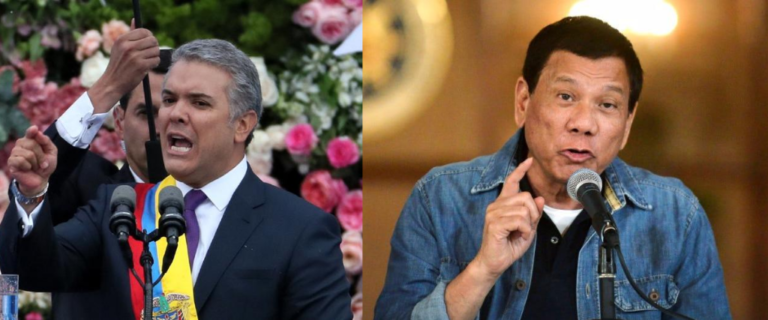
President Ivan Duque of Colombia (left) and President Rodrigo Duterte of the Philippines (right) have come under greater scrutiny over COVID-19 policies that leave rural peoples ever more vulnerable. Both countries have registered the highest number of land-related human rights violations during the pandemic, according to PANAP’s monitoring (Photos from New Straits Times and Business Insider, respectively)
In particular, two countries, Colombia and the Philippines, continue to top PANAP’s list of deadliest places for land rights defenders.
MANILA — Attacks continue to siege rural communities with impunity, with data indicating an escalation of atrocities against farmers, indigenous peoples and their advocates amid the COVID-19 pandemic.
PAN Asia Pacific (PANAP), a nonprofit advocacy organization, monitored land-related human rights violations worldwide from mid-March to June 2020 and found out that during the pandemic, within just 14 weeks, 65 rural people have been killed, or equivalent to four to five people every week. This is highercompared with last year’s peasant death toll of two every week. Legal persecution has similarly surpassed last year’s average rate of three victims per week, with 59 farmers, activists, or indigenous people — or four every week — arrested or detained while the pandemic runs rampant.
In particular, two countries, Colombia and the Philippines, continue to top PANAP’s list of deadliest places for land rights defenders. Both countries’ leaders have not made any strides in curbing these reported abuses, further inflaming tensions instead, between beleaguered sectors and retrograde actors, with ever-repressive policies or general indifference to their countries’ poor.
In Duque’s Colombia, social leaders face graver hostility
The knock-on impacts of the pandemic has crippled the peace deal that the Colombian government signed with the Revolutionary Armed Forces of Colombia (FARC), the largest of the country’s guerilla movements, in 2016, which has since made only halting progress. Not much has been done to stem the bloodshed. Normal security protocols have been derailed in the government’s myopic focus on its coronavirus response, leaving social leaders more vulnerable to death squads and paramilitaries keen on exploiting the panic over COVID-19 to ramp up such illegal economies as mining and drug trafficking.
There has indeed not been a letup in violence against Colombians who have suffered over five decades of a civil war largely rooted in the struggle for land. Armed conflicts have been documented to overlap with regions caught in the crossfire between vested interests claiming their stakes in these territories. Despite the peace deal’s promises, the demobilization and exodus of FARC rebels left criminal gangs, big landholders, drug cartels, and corporations more emboldened to scramble for power grabs. Local communities have either been expelled from their lands or routinely harassed and intimidated.
President Ivan Duque, who assumed office in August 2018, kept on with the implementation of the peace deal, even though he had initially campaigned against the agreement. His administration’s patchy commitment to enforcing the deal propelled country-wide protests at the tail-end of 2019. Though the mass demonstrations did not convulse on the scale seen in other Latin American countries, they threw an unrelenting spotlight on Duque’s unpopular economic policies and, in particular, the absence of state support for indigenous communities still reeling from generations-long strife and underdevelopment.
These communities cannot mobilize to the degree they probably would have, if not for the pandemic, as politically motivated killings remain on the rise. PANAP’s data show that, between mid-March and the end of June 2020, there have been at least two farmers, farmworkers, land activists, or indigenous leaders killed every week, even surpassing the total number of victims tallied in 2019 (see Table 1).
These numbers account for only rural peoples murdered but are certainly higher when the tally includes social leaders and human rights defenders working with other historically marginalized sectors. As early as March, international organizations like the Office of the United Nations High Commissioner for Human Rights (UNHCHR) already expressed alarm at brutal human rights abuses, such as in the province of Chocó, where three people had been beheaded even weeks before Duque declared a nationwide quarantine.
The lockdown has been extended for yet another two weeks from its supposed end last July 15. With no state sanction, armed groups have taken it upon themselves to supposedly enforce local COVID-19 measures like curfews and bans on mass gatherings, failure to comply which is punishable by, at worst, death.
“This abusive social control reflects the government’s long-standing failure to establish a meaningful state presence in remote areas of the country, including to protect at-risk populations,” said José Miguel Vivanco, Americas director at Human Rights Watch (HRW), an international watchdog, in its recent report from over 13 of Colombia’s 32 states, documented from March to June.
HRW has also found that armed groups impose movement restrictions with threats, harassment, or outright physical assaults against local residents, many of whom work out of street food stands, peddling fish or produce. In poor and remote areas, subsistence farmers and fisherfolk doubly carry the brunt of such unreasonably conceived measures meant to, authorities claim, slow the COVID-19 spread.
Checkpoints at provincial borders also hamper the work of humanitarian volunteers. They have provided relief aid, particularly to internally displaced civilians, who cannot now collect at community centers the periodic stipend the state has promised them. Indigenous and Afro-Colombian communities suffer overcrowded conditions, but the harsh social control has especially undermined their access to food.
Civil society organizations, including even workers from largely conservative church groups, have spoken out. Recently, Archbishop Dario Monsalve of Cali, the capital of the Valle del Cauca department in southwest Bogota, called attention to Duque’s inaction amid human rights violations and accused him of a “genocidal revenge to completely dismember society, social organizations and democracy in the fields and in the territories.”
Monsalve’s comment followed sweeping condemnations, especially from ethnic minorities that slammed the government’s hardening stance against such mechanisms as the war crimes tribunal and the special investigation unit for the search of disappeared persons, both of which the 2016 peace deal provides for. Another such mechanism guarantees a land restitution process, but has yet to lead to substantial headway in redressing the grievances of vast swaths of the population driven off their lands.
Crackdown on Filipino farmers and activists flares up
In the Philippines, President Rodrigo Duterte’s COVID-19 handling is marked by not so much indifference as hostility to the country’s most vulnerable. The human rights situation has taken a nosedive since the onset of the pandemic. Meanwhile, COVID-19 curve is far from flattening despite officials’ claims to the contrary. Both are causes for concern and ultimately strike oft-sidelined rural communities the hardest.
The warp-speed turn of events in the country could only offer a picture of democratic backsliding, which has been in the works since Duterte’s ascent to presidency in 2016. Notwithstanding the wanting boost in healthcare amid mounting case curves, official policies have been fast-tracked to the detriment of the general public, but much more so of farmers, land activists, and indigenous rights’ defenders.
The newly enacted Anti-Terrorism Law, in particular, raises fears of unbridled state power to brand the peasant sector and indigenous peoples – long the main targets of Duterte’s counterinsurgency campaign – as subversives or terrorists. State forces often crack down on them, with blatant brutality and various forms of legal persecution. In late April, for example, local police accosted and illegally detained six relief volunteers and a former lawmaker who were on their way to distributing food aid to urban-poor and peasant households in the town of Norzagaray in Bulacan province (just 54.5 kilometers north of Manila). Local human rights groups have also worried of extrajudicial killings by vigilantes during the pandemic (see Table 2).
At least one Filipino farmer or land defender is killed weekly. Within just 14 weeks of when regional lockdowns were imposed in the Philippines, PANAP’s monitoring also recorded three rural people detained or arrested every week. The pandemic has provided cover for land-related human rights violations to continue unchecked in such short order, while communities sink deeper in the throes of a yet-uncontrolled public health emergency.
“We can list a thousand and one reasons to protest the government’s negligence — mass testing targets remain lagging; tens of thousands of locally stranded individuals; millions lost their jobs and livelihood; millions have not received promised cash aid; the people have no means of public transport; cases of COVID-19 in the provinces rise as a result of the government’s Balik Probinsya program” — which encourages urban dwellers to flock to the countryside — “and more,” said Danilo Ramos, chairperson of the Peasant Movement of the Philippines (KMP), one of PANAP’s partners, at an independence day rally last July 12. This was days before Congress railroaded what was then the Anti-Terrorism Bill, though Duterte’s allies’ push for it had Ramos worrying over its ulterior agenda to silence people’s grievances.
Just in early July, KMP itself became one of the targets of a red-baiting Facebook post by the National Task Force To End Local Communist Armed Conflict (NTF-ELCAC). In a statement, Ramos dismissed allegations of their links to terrorist groups as malicious and defamatory, but expected that such attacks would be more common, yet no less dangerous, following the Anti-Terrorism Law’s implementation.
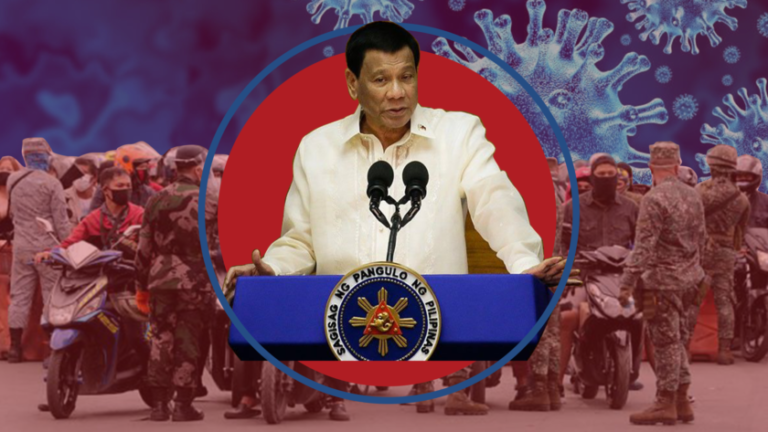
The new law derives from what has so far been a heavily militarist position on tackling the pandemic. It is no surprise that another recent plan has been unveiled, to deploy police officers and local officials on the ground to round up civilians with COVID-19 symptoms — a strategy that, according to human rights groups, resembles Duterte’s drug war tactics of house-to-house inspection and wholesale raids.
Welcome developments are on the horizon, however, as with the United Nations Office of the High Commissioner for Human Rights’ (UN OHCHR) latest recommendation to conduct an on-the-ground, impartial, and independent probe into the regressing human rights situation in the Philippines, including into violations against land and environmental rights of rural sectors. “We believe that such an inquiry could contribute to the process of reversing the environment of impunity in the country, help exact accountability from those behind these atrocities,” PANAP said in a statement on June 27.
Pressure from the international community can help push back against the troubling policies under the Duterte administration and those that rights advocates believe are yet sure to come in his bid to maintain hold on power. His popularity is waning. Public frustration indeed awaits his fifth State of the Nation Address on July 27 — a distressful marker for what has been a presidential term eager to join the global resurgence of regimes in weakening democratic institutions and values, at the expense of millions of people.
The story is part of #NoLandNoLife Features of PAN Asia Pacific, which discuss recent developments, events, and trends on land and resource grabbing and related human rights issues in the region as well as the factors and forces that drive it.
Environmental groups want Pres. Rodrigo Duterte to discuss his administration’s plan of action in protecting the environment during his fifth State of the Nation (SONA) address on Monday, July 27.
Construction workers take a rest. Government infrastructure projects continue amid the pandemic. Independent think-tank Ibon Foundation maintains such projects do not stimulate the economy and favor big business and foreign investors. (File photo by Raymund B. Villanueva)
“The Duterte administration’s plans for economic recovery revolve around continuing infrastructure projects as the main source of economic stimulus, which actually stalled economic recovery.”
SANTA ROSA, Laguna – The Duterte administration has used the COVID-19 pandemic to increase private profit at the expense of the Filipino people, according to economic think-tank Ibon Foundation.
In IBON’s mid-year Bird Talk hosted last July 21, the research institute concluded that “the worst outcomes of the pandemic are the result of poor government response,” owing to its “dogmatic obsession with neoliberal policies.” The group stated that Duterte’s authoritarianism and deliberate policy choices allowed private firms and government cronies to profit at the expense of the Filipino people.
Rosario Guzman, IBON’s executive editor and head of its research department, stated that the Duterte administration is deliberately prioritizing militarization and indifference to the poor “in favor of profits.”
She cited that there have been more arrests for “quarantine violations” than there were cases for mass testing. During the enhanced community quarantine period from March 17 to May 15, the Philippine National Police listed more than 136,000 cases of ECQ violations. Meanwhile, the government continued to neglect calls for mass testing as late as May.
Sonny Africa, Ibon executive director, also brought up that a link existed between militarization policies and crony capitalism, saying that the COVID-19 pandemic was exploited to “strengthen authoritarianism and support corporate and crony profits.”
Worst economic crisis in history
According to IBON, the militaristic lockdown also resulted in the “worst jobs crisis and economic decline in Philippine history.” IBON said that there are at least 14 million unemployed Filipinos, and at least 6.4 million underemployed workers, and at least 122,000 workers displaced by the pandemic as of July 2020. Additionally, 31 million, or roughly one-third of all Filipinos, worked in the informal sector, which IBON said was mostly neglected by government policies.
Most of these disenfranchised Filipinos get too little in terms of social amelioration. Poor families only received as little as P48 per day; far below NEDA’s own poverty line of P355 per day. IBON also noted that most of government’s aid budget is focused on tax breaks and capital recovery programs for formal enterprises, with P140 billion coming from the proposed Bayanihan Recover As One Bill, P667 billion allotted for tax breaks, and an additional P233 billion coming from liquidations made by the central bank.
According to Africa and Guzman, the Duterte administration’s plans for economic recovery revolve around “continuing infrastructure projects as the main source of economic stimulus,” which, they contended, actually stalled economic recovery. Guzman in particular criticized the continuation of the Build-Build-Build program during the pandemic, saying that it “doesn’t even work as a stimulus program.”
This is because, according to IBON, the Duterte administration focuses on importing materials, capital, and labor, while neglecting small and medium enterprises and unemployed workers.
“The economy can’t get back on its feet if people aren’t spending,” remarked Africa.
Deliberate policy choices
The focus on private enterprise and supply-side economics, IBON argued, is the result of “deliberate policy choices” made by the Duterte government.
According to IBON, the government’s focus on privatization and foreign investment resulted in “weakness in the health sector.” Africa for instance noted that from 2018 to 2020, the government’s budget for health steadily declined as the private sector took over, which he said “hampered health response during the pandemic.”
“Private profit seeking frowns upon excess capacity in health because it is a loss in profit and it is expensive to maintain,” he said. “The government also eroded excess capacity by reducing infrastructure spending over the past two years.”
IBON also criticized the government’s adherence to neoliberal policies. “Duterte is blindly loyal to the free market paradigm,” Guzman said. “The government is pushing policies and laws that uphold neoliberalism and favor big corporations and foreign investors instead of facing the health crisis.”
Guzman cited the Department of Agriculture’s “Plant-Plant-Plant” program as “market-driven and market-oriented, but ignores real issues of production.” She also noted that the Department of Labor and Employment Labor Advisory 17 allows employers to “cut wages, retrench and essentially do away with 50 percent of their workforce,” and the Department of Transportation’s renewed push for jeepney modernization despite concerns from the transport sector that jeepney drivers have made almost nothing during the lockdown.
IBON also noted that proposed legislature that is “at the very least irrelevant to solving the pandemic, and at worst, will damage the economy on the long term.”
The proposed Bayanihan 2 Bill, Guzman said, Bill is meant to give loan guarantees to small and mediums, while providing tax incentives to large corporations and foreign investments. Under the bill, corporations could also be exempted from competition and anti-trust laws.
Africa, meanwhile, noted the push for charter change, saying that “it will not address the pandemic but instead is focused on providing 100-percent foreign ownership to land, natural resources, education, media, and other key industries not already open.”
Need for structural reforms
IBON said that the Duterte administration could not continue with its existing policies. “The government is strangely oblivious with how drastically changed the world is,” said Africa. “And if it is not keen on observing the changes in the economy today, the structural problems will only remain.”
“There is massive unemployment, agriculture is failing, no significant Filipino industry, and the service economy is still dependent on external sources of growth,” he added. “We need to change our income strategy and focus more on agricultural and industrial development.”
IBON stressed the need for policies that are “people-oriented, self-reliant, stable, and ecologically sustainable” as essential to correcting “economic strategies that have already failed and will continue to fail.”
COVID-19 hastens PH economic decay
As COVID-19 wipes out whatever is left of the limited opportunities for Filipinos to earn a living, the Duterte administration’s lacking response, combined with an oppressive political environment, creates conditions for a perfect storm of social unrest.
Duterte’s double treason
Under the guise of ‘freedom of navigation’ and ‘commitment to support regional stability’, China and the US have been taking turns in militarizing our territorial waters and plundering our natural resources.
#DuterteLegacy | 4 years of gross human rights violations, impunity
“It is not enough to argue that the Government’s heavy-handed policies remain popular in the country. Because victims tend to be from lower socio-economic classes and relatively disempowered communities, there is an even stronger imperative to ensure their protection. We must not let them down. Political leadership is about respecting, promoting and protecting the rights of everyone in society, in particular the most vulnerable, so as to leave no one behind.” — UN High Commissioner for Human Rights Michelle Bachelet
WATCH: 2020 Alab SONA Special of Altermidya
Duterte’s COVID-19 response, no sense of urgency
With the cases increasing, concerned government agencies are swamped with backlogs, particularly on validating COVID-19 cases and an overwhelmed public health system.
TIMELINE | Attacks on free speech, press freedom during COVID-19 lockdown
In this timeline, Bulatlat enumerates all attempts to curtail free speech and press freedom since the country is placed under the enhanced community quarantine due to COVID-19 pandemic until before President Rodrigo Duterte delivers his fifth State of the Nation Address.
The Duterte era: A state of nature under attack
If we do not fight back, no one will be left to fight for us and the future generations. If we do not push back, the world that sustain our very lives will be pushed to the brink by tyrants and demagogues like Duterte.
Various progressive groups joining tomorrow’s protest hit the government’s memo to prohibit protests during President Rodrigo Duterte’s 5th State-of-the-Nation Address (SONA), prompting Metro Manila and Quezon City police and Quezon City local government unit to go back on their talks about allowing the protest in the area at the Commission on Human Rights office and […]
Nang mag-anunsyo ang aming parokya nang muling pagbubukas ito, hindi ako nagdalawang-isip na maglaan ng panahon. Lahat kami ay dumaan sa pagtatala ng aming sariling impormasyon. Kinunan ng temperatura, winisikan ng alkohol at dinala sa nakatalagang upuan. Para kaming robot, lahat ay nakaprograma. Para kaming nasa pabrika, lahat may hakbang na sinusunod. Malayo sa nakasanayang […]