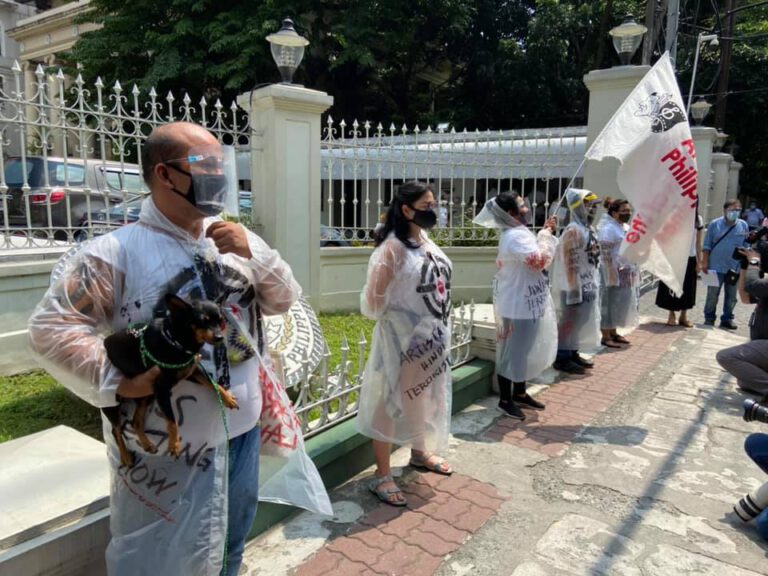
MANILA— Journalists, artists, and free expression advocates filed the 13th petition today, July 23, before the Supreme Court against RA 114979, or the Anti-Terrorism Act of 2020.
Joined by almost 40 individuals from Luzon, Visayas, and Mindanao, the groups filed a petition for Certiorari and Prohibition seeking to nullify the new measures as they are a clear violation of press freedom and free expression.
In their petition, the group cited that even before the enactment of the draconian law, many of the petitioners have already suffered from red-tagging, threats, and harassment from authorities.
They also cited how the National Task Force to End the Local Communist Armed Conflict (NTF-ELCAC) regularly tags journalists and artists not only as supporters of communists terrorists, but as active members of the Communist Party of the Philippines (CPP) and the New People’s Army (NPA).
The petition also described the law as ‘unconstitutionally overbroad and vague,’ particularly Section 4 of RA 114979; citing how it had failed to define key terms that would ensure that individuals airing out legitimate concerns against the government would not constitute as a violation of the law.
The group argued that the vague definition of terrorism that is mainly based on “intent” instead of actual acts of terrorism could be subjected to abuse. Section 9 of the law, ‘inciting to commit terrorism’ also includes free expression as one of the elements of the crime, a clear violation of Article 3 Section 4 of the 1987 Constitution.
The petition also pointed out how the law also violates the right to liberty and due process with Section 29 giving the Anti-Terror Council the power to arrest and put in detention ‘suspected individuals’ without a warrant. Additionally, it also violates the doctrine for separation of powers as the ATC will be mostly composed of Cabinet members of the Executive branch.
The group asks the higher court to put a temporary restraining order on the law, and to stop authorities from enforcing the law until the resolution of the filed petition.
“It is clear that the Terror Law is anathema to democracy,” said NUJP in their press statement.
“For all Filipinos who cherish liberty, there can only be one response: Resistance!” (Bulatlat.com)
“Given the vagueness of the definition of terrorism in the assailed law, its enforcement and implementation will encroach on basic rights and fundamental freedoms, particularly freedom of speech, expression, and association,” the petitioners said.
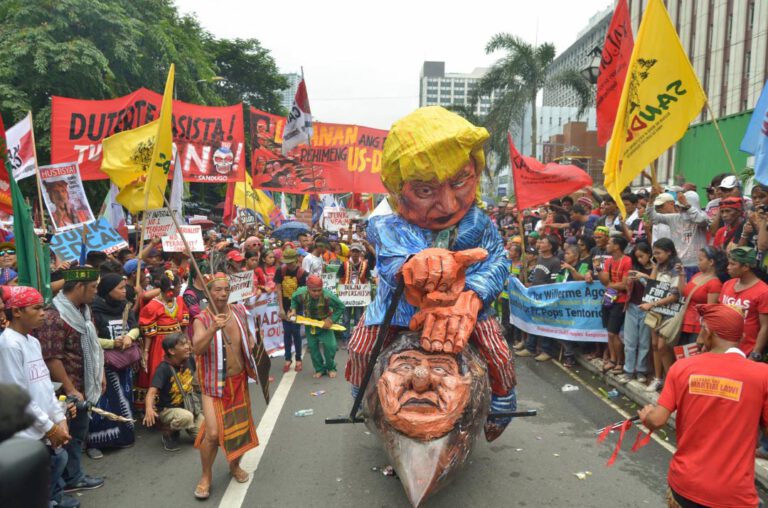
An effigy of US President Donald Trump and Rodrigo Duterte made by protesters in 2019. (Photo by Carlo Manalansan / Bulatlat)
Under the guise of ‘freedom of navigation’ and ‘commitment to support regional stability’, China and the US have been taking turns in militarizing our territorial waters and plundering our natural resources.
MANILA – Four years into the presidency, a genuine, independent foreign policy is among the major broken promises of Rodrigo Duterte. In his State of the Nation Address (SONA) speech last year, he vowed to prioritize the country’s national honor and territorial integrity. This came with his claim of stopping Chinese fishermen with their intrusion into the country’s exclusive economic zones. He declared to resolve the ongoing territorial dispute in the West Philippine Sea through a ‘delicate balancing act’ with China.
“I am not ready or inclined to accept the occurrence of more destruction, more widows and more orphans, should war, even on a limited scale, breaks out. More and better results can be reached in the privacy of a conference room than in a squabble in public,” Duterte said as one of the highlights of his 2019 SONA speech.
The President was suddenly anti-war and an advocate of non-violence when it came to confronting the conflict with China on our territorial waters. However, foreign incursions which also include US military exercises in Mindanao and other regions have continued to result in human rights violations and other heinous crimes against communities. Unfortunately, it seems like Duterte’s waging of wars was reserved not against China nor US, it was against the ordinary Filipino people.
Not a dispute, but a free entry to our territories
Despite series of reported Chinese aggression against Filipino fisherfolk such as the Reed Bank incident last year, Duterte has remained silent about it. He even downplayed it as a mere “maritime incident.” It could be recalled that around midnight of June 9 last year, a Chinese vessel rammed into a Filipino fishing boat Gem-Ver, which abandoned 22 Filipino fishermen floating at sea after their boat sank. Up to this day, not a single perpetrator has been held accountable.
Just this June 28, a Filipino fishing boat called F/V Liberty 5 collided with Hong Kong cargo ship M/V Vienna Wood off the coast of Mindoro island and left 14 of the crew members missing. Until now, they are nowhere to be found and their families have not received any official updates from the government. On the other hand, a United States Navy Nimitz-class nuclear-powered aircraft carrier called USS Ronald Reagan (CVN-76) and US Navy Ticonderoga-class guided missile cruiser USS Antietam (CG-54) were both reportedly spotted in San Bernardino Strait, Bicol earlier this month. According to reports, the naval ships were conducting military exercises and are heading to the West Philippine Sea.
Under the guise of ‘freedom of navigation’ and ‘commitment to support regional stability’, China and the US have been taking turns in militarizing our territorial waters and plundering our natural resources.
Debt trap and a comprador economy
From the unresolved maritime conflicts in the recent years, the Duterte government did not bat an eyelash even when critics and human rights groups have been consistently demanding for his government to act. He has been consistent in setting aside the welfare of the people as the Philippine economy has gone downhill and millions of Filipinos have remained unemployed.
“The country is currently operating in a comprador economy, with no agricultural and manufacturing capacity that we can’t even manufacture a simple face mask,” stated in the 2020 report of independent research group IBON Foundation.
Research by IBON shows that there is a negative growth in agriculture in the first quarter of 2020, and millions of jobs were lost. This has been the worst economic downfall in the last 30 years, the research group reported. The Philippine economy has heavily relied on the service sector, even with the absence of independent manufacturing. Even before the COVID-19 pandemic, there were already mass layoffs of workers in various corporations including the airlines, hotels, car dealers, transportation and parts, and even banks — almost 30 percent of the workforce have been retired and/or retrenched.
On the other hand, Duterte has announced this March that he will not suspend or shut down Philippine Offshore Gaming Operations (POGOs) despite the many controversies surrounding it. He claimed that government has earned around P17 billion from the industry, and that this could be used to fund infrastructure projects.
“POGOs only generate minimal income and employment for the country, contrary to the government’s claim that it is an essential sector and should be partially reopened and Duterte’s insistence on reopening POGOs appears to be yet another example of partiality towards China,” IBON added.
Duterte has pledged his allegiance with China in exchange for its funding of the government’s pet infrastructure project “Build, Build, Build” (BBB) program.
IBON reported that the government is seeking as much as US$14.3 billion in official development assistance (ODA) from China to finance 29 BBB projects costing US$16.8 billion. On top of this, we have been caught in China’s debt-trap policy as Duterte has agreed with the continuous loan deals such as the Chico River Irrigation Pump and the Kaliwa Dam project, while containing onerous provisions beyond the scope of Philippine laws. This surrender of our national sovereignty, in effect, has displaced indigenous peoples from their ancestral lands.
Labor export policy, worse than ever
With the lack of real medical solutions and misplaced priorities amid the COVID-19 pandemic, the government has also worsened the state of Filipino migrants in various parts of the world. This April, OFW remittances dropped to 16.5 percent — the lowest in the last 35 years.
Migrante International reported that over 180,000 overseas Filipino workers (OFWs) have been repatriated since May.
“Untold thousands of Filipino migrants are stranded overseas as multitudes are left without aid under ‘no-work-no-pay’ schemes while those who have been repatriated remain stuck in holding facilities after spending their most gruesome days in quarantine,” Migrante International said in a statement.
“As if Filipino migrants have not suffered enough, the Duterte regime is itching to extort hundreds of billions from OFWs through his mandatory Philhealth and premium rate hike. If it weren’t for the strong opposition registered by OFWs, even its suspension would have been unimaginable,” Migrante International added.
US dominance has remained
Duterte has attempted to create an impression of pushing for an independent foreign policy when he threatened to abrogate the Visiting Forces Agreement (VFA) with the US earlier this year. However, the abrogation of the VFA today proves to be insignificant when all the while, other lopsided military agreements with US have remained in effect. The Philippine government has continued to receive US military assistance under Operation Pacific Eagle-Philippines.
“Trump has practically given Duterte the license to form a civilian-military junta called the National Task Force-ELCAC (for “Ending the Local Communist Armed Conflict”) to further militarize his regime, escalate state terrorism in the name of anti-communism and prepare the ground for a full-scale fascist dictatorship,” International League of Peoples’ Struggles Chairperson Emeritus Joma Sison said.
Duterte has also installed a militarized bureaucracy with 73 officials (59 from the military and 14 from the police) who are rabid agents of US imperialism.
“Duterte’s government has monopolized its control over the Congress, Senate, and even the Supreme Court. This is part of the plan of a systematic attack against the Left and other government critics,” IBON said.
State-sponsored terrorism
The inter-imperialist rivalry of the US and China, especially in the recent years, has strengthened Duterte’s hold to power and worsened the attacks against democracy and freedom.
Duterte has placed all hands on deck for funding massive disinformation and trolling campaigns to quell public dissent and discredit resistance movements, while he has ordered to shut down largest media network ABS-CBN which has been a vital source of information for millions of Filipinos.
Even with the skyrocketing number of COVID-19 cases which has reached over 70,000 as of this week, Duterte and his cronies have prioritized the fast-tracking of the Anti-Terrorism Act of 2020 which is really aimed at vilifying vocal government dissenters. For the past four months, the government has deliberately confronted the pandemic with militarized solutions. The cases of COVID-19 have exponentially increased along with the number of warrantless arrests, killings, and harassment of ‘quarantine violators’, and activists.
United in the face of double treason
In his four years of presidency, Rodrigo Duterte has done so much in the name of treason, betraying our national sovereignty, and territorial integrity. In the middle of a global health crisis, the Filipino people have long been abandoned and pushed further into damnation as the US and China continue with their aggression in our country.
The Duterte regime cannot be trusted to protect the welfare of the Filipinos, his four years in office are more than enough proof of that. There is no other way for us to save ourselves but to fight and resist in the face of double treason.
The National Union of Journalists of the Philippines (NUJP), along with 37 individual petitioners—journalists, artists and free expression advocates—filed a petition for Certiorari and Prohibition before the Supreme Court against the Anti-Terrorism Law on July 23. They were assisted by their counsel, Atty. Evalyn Ursua. Along with NUJP, journalists who took part as individual petitioners […]
Forty-four leaders of various organizations appealed to the high court to declare the law unconstitutional, for it “insidiously encroaches upon fundamental and constitutional rights, such arbitrary deprivation of the right to life, liberty and property and the non-observance of the right to due process and to presumption of innocence.”
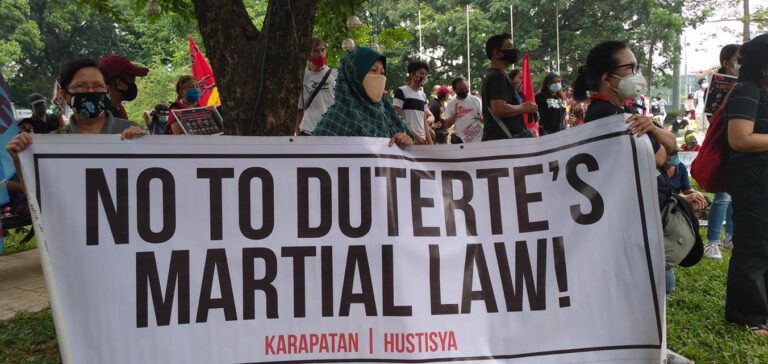
MANILA – Progressive organizations and human rights defenders labeled the Anti-Terrorism Act of 2020 or Republic Act 11479 as “worse than Martial Law.”
In a petition filed with the Supreme Court, Thursday, July, 23, the 44 leaders of various organizations appealed to the high court to declare the law unconstitutional, for it “insidiously encroaches upon fundamental and constitutional rights, such arbitrary deprivation of the right to life, liberty and property and the non-observance of the right to due process and to presumption of innocence.”
The petitioners, assisted by the National Union of Peoples’ Lawyers (NUPL) said that Section 29 of the law, “in essence and in effect, is even worse than Martial Law.”
Sec. 29 allows detention without warrant of arrest of persons suspected of terrorism or members of any organization declared as terrorist. The Anti-Terror Council (ATC) can authorize law enforcement agents or military personnel to arrest and detain suspects for up to 24 days.
It also directly violates Article 7, Section 18 of the Constitution which is “intended to limit the power of the Executive to detain persons without charges and only under the certain limited and specific circumstances: 1) only when there is a declaration of Martial Law and the privilege of the writ of habeas corpus is suspended, and 2) only in cases of rebellion and offenses involving invasion and for a limited period of three days.”
Article 7, Section 18 states that the Constitution is not suspended under a state of martial law nor automatically suspend the privilege of the writ of the habeas corpus.
“The suspension of the privilege of the writ of habeas corpus shall apply only to persons judicially charged for rebellion or offenses inherent in, or directly connected with, invasion,” the petition read, adding that any person arrested or detained should be charged within three days, otherwise he shall be released.
“The assailed law granted unto the Executive, through the ATC, the power to detain persons longer than what is allowed under the Constitution,” the petitioners said.
Under the Revised Penal Code, a suspect of grave offenses may be detained for a maximum of 36 hours or three days without charges.
The petitioners argued that the longer period of detention up to a maximum of 24 days without being judicially charged under Section 29 of RA 11479 “is akin to a criminal penalty.”
Sec. 29 of RA 11479, they said, violates Article 3 Section 1 of the Philippine Constitution, which prohibits deprivation of life, liberty and property without due process of law and denial of equal protection of the law.
The law gives the Anti-Terrorism Council (ATC) the power to impose a penalty “for an act without fair and impartial trial.” “The detention under Section 29 is a disproportionate and an excessive penalty imposed on a person whose guilt has yet to be established in a full scale criminal trial,” they said.
Super powers = abuse
The petitioners further pointed out that Anti-Terrorism Council’s power of designation of terrorists “violates due process clause, the right to be presumed innocent, and freedom of association.”
The ATC’s power of designation, they added, is a violation of the principle of separation of powers and a usurpation of judicial prerogatives.
The petitioners argued that Sec. 25 of the law, which allows ATC to designate as terrorist persons or groups or associations is similar to a bill of attainder. Bill of Attainder means that one is prosecuted without a trial and it is explicitly prohibited under Sec. 22 of the Philippine Constitution.
Criminalizing free speech
The petitioners also said that Section 9 of RA 11479, which penalizes both speech and non-speech elements that incite others to commit acts of terrorism, violates the clear and present danger rule.
The clear and present danger rule requires that the evil consequences sought to be prevented must be substantive, “extremely serious and the degree of imminence extremely high.”
The petitioners said, “Expressions of dissent and advocacy of disobedience, the use of force, the commission of illegal acts, or even the overthrow of government — by themselves — do not create any grave or imminent danger warranting censorship or punishment. The presence or absence of said danger, as well as the inevitability thereof, are matters entirely different from the content of the speech or other forms of expression, as well as the intent or purpose behind it.”
“By including exercises of constitutional rights in its definition of terrorism, Section 4 of RA 11479 focuses on the intent of the speaker or actor. In defining Inciting to Commit Terrorism, Section 9 focuses on the message, i.e. whether or not it incites others into the commission of prohibited acts or if tends to do so,” they said.
Ambiguous
The Bayan et.al petition argues that the acts of terrorism under Section 4 have not been defined or enumerated. It ambiguously refer only to “acts.”
“This failure to define the particular act(s) that would constitute the crime makes the penal law utterly vague and, perforce invalid, even if there is a qualification as to the intent behind it,” they said.
Thus, Section 4 of the law is invalid as it violates the due process.
According to the petitioners, the vague definition of terrorism is dangerous as it “leaves law enforcers unbridled discretion in carrying out its provisions. It allows law enforcers to intentionally or recklessly, or even mistakenly allege that a person – intended to cause death or serious physical harm’ to another person, — ‘to endanger a person‘s life, or to create a serious risk to public safety’ even while exercising a civil or political right.”
Contrary to the claims of the government that the RA 11479 does not violate the people’s right to freedom of expression, the petitioners assert that it does.
“Viewed in a different light, instead of providing a concrete and specific definition of terrorism — one which particularizes the conduct being proscribed — Section 4 expands its already vague definition to include legitimate exercises of free speech and other constitutional rights based solely on the ?intent of the speaker or the actor.”
“This was admitted by (former Gen. Hermogenes) Esperon, would be Vice Chairperson of the ATC, when he selectively yet misleadingly insisted that Section 4 does not prohibit free speech and expression, but said in the same breath: ‘Kung tahimik naman sila, huwag sila mababahala.’” (If they keep mum, they have nothing to worry about) the petition read.
The head of Region 10’s referral hospital for Covid-19 treatment explained his absence from duty is due to his leave of absence, shooting down speculation that he had resigned over a labor issue with health workers.
The Davao City Council is pushing for the grant of hazard pay for 1,200 barangay health workers (BHW) who had rendered service in combating the Covid-19 pandemic in communities.
During the physical filing of the petition on July 23 before the Supreme Court by Karapatan, Bayan, Movement Against Tyranny and other civil libertarians against the Anti-Terrorism Act, Karapatan Secretary General Cristina Palabay, one of the petitioners, said that “the recent erroneous and malicious Philippine government report disseminated among members and observers at the United Nations Human Rights Council, tagging human rights defenders and civil society in the Philippines as ‘communist front organizations’ and ‘terrorists,’ is precisely one