MANILA — A United Nations official urged governments anew to release all political prisoners amid the COVID-19 pandemic.
In a webinar organized by Ecuvoice on May 29, UN Special Rapporteur on Extrajudicial, Summary or Arbitrary Executions Agnes Callamard reiterated that to prevent the spread of the virus, prison population should be reduced.
“Prison borders will not stop the virus from spreading,” she said.
She added that the only way to address the spread of the virus is to release prisoners and the first ones to be released should be political prisoners who shouldn’t be detained in the first place.
“Politicians must be told that by keeping political prisoners in prison, they are making the fight against the virus more difficult, ” Callamard said.
According to human rights alliance Karapatan, there are more than 600 political prisoners in the country.
Kapatid, an organization of relatives of political prisoners, filed an urgent motion with the Supreme Court April 8 for the release of sick and ederly prisoners on humanitarian grounds. As of this writing, the high court has yet to issue a decision.
Xandra Casambre-Bisenio, daughter of peace consultant Rey Claro Casambre, called on the high court to grant their petition in the soonest possible time.
Callamard said that those who were detained because of violation of quarantine protocols should also be released.
“When the poorest people are detained in those prison they become disproportionately affected by the virus,” she said.
In the Philippines, state agents have detained over 52,000 so-called ECQ violators.
Callamard pointed out that international institutions have already demanded the reducing of prison population around the world including the Office of the High Commissioner on Human Rights, the different UN agencies and the World Health Organization.
“These are common sense recommendation that have been made by experts two months ago,” she said.
Under the ‘new normal’ of internet-based learning, those at the margins of society could find themselves struggling against further exclusion.
The concept of access needs further exploration beyond the popular understanding that it is mainly about the installation of broadband networks and distribution of gadgets to the community.
More than the means of providing a formal type of education in a world grappling with a pandemic, there should be a continuing review of what type of knowledge will be the focus of the adjusted curriculum.
The starting point in building a progressive education is recognition of the learner’s ‘cultural capital’. It assumes that every learner has a knowledge of the world that is worthy to be integrated into the schooling process. The student’s language, his ideas about the reality of the present, her struggles in a feudal household – all of these are essential in developing new knowledge and remaking the world.
Will this be the philosophy that will guide educators and technocrats?
Online education introduces a more difficult challenge since the learner has to be capable of coding, uploading, and streaming his worldview. She is allowed to articulate her reality but only in a language (and font) that is available on the internet. A student in a farming village can contribute to defining class topics but he has to present them in a digitized format.
What will be privileged are ideas, themes, and narratives shared by students who are not only able to participate in the online classes but also ready to interact with others because they have rudimentary familiarity with the rules for joining virtual sessions.
They have an advantage over the digitally excluded in unpacking the preprogrammed modules whose content reflects the values in mainstream society.
Education is under threat of being reduced into a mastery of prepackaged learning materials that are stored in downloadable files in the web cloud. Discovery of the new in the near future could simply refer to a browsing experience.
Information is presented in striking visuals, summarized in creative infographics, and standardized in conformity to national and global standards.
Diversity is equated with plural perspectives reacting to popular memes. Hence, the danger of limiting classroom discussions to topics that are viral and trending, even if these do not represent the lives of students. The valid aspiration to be relevant and seen could end up in a frantic race for cyber attention.
This has harmful consequences to students who might wrongly assume that their life stories have to garner social media boosting as a prerequisite for acceptance in society. Or they could disown their local cultures, habits, and ideologies because they diverge from the popular norm They might reject their framing of the world because it does not adhere to existing categories or it is deemed archaic for digital sharing.
The choice of what learning tools will be widely adopted, procured, and deployed should be subjected to critical scrutiny as well. The use of smartphones, laptops, and tablets has been normalized that it’s almost difficult to challenge the assumption that each gadget is fit only for individual usage. The varied IT applications in the community, the communal technologies in preserving local knowledge, the social character of schooling are all subsumed under the narrow technical discourse of making online education work. The sense of what community means might be lost in the rush to implement the individualized internet-guided type of education.
This could have a counterproductive legacy on community empowerment. Young citizens turning into self-obsessed, information-addicted, spectacle-seeking individuals with little or no sense of the grassroots and their liberating potential.
Enabling this looming reality is worship for a technological solution in response to the raging pandemic. What is discarded is the human factor in confronting a crisis. The sustained and systematic mobilization of communities to fight an invisible enemy. Blinded by the unpredictability of the situation, many succumb to fear which force them to put their trust in contactless technologies. When human interaction is suddenly viewed with suspicion, wireless alternatives suddenly become a necessity. This is taking place at a time when the pedagogic role of the internet is still promoted through corporate lens.
Therefore, the future of online education must be reshaped through a comprehensive critique of the political economy of the internet. Unmask the web of monopolies, the networks of surveillance, the economy of inequality that has condemned millions to be invisible and disconnected from the world. This will entail vigorous offline probing that students must undertake with others in the community in order to know the world and change the world.
Will this be the framework of the blended type of learning under the ‘new normal’?
What if the unmentionable aim is to pursue what neoliberal hardliners have been trying to impose through the policy reforms that they have been introducing for many years: establish a depoliticized education system. Remove the social context from the virtual environments of students. Mass produce an army of graduates possessing internet-driven skills required by the global labor market.
A complete negation of what education should be: transformative, radical, political.
Learning as an activity that makes the world knowable through dialogue and praxis. Individual enlightenment realized through the collective assertion of rights.
A reminder to build a stronger movement to derail the conservative agenda of making traditional and online education an instrument of hegemony.
And the antidote to the non-political education of learners is through political organizing. Knowledge of the world is grasped through political empowerment. A community of learners emerging from the margins asserting their voice and autonomy, tapping the power of the networks to build solidarity, and claiming power through struggle and resistance.
Mong Palatino is a Filipino activist and former legislator. He is the chairperson of Bagong Alyansang Makabayan Metro Manila. Email: mongpalatino@gmail.com
On May 30, Mayor Victorio Palangdan ordered the total lockdown of Barangay Ucab, Itogon in Benguet province. The measure came after a 40-year-old male from Ucab Proper tested positive for Coronavirus disease (COVID-19).
“The initial report is that he is a Jail Officer from New Bilibid Prison, Manila, who initially tested negative from rapid testing before going home to Itogon. Positive COVID 19 swab test result just came in today from RITM,” the mayor said on his Facebook last May 29.
The mayor lifted the lockdown after completing the contact tracing and return of negative test results of the individuals.
A test that resulted in a false negative threatened the mining town. However, this is not an isolated case. The social media is also teeming with personal narratives of the anxiety and financial issues that came from false-positive results of the rapid antibody test (RAT).
One of these accounts is about a 46-year-old female from Taguig City. She went to the hospital for dialysis, but because of the pleural effusion and pneumonia, the hospital conducted RAT on May 6. The rapid test yielded a positive result, and the hospital admitted her as a probable COVID-19 case. Medical personnel took swab samples on May 8, and the Research Institute for Tropical Medicine received the specimen the following day. The result of the confirmatory test came back on May 15 and turned out negative.
The hospital treated her as a probable COVID-19 case, and the bill reached P441, 506. The lengthy period it took before the result confirmatory test came out compounded the situation and anxiety the patient felt.
In both cases, the rapid test played a crucial role.
Rapid test kits donated by Narvacan Mayor Luis Chavit Singson to the Provincial Government of Ilocos Sur. In a press conference on June 1, Gov. Ryan Singson ordered the rapid testing of all individuals who came in contact with the newest COVID-19 patient in the province. Back in April, the governor also directed the purchase of RAT kits from his own pocket to start the screening of front line workers and a community in Tagudin where the first COVID-19 patient in the province resides. Photo from Ryan Singson Official Facebook page.
Rapid Test
According to the World Health Organization (WHO), there are two kinds of rapid test kits marketed by pharmaceutical companies: one that detects viral protein (antigen) and the other identifies antibodies. The quick antibody test is the more common kind and currently in use in the Philippines.
RAT kits determine the presence of antibodies – the immunoglobulin M (IgM) and the immunoglobulin G (IgG). The IgM is the body’s immune system’s response to the onset of infection, while IgG is the reaction from previous infection.
The test requires a blood sample from the patient. Results are available in 15 to 45 minutes, depending on the type of RAT used. Recently, Baguio City subjected the personnel of the City Public Information Office and some media members to RAT. The results came out in 10 minutes.
Compared to using real-time reverse transcription-polymerase chain reaction (RT-PCR), the “gold standard” for COVID-19 confirmation, RAT is cheaper. With the limited testing capacity of the country using RT-PCR, results can also take at least 24 hours.
Unreliable, waste of resources
However, the test is not reliable. This fact is why many members of the medical community advised against its use in dealing with the COVID-19 pandemic.
Dr. Gene Nisperos, co-convener of Cure COVID, pointed out that RAT has a 40-50% chance of arriving at a false negative result and 30-40% false positive. According to him, “rapid test brings unnecessary anxiety or complacency depending on the result.”
He also noted that those tested positive with RAT are still required to take the confirmatory RT-PCR test.
“Doing this would only double their expenses,” he said.
Nisperos said that people should be cautious of some sectors pushing for their definite agenda in using RAT kits. The doctor said utilizing rapid test to determine those who are fit work is unsafe.
“Malaking peligro ang nais nilang gawin. Gusto nila ng dahilan para masabing okay nang lumabas at pumasok ulit sa trabaho, kung rapid test kits ang gagamitin para dito, niloloko lang nila ang mga tao,” he added.
Cure COVID is a network of medical professionals, personalities, and organizations advocating a comprehensive socio-economic response to the current health crisis, including mass testing.
In an online press briefing organized by the Action for Economic Reforms, several medical societies in the country expressed the same concerns. In particular, the group opposed the use of the mandatory rapid test for workers.
Philippine Society for Microbiology and Infectious Diseases (PSMID) president Dr. Marissa M. Alejandria said RAT in asymptomatic individuals “has no added value to be used as a requirement to acquire the return-to-work clearance.”
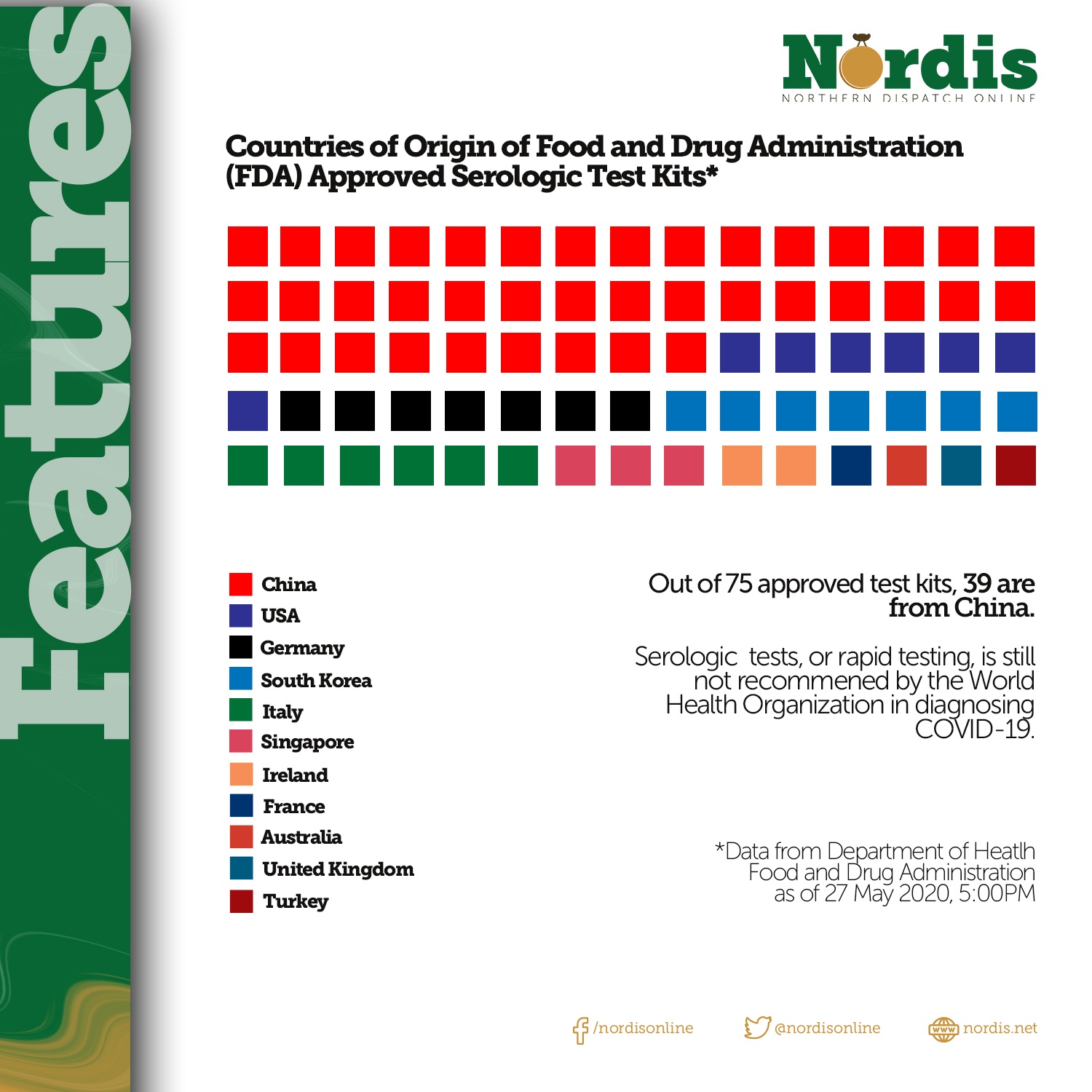
The majority of the FDA-approved rapid antibody test kits available in the country are from China where the COVID-19 was first recorded. The first three cases recorded in the country where all Chinese nationals, all of which have travel history to Wuhan.
“Only for research setting”
In its advisory dated April 8, WHO said that “based on current evidence, [it] recommends the use of these new point-of-care immunodiagnostic tests only in research settings.”
“They should not be used in any other setting, including for clinical decision-making, until evidence supporting use for specific indications is available,” it added.
Despite the advisory and the absence of clear guidelines from the DOH for RAT, President Rodrigo Duterte ordered the procurement of rapid test kits on April 13, late-night public address. Secretary Carlito Glavez, Jr., the Chief Implementer of the Philippines’ Declared National Policy Against the COVID-19, said the government plans to acquire around 2 million RAT kits.
Before the president’s announcement, the Department of Health said they do not recommend the use of the diagnostic kit during a Laging Handa briefing on March 23.
“Ang ating rapid test kits hindi nirerekomenda ng DOH na gamitin natin ito (DOH does not recommend rapid test kits for use),” said Health Undersecretary Maria Rosario Vergeire.
In his May 21 visit to Baguio City, Galvez announced that the government would use the RAT to compliment the current RT-PCR capacity of the country.
“Those doctors who say that the rapid test is not good, I believe, are wrong,” he said.
According to him, the National Task Force Against COVID-19 already purchased 200,000 rapid test kits. He said the government intends to provide 2,500 to 5000 of these sets to the provinces, prioritizing areas without PCR testing capacity.
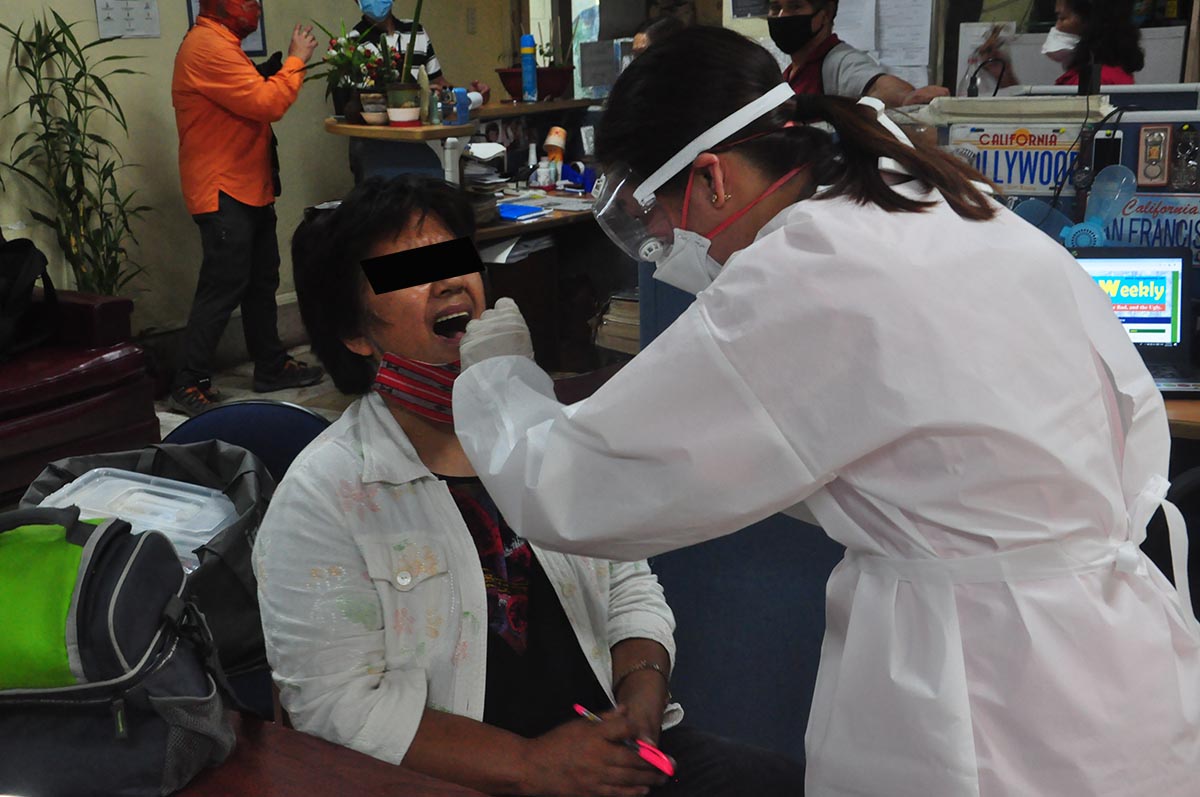
FALSE POSITIVE. A positive result using the rapid antibody screening would require a sample for confirmatory tests using the RT-PCR machine. Here an employee of the Baguio City Hall undergoes swabbing for specimen after getting a positive result. Her confirmatory test returned negative for COVID-19. Photo by Sherwin De Vera
RATs for mass testing
In Northern Luzon, some of the local governments that utilized the RAT kits for screening were Ilocos Sur and Baguio City. Recently, Ilocos Norte and Cagayan also rolled out similar programs. They tested suspected COVID-19 patients, those working in the frontlines and areas with COVID-19 positive individuals.
Mayor Benjamin Magalong pushed for the conduct of rapid tests to fast-track contact tracing, isolation of suspected cases, and other medical measures. Private institutions donated most of the kits the city utilized for the mass rapid testing program.
Ilocos Sur launched its mass testing using rapid test kits in April, days after the province confirmed its first COVID-19 case on March 28. Like Baguio, the initiative came even before the DOH released the guidelines and ahead of the government’s promised mass testing program.
Provincial administrator Cara Tabios explained that RATs are for “screening and precautionary measure since the situation in the province remains manageable, with zero active cases at present.” (Phone happened days before the new COVID-19 case in the province)
According to her, the province adheres to its earlier pronouncement that the test serves as a “preliminary assessment tool” to identify individuals for isolation and further examination. She stressed that RT-PCR remains the confirmatory test.
One of the towns in Ilocos Sur, Santa, undertook “targeted mass screening” using the ARK Project protocol. ARK, a project initiated by the business sector, stands for Antibody Rapid test Kit. The municipality identified 2948 individuals for testing under the program. It allotted P4 million for the purchase of 5,000 pieces of rapid test kits (P800/kit).
The local government identified the following specific objectives:
Detect, isolate, and treat those with an active infection (IgM+).
Identify those already recovered and with likely immunity (IgG+).
Use the test as a guide for tracing and monitoring active cases for appropriate interventions.
Identify those fit to work.
Vice Mayor Jeremy Bueno said they are well aware of the limitations of RAT. Like the other LGU testing programs, the initiative is adjunct to the RT-PCR test.
“In the absence of mass testing in our region, the LGU decided that this is better than doing no testing at all,” he explained.
He added that the municipality is open for partnership. The vice mayor said that they are urging other LGUs in the province to pool their resources to establish an accredited testing center.
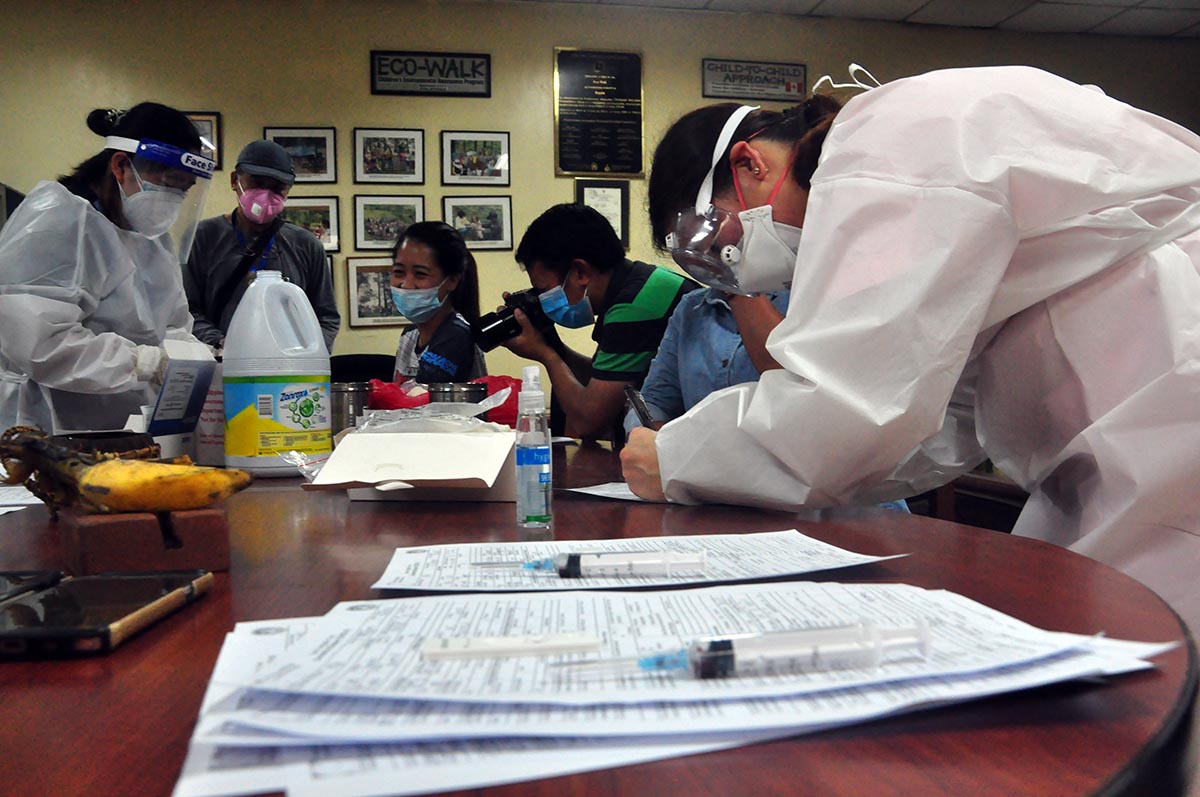
CHECKING THE FRONTLINES. Baguio City was among the first to use rapid test to determine the situation of workers in the frontline. The media, who are always out to find stories and information for the people, were among those who received the free rapid testing initiatives of the city. Photo by Sherwin De Vera
What is at stake?
Basing from the national government’s pronouncements, and the initiatives of local officials and the private sector, rapid testing will take a significant role as the community quarantine further eases this June.
In the absence of the government’s capacity to conduct extensive COVID-19 testing using RT-PCR, LGUs that want to ensure their constituents’ safety might turn to RAT. Their intention may be for the general welfare, but for the WHO and most medical societies, the use of unreliable tests remains a concern.
A false negative creates complacency; such is the case of the Ucab COVID-19 patient. Authorities may end up allowing a COVID-19 carrier to walk and further spread the infection. There is also a chance for those who test positive for the previous infection may assume that they developed an immunity.
Nisperos said there is no conclusive study yet that patients who acquired the disease cannot be infected again, nor is there a definite period of immunity.
Meanwhile, false-positive, as pointed out by Alejandria, could be a waste of medical and human resources. She stressed that false-positive would entail the unnecessary use of PPEs and PCR kits. It would also require the removal of a possible productive individual from the workforce and mobilization of personnel for the contact tracing.
False (positive or negative) results are sure to create harmful consequences and aggravate the situation. However, the more pressing concern is the assumption of some sections that RAT can stand as a basis for policies and decisions, like returning to work.
MINIMUM STANDARDS. Establishments at the Baguio City Public Market require facemask for their workers and clients. They also continue to innovate to maintain physical distancing in their daily operations. Photo by Sherwin De Vera
What should be the direction?
Doctors agree that strict implementation of minimum health standards remains the cheapest means to halt the spread of the disease. This includes the wearing of appropriate facemask, regular hand washing and disinfection, physical distancing, thermal scans, and symptoms check, and the 14-day quarantine.
However, with the continued rise of COVID-19 cases and easing of the restrictions, the medical community maintains the best defense is to strengthen the country’s capacity to detect and isolate infected persons and trace their contacts. The priorities include the testing of those regularly exposed to possible infection – the frontline healthcare workers and responders, and the vulnerable sectors and communities.
The government has started identifying and accrediting more testing centers. Last month, the DOH approved two independent testing centers in Northern Luzon. The testing centers are the Ilocos Training and Regional Medical Center for Region 1 and Cagayan Valley Center for Health Development GeneXpert Laboratory for Region 2. The facilities would unload the Baguio General Hospital and Medical Center and focus on testing specimens from the Cordillera Administrative Region.
As of May 29, the country has 43 DOH accredited testing centers. The recorded highest number of tests conducted in a day to date is on May 14, with 11,254 samples screened. These figures are still far from the targeted 30,000 daily tests and 78 testing labs by the end of May set by the IATF and DOH in April.
Joshua Danac of Scientists Unite Against COVID-19 in a virtual forum underscored that the need to “increase the RT-PCR testing capacity”. According to him, this requires not only the testing facility but also resolving the lack of personnel and necessary chemicals. He said that unreliable test has no place if the government makes the RT-PCR screening accessible and free for those who need it. Sherwin de Vera/nordis.net
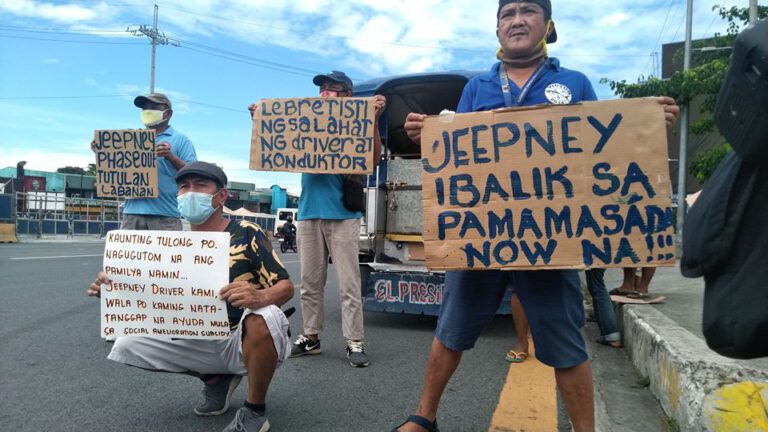
Jeepney drivers and operators hold #BusinaBalikPasada along Commonwealth Avenue on Monday, June 1. (Photo by Pinoy Weekly)
The transport movement argued that the old jeepneys must not be sidelined when there is an obvious increase in demand due to the reduced passengers of other PUVs for physical distancing.
MANILA — Jeepney drivers and operators take the streets of major roads in Metro Manila, not to continue their operations but to protest the seemingly lack of intent from the government to let them resume or at least provide aid.
The national government on Monday, June 1, has implemented the transition to General Community Quarantine (GCQ) allowing virtually everyone to go out without the need to present quarantine or travel passes. For many, this allowed them to go back to work and compensate the lack of income for employees that have been affected by the COVID-19 lockdown, but not for jeepney drivers and operators.
Pagkakaisa ng mga Samahan ng Tsuper at Operator Nationwide (Piston) mobilized in key transport areas in Metro Manila for their “Busina para sa Balik-Pasada,” against the Memo Circular 2020-017 of the Land Transportation Franchising and Regulatory Board (LTFRB)–allowing only modernized jeepneys to operate in GCQ areas nationwide and for public utility vehicles (PUVs) to apply for special permit to operate.
For many jeepney operators and drivers and the workers returning to work, this is just not fair.
Kilusang Mayo Uno (KMU) Chairperson Elmer Labog supported the transport drivers’ call in resuming their operations, saying that enduring three months of hunger without enough aid from the government was enough.
Labog also said that jeepney operations are most vital for the workers whom the economy rely onto for a “jumpstart.”
In their more-than-1,500-signed petition in Change.org, Piston pointed three salient points as to how the LTFRB MC 2020-017 become problematic in solving in imposing guidelines for public transport in these “new normal” times in the country.
The transport movement argued that the old jeepneys must not be sidelined when there is an obvious increase in demand due to the reduced passengers of other PUVs for physical distancing.
They added that there’s no need for special permit since the operators already have valid franchise from the agency itself to operate.
They also pointed out the inconvenience to draw another route for jeepneys without the LTFRB consulting the rivers, operators, passengers, and the local government.
Piston maintained that the “government needs to provide subsidies to compensate for the significant reduction in drivers’ revenue as only half of the PUVs can be taxed.”
They have also called for mass testing, as this will be the only thing that will ensure to safety of Filipinos from COVID-19.
“Noong umalis siya, balde na may kaning baboy, tubig, at itak lang ang dala. Ano ba ang kasalanan niya?” Panoorin ang katotohanan sa pagpaslang sa lider-pesante na si Allan ‘Mano Boy’ Aguilando ng Northern Samar.
The Duterte administration is continuing its brutal massacre of the poor in its bloody war on drugs, human rights watchdog Karapatan said, as the group decried the killing of barangay captain Diony Seromines in Brgy. Kawas, Alabel, Sarangani after he allegedly refused to sign a paper as a witness in a drug buy-bust operation.
The progressive Bagong Alyansang Makabayan comes to the defense of the displaced Lumad in UCCP Haran who have been accused of “murdering” two lumad infants due to negligence.
“I asked in a poll yesterday if you’ve heard of the Anti-terrorism Bill in the Philippines and about half haven’t. So as a small community here, I would love to share with you what I’ve gathered from other sources. We can help each other understand the things going on around us and look out for each other and our future in the process. #JunkTerrorBill”