Home Blog Page 239

Upon COVID-19: Time to tax the super-rich

0

The Philippines has never had a wealth tax. For as long as there
has been a tax system in the country, taxes have been collected from what
people pay for what they consume or from what they earn.

Since the pandemic exploded at the start of the year, much has
been said about the unprecedented impacts on people’s health and the economy.
It should also prompt a rethinking of the country’s accustomed sources of tax
revenues – a wealth tax would be historic.

This helps to shift the tax burden away from regressive
consumption taxes towards the handful of families with fortunes in the billions
or even hundreds of billions of pesos. Over time, a wealth tax would also take
some of the edge off the huge economic and political inequality in the country
today.

Income taxes just won’t work to do this. The truly wealthy don’t
rely on income to amass more wealth.

For instance, richest Filipino Manny Villar might have paid
himself about Php5-6 million annually as one of Vista Land’s top executives
before. At that rate, it would have taken him many years of working and not
spending to accumulate his current reported net worth of Php344 billion. Over
57,000 years, actually.

The amassed Villar wealth is the foundation and, some would also
say, result of the increasingly powerful Villar dynasty – a “good dynasty” as senate
race-topping Cynthia Villar called it. Former senate president Manny Villar is
also president of the Nacionalista Party, the Philippines’ oldest political
party. Just an example of how concentrated wealth is democracy-distorting – it amasses
political power in the hands of a few.

The minor relevance of income for the really wealthy explains why
the really wealthy don’t populate lists of the country’s highest personal
income tax payers. Well, that and their having armies of accountants and
lawyers and political connections to escape tax obligation.

Who are the super-rich?

Calling the wealth tax the “super-rich tax” will make it clear who
the only targets are. It’s a tax that should be fully supported by over 99.9%
of the population because they will definitely not be paying it.

The super-rich are the estimated 596 Filipinos with wealth over Php2.5 billion, and
possibly some 2,200 with wealth of at least Php1.5 billion. The 50 richest Filipinos alone have a combined net
worth of Php4.1 trillion, according to Forbes.

Nit-picking, the country’s “50 richest” are actually the country’s
65 richest – the 19 Sy, Ty, Consunji and Campos siblings are still counted as
one under same family names – as single heirs to their respective fathers’
fortunes.

In any case, by IBON’s estimates, these 50 richest own more wealth
than the poorest 71 million Filipinos combined. That’s one-half of
one-hundredth of a percent (0.005%) of the population owning as much as the
poorest two-thirds (65%). Such an extreme concentration of wealth makes a
wealth tax extremely progressive.

The ‘least-rich’ of the 50 richest Filipinos is valued at Php6.8
billion, while the richest at a staggering Php896 billion.

There’s no easy way to visualize Php896 billion. Converted to
Php1,000 bills, this would fit into 7,108 balikbayan boxes which, stacked one
on top of the other, would be one-and-a-half times as high as Mayon Volcano.
Laid end to end, they would reach from the northernmost tip of Batanes to the
southernmost tip of Tawi-Tawi – 78 times. Or are enough to go almost four times
around the world.

This is huge wealth among an uber-privileged handful, while tens
of millions of Filipinos barely subsist, while millions of families struggle to
eke out an uncertain living daily, and while hundreds of thousands suffer
decrepit hospitals and schools every day.

Which is just to say that there’s more than enough money to
provide a decent life every Filipino now and for generations to come. The
super-rich will not really feel if a small portion went to the government as a
wealth tax.

A wealth tax of 1% on wealth above Php1 billion, 2% on wealth above
Php2 billion, and 3% over Php3 billion is more than reasonable. This will raise
Php236.7 billion annually just from the 50 richest Filipinos alone who by any
standard are those who can best afford to pay much higher taxes. Applied to
Php896 billion, this comes to less than 500 out of 7,108 balikbayan boxes.

The wealth tax would be on top of other taxes on income, interest
earnings, dividends, the sale of stocks, or other capital gains the the rich
are wont to incur.

Challenges

The difficulties in designing, passing, implementing and enforcing
a wealth tax are admittedly considerable.

What counts as wealth? This is actually among the trickiest parts.
The idea is to tax wealth and assets, net of liabilities, rather than just
incomes.

The Forbes list of the world’s richest supposedly covers all types
of assets: ownership of companies, financial assets, real estate, property, and
more. Wealth presumably includes things like art, car or jewelry collections,
jets and yachts, precious metals, and the like, whether or not these are held
in the country or abroad. And cash, of course – balikbayan boxes of it.

Estimating the value of wealth is undeniably daunting and will
require a dedicated and incorruptible corps of lawyers, examiners, and experts.
A decent amount of cooperation with foreign financial authorities is also
necessary.

Won’t there just be avoidance and evasion? The country’s rich
certainly have a lot of practice obscuring wealth when they evade paying estate
taxes.

But something must be wrong if that difficulty is used to justify
taxing the poor instead – keeping wealth untouchable just because burdening the
poor is easier is the worst kind of public policy. Imperfect information is
never an excuse for inaction.

If administrative, logistical and regulatory costs are high then
the wealth tax can be made higher, or lower and broader, if that will make
compliance easier and the revenue take larger. There can also be a mechanism to
avoid lack of cash being made an excuse to not pay the wealth tax. This might
include, for instance, accepting payments even in non-cash assets.

Choices

Implementing a wealth tax also means a host of technical
challenges and political obstacles. There’s getting it passed to begin with,
which will need to surmount well-paid legal and well-placed political
obstacles. There’s no doubt that the country’s most powerful families and their
allies at the highest levels of government will mobilize against this and
indeed any legislator supporting this.

The concern will not just be in the run-up to 2022 but to every
election afterwards. Anyone even trying to loosen oligarchs’ grips on their
fortunes will face their very long memories.

The bottom line: complexity and difficulty should not be reasons
against a wealth tax. The only real way to overcome these is to do it – impose
wealth as actual practice.

This is also the danger in buying too much into the finance
department’s seemingly compelling arguments for ‘simpler’ and ‘more efficient’
tax systems as if these are ends in themselves. Buying into this narrative
dangerously allows all sorts of sins like overburdening the poor, preserving
wealth, and worsening inequality.

Albert Einstein should provide guidance. “It can scarcely be denied that the supreme goal of all theory is to make the irreducible basic elements as simple and as few as possible without having to surrender the adequate representation of a single datum of experience.” Or as it is neatly and self-referentially paraphrased: “Everything should be made as simple as possible, but no simpler.”

And the simple truth is that putting a wealth tax in place or avoiding this is a matter of political choice.
Delayed reporting, inaccurate data on COVID-19 worry advocates

While the Department of Health said that the error is just one percent, there should be due diligence on the part of the DOH down to those who release the data because this will “trigger policy changes that will affect millions of people.”

By ANNE MARXZE D. UMIL
Bulatlat.com

MANILA – Having correct and accurate data is important because this is the basis of government in crafting policies, a dean of the University of the Philippines(UP) said during an online forum of Second Opinion, May 25.

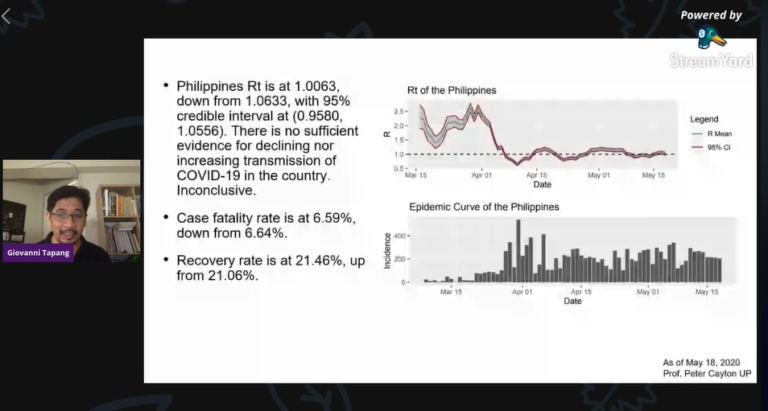
Giovanni A. Tapang, dean of UP College of Science and chairperson of Agham – Advocates of Science and Technology for the People, explained that while errors in the data are inevitable, there are opportunities to correct these.

This is why Tapang is calling for the Department of Health (DOH) to open its data to the public. The health department has so far tapped data science consulting firm, Thinking Machines Data Science Inc. for the creation of the COVID-19 tracker.

“We are not saying that we don’t trust the data that is being released to us, what we are saying is that we hope that the DOH open its data to other groups to help it improve,” Tapang, also a member of the UP COVID-19 Pandemic Response Team, said.

The UP experts earlier noted errors in the DOH’s data on coronavirus 2019. Tapang said that while the DOH said that the error is just one percent, he said that there should be due diligence on the part of the DOH down to those who release the data because this will “trigger policy changes that will affect millions of people.”

Delayed reporting

The UP Team also noted a delay in reporting of patients who have been tested positive for COVID-19. Tapang said DOH data reveal that the longest days that a person was reported positive of the virus since he/she was tested is up to 101 days or more than three months.

On the average, the DOH’s reporting rate is two weeks.

“It should be shorter so that the DOH can determine how to manage the case and do contract tracing,” he said.

A look into the COVID-19 tracker of the DOH would also reveal that while there are 13,777 confirmed positive cases as of May 23. Cumulative positive individuals, however, is already at 20,264, which means there is a gap of 6,487.

In his Twitter account, Renato Reyes Jr., secretary general of Bagong Alyansang Makabayan (Bayan), noted that in April, the gap in the number of cases is only at 800.

“Government says we are winning the fight because only 250 confirmed cases for every 11,500 tested. But the 250 daily average remains because that seems to be the maximum capacity for validating positive cases…False sense of security ito,” he said.

The explanation to this, according to Health Undersecretary Maria Rosario Vergeire, is that the validation process is “long and tedious” to make sure that the data being released are correct.

Inconsistencies

The UP Team also noted inconsistencies in the data drop of the DOH, errors such as reported sex, age and residence of confirmed cases.

Data compiled by UP COVID-19 Pandemic Response Team. Examples of errors in data released by DOH on April 25 and 25.

Tapang also said that the UP Team noticed that data reporting protocols have changed too often such as date format. He said government’s format is not consistent since March and has always changed even the date.

“It may be nit pricking that we are even talking about date, because date format would mean something. The format should be automated because the cases are increasing. When the format always changes so it’s difficult to analyze data properly,” he said.

Tapang said it is also important that the residence of the confirmed cases are correct because this is used by the local government units as as well as the Inter-Agency Task Force on Emerging Infectious Diseases as basis whether or not to lift or extend the enhanced community quarantine.

Tapang said that data input is really difficult especially when it is on a national scale. He said the errors in the data inputs may be attributed to the stretched manpower such as those who are in the epidemiological surveillance unit or provincial epidemiological surveillance units. In this case, he said, there is a need to beef up human resources.

Open data

Tapang said errors in the data can be easily corrected if only the DOH is open to the idea of open data. By open data, he said many groups can look into these data drops and can help into pointing out the errors and eventually correct these errors.

However, the process of data cleaning or data transformation is only done by Thinking Minds.

“Open data is very simple, if publicly funded then it is a public data and the public should have access to it. In this way, there will be many ideas about the data so that the society can make sense of what the number is all about,” he said.

The UP experts have earlier called on the DOH to make all data sources open, while also being mindful of the same data privacy protocols that DOH is following. This, they said, can further empower both official and unofficial stakeholders.

The UP team said that the reporting system should be standardized and regularized, integrated into the existing data tracker as much as possible.

The UP Team also called on the DOH to share relevant data that can help capable institutions make scientific assessments for discussions on the evolving crisis to come up with better peer-reviewed science.

Without open data, Tapang said it would be difficult to know if interventions are successful or not.

“Lockdown would be put to waste if the numbers are not improving. It would be difficult to just relax the restrictions and later on, problems would arise because the government is not prepared,” Tapang said. (https://www.bulatlat.com)

The post Delayed reporting, inaccurate data on COVID-19 worry advocates appeared first on Bulatlat.

Why make the poor pay for COVID-19 response?

0

There’s more than enough money for all the COVID-19 response we
need – the Duterte administration just has to take the side of the people and
stop being so scared of the rich.

The Philippines is in the middle of its worst public health and
economic crisis in decades, possibly even in its history.
The social, economic and health measures needed to deal with this are
undoubtedly expensive. But are they unaffordable?

Hangin

The government seems to think so. The president famously said that
the government does not have enough money to respond – “hangin lang iyan,”
he lamented.

The rest of the Inter-Agency Task Force for the
Management of Emerging Infectious Diseases haven’t been as blunt but they’ve
been acting that way. The social welfare department has, in effect, been
rationing already stingy cash aid with unduly strict requirements. The health
department isn’t testing, tracing, isolating and treating as much people as
they should for want of resources.

The finance department is at the helm of the
government’s economic team. It is voting with its feet – its Philippine Program
for Recovery with Equity and Solidarity (PH-PROGRESO) and stimulus plans don’t give income
support for tens of millions of cash-strapped families beyond the lockdown.

Unfortunately, strangely affirming the
importance Karl Marx gives to the economic base of society, the economic
managers are too decisive. The finance department is also in charge of revenue
generation. If it says there isn’t any money, then the rest of government won’t
have any money. Which explains where the president’s hangin comment came
from.

But is there really no money to be had?

The plan

But before looking into that, a more basic question – how much
does the government really need? Four months into the pandemic, it’s still not
actually very clear. PH-PROGRESO is presumably the national government’s plan
but this doesn’t include what must also be considerable efforts at the local
government level.

The four-pillar PH-PROGRESO also has to be interpreted carefully
because the finance department adds up actual spending, loans and guarantees,
foregone revenue, financing, and additional liquidity to come up with an
impressive looking grand total of Php1.74 trillion.

As it is, it looks like there’s only Php506 billion in actual
spending. This includes Php321.6 billion in emergency support, Php133.7 billion
in loan and credit guarantees, and Php50.7 billion for health measures.

The balance of Php1.24 trillion is actually composed of tax cuts
and other foregone revenues (Php142.8 billion), liquidity released into the
system by central bank measures (Php233 billion), and financing mostly from new
debt (Php861.8 billion). Put another way, the government doesn’t actually need
to raise funds for all these items accounting for 71% of the ‘grand’ total.

So where to get that Php506 billion that will actually be spent?

The Php861.8 billion in new financing of PH-PROGRESO – Php436.9
billion from official development assistance (ODA) and Php419.4 billion from
government bonds – is presumably a source.

But the program also mentions up to Php673 billion freed up from
existing budget items and so not really needing new financing or revenue sources.
This is from the 2019 and 2020 national budgets, off-budget items from
government-owned and controlled corporations and government financial
institutions, and private sector contributions as well as from “financial
sector, monetary policy, regulatory relief”. In his last weekly report to
Congress, the president cited raising Php257 billion already from discontinued,
abandoned, reprogrammed, reallocated and realigned items in the 2019 and 2020
budgets.

Looked at in this way, it appears that the government has come up
with a reasonably prudent plan.

Poor pay for meager response

But appearances can be deceiving. There are two problems here.

The first is that the planned Php506 billion in actual spending
falls far short of being a sufficient response. The COVID-19 response needs to
be much more comprehensive and ambitious. The combined cost of the range of
health measures, emergency relief, income support, and enterprise support
needed is likely more in the order of Php1.5-2 trillion.

Clearly, the perceived lack of funds is a major binding constraint to the broader response that is really needed and, indeed, even just a larger COVID-19 response than at present. This self-imposed limitation gravely undermines the public health response, risks undue infections and deaths, and will mean socioeconomic difficulties on a massive scale.

Which leads to the second problem. Meager as the response is, the
poor are paying for it more than they should – through debt and higher taxes –
while the rich are paying much less than they can.

Most of the Php861.8 billion in financing of PH-PROGRESO is
actually new and additional debt that will be paid for from taxes. Only a tiny
Php404 million of this financing are grants and the rest are ODA loans and
government bonds. The government has already been reported as seeking US$5.7 billion in foreign loans for its COVID-19
response. To date, the finance department reports US$4.9
billion
in COVID-related foreign debt.

The taxes to pay for this debt are disproportionately borne by the
poor with their low incomes. Especially after the Tax Reform for Acceleration
and Inclusion (TRAIN) Package 1 of 2017, the country’s tax system is more regressive and consumption tax-oriented than it
has ever been.

The self-imposed debt trap even to so-called development agencies
and friendly governments is glaring. The Duterte administration is programmed
to pay US$1.7 billion in debt service to multilateral
and bilateral agencies – especially the World Bank and Asian Development Bank –
this year. These are also the very agencies it has borrowed an additional US$2.5
billion
from to respond to COVID-19.

Taxing consumption

The government is also quick to tax consumption including of the
poor. Consumption taxes are inherently regressive in being paid the same by
everyone regardless of how poor or rich they are – as opposed to direct
taxation of income and wealth which is more progressive.

The administration has already hiked tariffs on imported oil
products by 10% to raise funds for dealing with the pandemic.
The planning agency, headed by a former finance department official, is already
proposing higher consumption taxes that will add to the
burden of poor and middle class families.

This includes a digital economy value-added tax proposal which
adds a Php50 billion tax burden on online consumers over 2021-2023, higher
taxes on sweetened drinks and junk food adding a Php22.7 billion burden, and a
higher Motor Vehicle Road Users’ Tax adding a Php40 billion burden.

Increasing taxes on low-income families amid a recession would be
perplexing if the insensitivity of the Duterte administration and its economic
managers when it comes to taxes were not already well-established. They are
only being hugely opportunistic in exploiting the COVID-19 crisis to push their
long-standing TRAIN agenda of raising consumption taxes on poor and low-income
groups while reducing taxes on the rich.

It’s all a bizarre repeat of TRAIN where the poor are made to pay
more so the rich can pay less. This time around, amid the COVID-19 crisis, the
rich will benefit from the biggest corporate tax break in Philippine history.

TRAIN Package 2, comically renamed Tax Reform for Attracting Better and High-Quality Opportunities
(TRABAHO) bill, soberly renamed the Corporate Income Tax and Incentives
Reform Act (CITIRA), and now opportunistically renamed the Corporate Recovery
and Tax Incentives for Enterprises Act (CREATE), is being primed for rapid
legislative passage. The Duterte administration is giving up Php667 billion in potential COVID-19 response
funds to boost corporate profits.

Tax the rich

So where can funds for the comprehensive COVID-19 response needed
come from? From the very same sources that funding for national development
should come from – the accumulated wealth and income of the rich.

The pandemic has seen the ideas of solidarity, unity and
compassion raised repeatedly. Beyond spontaneous acts of charity, paying higher
taxes is putting money where your mouth is.

In our population of 108 million, an estimated 596 Filipinos each have wealth of some Php2.5 billion pesos or more. This includes the 50 richest Filipinos whose combined wealth of around Php4.1 trillion is, by IBON’s estimates, more than what the poorest 71 million Filipinos own combined.

There’s no reasonable argument that taxing their wealth above Php1
billion will adversely affect their well-being and welfare. A wealth tax of 1% on wealth above Php1 billion, another 2%
above Php2 billion, and another 3% above Php3 billion will raise Php236.7
billion annually from these 50 richest alone. They are not going to be spending
this anyway versus the huge social, economic and health returns from
using this for COVID-19 response.

Other tax measures can also be considered. A two-tiered corporate
income tax scheme with higher taxes on large firms and lower taxes on micro,
small and medium enterprises can be designed to generate about Php70 billion
annually. Similarly, a personal income tax scheme with higher taxes on just the
richest 2.5% of Filipino families can raise about Php127 billion annually.

These are illustrative figures for now but the Duterte administration can come up with more precise figures if it was so inclined. There are technical challenges but these are not insurmountable and no reason not to try.

A wealth tax, higher taxes on large corporations, and higher taxes on the richest Filipinos are the most rational sources of revenues for COVID-19 response and development.

Does Congress have the political will for these? Sadly, our senators and representatives, looking to the 2022 elections already, are the biggest political won’t.

Opening of classes challenges: distancing, hygiene and sanitation in public schools, budget cut to education

The country’s readiness to open schools this August vis-à-vis the Department of Education (DepEd) and Commission on Higher Education (CHED) preparations are now being questioned in light of the order to reopen schools in August. In a public briefing held by the group Cure COVID group, the group tackled questions our nation’s readiness for the […]

The post Opening of classes challenges: distancing, hygiene and sanitation in public schools, budget cut to education appeared first on Manila Today.

Fighting over ‘waves’, is government unified in fighting COVID-19?

0

Government officials contradicting each other on what wave the country is now facing the COVID-19 pandemic raises concerns from doctors. Is the government unified in its assessment and approach to fight the virus?

COVID-19 pandemic from stories around the world: a health and human rights crisis

On May 21, 6am ET, WITNESS launched the UN-Gala COVID-19 Human Rights Stories along with Professor Angela Davis. WITNESS is a non-profit organization that helps people use video and technology to protect human rights. It was an hour-long virtual sharing of different human rights stories across the world amidst the pandemic. Peter Gabriel, an activist […]

The post COVID-19 pandemic from stories around the world: a health and human rights crisis appeared first on Manila Today.

Struggle for liberation of Palestine, every Muslim’s obligation

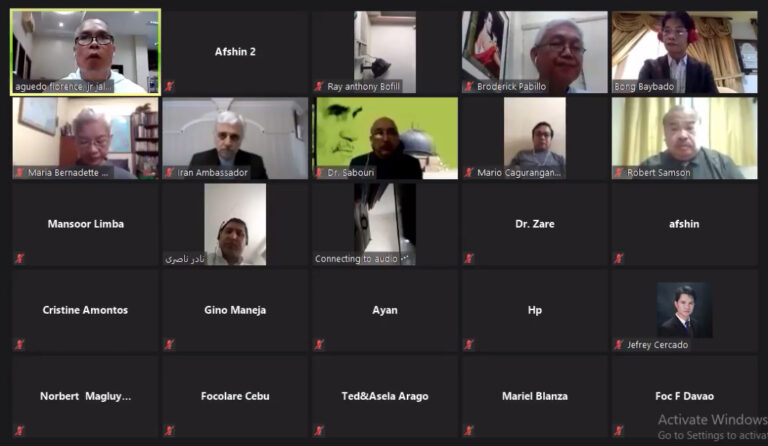
(Screenshot photo of the online video conference “QUDS: Stand in the Solidarity and Interaction of Religions” organized by the Cultural Section, Embassy of the Islamic Republic of Iran in Manila., May 21, 2020)

Israel has been a threat, not only to its people, but to its entire region. With the support of the US government, it has continued to build nuclear arsenal and weapons through the years, bombing and destroying houses, properties of innocent Palestinians. This is despite the several warnings issued by the United Nations.

By MENCHANI TILENDO
Bulatlat.com

MANILA — The annual International Quds Day (Jerusalem Day) is commemorated in a rather different way this year as COVID-19 cases continue to spike in various parts of the world. Despite the challenges posed by the ongoing health crisis, groups from inter-religious communities and democratic organizations have continued to show unity for the Palestinian people’s fight for real liberation.

This historical event, initiated by the Islamic Revolution since 1979, has been massively observed by Arab and Islamic countries in opposition to the “Jerusalem Day” instituted by Israel in 1968. This is usually met with protests and demonstrations during the last Friday of Ramadan (May 22 for this year) to show solidarity with the Palestinians in their fight against the Zionist Israel and its main instigator, the US government.

The Palestine occupation is one of the most important issues concerning the Islamic community, since this has been a reflection of the Muslim people’s quest for long-lasting peace. Aside from being a spiritual undertaking, the fight of the Palestinians has been a strong political and moral obligation for most of the followers of Islam.

Decades of the Palestine occupation have pushed its people to carry out selfless struggles even beyond its borders. Thus, it becomes an obligation for Muslims from all over the world to contribute to this Islamic struggle.

The war on Palestine is a war against Islam

In his televised speech on April 9, Iran’s Supreme Leader Ayatollah Ali Khamenei said Israel’s establishment is considered a ‘crime against humanity’, and that the Jewish state is a ‘cancerous tumor created by the Westerners and Jewish corporation owners.’

Khamenei likened Zionism to a ‘virus’ that must be eliminated as soon as possible, stressing that “the main goal of the Westerners and Jewish corporation in fabricating the Zionist regime was to build a stronghold to influence and dominate West Asia.” “They equipped the bogus, occupying regime with all kinds of military and non-military tools, even nukes,” he said.

The growing Iran-led resistance against Zionism is a product of the all-out war waged against the whole Islamic community. This war is deeply rooted in economic, political, cultural, and military factors and has been utilizing modern tools of propaganda to malign the Islamic world.

“The reason why the arrogant powers are extending full support to the Zionist regime is because they intend to create serious obstacles to the power and integrity of the Islamic world. Conquering Palestine will provide a gateway to the conquering of the Islamic world,” Khamenei said.

US as the main aggressor behind Zionist Israel

There is no denying that the Zionist Israel has become a tool of the American government to further consolidate power and dominate West Asia. Now, with the ongoing COVID-19 pandemic, the Palestinian people are combating a two-fold outbreak – the actual coronavirus and the intensified aggression by the Zionist Israel.

Israel has been a threat, not only to its people, but to its entire region. With the support of the US government, it has continued to build nuclear arsenal and weapons through the years, bombing and destroying houses, properties of innocent Palestinians. This is despite the several warnings issued by the United Nations.

In a virtual forum organized by the Cultural Section of the Embassy of the Islamic Republic of Iran on May 21, inter-religious leaders expressed their solidarity against the illegal occupation of Zionist Israel in the whole region of Palestine.

“At this time of COVID-19 pandemic wherein people of the world are demanding more humane actions and human solidarity to address the crisis, Israel, on its part, is taking full advantage of the situation by fast-tracking the extermination of Palestinians through intensified inhumane policies that started last month – the spraying of pesticides to destroy Palestinian farmlands, and the shooting of fishermen,” Zainab Javier, secretary of Friendship Society of Filipino-Iranian Women Inc., said.

“Some would argue that these Zionist Israelis are the ‘chosen people of God’– but this is just one of the many lies spread by Israel and its creators who are in fact masters in lying, cheating, and stealing, as US Secretary of State Mike Pompeo has nonchalantly admitted,” Zainab said.

“Today, the real Jews, Christians, and Muslims are united in denouncing the illegal state of Israel. More and more people are becoming aware that Judaism was hijacked by Zionism, Christianity was hijacked by Zionist Christians who backed the state of Israel, Islam was hijacked by ‘Wahabism’, which is the foundation of ISIS and other terrorist groups,” Zainab added.

Stronger interfaith solidarity

The growing number of people who have become aware of this manipulation by Zionist Israel is testament to the failure of the US hijacking project which used religion to divide and rule over the world.

The Embassy of the Islamic Republic of Iran stressed that they have always supported the plight of the Palestinians for their inalienable right to self-determination.

“Quds (Arabic term for Jerusalem) is a land sacred to the followers of all divine religions. Every attempt to attack places of worship or threaten the people through violent destruction is a deviation from the teachings of religion and international law,” said by Dr. Morteza Sabouri, cultural sounselor of the Embassy of the Islamic Republic of Iran in Manila.

Members of human rights and religious organizations have forged a stronger unity and international solidarity for the liberation of Palestine. They have become more resolute and awakened by the fact that the only way forward is to fight.

As what Imam Ruhollah Komeini, the leader of the Iranian Revolution said, “Fighting for the liberation of Palestine is a religious obligation of fighting against injustice.” (https://www.bulatlat.com)

The post Struggle for liberation of Palestine, every Muslim’s obligation appeared first on Bulatlat.

Pahirap na lockdown, dulot ay pahirap na online class sa mga mag-aaral ng FEU

Halos dalawang buwan na ang nakalipas ng ipataw ang Enhanced Community Quarantine (ECQ) sa bansa lalo na sa National Capital Region (NCR) ay nagkukumahog pa rin ang mga estudyante ng Far Eastern University (FEU) na magpasa ng mga requirements sa online class. Si Ery na nasa pangalawang taon ng Nursing ay nahihirapan sa kanyang pag-aaral […]

The post Pahirap na lockdown, dulot ay pahirap na online class sa mga mag-aaral ng FEU appeared first on Manila Today.