Home Blog Page 312

Anomalies in the mid-term election in the Philippines

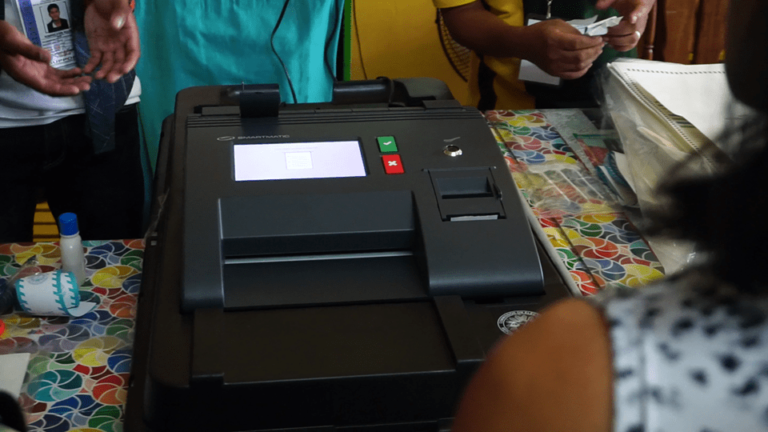
Photo by AlterMidya

By DELIA D. AGUILAR and E. SAN JUAN, JR.

Manipulating the mid-term May 13, 2019 elections, Philippine strong-man Rodrigo Duterte has finally seized full control of the State apparatus. He captured the last institution, the Senate, to guarantee absolute power (after removing an independent chief justice of the Supreme Court), with the election of his candidates to confirm his diktat over a nation of 106 milion people. Because of perennial lack of jobs and extreme poverty, over 12 million citizens are working abroad as “Overseas Filipino Workers.” Their annual remittance of over $30 billion keeps the economy afloat, enabling the privileged minority of oligarchs to enjoy obscene luxury.

Over a century of U.S. colonial and neocolonial rule has kept the economy backward, dependent on IMF-World Bank conditionalities. Today China is lending billions with onerous fees. During the Marcos dictatorship (1972-1986), Washington and the Pentagon supported the brutal Philippine National Police (PNP) and the corruption-ridden Armed Forces of the Philippines (AFP) to maintain elite rule.

The Trump administration is now their avid patron, with China’s party-boss following behind. Millions of U.S. tax-dollars in foreign aid have contributed to the jailing, torture, and extra-judicial killing of thousands of Filipinos critical of the regime. Hundreds of U.S. “Special Forces” have participated in counterinsurgency drives (the latest in fighting Moro rebels in the devasted Marawi City), enabled by various executive agreements (VFA, EDCA) to intervene in the affairs of a “sovereign” country.

The conduct and outcome of the recent Philippine midterm election is only the latest symptom of a society in deep trouble. The Commission of Elections (COMELEC), controlled by Duterte, ignored widespread protests of fraud, electronic rigging (vote shaving/padding) and other forms of cheating. It has proclaimed the entire process a “success.” NAMFREL, Kontra-Daya, and other civic organizations reported widespread anomalies. Among them are:

1) the failure of at least 961 machines machines for Voter Registration Verification and Counting Machines, affecting 600,000-800,000 votes;

2) at least 1,665 SD cards were defective, suffering glitches;

3) pre-shading of ballots, thus voters who rejected plunderers found in their receipts the names of Marcos, Revilla and other convicted felons;

4) rampant vote buying, with PNP forces deployed to spread black propaganda against opposition candidates, with threats of violence;

5) the Mindanao region with its decisive 12 milion votes is under strict martial law, leading to widespread voter disenfranchisement.

Unsupervised handling of the Smartamatic computers led to systematic cheating. Still unexplained is the suspension of transparency servers (electronic recording of votes cast) for seven hours, enough to allow tampering of the results to favor Duterte’s minions. Dennis Uy, a wealthy Duterte ally, owns the company that manages or administers the machines used by COMELEC in the election.

What is flagrantly unconscionable is the immense public and private spending of Duterte’s candidates. As a result, hugely popular candidates like lawyers Colmenares and Diokno–did not make it, while those with records as convicted plunderers, including Imee Marcos, dictator Marcos’ daughter, won.

What does Duterte gain from this election? Almost everything. The electoral defeat of the democratic opposition means that Duterte will have the backing of the Senate to introduce a new constitution to establish a federalist system. This will virtually insure Duterte’s permanent rule. He will continue to promote the PNP’s extra-judicial killings in the notorious “drug war” that has curtailed neither drug use nor profit from drug trafficking. Over 30,000 victims of “tokhang” (extra-judicial killings) have outraged the public as well as the international community. Duterte has ordered the banning of officials from the International Criminal Court and the United Nations.

In line with a retrograde agenda, Duterte will be free to reinstate the death penalty, lower criminal liability from age 15 to 12, and allow foreign corporations 100% ownership of the nation’s patrimony. This will surpass Marcos’ worst abuses while allowing drug lords (linked to Chinese syndicates) to intensify their influence beyond the corruption of ordinary policemen and petty bureaucrats.

All this is a frightening prospect for everyone who believes in democratic principles and the exercise of civic liberties and universal human rights. MAKABAYAN and other people’s organizations continue to oppose Duterte’s declared electoral “victory” by exposing the “dirty tricks” of this sham election. Washington DC-based Kamalayan, Bayan USA, and other groups are mobilizing their communities to demand the halting of U.S. military aid to fund the PNP and the AFP. Under Duterte’s open encouragement, these agencies have heightened their violation of human rights, as substantiated by Amnesty International, Human Rights Watch, and the UN Commission of Human Rights. We urge our legislators to halt all aid until investigations of Duterte’s crimes against his people are fully investigated and exposed. (http://bulatlat.com)


ABOUT THE AUTHOR: Delia D. Aguilar, formerly Irwin Chair, Women’s Studies, Hamilton College, New York

E. San Juan, Jr., emeritus professor of English & Comparative Literature, University of Connecticut; formerly chair of Dept of Comparative American Cultures, Washington State University

The post Anomalies in the mid-term election in the Philippines appeared first on Bulatlat.
Blueprint for unrest

The way the Philippine Party List System has worked, since it was created by the 1987 Constitution to assure “proportional representation” in the House of Representatives and the Party List Act ( Republic Act 7941) was passed in 1994, has provoked even the Commission on Elections (Comelec) to consider asking Congress to amend the law. But it is unlikely that that body will do so — at least not towards making it truly serve the voiceless and marginalized sectors of Philippine society.

Article VI of the Constitution specifies that half the 58 party list seats in the House of Representatives “shall be filled by the labor, peasant, urban poor, indigenous cultural communities, women, youth, and such other sectors as may be provided by law, except the religious sector.”

The obvious intention is to assure the representation, even if only to a limited extent, of those sectors of the population that have historically been denied a voice in the so-called House of Representatives. The Constitution implicitly acknowledges that their concerns have not been addressed by a legislature whose membership has over the years mostly consisted of landlords, provincial despots, political dynasties and/or their surrogates, agents and allies.

But that reason-for-being of the Party List System was completely missing in R.A. 7941. As a result, the Supreme Court made it possible through a series of decisions for the already over-represented political parties as well as those who claim to represent such sectors as tricycle drivers and security guards but who are neither to seek party list seats.

As indifferent to the voicelessness and underrepresentation of vast sectors of the Philippine population as any warlord coven, the Supreme Court based its decisions on nothing more than the letter of the law rather than its spirit.

The consequences are glaringly evident in the results of the May 13 party list elections. Billionaires are among the nominees of certain victorious party list groups as well as government officials and oligarchs from various dynasties. The case of a former National Youth Commission chair is specially demonstrative of how the system has been debased. The Comelec not only allowed his campaigning for his party list group while he was still in government and had access to its resources, but may even approve his representing it in the House despite his being overaged.

The Comelec did take note of how a system meant to represent the marginalized, in the hands of the most corrupt and most self-aggrandizing political elite in Southeast Asia and its minions, has morphed into just another means for the dynasties to keep their monopoly over lawmaking in this country. That dominance has over the decades made reforms practically impossible through legislative means, and made rebellion and the rise of armed social movements inevitable. But like the passage of an anti-dynasty law, any amendment to R.A. 7941 that would help make representation in the House at least partly proportional through the Party List System is doomed to failure, that option not being in the interest of the ruling majority in government.

What could prosper, however, are amendments to make the System even more pliable to the manipulation of the creatures who claim to be this country’s leaders. The primary reason for that travesty would be the failure of the present regime to prevent the election of the party list groups that truly represent marginalized sectors.

Despite police and military harassment, threats, intimidation and even the murder by supposedly unknown assailants of some of their leaders, these groups have nevertheless again won seats in the House. Even the fact that their number has been reduced, though not significantly, is unacceptable to the present regime, on the argument that they’re no more than “fronts,” allies and supporters of the Communist Party of the Philippines (CPP).

Any similarity between the programs of such groups as Bayan Muna, Gabriela, Act Teachers, Kabataan Party List, etc. and the CPP’s doesn’t prove that allegation. But their detractors used the anti-communist bogey to campaign against them — and only partly succeeded. Whatever their political and ideological convictions, the fundamental issue, however, is whether the presence in Congress of these party lists has been and is of any value at all to the imperative of giving the marginalized a voice so they can be part of the public discourse on what can be done to address the country’s legions of problems.

That of course is the point of the Party List System. It was part of the attempt by the more enlightened drafters of the 1987 Constitution to make government responsive to the plight of the poor, underprivileged and powerless, ignoring which had fed and continues to feed social unrest and even rebellion.

The sense of history implicit in that assumption is totally absent in the Duterte regime and its equally benighted police and military accomplices, for whom mindless violence is the only solution to any problem. Far more sophisticated in its approach to the ruling elite’s determination to end the armed rebellions that have haunted much of Philippine history, the 1992-1998 presidency of Fidel V. Ramos supported and supplemented the Party List System’s potential to make government open to reforms. It also revived peace negotiations with both the CPP and the Moro National Liberation Front (MNLF). Its congressional allies repealed the Anti-Subversion Law (RA 1700) in 1992, in effect legalizing the CPP and similar organizations.

The idea was to enable reformists and even revolutionaries to have the legal opportunity to work for their programs, and even get elected to public office. It would then send to the dispossessed and discontented the message that they need not take up arms because the political system works well enough to welcome the demand for reforms and even radical change. Among the indicators of how effective this approach could be was the successful forging of a peace agreement between the Philippine government and Nur Misuari’s MNLF during the Ramos administration.

The assumption is that only the certifiably insane — and those militarists who benefit from it — prefer war over peace. Unfortunately for the ruling system, that basically sound approach met only limited success. It is failing, among other reasons because dynastic dominance over the political system has made running for public office an exclusive billionaire and warlord game, and because of police and military allegiance to their local and foreign patrons and the unjust order that has so enriched and empowered them.

Together with the rapid and irreversible perversion of the already limited Party List System, the exclusion of the poor, powerless and voiceless from participation in their own governance partly explains why rebellions and so-called “insurgencies” have been, and will always be, part of the Philippine landscape for decades. It is a blueprint for social unrest driven and protected by the very same ruling elite that’s focused on preserving itself and the political, economic and social systems that have served it so well.

But if history is any guide to human affairs, the very same blueprint could also help end the oligarchy’s decades-long monopoly over the political power it has so steadfastly denied the marginalized millions of this alleged democracy. More than the supposed “fronts” of the CPP, the message it is sending the poor and powerless is that the system doesn’t work, and reforms cannot be achieved through parliamentary means.

Luis V. Teodoro is on Facebook and Twitter (@luisteodoro).

www.luisteodoro.com

Published in Business World
May 30, 2019

The post Blueprint for unrest appeared first on Bulatlat.

Protecting dissent: Writs of amparo, habeas data

For the second time last month, the Supreme Court took steps to make use of two writs that may offer significant protection to political and social activists facing threats to their lives, liberty and security because of their continuing defense of human rights.

The order to take up the two writs – the judicial remedies of amparo and habeas data – were actually issued earlier in the week but made public only two days ago. Since 2007, they have been part of Philippine jurisprudence that could help correct the abuses inflicted by government upon dissenting citizens who dare to speak up and take action within the framework of existing law.

It was the Supreme Court itself, led by then Chief Justice Reynato Puno, that instituted these novel remedies (already used in other countries) as a response to the surge of human rights violations – topped by extrajudicial killings and forced disappearances – under the Arroyo regime in the second half of the 2000s.

The writ of amparo pertains to the protection by the highest tribunal extended to petitioners where threats to their life, liberty and security emanate from the military, police and other state security forces. The writ of habeas data requires the respondent state authorities to disclose to the petitioners all of the dossiers the former hold against them and, as warranted, to destroy such files against each of them.

In the present case, the court acted on a petition filed by the militant groups Karapatan, Rural Missionaries in the Philippines (RMP), and Gabriela through the National Union of People’s Lawyers (NUPL). The petitioners are seeking relief from the unabated campaign of red-tagging, vilification, threats, harassments, and killings attributed to state security forces under the Duterte government.

The Court of Appeals was directed by the SC to conduct a hearing on the merits of the petition on June 18 and to submit a decision on the case within 10 days after. Once the CA rules in favor of the petitioners, the SC will formally order the implementation of the writs.

The fact that the SC ordered a formal hearing on the petition, and not denied it outright, already indicates it may have found merit in the issues that have been raised, a human rights lawyer explained to me. The lawyer also expressed cautious optimism that an early date (June 13) had been set for comments to be filed by the respondent government and military officials, allowing the process to continue.

Earlier on May 3, the Supreme Court issued a similar order on a parallel petition filed in April by the NUPL, through its legal counsel, the Public Interest Law Center. Thus both the clients (Karapatan, RMP, and Gabriela) and their legal counsel are in the quaint situation of feeling under threat and seeking the same twin judicial remedies from the high court.

This quaint situation speaks volumes about how low the state of human rights has sunk under the Duterte administration – given President Duterte’s sustained verbal attacks against human rights defenders, both national and international, in his first three years in office.

In both petitions, President Duterte heads the respondents, as commander-in-chief of all the state’s armed forces; the others are his top defense and military officials.

Other AFP and PNP officers (identified as members of the National Task Force to end local communist armed conflict, created by Duterte in December 2018) are respondents as well in the Karapatan-RMC-Gabriela petition, along with two Malacanang civilian officials.

Karapatan says in the petition that four of its staff workers have been summarily killed under Duterte’s watch (among the 48 human rights defenders slain from 2001 to 2019). Since October 2017, it adds, President Duterte has red-tagged and vilified Karapatan six times in his public speeches and press conferences, threatening to go after the organization which he alleged to be a “legal front” of the CPP-NPA. Before this, it had already submitted report-complaints to four special rapporteurs of the United Nations, as well as to the Commission on Human Rights.

On its part, Rural Missionaries of the Philippines complains that state security forces have branded as “terrorist activities” its religious and missionary work intended to provide basic social services (such as literacy and numeracy) to the poor, citing specific incidents in Bukidnon and Lanao del Norte. In November 2018, it says, army soldiers abducted four of its volunteer teachers. Like Karapatan, RMP also submitted its report-complaints to the CHR.

Gabriela pointedly cites a March 26, 2019 letter of security adviser Hermogenes Esperon Jr. to the European Union counter-terrorism coordinator Gilles de Kerchove naming three Belgian NGOs that allegedly partnered with “communist front organizations” including Gabriela. It also cites Lt. Gen. Rodolfo Obaniana, AFP Eastern Mindanao Command chief, as having tagged the Gabriela Women’s Party, along with 23 partylist groups, as “CPP-NPA fronts.” Also, Gabriela says its national office in Quezon City has consistently been subjected to “heavy surveillance.”

The three petitioning organizations aver that red-tagging against them became “more systematic” after Duterte signed and issued Executive Order 70 on Dec. 4, 2018. In early 2019, the National Task Force created under EO 70 sent a delegation to Europe that met with officials of various United Nations bodies and member-governments of the European Union. In those meetings, the petitioners say, the NTF delegation tagged them as CPP-NPA front organizations and sought a stop to European funding support for their programs and activities. In a press conference at Malacanang on March 1, they point out, Maj. Gen. Antonio Parlade and three Malacanang minor officials took turns “maligning” Karapatan and RMP.

Based on these incidents, plus others cited in the complaint, the petitioners said the Duterte government officials ”acting directly and indirectly, violated and continue to violate [our] rights to life, liberty and security.” They add that “the glaring incidents of threats, harassment, and killings are aimed at crippling their legitimate operations and programs for the marginalized sectors and the victims of human rights violations.”

A formal hearing has been set this Tuesday at the Court of Appeals on the NUPL petition, and on June 18 regarding the Karapatan-RMC-Gabriela petition. As President Duterte is the lead respondent in both petitions, the solicitor general is expected to do every legal maneuver he can employ to exculpate him. Will the CA justices and, for that matter the SC magistrates many of whom are Duterte’s appointees, be swayed by his arguments? Or will they fairly appreciate the evidence presented by the petitioners and see their way toward granting the writs of amparo and habeas data?

* * *

Email: satur.ocampo@gmail.com

Published in Philippine Star
June 1, 2019

The post Protecting dissent: Writs of amparo, habeas data appeared first on Bulatlat.

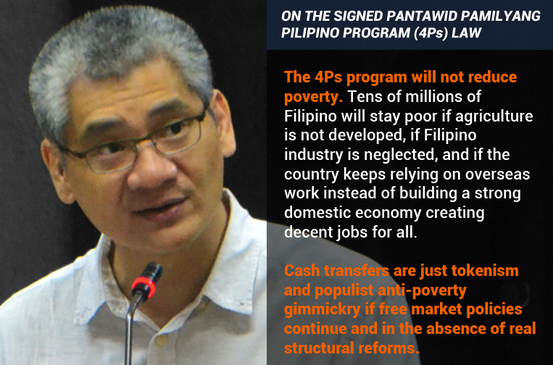
Cash transfers tokenism in the absence of real reforms

0

#MalalangEkonomiya #MayMagagawa #PeopleEconomics

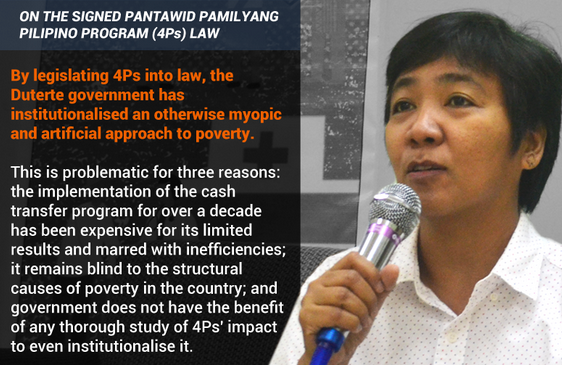
4Ps: Myopic, artificial approach to poverty

0

#MalalangEkonomiya #MayMagagawa #PeopleEconomics

‘Comes in a crucial time’: SC issues writ of amparo for rights group

0

The human rights group Karapatan welcomed the Supreme Court’s issuance of writ of amparo and habeas data in favor of rights groups, which have been accused as “communist fronts” by the military.

Advocating a sustainable mass transport system

0

#MalalangEkonomiya #MayMagagawa #PeopleEconomics