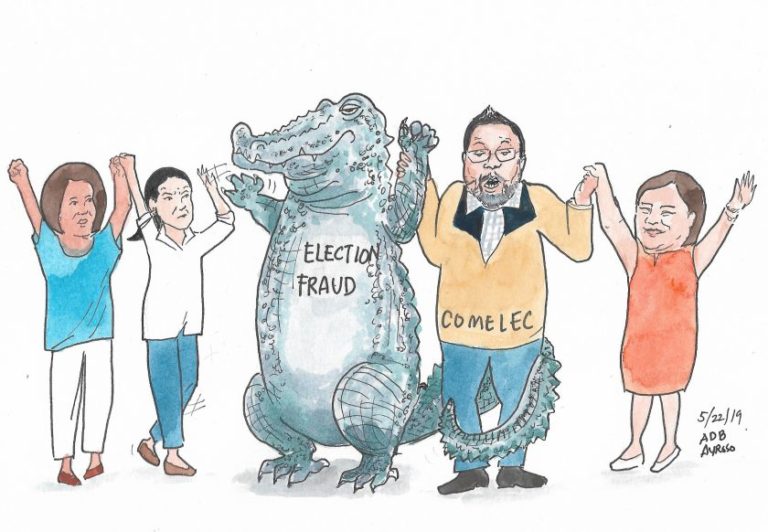
An airline has canceled two of its flights Wednesday to reboot its system, said the Civil Aviation Authority of the Philippines (Caap) at Laguindingan Airport in Laguindingan, Misamis Oriental.
Paramilitary forcing Lumad evacuees to go home, group claims
The Lumad group PASAKA slammed the military and paramilitary group Alamara for forcing Lumad evacuees to return to their communities amidst the height of intensive and continuing military operations in the hinterlands.
Makabayan bloc set to win 6 seats
Despite relentless harassments and vilification by the military and police throughout the campaign period up to election day last May 13, the progressive parties amassed a total of 2,236,155 votes that is good for six seats in the 18th Congress.
Makabayan bloc to get 6 seats

By RAYMUND B. VILLANUEVA
Kodao Productions
The Makabayan bloc may increase its number of seats by one in the House of Representatives as the National Board of Canvassers (NBOC) is set to proclaim the winners of the party list race tonight.
Despite relentless harassment and vilification by the military and police throughout the campaign period up to election day last May 13, the progressive parties obtained a total of 2,236,155 votes which qualify them for six seats in the 18th Congress.
Bayan Muna is set to have three seats after garnering 1,117,403 votes representing 4.01 percent of all party list votes cast.
It placed second behind high-spending ACT-CIS Party.
Gabriela Women’s Party placed 12th in the race, garnering 449,440 votes representing 1.61% of all party list votes cast and winning one seat.
ACT Teachers Party came close behind at 15th place, with 395,327 votes representing 1.42% of all party list votes cast and winning one seat.
Gabriela Womens’ and ACT Teachers’ each have two sitting representatives in the 17th Congress.
Both groups are the only parties in their respective sectors elected to any legislature in the entire world.
At 51st place and the last group to win a seat is Kabataan Partylist, garnering 196,385 votes representing 0.70% of all party list votes cast.
Anakpawis, however, failed to win a seat with only 146,511 votes and 0.53% of all party list votes cast, placing at 62nd place.
The NBOC is set to proclaim all 51 winning parties at seven o’clock tonight at the Philippine International Convention Center in Pasay City.
In the current 17th Congress, Gabriela Womens’ Party has two seats, ACT Teachers Party has two more while Bayan Muna, Kabataan and Anakpawis have one each.
Relentless attacks
Earlier, the Makabayan bloc complained of threats and harassment of its campaigners, members and supporters by the military.
Its members also suffered two massacres in Negros island and arrests of supporters in Bulacan and Bohol while its supporters were prevented from voting in several regions across the country.
On election day last May 13, Philippine National Police officers distributed newsletters tagging Makabayan parties as communist fronts.
“Despite many reports of fraud, the Rodrigo Duterte regime cannot defeat the people’s will,” Bayan Muna second nominee Ferdinand Gaite earlier told Kodao. Reposted by
The post Makabayan bloc to get 6 seats appeared first on Bulatlat.
Igorot leader, 1st Filipina receives Gwangju Prize for Human Rights
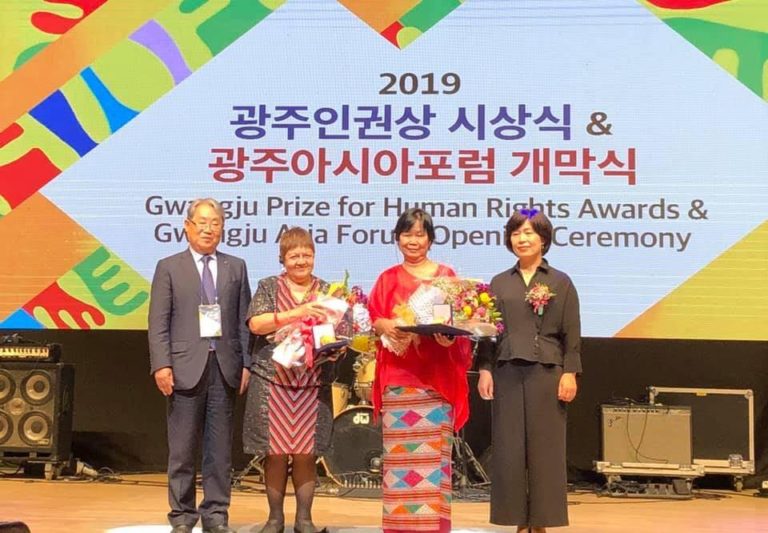
“Human rights make us human. With every violation of human rights, our humanity is diminished.”
By ANNE MARXZE D. UMIL
Bulatlat.com
MANILA – Joanna Kintanar Cariño was awarded the 2019 Gwangju Prize for Human Rights on May 18 in Gwangju, South Korea.
Carino, a longtime activist is the first Filipina to receive the award, according to the May 18 Memorial Foundation.
“This is a vindication of my lifelong vocation to defend and promote democracy and human rights,” said Cariño in her speech during the awarding ceremony.
It is ironic, she said, that while President Duterte’s government labels human rights activists as terrorists, prestigious foreign institutions such as the “May 18 Memorial Foundation recognizes her human rights activism as honorable.”
Cariño was listed along with 600 others in the Department of Justice’s so-called terror list which seeks to proscribe the Communist Party of the Philippines and the New People’s Army as terrorist organizations. It was in January this year that their names were dropped from the list after they fought for its removal.
Last April, the May 18 Memorial Foundation announced that Cariño bagged this year’s Gwangju Prize for Human Rights due to her longtime commitment to human rights work in the Philippines.

“Human rights make us human. With every violation of human rights, our humanity is diminished. The human spirit can only take so much oppression, however, before resistance develops. Repression breeds resistance. To stand up for human rights, to resist tyranny, and to rebel against an oppressive system is justified,” Cariño said.
“But we have to prepare ourselves for sacrifice and even death in the struggle against tyrants for people’s democracy and a better world. It is honorable to stand up for democracy and to defend human rights, especially for the less fortunate and downtrodden,” she added.
Cariño also urged the people to hold on to the lessons of the Gwangju Democratic Uprising and the 1986 People Power in the Philippines especially with the resurgence of tyranny and dictatorship.
“We should always remember, we should never forget. The people, united, shall never be defeated. Never again to martial law!” Cariño said.
Cariño shared her award to her organizations, the Cordillera Peoples Alliance, SELDA, an organization of former political detainees, and Sandugo National Alliance of Moros and Indigenous Peoples for Self-Determination.
Cariño is the founding secretary general and current member of the advisory council of the Cordillera Peoples Alliance (CPA), regional council member of the Cordillera Human Rights Alliance (CHRA) and chairperson of SELDA-North Luzon.
During Marcos’ era martial law, Cariño was arrested, tortured and detained for two years.
But her detention did not stop her from continuing in human rights work. Cariño was among the founders of the CPA in 1984, and served first as its treasurer, then as secretary-general from 1985 to 1987.
She also served as the convener of the CPA’s International Solidarity Commission and later of its Research Commission. She coordinated the Ancestral Domain Research Network (ADRN) in the 1990s which did research into ancestral land issues in the Cordillera region.
Related story: Cordillera woman leader bags 2019 Gwangju Prize for Human Rights

The post Igorot leader, 1st Filipina receives Gwangju Prize for Human Rights appeared first on Bulatlat.
‘Incoming Duterte Youth congressman’
The Commission on Elections has yet to proclaim the winners of the party list elections and his petition to substitute “resigned” nominees has yet to be decided on, Duterte Youth chairperson Ronald Cardema has already claimed he is an “incoming congressman” in the House of Representatives.
My first five years as a full-time activist
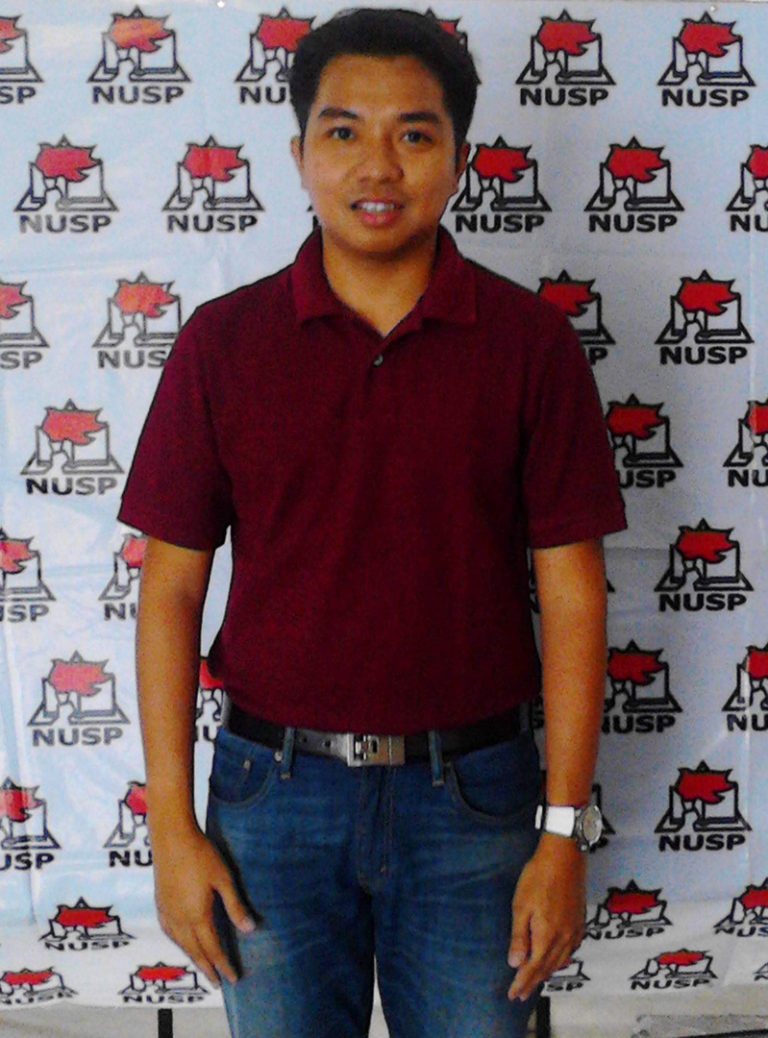
QUESTION EVERYTHING
Mong Palatino
I joined the Center for Nationalist Studies in 1997, became an active member of STAND UP in 1998, and declared my commitment to be a full-time activist after graduation in 2000. I enrolled for a master’s degree but decided to discontinue pursuing this during the ‘Oust Estrada’ campaign.
As a full-time activist, it meant having work but without a regular salary. Our work doesn’t provide remuneration and we even have to help in raising campaign resources. Looking back, perhaps I could have done some freelance job (raket) but it didn’t figure in my priorities during that time.
We were focused on immersing ourselves in the mass movement. We were overeager students of what we believe was radical politics. And we felt that the nation’s politics at that time demanded greater attention and sacrifice. The Left was reenergizing itself through a rectification movement, a populist president was removed from office through ‘People Power’, and we were inspired by the election victory of Bayan Muna.
There’s almost no lull in waging mass campaigns on sectoral and people’s issues. After the 2001 elections, there was a vigorous movement calling for the abolition of ROTC. Meanwhile, community-based groups led the clamor against exorbitant power rates. Gloria Arroyo endorsed the ‘war on terror’ after 9/11 and expanded the presence of foreign military troops in the country. If rallying in response to these issues reflected the espousal of an anti-government agenda, then we plead guilty. But it is a simplistic and inaccurate accusation because it reduces activism into mere agitprop against politicians in power. It denies the role of activism not just in the pursuit of reforms but also how it empowers those living in the margins of society.
Indeed, protest rallies are the visible manifestation of activism and represent pure democracy in action. But activists are aware that there are also other means to advance a progressive type of politics in other arenas of struggle. If rallies are given prominence, it is because they directly intervene in politics while strengthening the collective voice of its participants and the ‘imagined community’ of dissenters.
When activists organize rallies, they do not just think of the logistics but more importantly, the political sense and aim of the protest. Rallies are often the culmination of a particular campaign, serving as the focal point of political engagement. Beyond the technical requirements of holding rallies, there has to be a sustained and coordinated education initiative, effective messaging strategy, alliance formation, legal preparation, and membership expansion. Activists multitask in carrying out their comprehensive political work. No work is too small or too big for dedicated activists.
It is a creative and collaborative endeavor. Repeated planning sessions, consultations, and even late-night meetings to assess the political situation and the status of our organized forces. We discuss and debate the tactical objectives of our campaigns, the methods of organizing, the means to attain our target mobilization, and the forms of our propaganda materials.
Slogans are formulated, press statements are readied, and pamphlets/flyers are prepared for wide dissemination. These are continually scrutinized vis-a-vis the intended political effect. Did they agitate the masses? Did the media quote the statements? Did state officials respond already? Perhaps the analysis is wrong, perhaps a better phrasing is needed, perhaps the font is too small.
Our critique of the social situation has to be refined for the general population. The local campaign is linked to the broader political struggle. We test ideas and our practices while aiming to retain the clarity, sharpness, and correctness of our political line. We conduct lobbying in aid of the political struggle. We form partnerships to solidify our fighting capacity. We work with various community members to learn from their conditions and establish the basis on how to implement our political education program.
It is methodical, thorough, repetitive, but never dull. That’s why those who lampoon the mundaneness of rallies are either clueless commenters, misinformed keyboard analysts, or apologists of the state.
We are not passive members of the resistance. As full-time activists, we do not just find ourselves in the middle of a raging political conflict; but the more apt description is that we situate ourselves in the struggle to master the dialectics of politics, excel in praxis, and win the revolution.
Time is both a friend and foe. We scramble for time to fulfill our duties. The day is always never enough for the many things, scenarios, encounters, and outcomes we wanted to achieve. We greet the day filled with proletarian enthusiasm but we often go back to the headquarters infected with existential disillusionment. Our scientific workplan didn’t deliver, our organizational gains are too puny to measure, our mastery of the political terrain is negligent. In other days, we fail to properly read the situation and it overwhelms us. Our source of despair is the knowledge that the tiniest of our errors translate into the prolonged misery of the masses whom we vowed to serve.
Our defeatist outlook is tempered by a collective evaluation of our work. And from this new knowledge, we develop a better plan to overcome our shortcomings, conquer self-doubt, and seize the new day. We celebrate and seek to accumulate even the small victories as we anchor them to the protracted struggle for genuine emancipation.
There was no concept of self-care or life-work balance that guided our daily routine during that time but the best of our days were spent doing politics. We viewed life and its contradictions through the lens of politics. But we didn’t wallow in abstractions because there were always practical questions that needed to be resolved. Every day was a new opportunity to shed aspects of life that embraced selfish individualism. Oh, what a difficult, painful transition. You attend parties, reunions, and family dinners hoping that you could contribute more other than your keen political viewpoints.
You do not stop feeling inadequate but you’re more at peace after surviving different types of political upheavals. In time, you will appreciate the value of friends lending support, the family as your generous refuge, and kasamas as your guide (gabay) in the struggle.
Will I do this again if given the chance to rethink the choices I made with my life? There was no certainty of success. There was no promise of reward. Only the idea that I will be joining an army of radicals and dreamers. And from the inside, we fashioned the template of resistance into something that will hasten the arrival of the future. We constantly failed, but we kept on marching forward, always and still determined to make the impossible possible. Proud that I sided with the good ones, the Natdems. The formative years as a full-time activist which gave me the confidence, courage, and progressive perspective to advance the cause of the revolution whether inside the halls of Congress, the streets of Manila, or in the interstices of the rural and urban.
Mong Palatino is a Filipino activist and former legislator. He is the chairperson of Bagong Alyansang Makabayan Metro Manila. Email: mongpalatino@gmail.com
The post My first five years as a full-time activist appeared first on Bulatlat.