Kin, together with Lumad youths and friends paid their final respects to Datu Kaylo Bontulan, council member of Salugpungan Ta Tanu Igkanogon, before his remains, was laid to rest at the Wireless Public Cemetery at Madapo Hills, Davao City on Tuesday, April 16.
PH justice system ‘broken but mendable,’ lawyer-senatorial aspirants say
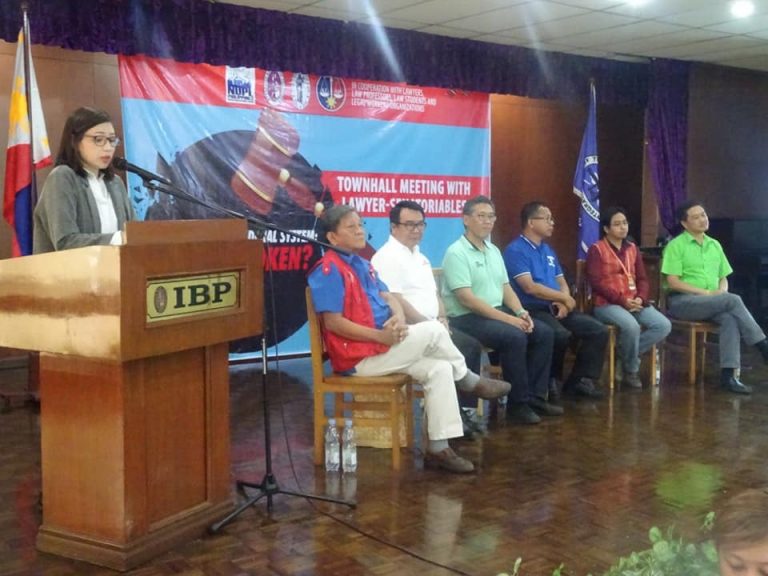
“It is not just an issue of poverty but also of the president’s intolerance of dissent.”
By ALYSSA MAE CLARIN
Bulatlat.com
MANILA — “Is the legal and judicial system of the Philippines, broken?”
This was the question posed to lawyer-candidates vying for a senatorial seat in a town- hall meeting on April 12, 2019 at the Integrated Bar of the Philippines Building in Ortigas.
In his opening speech, Integrated Bar of the Philippines president Abdiel Dan Elijah Fajardo highlighted the importance of Senate as an institution that will ensure the so-called rule of law in the country.
Six lawyer-senatorial candidates were present during the town-hall meeting, namely: Neri Colmenares, Chel Diokno, Erin Tañada, Ernesto Arellano, Joan Sheelah Naliw, and Sonny Matula.
“(The theme question) is precisely the reason why I filed my certificate of candidacy,” said Diokno during the town-hall meeting.
Lawyers groups that organized the town-hall meeting were: National Union of Peoples’ Lawyers, Integrated Bar of the Philippines, Philippine Bar Association, and the Association of Law Students in the Philippines.
Among the issues discussed during the town-hall meeting were the need to improve the pace of cases being filed before courts and much-needed reforms in the legal education of future lawyers.
“Our kind of justice caters to those who have money,” said Arellano.
The six lawyer-senatorial aspirants believe that the judicial system in the country remains very much inaccessible to the poor, most especially when they are up against multi-national corporations.
Arellano related that there are workers still struggling for their separation pay about a decade since they were terminated by big companies.
Lawyers under threat
Colmenares, for his part, said the inaccessibility of the judicial process among poor Filipinos does not only relate to their dire conditions but also to the fact that many lawyers are under threat for fighting for their rights and welfare.
This happens, he said, most especially in drug-related cases and human rights violations.
An independent probe carried out by foreign lawyers last month revealed a pattern of state-sanctioned killings of their Filipino counterparts. The NUPL has documented at least 37 lawyers killed in relation to their profession.
Mission finds ‘patterns of state-sanctioned violence’ against Filipino lawyers
“It is not just an issue of poverty but also of the president’s intolerance of dissent,” Colmennares said, adding that Philippine judicial system becomes compromised for fear of facing the president’s wrath.
Problems within the structure
During the forum, Diokno pointed out the need to employ more prosecutors and judges that are at par with private practice in order to provide more legal services to the people. This, he added, should be funded instead of what he considered as “useless” project.
“If we want the get the people’s trust back, then we (the judiciary) should have the capability,” he added.
Tañada, on the other hand, said that the “broken system” has always been weaponized by whoever is seating in Malacañang against those they perceive as enemies, adding “there has to be a recognition that something is broken, in order for us to fix it.”
Matula said it is possible to mend the broken justice system if the “determination to succeed is strong enough.”
Such effort, said Naliw, should come not just from the judiciary but also from various sectors of society. (Bulatlat.com)
The post PH justice system ‘broken but mendable,’ lawyer-senatorial aspirants say appeared first on Bulatlat.
The role of public intellectuals in transforming society: postscripts from Roland Simbulan’s ‘A Liberating Education for Filipinos’
Citing UP as the country’s premier university, Simbulan notes the praxis of theory and practice as a critical element. After all, UP’s symbol, the oblation signifies offering oneself for the people.
By AMIHAN MABALAY
In these critical times, our ideals as one nation are put to test. The current regime pits people against each other, divides the country over which values are acceptable or not; which are truth and which have become truth from spawned lies; which are “legal”, and which are just and fair.
To gain grasp on social issues, we turn to academics and scholars. Having spent years studying theory, teaching in universities, conducting research and translating them into writings, intellectuals are crucial in shaping public opinion.
In a thanksgiving (retirement) lecture and book launch, Professor Roland Simbulan resonated the call for public intellectuals to strive for a liberating education. An academic for the people for almost four decades, Simbulan underscored the social responsibility of public intellectuals, “Yes, we try best to be objective but we are biased for majority of the marginalized Filipinos, we do not want to serve oppressors and exploiters of the country, nor do we want to support destroyers of the ecosystem. We oppose unjust and inequitable economic structures and we believe in the capacity of the people to change society and importance of organized movements to bring about better future for all.”
Professor Roland Simbulan: educator, activist and public intellectual
As an educator, Simbulan holds the highest academic rank as professor of Development Studies, and Public Management in University of the Philippines. He was instrumental in creating the Development Studies program in UP Manila during the 1982. The program specializes in political economy of the Philippines as well as “counter-culture, counter-institution” alternative development paradigms in Third World. Quacquarelli Symmonds (QS) has named UP as one of the world’s top 100 universities for development studies Development Studies March this year.
As a scholar, his works to advance national sovereignty is reflected in his expertise in Philippine foreign policy, Philippine – US relations, and US intervention. Through the years, he has authored a number of publications on the subject. Among these is his first book in 1983 tackling the presence of US bases in the country, critically acclaimed “The Bases of our Insecurity,” his postgraduate thesis greatly contributed to the landmark Senate rejection of the US military base treaty in 1991.
Prior to becoming an educator, Simbulan became one of the youngest political prisoners of martial law dictatorship during the Marcos regime. In 1974, he was detained with activist students and co-writers of the UP student paper Philippine Collegian.
His latest writing, “A Liberating Education: Critical Notes of An Insurgent Scholar” gives context to the vital role of social science scholars in society. For Simbulan, a liberating education that is instrumental in transforming society is anchored on the praxis of theory and social conditions. He explains that the academic, through immersing with the people and their struggle, explaining to them socio-economic and political issues, helps social movements become effective catalysts for genuine democracy and people’s development.
As a prolific author, Simbulan states that he does not write strictly for academic work but to empower grassroots sector and organizations for social change, and raise the level of social consciousness of the greatest number of Filipinos.
The role of the intellectual
In this day and age, the knowledge-based economy has produced a number of Filipino scholars who were privileged to study and gain expertise abroad. Advances in technology such as social media have enabled many of them to share their insights with just few taps and clicks. But here lies the danger of intellectuals miseducating the public.
While impartiality is an esteemed value for academics, deepening crises in society may compel them to take sides. Consciousness of the oppressed people’s struggle in a deepening social crisis separates the observers, apostate intellectuals from public intellectuals, scholars for the people.
In studying society, the former use the observer lens, writes strictly for academic purposes, distancing themselves. While this is the accepted approach, such standpoint alienates the intellectual from the people. The latter, meanwhile involve themselves through participatory research, immersing with the masses and their struggle.
Simbulan, together with economist, fellow activist and public intellectual Dr. Edberto Villegas, crafted the Development Studies (DevStud) practicum program which requires junior students to immerse with marginalized sectors, particularly the toiling masses (farmers, workers, fisherfolks) for a month. Deviating from traditional university practicum programs that place students in the comfort of office spaces, students learn the conditions of the masses by living their lives and witnessing their struggles in the farmlands, fishing communities, urban poor areas. Simbulan aptly calls the practicum program “Paaralang Bayan.”
An educator unionist and one of the founding members of ACT Teachers Partylist, Simbulan urges intellectuals to strive for a liberating education, one that is “makabayan, makamasa, at siyentipiko” (nationalist, mass based, scientific), instead of being mere observers of the society. Having been a university administrator for a number of years (Department Chair, Vice Chancellor for Planning and Development, and Faculty Regent), Simbulan notes the role of the academe, the educational system as counter-institutions cannot be over emphasized in this objective. Citing UP as the country’s premier university, Simbulan notes the praxis of theory and practice as a critical element. After all, UP’s symbol, the oblation signifies offering oneself for the people.
In summarizing the role of education in changing society, Simbulan writes “education will be a vital tool for our people’s national development if it has a transformative framework that arms both teachers and students with social awareness and commitment to genuinely contribute to national development, especially for the poor and disadvantaged in our society. Transformative education is the outcome of critical thought, reflection and interaction, engaging in continuous debate on historical, theoretical, and empirical evidence inside and outside the four walls of the classroom.”
Simbulan’s discourse on the social responsibility of public intellectuals and liberating education is greatly influenced by American anti-imperialist intellectual Noam Chomsky. In his essay on the Vietnam war, “The Responsibility of Intellectuals” Chomsky writes that intellectuals have deeper responsibility. According to Chomsky, “it is the responsibility of the people to speak the truth and expose lies,” having power that comes from access to information, academic freedom and political liberty. Intellectuals are thus in the position to expose lies of governments, analyze actions according to their causes and motives behind hidden intentions, and free itself from subservience to power. Along this line of academics resisting subservience, Simbulan prefers to call himself an “insurgent scholar.”
At the end of the day, intellectuals must be able to answer the question “What have I done” in determining their place in history. When tumultuous times bring suffering to the people, they must not watch with a blind eye, tolerating injustices and asquiescing to authority. For after all, silence implies consent.
Various intellectuals have and will continue to seek different interpretations of the society, but the point however, according to philosopher Karl Marx is to change it. Simbulan believes that the hope for a liberating education greatly lies in educators with their clarion call, “Ang guro ng bayan, ngayon ay lumalaban.”
The post The role of public intellectuals in transforming society: postscripts from Roland Simbulan’s ‘A Liberating Education for Filipinos’ appeared first on Bulatlat.
GAME FISHING
Surigao del Norte 1st District Representative Francisco Jose “Bingo” F. Matugas (2nd from left) together with DOT-XIII Regional Director Ma. Ana T. Nuguid (5th from left), and Pilar town Mayor Atty. Maria Liza G. Resurreccion (left) led the opening ceremony of the 12th Siargao International Game Fishing Tournament on Thursday last week in Pilar, Surigao del Sur. (Alex D. Lopez/davaotoday.com)
Cordillera woman leader bags 2019 Gwangju Prize for Human Rights
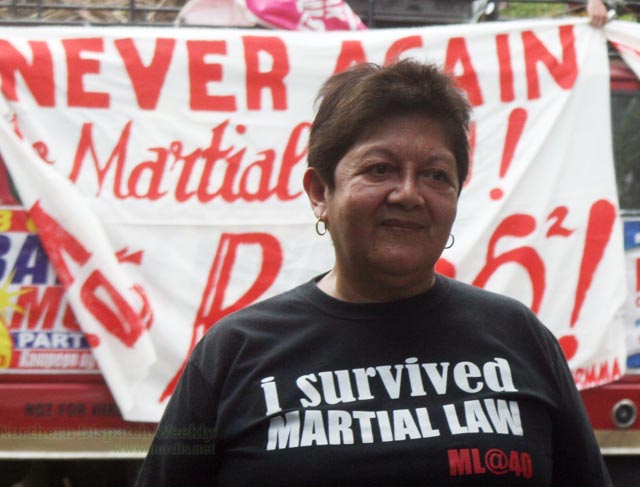
“Whatever the suppression, however, they failed to stop her continuing courageous actions, inspiring global citizens throughout the world, and thus was selected her (Cariño) as the winner of the 2019 Gwangju Prize for Human Rights,” it added.
By ANNE MARXZE D. UMIL
Bulatlat.com
MANILA – A Filipina human rights defender, Joanna Patricia Kintanar Cariño, has been named as this year’s recipient of Gwangju Prize for Human Rights.
Cariño is the founding secretary general and the current advisory council of Cordillera Peoples Alliance (CPA), regional council member of the Cordillera Human Rights Alliance (CHRA) and chairperson of SELDA-North Luzon, an organization of former political prisoners.
The May 18 Memorial Foundation is giving the Gwangju Prize for Human Rights to individuals, groups and institutions in Korea and abroad “that have contributed in promoting and advancing human rights, democracy, and peace in their work.” It also recognizes the exemplary efforts of individuals and organizations aspiring to the restoration of justice and human rights in their respective countries.
Cariño is among the 600 individuals listed in the Department of Justice’s (DOJ) so-called terror list, which seeks to proscribe the Communist Party of the Philippines and the New People’s Army as terrorist organizations.
Cariño, together with other activists who were included in the list, fought for the removal of their names and in January this year, the DOJ has acted by finally removing the names of scores of activists and human rights defenders in the Cordillera region.
The Foundation recognizes Cariño’s track record as human rights defender from the time of the late dictator Ferdinand Marcos up to the present.
“She has been illegally arrested, detained and harassed for being tireless and vigorous in the indigenous people’s fight against militarization of their communities,” the Foundation said in their statement.
“Whatever the suppression, however, they failed to stop her continuing courageous actions, inspiring global citizens throughout the world, and thus was selected her as the winner of the 2019 Gwangju Prize for Human Rights,” it added.
The award also aims “to promote the spirit of the May 18 Democratization Movement, in which the people of Gwangju resisted against brutal military forces for the sake of democracy and human rights in 1980.”

The post Cordillera woman leader bags 2019 Gwangju Prize for Human Rights appeared first on Bulatlat.
Despite the drought, supply of water in Davao City assured
Despite the continuing onslaught of the El Niño phenomenon in the country, including here in Mindanao, the Davao City Water District (DCWD) has assured residents of Davao City of ‘No water shortage’ as they have enough supply of groundwater.
Progressive solon wins international award for championing union rights
By ANNE MARXZE D. UMIL
Back story: France Castro: teacher, friend, activist
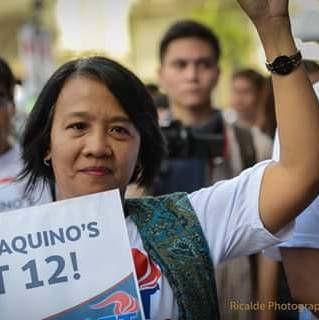
MANILA– Amid red-tagging of the progressive leaders, ACT Teachers Party-list Rep. France Castro has been named as recipient of the Arthur Svensson International Prize for Professional Rights 2019.
The Svensson Prize has been awarded to persons and organizations working to promote trade union rights and organizing around the world.
In its statement, the Svensson Foundation said Castro received the award for her “long-standing struggle to organize teachers and to fight for basic workers’ rights in the Philippines.”
Castro, a public school teacher for more than 20 years thanked the Svensson Foundation for the recognition “especially in light of the current dire political, economic, and human rights situation in our country which gravely affects the marginalized such as teachers and unions.”
Education International, the global union federation of teachers’ and education workers’ trade unions, nominated Castro for the 2019 Svensson Prize.
Castro as brave leader
In its statement, the Svensson Foundation described Castro as a brave leader who defies threats and dangerous condition.
“Despite threats and persecution, there are brave people fighting for democracy and human rights. The regime has particularly attacked unionists among teachers and journalists. Some are killed and many imprisoned. Death threats are not uncommon. In recent times, police officers in the Philippines have been running an organized campaign where they are herding and publishing information on unionized teachers,” Svensson Foundation said in a statement referring to the profiling of the public school teachers, particularly the members of the Alliance of Concerned Teachers (ACT) by the Philippine National Police (PNP).
Castro was also among those who were detained by the Talaingod police last November 2018, together with former Bayan Muna Rep. Satur Ocampo and Lumad teachers, students and administrator, for defending Lumad’s right to education.
Championing public school teachers’ welfare
The Foundation also took notice of Castro’s role in the fight for public school teachers’ rights and welfare.
Before being elected as nominee of the ACT Teachers Party-list in 2016, Castro became the founding president of the ACT-National Capital Region Union, the first union representing public school teachers in the Philippines.
ACT is the largest union in the country with 200,000 union members nationwide. The ACT-NCR Union also successfully negotiated and signed in 2015 the collective negotiation agreement with the Department of Education-NCR.
Read: DepEd, NCR public school teachers union ink CNA
While working as a mathematics teacher at the Quirino High School in Quezon City, Castro who hold different positions within the teachers movement in the local and international spheres. She served as president of the Quezon City Public School Teachers Association, Member of National Trustees of the Philippine Public School Teachers Association, and Member of the World Executive Board of Education International representing the Asia Pacific.
The Svensson Foundation also noted Castro’s involvement in the fight for teachers and people’s welfare while serving as ACT Teachers Party-list representative in Congress from the fight against the neoliberal reforms in the education sector and for better working conditions for teachers to fight against lowering the minimum age of criminal responsibility.
“We also hope that the Svensson Prize will highlight our struggles here and uplift the morale and fighting spirit of teachers not just here in the Philippines but around the globe as well,” Castro said in a statement.
The Svensson Prize was created by Industri Energi and is awarded annually by the Committee for Arthur Svensson’s International Prize for Professional Rights.
As a recipient of this award, Castro gets 500,000 Norwegian kroner (P3 million or $58,000) which half goes directly to the winner and a corresponding amount allocated for follow-up work related to the winner or similar projects.
The post Progressive solon wins international award for championing union rights appeared first on Bulatlat.
Tungkulin ng isang guro ng peryodismo
Mula pa noong dekada 90, nagtuturo na ako. Ang part-time sa simula ay naging full-time din nang magkaroon ng bakanteng posisyon sa Unibersidad ng Pilipinas (UP) Diliman. Marami sa mga itinuring kong “anak” sa loob ng klasrum ay may mga sariling anak na rin. Kaya nga sa pagputi ng buhok ko sa pagtuturo, mistulang “lolo” na talaga ako!

Kung mayroon man akong natutuhan sa mahigit dalawang dekadang pagtuturo ng peryodismo, ito ay ang pangangailangang pumaloob sa mismong propesyon para direktang maibahagi sa mga estudyante ang kalagayan ng midya. Mas nagiging makatotohanan ang mga diskusyon sa klase kung naibabahagi ng guro ang kanyang karanasan. Hindi lang kasi natatali sa teorya ang mga pinagninilayan dahil may naihahalo ring praktika.
Paano ba sumulat ng isang balita o editoryal? Ano ba ang kailangang gawin para makumbinsi ang mga nais mainterbyu na magbigay ng pahayag? Saan kaya pinakamainam magtrabaho bilang peryodista?
Paano. Ano. Saan. Ilang praktikal na tanong para mapahusay ang kakayahan sa peryodismo. Pero higit pa sa mga importanteng tanong na ito, kailangan ding sagutin ang pundamental na usapin sa peryodismo: Bakit ba natin ginagawa ito?
Bakit nga ba? Patuloy pa rin kasi ang pagtatrabaho sa kabila ng mga banta sa buhay at kabuhayan. Hindi natatapos ang trabaho sa pagsusumite ng mga ginawang akda dahil kailangan pang makipag-ugnayan (o makipagbangayan kung kinakailangan) sa ilang social media user (o trolls) na may mga tanong (o patutsada) tungkol sa mga nangyayari sa lipunan. Paminsan-minsan, kinakailangan ding literal na lumabas ng opisina o bahay para magmartsa’t ipaglaban ang kalayaan sa pamamahayag na patuloy na sinisikil ng mga nasa kapangyarihan.
Sa aking palagay, mas epektibong nasasagot ang tanong na “Bakit?” hindi ng salita kundi ng gawa. Tungkulin ng sinumang nagtuturo ng peryodismo na magpakita ng tamang halimbawa sa mga estudyante. Patunayan niyang kayang makapag-ulat sa kabila ng kultura ng walang pakundangan (culture of impunity). Ipakita niyang handa siyang lumaban para sa kalayaan sa pamamahayag. Mangako siyang hindi mangingiming manindigan kahit na nangangahulugan ito ng pagbangga sa mga nasa kapangyarihan.
Kung kailangang mataas ang pamantayan ng peryodismo, kailangan ding mataas ang pamantayan ng pagtuturo nito. Tandaan nating ang pag-uulat ay pinagsamang pag-uungkat at pagmumulat. Layunin ng interpretasyon ng datos hindi lang ang pagpapasimple kundi pagpapalalim at pagpapatalas. Hindi biro ang paghuhubog ng opinyong pampubliko lalo na sa panahon ng misimpormasyon at disimpormasyon. Higit na kinakailangan ang peryodismong nagtataguyod ng katotohanan sa sitwasyong ibinabandera ng mga nasa kapangyarihan ang kasinungalingan.
Sa panahon ng kadiliman, etikal na obligasyon ng mga mamamayan ang lumaban. Hindi na uubra ang pagiging “neutral” diumano ng isang peryodista dahil dapat lang na iwaksi ang hindi katanggap-tanggap. Ang pagsisinungaling ay pagsisinungaling. Katotohanan lang ang dapat na iulat para tamang impormasyon lang ang nalalaman ng publiko.
Sa panahon ng kasinungalingan, bahagi na ng trabaho ng peryodista ang manindigan hindi lang para sa katotohanan kundi para sa kalayaan sa pamamahayag. Estudyante pa lang, sadyang kailangan makondisyon ang utak para sa mas matitinding hamon sa hinaharap.
Sana nama’y tugunan ng mga guro ng peryodismo ang ganitong hamon.