On March 15, 2019, Karapatan and Rural Missionaries of the Philippines (RMP) filed complaints with the Joint Monitoring Committeee of the Government of the Republic of the Philippines with regard to the red-tagging and terrorist-labelling of said organizations. The filing was also done a day prior to the 21st year of the signing of the Comprehensive Agreement on the Respect for Human Rights and International Humanitarian Law (CARHRIHL). CARHRIHL was an agreement entered into between the government of the Philippines and the National Democratic Front of the Philippines (NDFP) on March 16, 1998 in the Hague, Netherlands.
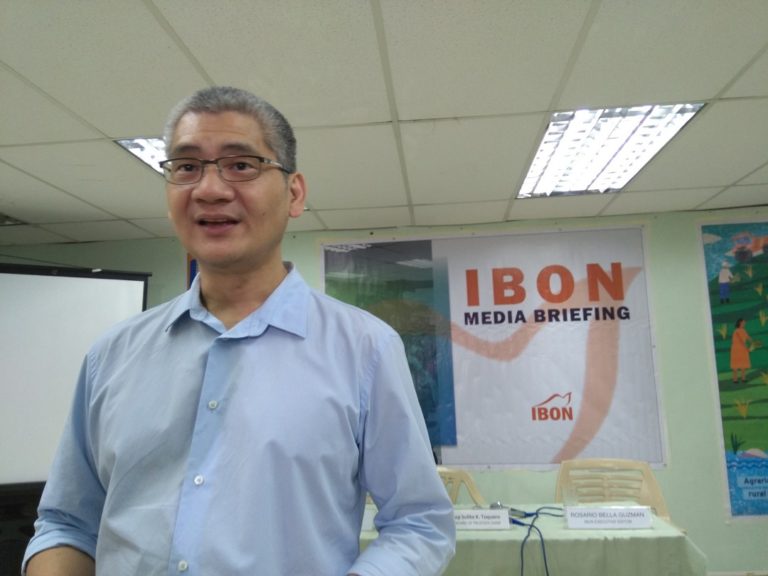
MANILA — Independent think-tank Ibon Foundation slammed Duterte administration’s claim that the group is a front organization of the Communist Party of the Philippines (CPP).
In a press conference, March 14, Jose Enrique Africa, Ibon Foundation’s executive director, said the red-tagging is baseless, malicious and deliberate attack aimed to bury the truth about the true state of the Philippine economy.
Ibon has consistently criticized the economic policies of the Duterte administration such as the Tax Reform for Acceleration and Inclusion (TRAIN) Law, which resulted in inflation and price hikes, rice tariffication law, Build Build Build infrastructure projects, among others. Recently, Ibon earned the ire of Malacanang after it exposed the unparalleled job crisis under Duterte.
The red tag, Ibon said, aims to “stifle economic analysis that is inconsistent with its (Duterte administration’s) preferred narrative of growth and development.”
“It seems that ‘truth’ for the Duterte administration is not what is true but only what makes it look good. The Duterte administration cannot handle the truth and goes to great lengths to insist on its narrative,” the group said.
Jose Enrique Africa, Ibon Foundation executive director, decries the malicious, deliberate red tag against his group.
In the recently concluded European roadshow to the European Union (EU), United Nations (UN) agencies, Belgian government and others, the Philippine delegation has accused Ibon and other groups of channeling funding to so-called “communist-terrorists”. Presidential Communications Operations Office (PCOO) Undersecretary for New Media and External Affairs Lorraine Badoy accused us of “[pulling] statistics out of thin air”. Armed Forces of the Philippines (AFP) Deputy Chief of Staff for Civil Military Operations Brigadier General Antonio Parlade also claimed that Ibon submits “fabricated reports” to the EU and UN.
For over 40 years, Ibon has sought to explain socioeconomic and political issues, often using government statistics.
“We categorically state that our analysis is always based on evidence and facts at hand,” Ibon said, adding that the statistics they use come from the Philippine Statistics Authority (PSA).
“Our adherence to facts is in contrast with the government’s cavalier attitude to the truth,” the group said.
Enrique said this is the first time in the 40-year history of Ibon that Malacanang publicly labeled them as front organization of the Communist Party of the Philippines (CPP).
Bishop Solito Toquero, chairperson of Ibon Foundation’s Board of Trustees, decried what he called as McCarthyism. He underscored that even Church people are not spared from red baiting and other forms of attacks.
“Those who speak the truth are persecuted,” Toquero said.”This administration does not want to be criticized.”
Africa said that since last year, their offices have been subjected to surveillance and their staff have been accosted.
The group wrote to the National Security Council and the Armed Forces of the Philippines seeking clarification about the military’s statements reported in media. Africa said the NSC representatives could not full explain their actions and asked Ibon to write the president in his capacity as chairperson of the National Task Force to End Local Communist Armed Conflict.
Ibon has filed a complaint with the Commission on Human Rights on March 4.
Want to read stories like this? Help us keep up continue writing about issues that matter.
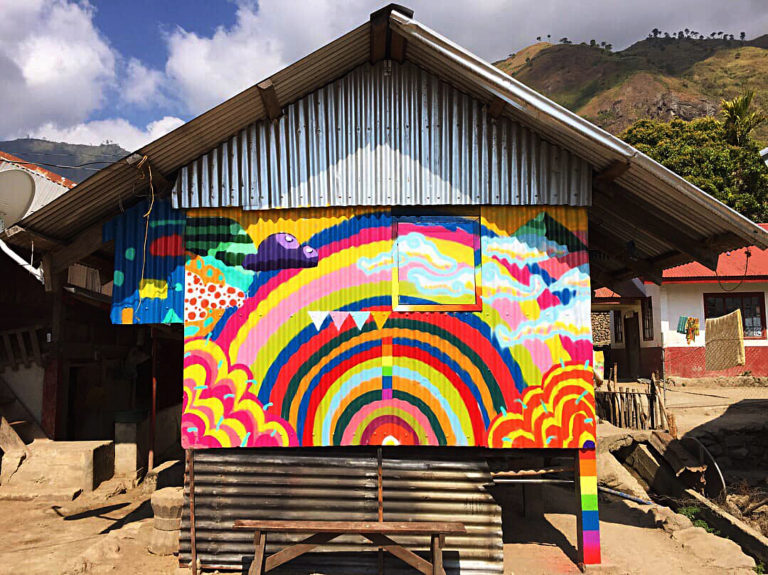
March 14, 2019, a few days after the culmination of the artist-led and community-based art activity, the Buscalan Village on top of the Tinglayan Municipality in the Mountain Province was transformed into a visual feast of cultural stories and identity.
Initiated by artist Archie Oclos, together with street artists, cultural workers, and art practitioners, Kris Abrigo, Bvdot, Jenn Ban, Doktor Karayom, Ralph Eya, Ilona Fiddy, Dee Jae Paeste, Kookoo Ramos, and Sim Tolentino, the collective action is an effort to create and expand spaces of artistic expression that facilitates communal experience and interaction for the Filipino people. Oclos explained that this event is about sharing different art forms, media, and culture with different communities in the Philippines, as well as, instigating an inquiry on how artists can respond to a community and to today’s challenges in the country.
Work by Kris Abrigo
Work by Jenn Ban
Artwork by Ilona Fiddy
Armed with a vision and an entire vehicle of art paraphernalia, the team went on a 4-day mission to immerse, connect, and collaborate to create community murals on various sites of Buscalan Village.
“The locals practice communal living in Buscalan. Their ways of living are rooted in their own beliefs and traditions. It is an ideal condition where people are in charge of cultivating their own culture. As artists, our work here is about bridging the gap of the traditional and the contemporary. For example, I based my piece on the stories of the indigenous group and the local homeowners, about how they bring in commercial products up there in the mountains. The people know that they need those products to sustain their living, but in the process, they also recognize that they too, become dependent of the existing system of commerce. They also need to somehow go with the flow of modern times. So, what can we do? I think what we need to acknowledge here is their right to decide for their own community. It’s actually their community, not ours. They have the right to self-determination. We are just messengers of their causes” Oclos said.
“Karapatan sa Sariling Pagpapasya” by Archie Oclos
Mural by Bvdot
Mural by Doktor Karayom
Street artists Bvdot and Doktor Karayom’s works are virtually representations of what Oclos is pertaining to. The murals of Bvdot and Karayom are likewise anchored in a community-driven narrative. Both artworks mindfully connected elements of the Buscalan culture, work, and environment to our daily lives while respecting the uniqueness and treasures of the village. Bvdot’s “Tagpuan” or “Meeting Place” was thoughtfully based on his immersive experience and the story of Nanay Ampit (Mother Ampit) and the Butbut tribe of Kalinga.
“Working and immersing with communities made me realize that wherever we go, we must respect each other’s traditions and ways of life. We should always remember to live and let live” Bvdot said. “It is important for us to know our place in a ‘foreign’ place. Not just because people live up here in the mountains, doesn’t mean they know less. And we, the city dwellers, know better than them. I feel that the people here actually know what living means more than us” Karayom added.
Work by Kris Abrigo; Photo by JC Valencia
While valuing the same principles, urban artist Kris Abrigo further explored creating a fusion of the old and the new for his work with the community, he defined his involvement in the activity as a way of contributing to community design and highlighting the relationship of its structures to the people.
“It’s about transforming basic local concrete architecture (barangay hall) into something that represents the people and reflects the place around it while focusing only on the essential, recognizable, and significant objects that the viewers can relate to” he said.
Work by Sim Tolentino
Work by Dee Jae Paeste
As for muralist Kookoo Ramos, the entire event was about relational processes. Being able to meet genuine individuals and developing a similar level of consciousness about cultural identity among them was considered a game changer for her. Aside from raised questions about living conditions, the exposure to community work incited criticality in her art process.
“There were a lot of visual inspirations in the area, mostly symbols of livelihood which resonates a lot with hunting and farming; animal bones, dried plants, wooden items, and other articles of nature hanging outside their household. Seeing all those materials, I initially wanted to incorporate a carabao skull for my female portrait piece. As a woman, it felt right to illustrate a female portrait wearing a skull headpiece that would symbolize men’s work which can also be done by any woman. But from what I saw in Buscalan village, the role of women seemed simple, but it is definitely relevant for them. ‘Tunay silang Ilaw ng Tahanan’, and there was no need for me to exaggerate, twist, or create a more ‘aesthetically appealing’ statement piece. Because I found value in that simplicity. The fundamental value of taking care of the people, the community, and the next generations to come. If this experience changed me, I am hoping that artist initiatives like this will trigger and ripple more change with and to others as well” she concluded.
Work by Kookoo Ramos
Work by Ralph Eya
We Are Warriors by Ralph Eya
Work by Kookoo Ramos
Community-based art practitioner and advocate Ralph Eya ultimately described the project as a living testament of what the merging of artistic production, collective action, and active social participation is capable of doing.
He stated, “There will always be a burning passion with artists to greater impact the society. It is just a matter of igniting that spark and someone taking on the challenge of leading our fellow creative practitioners into progressive and meaningful collaborations. That’s the essence of community art, it is not just about ‘murals or artworks placed in a community setting’ nor just another buzzword we lightly use in art practice – it is about co-creating. It is about evolving together. Community art is a form of activism. And I’m treating this as our signal fire. Thanks to Archie Oclos, this type of movement today, particularly an artist-led one, shall serve as a reminder for all of us, specially the youth, about the universality of art and the human experience, and of course, the undying power of creativity.”
“Moreover, in the context of our nation’s ‘ongoing divisiveness’, I think this poses a significant challenge for all of us – how do we really work together to innovate ways and bring about ‘real’ change in our communities and our country? With an existing threat to our cultural identity, how do we continue to uphold, defend, and protect each other’s right to freely express our culture and our identity? How do we fight and keep the fire burning? With art and its endless possibilities, I guess we’ll have to always look closely and see…”
Work by Kris Abrigo
Work by Jenn Ban
According to artist Jenn Ban, the socially-engaged art project will be a continuing effort of the team. The initiative aims to sustain a conscious effort and reach different communities in various parts of the Philippines in the following years. Thus, looking forward to create a ripple effect among like-minded individuals, artists, community leaders, cultural workers, stakeholders, and the youth. The team believes that when artists and communities rise up and unite, it can do so much and art might just be powerful enough. That social transformation is about treating every action as a contribution. That every community is part of humanity. And people will rise when art continuously strikes. Community art is rising.
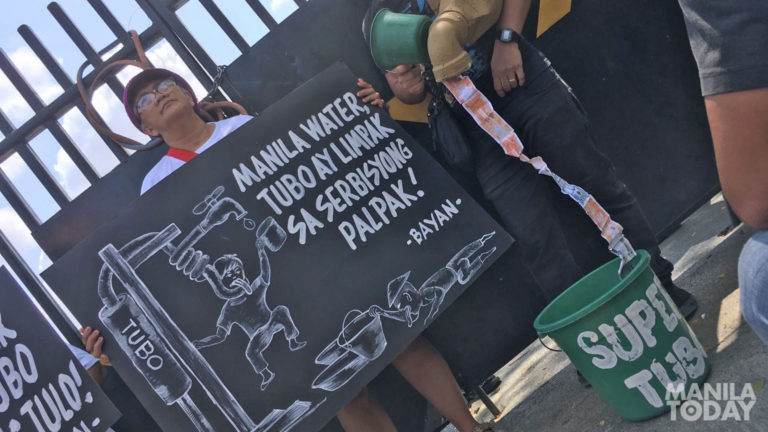
Bagong Alyansang Makabayan (BAYAN) and other groups protested in front of Manila Water office in Quezon City as parts of Metro Manila and Rizal continue to be affected by water supply shortage.
BAYAN accused the government of using the water shortage issue to justify ‘environmentally-destructive’ projects such as the Kaliwa Dam allegedly being funded by China through ‘onerous’ loans.
BAYAN criticized Manila Water ‘ poor service in contrast to its profits. The group said that Manila Water earned a whopping P6.5 billion in 2018 and another P6.5 billion in 2017 and was even granted a rate hike of P6.50 per cubic meter spread over 5 years. The private water concessionaire has even expanded its operations overseas to include Indonesia, Thailand, and Vietnam.
Manila Water previously told government that the water level at the La Mesa Dam continues to drop as a result of El Niño but water delivery operations may normalize only by August. The company’s officials also reported earlier that the dam’s water level has breached its lowest in 21 years, down to the 68.74 meter mark.
Bayan also said the El Niño phenomenon should not be blamed, as Manila Water said it was unable to adapt to the demands of an expanding customer base. The consumer demand rises 3% every year since 1997, according to Manila Water.
BAYAN hit Manila Water’s inefficient service despite huge profits. Photo by Jade Dela Cuadra.
Privatization of public utilities
Water privatization in Metro Manila began in 1997 during the term of President Fidel V. Ramos, along with many other public utilities. Water privatization was the proposed solution to the water crisis in 1994 and in general, privatization was the proposed solution to the inefficiency of government to provide basic public utilities and services to the people.
Concession contract for East Manila was awarded to Manila Water, owned by Jaime Augusto Zobel de Ayala of Ayala Corporation, that also owned Ayala Land, BPI, Globe Telecom, Ayala Malls, and other strategic holdings in power, transport, manufacturing, automotive, etc.
Concession contract for West Manila was awarded to Maynilad Water Services owned by Manny V. Pangilinan, also the owner of Philex Mining Corporation; tollways, water, hospitals and Metro Manila’s only electricity distributor Meralco under Metro Pacific Investments Corporation; and, the largest telecommunications and digital services in the country PLDT, among others.
Corporations of the two water concessionaire holders also won contracts to build the North Avenue LRT 1 Unified Grand Central Station and the LRT 1 Bacoor Extension.
“The Duterte administration is exploiting the vulnerability of Metro Manila residents who are justly demanding accessible and efficient water services.”
By MARYA SALAMAT
MANILA – “There is enough water for all of us. The water “crisis” is just a ruse to push profit-driven projects such as dams and more privatization of natural resources.”
This is the recurring warning aired Thursday (March 14) by indigenous peoples such as the Dumagat of Southern Tagalog and the Igorot of the Cordillera. Wilma Quierrez, a Dumagat and the secretary-general of Dumagat Sierra Madre, said they know for a fact that there is plenty of water but profit interests are diverting these instead to, say, the water-hungry golf courses. And this is just one example.
Based on reports, too, there are enough water in dams around Metro Manila but certain arrangements in the privatization of water distribution are preventing the efficient delivery of water to those in need.
Wilma Quierrez of Dumagat Sierra Madre requests more public support to the indigenous peoples’ staunch defense of forests, watersheds, against destructive dam-building projects (Photo by M. Salamat / Bulatlat)
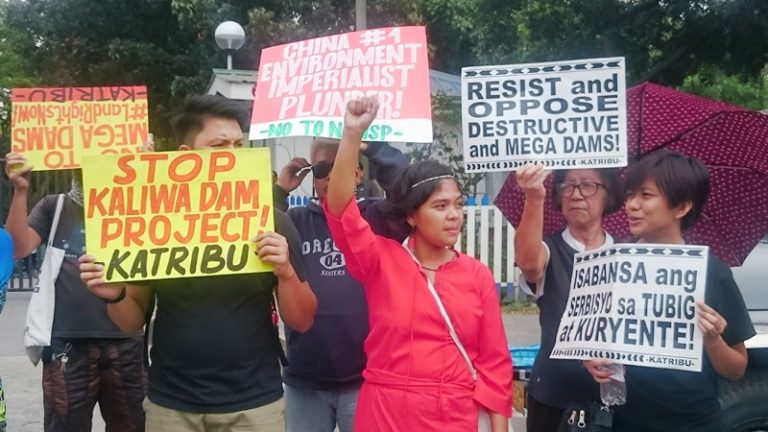
Amid the worsening disruption in water services affecting the service areas of Manila Water, officials in the Duterte administration have proffered as ‘solution’ the building of dams and other big-ticket projects under Duterte’s Build Build Build. But most of these projects are meeting stiff resistance from the directly affected locals. Unfortunately, the Duterte administration is offering up the indigenous people and their lands like “sacrificial lambs” toward resolving this dubious crisis, said Joan Jayme, head of research and documentation of Katribu.
“The Duterte administration is exploiting the vulnerability of Metro Manila residents who are justly demanding accessible and efficient water services,” said Katribu, the national alliance of indigenous peoples organizations in the Philippines.
Solutions exclude destructive dam-building
The eruption of water crisis in half of Metro Manila can be traced to the privatization of the water industry, Jayme of Katribu said during the groups’ picket in front of the Chinese Embassy in Makati this morning and in front of the Metropolitan Waterworks and Sewerage System (MWSS) in Quezon City in the afternoon.
Jaime said the so-called water crisis springs from profit interests which, to further increase it, is in turn fueling the drive to eject the indigenous peoples from their ancestral lands and do away with their centuries’ long protection of the forests, watersheds and rivers.
An elderly Dumagat joins picket in font of MWSS headquarters in Quezon City, March 14, 2019 (Photo by M. Salamat)
Where a comprehensive economic planning of sustainable use and distribution of resources is the logical answer to the troubles in water distribution, the government has been considering only more privatization.
Instead of building another dam when many dams have been built and these have proved disastrous to the environment and most of the ordinary people, the indigenous peoples under Katribu urged the people to help in pushing the government to really plan the economy, and look instead for alternatives to building destructive dams.
“We don’t need another dam. What we need to do is to nationalize water,” said Jayme.
IP and non-IP communities to be swallowed by dams and debts
Before the woes of consumers under Manila Water heightened this month, the MWSS has already signed a loan agreement with Chinese EXIM Bank and a contract with China Energy Engineering Co. for the construction of the Kaliwa Dam of the New Centennial Water Source Project (NCWSP) in November 2018. Against a 40-year resistance of the communities, the Duterte administration has pushed the project to start this year, according to the locals. Recently, they reported, Chinese workers barged into some of their homes taking measurements and announcing that they will put in place territorial markers.
The NCWSP will flood thousands of hectares of indigenous people’s ancestral lands in the Sierra Madre Mountain Ranges. It is estimated to displace at least 20,000 peasants, Dumagat and Remontado in Rizal and Quezon. Worse, the dam project is located on top of a fault line, putting at risk more communities in the downstream villages.
Quierrez said the dam project will not only submerge their ancestral territory, sacred rites and burial grounds, destroy their lands, water sources and livelihood, it will also drown the people in onerous debts and lopsided terms with China. In the end, the people will be denied livelihood and historical and cultural markers, they will be captive market of rising water rates and problematic distribution such as happening now. On top of it, having become poorer, they will be more vulnerable to disastrous weather disturbances and climate change.
The Dumagats and their supporters vow they will continue to resist the construction of mega dams in their ancestral domain.
In the Cordillera, Chinese funding has also been blamed for “developments” in the Chico River that are not in keeping with the communities’ planned development program for it. There are ongoing hydropower projects or so-called baby dams along Chico River and even along some of its tributaries, Raven Desposado, coordinator of Igorot support group Takder, told Bulatlat. He warned that if all the almost 10 hydropower projects in the pipeline along the Chico River were to be constructed, they will get even less water in the downstream agricultural communities than they are getting now.
Similar to the experience of the Dumagat, the Igorot are seeing the start of construction even though not all requirements have been successfully passed by the proponents. In Rizal, Kalinga, the locals reported that bunkers for the Chinese construction workers have been built even when the communities maintain there is as yet no Free Prior and Informed Consent (FPIC), and the Duterte government has already entered an international loan agreement.
Katribu said a genuinely free, prior and informed consent has not been secured in any of these target dam areas when “developments” have been happening there. Consistent with the absence of transparency, projects were signed without consulting the indigenous communities.
“We will not allow the building of new dams whether it (supposedly) has the “approval” of indigenous peoples or not,” Quierrez said. She chided the MWSS and the NCIP (National Commission for the Indigenous Peoples) for “colluding” to forcibly gather community approval even if just on paper.
“The struggle will not be over simply because they said they have finished all the paper requirements,” Quierrez said.
Hi. More sustainable actions for water and forest resources are happening daily. Help us find out all about these and report it here.
MANILA — Alarmed with the attacks on lawyers, judges and prosecutors in the Philippines, nine foreign lawyers from six different countries have come to the country to conduct their own investigation.
The fact-finding mission is composed of lawyers from Belgium, Italy, Japan, Korea, the Netherlands and United States.
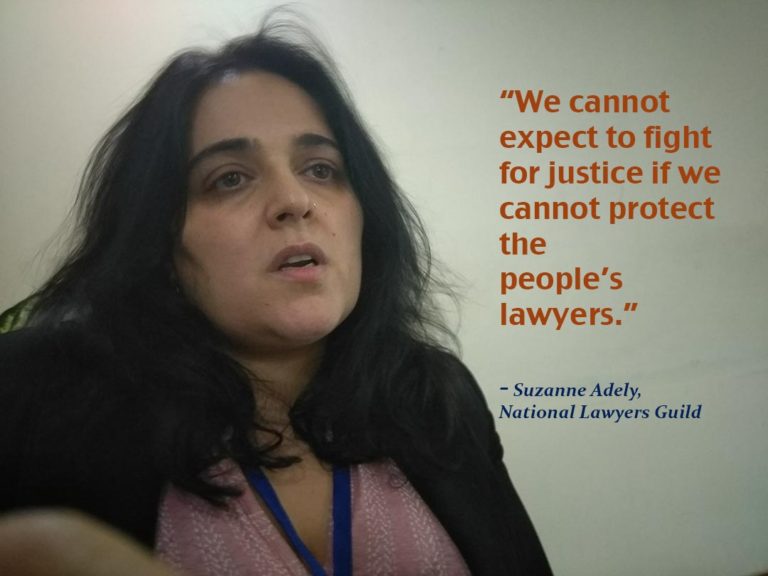
Suzanne Adely of National Lawyers Guild (NLG) of the U.S, and International Association of Democratic Lawyers (IADL) said the delegation is hoping to collect information and answers from government institutions about the alarming rate of extrajudicial killings of lawyers and judges.
According to the Integrated Bar of the Philippines (IBP), 38 lawyers have been killed under the Duterte administration. On March 14, another lawyer, Rex Jasper Lopoz, was gunned down in Tagum City.
Adely said their mission will focus on the extrajudicial killings of lawyers. “We cannot expect to be able to fight for justice if we cannot protect the peoples’ lawyers,” Adely told Bulatlat in an interview.
A trade unionist based in New York, Adely said she has been active in solidarity work with Filipinos in the U.S. and has learned about the political situation in the Philippines from her Filipino friends. “I always knew that I would come at some point,” she said.
Also joining the delegation is Johannes Karel Geesbaak, director of the Foundation for the Day of the Endangered Lawyer, who joined similar missions in the country during the Gloria Macapagal-Arroyo administration.
“The situation has not changed since the last time,” Geesbaak said during the colloquium held at the IBP building, March 15.
International fact-finding missions investigating the attacks on Filipino lawyers were conducted in 2006 and in 2008. The 2008 mission noted little or no progress has been made in the cases investigated in 2006.
This time, the mission will look into 15 incidents of attacks against lawyers, judges and prosecutors, according to Edre Olalia, president of the National Union of Peoples’ Lawyers (NUPL). These include the murder of Benjamin Ramos and the red tagging of NUPL members in Panay.
The foreign lawyers are scheduled to meet with government offices, law enforcement agencies, bar associations, law professors, non-government organizations, and victims and/or their families. They will release their findings next week.
The nine lawyers are representing IADL, NLG, Union of International Advocates (UIA), Confederation of Lawyers in Asia and the Pacific (Colap), Progress Lawyers Network of Belgium, Italian Democratic Lawyers, Japanese Lawyers for International Solidarity and Action (Jalis), and Minbyun of Korea.
Olalia thanked their foreign colleagues for their bravery. “An attack on lawyers anywhere is an attack on lawyers everywhere,” he said.
Gaasbeek said they will try to bring the issue to the Philippine government and even to international institutions.
“As Migrante feared, it is the OFWs who will bear the brunt of paying the monthly contributions and not the employer. How can OFWs have a secure future with SSS if 12% of their monthly income gets robbed by the government that stubbornly refuses to raise pensions?”– Arman Hernando, Migrante Philippines chairperson
“Is there an intelligent priest? They are all stupid. If they aren’t stupid, they wouldn’t enter priesthood. You are a man, but you chose to be a priest. You keep on looking at all the beautiful women that you can’t court. My God!…The women should refrain from going near the priests because when you are near him, he will just smell the scent of your body. And if he corners you in the church, patay ka (you’re in trouble). He will court you. Do you know why? It’s because he is a man…God gave him a penis. What will they do with that? Will they slap it against the door every morning? God was the one who made a mistake there, not us.”–Rodrigo Roa Duterte.
In the midst of heated political campaigns for 2019 May elections, President Duterte continues to attack clergy people.
He continues to do this so that some relevant issues for the May electoral processes would not be noticed by the public. Duterte does not worry about “honesty” concerns during the campaign trail. Duterte focused his rants on church people for purposes of diverting the attention of the people.
He maintains his role in the psywar operations of his government. He called the bishops “useless.” He called priests as “stupid” and insulted them by telling women church goers not to go near to the priests. He called people to rob rich bishops, kill them if they fight back. Duterte’s spokesperson Sal Panelo blamed to the anti-Duterte group for Duterte’s attacks against the church people.
Aside from open tirades of the clergy, Duterte’s minions the Armed forces of the Philippines (AFP) and the Philippine National Police (PNP), its force multiplies such as Special Civilian Auxiliary, barangay intelligence networks and the rebel-returnees are harassing and threatening the clergy through surveillance, red-tagging and death threats through text messages. The state forces tagged the progressive clergy as “terrorists” and “have worked with the CPP-NPA.”
The state forces employ combat and psywar operations in this counter-insurgency campaign. They use fake news and other forms of disinformation. They mobilize fake surrenderees through, the barangay officials and local government units. They cannot win over the Churches to support this campaign, therefore they have to destroy the image of the Churches through red-baiting, red scare and vilification.
Inspired by the “kill, kill, kill” pronouncements and rants against the clergy who opposed the militarist policy of Duterte, the AFP and PNP are willing to violate human rights of the people. In Mindanao, Negros, Samar and Bicol military officers rule over the civilian officials. They prevent independent and people’s movement to deliver humanitarian and legal assistance to the victims of militarization and counter-insurgency operations.
The counter-insurgency campaign of the government will be intensified during elections. The AFP and PNP will use all means of combat and psywar operations to deny the votes of the people for the progressive and opposition candidates and party-lists.
When progressive and opposition candidates and party-lists win in May electoral processes, this only means that fraud and terrorism are prevented even though the Duterte camp will pour out government funds against his critics and for his candidates. The “inserted pork barrels” in the 2019 national budget will be used for political campaigns and vote-buying in elections.
Many people believe that the 2019 May elections are crucial in stopping Duterte’s immoral and fascist government. Some people think of the future of the Filipinos. That is why they are asking people to vote honestly and rightly. However, voting is not enough. There is a need to help bring issues in political campaigns either for candidates for national level or local government officials.
The ‘kill, kill, kill’ policy and “useless bishops, stupid priests” are May Elections issues. These issues should be added to basic issues such as TRAIN Law, Charter Change and bogus federalism, human rights, sovereignty and claim over West Philippine Sea and resumption of peace talks between the Government of the Philippines (GRP) and National Democratic Front of the Philippines (NDFP). Church people must discuss these issues inside and outside activities of the Church.
Is there a Church vote? There are votes of the faithful in this Christian country. Duterte himself said that he does not need the “Catholic votes.” He can count on the votes of the Iglesia ni Cristo. He can also count on the votes of the Quiboloy’s members and other evangelical churches. He can mobilize the fanatical groups to vote for his candidates. The faithful of the Roman Catholic and Protestant Churches must be counted on by the progressive and opposition candidates.
The Philippine Churches must encourage their members to vote based on issues. They must guide their members in voting for rightful candidates based on issues. They must guard their votes. They must protect their votes against the devils that wander.
The ‘kill, kill, kill’ campaign and tirades against the Church by Duterte regime may continue even after the 2019 May Elections. It will even intensify if the results of the elections favored the progressive candidates and party-lists.
The ‘kill, kill, kill’ policy and rants against the Church must stop. The Duterte government must be stopped. The 2019 May Elections is an arena to act and work for. It does not mean that other options of struggle are irrelevant and unnecessary, especially the mass movement and armed struggle.