Home Blog Page 41

‘I don’t care about human rights’: Duterte and the failure to see human rights’ role in progress

0

By: Kurt Dela Peña – Content Researcher Writer /Philippine Daily Inquirer /December 10, 2021

MANILA, Philippines—“I don’t care about human rights.”

Lost in those words uttered by Rodrigo Duterte as president in 2020 was the value of human rights not just as a vague idea or concept but as a key cog in the machinery that nations use to achieve inclusive progress, one that is measured not by the amount of wealth that is produced but how that wealth is distributed.

It has been well-documented that nations with enormous wealth but with no respect for human rights do not attain progress for their people but only for a small circle of elites in government and those in control of resources.

The argument for progress as a worthy trade for human rights or that human rights is an obstacle to progress often finds an example in Singapore, a small island state where criticism of government comes at a very high price but where discontent is nearly absent mainly for one reason—very little or zero corruption in high places.

When Duterte said he didn’t care about human rights, he was not engaging in hyperbole or just driven by knee jerk reaction to constant criticism of his record in human rights both as president and as mayor of Davao City. He meant it.

“P…tang…in,” Duterte would blurt out repeatedly to display irritation at being constantly reminded that his methods in fighting the drug trade and crimes came at the expense of human rights.

Not even reminders that human rights is instilled in the 1987 Constitution, by which Duterte swore when he took his oath as president in 2016, would soften the toughie leader’s rhetoric.

The Constitution was clear that the State “values the dignity of every human person and guarantees full respect for human rights.” There could not be another interpretation of that.

But in the last five years, Duterte’s rhetoric, according to critics and human rights monitors, not only disregarded human rights as a key element in a nation’s progress but as a mandate inscribed in the highest law of the land—the Constitution.

Human rights, in the Philippine setting, is often just an afterthought in cases of killings, torture or deprivation that are so shocking they land in the news. Human rights has not been viewed as essential to the push for the Philippines to achieve the status of developed from developing country.

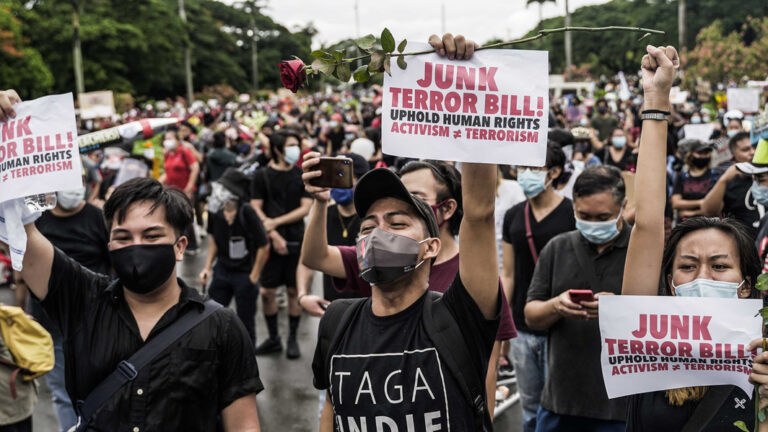
That human rights is always weighed against peace and order or national security was on display again on Thursday (Dec. 9), eve of International Human Rights Day on Friday (Dec. 10). On Thursday, the Philippine Supreme Court (SC) ruled in favor of the Anti-Terrorism Act except for two provisions of the highly controversial law that allows prolonged detention of terror suspects without charge and arrests without warrant on several grounds.

READ: Anti-Terror Law constitutional except for two parts, says SC

The SC flagged a qualifier in the law’s Section 4 which the high court said was too broad and violative of basic rights and also flagged a provision in Section 25. Both were considered unconstitutional.

The law, which was enacted in 2020, lit fear of massive rights violations in a country already reeling from impunity. Groups said the law carried “deadly consequences.”

Cristina Palabay, secretary general of the human rights group Karapatan (Right), said the dangerous law has direct harm on basic rights and freedoms. Palabay described it as repressive.

‘Dismal’

She said the law was “set to worsen the already dismal human rights situation,” saying under Duterte, the Philippines had once again become a “killing field.”

This year’s remembrance of the 73rd International Human Rights Day is the sixth and last one under the Duterte administration that was marked with “systematic violations of people’s rights”, said Palabay.

She said under Duterte the Philippines plunged into a “deadly crisis” as the populist leader paved the way for “democratic backsliding and the revival of the worst horrors” last seen during the Marcos dictatorship.

READ: In Duterte war on Reds, Marcos’ martial law survivors fall victims again

The last five and a half years was filled with “state terror, violence and repression,” Palabay said, with the government leaving “thousands of dead.”

According to Palabay, this was made possible by Duterte’s attack on writers and press freedom, failure to curb corruption, neglect of people’s welfare and dragging of civilian agencies into the counterinsurgency campaign through the National Task Force to End Local Communist Armed Conflict (NTF-Elcac).

PH’s HR Days

As this year’s celebration will be the last under the Duterte administration, INQUIRER.net looks back at human rights issues that drew attention in the Philippines since Duterte became president in 2016.

  • ‘Marcos is no hero’

Graphic by Ed Lustan

In 2016, as Filipinos marked the 68th International Human Rights Day, the spotlight fell on abuses committed during martial law and the more than 20-year reign of the late dictator Ferdinand Marcos.

This was spurred by the secretive work that laid the ground for Marcos’ burial at the Libingan ng mga Bayani, a graveyard for Filipinos who devoted and gave up their lives for their country,

The Marcos burial pushed through on Nov. 18, 2015, just months after Duterte assumed office, “like a thief in the night,” according to groups and victims of martial law.

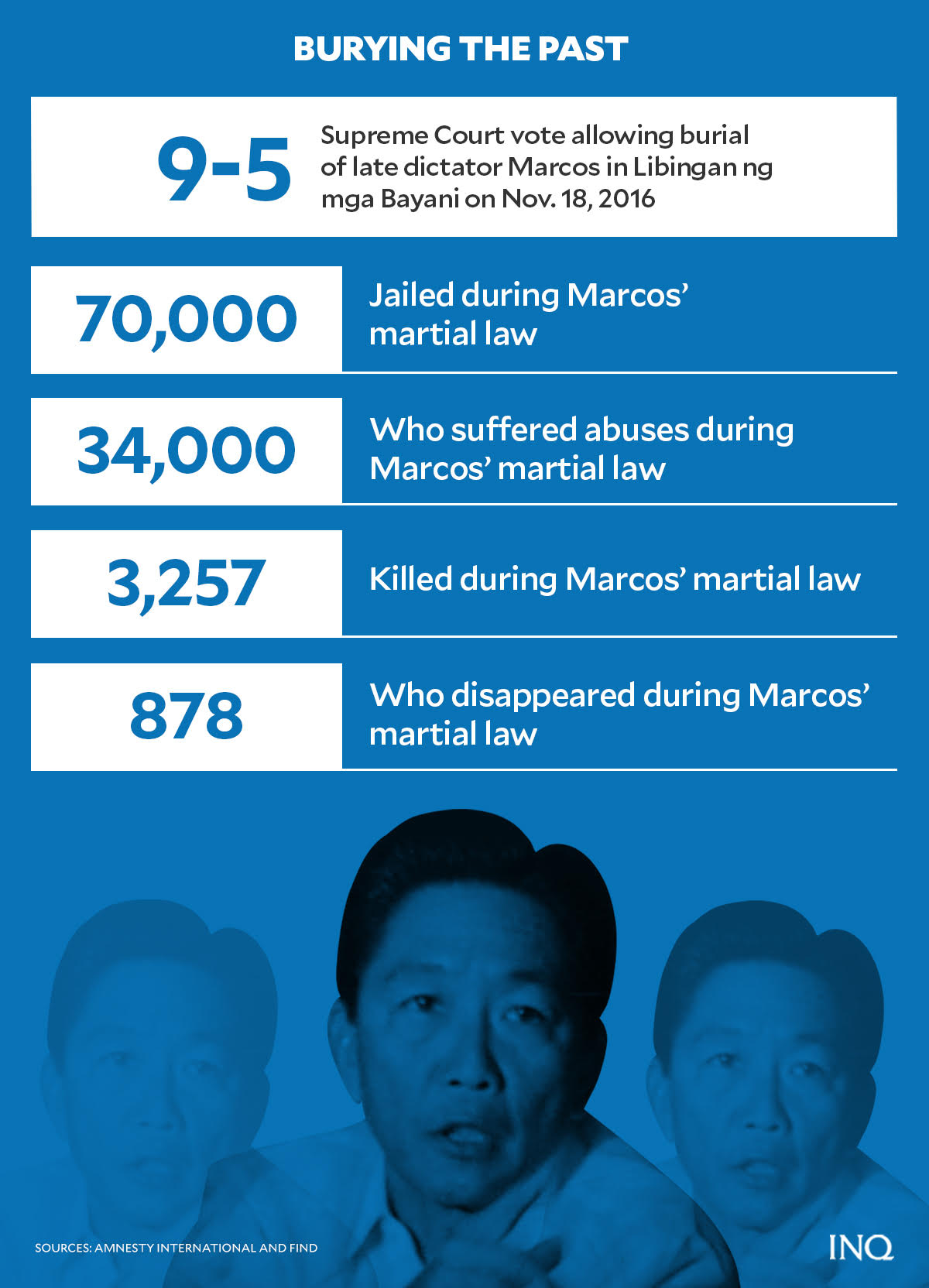
The way was cleared by a 9-5 Supreme Court vote rejecting a petition to stop the burial and Duterte’s order allowing it.

Protesters parted the curtains on martial law. According to Amnesty International and the group Families of Victims of Involuntary Disappearance (FIND), 3,257 people were killed during Marcos’ rule. At least 34,000 people had been tortured. Some 70,000 had been jailed without charge and 878 had disappeared.

READ: Marcos’ martial law: Golden age for corruption, abuses

  • Martial law in Mindanao

Martial law rose from the ashes again in 2017 when Marawi City was attacked by Islamic State (IS) followers who planned to turn the only Muslim city in the Philippines into an IS caliphate. To quell it, Duterte declared martial law in the whole of Mindanao on May 24, 2017.
Graphic by Ed Lustan

Martial law lasted for more than two years and was lifted on Dec. 31, 2019 with an indelible impact—cases of human rights violations.

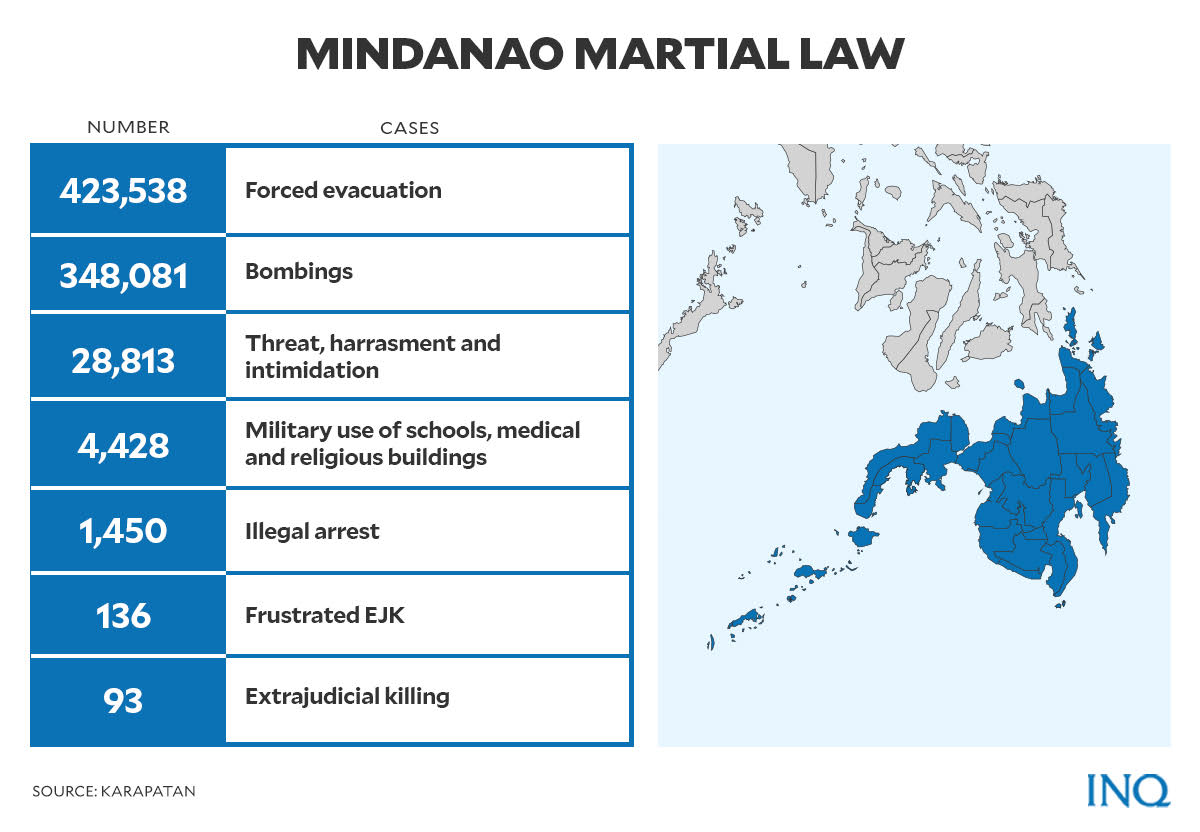
Karapatan said from May 23, 2017 to May 23, 2019, it was able to document 815,734 violations of civil and political rights during martial law in Mindanao, saying Duterte’s version of it had “little to no checks and balances and is the real threat to public safety.”

During the two years of martial law in Mindanao, Karapatan said 93 people were killed, 136 escaped death, six disappeared, at least 1,450 were illegally arrested, 35 were tortured, at least 28,813 were threatened, harassed and intimidated.

READ: Martial law in Mindanao: What changed, what didn’t—and at what cost

The group said it also documented 4,428 victims of military use of schools, hospitals and churches. At least 423,538 fell victim to forced evacuations and 348,081 fell victims to bombings either by suffering injuries or losing homes.

  • Duterte’s drug war

The killings committed in the government’s campaign against illegal drugs have been highlighted since 2016, the year when Duterte launched the campaign with a promise to end the drug menace. “Give me three to six months,” he said.

https://googleads.g.doubleclick.net/pagead/ads?gdpr=0&client=ca-pub-3470805887229135&output=html&h=280&slotname=8007816029&adk=3301384702&adf=401186263&pi=t.ma~as.8007816029&w=640&fwrn=4&fwrnh=100&lmt=1639164636&rafmt=1&psa=1&format=640×280&url=https%3A%2F%2Fnewsinfo.inquirer.net%2F1526313%2Fi-dont-care-about-human-rights-duterte-and-the-failure-to-see-human-rights-role-in-progress&flash=0&fwr=0&rpe=1&resp_fmts=3&wgl=1&dt=1639152488702&bpp=4&bdt=6911&idt=2079&shv=r20211207&mjsv=m202112020101&ptt=9&saldr=aa&abxe=1&cookie=ID%3D09624eb266bfee6c-22cadb9905cb00e7%3AT%3D1635633505%3AS%3DALNI_MZBTX-qF2vgF8yIezLDR9J2XLhR3w&prev_fmts=0x0%2C640x280&nras=1&correlator=4871567027431&frm=20&pv=1&ga_vid=1359814020.1635633499&ga_sid=1639152491&ga_hid=1061720888&ga_fc=1&u_tz=60&u_his=3&u_h=768&u_w=1366&u_ah=728&u_aw=1366&u_cd=24&u_sd=1&adx=185&ady=7561&biw=1349&bih=643&scr_x=0&scr_y=5124&eid=44750774%2C31063858%2C31063867%2C31063883&oid=2&psts=AGkb-H_JfS5Y-QgA9QYuTY7yLWwhc8PrvPz6khqbBZcK8V8PvG2CQSr10YLmA_Vwfm8_4V9lb0xvNSM5Ff2HNg&pvsid=3607085513890849&pem=74&tmod=868&ref=https%3A%2F%2Fnewsinfo.inquirer.net%2F&eae=0&fc=896&brdim=-8%2C-8%2C-8%2C-8%2C1366%2C0%2C1382%2C744%2C1366%2C643&vis=1&rsz=o%7Co%7CoeEbr%7C&abl=NS&pfx=0&fu=128&bc=31&ifi=2&uci=a!2&btvi=2&fsb=1&xpc=nys9IFT2OQ&p=https%3A//newsinfo.inquirer.net&dtd=M
Graphic by Ed Lustan

His war, however, saw thousands of people killed in police and vigilante-style killings—which the International Criminal Court said will be investigated as the “specific legal element of the crime against humanity of murder” appears to have been committed.

RELATED STORY: ICC asks PH gov’t to show proof it is investigating drug war killings

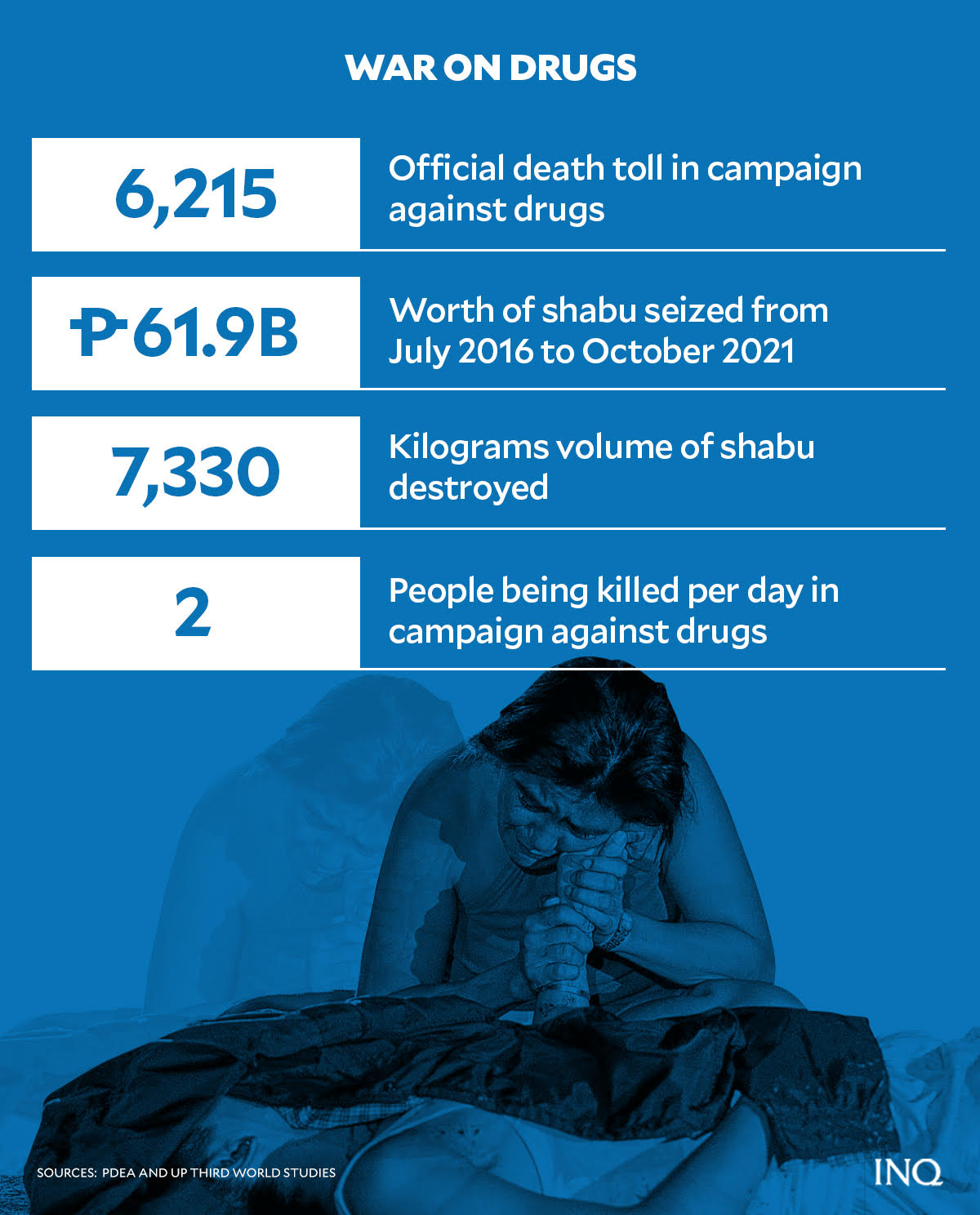
The Philippine Drug Enforcement Agency (PDEA) said 6,215 people have been killed while 315,635 have been arrested between July 1, 2016 to Oct. 31, 2021. Rights groups, however, said the death toll could exceed 30,000.

READ: PH’s ‘bloodiest killing field’ not on DOJ list of drug campaign killings

The University of the Philippines Third World Studies Center said since 2016, the government’s war on drugs has been claiming the lives of at least two people per day.

In 2020, five years into the war, the United Nations Office on Drugs and Crime (UNODC) said crystalline methamphetamine, or shabu, remained to be the main drug being used in the Philippines. The killings appeared to be for naught.

The PDEA said P61.99 billion worth of shabu (9,702.46 kilos.) was seized from July 1, 2016 to Oct. 31, 2021. The agency destroyed a total of 7,330.27 kilos.

UNODC said in 2020, there were 2,000 shabu-linked admissions—lower than the 5,000 in 2019. There were 7,000 shabu-related arrests in 2019—lower than 57,000 in 2018. However, there were 2,196 kilos of shabu seized in 2020—higher than the 2,071 kilos in 2019.

  • Attacks against activists

Since 2016, the Duterte regime has also removed the distinction between the underground and above ground Left and ordered attacks on both combatants and noncombatants.

Targeted were farmers, indigenous peoples and government employees on the basis of mere suspicion of involvement in the communist rebellion.
Graphic by Ed Lustan

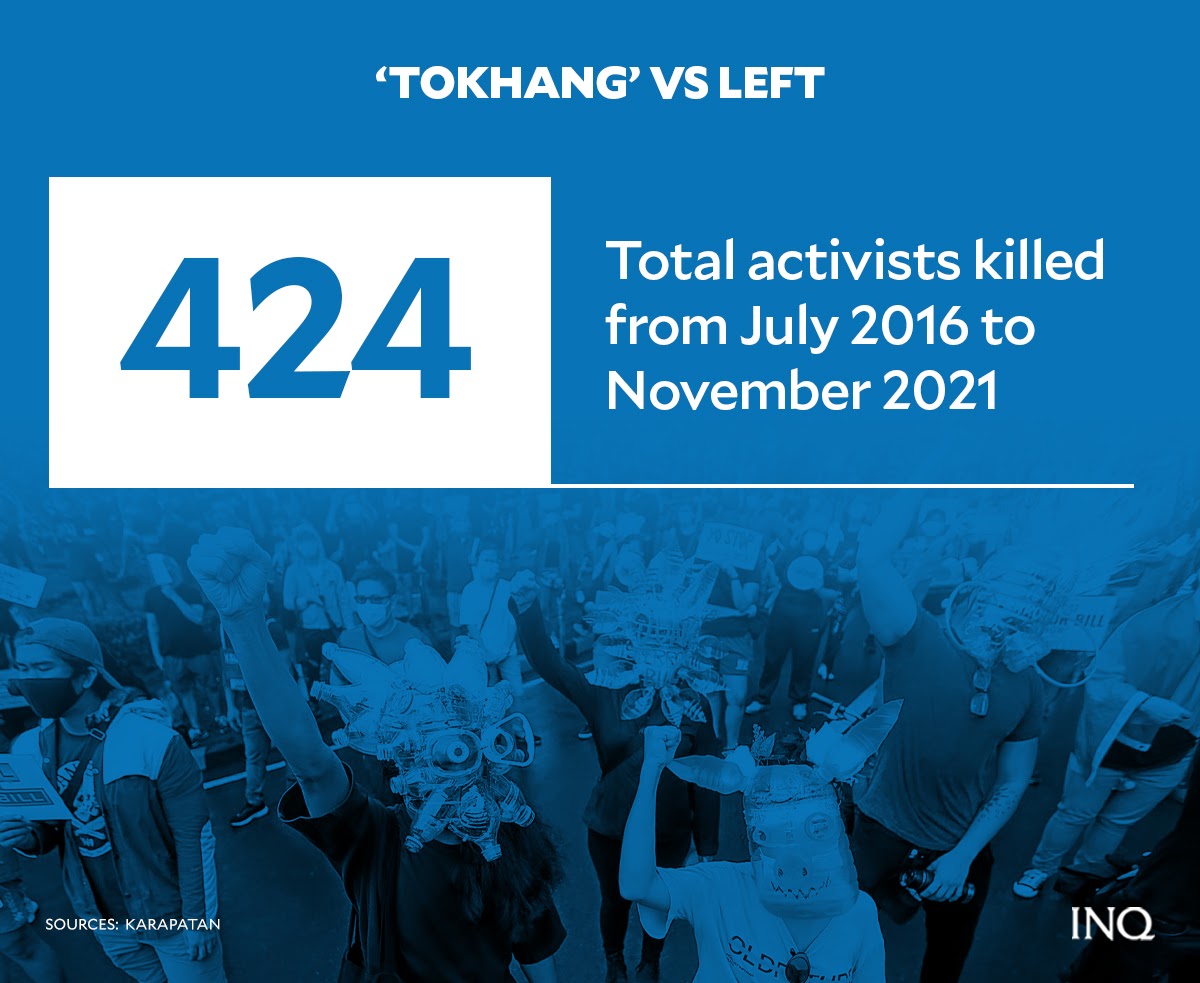
Karapatan said from July 2016 to November 2021, 424 activists have been killed.

READ: ‘Undas’ 2021: Red-tagging as death warrant

It said 1,159 people had been illegally arrested and detained. At least 575,139 people had fallen victims to threats, harassment and intimidation. The cases included red-tagging or vilification of activists as terrorists.

At least 712 political detainees languish in jails. These included 489 arrested under Duterte alone. At least 99 of these political detainees are now sick, 64 are elderly and 133 are women. All the detainees were victims of fabricated cases, Karapatan said.

  • Peace talks

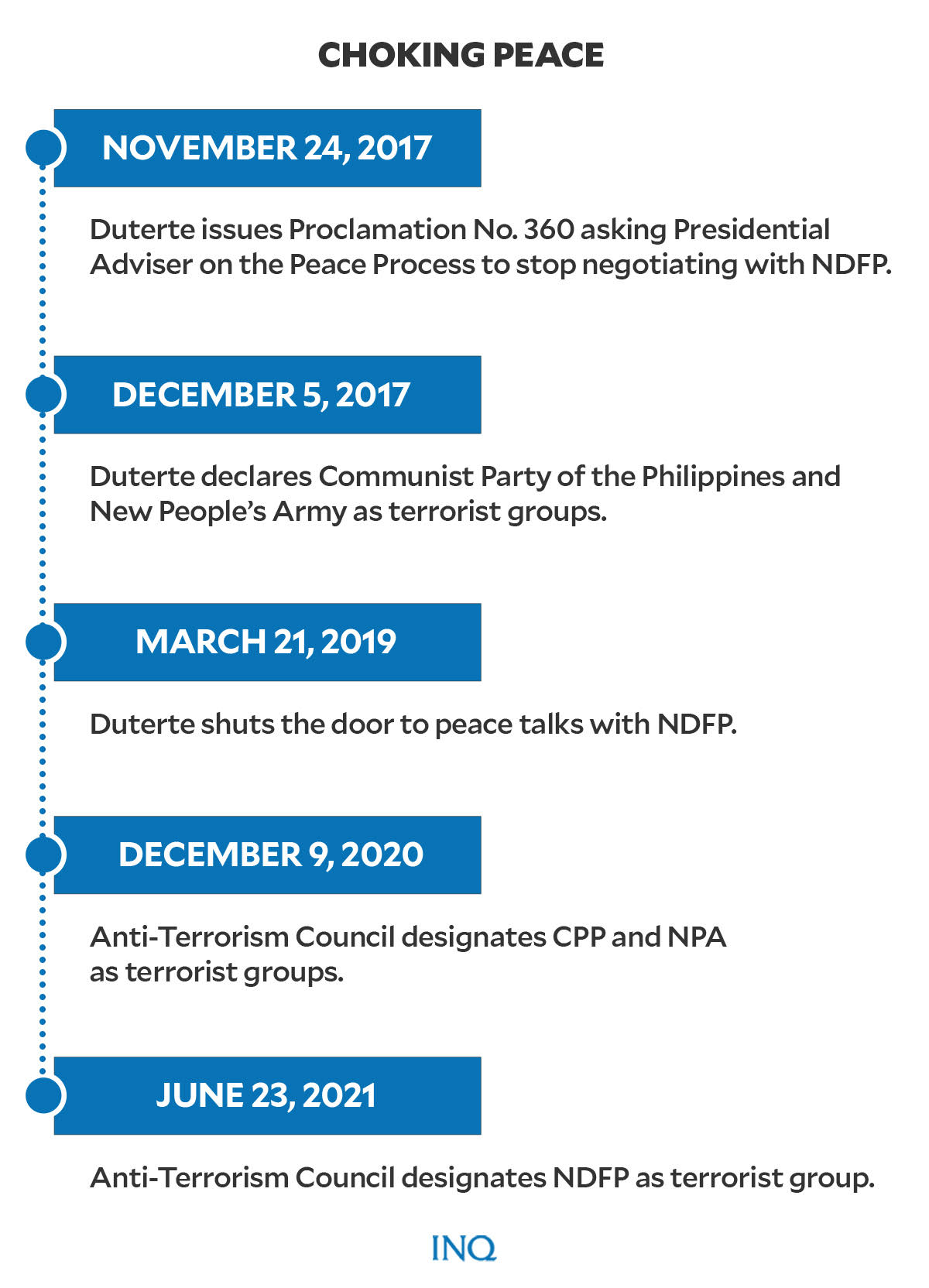
In 2017, through Proclamation No. 360, Duterte, breaking the “promise of peace,” asked the Presidential Adviser on the Peace Process to stop negotiating with the National Democratic Front of the Philippines (NDFP).

READ: Breaking the promise of peace, Duterte turns from rebel ‘friend’ to worst foe
Graphic by Ed Lustan

Karapatan said from July 2016 to November 2021, 15 peace consultants were killed, including Randall Echanis and Randy Malayao. It said one went missing while 11 were arrested, including Vicente Ladlad and Rey Casambre.

Duterte declared the Communist Party of the Philippines (CPP) and the New People’s Army (NPA) as terrorists in 2017 years after gaining popularity as a negotiator for the release of rebel captives. Two years later, Duterte shut the door to peace talks with the CPP, NPA and NDFP.

In 2020, armed with the Anti-Terrorism Act, the government, through the Anti-Terrorism Council created by the law, declared communist rebels as terrorists. In June 2021, NDFP, the umbrella organization of underground activists and rebel groups, was declared as a terror group.

Human rights not just a vague idea

The International Human Rights Day marks the day when the United Nations General Assembly, in 1948, adopted the Universal Declaration on Human Rights which lists human rights that should be “universally protected”. This has been translated into over 500 languages.

The website Human Rights Careers, highlighting the Universal Declaration on Human Rights as the “standard for basic equality and human dignity,” listed the reasons human rights is important.

  • It warrants that the basic needs of people are met
  • It protects at-risk individuals from abuse
  • It allows people to rise against societal corruption
  • It encourages freedom of speech and expression
  • It gives people the freedom to practice religion (or not practice any)
  • It allows people to love who they choose
  • It encourages equal work opportunities
  • It gives people access to education
  • It protects the environment
  • It provides a universal standard that holds governments accountable

In a study, the non government group Center for Economic and Social Rights (CESR) based in New York and Johannesburg said human rights is not just an idea but a necessary ingredient in progress for nations and peoples.

“Many of the key determinants of inequality can be framed as manifest denials of internationally guaranteed human rights,” CESR said in the study.

According to the anti-poverty group Oxfam as quoted by CESR, disregard of human rights “perpetuates poverty and social exclusion which, in turn, are key drivers of conflict and insecurity.”

In a study titled “Human Rights and Economic Growth”, the Danish Institute of Human Rights investigated the role of freedoms and participative rights in economic growth.

It found that human rights have a positive impact on economies.

Dr. Ronald Mendoza, dean of Ateneo School of Government, said in an opinion piece published in the magazine Diplomat that rule of law, of which human rights is a key component, is essential for economic development.

Quoting a study made of 165 countries from 1977 to 2013, Mendoza said states that are tagged by United Nations Human Rights Council as human rights violators suffered a 49 percent drop in foreign direct investments (FDI), which create jobs and factories.

The study, according to Mendoza, found that “bad human rights records of a state itself also leads to FDI loss.”

Quiboloy sexually abused women, minors – ex-followers, US prosecutors

0

Dec 9, 2021, Herbie Gomez, Inday Espina-Varona, Rappler.com

Former workers and members of the Davao-based Kingdom of Jesus Christ organization are out to make the preacher account for the years of abuse and exploitation they experienced

Embattled Kingdom of Jesus Christ (KOJC) leader Pastor Apollo Quiboloy allegedly exploited minors and women, manipulating them into believing that salvation would be theirs only if they dedicated to him their lives or, in the case of some, their bodies. 

In an exclusive interview with Rappler, three women disclosed what they saw and experienced during the years they were part of his “kingdom.” Their accounts corroborated certain details in a 74-page indictment document in the United States against the 71-year-old Quiboloy, a close friend and supporter of President Rodrigo Duterte.

Their accounts corroborate details in an indictment document from the United States, where Quiboloy and several other officials of his Davao City-based KOJC are facing charges of sex trafficking.

The three women – Minnesota-based Arlene Caminong Stone, Kentucky-based Faith Killion, and Singapore-based Reynita Fernandez – revealed the inner workings of the KOJC, including the physical and sexual abuses allegedly committed by Quiboloy against church members and “pastorals.” 

Pastorals refer to privileged and attractive women who perform special tasks and do numerous errands for Quiboloy as supposed forms of service to God. 

The women who spoke to Rappler joined the KOJC at varying ages and for different reasons. One grew up in the organization since her mother was already a member. Another was recruited when she was a teenager and stayed as a full-time worker for about eight years before struggling to leave. The third had an off-and-on relationship with the KOJC since 1986 – running away after 12 years in 1998 because she could no longer meet the group’s steep solicitation quotas, but continued believing in the preacher until 2019. 

Quiboloy, known for his lavish lifestyle, was detained briefly in Hawaii in 2018 after authorities found US$350,000 in undeclared cash and rifle parts in his aircraft. This prompted the Federal Bureau of Investigation (FBI) to start looking into allegations of human trafficking against his group.

In November 2021, federal prosecutors in Los Angeles, California, indicted Quiboloy and several other KOJC officials of sex trafficking. They allegedly forced victims as young as 12 to have sex with him under the threat of being doomed to “eternal damnation.”

Rappler tried to reach Quiboloy and his lawyers to get his side. We sent private messages via their Facebook accounts, made repeated calls on three mobile phone numbers that did not get through since December 6, and also called his lawyer’s office in Hawaii on December 7 and December 9. 

Over The Filipino Channel on November 20, Quiboloy’s Hawaii-based lawyer, Michael Green, blamed the indictment of the preacher and his associates on a faction of former KOJC members out to discredit him. Some of Quiboloy’s accusers, he said, had been accused of embezzlement. We will update this story once we hear directly from Quiboloy’s lawyers. 

Earlier statements posted on Quiboloy’s Facebook wall said the accusations against him were malicious and “another vicious attempt” to bring him down. 

‘Night duties’ and spiritual wives

The three women were subjected to indoctrination, tricked into believing that they had the devil in them whenever they entertained doubts about the religious leader they idolized and failed to deliver what was expected of them as followers.

They were made to believe they were special, but that status hinged on their obedience to him. Like the other women still in Quiboloy’s church, they financially supported and defended the pastor for years, even after they had left the church. And it came with great cost to their lives.

FORMER KOJC MEMBER. Pastor Apollo Quiboloy sits with one of his former youth workers, then 17-year-old Arlene Caminong Stone.

Quiboloy – who proclaims himself the “Appointed Son of God” – surrounded himself with “spiritual wives” and the “pastorals.” He justified this by quoting biblical passages and asserting that it was in line with his so-called “Solomonic ministry” –  a reference to King Solomon in the Old Testament who had 700 wives and 300 mistresses. 

Very much like a king, Quiboloy had everything – including his socks and underwear – cleaned and arranged for him. “Even after he had taken a bath, someone would come to wipe him dry,” recalled Stone, who belonged to the KOJC’s pastoral care department.

The department is composed of the creme de la creme of full-time female church workers or pastorals who take care of the needs of both Quiboloy and his spiritual wives.

Stone, now a quality engineer in the US, said she joined KOJC in Davao City in the 1990s when she was just 15, and became a full-time church worker about a year later. She served in the pastoral care department for about eight years. She did his laundry – like a domestic helper would – and, like the other pastorals, made sure the water he used to bathe had the right temperature. 

The pastoral care department, said Stone, has an “inner circle” and an “inner of the inner circle.” Those in the inner circle, according to her, did not have sexual relations with Quiboloy and “just did nanny duties.” Pastorals in the innermost circle were turned into the pastor’s spiritual wives, some of whom were also entrusted to do administrative duties. 

Stone said she served the spiritual wives first and even gave them massages before she started doing things for Quiboloy himself. Part of her duty was to massage the pastor’s feet.

US federal prosecutors said the pastorals were typically between the ages of 12 and 25 who prepared Quiboloy’s meals, cleaned his residences, gave him massages using lotion, accompanied him in his foreign travels, and engaged in sex with the pastor in what was referred to as “night duty.”  

“For some pastorals, ‘night duty’ began before the pastoral reached the age of eighteen,” the indictment document reads. The prosecutors said a “night duty” with Quiboloy was made under the threat of physical and verbal abuse and “eternal damnation.”

Stone said most church members were clueless about the “night duties” and the “spiritual wives” – well-guarded secrets in the pastoral care department during her time. The pastorals, she added, were abused physically, emotionally, and, some, even sexually.

US prosecutors said the young women were told that performing “night duty” was “a necessary demonstration of the pastoral’s commitment to give her body to defendant Quiboloy.”

Stone recalled there were at least 10 of them in the pastoral department, half of whom served as spiritual wives. She said she didn’t have intimate relations with Quiboloy, but that there was a time when his spiritual wives asked her if she was still a virgin. She was only 17.

Now, Stone is among those in a group of former church workers and members out to make Quiboloy account for what she called years of abuse and exploitation they experienced in the KOJC.

Sex trafficking of children

Quiboloy and several of his church associates have been indicted in the US for conspiracy to engage in sex trafficking by force, fraud, and coercion, and sex trafficking of children.

They were also charged with marriage fraud, fraud and misuse of visas, bulk cash smuggling, promotional money laundering, concealment money laundering, and international promotional money laundering.

The indictment document lists 16 overt acts in connection with the sex trafficking charges. US federal prosecutors documented at least five victims who included three minors – aged 14, 15, and 17 – who were allegedly made to have sex with Quiboloy on separate occasions from 2002 to 2011. 

One was even sent out to buy erectile dysfunction medication for the preacher in 2014, according to the prosecutors. They said another was given lingerie and lotion as part of her “night duty” in 2007, and was told by Quiboloy to keep it a secret.

The indictment says there was another victim who initially resisted in 2009, but was made to write a “commitment letter” by one of Quiboloy’s associates to state she was devoting her life, and her body, to the preacher. She was also told by the associate that if she was afraid to go near Quiboloy, then she “had the devil in her.”

Quiboloy allegedly made her write a similar letter again until she acquiesced. While having sex, Quiboloy assured her it was the “Father’s will and that the Father was happy over what the Son was doing,” the US prosecutors said.

Stone said Quiboloy justified the alleged sexual acts by quoting a Paulitian admonition about the offering of the body as a “living sacrifice to God through the appointed son.” Quiboloy gave the verse a “sexual meaning,” she said.

Rewards and privileges

Prosecutors said satisfying Quiboloy meant getting rewards and privileges – trips to tourist destinations like Disneyland, flights in private jets, use of cell phones, fat allowances and yearly payments based on performance, good food, expensive restaurants, signature clothes, and luxurious hotel rooms. Typically it was the pastorals, the spiritual wives, and those who had been in the kingdom the longest who enjoyed these perks. All these, the prosecutors said, were provided using money raised through solicitations by KOJC workers.

Unlike the privileged women, the newer and younger ones, according to US-based Killion, “barely have enough to eat – their clothes are tattered and torn and the only money they are given is just enough to buy for basic needs.” 

While they may eventually move up the ladder, “they have to continually prove themselves trustworthy and loyal,” said Killion, who spent 25 years as a member and later part-time worker of Quiboloy’s church.

Being a pastoral in the church was seen as an honor because that meant being near the “appointed son of God.” The more privileged spiritual wives just took turns sleeping in Quiboloy’s bedroom, Stone said.

Getting back at those who leave

Yet, those who displeased the religious leader, made him feel jealous, or, worse, left the church, had a price to pay.

In 2014, Quiboloy allegedly hit and slapped one of the victims and sent her out to solicit money in Los Angeles – just for speaking with another man. He delivered a sermon four years later in which he publicly accused the same woman of engaging in cybersex and stealing church equipment, US prosecutors said.

Other victims who left the KOJC were subjected to public humiliation. Another was yelled at and called a “whore” for allegedly not performing sexually to Quiboloy’s satisfaction in Calabasas, California, in 2013. An underaged KOJC member, according to the prosecutors, was made to fabricate allegations of sexual assault against one of those who left the church in 2015.

In the indictment document, US federal prosecutors said Quiboloy physically abused victims for merely communicating with other men or engaging in other behavior that upset him. He considered such behavior “adultery and a sin.”

Stone said church workers were subjected to restrictions and regulations. They were barred from watching TV, using the internet, which he associated with “666,” and prohibited from watching movies. “It’s all about Quiboloy’s teachings, all day,” Stone said.

The rules Quiboloy imposed on his workers did not apply to him. Stone recalled that she and several other workers decided to take a break once by watching movies while they were in Manila. They broke the rule after word leaked that the preacher went to see a movie in the US with those who accompanied him there. For that infraction, Stone said, they were whipped repeatedly.

Some were also discouraged from pursuing studies because, supposedly, it was a “waste of time given the Second Coming.” Quiboloy teaches that the “Second Coming of Christ” has already taken place, specifically in Davao City, through him, the “appointed son of God.”

Stone said she earned a college degree in the US a bit late, something which she could have done when she was younger had it not been for her years of involvement in Quiboloy’s church. “My youth was stolen from me,” she said, adding that there were others like her who were still struggling to repair, or were unable to repair, the damage Quiboloy caused.

Stone cited the case of a half-Filipino, half-European toddler who was adopted years ago, raised by Quiboloy’s group, and grew up to become the preacher’s favorite pastoral. Quiboloy spoke of the girl as his “angel,” something he claimed was “revealed” to him.

“She wasn’t to be exposed too much to the outside world, and she wasn’t supposed to have a boyfriend,” Stone said.

Quiboloy’s photos in bedrooms, toilets 

When a friend confided about how she was allegedly violated, Stone scolded her even while the woman was crying because she thought it was all fabricated. Stone’s refusal to believe her friend stemmed from her blind faith in the man who brainwashed them.

That friend left the KOJC and was smeared by Quiboloy’s group for leaving. 

Quiboloy was treated like he was Christ, according to Singapore-based Fernandez. He was omnipresent in their homes via his venerated photos. “I once had his photograph displayed in my room. We had photos of him in our homes and, for some, even inside their toilets,” Fernandez said. 

Besides convincing his followers that he was the “owner of the universe,” Quiboloy, according to Killion, also ascribed these titles to himself: “The Third Adam,” “The Messiah to the Gentiles,” “The Fulfillment of the New Testament,” and “The King of the New Creation and the Second Coming.” 

She added that Quiboloy was supposedly writing “The Book of Fulfillment,” a continuation of the New Testament, to chronicle his “life, calling, teachings, ministry, revelations, dreams, and wonders.” 

Members behaved and looked at the world differently. Killion said: “There is an ‘us’ versus ‘them’ mentality. Anybody who is not a kingdom citizen (member) is automatically a child of the devil and doomed to hell.” 

Members of the church were competitive, smug, and self-righteous. They were made to believe that their sacrifice, according to Killion, would “seal their salvation,” the reason they felt only pity for those who were not members of the kingdom and were not chosen like them. 

Trapped in a ‘cult’ 

Sociologist and Ateneo de Manila religion professor Jayeel Cornelio told Rappler these psychological and social traps were an offshoot of the iron discipline Quiboloy imposed.

Cornelio said the sacrifices were part of “subjecting [their] will to the ‘appointed son of God.’” This is why “they could be harassed, they could be raped, they could be manhandled. Because he is the embodiment of God.” 

Quiboloy, he said, represented “a very consistent, coherent theology” that focused solely on himself.

This is why members are supposedly discouraged, if not prohibited, from attending activities in other churches. They are also discouraged from questioning Quiboloy’s teachings and the church’s practices, and those who do or show signs of doubt are immediately shut down by guilt-riding, persecution, criticism, ridicule, and condemnation, said the three former church members. 

“Fatima,” another ex-member working in Hongkong, said they were conditioned not to ask questions on dogma and practices like they had no right to think, and neither were they supposed to breach the circle formed around Quiboloy.

Whenever she had questions and doubts, Fatima said she felt irrational fear and guilt. “It’s a cult,” she told Rappler on Thursday, December 2. 

Full-time church workers were instructed not to communicate with family and old friends regardless of whether or not they were critical, said Stone. She and Killion said that, because they were “highly discouraged” from making phone calls and exchanging emails, church workers lost all support networks outside KOJC, making it difficult to ever leave or seek outside help.

“Religion is not only a psychological thing. Religion is also a social thing,” said Cornelio. Those with family still in the church don’t just wrestle with abandoning the “appointed son of God.” To many of them, the hardest struggle is being told they have abandoned their families. The whole mix of the salvation promise, the cycle of reward and abuse, creates multi-layered guilt. – Rappler.com

(To be continued: Part 2 | ‘Root of all evil’: Quiboloy church’s demand for money mires followers in debt)

Billionaires’ share of global wealth soars during pandemic

0
Ali Bekhtaoui, Agence France-Presse

Posted at Dec 07 2021, news.abs-cbn.com

The share of global wealth of the world’s richest people soared at a record pace during the COVID-19 pandemic, a report on inequality showed Tuesday.

Since 1995, the slice held by billionaires has risen from one percent to three percent, according to the World Inequality Report.

“This increase was exacerbated during the COVID-19 pandemic. In fact, 2020 marked the steepest increase in global billionaires’ share of wealth on record,” the document said.

The club of the richest one percent has taken more than a third of all additional wealth accumulated since 1995, while the bottom 50 percent captured just two percent.

“After more than 18 months of COVID-19-19, the world is even more polarised,” Lucas Chancel, co-director of the World Inequality Lab at the Paris School of Economics, told AFP.

“While the wealth of billionaires rose by more than 3.6 trillion euros ($4 trillion), 100 million more people joined the ranks of extreme poverty,” said Chancel, noting that extreme poverty had been previously falling for 25 years.

A real-time ranking by Forbes magazine shows that the top 10 richest people each have a net worth exceeding $100 billion, with Tesla boss Elon Musk on top with $264.5 billion.

Only one of the men is not American — LVMH luxury group chief Bernard Arnault — and all but two are tech industry leaders whose fortunes have been turbocharged by soaring company share prices.

The 228-page report, whose contributors include French economist Thomas Piketty, calls for a “modest progressive wealth tax on global multimillionaires” in order to redistribute wealth, along with measures to prevent tax evasion.

“Given the large volume of wealth concentration, modest progressive taxes can generate significant revenues for governments,” the report said.

Rohingya refugees sue Facebook for $150 billion over Myanmar violence

0

Dec 6 (Reuters) – Rohingya refugees from Myanmar are suing Meta Platforms Inc (FB.O), formerly known as Facebook, for $150 billion over allegations that the social media company did not take action against anti-Rohingya hate speech that contributed to violence.

A U.S. class-action complaint, filed in California on Monday by law firms Edelson PC and Fields PLLC, argues that the company’s failures to police content and its platform’s design contributed to real-world violence faced by the Rohingya community.

In a coordinated action, British lawyers also submitted a letter of notice to Facebook’s London office.

Facebook did not respond to a Reuters request for comment about the lawsuit. The company has said it was “too slow to prevent misinformation and hate” in Myanmar and has said it has since taken steps to crack down on platform abuses in the region, including banning the military from Facebook and Instagram after the Feb. 1 coup.

A Myanmar junta spokesman did not answer phone calls from Reuters seeking comment on the legal action against Facebook.

In 2018, U.N. human rights investigators said the use of Facebook had played a key role in spreading hate speech that fueled the violence.

A Reuters investigation that year, cited in the U.S. complaint, found more than 1,000 examples of posts, comments and images attacking the Rohingya and other Muslims on Facebook. Almost all were in the main local language, Burmese.

The invective included posts calling the Rohingya or other Muslims dogs, maggots and rapists, suggested they be fed to pigs, and urged they be shot or exterminated.

The posts were tolerated in spite of Facebook rules that specifically prohibit attacking ethnic groups with “violent or dehumanising speech” or comparing them to animals.

Facebook has said it is protected from liability over content posted by users by a U.S. internet law known as Section 230, which holds that online platforms are not liable for content posted by third parties. The complaint says it seeks to apply Myanmar law to the claims if Section 230 is raised as a defense.

Although U.S. courts can apply foreign law to cases where the alleged harms and activity by companies took place in other countries, two legal experts interviewed by Reuters said they did not know of a successful precedent for foreign law being invoked in lawsuits against social media companies where Section 230 protections could apply.

Anupam Chander, a professor at Georgetown University Law Center, said that invoking Myanmar law wasn’t “inappropriate.” But he predicted that “it’s unlikely to be successful,” saying that “it would be odd for Congress to have foreclosed actions under U.S. law but permitted them to proceed under foreign law.”

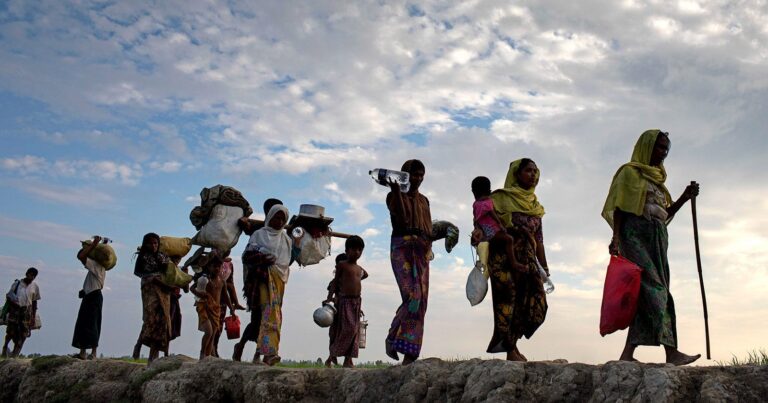
More than 730,000 Rohingya Muslims fled Myanmar’s Rakhine state in August 2017 after a military crackdown that refugees said included mass killings and rape. Rights groups documented killings of civilians and burning of villages.

Myanmar authorities say they were battling an insurgency and deny carrying out systematic atrocities.

The International Criminal Court has opened a case into the accusations of crimes in the region. In September, a U.S. federal judge ordered Facebook to release records of accounts connected to anti-Rohingya violence in Myanmar that the social media giant had shut down.

The new class-action lawsuit references claims by Facebook whistleblower Frances Haugen, who leaked a cache of internal documents this year, that the company does not police abusive content in countries where such speech is likely to cause the most harm.

The complaint also cites recent media reports, including a Reuters report last month, that Myanmar’s military was using fake social media accounts to engage in what is widely referred to in the military as “information combat.”

Mohammed Taher, a refugee living in the camps in Bangladesh that are home to more than a million Rohingya, said Facebook had been widely used to spread anti-Rohingya propaganda.

“We welcome the move,” he said by phone.

Reporting by Elizabeth Culliford in New York. Additional reporting by Poppy McPherson and Ruma Paul. Editing by Gerry Doyle and Nick Macfie

Profound public interest issue

0

Philippine Daily Inquirer / December 08, 2021

For fulfilling their duty to report on matters of abiding national significance, 21 journalists, editors, and executives of seven news organizations were unexpectedly slapped last Nov. 29 with multiple libel and cyberlibel suits by Energy Secretary Alfonso Cusi and Davao-based billionaire Dennis Uy.

Their supposed crime? Publishing “libelous and false statements” about Cusi and Uy’s involvement in the controversial multibillion-dollar sale of a combined 90-percent stake in the Malampaya gas field project to the Uy-led Udenna group.

Geologist Balgamel Domingo and US-based Filipinos Rodel Rodis and Loida Nicolas Lewis alleged in a 42-page complaint filed last Oct. 18 at the Office of the Ombudsman that Cusi had conspired with private and public officials to give “unwarranted benefits, advantage or preference to Udenna,” ultimately allowing the group led by Uy, a personal friend of President Duterte and one of his biggest campaign donors in 2016, to secure a 90-percent stake in Malampaya under a two-tranche deal.

The criminal complaint at the Ombudsman was obviously major news, and the published articles that reported on it were not plucked from thin air, but rather from information gleaned from the graft complaint — a public document — as well as a press conference and a statement issued by the complainants.

Media outlets ensured basic fairness by devoting space to Uy and Cusi’s side, who both insisted that the deal was aboveboard and that any allegations that the agreement was crooked, especially those made by Senate committee on energy chair Sen. Sherwin Gatchalian, were “misguided, lacking in factual and legal basis.” Cusi, who chairs a faction of the divided administration party, was also quoted as claiming that the complaint was made “for the singular purpose of political propaganda.”

But, in his libel suits filed in Taguig City, the energy chief said that by reporting on the Oct. 18 charges, the journalists had already “publicly accused” him of graft, thus smearing his “reputation and good standing in government.” For that, Cusi is demanding P200 million in damages from each of the seven media outfits — “to send a strong message that there is a fair and humane way to settle misunderstanding and differences without resorting to malicious news reporting.”

One is hard-pressed to be sympathetic to a public official bearing this mindset. The journalists and media outlets were merely doing their job to report on a legal challenge lodged against one of the biggest and possibly most impactful deals entered into by the Duterte administration.

The “profound level of public interest in the issue,” as pointed out by the statement of the Foreign Correspondents Association of the Philippines condemning the multiple libel suits, is clear: Malampaya is a “critical infrastructure that supplies a fifth of the Philippines’ energy requirements and benefits millions of Filipinos and businesses.” Thus, basic scrutiny and due diligence on where this key national asset goes, and utmost transparency in how it changed hands to end up with a businessman closely associated with the President, are more than required. It is Cusi’s job to explain to the public the nature and fine print of the deal that bears his signature in the Filipino people’s name; instead, he has chosen to try to shut down news coverage of the issue by hauling journalists to court.

Rodis et al.’s call for accountability in the Malampaya transfer is, in any case, not an isolated demand deserving to be ignored. Various civic groups have likewise voiced concerns over the integrity of the deal — among them the Integrated Bar of the Philippines (which urged the Department of Energy to “exercise transparency in evaluating transactions” related to Malampaya), the Makati Business Club (the Senate, it said, should determine why the government did not exercise its right to buy the private sector’s shares when they became available, and instead allowed the Uy group to take over sans any experience in oil exploration and development), the Philippine Bar Association (“Malampaya is a crown jewel of the country’s energy infrastructure,” it noted; “That it ended up in the hands of an entity that is not technically or financially sound is beyond negligent, it is criminal”), and, not least, Gatchalian’s Senate committee.

Gatchalian has described the mammoth transaction as a case of “lutong macau” — the most damning appraisal yet of the deal. But Cusi chose the easier target, training his incensed eyes on the media and not the public official leading the charge against his pet agreement.

The Economic Journalists Association of the Philippines, just one of several media groups that spoke up to denounce Cusi’s move, can’t be faulted for characterizing the libel charges as naked “harassment suits meant to intimidate the press.” All in a day’s work for Philippine media.

Gordon says Malacañang’s hallmarks all over Pharmally mess as past officials get involved

0

By: Gabriel Pabico Lalu – Reporter /INQUIRER.net /December 07, 2021

MANILA, Philippines — The footprints and hallmarks of Malacañang and Sen. Bong Go appear to be all over the mess involving the Pharmally Pharmaceutical Corp., Sen. Richard Gordon said as the names of past officials linked to both have been brought up during the investigations.

In an interview with ABS-CBN’s Headstart on Tuesday, Gordon stressed that some of the names that popped out during the Senate blue ribbon committee’s investigation of Pharmally had either worked for President Rodrigo Duterte or campaigned for him in the 2016 national elections.

Gordon was talking about former Procurement Service (PS) head Lloyd Christopher Lao, Deputy Ombudsman Warren Rex Liong, and lawyer Daryl Valles — officials who have allegedly also worked under Go back when he was still Special Assistant to the President (SAP).

“He (Lao) was with the Office of the President, in the office of Senator Go, then SAP.  And all these people, what is the common denominator? They were all appointed by the President, all of them came from Davao, all of them worked, at some time or another, with the President,” Gordon said.

“All of them campaigned for the President, all of them worked with Senator Go and these are known henchmen of the President. And look at the hallmark: how can Malacañang deny that they appointed Lao, and then afterwards they tried to appoint Lao, he had applied for the Ombudsman to cover his tracks,” he added.

Gordon said that even with corruption allegations hounding Lao at his past posts, he was still appointed to the Procurement Service of the Department of Budget and Management (PS-DBM), and then was considered to be Deputy Ombudsman.

And when Lao reneged from his aspiration to be deputy ombudsman, Gordon noted that it was Liong — also involved in PS-DBM and the Pharmally issue — who got the post.

“You know all these things are hallmarks.  When Lao was placed, obviously under protection, when Lao was with the Housing authority, people rose up in arms because of his corruption.  And then all of a sudden he is appointed to the PS-DBM […] and you can see the fingerprints, the hallmarks of Malacañang are all over,” Gordon claimed.

“And when he balked, he went out and who got appointed?  His (Lao’s) assistant, Mr. Liong, who also worked for the President, who also worked in the DBM in this so-called division that’s practically independent, working in the dark.  And he was appointed Deputy Ombudsman,” he added.

Gordon also said that Go cannot just deny his links to the officials mentioned.

“Well we’re not gonna go by guilty by association.  But the point is there is a lot of series of circumstances; first they were denying that Lao was not there, but Lao himself said he was with the Office of the SAP.  I’m not saying Bong Go should be part of it, but certainly, no one can get appointed in the Office of the President without the fingerprints and the recommendation of Sen. Bong Go.  That he cannot deny,” Gordon said.

“In fact he (Go) denied it right away, ‘I have nothing to do with that’.  And we let him out of courtesy to a fellow Senator, it’s up to him that if he feels he is being alluded to, he can always come out and he did […] But you know, you cannot just say simple denials, in the face of the overwhelming evidence,” he added.

During the earlier part of the investigations done by both the Senate and the House of Representatives regarding the pandemic supply procurement made by the PS-DBM, Lao was asked whether he worked for Go.

Lao denied such claims before the House committee on public accounts last August 26, but committee chair and Probinsyano Ako Rep. Jose Singson showed him a letter which Lao signed as an undersecretary of SAP — Go’s position before he was elected to the Senate in 2019.

READ: Ex-DBM Usec Lao denies working for Bong Go; solon shows him letter he signed as SAP’s Usec 

On the same day, Go said that it’s futile to link him to Lao, as even if he did knew Lao, it would not be a factor in fulfilling the administration’s anti-corruption drive.

READ: Go: Don’t link me to Lao, it’s irrelevant as those with corruption links would get punished 

INQUIRER.net has contacted Go and Malacañang to get their side after Gordon’s comments, but both have not replied as of posting time.

Gordon and administration allies, including President Duterte himself, have been at odds recently as the blue ribbon committee continues its probe on the anomalous transactions involving Pharmally.

While Duterte had explicitly said the Senate can “crumple” Pharmally, Gordon accused the President of protecting his past officials and those linked to the company, like former presidential economic adviser Michael Yang.

READ: ‘Napapaso ba kayo?’ Gordon hits ‘Atty. Duterte’ for defending Yang, others in Pharmally deals 

READ: Gordon, Lacson on capture of Dargani siblings: Davao City not safe haven for them 

Filipino Slang: Decoding Street Words from the ’70s through the ’90s

0

By Mario Alvaro Limos   |   Dec 14, 2019, www.esquiremag.ph

You might not be aware of it but you may be using Filipino slang that your parents may have used way back in the ‘70s. Filipino slang is a fascinating topic for any scholar of language because of its quickly and constantly evolving dynamics. Its mechanics of creating new words remain the same: adding or subtracting suffixes or prefixes, transposing syllables so words are read backward, and borrowing words from foreign languages.

But the thing with Filipino slang is its temporariness in popularity. For example, japeyks, a word used to describe counterfeit merchandise, was widely used in the ’90s but no longer used today. Japeyks comes from the word fake with an added prefix of ja. The same could be said of japorms, a word to describe someone who dresses excessively. More than a compliment, japorms is used to convey condescendence about someone’s outfit that is unfit for the hot weather in the Philippines. It comes from the word porma with an added prefix of ja. Never be caught using these two Filipino slangs nowadays or else you would be labeled as baduy, another colloquial term that means uncool, low class, or out of fashion.

The following are other words in Filipino slang that saw their popularity in the ’70s through the ’90s, some of which are still widely used today.

1| Resbak

Resbak is Filipino slang that means retaliate or to avenge something or someone. It comes from the words wrest back, which means to forcefully retake something from someone through a violent or twisting movement. In the case of resbak, what is being taken back through retaliation is the dignity of a person who was maligned, offended, insulted, or physically harmed.

For example: “Pare, rumesbak tayo sa gagong yun. Sasamahan ka namin.” (“Bro, let’s retaliate on that fool. We’ll back you up.”)

2| Kopong-kopong

Kopong-kopong is a phrase used to denote something antiquated or an event that happened a very long time ago. You might have heard a tita or tito utter the words when reminiscing on something. The word kopong is actually an Austronesian word that means nothing, empty, or zero. Austronesian languages include almost all languages in the Philippines including Tagalog, Cebuano, Bicolano, Kapampangan, and also the languages of Indonesia and Malaysia. Hence, when you hear someone say “Nineteen kopong-kopong pa iyon,” they’re actually literally saying nineteen zero zero or ninteen hundred (1900) as a form of exaggeration.

For example: “Pang nineteen kopong-kopong pa ang porma mo!” (“Your outfit belongs in the 1900s!”)

3| Sputing

Rarely used these days, sputing is a colloquial term used to praise someone’s attire. It was widely popular in the ’70s, but eventually faded in use. Sputing comes from the word sporting, which was frequently used in sartorial commentary: “Here comes Juan, sporting an American suit and tie.” But used in Filipino slang, sputing took on the form of an adjective that means good-looking, instead of a verb.

For example: “Uy, sputing ka ngayon ah!” (“Hey, you look dashing today!”)

4| Epal

Epal is a derogatory term used to describe someone who likes to meddle or insert themselves into other people’s businesses. In more recent years, it has evolved to pertain to politicians placing their names and faces on tarpaulins announcing government projects. Epal comes from the word papel, which is also used as a derogatory word to describe someone who likes to take credit for something they have little to do with.

For example: “Huwag ka ngang epal. Umalis ka dito.” (“Stop butting in. Go away.”)

5| Toka

Toka is a popular word used by various generations of Filipinos whenever there are potlucks at parties, reunions, get-togethers. In Filipino slang, toka means something assigned for you to bring or take care of. You might hear someone say that the lasagna or lechon is his toka for this year’s Christmas party. Toka may have come from the Spanish word toca, whose loose translation is to handle or to manage.

For example: “Kayo na bahala sa alak. Toka ko yung yelo!” (“You guys take care of the booze. I’ll bring ice!”)

6| Lintik

Lintik is one of those vague Filipino slang words that could mean anything, but is usually used as an expression of surprise, anger, irritation, or frustration. It actually has an entry in the UP Diksiyonaryong Filipino. It means kidlat or lightning. Hence, when you hear someone say “Tinamaan ng lintik,” he is literally saying struck by lightning. For any other uses and expressions, it can generally mean damn.

For example: “Lintik! Umayos ka nga!” (“Damn it! Will you please behave!”)

7| Kupal

Not one of the words you want to hear out loud, this Filipino slang is actually used to describe someone who acts like a jerk just to look cool. It may have been derived from the term pa-cool, which when transposed is cool-pa. Further transposition of the letter L turned it into coopal, and eventually became kupal. Unfortunately, kupal is also the Filipino biological term for smegma, the odorous sebaceous secretion in the folds of the skin in the male genitals.

For example: “Wag mo pansinin yun. Kupal yun.” (“Don’t mind him. He’s a jerk.”)

8| Pabebe

It’s easy to discern where this Filipino slang came from. Pabebe comes from the term pa-baby, which means acting cute or like a baby. It is also used as an alternative word for maarte or someone who drags everyone down because of sassy attitude or diva complex.

For example: “Huwag ka ngang pabebe.” (“Stop being so sassy.”)

9| Tukmol

In Filipino slang, tukmol means ugly. However, its original meaning in the Filipino dictionary is a bird, which is a type of pigeon or kalapati but smaller in size and has brown feathers. It’s very unfortunate that the innocent bird is now associated with the vulgar colloquial term.

For example: “Tukmol ka.” (“You look hideous.”)

10| Gunggong

Tukmol is not the only animal whose name found its way in colloquial use. Gunggong is actually a type of saltwater fish (Pelates quadrilineatus) found all over the world. In Filipino slang, gunggong is a superlative form of stupid. You might have heard villains from Filipino action films from the ’80s through the ’90s shout this word to his minions.

For example: “Mga gunggong kayo!” (You are a bunch of brainless idiots!”)

1Sambayan backs media over Cusi’s libel case

0

Marc Jayson Cayabyab – The Philippine Star December 6, 2021

MANILA, Philippines — Coalition 1Sambayan yesterday threw its support for news organizations sued for libel by Energy Secretary Alfonso Cusi regarding coverage of the Malampaya gas field deal.

In a statement, the coalition that endorsed the presidential bid of Vice President Leni Robredo said it “stands behind ABS-CBN, Business Mirror, BusinessWorld, GMA News Online, Manila Bulletin, Philstar Global and Rappler and the constitutionally guaranteed mandate of the media to provide information to the general public, as well as with the protection of our civil liberties foremost of which is the freedom of speech and of the press.”

1Sambayan said it “opposes any action to suppress the freedom of the press,” as it called out Cusi for his “baseless and unnecessary libel cases” on media for their reportage on the “heavily criticized Malampaya gas field buyout.”

“Cusi’s action is meant to stifle the free flow of information to the public, by employing legal harassment tactics against the media organizations. His suit aims to cow the media into silence and keep our citizens in the dark,” the coalition added.

1Sambayan urged Cusi not to “shoot the messenger” as it called the deal a “citizens’ concern.”

“We encourage you to air your side of the issue instead. This is how democracy works,” the coalition said.

Cusi filed the libel suit as he criticized news outlets for reporting on the acquisition by Dennis Uy’s Udenna of Chevron and Shell’s stake in Malampaya.

Cusi accused media of malice, although reports merely quoted the complaint filed before the Office of the Ombudsman about the acquisition and included Cusi’s previous statements and Udenna’s side on the issue.

Business journalists slam suits

The country’s business journalists slammed the recent libel suits filed by Cusi and Uy over the controversial Malampaya gas field buyout.

In a statement yesterday, the Economic Journalists’ Association of the Philippines (EJAP) stood with the seven news organizations facing libel raps filed by Cusi and Uy last week.

The EJAP is composed of business journalists and editors across print, online and TV media.

Two of the EJAP’s members are among the journalists facing the libel suits.

The EJAP maintained that the libel complaints filed against the journalists are an assault to press freedom and are meant to intimidate the media.

“It sends a chilling effect as this clearly signals that the media would incur the ire of government officials and businessmen even if they do their best to ensure that their stories are factual, accurate and objective,” the EJAP said.

It argued that the media is simply doing its job and that is to report based on the facts at hand.

“Secretary Cusi is a public official and is therefore subject to scrutiny,” the group said.

The EJAP emphasized that the issue is not one of simple transaction but a great public concern.

The asset involved is also crucial to the country’s energy security, thus deserving scrutiny from media without undue interference or threats.

The EJAP said Cusi’s camp has claimed that the news reports accused them of graft, when the reporters and editors simply based their news stories on a press conference, press release and documents coming from those who filed graft complaints against them.

“This latest attack on journalists shows the urgency of decriminalizing libel to uphold public interest by keeping those accountable in check,” the EJAP added.

In late 2006, then first gentleman Jose Miguel Arroyo, husband of then president Gloria Macapagal-Arroyo, filed criminal libel suits totaling more than P70 million against more than 40 journalists from print, broadcast and online media, many of which were related to allegations in the media that Arroyo helped rig the closely contested 2004 national elections, which the Arroyo camp strongly denied.

A month later, 36 journalists filed a counter lawsuit against Arroyo, accusing him of harassing the country’s media, according to the Committee to Protect Journalists.

Arroyo withdrew the charges in mid-2007. – Louise Maureen Simeon