Home Blog Page 420

Profiling sa mga kasapi ng ACT

Ano ba itong kontrobersiya tungkol sa profiling ng mga guro na binabanggit ngayon sa radyo, telebisyon, peryodiko, at pati na rin sa social media?

Nagsimula ito noong Disyembre nang mabalitaan na ang Philippine National Police (PNP) sa Manila at Zambales ay humiling sa mga eskuwelahan sa nasabing lugar na bigyan sila ng listahan ng mga guro na kasapi sa ACT (Alliance of Concerned Teachers).

Ang kahilingang ito diumano’y galing kay Manila Police Chief Inspector Rexson Layug at Zambales Police Chief Inspector Pancho Doble.

Ang ACT ay isa sa mga kilalang unyon ng mga guro sa National Capital Region, Bicol, Western Visayas, Central Visayas at Davao Regions na tinagtantyang may 200,000 kasapi.

Sa Kongreso, kilala bilang progresibong party-list ang ACT Teachers Party-list na may dalawang kinatawan at bahagi ng blokeng Makabayan.

Ayon sa ACT, kinausap ng mga opisyal ng PNP ang mga pinuno ng paaralan na magbigay ng listahan ng mga gurong kasapi sa ACT, banggit ang isang memorandum order mula sa PNP Intelligence Department. Ito diumano’y bilang preparasyon sa darating na halalan sa Mayo 2019.

Ilegal ang ginawang ito ng pulisya at umaatake sa kanilang
karapatang mag-organisa bukod pa sa karapatang magpahayag, sabi ng ACT sa isang
deklarasyon.

Isang uri ng harassment ito, at paraan ng surveillance na makakaapekto sa iba pang karapatan.

Nababahala ang ACT na matulad ito sa karanasan natin sa Oplan Tokhang kung saan matapos kumuha ng profiles ng mga pinaghihinalaang drug lords ang pulisya ay nasundaan ito ng walang humpay na pamamaslang sa mga pinaghihinalaang nagbebenta ng droga.

Ang ginawa ng PNP na ito’y lumalabag din sa karapatang magkaroon ng privacy, dagdag pa ng ACT, at labag din ito sa Magna Carta of Public School Teachers kaugnay ng karapatan sa malayang pagtatayo ng unyon at pag-oorganisa.

Kaya ayon kay ACT Teachers Rep. Antonio Tinio, pinag-aaralan nila ang pagsasampa ng kaso laban sa kapulisan at maaring laban sa Department of Interior and Local Government (DILG) sa Ombusman dahil sa ilegal na profiling na ito. Bahagi ito ng witch hunt ng estado, paliwanag niya

Pero ayon naman kay PNP NCR Director Guillermo Eleazar, walang dahilan upang pangambahan ang sinasabing profiling ng pulisya sa mga kasapi sa ACT.

Bagamat tinatanggi niya ito, sinabi ni Eleazar na kung totoo man, ang lahat ng makuha nilang inpormasyon ay ituturing na confidential at para sa internal consumption lang. Ang pagkuha daw ng inpormasyon tungkol dito ay bahagi ng kanilang trabaho at kanilang susundin ang privacy rights ng mga mamamayan.

Ayon naman kay PNP Director General Oscar Albayalde, ang pagtangka ng pulisyang kilalanin ang mga miyembro ng ACT sa hanay ng mga paaralan ay bahagi ng kanilang kampanyang tapusin ang communist insurgency.

Hindi namin sinasabi na ang ACT bilang organisasyon ay
kaaway ng gobyerno, banggit niya. Ngunit maaring may mga kasapi ito na kaaway
ng gobyerno. Ito ngayon ang dahilan bakit namin sinusuri ito, dagdag pa ni
Albayalde.

Sinabi naman ni Sen. Panfilo Lacson na ang dapat gawin ng PNP ay ang pagsagawa ng profiling at surveillance sa mga natanggal na taga-PNP at AFP upang malaman ang kanilang mga aktibidad pagkatapos na sila ay matanggal kabilang na ang kanilang lifestyle.

Ayon kay Commission on Human Rights (CHR) Spokesperson Jacqueline De Guia, ang mismong profiling ay isang uri ng diskriminasyon sa mga kasapi ng ACT. Sinabi pa niya na paglabag sa batayang karapatang pantao ng mga guro ang gawaing ito ng PNP.

Naglabas din ng House Resolution No. 2235 sa House Committee on Human Rights ang blokeng Makabayan na humihiling na imbestigahan ang hakbang na ito ng PNP tungkol sa profiling ng mga tao, organisasyon at mga kandidatong inuugnay sa komunismo. Ang naturang hakbang diumano’y maaaring gamitin ng puwersa ng estado upang i-black mail at impluwensiyahan ang darating na halalan sa 2019.

Ngunit ano ba talaga ang probisyon ng ating Saligang Batas na maaaring nilabag ng profiling na ito?

Una, nakasaad sa ating Bill of Rights, Seksiyon 3 (1) na “(h)indi dapat labagin ang pagiging lihim ng komunikasyon at korespondensiya maliban sa legal na utos ng hukuman, o kapag hinihingi ang naiibang kaligtasan o kaayusan ng bayan ukol sa itinatakda ng batas.”

Nababanggit din sa Seksiyon 8 na “(h)indi dapat hadlangan ang karapatan ng mga taong-bayan kabilang ang mga naglilingkod sa publiko at pribadong sektor na magtatag ng mga asosasyon, mga unyon, o mga kapisanan sa mga layuning hindi lalabag sa batas.”

Maalaala rin na mayroon tayong batas, ang RA 10173 o Data Privacy Act na bagamat tinitiyak ang malayang pagdaloy ng inpormasyon ay nagbibigay naman ng proteksiyon sa mga mamamayan kaugnay ng kanilang karapatan sa privacy.

Kanino tayo dapat kumampi rito, mga kasama? Siyempre, kung
ano ang sinasabi ng ating Saligang Batas, doon tayo dapat kumampi.

Maliwanag na palpak na naman ang PNP pagdating sa isyung
ito. PW

Kamusmusan at karahasan

Naglipana sa Facebook ang litrato ng mga taong tumutuligsa sa pagpapababa ng edad na kailangan para maikulong, o minimum age of criminal responsibility (MACR). Pinili nila ang litrato noong sila’y bata pa, paminsa’y bungal, nakangiwi, o nakatitig sa kawalan. Kasama ng mga litratong ito ang kuwento ng kanilang pagkabata, kung paano sila unang nagkaroon ng away magkapatid, kung paano sila nakikipaglaro ng patintero—kung paano sila nagbabad sa kanilang kamusmusan.

Bahagi ito ng kampanya na tutulan ang pagbaba ng MACR mula
15-anyos patungong siyam na anyos na lamang. Giit ng marami, ano ba ang alam ng
siyam na anyos? Ni hindi nga kinikilala ng batas ang kakayahan nilang makaboto
pagkat musmos pa nga, ngayong pagkakakulong ang usapan, iba na.

Kung susuriin ang payo ng iba’t ibang doktor at counselor pagdating sa pakikitungo sa mga siyam na taong gulang na mga bata, halos iisa ang puso ng kanilang mensahe: ang edad na ito ay panahon ng pagdiskubre ng sarili, ng kapwa, at ng pakikisangkot sa komunidad. Dito, hindi pa buo ang pag-intindi ng bata sa kanyang kinalalagyan sa lipunan. Sa edad na ito, kritikal ang paggabay ng nakatatanda. Malayo pa sila sa kinalalagyan ng milyon sa ating pupuwede nang pumirma nang walang permiso ng magulang.

Imbis na suporta at pagkalinga, pagtugis ang inaabante ng
administrasyong Duterte na walang ibang inintindi kundi ang walang direksiyong
pagpapakulong at pangingikil sa pinakabulnerableng mga miyembro ng lipunan: ang
mga maralita, ang mga minorya, at ngayo’y pati mga menor de edad.

Iisang kanta na lang rin ang pinapatugtog ng rehimeng ito.
At kung hindi man dumating ang panahon na makabuo ng magandang solusyon,
nariyan naman ang kulong. Kung ano iniintindi ng mga sumusuporta sa pagpapaba
ay ang pagtigil sa mga sindikatong gumagamit ng mga bata, bakit hindi paigtingin
ang mga operasyon laban sa mga sindikato? O masyado ba itong malaking hiling
para sa isang gobyernong ang alam lang naman puntiryahin ay ang ordinaryong
mamamayan kaysa ang mga organisadong crime group na pinagkakakitaan ng
nagsisiyamang mga punong kawatan.

Ito ngang 89 taong gulang na si Imelda Marcos, na buo na ang
pag-iisip ngayon at noong nandarambong silang magpapamilya ay kayang kayang
protektahan ng hustisya’t batas. Sa bagay, sino nga lang ba ang may kakayahang
umabot sa ganyang edad kundi silang mga bampirang kumukuha ng lakas sa kaban ng
bayan. Habang ang mga tulad ni Imelda’y nagpapakasarap sa mga mansiyon, anong
kinabukasan ang haharapin ng kabataan ngayon pa nga lang na sa buong Pilipinas,
hindi aabot sa 60 ang pasilidad na pupuwede sa mga batang lumabag sa batas?

Kadalasan pa’y galing ang mga ito sa maralitang mga pamilya, o kaya naman ay naulila na—mga biktima ng pagkakataon at sistema. Ang biktima, kinakalinga, tinutulungang makabangon. Pero posas at dahas lang ang nakikitang solusyon ng gobyernong hindi tumitingin sa danas ng mga mamamayan.

Bagsak na ekonomiya, Desperadong pasista

Ibinandera sa balita ng malalaking network sa telebisyon ang diumano’y pagbaba ng presyo ng mga bilihin noong nakaraang Kapaskuhan. “Bumaba ang inflation sa 5.2 porsiyento nitong Disyembre,” masayang ibinalita ng Philippine Statistics Authority (PSA), habang nagpalabas naman ng interbyu ang midya ng mga mamimili na natutuwa sa mas murang bilihin noong panahon ng Pasko.

Agad na ibinandera rin ito ng rehimeng Duterte. Ayon sa economic managers nito (mga miyembro ng gabinete na mula sa National Economic Development Authority, Department of Finance at Department of Budget and Management), inaasahang magpapatuloy ang pagbaba ng inflation sa taong 2019.

Pero sa unang tatlong linggo ng Enero 2019, tila nararamdaman na agad ng publiko ang muling pagbalik ng trend ng tuluy-tuloy na taas-presyo ng mga bilihin.

Nitong Enero 22, muling tumaas ang presyo ng mga produktong petrolyo. Umabot sa P0.10 ang itinaas sa gasolina, habang P0.40 naman ang itinaas sa presyo ng diesel. Pangatlong beses na itong tumaas ngayon pa lang Enero 2019. Noong Enero 8, tumaas ang gasolina nang P0.80 kada litro, habang tumaas naman ang diesel nang P0.70 kada litro. Matapos ang isang linggo, noong Enero 15, muling tumaas ito.

Siyempre pa, agad na naapektuhan ng naturang taas-presyo ng
produktong petrolyo ang presyo ng batayang mga bilihin. Unti-unti nang
nagsisitaasang muli ang mga ito.

Taas-presyo ng langis agad

Ang itinuturong isa sa pinakadahilan ng taas-presyo ng
produktong petrolyo, siyempre, ay ang mga polisiya ng rehimeng Duterte sa
ekonomiya.

Ayon sa Ibon Foundation, independiyenteng institusyon ng pananaliksik sa mga usaping pang-ekonomiya at pampulitika, patuloy ang pagpapatupad ng rehimeng Duterte ng Oil Deregulation Law (Republic Act No. 8479 o ang Downstream Oil Industry Deregulation Act of 1998) na nagpapabaya sa industriya ng langis sa monopolyong kontrol ng malalaking kompanya ng langis sa daigdig at kapartner ng mga ito sa Pilipinas (hal. Pilipinas Shell, Caltex, Petron, atbp.).

“Iniluluwal ng oil deregulation ang overpricing (o sobrang pamemresyo sa langis sa pandaigdigang merkado),” sabi ng Ibon Foundation. “Dahil deregularisado ang industriya ng langis sa Pilipinas at nakaasa sa pandaigdigang merkado, mas malupit ang epekto ng (taas-) presyo sa mga konsiyumer, sa kabuhayan ng mga mamamayan at sa ekonomiya,” sabi pa ng Ibon.

Pinalalala lang ito, ayon sa grupo, ng 12 porsiyentong value-added tax sa mga produktong petrolyo at ng excise tax sa langis sa ilalim ng Tax Reform for Acceleration and Inclusion (Train) Law.

Kay Duterte, ibayong hirap

Samantala, wala ring maiharap na lunas ang rehimeng Duterte
sa dumadausdos na kalagayan ng mga mamamayan. Sa usapin lang ng sahod ng mga
manggagawa sa pribadong sektor at mga kawani ng gobyerno, patuloy na
tinatanggihan ng rehimen ang maingay na panukala para sa isang makabuluhang
dagdagsahod na sasaklaw sa lahat ng manggagawa sa buong bansa.

Ikinakampanya ng Kilusang Mayo Uno (KMU) ang P750 na dagdag sa minimum na sahod sa buong bansa, mula sa mga probinsiya hanggang sa mga sentrong lungsod tulad ng National Capital Region. Sinasang-ayunan ito ng Ibon Foundation, na malaking tulong sana ang makabuluhang dagdag-sahod sa pag-agapay sa mga manggagawa sa panahong tuluy-tuloy ang taas-presyo ng langis at batayang mga bilihin. Makakatulong din sana sa mga manggagawa ang kaseguruhan sa trabaho, o ang pagbasura sa laganap na praktika ng kontraktuwalisasyon.

Pero nauna nang tinanggihan ng rehimeng Duterte ang pagtupad
sa ipinangako niya noong tumatakbo pa lang siya – ang pagbasura sa
kontraktuwalisasyon, ang taas-sahod.

Samantala, ang pagtalikod na ito ni Duterte sa mga pangako niya sa mga manggagawa ay bahagi lang ng mistulang pagpapasahol niya sa kalagayan ng mga mamamayan. Nakapaloob ito, ayon sa Ibon, sa pakete ng mga polisiyang neoliberal sa ekonomiya na itinutulak ng gobyernong US. Pagpapatuloy lang ito sa dati nang mga polisiya ng nakaraang mga rehimen, pero sa ilalim ni Duterte, pinatindi niya ang pagpapatupad nito. “Patuloy na pinagkakakitaan ng lokal na elite at dayuhang kapital ang pinakamahihirap na mayorya na namomroblema sa tumataas na bilang ng kawalan-ng-trabaho, mababang sahod, mataas na mga presyo, mabibigat na mga buwis at bulok na mga serbisyong pampubliko,” ayon sa executive summary ng Ibon Foundation sa inilunsad nitong BirdTalk, o talakayan hinggil sa kalagayang pang-ekonomiya at pampulitika ng bansa, noong Enero 17 sa Quezon City.

Pinalalala pa, siyempre, ang problemang ito, ang sunud-sunod na korupsiyon at kontrobersiya sa ilalim ni Duterte. Sa kabila ng madugong giyera kontra droga, nadadawit ang ilang piling opisyal ni Duterte sa malakihang smuggling ng ilegal na droga. Pati ang anak ng presidente, si Davao Vice Mayor Paolo Duterte, ay nasasangkot dito. Pinalalala din ito ng pagpapabor ng rehimeng Duterte sa gobyernong Tsino, kabilang ang pagbibigay ng malalaking kontrata sa mga kompanyang Tsino sa ilalim ng programang pang-imprastraktura na Build! Build! Build! na inaasahang lalong magpapalugmok sa bansa sa utang.

Sa harap ng tumitinding krisis na ito sa ekonomiya,
inaasahan ang tumitindi ring pagtutol at protesta ng mga mamamayan. Hindi
kataka-taka, kung gayun, kung bakit pinaiigting ni Pangulong Duterte ang
pasistang panunupil sa bansa. Kasalukuyan, ayon sa maraming tagamasid sa
pulitika ng bansa, may de facto (o hindi inaanunsiyo pero nangyayari na)
martial law na sa bansa.

De facto batas militar

“Dinodoble na ng paksiyong Duterte ang mga hakbangin nito
para palawakin pa kapangyarihan nito at palawigin ang pamumuno nito nang walang
palugid,” sabi ng Ibon.

Kasalukuyan, itinutulak nito ang Charter Change o pagpalit sa Saligang Batas ng bansa, sa Kongreso, sa pamumuno ng dating pangulo, at alyado ngayon ni Duterte, na si House Speaker Gloria Macapagal-Arroyo. Sa panukalang Charter Change na ito, ayon kay dating Bayan Muna Rep. Neri Colmenares na aktibo sa isyu, ang “pinakamasahol na Cha-cha sa kasaysayan.” Paliwanag niya, bahagi ng panukala na gawing sa 2022 na ang sinuod na halalan sa ilalim ng bagong Saligang Batas – ibig sabihin, kung maipapasa nga nila ang Cha-cha bago Mayo 2019, posibleng hindi pa matuloy ang halalan. Ibig din sabihin, palalawigin pa ang termino ng kasalukuyang nakaupong mga kongresista at senador sa bansa.

 Sa naturang Cha-cha ni Arroyo, sabi ni Colmenares, nakasaad din na kung sakaling bumaba sa puwesto o pumanaw ang kasalukuyang Pangulo, ang bise-presidente ang aaktong presidente hanggang maganap ang halalan. Pero “acting president” lang ang bise – taliwas sa nakasaad sa kasalukuyang Konstitusyon na ang bise ang magiging presidente sa panahong mawawala ang nakaupong presidente.

Nakapasok din sa Cha-cha na ito ang mga panukala sa pagpayag
sa 100 porsiyentong pagmamay-ari ng mga dayuhan sa mga lupain sa Pilipinas.
Pinahihintulutan din ng Cha-cha ni Arroyo ang 100 porsiyentong pag-aari sa mga
industriyang katulad ng midya.

Para kontrahin ang tiyak na tumitinding galit ng mga
mamamayan, tumitindi rin ang panunupil ng rehimen. Sa tala ng Karapatan
hanggang Nobyembre 2018, sa ilalim ng giyerang kontra-insurhensiya na Oplan
Kapayapaan ay nagkaroon na sumusunod na mga paglabag:

  • 216 extrajudicial killngs;
  • 378 biktima ng tangkang pagpatay;
  • 100 biktima ng tortyur;
  • humigit-kumulang 2,000 biktima ng ilegal na aresto;
  • 71,520 biktima ng banta at panghaharas;
  • 447,963 indibidwal na biktima ng sapilitang paglikas sa kanilang mga komunidad dahil sa mga pagbomba at operasyon.

Mistulang tuluyan nang sinara ni Duterte ang pinto sa usapang pangkapayapaan sa National Democratic Front of the Philippines (NDFP), na kumakatawan sa rebolusyonaryong kilusan sa bansa. Ilang ulit na niyang idineklara na magkakaroon ng crackdown o malawakang paghuli sa mga progresibong organisasyon. Noong Disyembre, inanunsiyo na ni Duterte ang pagbubuo ng National Task Force to End Communist Insurgency. Sa task force na ito, pinakikilos ng Pangulo hindi lang ang militar kundi ang buong burukrasya ng gobyerno, para labanan diumano ang rebolusyonaryong kilusan. Noong Nobyembre naman, matatandaang naglabas din siya ng Memorandum Order No. 32, na nag-utos sa militar na buhusan ng puwersa ang isla ng Mindanao, ang rehiyon ng Bikol, gayundin ang mga probinsiya ng Samar at Negros.

Ang huling probinsiya, nasampolan na noong Diyembre 27. Ayon sa Karapatan, grupong pangkarapatang pantao, pinangunahan ng 302nd Infantry Brigade at 94th Infantry Battalion ng Philippine Army, katuwang ang Philippine National Police, ang serye ng mga atake sa mga komunidad ng mga magsasaka. Sa ulat na umabot sa grupo, may anim (6) na kataong napaslang—pawang mga lidermagsasaka o miyembro ng progresibong organisasyon ng mga magsasaka sa Negros.

Samantala, 16 katao naman ang inaresto, karamiha’y mga organisador sa hanay ng mga magsasaka. “Ayon sa kaanak ni Margie Vailoces (isa sa mga inaresto), walang mandamyentong ipinakita ang mga pulis at militar sa tahanan ng pamilyang Vailoces,” ayon kay Cristina Palabay, pangkalahatang kalihim ng Karapatan.

Siyempre, nariyan din ang extrajudicial killing kay Randy Felix Malayao, konsultant pangkapayapaan ng NDFP, noong Enero 30 sa Nueva Ecija. Mula noong nakaraang taon, pinaghuhuli rin at sinampahan ng gawa-gawang mga kaso ang mga konsultant ng rebolusyonaryong kilusan tulad nina Adelberto Silva, Vicente Ladlad, Ferdinand Castillo at Rey Casambre.

Mukhang desidido ang rehimeng Duterte na supilin ang pampulitikang mga puwersa mula sa progresibong kilusan na pinaka-epektibong lumalaban sa mga polisiya nito. Ayon sa National Union of People’s Lawyers (NUPL), naglabas pa ang Securities and Exchange Commission ng “ilegal” na Memorandum Circular No. 15 na naglalayong uriratin ang pinagmumulan ng pondo ng nongovernment organizations (NGOs) at mistulang hadlangan ang kanilang mga operasyon. Marami sa mga progresibong grupo ay rehistradong NGO sa SEC ng gobyerno.

Pero katulad ng nakaraang matitinding krisis sa pulitika at ekonomiya—sa Pilipinas man o sa ibang bansa—iniluluwal lang ng matinding panunupil ang lalong matinding pagtutol. “Maaaring masilaban ito ng isa o bungkos ng mga pangyayari— flashpoints na katulad ng isang matinding pagbagsak sa ekonomiya, o, katulad ng nakaraan, matinding korupsiyon, o mga isyung elektoral na dumudulo hanggang sa presidente,” ayon sa Ibon. Ibig sabihin, kung itutuloy ni Duterte ang lalong pagsupil sa mga mamamayan, titindi rin ang paglaban.
Muslim, Christian groups call for unity amid bombings in Mindanao

0

Christian and Muslim leaders based here came together in time for the World Interfaith Harmony Week to renounce the recent bombings in some parts of Mindanao as they urged the people to unite in the face of violence which many feared was aimed at sowing sectarian discord.

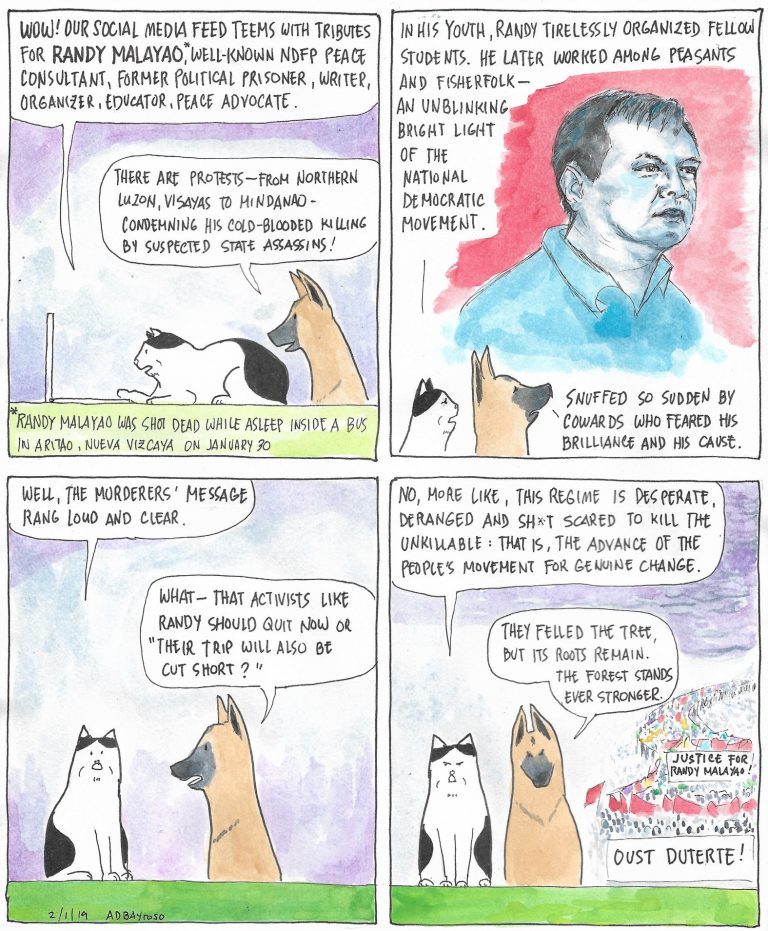
Justice for Randy Malayao!

0

By DEE AYROSO
(http://bulatlat.com)

The post Justice for Randy Malayao! appeared first on Bulatlat.

Arsenal of oppression

0

Not even child rights advocates have been saying that children are incapable of committing crimes. Neither has anyone said that children are angels. But in reaction to Senator Risa Hontiveros’ opposition to the bill lowering the age of criminal responsibility to 12, Davao City Mayor Sara Duterte made it seem as if those two assumptions were at the heart of the resistance to that outrage.

But Mayor Duterte wasn’t all wrong. She was right when she went on to say that there are “documented cases of 12, 13, 14-year-old children committing rape, murder, theft, robbery, drug smuggling, drug peddling, even arson.”

Anyone with the physical capacity and the opportunity to do so can commit a crime. But the extent of his accountability depends on the perpetrator’s motives and awareness of the consequences. A four-year old playing with matches can burn down an entire community. A five-year old envious of a playmate’s mobile phone can steal it when he’s not looking. And a six-year old can be made to smuggle drugs to someone, perhaps a parent, in prison. But no one in his right mind would argue that they should all be criminally liable, and for a quite obvious reason: none of those children could have had the awareness of the consequences of their actions on themselves and others that criminally prosecuting and imprisoning them presumes.

The same principle applies to those below 15 years old, which, it can be argued, does not qualify as the age of discernment, since psychological and other studies have established, among other findings, that the brain doesn’t stop developing until one is in his or her mid-20s. These studies challenge conventional ideas about childhood, adolescence, and adulthood. Being 18 years old in many cultures marks childhood’s end, but even being of that age doesn’t make one an adult.

This is not to argue that the age of criminal responsibility should be 25, only to point out that the assumption in the bill lowering that age to 12 that a child who steals or hurts someone should be tried as an adult is woefully mistaken.

Its advocates — President Rodrigo Duterte, Mayor Duterte, their allies in the House and Senate majorities, the Philippine National Police — nevertheless not only say so. They also claim that it will reduce the crime rate and at the same time protect children 12 years old and below.

But the National Police Commission’s own numbers say that only 1.72% of all crimes are committed by children, and that 98.28% are committed by adults. Those adult crimes are not limited to the thefts most child offenders are accused of. They include extrajudicial killings, kidnapping, large-scale smuggling, plunder, graft and corruption, and those other skills with which so many adults including government officials are gifted, and for which they continue to escape prosecution and even imprisonment when already convicted.

Imelda Marcos is yet to see even the inside of a specially constructed air-conditioned facility complete with all the amenities to which she is accustomed. Joseph Estrada was convicted of plunder but was pardoned by Gloria Macapagal- Arroyo, and is now mayor of Manila. A subordinate of Ramon “Bong” Revilla has been convicted of plunder, but he himself was acquitted. Ninety percent of the killers of journalists, political activists, lawyers, judges, clergymen, and reformist local officials have escaped prosecution, while the masterminds behind them have quite literally gotten away with murder.

In contrast to the impunity of the wealthy and politically well-connected is the focus on child crimes that is so obviously another front in the war against the poor, the majority of children in conflict with the law being from needy, dysfunctional families.

As for protecting them, the specious claim is that they will be insulated from the syndicates that use them by detaining them in the Bahay Pag-Asa centers mandated by the Juvenile Justice and Welfare Act of 2006 (Republic Act 9344) as amended by RA 10630. What the advocates of lowering the age of criminal liability don’t mention is that there are only 63 of these nationwide, and that most of them have been described as unfit for children by the government’s own social workers.

They point out that in most of these “Houses of Hope,” the detained children have no bedding and must sleep on the floor. They have no space for recreation, and can’t feed their residents adequately. Children as old as 17 are still detained in them for committing such crimes as rape when they were 12 years old. (The law mandates the confinement of 12-year-olds involved in “heinous crimes” in these prisons-in-disguise.)

Putting 12-year-olds with older children regardless of the nature of the crime they’re supposed to have committed will not only make them vulnerable to physical and sexual abuse, but also to being apprenticed for other crimes. Rather than rehabilitation facilities, these prisons will become, if they are not yet training centers for future adult criminals.

There is also the probability that with the surge in the Bahay Pag-Asa populations that lowering the age of criminal liability will bring, the resulting congestion will lead to 12-year old children’s being held in the foul prisons this country is noted for. They will end up with adult prisoners, making them even more vulnerable to abuse as well as to the same criminal apprenticeship.

Lowering the age of criminal liability will hardly affect the availability of children for use by the crime syndicates. Any imprisoned 12-year-old can be replaced by others from the limitless supply of children that the country’s 2.4% population growth rate provides.

All these raise the question of why, despite the cruelty, lack of foresight, plain stupidity, and minimal impact on the crime rate of lowering the age of criminal responsibility is, the Duterte regime and its allies are so obsessed with putting more children in facilities that, no matter what they’re called, are still prisons complete with iron bars, guards and padlocks.

The reason is as plain as the simple-mindedness of its proponents. Unable and unwilling to address the fundamentals of such problems as drug addiction and criminality, they think that quick fixes will suffice without the social and economic reforms needed that will bring about authentic change.

The quick-fix mentality is evident in the focus on repression, hate, and the mantra of “kill, kill, kill” on “solving” the drug problem, ending rebellion, and silencing dissent and protest. Hence the continuing effort to restore the death penalty that together with the extrajudicial killings, arbitrary arrests and the imprisonment of children would be one more means of mass intimidation.

The consequences of these offenses to reason and humanity are too evident to deny, among them the debasement of democratic discourse that makes it virtually impossible to rationally explore solutions to the country’s problems. The enshrinement of the rule of force as policy has also led to the making of a climate of fear in the poorest communities in both city and countryside — where both armed and unarmed resistance are growing.

Lowering the age of criminal responsibility will also have results contrary to its announced intentions. It will create conditions for the further surge in criminality, and doom thousands of children to the short and brutish lives to which their families have been condemned by the poverty and social injustice that a corrupt and irresponsible political class has been unwilling and unable to address for decades.

Putting children in prisons disguised as rehabilitation centers is only among the many weapons in the arsenal of oppression of those at war with the poor and powerless millions of Philippine feudal society. But it is also among the most heartless.

Luis V. Teodoro is on Facebook and Twitter (@luisteodoro).

www.luisteodoro.com

Published by Business World
Jan. 31, 2019

The post Arsenal of oppression appeared first on Bulatlat.

Peace consultant killing raises serious questions

0

He was fast asleep inside the bus, too tired perhaps to get out and stretch his legs during the stopover in Aritao, Nueva Vizcaya, at about 2 a.m. Wednesday. So when a gunman boarded the bus to kill him in cold blood, the murder went very fast. The assassin then quickly left the scene on a waiting motorcycle driven by another man.

Randy Felix Malayao, 49, a peace consultant of the National Democratic Front of the Philippines, was the first NDFP consultant slain in such a manner since late 2017. But his assassination followed a pattern.

In recent months, four other NDFP peace consultants – Rafael Baylosis, Adelberto Silva, Vicente Ladlad, and Rey Claro Casambre – had been individually arrested by state security forces. All were similarly implicated in murder cases, filed in far-flung areas. To ensure their prolonged detention, they were slapped with non-bailable charges of illegal possession of firearms and explosives. (Two weeks ago, however, a Quezon City trial court dismissed the charges against Baylosis, ruled his arrest as illegal, and ordered him freed.)

Randy Malayao may have been considering himself lucky because, unlike these others, no criminal charge had been filed or arrest warrant issued against him. True, he had been falsely arrested in 2008, heavily tortured, detained and prosecuted for four years on trumped-up charges. But the trial court cleared him of all charges and ordered him freed in 2012. He then joined the peace talks as consultant and one of the NDFP peace panel spokespersons in negotiations with the Duterte government.

Apparently not too worried about his physical safety, Randy had been travelling by public transport from his hometown in San Pablo, Isabela to wherever he needed to go and returning home the same way. He went about his business as a human-rights activist, unarmed and alone, like anyone who felt secure in his clean conscience.

That he was killed, rather than framed up and arrested on illegal possession of firearms and explosives, has raised alarm in the human-rights community. Their legalist moves now being exposed as shamefully contrived, are the state security forces now taking deadlier, offensive action against NDFP peace consultants?

Did President Duterte’s latest flip-flopping on peace talks with the NDFP induce Randy’s killer to hunt him down and pull the trigger?

Consider this shift in Duterte’s mood and outbursts. On Jan. 4, 2019, speaking in Camarines Sur, he indicated he was again open to talking peace with the Left revolutionary movement. He said:

“At this time, [Jose Ma.] Sison [NDFP chief political consultant] and I do not understand each other. But I’d like you to know that we are keeping the fire burning, and you cannot really close [the door on the peace talks]. You cannot afford to lose all channels of communication. You would have to leave even a small opening.”

On Jan. 29 that sober tone again changed. Condoling with the families of the victims of the twin bombings in Jolo, Duterte declared he would never negotiate with terrorist groups (referring to the Abu Sayyaf). But he added: “Same with the NPA [New People’s Army]. I will never talk to you. I can’t do anything about it.”

That sharp shift in stance harked back to his Christmas gift-giving talk to Philippine Army soldiers in Compostela Valley on Dec. 22. Speaking of “law and order,” he pointed to the Communist Party of the Philippines “including its legal fronts and infrastructure,” and barked out this order:

“Do not fight them. Destroy them. Kill them. Just destroy. Who ordered you to do so? I did.” After lambasting Joma Sison, he repeated: “We have to destroy them. Destroy them. Do not believe in human rights. I assume full responsibility.”

In consonance with that presidential stance, the Department of Justice has amended its petition for proscription, filed in a regional trial court seeking the declaration of the CPP and the NPA as “terrorist organizations,” to skirt the legal hurdles to the court’s early action on the petition. Meantime, former military and police officers sitting as congressmen have been pushing hard to amend the Human Security Act of 2007, the basis for filing the proscription petition. Their objectives: to delete the safeguard provisions and make it easy for the court to declare the CPP and NPA as terrorist organizations, broaden the law’s coverage, and impose a harsher penalty (life imprisonment) on anyone deemed as a terrorist or member of a terrorist organization.

Mindful of these moves, NDFP peace panel chair Fidel V. Agcaoili, warned that Randy’s killing “may very well [be a] portent of worse moves against the NDFP consultants.” It indicates, he added, “an escalation of attacks against [them] and serves as further serious obstacle to the resumption of peace negotiations.” He voiced out the panel’s “outrage and strongest condemnation” of the murder while according Randy “our highest honor for his invaluable contributions to the revolutionary movement and the NDFP’s peace efforts.”

Labor Secretary Silvestre Bello III, who also chairs the GRP peace panel, expressed shock and sadness over the killing and his panel’s hopes that persons involved in peace negotiations would be spared from such attacks.

“It is our ardent hope that the life sacrificed by Malayao served to give new life to our common desire for that elusive peace,” Bello said. “We in the (GRP) negotiating panel remain unperturbed, even as the slimmest ray of hope for a just and peaceful settlement of the armed conflict with the CPP-NPA-NDFP is dimmed further with the silencing of the purveyors of peace.”

Bello recalled that Malayao, “a good personal friend” for whom he had lawyered in 2008, “would meet with me at my house in Isabela whenever we had time and we would talk [about] peace and human rights issues.”

Can the unjust killing of an ardent peacemaker personally lauded by his chief peace negotiator move President Duterte back to his sober stance? Can he give justice to Randy’s sacrifice of life by seriously resuming the stalled GRP-NDFP peace negotiations?

* * *

Email: satur.ocampo@gmail.com

Published in Philippine Star
Feb. 2, 2019

The post Peace consultant killing raises serious questions appeared first on Bulatlat.

FQS, the beacon of today’s youth activism

0
MARTIAL LAW VICTIMS. Activists from the First Quarter Storm period in the ‘70s join the Martial Law commemoration, September 21 in Davao City. The torches they bring symbolize their hope that those days of grave rights abuses will never happen again. (davaotoday.com photo by Medel V. Hernani)

Forty-nine years ago, thousands of brave Filipino youth fought the dictatorial regime of the late Ferdinand Marcos with a series of mass demonstrations.