By Melvin Gascon Environment groups on Monday expressed concern over the proposed charter change by the Duterte government, saying the draft federal constitution bodes danger for the environment. In a statement, Kalikasan People’s Network for the Environment rejected the bid to change the constitution and replace it with one that would supposedly allow foreigners and […]
PLDT worker wears ‘protest barong’ at SONA, join thousands at People’s SONA
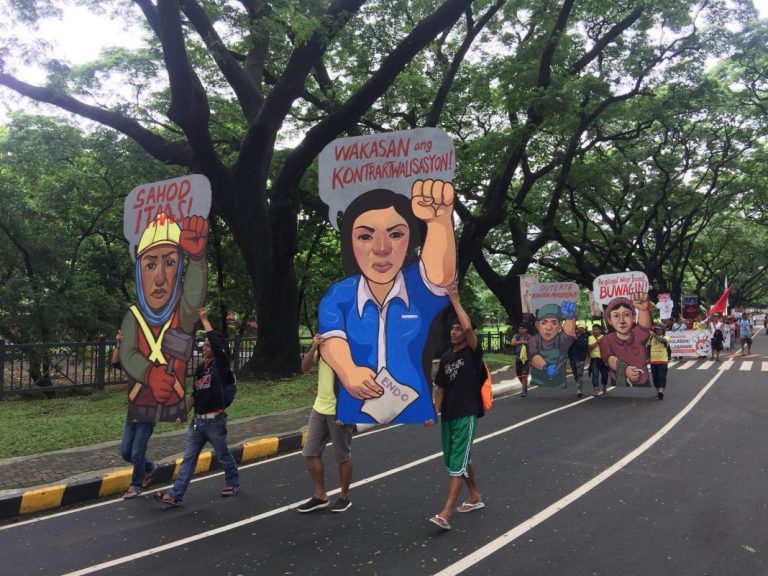
Terminated contractual workers from various companies and pro-labor groups Kilusang Mayo Uno – Metro Manila, Defend Job Philippines and Alyansa ng mga Manggagawa Laban sa Kontraktwalisasyon (ALMA Kontraktwal) raised the issue of contractualization, wage hike and better working conditions in Monday’s State of the Nation Address protest in Commonwealth Avenue.

“As the Duterte administration vowed to end contractualization in 2016, this promise remains unfulfilled and empty two years after,” said KMU Metro Manila chair Ed Cubelo.
Kilusang Mayo Uno maintains their stance on Duterte’s ‘toothless’ moves to end contractual labor, saying Executive Order 51 which he signed on May 1 still allows for certain forms of contractualization.
In response, terminated workers mounted a five-day protest camp in Mendiola from July 18 to 22 before marching to Batasang Pambansa on July 23. These include terminated workers from PLDT (Philippine Long Distance Telephone Company), Jollibee Foods Corporation, UniPak manufacturer Slord Development Corporation, Manila Harbour Centre, Pearl Island Commercial Corporation, and members of Liga ng mga Manggagawa sa Valenzuela City.
‘Protest Barong’ vs. endo
PLDT Organization of Workers and Employees for Rights (POWER) President Dan Joshua Nazario sported a maroon ‘protest barong’ at Duterte’s SONA created by Mimi Salibio of Sama-samang Artista para sa Kilusang Agraryo (SAKA).
The barong depicted three clenched fists holding cable wires, chains and a headset to represent the 12,000 PLDT employees and workers who have been terminated by the telecom company despite existing DOLE compliance order to PLDT to regularize its workers.
On June 30, 2018, PLDT terminated its service contracts with its various agencies that led to the mass lay-off of its contractual workers who were supposed to be regularized.
“We walk down the SONA red carpet and march with the thousands of people in the street for the SONA protest today to send the message of the hundreds of thousands of terminated contractual workers nationwide, who have been hoping for the Duterte government to do something decisive and significant in making our aspirations to be regular workers possible,” Nazario said.
The post PLDT worker wears ‘protest barong’ at SONA, join thousands at People’s SONA appeared first on Manila Today.
Journalist groups decry media killings, attacks on press freedom in SONA protest
Journalists were also among the thousands who marched along Commonwealth Avenue yesterday for the United People’s SONA as they slammed the spate of killings of journalists and President Rodrigo Duterte’s attacks on the media.
“Mula noon, 12 na sa hanay namin ang napapatay,” National Union of Journalists of the Philippines (NUJP) Chair Nonoy Espina told the crowd during the protest.
Espina claimed that this number is the largest number of journalist killings within the first two years of any president’s term; he cited the recent killing of radio announcer Joey Llana, who was gunned down on his way to Legazpi last Friday, July 20.
He also decried Duterte’s threats on media companies such as online news site Rappler and broadcasting giant ABS-CBN, Sen. Vicente “Tito” Sotto III’s takedown of Inquirer’s articles on Pepsi Paloma, and the continuing proliferation of fake news and disinformation.
Campus press under attack
Echoing Espina’s sentiments, College Editors Guild of the Philippines National President (CEGP) Jose Mari Callueng also decried attacks on campus journalists.
“The campus press is also under attack and some student publications are under surveillance both by the Philippine National Police and the Armed Forces of the Philippines,” (AFP) Callueng said in a statement.
September last year, CEGP decried the red-tagging of their member publications in Camarines Sur after they reported that they were under the watch list of the AFP as part of the Duterte administration’s so-called counterinsurgency operations.
Chapters in other regions and provinces also reported similar incidents.
CEGP is also set to file reports of campus press freedom violations to the Commission on Higher Education tomorrow, July 25, in commemoration of CEGP’s 86th founding anniversary.
From 127th place in 2017, the Philippines also went down six spots to 133rd in the 2018 World Press Freedom Index of media watchdog Reporters Without Borders (RSF).
In RSF’s 2017 year-end report, they declared the Philippines as the deadliest country for journalists in Asia and was included in the top five dangerous countries for journalists together with Mexico, Syria, Iraq and Afghanistan.
The post Journalist groups decry media killings, attacks on press freedom in SONA protest appeared first on Manila Today.
NUJP condemns media threats and killings at United People’s SONA 2018
The National Union of Journalists of the Philippines condemns the continuing threats against journalists and the media killings two years into the Rodrigo Duterte presidency. Speaking before the massive United People’s SONA protests, NUJP chairperson Nonoy Espina said that with the help of the Filipino people, they will defeat threats against press freedom.
Magna Carta: Another attempt at silencing critical journalists
AMID great fanfare in 2017, President Rodrigo Duterte signed an administrative order – his first – creating the Presidential Task Force on Media Security (PTFoMS). Mandated to look into and reduce the number if not completely stop the killing of journalists, the task force, under its executive director Joel Egco, has since then done neither. Fourteen journalists have been killed since Mr. Duterte assumed the Presidency in 2016, with six killed this year. Part of the reason is former tabloid reporter Egco’s refusal to share information with journalists’ and media advocacy groups, primarily because most of the killings have been perpetrated by State actors such as police and military men, and masterminded by local officials.
Although that fact is fairly well known among journalists, if it were officially validated by his task force, Mr. Egco’s tenure as PTFoMS executive director would be in peril from his bosses, among them Presidential Communications Operations Office (PCOO) Secretary Martin Andanar, and the Director General of the Philippine National Police (PNP), who sit in the PTFoMS together with the secretaries of defense and interior.
Having failed to do its mandated job, Mr. Egco’s task force has instead resurrected an old and properly dead idea calculated to enable government to choose who can practice journalism and who cannot. In a speech in Cebu City, Mr. Egco suggested the adoption of a “Magna Carta” for journalists – except that his proposal isn’t about rights, which is what a Magna Carta is fundamentally about, but about licensing. If his proposal were implemented, anyone who wants to practice journalism will be made to take an examination not once, but every six months, so they can establish whether they’re qualified to be reporters, editors, or whatever else in the news media. The intention is supposedly to “professionalize” journalism practice – in which enterprise, however, a number of schools have been engaged for decades.
Mr. Egco, his bosses and the entire Duterte bureaucracy should read the Constitution. Article III, Section 4 of that document prohibits the passing of any law abridging free speech, free expression, press freedom, and freedom of assembly. But there has been no lack of attempts at state regulation of the press and media in the guise of either protecting practitioners’ rights or “professionalizing” journalism practice. A “Magna Carta for journalists” was similarly proposed in the House of Representatives in 2013, and in the Senate during the 16th Congress, for example, and board examinations and a licensing system for journalists was suggested by Duterte ally Senator Sherwin Gatchalian in 2017.
All were attempts at government regulation of the press through a system of licensure examinations that anyone who intends to go into journalism practice must pass. Because such a system is premised on the creation of a government or government-approved body to administer the tests, it necessarily raises the question of who and which body in government would be charged with that task. The “logical” choice would be the skills- and ethically-challenged bureaucrats of the PCOO, which again raises another question: that of competence. What is paramount, however, is that in violation of the Constitution Mr. Egco’s proposal once implemented would empower government to prevent critical journalists from practice while allowing only those it approves of to report, analyze and comment on events and issues of public interest.
As our own experience during the Marcos terror regime, and that of some of the Philippines’ neighboring countries that have adopted a licensing system for journalists demonstrate, the system would transform journalism from a calling vital to the flourishing of the multiplicity of views needed in democratic discourse, and the realization of the changes these isles of uncertainty so desperately needs, into an instrument of whatever regime is in power.
Journalists need only the same protection that government is mandated to provide every citizen, and do not have to be singled out as members of a privileged group, hence the superfluity of any special recognition of their rights through alleged Magna Cartas that are actually meant to impose government control and regulation. The only form of regulation consistent with the Constitution and the mandate of journalists as providers of information, analysis and interpretation of issues and events of public interest is self-regulation. This is especially important to uphold in times such as the present when tyranny rules and only an awakened people and a truly free press can monitor and hold power to account.
The post Magna Carta: Another attempt at silencing critical journalists appeared first on Altermidya.
IN PHOTOS: State of the Nation
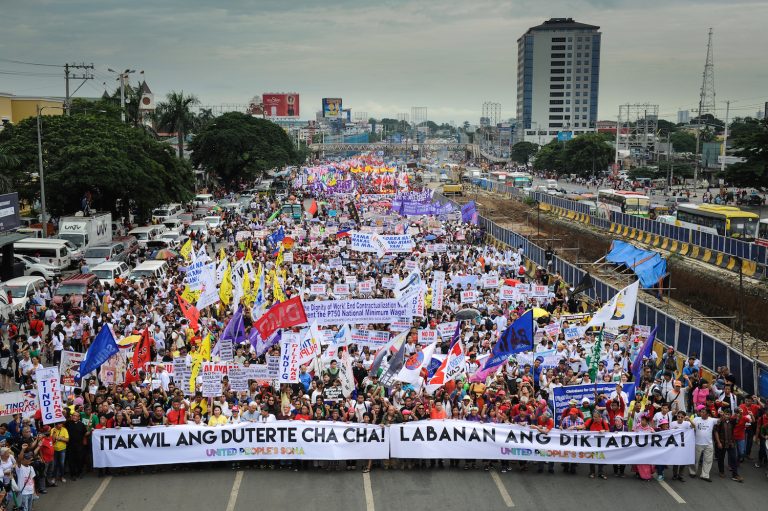
On July 23, on the day the Philippine President delivered his third annual socio-economic report, thousands of people took to the streets to show the real state of the nation.
Dubbed the United People’s SONA, groups from different political affiliations, including those from the worker, peasant, church, youth, and indigenous sector, marched along Commonwealth near Batasang Pambansa where Duterte gave his speech.

We asked one very simple question to the people we interviewed: “Bakit ka sumama sa protesta para sa SONA ni Duterte?”

Pepito Mendoza, 65, magsasaka
“Umaasa akong makarinig ng magandang balita.”

Nieves, myembro ng Pamalakaya National Federation of Small Fisherfolk Organizations in the Philippines
Doble ang hirap para sa mga kababaihan. Sila ‘yung taga-budget ng kita ng pamilya. Sa isang araw, may P185 o P200 ang madadala nila sa bahay nila . Itong mga munting sahod na matatanggap ng asawa nila tsaka ‘yung mga sariling kita ng mga maliliit na mga mangingisda, para magkatugma sa pangangailangan ng pamilya, ang nanay ‘yung naghahanap ng pantustos. Naglalabada siya, nagkakatulong siya o iniwanan ‘yung bata niya. Nagiging yaya siya sa ibang mga bata o nagtitinda-tinda, nag-aangkat ng isda, kung saan apektado rin sila sa konting kita sa mga mangingisda dahil maraming [kaagaw na] malaking vessels sa laot. Triple ang nararanasan nilang pagod.

Ka Wilmer, cargo forwarder sa Retiro
Nandito ako para ipakita kay Duterte na marami nang naghihirap sa kanyang administrasyon, lalo na mga manggagawa. Hindi niya tinupad ang kanyang pangako n’ung iluklok siya na wakasan ang endo. [Ngayon] lahat ng binoto siya ay hindi na sang-ayon, marami nang nagugutom, pinapayagan niyang itaas ang bilihin pero ang sahod ay makunat. Marami nang nagsasalita para alisin si Duterte.

Ka Maris, dating saleslady sa SM
Unang sabak ko sa pakikibaka ay noong 2003 na nag-strike ang mga manggagawa ng SM. Noong 1980s kung kailan nagsimula akong nag-sales lady sa SM, P19 lang ang arawang sahod. Isa ako sa 243 manggagawang tinanggal ng SM dahil sumama kami sa welga. Simula noong natanggal ako, nagpasya akong maging full-time na organisador ng mga manggagawa para ipaglaban ang kanilang mga karapatan sa paggawa. Kaya ako nandito ngayon.

Ka Sonny, Central Luzon Aeta Association
Kaya kami sumama dito para iparating ang aming mga isyung kinakaharap gaya ng Balog-Balog Dam, New Clark City, Aboitiz Power Plant, at y’ung pagtambak ng sundalo sa amin sa Tarlac sa Balog-Balog, ang 50th IB at 48th IB ng AFP. Kaya sumama kami dito para ipanawagan sa Presidente na palayasin ang mga militar sapagkat nakakasagabal sa aming mamamayang katutubo ang mga sundalo.

Segundo Melung, Lumad mula sa Mindanao
Isa sa mga ipinaglaban namin ay ‘yung ipahinto na ‘yung martial law sa Mindanao. Sobrang naaapektuhan ‘yung mga kababaihan doon sa amin kase binabastos sila ng mga military.

Manilyn Gantangan, 18, Grade 10 student sa eskwelahang Lumad
Isa akong estudyante na sumama [upang] iparinig at makiisa sa pakikipaglaban ng pambansang minorya para ipanawagan kay Presidente Digong na sana po patalsikin na siya sa kanyang posisyon. Nananawagan din kami na suportahan ang mga Lumad schools at itigil na ang martial law sa Mindanao.

Nanette Castillo, mother of Aldrin Castillo who was killed in Oplan Tokhang
Nanette addressed the crowd together with other mothers whose children lost their lives to the government’s war on drugs.
Buhay pa ba tayo? [Crowd answers back]. Pero araw-araw pinapatay nila ang mga anak at asawa namin. Kami ay nabibilang sa mga maralitang lungsod. Kabilang kami sa nahihirapan sa pagtaas ng mga bilihin, lalo na sa pagpataw ng TRAIN. Karamihan sa amin ay nagtitinda, construction worker, namamasura, naglalabada. Alam namin ang kahulugan ng kahirapan at kagutuman. Pero imbes na droga, mga anak namin ang pinapatay sa gera kontra-droga.

Ka Jimmy, 78, jeepney driver
Gusto ni Duterte na i-phase out ‘yung mga jeep namin. ‘Pag wala na kaming jeep, wala na kaming imamaneho, wala na kaming hanapbuhay. Marami na siyang napatay na mga adik, puro adik na lang pinapatay niya pati tambay. Pati kami malapit na rin niyang patayin. ‘Pag wala na kaming jeep, papatayin na niya kami.

Cleo, senior citizen
Yung pinagawang pabahay ng NHA [National Housing Authority] doon sa amin nakatiwangwang nalang, ngayon hinihiling nalang namin na ipamahagi na lang sana sa mga mahihirap na mamamayan o ibigay na lang din siguro sa amin sa mababang presyo, ‘yung kaya lang namin sana. Dalawang taon na namin ‘yan nilalakad, napirmahan na ng presidente. Ngayon pagdating sa NHA pinagpasa-pasahan na lang kami, nakarating na kami NHA main, NHA Bagong Silang, NHA ng Bulacan. [Sabi ng NHA], ‘Punta muna kayo doon, punta muna kayo dito’. Hindi nila pinakikinggan yung hinihiling namin.

Cynthia N. Rejidor, 66, naninilbihan sa St. John Mary Vianney, Antipolo
Kaya ako sumama dahil napagmasdan ko ang mga kamaliang ginagawa ng kasalukuyang gobyerno lalo na ang mga taong pinapalayas sa kani-kanilang lupa. Ako naman, bilang taga-simbahan, nagkampo kaming lahat, pati pari at saka mga mananalangin dahil minura ni Pangulong Duterte ang Panginoon. ‘Yun ang dahilan, kaya, fight!

Mimi Alipio, peasant advocate
Gusto kong makiisa sa laban ng mga magsasaka. At ibalita rin sa mga kababayan natin na maraming bilang na ng magsasaka ang namatay sa administrasyong Duterte. Nandito rin ako para ipaglaban ang solidarity para sa iba’t ibang sectors.
The question may have been plain and straightforward, but the answers we received are not.
In the two years since Duterte took oath, 163 people have become victims of political killings. Of this number, 106 come from the indigenous and peasant sector in Mindanao as leaders of national minority groups forward their fight against plunder of their ancestral domain to favor international mining corporations.

The government’s war against illegal drugs continues to target the poor as the number of dead has reached 23,000. Duterte himself said in his SONA that the war on drugs is “far from over” and that it will be “relentless” and “chilling”.

The media is not safe, either; 12 journalists have been killed in the line of work under the Duterte administration.
Labor leaders, church workers, and activists who were illegally and arbitrarily arrested number 509, with 179 arrested under Duterte.

Almost 500,000 peasants and indigenous people have been uprooted from their communities because of heavy militarization in their communities.
The numbers are still increasing, and many cases remain unreported.
On the economic front, most workers are still on contractual basis. Jollibee Foods Corporation hires 14,000 contractual employees while PLDT has 8,000 which, only very recently, the two companies dismissed to circumvent the labor department’s orders to regularize the workers.

Duterte remains defensive towards the government’s tax reform program, despite many poor Filipinos trying to cope with rice shortage and high prices of food and fuel products.

Three Supreme Court petitions have been submitted so far to stop the implementation of the Tax Reform for Acceleration and Inclusion Law, while Duterte in his SONA hopes to sign Package 2 before the year ends.
No, the reasons why tens of thousands attended the protest can never be simple. As Bagong Alyansang Makabayan’s Renato Reyes said:
Nandidito tayo hindi lamang para sa ating mga sarili. Nandidito tayo para sa mga hindi makapunta dito sa Commonwealth. Nandidito tayo, tumitindig, para sa mamamayan ng Marawi na nadurog ang kanilang kabuhayan at mga buhay. Nandidito tayo para sa daan-daang mga Lumad na mga bakwit, hindi makabalik sa kanilang mga komunidad dahil sa militarisasyon. Nandidito tayo para kay Sister Patricia Fox na pinapalayas ng gobyernong ito. Nandidito tayo para sa 500 mahigit na political prisoners na nakakulong dahil sa mga gawa-gawang kaso. Nandidito tayo para sa mga kamag-anak ng mga biktima ng extrajudicial killings na hindi natin makasama, pero kaisa natin sa labang ito.
If the price of progress in the eyes of the government is bloodshed and suffering, then for the people it is dissent right in the face of tyranny.

The post IN PHOTOS: State of the Nation appeared first on Manila Today.
Arroyo’s rehabilitation an insult to victims–groups
Families of victims of human rights violations under the Gloria Macapagal Arroyo government slammed the newly-installed House of Representatives Speaker, saying she is still accountable for the many atrocities from 2001 to 2009. Angered at the complete rehabilitation of Arroyo’s political career, the families said her comeback is an insult to the victims and to […]
Karapatan: Corrupt, shameless Arroyo belongs in jail, not as house speaker
“Lest we forget that the murderous Arroyo regime is responsible for 1,206 extrajudicial killings during her 9-year term, 204 enforced disappearances and thousands of illegal arrests, appointing her as the new House Speaker will pave the way for more repressive legislation that will further justify rights violations. It will be a gross injustice to all victims of rights abuses under her term – a testament to the prevailing climate of impunity so fervently preserved by President Duterte,” said Karapatan Deputy Secretary General Roneo Clamor.