Home Blog Page 88

Top universities denounce red-tagging of schools

0

Jan 24, 2021, Rappler.com

Four of the Philippines’ top universities denounced on Sunday, January 24, the latest red-tagging effort against them by the spokesperson of the government task force against communists.

In a joint statement, leaders of the Ateneo de Manila University (ADMU), De La Salle University (DLSU), Far Eastern University (FEU), and University of Santo Tomas (UST) took issue with Lieutenant General Antonio Parlade Jr of the National Task Force to End Local Communist Armed Conflict (NTF-ELCAC).

Parlade tagged them on Saturday, January 23, as among the 18 schools that he claims are “recruitment havens for the New People’s Army.”

Parlade claimed that the 18 are in the same ranks as the University of the Philippines (UP). His statement came more than a week after the Department of National Defense (DND) on January 15 unilaterally ended an accord with UP over supposed communist recruitment activities in the country’s premier state university.

In their joint statement, the 4 schools objected to Parlade’s statement red-tagging them. “This charge, though, is really ‘getting old’ – a rehash of the public accusation the general made in 2018 – irresponsibly since cast without proof,” the schools’ joint statement read.

The 4 schools also asserted that they “value the Filipinos’ basic constitutional rights of speech, thought, assembly, and organization.”

“As universities with high aspirations for our country, we seek to direct our students to engage in acts that contribute to the strengthening of social cohesion, defend the country’s democratic institutions, and promote nation-building,” they continued. 

They also stressed that they “must retain independence and autonomy from the State and other social institutions.”

“We therefore object to General Parlade’s statement and emphasize that our institutions neither promote nor condone recruitment activities of the New People’s Army and, indeed, of any movement that aims to violently overthrow the government,” the 4 universities said.

They also said they uphold their responsibilities “to promote learning and safeguard the rights of the young who are entrusted to our care.”

The joint statement was signed by ADMU president Father Roberto Yap, SJ, DLSU president Brother Raymundo Suplido, FSC, FEU president Dr Michael Alba, and UST vice rector Father Isaias Tiongco, OP.

‘Giving AFP a bad name’

Like these 4 universities, government critics continued to denounce red-tagging, as well as the Duterte government’s decision to end the UP-DND accord.

Opposition Senator Francis Pangilinan slammed the military on Sunday for involving itself in red-tagging some prominent personalities from UP.

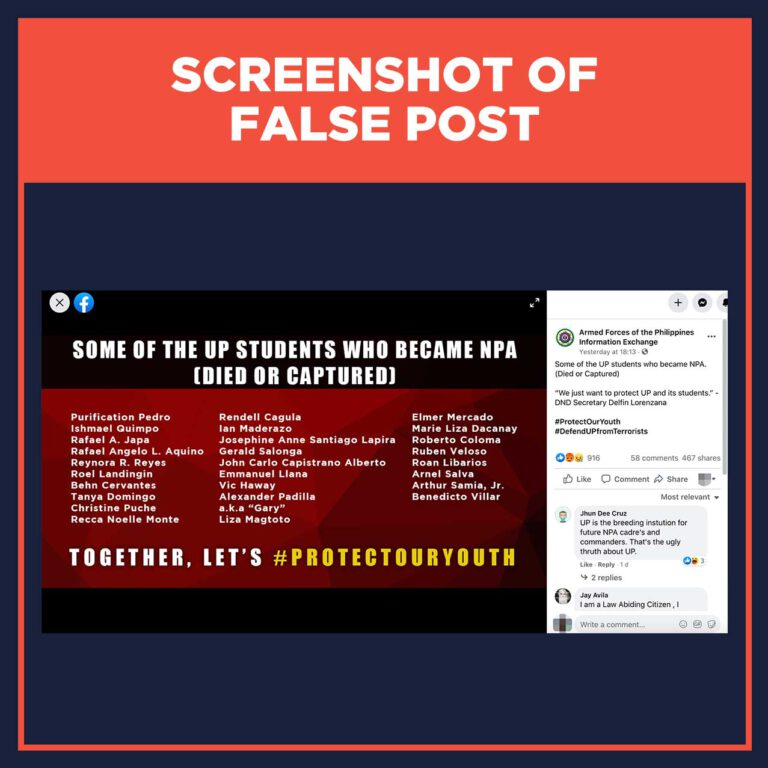
A viral post late last week by Facebook pages that identified themselves as connected to the Armed Forces of the Philippines (AFP) listed down UP alumni who supposedly joined the NPA and later died or were captured. Rappler, in a fact check, rated this claim as false.

“It is sad that some in the AFP are giving the institution a bad name and tainting its professionalism,” Pangilinan said in Filipino. He also warned that falsely labeling people “makes them target of harassment and worst, killings.”

“We cannot afford to have a politicized and unprofessional AFP. Let us not forget that it was the glaring lack of professionalism in the AFP that caused it to turn against itself during the last years of the Marcos regime,” he said.

Vice President Leni Robredo also urged dialogue between UP and AFP. In her weekly radio show on Sunday, Robredo said the AFP’s actions on UP and other groups are “not helping its image.”

Sana pag-usapan muna. Magkaroon ng agreement. Kung mayroong basehan iyong kanilang reklamo, sana i-present ito sa UP community, i-demand sa UP community na, alam mo iyon, pagtulungan, pagtulungan iyong mga problema na nagbe-beset sa atin. Pero huwag naman, huwag naman iyong parang kalaban, kasi hindi naman tayo magkakalaban,” the Vice President said.

(I hope they discuss it first, come up with an agreement. If the AFP’s claims have basis, I hope it’s presented to the UP community, then demand the UP community to work with them to solve the problem besetting us. Don’t treat them as enemies, because we’re not each other’s enemies here.) – Rappler.com
FALSE: List of dead, captured former UP students who became NPA

0

At least 8 of the people on the list are still alive, not captured, and have not been linked to the New People’s Army

At a glance:
  • Claim: A list of former UP students who joined the New People’s Army (NPA) are now dead or captured by the Armed Forces of the Philippines (AFP). 
  • Rating: FALSE
  • The facts: At least 8 people on the list are public figures who are still alive and have not been captured as members of the NPA. There have also been no official reports or proof that they were members of the NPA. 
  • Why we fact checked this: At least 12 Facebook pages that identify as linked to the military shared this list on Thursday, January 21. 
Complete details:

A list on the Facebook page “Armed Forces of the Philippines Information Exchange” names 27 people who are supposedly “UP [University of the Philippines] students who became NPA [New People’s Army] (died or captured).” 

The list was posted on Friday evening, January 22, and had at least 916 reactions, 58 comments, and 467 shares before it was taken down on Saturday morning. According to CrowdTangle data, there are at least 12 other Facebook pages that posted the same list on Friday. 

This claim is false. 

At least 8 names on the list are journalists, former government officials, lawyers, teachers, or entertainment personalities who are still alive and have not been captured as members of the NPA. They are the following:

  • Rafael Angelo L. Aquino is a partner of the Santos Parungao Aquino & Santos Law Offices and is a member of the Free Legal Assistance Group (FLAG). 
  • Roel Landingin is a business journalist and was formerly editor-in-chief of the magazines Forbes Philippines and Entrepreneur Philippines. 

In a text message to Rappler, Landingin said that whoever posted the list should take it down and issue a public apology. “The post is patently false on all counts. I never became an NPA. Neither have I been captured. And I’m very much alive. Truth is, I have been working as an economic and business journalist for more than 3 decades now,” he told Rappler. 

  • Alexander Padilla was the former Philippine Health Insurance Corporation (PhilHealth) president and CEO. In a statement on Facebook, Padilla said:

“I am appalled and disgusted [at] how government cavalierly plays with the lives of innocent people on that list. As for me, I am not NPA, never been. I have not been jailed or captured, never have. I am not dead, obviously. But I am a proud UP graduate of the College of Law. I have served in government for over twenty years and even served as chair of the government peace panel negotiating with the CPP/NDF/NPA. With these baseless allegations and because of red tagging and the anti terrorism law, I am now anxious for me and for others on the list, whose lives are now placed in peril.”

  • Liza Magtoto is a playwright and a member of the Philippine Educational Theater Association (PETA). She is known for the comedy musical “Care Divas” and for “Rak of Aegis.”
  • Elmer Mercado was an Undersecretary for the Department of Environment and Natural Resources. On his LinkedIn profile, Mercado denied ever being a member of the NPA. 
  • Marie Liza Dacanay is the president of the Institute for Social Entrepreneurship in Asia (ISEA) and is a faculty member of Ateneo de Manila University. In a text message to Rappler, Dacanay said:

“I never became an NPA, I was never captured and I’m alive. I’m gravely concerned that an official AFP page is spreading false news. In the context of the unconstitutional provisions of the anti-terror law, I will not take this lightly as we need to make the AFP accountable for actions that are libelous and potentially endangering and wreaking havoc on the lives of individuals like me who are leading peaceful, meaningful lives as responsible citizens and advocates of democracy and sustainable development.” 

Dacanay also said that she is consulting her lawyer and organizations she leads on possible responses to the post, including legal action. 

  • Roberto Coloma is the Singapore bureau chief of Agence France-Presse. 
  • Roan Libarios is the founder and managing partner of the firm Libra Law. He has held a number of positions in the public sphere, including serving as president of the Integrated Bar of the Philippines from 2011 to 2013, vice governor of Agusan del Norte, and Agusan del Norte 2nd District congressman. He was also one of the members of the Consultative Committee formed by President Rodrigo Duterte to craft a new constitution for a federal system of government. 

Behn Cervantes died on August 13, 2013. He was an artist and activist who founded or was a founding member of the UP Repertory Company and PETA. He directed, acted, and produced plays, musicals, films, and documentaries, and has won numerous awards, grants, fellowships, and scholarships. He is recognized on the Bantayog ng mga Bayani (Monument to the Heroes) memorial as one of the individuals who fought against Martial Law and dictator Ferdinand Marcos from 1972 to 1986. 

There are no official reports or proof that these people were ever members of the NPA.

The pages that posted the list identified themselves as connected to the Armed Forces of the Philippines. The page that received the most interactions on Facebook was called “Armed Forces of the Philippines Information Exchange.” Other pages that posted the list were: 

  • Eastern Mindanao Command, AFP
  • Western Command Armed Forces of the Philippines
  • SecondtoNone Infantry Battalion
  • 9CMO Kaagapay Battalion Page
  • 141st CMO Special Enabler Company, 14CMOBn
  • 6th Civil Relations Group, Palawan
  • 12th Infantry “Lick ‘Em” Battalion 3ID PA
  • 77th Infantry “Don’t Dare” Battalion
  • 54th Engineer Brigade
  • 201st Infantry – Kabalikat Brigade, PA
  • 66th Infantry Kabalikat Battalion

The page “Conservatives of the Philippines” also shared the list, but it does not identify itself as connected to the military. – Vernise Tantuco/Rappler.com

Keep us aware of suspicious Facebook pages, groups, accounts, websites, articles, or photos in your network by contacting us at factcheck@rappler.com. Let us battle disinformation one fact check at a time.

Divert, repress, repeat

0

Editorial, Philippine Daily Inquirer / January 22, 2021

Why did Defense Secretary Delfin Lorenzana suddenly and unilaterally terminate the 31-year agreement between the University of the Philippines and the Department of National Defense that bars police and military forces from entering the state university without first notifying its officials?

The accord, signed in 1989 between then UP president Jose Abueva and former defense secretary Fidel Ramos, was meant to protect students in the university from government forces. This came after a Philippine Collegian staffer, Donato Continente, was abducted by the military for his alleged role in the killing of US serviceman James Rowe. Following his release after 14 years in prison, Continente said he was severely tortured to admit to the crime.

In his letter to UP president Danilo Concepcion, Lorenzana characterized the agreement as “a hindrance in providing effective security, safety, and welfare of the students, faculty, and employees of UP.”

Claiming that UP has become “a safe haven for enemies of the state,” he cited—without presenting proof—“an ongoing clandestine recruitment inside UP campuses nationwide for membership in the Communist Party of the Philippines/New People’s Army.” Armed Forces of the Philippines spokesperson Maj. Gen. Edgard Arevalo also brought up the administration’s most convenient and overused bogey: the war on drugs. “What if there’s a shabu lab in UP?” he asked—a claim quickly laughed off by those who had occasion to use the university’s shoddy and severely underfunded laboratories as part of school requirements.

Although Lorenzana gave the assurance that the military and police have no plans to build stations or outposts inside UP, or “to suppress activist groups, academic freedom, and freedom of expression,” his words are understandably met with skepticism, given the state forces’ already spotty record of honoring the accord in previous years. In 2015, six men believed to be military agents were caught on campus; they were said to be surveilling the lumad solidarity event preparations then. In June last year, police arrested three students and five other individuals inside the UP Cebu campus who were protesting the anti-terror bill; the cops said they were violating social distancing, but then bundled them off to the precinct inside a cramped police vehicle.

UP chancellor Fidel Nemenzo described academic freedom as “the lifeblood of UP” that “has propelled (the) university into path-breaking areas of research and discoveries across various fields and disciplines.” Academic freedom, he said, has allowed UP to do what it does best: “to nurture young minds to dream and think big for our country, to be mission-driven and service-oriented. This is why we must defend, and will defend UP as a zone of free thought and free speech.”

UP’s most recent international ranking—65th among the 489 universities in Asia as evaluated by the Times Higher Education Asia University Rankings—also attests to the high quality of its achievements, pointed out Concepcion. “That performance, Mr. Secretary, is the result of its exercise of academic freedom—the freedom to think, to probe, to question, to find and propose better solutions.”

Lorenzana said he was open to meeting Concepcion to discuss the matter, but first, he demanded that the UP official explain why some UP students have allegedly ended up rebels and been killed in encounters with the military. An absurd proposition: What students of legal age do with their lives and abilities is ultimately their own business. Why should their decisions and fates outside of school be UP’s accountability? By that logic, would Lorenzana also explain and take responsibility for why the Philippine Military Academy has produced its considerable share of corrupt law-enforcement officials, plunderers, human rights violators, coup plotters, etc.?The defense chief’s decision to terminate the agreement at this time, and without warning to the other party, smacks of yet more diversion and repression: Public sentiment is simmering over the government’s inept handling of the COVID-19 pandemic and vaccine response and many other persistent issues: the rot in PhilHealth, the draconian anti-terrorism law, the revived Cha-cha attempt, the unabated killings and impunity among the police.

Against these rampant social ills, young Filipinos—UP students, particularly—have been among the fiercest, most vocal objectors. Tearing up the UP-DND accord not only throws up a smokescreen for the administration’s misdeeds, but may now also signal open season for state forces to intensify targeting dissenting voices and critical thought in the country’s campuses. But, as netizens have wondered: Why is Lorenzana looking for communists inside UP, when they’re all over the West Philippine Sea and, nearer to home, are already building telecom towers inside the military’s own backyard?

UP president challenges AFP claim on Reds’ campus infiltration

0

By: Katrina Hallare – Reporter/INQUIRER.net /January 23, 2021

MANILA, Philippines — University of the Philippines (UP) president Danilo Concepcion on Saturday said the Armed Forces of the Philippines’ (AFP) allegation that some of the university’s colleges, units and offices have condoned the “infiltration” of communist rebels lacks evidence and serves as an unnecessary distraction. 

 “The UP administration is unaware of and has received no specifics regarding these recent allegations and the circumstances surrounding them,” Concepcion said in a statement posted on the university’s official website. 

Concepcion added that the UP community is willing to sit down with authorities to discuss the facts, as well as to cooperate with them “ through the proper legal procedures for their resolution.”

“As it stands now, these allegations, lacking as yet any factual evidence, serve as unnecessary distractions for both UP and the AFP at a time when there are far greater crises, including a global pandemic, confronting us,” the UP president said. 

AFP Southern Luzon Command chief Lt. Gen. Antonio Parlade Jr., who is also spokesperson of the National Task Force to End Local Communist Armed Conflict, previously alleged that some members of the UP community have been helping to prepare “for some activities in the underground” like anniversaries of the New People’s Army, the armed wing of the Communist Party of the Philippines.

Parlade, without presenting evidence, also alleged that the military is also aware the UP community members have been providing materials for propaganda “to destroy the government and bring down the government like printing materials for making bombs.”

This, he said, are violations of the anti-terror law taking place at the UP campus. 

“The University of the Philippines is, has always been and will continue to remain a safe space for free thought and expression, intelligent criticism and dissent,” Concepcion said. 

“This, too, is in accordance with the law of the land. While we will continue to work with the AFP, the PNP and other government agencies to achieve our common aspiration to improve the lives of the Filipino people, we will also continue to defend UP from all attacks and machinations against our academic freedom and to uphold the safety and freedom of all the members of our community,” he added. 

“Again we do not condone violence, terrorism, or coercion as a means of political action from whatever source or for whatever purpose. We call on the military and police leadership to engage with UP and other universities in a constructive dialogue on the issues involved in these allegations, to dispel their chilling effect and encourage trust and confidence in our uniformed services,” said Concepcion.

House bill to apply ‘UP-DND Accord’ to all SUCs filed

0

By: Neil Arwin Mercado – Reporter /INQUIRER.net /January 21, 2021

MANILA, Philippines — A bill that would essentially make the recently terminated University of the Philippines-Department of National Defense (UP-DND) Accord applicable to all state colleges and universities (SUCs) in the country has been filed in the House of Representatives.

Quezon City 6th District Rep. Kit Belmonte filed Thursday House Bill No. 8443 or the Academic Freedom Act of 2021, which seeks to “strengthen and uphold the freedom of teachers and students to teach, study, and pursue knowledge and research without unreasonable interference or restriction in all state universities and colleges.”

Under the bill, no member of the government’s uniformed personnel may enter premises of any SUCs except only in cases of hot pursuit and similar occasions of emergency, or in cases of ordinary transit through the premises.

The proposed law adds that the conduct of any operation by members of the government’s security personnel may be allowed only upon prior coordination with the administration of the SUC.

It likewise states that serving of search warrants or warrants of arrest on any SUC student, faculty, employee, or invited participant in any official SUC activity shall, as far as applicable, be done after prior notification is given to the proper SUC official.

“In case of prior notification, the party serving the warrant shall coordinate closely with the members of the SUC police or security force who shall accompany and assist them in the service of warrants,” says Belmonte’s bill.

“Similarly, no warrant shall be served without the presence of at least two faculty members designated by the appropriate SUC official.”

Moreover, the proposed measure states that the arrest or detention of any SUC student, faculty, or personnel anywhere in the Philippines shall be reported immediately by the responsible head of the uniformed personnel enforcing the arrest or detention to the appropriate SUC official, who shall then take the necessary action.

“No SUC student, faculty or employee shall be subjected to custodial investigation or detention without warrant of arrest under the Anti-Terrorism Act of 2020 without, as far as practicable, prior notice to the appropriate SUC official, and except in the presence of the counsel of choice of the student, faculty or employee, or with the assistance of a counsel appointed for them by the said SUC official,” the lawmaker’s proposal states.

Since the bill wants to declare SUCs as “freedom parks,” no permit shall be required by the national or local government for any person or persons to organize and hold a public assembly within SUCs.

“Uniformed personnel shall not interfere with peaceful protest action by SUC constituents within SUC premises,” it says.

Belmonte said in a statement that the right to protect the freedom of speech should not be limited only to UP.

“Bakit natin ili-limit sa UP? This freedom, the right to protect our freedom of speech, our academic freedom – dapat available po sa lahat itong mga prinsipyo na ito. Dapat isama na ito sa mga mandate ng state universities,” he argued.

Belmonte filed House Bill No. 8443 after the DND unilaterally terminated the agreement with UP prohibiting any military and police presence inside its campuses without prior notice.

In a letter to UP President Danilo Concepcion dated Jan. 15, Defense Secretary Delfin Lorenzana said the agreement had been a hindrance to operations against communist rebels, especially the supposed recruitment of cadres in UP.

In response, Concepcion said the unilateral termination of the pact was totally unnecessary, adding that it may worsen, rather than improve, relations between the institutions.

“History tells us, repression breeds resistance. With the unilateral termination, lalo lang nila papalakihin ang problema instead of solving it,” Belmonte said.

‘Not the time to forget’: UP chancellors push back on DND ending of 1989 accord

0

Christian Deiparine (Philstar.com) – January 19, 2021

MANILA, Philippines — Chancellors of different University of the Philippines campuses pushed back on the defense department’s termination of the accord barring state forces in their schools, urging government to rescind the widely criticized decision.

The DND’s move this week had been an apparent culmination of the Duterte administration’s repeated yet unproven claims that the state-run institutions are being used to recruit students to the armed communist movement.

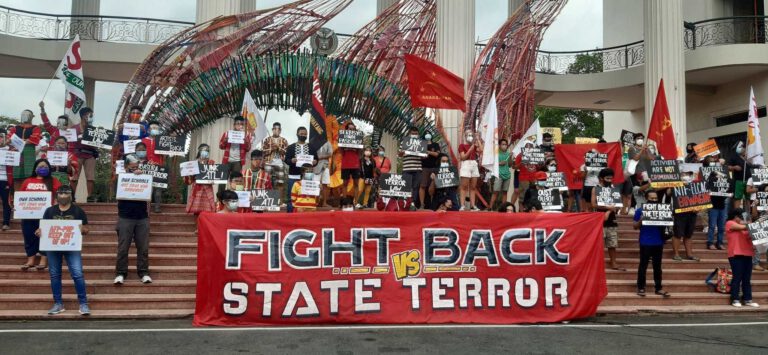
Students earlier today trooped to the Diliman campus to protest the nixing of the decades-long accord, first signed in 1989, that prohibits military and police from entering their grounds without prior notification from university officials.

In a statement, UP Diliman Chancellor Fidel Nemenzo said the DND’s claim about communist recruitment in campuses need concrete proof and “are not grounds to cancel an agreement founded on a constitutional right,” adding that academic freedom may face threat with the accord ending.

“Academic freedom has allowed us to do what we do best: to nurture young minds to dream and think big for our country, to be mission-driven and service-oriented,” he said. “This is why we must defend, and will defend UP as a zone of free thought and free speech.”

He added: “This year we commemorate the 50th anniversary of the Diliman Commune; next year is the 50th anniversary of the imposition of martial rule. It is not the time to forget.”

Several lawmakers who graduated from UP have since aired their opposition on the move, with members of the upper chamber formalizing their opposition through a resolution.

But it remains unclear if the DND would take back its decision, especially with the Palace saying it had the backing of President Rodrigo Duterte, who himself had said that the university is a breeding ground for communists.

In November last year, the president also threatened to defund UP on misguided claims that it was their students who called for an academic strike over government’s handling of recent typhoons that affected millions and left scores dead.

The Commission on Higher Education has also so far kept mum on the issue, despite its chairman Prospero de Vera III, who had taught in UP, sitting as the de facto chairman of the UP Board of Regents.

In UP Visayas, Chancellor Clement Camposano said cases of government troops involved in cases of human rights abuse “cannot but leave us unassured” that rights and freedoms would indeed be honored, as claimed.

“Historical events that have shaped the relationship of UP and the country’s security forces—many of these leaving wounds that have yet to heal—explain the university’s strong apprehension,” he said.

UP Cebu Chancellor Liza Corro cited too the intimidation, threats and red-tagging students had experienced, including the arrests made in June 2020 when police forcibly entered the campus despite the accord still in place then.

While in UP Los Baños in Laguna, Chancellor Jose Camacho Jr. described the abrogation as “an assault against the freedom of UP as an institution.”

He said that in the past, the university had cooperated with government on enforcing laws, hence the accord is not a hindrance to implementing order.

“As a bastion for the expression of ideas, ideals, and advocacies and as a sanctuary for the exercise of our cherished rights and freedoms, UP is hallowed ground for activism and dissent, not rebellion,” he said.

Nixing the agreement followed after the CPP-NPA was designated as a terrorist organization by the unelected Anti-Terrorism Council, formed under the highly controversial Anti-Terror Law which faces 37 petitions before the Supreme Court to strike it down as unconstitutional.

The deal, signed in 1989 between then UP President Jose Abueva and then defense chief Fidel Ramos, holds that military and police cannot enter any UP campus “except in cases of hot pursuit and similar occasions of emergency” or when assistance is requested by university officials.

Incumbent UP President Danilo Concepcion has since said that the scrapping of the pact is “unwarranted” and could only stir confusion and mistrust.

Samsung chief jailed for 2.5 years over corruption scandal

0

Agence France-Presse/January 18, 2021

SEOUL — The de facto chief of South Korea’s Samsung business empire was convicted Monday over a huge corruption scandal and jailed for two and a half years, in a ruling that deprives the tech giant of its top decision-maker.

Lee Jae-yong, vice-chairman of Samsung Electronics, the world’s biggest smartphone and memory chip maker, was found guilty of bribery and embezzlement in connection with the scandal that brought down president Park Geun-hye.

Lee “actively provided bribes and implicitly asked the president to use her power to help his smooth succession” at the head of the sprawling conglomerate, the Seoul Central District Court said in its verdict.

“It is very unfortunate that Samsung, the country’s top company and proud global innovator, is repeatedly involved in crimes whenever there is a change in political power.”

It jailed him for two and a half years, concluding a retrial that was the latest step in a long-running legal process that has hung over Samsung for years.

The multi-billionaire Lee — who had earlier walked into court grim-faced and wearing a facemask, without responding to reporters’ shouted questions — was immediately taken into custody.

He has effectively been at the head of the entire Samsung group for several years after his father was left bedridden by a heart attack, finally dying in October.

“This is essentially a case where the freedom and property rights of a company were violated by the former president’s abuse of power,” Lee’s lawyer, Lee In-jae, told reporters.

“Given the nature of the matter, I find the court’s ruling regrettable.”

Samsung is by far the biggest of the family-controlled conglomerates, or chaebols, that dominate business in the world’s 12th-largest economy.

Its overall turnover is equivalent to a fifth of the national gross domestic product and it is crucial to South Korea’s economic health.

Its rise has been driven by a willingness to invest billions in strategic bets on key technologies.

But experts say the sentence will create a leadership vacuum that could hamper its decision-making on future large-scale investments.

“It’s really a huge blow and a big crisis for Samsung,” said Kim Dae-jong, a business professor at Sejong University.

Samsung Electronics, the group’s flagship subsidiary, declined to comment on Monday’s ruling.

Like many tech firms, its shares have risen significantly during the coronavirus pandemic, more than doubling from their lows in March, but closed down 3.4 percent on Monday.

Public apology

The case centers on millions of dollars the Samsung group paid Park’s secret confidante Choi Soon-sil, allegedly for government favors including ensuring a smooth transition for Lee to succeed his then-ailing father.

The scandal highlighted shady connections between big business and politics in South Korea, with the ousted president and her friend accused of taking bribes from corporate bigwigs in exchange for preferential treatment.

Lee was first jailed for five years in 2017, after Park’s ouster.

He walked free the following year when an appeals court dismissed most of his bribery convictions and gave him a suspended sentence, but the Supreme Court later ordered the 52-year-old to face a retrial.

In May, Lee made a rare public apology, bowing before flashing cameras for company misconduct including the firm’s controversial plan for him to ascend to the leadership.

His own children, he promised, would not succeed him in top management roles at the company.

Both Lee’s father Lee Kun-hee and grandfather — Samsung founder Lee Byung-chull — had brushes with the law themselves but never served time behind bars.

In the past, leaders of South Korean conglomerates convicted of crimes such as tax evasion or bribery have been given presidential pardons in recognition of their economic role.

The Federation of Korean Industries said in a statement: “Considering Samsung’s share of the Korean economy and its status as a global company, the ruling is feared to have a negative impact on the overall Korean economy.”

Lee, it added, “has been helping to sustain the Korean economy by spearheading bold investment and job creation amid the economic crisis over the coronavirus”.

Earlier this month, Samsung Electronics flagged a jump of more than 25 percent in fourth-quarter operating profits, citing benefits from pandemic-induced working from home that boosted demand for devices powered by its chips.

Analysts forecast a stable outlook for the company in 2021, driven by continued demand for memory chips. (From Inquirer.Net)

Ang babala ng atake sa Capitol Hill para sa mga Pilipino

0

Editorial, Jan 18, 2021, Rappler.com

Hindi nagulat ang mga taga-Rappler na nagsasaliksik ng  disinformation sa nangyari sa Capitol Hill sa Washington DC nitong Enero 7.

Totoong nakagigimbal makitang sinusugod ang Capitol Hill, ang tahanan ng US Congress, ang pugad ng demokrasya ng bansang Estado Unidos, na de facto lider naman ng kilusang demokratiko sa buong mundo. Mas nakagigimbal na sinusugod ang kapitolyo ng mga supporter ng nakaupong Presidenteng si Donald Trump.

Tumawid sa tunay na buhay

Pero hindi rin nakagugulat sa isang banda. Ito ang lohikal na patutunguhan ng pagkabiyak ng lipunang America.

Ano ang nangyari sa Capitol Hill at bakit mahalagang maintindihan ito ng mga Pilipino?

Ayon kay Kate Starbird, isang eksperto sa disinformation at propesor sa University of Washington, ito ay “online hate transforming into real-world violence” o ang pagtawid ng poot sa online at pagsalin nito sa karahasan sa tunay na buhay.

Ayon kay Starbird, ito ang pagsasama-sama ng iba’t ibang mga grupo: QAnon, mga aktibistang pro-Trump, right-wing militias, at white nationalists sa ilalim ng bandila ni Trump.

At bihasa si Trump sa pagsasamantala ng sama ng loob ng mga tao at paano ito gagamitin sa kanyang agenda.

Halimbawa na lang ang grupong QAnon. Ito ang grupong naniniwalang may engrandeng conspiracy ang mga umano’y sumasamba kay Satanas at mga pedopilya sa gobyernong US. Naniwala rin ang grupo na si Trump ang sugo na nagsusulong ng sikretong gyera laban sa mga kampon ng kadiliman.

Salamin, salamin

Kaya niyo ‘yun, mga Duterte Diehard Supporters (DDS)? Taob ba kayo sa teorya ng mga supporter ni Trump?

Napag-uusapan na rin lang ang mga DDS, ano ba ang link na nag-uugnay kay Trump at Presidente Rodrigo Duterte?

Pareho silang eksperto sa personality politics, oo, pero ang secret sauce nila ay ang social media.

Ginamit ni Trump at ng Russia ang mga mapanlinlang na balita upang imanipula ang eleksyon ng 2016 at talunin ang llamadong kandidato ng mga Democrats na si Hillary Clinton. Sa conspiracy theory na “pizzagate” na kakatwa sana kung hindi ito nagtagumpay, sangkot daw sa child sex ring si Clinton at mga Democrats at pronta nila ang mga pizza parlor.

Sa Pilipinas naman, social media ang nagpanalo kay Duterte at nagtaob sa partidong incumbent na mas may network at pera noong panahong iyon.

Pero hindi puwedeng simpleng sabihing “will of the people” o kagustuhan ng mga Pilipino ang nanaig sa eleksyon 2016 sa Pilipinas. Bakit napakabilis ng pagsikat ni Duterte simula ng 2015? 

Ayon sa whistleblower ng Cambridge Analytica na si Christopher Wylie, una nitong “petri dish” ang Pilipinas. Ang Cambridge Analytica ang consulting firm na nagmanipula sa sentimyento ng mga Amerikano sa 2016 elections gamit ang Facebook data. 

Pero kahit na wala na sa eksena ang Cambridge Analytica, hindi tumigil ang disinformation. Sa katunayan, hindi ang mga buwitreng tulad ng Cambridge Analytica ang ugat ng problema.

Mismong Facebook ang nagpapanatili ng aparato ng disinformation dahil krusyal ito sa kanilang business model o disenyo ng negosyo.

Eto ang sinasabi ng mismong dating investor sa Facebook at may-akda ng Zucked: Waking Up to the Facebook Catastrophe na si Roger MacNamee.

Sa isang panayam, ipinaliwanag niya ang negosyo ng mga higanteng social media platform tulad ng Twitter, YouTube at lalong-lalo na ang Facebook. “They do that by grabbing the attention of people…using emotionally inflammatory content.” Inaagaw nila ang atensyon ng mga tao gamit ang nakagagalit na content. Sa madaling salita, nanunulsol. Nang-uudyok. Nanggagatong. 

Sabi pa ni MacNamee, ito’y “core” sa negosyo ng Facebook.

Ayon mismo sa isang internal na pag-aaral ng Facebook, 64% ng mga sumali sa mga extremist na organisasyon sa US tulad ng QAnon ay naakit dahil inirekomenda ito ng Facebook.

Sabi ng mga nakakita ng mga slide ng pag-aaral, “Our algorithms exploit the human brain’s attraction to divisiveness.” Sinasamantala daw ng algorithms ng Facebook ang pagkahilig ng utak ng tao sa bangayan.

Pero isinantabi mismo ng Facebook ang sarili nitong pag-aaral na nagsabing pinapalala nito ang tribalismo at pagkakawatak-watak.

Bakit? Dahil oxygen ng Facebook ang pagrerekomenda ng galit at poot dahil ito ang mas madikit, mas mahilab, kaya’t mas nag-aakyat ng dolyar. 

Sabi nga ng CEO ng Rappler na si Maria Ressa, “Lies laced with anger and hate spreads fastest on social media.” Tila virus daw ang bilis makahawa ng kasinungalingan at poot sa social media.

Wala itong pinagkaiba sa isang drug dealer na nagtutulak ng droga.

‘Been there, done that’

Pero sa totoo lang, nauna na sa ganitong karanasan ang mga Pinoy.

Pamilyar sa atin ang pagsugod sa trono ng kapangyarihan. Noong 1986, sinugod ng taumbayan ang Malacañang upang mapatalsik si Pangulong Ferdinand Marcos. Nilooban ang Palasyo at maraming nanakaw na gamit at nawasak na kasangkapan. Pero tinawag itong “People Power.” Hindi naging malaking isyu ang panloloob sa Palasyo sa harap ng pagkalasing ng bayang nagpatalsik sa isang diktador.

Matapos ang EDSA Revolution, nagsalin ng kapangyarihan ang bayan mula sa isang grupong elitista papunta sa isa pang grupong elitista.

Nanumbalik lang ang katahimikan pero walang tunay na pagbabagong naganap at hindi rin naibsan ang ‘di-pagkapantay-pantay at kahirapan.

Naulit na naman ito sa EDSA Dos na nagpa-resign kay Presidente Joseph Estrada at EDSA Tres na isinulong naman ng mga supporter ni Estrada. Pero ‘di tulad ng unang EDSA uprising, tinawag ang EDSA Tres na “siege,” “riot,” at “insureksiyon.”

Walang shortcut

Hindi natin sasagutin kung bakit magkaiba ang turing ng kasaysayan sa dalawang pangyayari. Pero ipaaalala naming walang shortcut sa demokrasya.

Maliban diyan, kung meron mang dapat na take-away ang mga Pilipino sa nangyari sa Washington DC, ito’y ang pagpapakita ng kamandag ng disinpormasyon, at kung paano puwedeng tumawid ang poot sa online, papuntang tunay na buhay.

Sa katunayan, ito’y bagay na ipinagdarasal ng mga DDS upang maipakita nila ang kanilang asim. Maari itong mag-translate sa appointments, kontrata sa negosyo, at higit sa lahat, tagumpay sa eleksiyon.

Isang taon at kalahati na lang at nariyan na ang Mayo a-nuebe, 2022. Asahan nating titindi pa ang disinpormasyon. Titindi pa ang pambabaluktot at kasinungalingan.

Natawa ka ba o nanliit nang mabalitaang Pinoy ang may hawak na walis tambo na sumugod sa US Congress?

Ipinapakita ni Walis Tambo Boy at ng iba pang Fil-Am na sumugod kung gaano nakahahawa ang veerus ng disinformation at kung gaano kabulnerable ang mga Pilipino sa lengguwahe ng mga tulad ni Trump.

Ngayon pa lang, kumilos na tayong huwag mangyari sa Pilipinas ang nangyari sa Estados Unidos. Hindi lamang upang maiwasan ang isang riot, kundi upang muling mangibabaw ang katarungan at katotohanan. Rappler.com