Home Blog Page 97

Newspoint – Duterte’s desperate plot

0

‘By militarizing, terrorizing, and Red-labeling, Duterte hopes to create a climate of fear that would allow him to keep power or pass it on to a trusted successor in order to escape accountability for the crimes of his regime’

Dec 12, 2020, Vergel O. Santos

There’s every reason – much of it clinical, to be sure – to ascribe Rodrigo Duterte’s abnormal or extreme actions to his narcissistic personality and despotic disposition. The danger there lies in missing the method to his madness by taking his actions discretely.

Duterte is definitely no simple case. Not only does his condition transcend the psychological, it affects an entire nation. He happens to be President, and one backed by coopted institutions and enabled by a circle of sycophants similarly afflicted as he or looking to profit for themselves from his gangland-style leadership.

Duterte is not an individual case; he is one whole sick regime. And, if dire surprises are to be avoided, everything he does ought to be taken in that context.

When recently, for instance, Vice President Leni Robredo, whom he has sidelined from his presidency in great fear of her political possibilities, appeared in his hallucination riding a military cargo plane carrying aid to typhoon victims – a case of misappropriation in his presumptuously proprietary view – it did not signify a moment of pique or jealousy; rather, it betrayed a broad-based, farsighted conspiracy.

In fact, the conspiracy also connects to a more revealing, more dangerous, currently running Duterte hallucination – seeing Red everywhere. If the syndrome seems to surprise the communists themselves, it is likely because, in all their 3 quarters of a century of rebellion, they never found a more accommodating President than Duterte.

From the much publicized videophone conversations between the Filipino communist Supremo, Jose Ma Sison, speaking from exile in the Netherlands, and Duterte, calling from Manila at the height of his electoral campaign, their courtship looked hot, indeed. After taking office, President Duterte lost no time in sending off a panel to begin peace talks with Sison and his lieutenants, formally and in person. A diplomatic pivot from the United States, toward China, ideological model to the Philippine communist movement, seemed a nicely added, if vaguely intended, concession. Up to that point, Duterte looked the perfect courter of noble intentions.

Duterte is not an individual case; he is one whole sick regime. And, if dire surprises are to be avoided, everything he does ought to be taken in that context.

Alas, in his godless truth, China is one thing, the local communists another: the first a patron, the second a liability, coming handy only for propaganda. And so, while China continued to exert increasing influence over Duterte, the local communists steadily fell from favor with him.

Unable to get going from fits and starts, the peace talks finally collapsed, early this year, and the communists are on the run again. Duterte won’t be able to catch them, let alone stop them. No President, no one, has been able to, not even his idol, Ferdinand Marcos, with Martial Law.

But subduing the communists is not Duterte’s aim, really; they figure only as a pretextual component of a plot to keep himself in power or, at any rate, immune from retribution. The plot was actually foreshadowed by its two other, substantial, components.

Last July Duterte signed an Anti-Terrorism Act that defines the crime so abstractly one can get into trouble with it on the slightest suspicion. And even much earlier Duterte had begun to recycle newly retired military generals into the bureaucracy – around 60 of them, by one count, now occupy powerful civilian positions.

With a year and a half left of his 6-year term, Duterte must feel so anxious and harried he might settle for anyone he could pass off as a communist. Communist branding has in fact become so indiscriminate you can get it by heredity and other merely fortuitous connections. You become more susceptible if you stand to the left of Duterte’s fascist regime. In the worst case, as in a recent one that recalls his drug war, you could end up dead in your own home in a raid in the dead of night – incontrovertibly pronounced nanlaban.

Duterte has taken to branding even such legitimate players in democratic politics as those rights groups voted to Congress for party-list representation.

As the most familiar certified enemy, communism is worked as a bogey by desperate leaders. It affirms the usefulness of the military and the police. In Duterte’s regime particularly, it also makes them feel worthy of their doubled salary and his promise to protect them from prosecution.

By militarizing, terrorizing, and Red-labeling, Duterte hopes to create a climate of fear that would allow him to keep power or pass it on to a trusted successor in order to escape accountability for the crimes of his regime. Nothing is either new or unique in that strategy. But it held for Marcos – for 14 years. – Rappler.com

After Human Rights Day arrests, HRW says there is ‘damning history’ of cops planting evidence

0

Bella Perez-Rubio (Philstar.com) – December 12, 2020

MANILA, Philippines — The arrests of six trade unionists and a journalist in a single day —  and for the same charge — have been slammed by an international rights watchdog as being highly questionable.

“The accused claim that police planted evidence to justify the charges against them. It is critical that these allegations must be thoroughly and impartially evaluated by independent investigators,” Human Rights Watch deputy Asia director Phil Robertson said.

In chorus with other rights groups and lawyers, he noted that this is not the first time the Philippine National Police has been accused of planting evidence in order to justify arrest.

Illegal possession of firearms and explosives? From ‘drug war’ to activist arrests

“Human Rights Watch has previously documented illegal planting of evidence by police in cases of ordinary Filipinos gunned down by police in the government’s ‘drug war.’ There is also a damning history of such underhanded police actions against political activists that correctly arouse suspicions,” Robertson said.

In its March 2017 report on the Duterte administration’s campaign against illegal drugs, HRW said “police routinely planted guns, spent ammunition, and drug packets next to the victims’ bodies,” to justify their claims of self-defense in official reports.

These claims from the police, the New York-based rights monitor said, run “contrary to eyewitness accounts that portray the killings as cold-blooded murders of unarmed drug suspects in custody.”

A more recent June 2020 report from the Office of the United Nations High Commissioner for Human Rights found that “police repeatedly recovered guns bearing the same serial numbers from different victims in different locations,” which suggests “planting of evidence by police officers and casts doubt on the self-defense narrative, implying that the victims were likely unarmed at the time of killing.”

The national police’s own figures acknowledge around 8,000 “drug personalities” slain in official operations where cops routinely claim that only suspects who fought back were killed, though rights groups say the number may be as high as 30,000 deaths since Duterte’s “war” began in 2016.

Meanwhile, National Union of Peoples’ Lawyers president Edre Olalia also on Friday noted that illegal possession of firearms and explosives are the usual charges filed against activists and claimed that this is because it is a case that is the easiest way to lock up activists.

As of December 3, rights alliance group Karapatan said more than 400 political prisoners arrested under the administration of President Rodrigo Duterte are accused of these same charges.

“It is outrageous and unacceptable that the Philippines government is cracking down on political activists…This really highlights the Duterte government’s contemptuous attitude toward human rights and its confrontational stance against dissenters and political activists,” Robertson said.

Among those arrested on Thursday were trade union organizer Denisse Velasco and journalist Lady Ann Salem. Also arrested were Mark Ryan Cruz, Romina Astudillo, Jaymie Gregorio, Joel Demate and Rodrigo Esparago, whom Karapatan said were also labor organizers.

All seven of these individuals are accused of possession of firearms and explosives.

— with reports from Franco Luna and Kristine Joy Patag

Philippines sends fewest workers abroad in 24 years even sans jobs at home

0

Xave Gregorio (Philstar.com) – December 8, 2020

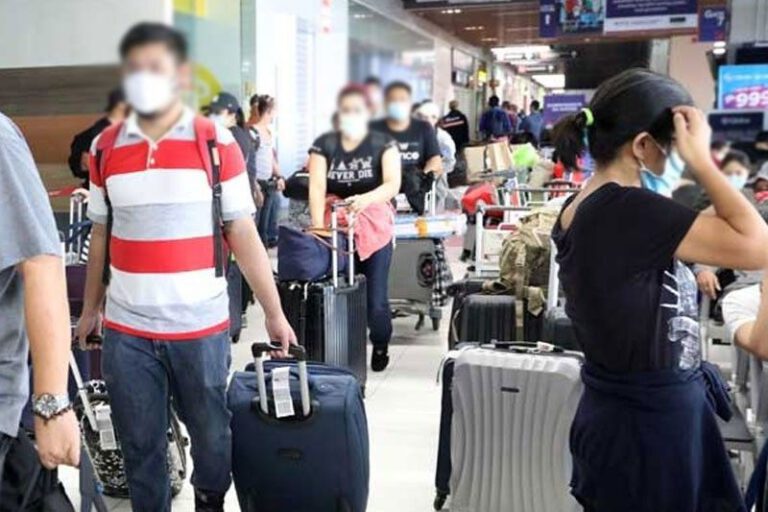
MANILA, Philippines — Even with no jobs at home, hiring of Filipino migrant workers is on track to its lowest level in nearly 3 decades due to sprawling lockdowns that stopped deployment, putting the Philippines’ main dollar source at risk of future decline.

From January to October, 693,237 overseas Filipino workers had been deployed, plummeting 60.8% from same period a year ago, preliminary data from the Philippine Overseas Employment Administration showed.

The latest tally is running at its lowest since 1996, a year before the Asian financial crisis, when yearend deployment registered 660,122. With only 2 months left to record, OFW placement is on track for its third slump in 4 years.

“The decreased deployments do not surprise authorities. Hurt also by this development is the recruitment industry, with reports that some of them have closed operations,” Jeremaiah Opiniano, executive director of the Institute for Migration and Development Issues, said in an online exchange.

The impact of lower OFW deployment is slowly revealing. Cash remittances from migrant workers declined 1.4% from January to September, hitting households dependent on these earnings hard, with their consumption down 8.7% in the same 9-month period.

Dismal deployment is also the reason analysts have remained pessimistic about remittances’ future trajectory despite inflows regaining some ground since June. The central bank believes the altruistic nature of inflows to families they support here would deliver the needed boost onwards, but Opiniano thinks OFWs are simply exhausting their savings.

“They had to send more now because the Philippine peso to the dollar appreciated from 50 to 48 during this pandemic! That alone, for me, indicates some measure of financial pressure and stress,” he said in an online exchange.

Alvin Ang, director of the Ateneo Center for Economic Research and Development, agreed and said “consumption (would be) slower” as remittances taper off in coming months. Consumption accounts for 70% of economic output, so further weakness on this front would only derail a rebound from 10% contraction in gross domestic product to date.

Re-migration or reintegration?

But in the long term, job losses among migrant workers are the bigger concern. As it is, OFW deployment is not going down because there are more jobs generated locally. In fact joblessness is still treading at record levels of 8.7% as of October, even as it already went down from a historic high of 17.7% in April.

Deployment is also not picking up despite economies reopening and government allowing health workers to fly out after prohibiting them to leave for months. Among those deployed as of October, land-based workers, which accounted for 63.8% of total, dropped a bigger 69% year-on-year to 442,071. 

On flip side, the number of seafarers went down a smaller 28.02% annually to 251,616 after monthly deployment reversed back to growth from July.

Opiniano is surprised sea-based workers have recovered quickly despite cruise ships where most of them are employed halting sails when cities closed down. That said, rehiring of existing OFWs also got stunted, cementing a bleak outlook for remittances. 

“New hires may not be able to remit right away since they may have borrowed money to finance pre-migration expenses,” he explained.

For the 320,000 OFWs displaced by pandemic, it’s hard to say for now how swift can they go back offshore, although better local jobs can prompt them to stay home permanently. “The infrastructure plan can create new jobs and in case those OFWs decide to stay, they will have more options,” Rong Qian, senior economist at World Bank local office, said in a briefing.

Labor export policy disrupted?

Policy-wise, Joanna Concepcion, chair at Migrante International, a labor group advocating OFW welfare, said the pandemic had only revealed the government’s problematic “long-standing policy” of exporting Filipinos. “(It) cannot guarantee long-term economic security for our migrant workers and cannot genuinely solve the economic and development problems facing our country,” she said.

The Philippine Overseas Employment Administration denied there is such a policy, even as it has persistently held job fairs showcasing overseas work opportunities. On top of that, President Rodrigo Duterte has pushed for the establishment of a sole agency to address OFW concerns, a move that would only institutionalize labor exportation only explored as band aid solution during the Marcos era.

“The Philippines cannot continue to be a remittance dependent country,” Concepion said in an email.#

Firearms and explosives raps easy way to lock activists up, NUPL says

0

Kristine Joy Patag (Philstar.com) – December 11, 2020

MANILA, Philippines (Updated 4:56 p.m.) — The number of activists charged with illegal possession of firearms and of explosives continues to rise with the arrest of six trade union organizers and a journalist on Thursday, on the International Human Rights Day.

National Union of Peoples’ Lawyers president Edre Olalia, in a post labeled as a legal opinion, noted that illegal possession of firearms and explosives are the usual charges filed against activists. He claimed that this is because it is a case that is easier to prove in court.

The NUPL is no stranger to handling cases against activists, as they have been providing legal services to the poor and marginalized sectors of society, including peasants, workers, indigenous peoples, activists, and the urban poor. They also represent political detainees, whom they say are facing spurious cases.

As of December 3, rights alliance group Karapatan said more than 400 political prisoners arrested under the administration of President Rodrigo Duterte are accused of the same charges.

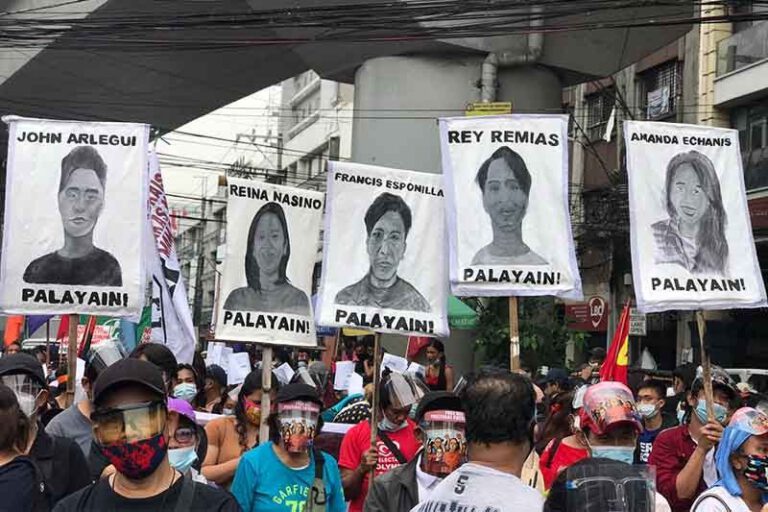
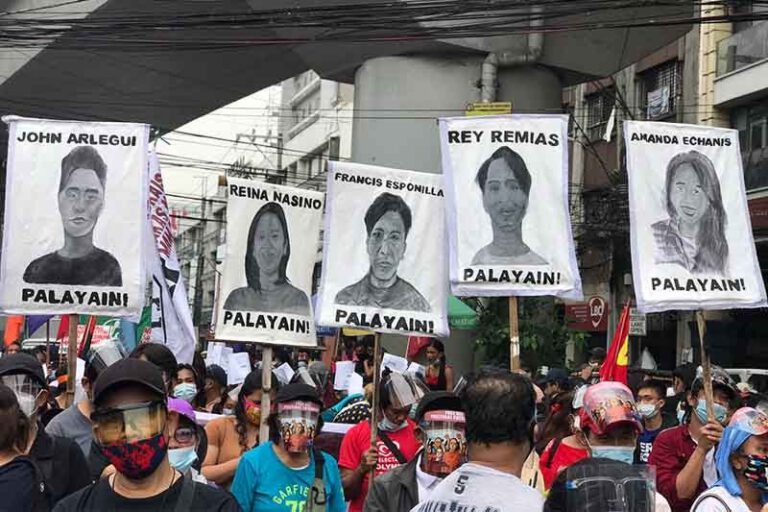
Peasant organizer Amanda Echanis, daughter of murdered peace consultant Randall, was arrested last week and charged with illegal possession of firearms and explosives—an accusation she and her lawyers decried as trumped up

On International Human Rights Day, the arrests continued: Trade union organizer Denisse Velasco and journalist Lady Ann Salem are among the latest to be accused of possession of firearms and explosives.

Also arrested were Mark Ryan Cruz, Romina Astudillo, Jaymie Gregorio, Joel Demate and Rodrigo Esparago, whom Karapatan said were also labor organizers. 

Procurement of search warrants

Velasco’s arrest was made following the implementation of a search warrant from Quezon City Judge Cecilyn Burgos-Villavert, Defend Jobs Philippines said.

Police Lt. Col. Arnold Moleta of the police’s Criminal Investigation and Detection Group said in an interview with ANC that Villavert also issued the search warrant implemented in the residence of Salem. According to a CIDG press release on Thursday, the five warrants that led to the arrest of the seven were all issued by the same judge.

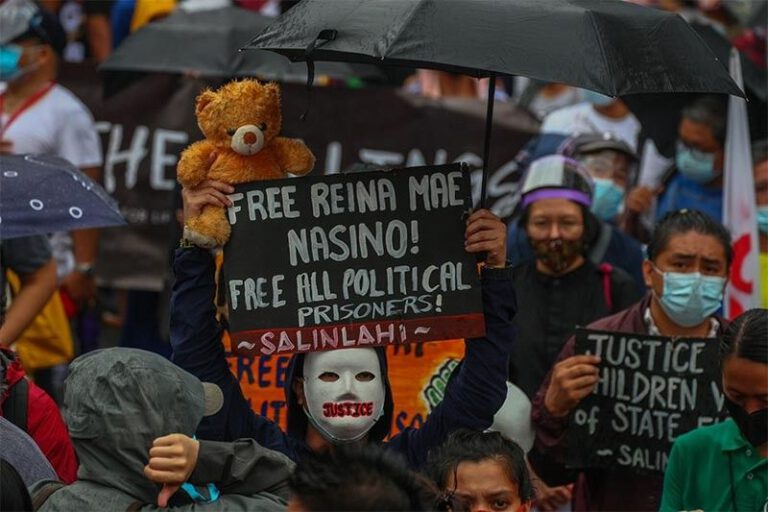
Defend Jobs, in its alert on Thursday, pointed out that Villavert is also the judge that issued search warrants in 2019 that led to the arrest of dozens of activists in Negros and Manila, among them Reina Mae Nasino.

Olalia explained that search warrants can be “procured by going through the motions and by mere presentation even under oath of supposed witnesses from authorities to claim that such materiel are supposedly in the possession of those to be arrested.”

Moleta however said that Salem had been under surveillance for at least two months before the arrest.

“[The] arrested people were linked to gun-running activities. There were a lot of times that those linked to gun-running went in an out of Salem’s home. I cannot say how many times, but [this happened] repeatedly,” he said, partly in Filipino, in an ANC tweet report.

Salem and Esparago were arrested in a condominium unit in Mandaluyong City.

Evidence ‘easy to plant’ too

Olalia added that under the same charge, evidence of firearms and explosives supposedly seized in the area are “easy to plant” too, noting that these materials are “monopolized by the police and military.”

He also noted that conducting operations at dawn or night, where the arrested persons are first “segregated, controlled or neutralized” and have no chance to witness the search make this easy.

NUPL’s Maria Sol Taule, in an earlier press conference, also noted how operations are usually done at night, to take advantage of the “nocturnity” in planting evidence.

Olalia also said: “The routinary legal presumption of regularity in the performance of official duty is always invoked against serious claims that these are planted and irregular.”

Non-bailable offense

The NUPL lawyer also pointed out that a charge of illegal possession of firearms and explosives can keep the accused in jail as these are normally non-bailable offenses.

“[Y]ou rot in jail meantime and need to go through a rigorous process over time to prove that the evidence of your guilt is not strong for you to avail of bail if you are lucky,” Olalia added.

He also said conviction can also secured on testimonial evidence that can be “rehearsed and developed over the years to ‘prove’ mere possession of a thing and its ‘chain of custody.’”

Taule, in a series of tweets in October, raised similar points. She said: “We do not have scientific approach of dealing with fingerprints present in firearms and explosives during trial to know if indeed, fingerprints of the alleged owners can be seen in these items.”

Political narrative and demonization of activists

Olalia added that accusing activists of illegal possession of firearms and explosives “fits into the false political narrative” that they have links to underground movement and are therefore terrorists.

“It demonizes legal activists as plain criminals who are armed and dangerous and not fighting for a legitimate cause and issues of public interest through non-armed means and fora,” Olalia said.

This also sends a message of threat and intimidation, he added.

The NUPL on December 9 filed the latest complaint against officials of the National Task Force to End Local Communist Armed Conflict over their red-tagging, or the practice of linking individuals or groups to the communist groups.

NUPL stressed they are filing the complaint “to finally address a continuing wrong, to vindicate their basic rights and to remind public officials that illegal, improper, unjust and oppressive acts and utterances, especially those vicious and virulent, are not without consequences.”

They said: “We also just want to do our work as lawyers.”

HRW: Timing of arrests shows government attitude towards human rights

In a press statement, New York-headquartered Human Rights Watch said it “is deeply concerned by the series of highly questionable arrests”, saying instances of planted evidence in the course of the government’s “drug war” have been documented in the past.

“The accused claim that police planted evidence to justify the charges against them. It is critical that these allegations must be thoroughly and impartially evaluated by independent investigators. There is plenty of room for suspicion about police actions,” HRW said.

“It is outrageous and unacceptable that the Philippines government is cracking down on political activists. It should be lost on no one that the police conducted these raids and arrests on International Human Rights Day,” it also said.

“This really highlights the Duterte government’s contemptuous attitude toward human rights and its confrontational stance against dissenters and political activists.”#

Arrests mar commemoration of International Human Rights Day

0

Kristine Joy Patag (Philstar.com) – December 10, 2020

MANILA, Philippines — Six trade union organizers and a journalist were arrested Thursday as the world commemorated International Human Rights Day.

Human rights advocates and progressive groups in the morning of December 10 marched to Mendiola to commemorate the International Human Rights Day as they called for accountability for alleged violations.

Related Stories What is International Humanitarian Law and why is it being raised vs red-tagging?

Protests were also held on Osmeña Boulevard in Cebu City on Thursday, The Freeman reported.

In a press release on Thursday afternoon, the police Criminal Investigation and Detection Group said the arrests were part of “intensifying police operations against loose firearms and criminal gangs,” saying search warrants were implemented simultaneously in Quezon City, Manila, and Mandaluyong City around 2 a.m. on Thursday.

Trade union organizers arrested in Quezon City, Manila

Defend Jobs Philippines reported that Dennise Velasco was arrested at around 3:00 a.m. in his house in Quezon City.

The group said members of the Philippine National Police-Criminal Investigation and Detection Group “raided” their residence, based on a search warrant issued by Quezon City trial court executive judge Cecilyn Burgos-Villavert. According to the CIDG, the other warrants served in the raids were issued by the same judge.

Villavert is the same judge who issued search warrants that resulted in arrests of dozens of activists in Negros and Manila in 2019.

“We slam the planting of fake [evidence] such as firearms and explosives on Velasco’s possession as evidence,” Defend Jobs Philippines said in a statement.

It added that the arrest followed reported surveillance of their office on the night of December 3.

The group also said Velasco has been active in their campaign against contractualization and various labor disputes. The arrested trade union organizer also served as lead initiators in disaster relief efforts for typhoon victims in Metro Manila.

CIDG said their arresting team seized a grenade, a rifle, a pistol, and bullets in the raid along with “assorted suspected subversive documents.”

Also arrested, according to the CIDG press release, were Mark Ryan Cruz, Romina Astudillo, Jaymie Gregorio and Joel Demate. They said police recovered grenades, guns and bullets in searches of their residences in Quezon City and in Manila.

Rights group Karapatan, in a statement on Thursday evening, said they are also trade union organizers and called the arrests “a full mockery of International Human Rights Day.”

Journalist arrested in Mandaluyong City

Just hours later, journalist and Manila Today editor Lady Ann Salem was reported arrested by the police in her residence in Mandaluyong.

The National Union of Journalists of the Philippines said that police have yet to release details on charges against Salem.

The journalists’ group said Salem is the communications officer of the International Association of Women in Radio and Television. IAWRT was the first to issue an alert on Salem’s arrest.

Manila Today is a member of alternative media network AlterMidya and hosts a chapter of NUJP.

An official of the National Task Force to End Local Communist Armed Conflict recently alleged AlterMidya and its member organizations are part of the Communist Party of the Philippines’ National Propaganda Bureau — an accusation denied by the group and condemned by journalists’ groups.

CIDG said in its press release that police officers recovered four grenades, four pistols, and bullets in the raid on Salem’s residence, where Rodrigo Esparago was also arrested. Police did not give further details on Esparago but identified Salem as a journalist.

Karapatan identified Esparago as a trade union organizer as well.

“Cases for violations of RA 10591 (Comprehensive Firearms and Ammunition Regulation Law) and RA 9516 (Illegal Possession of Explosives) are being readied for filing against the arrested persons,” police said.

Karapatan, which documents alleged human rights violations, said the charges against the seven were fabricated and that the arrests “follow a clear modus operandi ever since the series of police raids and mass arrests in Negros and Manila in October and November last year.”

It added that the raids are part of a crackdown on dissent that it said has included trumped-up charges, planted evidence  “or worse, cold-blooded rub-out operations disguised as another ‘nanlaban’ case.” 

Karapatan added that complaints against the seven “will be predictably used by the rabid red-taggers in the National Task Force to End Local Communist Armed Conflict as so-called proof to discredit and vilify activists as ‘criminals’ and ‘terrorists’ — and we assert that these are nothing more than cheap propaganda tactics.”

What is International Humanitarian Law and why is it being raised vs red-tagging?

Kristine Joy Patag (Philstar.com) – December 10, 2020

MANILA, Philippines — No less than President Rodrigo Duterte, has been accused of red-tagging — the practice of labeling dissenters and activists as rebels, terrorists or enemies of the state that he the government prefers to call “truth tagging.”

In Zarate v Alvarez, Associate Justice Marvic Leonen defined the practice as “the act of labelling, branding, naming and accusing individuals and/or organizations of being left-leaning, subversives, communists or terrorists (used as) a strategy…by State agents, particularly law enforcement agencies and the military, against those perceived to be ‘threats’ or ‘enemies of the State.’”

At the Senate, hearings into the red-tagging of personalities — including celebrities and members of Congress —  have led to discussion on whether red-tagging should be penalized, though senators are wary of restricting freedom of speech. The hearings have also served as a venue for the government’s anti-communist task force to throw more allegations against activist groups and the alternative media.

Karapatan files suit

But rights alliance group Karapatan last week ran to the Office of the Ombudsman, accusing officers of the National Task Force to End Local Communist Armed Conflict of violating the International Humanitarian Law, specifically the principle of distinction, over its practice of red-tagging.

Karapatan, in a complaint prepared with the assistance of the National Union of Peoples’ Lawyers, said continued red-tagging of its human rights workers are a violation of Section 6(h) of Republic Act 9851, or the Philippine Act on Crimes Against International Humanitarian Law, Genocide and Other Crimes Against Humanity.

RA 9851 holds that the state adopts “generally accepted principles of international law, including the Hague Conventions of 1907, the Geneva Conventions on the protection of victims of war and international humanitarian law, as part of the law our nation.”

The provision holds that “persecution against a group on political, racial, national, ethnic, cultural, religious, gender, sexual orientation or other groups that are impermissible under international law” fall under “other crimes against humanity.”

What is IHL?

When the military posted photo of the remains of Jevilyn Cullamat, whom they identified as a medic for the New People’s Army, alongside seized arms and streamers in an encounter with rebels, her mother, Rep. Eufemia (Bayan Muna party-list) said this was a violation of IHL.

Cullamat, in her letter-complaint to the Commission on Human Rights, said the soldiers violated Article 16 of the fourth Geneva Convention, which states that all parties to a conflict shall protect all killed against “pillage and ill-treatment.”

Despite a photo of her dead body posed with a rifle that was posted on an Army website, task force officials said Jevilyn’s remains were cared for and shown respect. Defense Secretary Delfin Lorenzana has since said troops have been ordered  to “see to it that all casualties, either [New Peoples’ Army], Abu Sayyaf or everything, should not be published where they are lying helpless.”

A briefer from the International Justice Resource Center explained that IHL “is the legal framework applicable to situations of armed conflict and occupation” that aims, “for humanitarian reasons, to limit the effects of armed conflict.”

Retired Supreme Court Associate Justice Adolfo Azcuna, in a webinar on human rights hosted by the Department of Justice, explained that the IHL “binds states to respect, recognize and enforce the fundamental rights of people in their territory, based on customary international law and treaty law.”

Azcuna, who previously sat as a commissioner of the International Commission of Jurists, added that IHL applies at all times, whether or not there is an armed conflict or even when there a country does not have a constitution.

“It is applicable in times of war, as well as times of peace because it is based on humanity that is always continuing,” Azcuna added.

NUPL National President Edre Olalia explained the IHL “sets out ‘rules of war’ and is also known as ‘law of armed conflict’ because it sets limitations, standards and principles on what is legally permissible or allowed even if, because of, or in spite of armed hostilities between parties.”

He continued that IHL was crafted to “’humanize’ armed conflicts by primarily protecting civilians, civilian populations and those not taking or have ceased to take part in armed hostilities (medics, chaplains, hors de combat). “

RA 9851 defines hors de combat as a person “in the power of an adverse party,” who has expressed an intent to surrender, or has been rendered unconscious or incapacitated by wounds or sickness and unable to defend themselves.

Distinction between civilians, armed combatants

Olalia, in an e-mail to Philstar.com, added that IHL “distinguishes between unarmed civilians and armed combatants,” as the law also aims to protect combatants’ rights in the course of war. This means, Olalia said, there should be no deceitfulness, cruelty, torture, attacks on dignity, or disrespect of the dead even in conflict areas.

IHL also protects those involved “in the peace talks in whatever capacity do so as civilians and thus should be protected from attacks, reprisals, harassment, hostility and punishment.”

Azcuna also explained that IHL protects combatants and civilians alike, such as organizations like the International Red Cross that often operates in conflict areas.

“Even during conflict itself, armed forces are protected in the sense that rules limit the type of warfare or weapons that can be used to minimize the damage even to combatants,” he added.

Peace talks and the CARHIHL

In the NUPL-crafted Karapatan suit, complainants asserted that IHL applies in the prevailing armed conflict between the government and the Communist Party of the Philippines-New Peoples’ Army, which was also recognized under the Comprehensive Agreement on Respect for Human Rights and International Humanitarian Law (CARHRIHIL) in 1998.

The National Democratic Front of the Philippines represents the rebels at peace talks and is not included in President Duterte’s proclamation declaring the CPP and NPA as terrorist groups. 

Under CARHRIHL, which was signed in 1998, the government and the NDFP committed to “uphold, protect and promote the full scope of human rights, including civil, political, economic, social and cultural rights.”

But when Duterte terminated peace talks in 2017, the government asserted that they will suspend recognition of previous agreements with the CPP-NPA-NDF. This included the Hague Joint Declaration — the framework of the formal peace talks — and the CARHRIHL.

Olalia however said the government’s assertion that CARHIHL has been terminated along with the peace talks is still open to factual and legal challenge.

“The CARHRIHL is, unless mutually rescinded or abrogated, remains a bilateral agreement that is binding and effective regardless of the status of the peace negotiations, much less the peace process as a whole, and independent of who represents or holds power of each power at any given time,” he said.

Olalia said that a party cannot just unilaterally get out of an agreement, and this applies to the Hague Joint Declaration and the Joint Agreement on Safety and Immunity Guarantees.

“In fact, alleged violations from both sides continue to be claimed or reported and this is not suspended by the so-called suspension of CARHRIHL,” Olalia added.

Former Rep. Mong Palatino (Kabataan party-list), in a 2016 opinion piece on Bulatlat.com, explained that CARHIHL also “specified the duty of both parties to probe all cases of human rights abuses.” Under the agreement, the rights of victims and survivors to seek indemnification was also laid down. 

Olalia continued: “Independent of the CARHRIHL, IHL as understood in international law (mainly 1949 Geneva Conventions and its 1977 Protocols) subsist and are binding on both parties as they have both either signed or acceded to them. And their protection extends and covers with even greater reason to non-parties.”

The Philippines and the Anti-Terrorism Act of 2020

Olalia said that the IHL is “very important and imperative” in the Philippines where armed conflicts exist.

“It is especially so because of chronicled incidents of serious violations of these rules and because of credible reports of attacks on civilians & civilian populations, and even on combatants themselves,” he added.

Karapatan, in its complaint, said the principle of distinction — between civilians and combatants — is a hallmark of IHL and should be respected, “regardless of nature of conflict.” But through red-tagging, “civilians are deemed to be affiliated with or even members of the CPP or NPA,” they told the Ombudsman.

And in 2020, the much feared anti-terrorism law was entered into the Philippines’ statute books.

Under the law, which faces 37 legal challenges at the Supreme Court, Olalia said that “the distinction and protection of civilians is blurred and the same is even legally sanctioned.”

Petitioners assailed the law for being vague and overbroad, saying it leaves authorities with unbridled discretion “to select the targets of the new terror law.”

“They may be ‘mis-associated’ with armed combatants without any rational connection except mere allegations and claims that will not satisfy competent, credible and admissible evidence in an impartial tribunal,” he added.

The SC will hold oral arguments on the petitions in January 2021.

Fight against impunity

Azcuna, for his part, said IHL is significant as there is a need for “an overarching principle against humanity.”

He stressed that the IHL is addressed to individuals, and not just to groups, and refers to individual responsibility.

“No individual should feel that he can do these violations of these rules with impunity. Sooner or later he or she will be punished,” Azcuna added.

The United Nations Human Rights Office said in a report published in June that there has been “near impunity” for drug war killings with only one conviction—for the murder of 17-year-old school boy Kian delos Santos in 2017. 

“Despite credible allegations of widespread and systematic extrajudicial killings in the context of the campaign against illegal drugs, there has been near impunity for such violations,” the report said. 

The Department of Justice is holding a three-day Human Rights Summit. The event is one of the projects in a joint program on technical cooperation between the Philippine government and the United Nations pursuant to the latest resolution adopted by the UN Human Rights Council.

It closes on the December 10, International Human Rights Daw, with a message from United Nations Resident Coordinator Gustavo Gonzalez.#
DUTERTE GOV’T FAILS TO MEET ITS HUMAN RIGHTS OBLIGATIONS AMID THE PANDEMIC

0

STATEMENT | December 10, 2020
IBON Foundation

The Philippine government is a signatory to the International Covenant on Economic, Social and Cultural Rights (ICESCR). The covenant obliges the government to take measures to prevent or at least mitigate the impact of the pandemic. Its gross failure to do so is leading to unprecedented but preventable suffering for millions of Filipinos.

The country’s poorest and most marginalized are being left behind by the COVID-19 response of the Duterte administration. On the other hand, wealthy creditors are protected and large corporations including foreign investors are getting their profits boosted.

COVID-19 spreading

The Duterte administration’s inability to contain COVID-19 is the clearest sign of its failure to address the pandemic. In Southeast Asia, Vietnam and Thailand show that an effective government response is possible. Yet the Philippines, adjusting for population size, has the second most number of COVID cases next to small city-state Singapore, and the most number of deaths.

The Philippines has over 4,000 cases per million population (more than double the regional average of around 2,000), and nearly 80 deaths per million population (more than triple the regional average of 26). This is despite the longest and harshest lockdowns and quarantine measures in the region.

Emergency aid falling

The government’s refusal to give meaningful aid is causing unparalleled suffering. The latest labor force survey reported 3.8 million unemployed Filipinos and an unemployment rate of 8.7% in October. IBON however estimates the real number to be at least 5.8 million, with an unemployment rate of 12.7%, if those who were forced out of the labor force by the pandemic or discouraged by the obvious lack of work are also counted. Earlier, private opinion surveys already reported 7.6 million families going hungry.

At least 12-13 million Filipino families, or the poorest half of the population, are facing economic distress because of the pandemic and the worst economic collapse in the country’s history. The administration’s Bayanihan 2 however gives emergency aid to at most around 3.3 million families, who are even getting just half as much cash subsidies as supposedly given under Bayanihan 1.

This is because the economic managers refuse to spend on emergency aid for poor and vulnerable families and only allowed a token Php22.8 billion under Bayanihan 2. This is a far cry from the Php238 billion in aid under Bayanihan 1 which has already been used up by beneficiary households. It is even worse in the proposed 2021 national government budget where pandemic-related aid falls to just Php9.9 billion.

As it is, with only nine days left in the effectivity of Bayanihan 2, the social welfare department has only given one-time emergency subsidies to a mere 64,839 beneficiaries at an average of just Php6,720 per family. The labor department meanwhile has only given CAMP support to around 350,000 workers.

The Duterte administration’s so-called emergency assistance is so small that it is just a token measure to give the illusion of responding. Tens of millions of Filipinos are not getting any help causing millions to go hungry and sink deeper into poverty.

Corporate profits rising

The government is also making inequality worse. While millions of poor families are neglected, large corporations including foreign firms are going to get hundreds of billions of pesos in additional profits over the coming years from big corporate income tax cuts.

Disregarding the critical need for revenues to respond to the pandemic, the economic managers pushed their Corporate Recovery and Tax Incentives for Enterprises (CREATE) Act and even dishonestly presented this as a COVID-19 stimulus. This is a willful violation of the obligation to mobilize the necessary resources for responding to serious health and economic distress from COVID-19.

Rights being violated

The proposed 2021 budget also violates human rights. The state has an obligation to devote the maximum available resources to combat COVID-19 and the economic crisis in the most equitable manner.

However, the 2021 budget fails to allocate resources in a way that prioritizes the public health crisis and the economic burdens the poor are facing. The proposed 2021 budget spends less on health and on emergency aid than in 2020. On the other hand, the budgets for infrastructure, military and police, and debt servicing all increase. Next year’s budget does not protect poor and vulnerable groups nor mitigate the impact of the pandemic on them.

The Duterte administration’s contempt for human rights is complete. It violates civil and political rights with its systematic political repression and killings of activists and alleged drug offenders. With its neglectful pandemic response, it also violates the social and economic rights of tens of millions of Filipinos. The country is even further away from the full and equal enjoyment of the social and economic rights enshrined in the ICESCR and even in the 1987 Philippine Constitution.

#MalalangEkonomiya #PeopleEconomics #HumanRightsDay

Locked up in the PH Embassy’s basement, 38 OFWs in Syria need urgent rescue and repatriation

0

Migrante International News, December 9, 2020

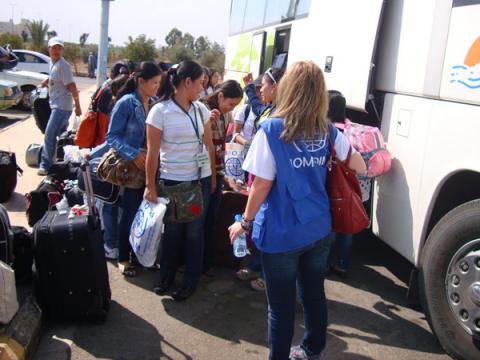
More than a month after immediate relatives called on the Duterte government to rescue 52 OFWs locked up at the Philippine Embassy’s shelter in Syria, 38 Filipino women who were victims of human trafficking, illegal recruitment and abuse continue to languish under subhuman conditions. Included in this group were trafficked minors who endured extreme maltreatment from their employers and life-threatening situations in ISIS-held territories. Many have completely lost contact with their families. These OFWs were already bound to be repatriated months ago, some even as early as February this year but according to the OFWs, embassy officials have been demanding huge sums of money before they get allowed to be released. Their relatives back in the Philippines have already raised their demands to OWWA, OUMWA-DFA and even directly to Malacanang but to no avail. 

Migrante International has condemned the Duterte government for its inaction to the demands of the 38 remaining OFWs who were recently transferred and locked up in the embassy’s basement.

According to the Migrante, the OFWs fear that their lives are now in peril since they won’t be able to get out easily from the basement in case of fire or any other emergency.

“How can a government office tasked to protect and uphold the welfare of overseas Filipinos do this to distressed OFWs? Migrante International demands that the embassy officials and personnel involved in extorting and abusing these OFWs be investigated, charged and be sent to jail if found guilty,” the group stressed. 

Embassy officials claim that they are unable to repatriate the distressed OFWs since they have pending cases and that Syrian courts are currently closed due to lockdown restrictions. Exit visas and penalties that need to be paid were also cited. However, Migrante International countered that their alibis are ludicrous since embassy officials are just shifting the blame when they are supposed to intervene for these OFWs for humanitarian reasons. 

It is also outrageous, the group said, that the Duterte government’s budget priorities are intentionally misplaced at a time when many OFWs are stranded and distressed as they continue to be hit by the global crisis and lockdown restrictions.

“The Duterte government will not be providing increased funding for legal assistance and other DFA services for troubled OFWs. The regime allocated more funds for war, militarization and in attacking human rights instead of delivering services for our kababayans impacted by the COVID-19 crisis. The DFA and the Duterte government are both answerable to the corruption issues being raised by Syria OFWs. The OFWs are already inside the Philippine Embassy but they are being held incommunicado by embassy officials. This is a serious violation of their rights and their families back home are very worried and alarmed. For victimizing distressed OFWs in Syria with extortion, corrupt officials must be held accountable and face the consequences of their actions before the law,” Migrante International stated. (Photo of OFWs in war-torn Syria)#

Congress approves P4.5-trillion 2021 budget for pandemic-hit Philippines

0

Dec 9, 2020, Mara Cepeda/JC Gotinga

MANILA, Philippines

The proposed budget includes P72.5 billion for the purchase of COVID-19 vaccines next year

Congress on Wednesday, December 9, passed the proposed P4.5-trillion trillion budget for 2021, the first to be crafted under President Rodrigo Duterte’s administration amid the coronavirus pandemic. 

Both chambers of Congress separately ratified the bicameral conference report on the 2021 General Appropriations Bill (GAB) on Wednesday, December 9, mere hours after the bicam approved it.

The 2021 GAB would set aside P72.5 billion for the purchase of COVID-19 vaccines, which the government targets to administer to the general population by the second quarter of 2021. 

Of this amount, P2.5 billion are lodged under the Department of Health, while P70 billion is under unprogrammed appropriations, dependent upon the availability of government revenues next year. 

The proposed appropriations for COVID-19 vaccines is on top of the P10 billion that the Bayanihan to Recover As One Act has already allotted for it. This puts the country’s total budget for the COVID-19 immunization program at P82.5 billion in 2021. 

The 10 agencies that would receive the highest allocations under the proposed 2021 national budget are as follows:

  • Education (including DepEd, SUCs, CHED, TESDA): P708.2 billion
  • Department of Public Works and Highways: P694.8 billion
  • Department of Health (including DOH, PhilHealth, COVID-19 vaccines): P287.5 billion
  • Department of the Interior and Local Government: P247.5 billion
  • Department of National Defense: P205.5 billion
  • Department of Social Welfare and Development: P176.7 billion
  • Department of Transportation: P87.4 billion
  • Department of Agriculture: P68.6 billion
  • The Judiciary: P44.1 billion
  • Department of Labor and Employment: P36.6 billion

The 2021 GAB will now be transmitted to Malacañang for President Rodrigo Duterte’s signature.

He has until the end of the year to sign the GAB into law or to veto parts of the budget. Otherwise, the government would be forced to reenact this year’s funds, which does not have allocations for programs aimed to combat the COVID-19 pandemic. 

COVID-19 infections in the country are still steadily rising, with the total number of cases at 444,164 as of Wednesday afternoon. The Department of Health said 8,677 people have died from the disease, while 408,164 have recovered.

Drilon: Where will funds for vaccines come from?

Senate Minority Leader Franklin Drilon raised caution over the fact that a vast majority of the budget for COVID-19 vaccines – P70 billion – is under unprogrammed appropriations, dependent upon the availability of government revenues.

“All of us are unclear how we will fund the P70 billion unprogrammed funds because, I’m sorry to say, what you enumerated as excess collection, given the pandemic – there is no excess in collection,” Drilon told Angara.

Angara earlier said he had an assurance from the Department of Finance that there is a high probability there will be enough non-tax revenues or even excess collections to fund unprogrammed appropriations.

“We will be having deficits. New revenue collection? Let us be candid with each other. This is not forthcoming. Where will this be coming from?” Drilon added.

He reiterated his position that the government should realign some P33 billion held by the Philippine International Trading Corporation (PITC), which he said was “lying idle” and could be put to good use in buying COVID-19 vaccines.

“May bilyones para sa pulis at militar pero barya-barya para sa health facilities at programa laban sa pandemya at ayuda sa milyong Pilipinong nawalan ng trabaho,” said Castro. (Billions for the police and military but loose change for facilities and programs against the pandemic and aid for millions of jobless Filipinos.)

Lacson dissents

Senator Panfilo Lacson cast a dissenting vote on the budget bill, citing reservations about an increase in the budget of the Department of Public Works and Highways (DPWH), and a decrease in the budget for the national broadband program of the Department of Information and Communications Technology (DICT).

From the original proposal of P666.5 billion, the bicameral version allotted P694.8 billion to the DPWH. Lacson had wanted to slash the agency’s budget by P63 billion because of its “low utilization rate” and half-baked, rehashed local infrastructure projects.

Meanwhile, the bicameral budget bill cut the DICT budget by P8.46 billion, and reduced the allocation for the national broadband program from P5.9 billion to just P1.9 billion.

Lacson asked Senate finance committee chief Sonny Angara what the “wisdom” was behind these adjustments.

Angara admitted “there are missed opportunities here,” acknowledging Lacson’s concerns.

However, there was no turning back from ratifying the budget bill, and Lacson said lawmakers should just “try better next time.” – Rappler.com