Home Blog Page 109

Ocean lockdown: Filipino seafarers face perils, death at sea

Rappler.Com, Oct 23, 2020, Ana P. Santos, Research Leika Golez and Cristina Chi In partnership with the Pulitzer Center

MANILA, Philippines

Part 1: Long-haul fishing is notorious for its exploitative working and deplorable living conditions. Solitary months in the high seas place crew at the mercy of extreme weather disturbances and at risk of physical abuse by malevolent captains.

Jesus Gaboni and 8 other men carefully wrapped Raul Calopez’s body in a white blanket before storing it in the ship’s freezer. Afterwards, the men gathered around in silent prayer. 

Some Chinese crew members joined them as they lit a candle and laid out some food, a bottle of mineral water, and Coke. As a final tribute, they lit a cigarette and hung it on the freezer’s lock.

More than two weeks had passed since the fateful day of December 31, 2019. The sun in the rich fishing grounds in the waters off Peru was beating rays of blistering heat on the men working on the ship.  

Deckhand Calopez was fixing the ship’s “parachute,” the thick metal line that serves as an anchor, when he suddenly fainted, hit his head on a pipe, and momentarily lost consciousness after he fell to the floor. 

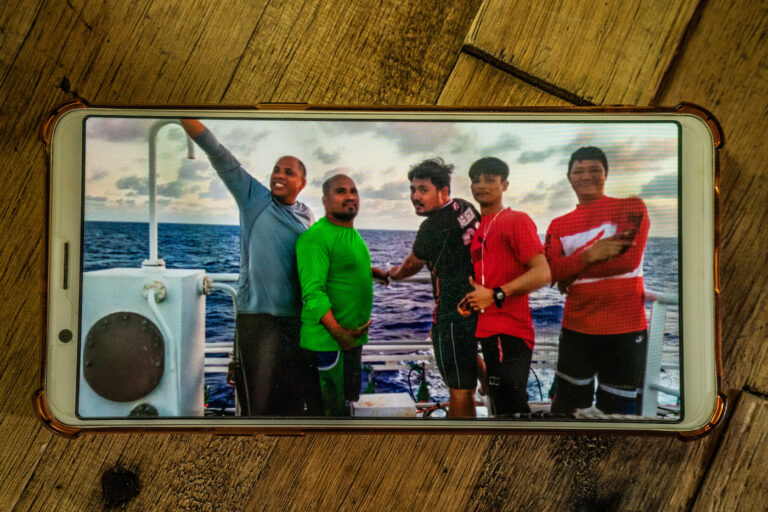
He went back to work after a few days but often complained of headaches and difficulty breathing. As his condition deteriorated, the men on board the Fu Yuan Yu 7874 fishing vessel took turns looking after Calopez, feeding him porridge, giving him sips of water, and helping him to the bathroom. Crew members shared photos and videos of Calopez lying in bed, visibly weak. 

Gaboni – “Gabo” to the 40 other Filipino seafarers of the vessel that had been out in the fishing grounds of the Atlantic Ocean since March 2019 – pleaded with their Chinese captain to bring Calopez to a doctor. It fell on deaf ears.

A bulky man of almost 6 feet, Gaboni’s physical presence could be intimidating if it were not for his gentle protective aura. On land,his years working as a security guard trained him to be a person of quiet authority, the one you count on for a welcoming smile and also the one you would turn to for help. 

At sea, he was the group’s natural choice to be the leader they entrusted their lives to.

Desperate to ease Calopez’s pain, the men tried asking their captain for medicine but the attempt was futile.

Binigyan kami ng gamot dun, eh, hindi naman namin maintindihan kasi Chinese ang sulat,” he said. (They gave us medicine but it was in Chinese characters that we couldn’t understand.)

More than two weeks would pass after the accident, before Calopez was transferred to a sister Fu Yuan Yu vessel where he was supposed to have been attended to by a doctor. That was the last time the crew saw Calopez alive. 

On January 19, Calopez’s body was transferred back to the Fu Yuan Yu 7874 where crew members buried him.

Fast forward: Trauma, anxiety

Sleep eludes Gaboni. He gets only three to four hours of sleep a night – “like a chicken,” he chuckled. When he does get to sleep, his screaming and grumbling wake his wife. 

Minsan ginigising ako ng misis ko, galit na galit daw ako. ‘Ano yung sinisigaw mo na para kang galit?’” he recalled her asking him. (Sometimes my wife wakes me up because I sound angry. She asks why am I shouting and what am I angry about?)

It’s been more than two months since Gaboni returned to the Philippines but he still has flashbacks of the year he spent in Peru onboard the Fu Yuan Yu 7874 – the long nights that stretched to early morning hauling squid as big as his arm, cleaning it, freezing it. The bland porridge and the instant noodles that passed for food. The filtered drinking water that came out of the pipes smelling and tasting like rust. 

The company of his wife and three children is the salve to the physical hardship he had to endure as a deep sea fisherman, but when Gaboni finds himself alone, feelings of helplessness creep in accompanied by the memories of illness and death. 

Naiisip ko pa rin si Raul. Hindi porke’t nakarating na ako dito nang matiwasay at nasa magandang kalagayan na ako, kumbaga safe na ako. Iniisip ko pa rin ‘yung kasama ko,” said Gaboni. (I still think of Raul. Just because I am home and have arrived safely, it doesn’t mean that I don’t think of my crewmate anymore.)

Sa maiksi lang na panahon na pinagsamahan namin hindi ko na rin tinuring na kaibigan kundi bilang kapatid [si Raul] dahil sa lahat ng crew doon na Pilipino, ako ‘yung pinakamatanda sa kanila,” said Gaboni.

(We were together for only a short time but I didn’t think of Raul as just a friend. I thought of him as a brother because among all the Filipino crew, I was the oldest.)

Life at sea

Overfishing driven by an insatiable global demand for seafood plus climate change are pushing fish and the crews who catch them farther from shore. Long-haul fishing boats venture out for months at a time – sometimes, years – into the high seas, disconnected from the rest of the world and away from legal surveillance and tracking. 

The fatigue from the long months of working at sea makes seafarers prone to injury and accidents. The European Maritime Safety Agency estimates about 4,000 marine casualties and incidents occur annually, injuring almost 1,000 seafarers. 

Apart from the brutal working conditions, being cut off from their loved ones and isolated on a ship add to the reason why a high number of seafarers suffer from depression.

Other studies show that feelings of helplessness when they witness the death of a crewmate can leave long-lasting emotional trauma.

Philip Cachero, 32, wasrocked by a mix of shock and sadness after Calopez’s death. Cachero was one of the men who helped lay Calopez to rest, and for days after, he tossed and turned in his narrow bunk bed, tormented by thoughts about their boat sinking and the overwhelming fear that any of them could die next. 

Nawalan kami ng gana magtrabaho simula nung nangyari. Gustong-gusto na po talaga namin umuwi. Kasi, what if sa amin naman mangyari yun?” said Cachero. (We didn’t feel like working after that happened. We wanted more than anything to go home because what if that happened to us?)

Floating prison

Long-haul fishing is notorious for its exploitative working and deplorable living conditions. Solitary months in the high seas place crew at the mercy of extreme weather disturbances and at risk of physical abuse by malevolent captains. The New York Times called long-haul fishing vessels “floating labor camps” and the mostly male crew who work on them “sea slaves.”

Pag nalalasing ’yung ibang Chinese, pinapasok ’yung kuwarto namin, pinag-ti-tripan kami, binabatukan kami,” said one seafarer who asked to remain anonymous, fearing he could be blacklisted by manning agencies and ship owners. (When some of the Chinese crew get drunk, they barge into our room and bully us or smack us on the head.)

Di baleng malaglag ka, basta lang hindi malaglag ’yung pusit.” said Fernando Tangalin, a seafarer on board the Fu Yuan Yu 7877, describing the workplace hierarchy. (It doesn’t matter if you fall off the ship, as long as the squid don’t.)

There are an estimated 41,000 migrant fishermen but the number could be closer to 100,000 with many trafficked on boats and falling under industry safeguards like pre-departure training that would prepare them for a life in the high seas. Worse, some ships do not always have tracking systems or turn them off to evade detection if trespassing into protected waters or overfishing. 

“And once they are already on board, who gets to check how they are doing? When something happens, the captain holds your fate in your hands. And of course, there is always the possibility of being dumped at sea,” said Marla Asis, director of research at the Scalabrini Migration Center in Manila.

A crew working together in confined space allows for a closer sense of camaraderie but it can also amplify experiences like the distress over the death of a crew member. According to a study published by the Journal of Occupational Medicine and Toxicology, “The traumatization is even more likely if an unaffected crew member empathizes with the primary victim and…experiences being unable to help.” 

Ryan Tabulod, a 7874 crew member, can’t help but think of the similarities between him and Calopez. Like Calopez, he also had two young children and a wife waiting for his return.

Awang-awa talaga ako kay Raul at saka sa asawa niya at ang mga anak niya. Sana maiuwi na ‘yung katawan niya,” said Tabulod. (I really feel sorry for Raul and his wife and kids. I hope his remains are returned to them.)

Among the most dangerous jobs

Seafaring is not only one of the most dangerous jobs in the world. Seafarers also experience dangerously high levels of mental stress and have contemplated suicide perhaps more than any other occupation. 

Though studies on mental health of seafarers are still sparse, seafarer welfare organizations and manning agencies have responded by making online and virtual counseling and emotional support services available to those suffering from depression or having suicidal thoughts.

But compared to their merchant marine and cruise liner counterparts, these services are mostly out of reach for deep sea fishers whose spartan living conditions and stations in the middle of the high seas do not offer the luxury of connectivity or even an occasional shore leave.

Additionally, maritime laws that vary by country do not always classify deep sea fishers as seafarers, leaving them in an ambiguous category when it comes to worker rights. 

The International Labour Organization’s Work in Fishing Convention aims to set international standards for the protection specifically of fishermen, but among the major commercial fishing countries, only Thailand has ratified the convention. The Philippines, among the biggest suppliers of seafarers in the world, has not signed on the convention.

Oblivious to pandemic

These conditions were exacerbated  by the COVID-19 outbreak, which has kept an estimated 300,000 seafarers quarantined in their ships, with little to no chance of being replaced by a fresh crew, according to the International Transport Workers Federation (ITF).

The Philippines is at the center of this maritime crisis where a global pandemic has collided with life at sea, pinning deep sea fishers against a corner of compounded hardship.

The crew on the Fu Yuan Yu 7874 began their journey back to the Philippines from Peru last March. In May, their ship docked in China, where they  got their first mobile connection in over a year.

They were shocked to hear about a global pandemic that closed down the world and prevented them from disembarking. The crew had heard scraps of news about a virus in December but they refused to believe it, thinking it was an excuse to keep them onboard working.

Buti pa po ‘yung mga nakakulong, mga nakabilanggo. May mga dumadalaw. May mga alam sa mga bali-balita, kung ano nangyayari sa mundo. Kami, wala talaga, as in zero, kasi nasa dagat lang kami. Di namin alam ang mga nangyayari. ’Yung COVID-COVID na ’yan, hindi namin alam ‘yan,” said Cachero. 

(Prisoners who are locked up in jail are better off. At least they get visitors. They get news about what is happening in the world. For us, totally nothing. Zero because we are out at sea. That COVID virus, we didn’t know anything about that.)

Travel restrictions related to the pandemic stalled the 7874 in China, along with other vessels of the same fishing company. The ships were also carrying the remains of sailors who had died on board. On June 6, Stanley Jungco also met an accident and died on board. On another ship, Mark Felix Guial died of unknown causes after suffering intense stomach pain.

The men would sail back to the Philippines only in July – after almost three months of being stranded by the pandemic and more than a year of living in the ocean.

It was only the remains of Guial and another unnamed seafarer’s that were repatriated to the Philippines and returned to their families. 

In the shuffle and transfer to the Star Mariner that would eventually sail back to the Philippines, Jungco’s remains were left behind in a mortuary in Fuzhou, southern China. Calopez’s body was left in the freezer of the 7874 which sailed back to Peru. A locator on a global maritime tracking website indicated that the ship’s latest position as of October 13 was west of the Peru exclusive economic zone, already out of range.

Correspondence between the Philippine embassy in Chile – which has jurisdiction over Peru – and Calopez’s family showed that communicating  with the ship is difficult, and varying inter-country protocols are complicating the repatriation of his remains. If the ship docks in Peru this October, there may be a possibility of retrieving Calopez’s body. By then, it would be almost a year since he had died.

Hangga’t hindi naiuuwi ’yung bangkay (ni Raul) at hindi naililibing, para sa ’kin hindi pa rin ako komportable,” said Gaboni. (Until Raul’s body is returned and buried, I will not be at peace.)

Don Eliseo Prisno III, a research associate at Seafarers’  International Research Center at Cardiff University, described the recurring thoughts of helplessness and grief as heightened anxiety.

“Closure is essential to grieving. Until the bodies are returned and the families – as well as the seafarers – can have a final goodbye, grieving and closure will be difficult,” said Prisno.

When the men were at sea, they prayed for salvation, for rescue. Now home, they pray to God for those who did not make it alive. And for having survived, they ask for one more thing: forgiveness. (To be concluded) – Rappler.com

Coming up: Part 2 | After freedom, Filipino seafarers captured by pirates battle trauma

‘Sounds like a death threat’: Netizens slam Parlade’s warnings toward Liza Soberano

0

Gaby Baizas, Oct 22, 2020/ Rappler.Com

Filipinos criticize Lieutenant General Antonio Parlade Jr for saying Liza Soberano will ‘suffer the same fate’ as killed activists if she continues supporting Gabriela

Netizens were up in arms after Lieutenant General Antonio Parlade Jr warned Liza Soberano she would end up getting killed if she continued supporting women’s group Gabriela.

In a statement posted on the National Task Force to End Local Communist Armed Conflict (NTF-ELCAC) Facebook page, Parlade said Soberano “has to be protected in the exercise of her rights,” and hit Gabriela and Representative Arlene Brosas for their “hidden violent agenda.”

“Is [Soberano] an NPA? No, of course not. Not yet. So let’s help educate her and the other celebrity targets of Malayang Kilusan ng Bagong Kababaihan (MAKIBAKA), the Underground Mass Organization hiding under Gabriela Women’s Party,” the statement read.

Parlade also said, if Soberano does not withdraw her support from Gabriela, she would “suffer the same fate” as activist Josephine “Jo” Lapira. Lapira was a UP Manila student who was killed in a clash between government troops and suspected New People’s Army members in November 2017.

In the same statement, Parlade also warned Miss Universe 2018 Catriona Gray “not to follow the path” taken by actress Angel Locsin, who has supported several rights groups.

Brosas has since responded to Parlade’s remarks, and said he should stop red-tagging and mansplaining when it comes to Soberano and other women defenders. In a statement on Gabriela’s Facebook page, Brosas said it was “starkly ironic” that Parlade appealed to stop red-tagging the actress only for him to follow suit in the same statement.

“How come these macho-fascists have the audacity to mansplain strong women and lecture them on what to do? And why do they seem so afraid of women using their platform to defend other women?” the statement read.

Soberano only recently spoke at a Gabriela Youth webinar on Tuesday, October 13, where she called on influencers to speak up on issues involving women and children. Shortly after the webinar, internet trolls worked hard to make the hashtag #BoycottLizaSoberano trend on social media.

Many Filipinos slammed Parlade for his remarks against Soberano, which they said were tantamount to a death threat – from no less than a uniformed official tasked to protect his countrymen.

Several netizens also said Soberano had the right to express her support for women’s groups and women’s issues without being threatened by military officials. (READ: On social media, PH military declares war vs rights defenders)

Filipinos were also quick to support Soberano and to condemn the military for threatening women and for resorting to red-tagging anyone critical of the government.

Europe coronavirus cases doubles to 200K daily cases for the first time

0

Reuters / October 23, 2020

Europe’s reported coronavirus cases more than doubled in 10 days, crossing 200,000 daily infections for the first time on Thursday, according to a Reuters tally, with many Southern European countries reporting their highest single-day cases this week.

Europe reported 100,000 daily cases for the first time on Oct. 12.

Europe has so far reported about 7.8 million total coronavirus cases and about 247,000 deaths, according to a Reuters tally.

European countries like Italy, Austria, Croatia, Slovenia and Bosnia reported their highest single-day coronavirus cases on Thursday.

Europe as a region is reporting more daily cases than India, Brazil and the United States combined. The increase is partly explained by far more testing than was done in the first wave of the pandemic.

The global coronavirus tally stands at about 41.4 million cases and about 1.1 million deaths.

According to a Reuters tally, Wednesday saw the highest total of infections reported in a single day across the world, at 422,835.

As of now, Europe accounts for nearly 19% of global cases and about 22% of global deaths, according to Reuters tally.

In Western Europe, France, which is reporting the highest seven-day average of new cases in Europe with 25,480 infections per day, reported an all-time high of 41,622 new confirmed COVID-19 cases on Thursday, according to French health authorities.

To slow the spread of infection, France’s Prime Minister Jean Castex on Thursday announced widening of a coronavirus curfew to more than two thirds of its population.

Another Western European country Netherlands reported more than 9,000 in 24 hours, a new record, data released by the National Institute for Public Health (RIVM) on Thursday showed.

Germany, which reported more than 10,000 daily cases for the first time on Thursday, extended travel warnings for Switzerland, Ireland, Poland, most of Austria and Italian regions including Rome.

Hospitals across Europe remain under strain. Even though the it remains well below levels at the peak of the crisis six months ago in the region, COVID-19 hospital admissions and occupancy are going up again.

A World Health Organization (WHO) expert said on Monday said Europe and North America should follow the example of Asian states by persevering with anti-COVID measures and quarantining anyone who comes into contact with infected people. (Inquirer.Net)

Angel Locsin’s red-tagged sis rebukes Parlade: I support women’s rights, but I ain’t with NPA

0

By: Gabriel Pabico Lalu – Reporter / INQUIRER.net / October 22, 2020

MANILA, Philippines — The sister of actress and philanthropist Angel Locsin has come out to rebuke military official Lt. Gen. Antonio Parlade Jr.’s claim that she is a member of the New People’s Army (NPA), insisting that she is supportive of women’s rights and not the armed struggle.

In a post on Twitter on Thursday, Ella Colmenares said she was not supposed to defend herself but eventually decided to speak up to clarify things as her life and her family may have been placed in danger with the red-tagging incident.

Parlade, who is the Armed Forces of the Philippines (AFP) Southern Luzon Command chief and also a member of the National Task Force to End Local Communist Armed Insurgency (NTF-ELCAC), mentioned Colmenares’ name in his advice against celebrity Liza Soberano on Wednesday.

Soberano was on the wrong end of red-tagging accusations after she appeared in an online seminar hosted by Gabriela.  In the statement, Parlade said that fellow actress Angel Locsin and her uncle Bayan Muna chairperson Neri Colmenares would not inform Soberano of the truth about “Ella Colmenares.”

“I do not have to defend myself as I have not done anything wrong but I decided to speak up, not just for myself but also for my children, whose lives may have been endangered because of this reckless red-tagging being broadcasted on social media,” Ella Colmenares said in her statement.

“Yes, I believe in the protection of women’s rights and human rights, the same advocacies that Angel and Neri fight for, but so do millions of Filipinos across the country.  That doesn’t mean that I’m a member of the NPA as what is being claimed,” she added.

INQUIRER.net has sought the side of Angel on Wednesday, but she has yet to reply as of this posting.  But in a cryptic story posted by Angel on Instagram, she greeted their younger brother who is celebrating his birthday on Thursday, while noting that her sister — Colmenares — whom Parlade said was at the “underground,” is with them.

“Happy birthday sa bunso namin […] with our controversial sister na nasa underground daw sa Quezon,” Locsin said.

Colmenares also cracked a joke — about her feeling beautiful — since she was placed alongside Soberano, Locsin, and Miss Universe 2018 Catriona Gray.

Parlade mentioned Colmenares seemingly to warn Soberano and Gray about the dangers of being attributed with groups like Gabriela.

However, he drew flak after netizens believed that his statement — that Soberano should not be red-tagged because she is “not yet” an NPA member — was a veiled threat.

Parlade’s comments about Soberano, that she needs to be educated about the dangers, was also taken by various lawmakers as a form of mansplaining — or men explaining matters to women in a condescending manner.

Colmenares called on the public to stand up and defend people who may have been targeted for just expressing their opinions that may be viewed as dissenting, to those in the administration.

“Let us stop the cycle of hate and instead, discuss the merits of the issues being raised.  #ActivistsNotTerrorists,” she ended.#


Stop ‘mansplaining’: Parlade chided for ‘threats’ vs Liza Soberano, other celebrities

0

By: Christia Marie Ramos, Gabriel Pabico Lalu/INQUIRER.net / October 22, 2020

MANILA, Philippines — Several lawmakers scored a top-ranking military official over his “unacceptable threats” against actress Liza Soberano and other celebrities for engaging with women’s group Gabriela and speaking out against violence against women and children.

Senator Risa Hontiveros said Thursday that Armed Forces of the Philippines (AFP) Southern Luzon Command chief Lt. Gen. Antonio Parlade Jr. should not use his authority as a general to “threaten” and issue warnings against Soberano.

“Your threats and harassment are unacceptable,” the legislator said in a statement. “By silencing them, pinapalampas mo ang karahasan, panggagahasa at pangaabuso na nararansan ng napakaraming Pilipino (you are condoning violence and abuse being experienced by a lot of Filipinos.) This is a shame to your rank and to the [Philippine Military Academy].”

“I started as a young advocate for women’s rights, and married a military man, and raised a family of [four] with him. We betray the integrity of our military, and especially our women and children by allowing abuses of power like this to happen,” she added.

Further, Hontiveros, who chairs the Senate Committee on Women, cautioned Parlade when he faces again the Commission on Appointments (CA).

Parlade last faced the Senate’s CA in August.

“We will not forget this. Tatandaan ko ang lahat ng mga ito at paghandaan mo ang susunod natin paghaharap sa Comission on Appointments. Hindi ko ito kayang palampasin,” Hontiveros went on.

(We will not forget this. I will remember this and be ready when we see each other again before the Commission on Appointments. I will not let this slide.)

Stop ‘mansplaining’

Gabriela Women’s Party-list Rep. Arlene Brosas likewise slammed Parlade for trying to “mansplain” things, after the military official gave unsolicited advice to Soberano.

Brosas said the military official was “mansplaining” — or men explaining issues to women in a condescending and belittling manner — when he told critics of Soberano that the actress needs to be educated about the supposed true agenda of the party-list group.

Brosas further noted that Parlade’s pronouncements were loaded with irony because he also red-tagged Soberano in the same statement.

Earlier, while Parlade, who is also part of the National Task Force to End Local Communist Armed Conflict (NTF-ELCAC), urged Soberano’s critics to stop red-tagging her – or labeling someone as sympathetic to the local communist movement – for joining an online seminar hosted by Gabriela, he also said the actress is “not yet” part of the New People’s Army, the armed wing of the Communist Party of the Philippines (CPP).

“It is clear that Parlade, the NTF-ELCAC, and the paid trolls are the ones who are rabidly red-tagging Liza Soberano and other female celebrities and influencers who are taking a stand and speaking out against the macho-fascism under the Duterte regime,” Brosas said in a separate statement.

“How come these macho-fascists have the audacity to mansplain strong women and lecture them on what to do? And why do they seem so afraid of women using their platform to defend other women?” she asked.

Parlade has also mentioned in his statements other female celebrities — actress Angel Locsin and Miss Universe 2018 Catriona Gray, who both have expressed support to women and children advocacies.

The AFP official even said Locsin and her uncle, former Bayan Muna Rep. Neri Colmenares, would never tell Soberano and Gray about Ella Colmenares — Locsin’s sister whom he accused of joining the NPA.

“General Parlade’s appeal to stop red-tagging Liza Soberano is starkly ironic because he actually red-tagged Soberano in his same statement,” Brosas said.

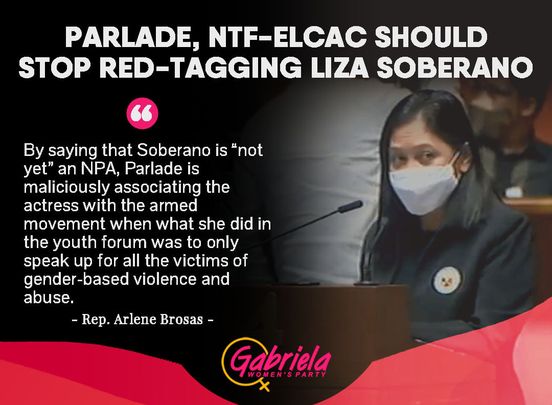
“By saying that Soberano is ‘not yet an NPA,’ he is maliciously associating the actress with the armed movement when what she did in the youth forum was to only speak up for all the victims of gender-based violence and abuse,” she explained.

Recently, Soberano was tagged by vlogger as a supporter of the communist movement after appearing in the online seminar of Gabriela youth.  However, Soberano’s role in the seminar was to speak on violence against women and children, and safe spaces — legitimate and legal issues that are neither subversive nor violent.

Brosas believes that Parlade’s recent statements were only meant to discredit Gabriela despite its background as a staunch women’s rights defender.

“These rabid NTF-ELCAC executives are using their rehashed script to discredit Gabriela Women’s Party despite our long track record of advocating women’s rights,” she said.

“Our 20 years of advancing women and children’s rights inside and outside of Congress cannot be smeared by their repeated lies. They are becoming desperate as we approach our 20th Anniversary celebration on October 25, wherein we will highlight our achievements and the broad support for our agenda and advocacy,” she added.

The NTF-ELCAC and the Makabayan bloc have butted heads several times, even during this COVID-19 pandemic, as mass movements continued despite the lockdowns.

‘Uncalled for, unprofessional’

Senator Francis Pangilinan, meanwhile, pointed out that the duty of the AFP is to protect and not to oppress.

“These threatening statements are uncalled for and unprofessional and should be called out,” he said.

Pangilinan recalled that his daughter, Frankie, was previously red-tagged for shouldering the bail of those who were arrested for lining up for food rations and violating lockdown restrictions in Quezon City.

“Advocates and progressives must not be mistaken for communists and terrorists,” the senator said.

“They speak to express and to empower,” he added.

‘Don’t be afraid’

Hontiveros then called on both Soberano and Gray to continue speaking up about their advocacies.

“It is difficult and painful to be at the frontlines fighting beside persons oppressed by a norm that advocates rape, murder, and exploitation. But every time you speak up, another girl becomes braver and another life is saved. I’m behind you every step of the way,” the senator said.

“This is your constitutional right; don’t be afraid. Patuloy niyo lang panindigan ang karapatan niyong magsalita…I salute and embrace you,” she added.

(This is your constitutional right; don’t be afraid. Continue defending you principles and your right to speak up…I salute and embrace you.)

KGA

Duterte: Hold Me Responsible for Killings in Drug Crackdown

0

By Jim Gomez October 20, 2020

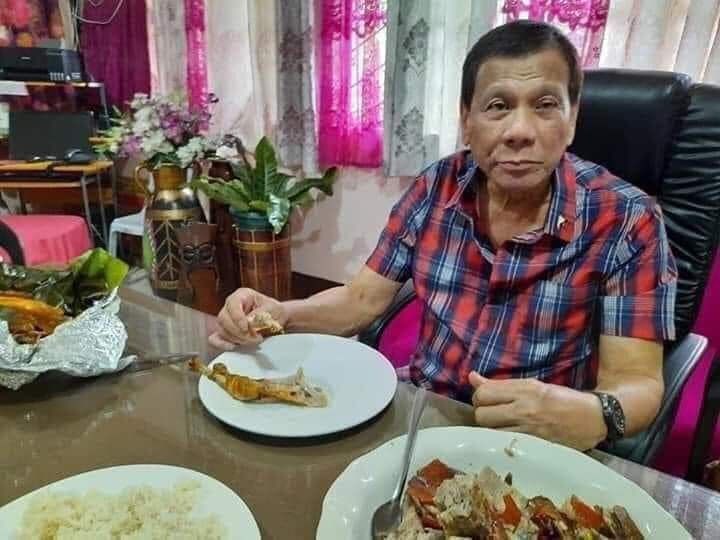
“If you get killed, it’s because I’m enraged by drugs,” Duterte said.

The Philippine president has said he accepts responsibility for the thousands of killings committed during police operations in his crackdown on drugs, adding that he was even ready to go to jail.

President Rodrigo Duterte’s televised remarks Monday night were typical of his bluster — and tempered by the fact that he has pulled his country out of the International Criminal Court, where a prosecutor is considering complaints related to the leader’s bloody campaign.

The remarks were also a clear acknowledgement that Duterte could face a deluge of criminal charges. Nearly 6,000 killings of drug suspects have been reported by police since he took office in mid-2016, but rights watchdogs suspect the death toll is far larger.

“If there’s killing there, I’m saying I’m the one … you can hold me responsible for anything, any death that has occurred in the execution of the drug war,” Duterte said.

“If you get killed, it’s because I’m enraged by drugs,” said the president known for his coarse and boastful rhetoric. “If I serve my country by going to jail, gladly.”

He said, however, that drug killings that did not happen during police operations should not be blamed on him, alleging that those may have been committed by gangs.

Duterte has made a crackdown on drugs a centerpiece of his presidency. At the height of the campaign — which has often targeted petty dealers and users along with a handful of the biggest druglords — images of suspects sprawled dead and bloodied in the streets were frequently broadcast in TV news reports and splashed on the front pages of newspapers. Tens of thousands of arrests in the initial years of the crackdown worsened congestion in what were already among the world’s most overcrowded jails.

U.N. human rights experts and Western governments led by the United States have raised alarm over the killings, enraging Duterte, who once told former U.S. President Barack Obama to “go to hell.”

There have been widespread suspicions that police engage in extrajudicial killings in the crackdown, allegations that they and Duterte deny. In 2018, a court convicted three police officers of murdering a 17-year-old student after witnesses and a security video disproved their claim that the suspect was shot after violently resisting, a common reason cited by police officers after drug suspects are killed.

At least two complaints for crimes against humanity and mass murder in connection with Duterte’s campaign are being examined by an ICC prosecutor, who will determine whether there is enough evidence to open a full-scale investigation.

When the complaints were made, Duterte withdrew the Philippines from the world tribunal two years ago in a move that human rights groups said was a major setback in the country’s battle against impunity. The ICC prosecutor has said the examination into the drug killings would continue despite the Philippine withdrawal.

Duterte reiterated his defiance of the court’s probe Monday by asking, when did “drugs become humanity?”

Instead, he framed the drug menace as a national security threat, as he has in the past, comparing it to the communist insurgency that the government has tried to quell for more than a half-century.

“If this is allowed to go on and on and if no decisive action is taken against them, it will endanger the security of the state,” said Duterte, a former government prosecutor.

“When you save your country from the perdition of the people like the NPAs and drugs, you are doing a sacred duty,” he said, referring to communist New People’s Army insurgents.

Police have reported at least 5,856 drug suspects have been killed in raids and more than 256,000 others arrested since the start of the crackdown. Human rights groups have accused authorities of considerably under reporting the deaths.

By Jim Gomez for the Associated Press in Manila, Philippines.

Amid a Pandemic, Evictions Plague the Philippines

0

By Michael Beltran October 09, 2020, The Diplomat

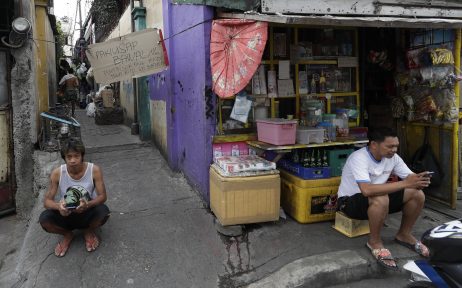
How can Filipinos, especially low-income families, stay at home when they are being forced into homelessness?

Evictions in slum communities have been steadily increasing in the Philippines even as the country continues to enforce quarantine procedures. More commonly called “demolitions,” the violent tearing down of homes is a common feature in informal settlements, especially around Metro Manila. These demolitions and evictions are done either on the whim of private claimants to lots of land where informal settlements have been established, via the right of way given for public and private infrastructure development, or when a community is deemed a “danger area” by the authorities.

However, with the global and local public health crisis stemming from the coronavirus still in full swing, it begs the question of how Filipinos, especially low-income families, are supposed to stay at home when they are being forced into homelessness.

On April 2, the Department of Interior and Local Government (DILG) issued a memorandum ordering all local governments to postpone any and all eviction-related activities. The memo cites the standing state of calamity in the country. The state of calamity was recently extended by President Rodrigo Duterte for another year, until September 2021. In the past, the administration has routinely preached that there would be “no demolition without relocation.” 

And yet, even early in the lockdown, evictions were reported. Even without the DILG’s memo in place, one might think that evictions would be put on hold to focus on responding to more pressing matters. But in March, around 120 families in Pasay, Metro Manila were evicted without prior notice. In July, 300 families in Cabuyao, Laguna were also evicted to make way for the expansion of the Philippine railway system. Neither of the two incidents featured any options or assistance for relocation. 

More recently in early September, the Manila government issued a demolition order that would affect thousands of residents living in state-owned housing in the Tondo area. An estimated 800 families are living in two tenements owned by the National Housing Authority (NHA). The tenements are set to be torn down to make way for a service road that leads to a cockfighting arena and a newer housing project dubbed by city officials as the “Tondominum.”

At congressional budget deliberations, when the NHA general manager was pressed on why the evictions were being allowed to happen, he deferred on the matter, saying it was the city’s prerogative. However in a separate report, he acknowledged that the tenements were considered condemned by the agency and therefore had to be torn down. The NHA’s categorization arguably emboldened the city government to order a demolition. Manila Mayor Isko Moreno has offered the affected residents a spot in the new Tondominium, but public housing is not always readily affordable. There are no guarantees that low-income families will be able to pay for the offered relocation sites. 

For her part, Gabriela Women’s Party and Housing Committee member Congresswoman Arlene Brosas questioned the validity of the demolition notice. She told The Diplomat: “Why are demolitions being upheld during the pandemic? Things are bad enough without unnecessarily working to worsen the situation.”

Within the Intramuros district is another Manila slum facing demolition. More than a thousand residents face certain homelessness in October with relocation yet to be offered by any government body. According to Jessa Tolda, of the local group United Homeowner’s Association, a Chinese company — L.G. Mathieson Development — won a legal case in court declaring themselves the legitimate owners of the land on which the residents currently live. Furthermore, the court deemed that claiming the land can take effect on October 11.

Tolda also revealed that in September, the Presidential Commission for the Urban Poor (PCUP) informed locals that they underwent a pre-demolition conference that would eventually lead to an eviction notice. No notice has so far been served, but in many cases demolition teams and trucks accompanied by law enforcement often strike without warning. 

Tolda shared with The Diplomat the sentiments of her fellow homeowners: “We have no idea why the company is pushing for a demolition during the pandemic. Even the courts are siding with them. If we have to go, then we will, but not without a proper relocation site for us. But then there is even another complication of getting tested for the virus before we are transferred. Tests are very expensive.”

The national urban poor group slammed the surge in demolitions being reported in the country and in Metro Manila especially. They noted that aside from Tondo and Intramuros, four other communities in the city face evictions with more than 10,000 families being affected in total. They also noted another two cases in the nearby provinces of Bulacan and Cavite, to make way for the state sponsored Aerotropolis and a real estate project, respectively. 

While city governments have come to the forefront of these demolition conflicts, Mimi Doringo, spokesperson of Kadamay, also points a finger at the Duterte administration. “Both the NHA and the PCUP have hands in the approval of demolitions in the country. Both agencies are under the direct supervision of the president. It seems that the earlier released DILG memo was a mere sham, lip-service for the public but the reality is business as usual in increasing the homeless population,” said the activist leader. 

Indeed the Duterte administration and its attached agencies are acting as enablers of the eviction trend. One reason could be that the overall priority of the administration is neither public health nor social housing, but infrastructure. The think tank Ibon Foundation indicated that the proposed national budget for the Department of Health is 23.2 percent less than this year. Conversely, the expected 1.1 trillion peso funds for infrastructure spending in 2021 is 413 percent bigger than the health budget. Lots of construction requires a lot of space, and the state’s way of doing that is to vacate areas occupied by informal settlers.  

With economic woes piling up, the prospect of becoming homeless or even being forcefully uprooted amid a pandemic presents hazards many are understandably wary of. Kadamay says that shelter policies need to be seriously reconsidered, but in the meantime, refraining from tearing down communities and prioritizing public health should take primacy over political pet projects. 

Michael Beltran is a freelance journalist from the Philippines.

Why Is Rodrigo Duterte Still Popular in the Philippines?

0

By Mong Palatino October 21, 2020, The Diplomat

Despite allegations of corruption and his ineptitude in handling the COVID-19 crisis, the Philippine leader’s popularity continues to climb.

The recent news that Philippine President Rodrigo Duterte currently enjoys a 91 percent approval rating, even as his government battles a series of scandals, continues to astound many observers.

Since announcing his intent to run for president in 2015, and ever since his election victory the following year, Duterte has consistently enjoyed high ratings. It should therefore not come as a surprise to get yet another report about Duterte’s popularity. But a 91 percent score can only be seen as astoundingly high for a presidency that has so far failed to fulfill its avowed priorities, such as ending the drug menace and adopting a federal form of government. Duterte’s rating is even higher compared to other Asian leaders whose governments have been better able to curb the spread of COVID-19 in their respective countries.

Polling firm Pulse Asia conducted the survey in September, at a time when the Duterte government was hounded by serious allegations of corruption, ineptitude in handling the COVID-19 crisis, and failure to adequately prepare for the resumption of classes in public schools. This was a month in which the number of unemployed soared to a record high. Another survey firm reported that seven million families had experienced hunger during the pandemic.

Why would Filipinos who have endured severe hardships this year continue to support Duterte’s leadership?

There were some skeptics who questioned Pulse Asia’s methodology, including its motives in conducting the survey. But Pulse is a company with credible record and has accurately predicted election outcomes for many years. Its findings cannot be so easily dismissed by Duterte’s critics.

The Palace cited the survey results as proof that the president’s programs are appreciated by the majority of the people. As presidential spokesperson Harry Roque reminded the opposition, “Filipinos don’t like politicking amid the pandemic.”

Supporters of the president attributed his high trust rating to his decisive leadership in dealing with the COVID-19 crisis. They mentioned the lockdown imposition, which has been criticized by human rights advocates for being one of the longest and harshest in the world, as an effective measure that actually garnered public approval.

For veteran journalist Luis Teodoro, however, the survey results reflected the spread of fear under the Duterte presidency. “The transformation of the country’s political context from one that prior to 2016 was relatively threat-free to the climate of fear that now defines it is most certainly a factor as well in the way the populace responds to surveys and public opinion polls,” Teodoro wrote.

Indeed, Duterte is known for verbally attacking critics in his speeches. He has threatened to jail and kill those who would conspire to “destroy the nation.” Extrajudicial killings have sharply increased in the last four years. Most victims were suspected illegal drug users and peddlers, but the killings also targeted activists, lawyers, journalists and environmentalists.

Critical journalists and media networks either faced censure or prosecution. The country’s biggest media network was forced to stop operating this year after Duterte allies in Congress rejected its franchise renewal application. Duterte hailed the shutdown of the broadcaster as a victory against the oligarchy.

The government is also accused of deploying a “cyber army” of trolls and paid influencers who gained notoriety for demonizing critics of the president. Some internet users who have lambasted the president were charged for posting “fake news.”

The tactic of instilling fear is accompanied by the bombardment of the public with televised speeches of the president and daily agency briefings about the COVID-19 situation. The state information machinery has been mobilized to ensure that government initiatives are made visible on all networks, including social media.

Some of Duterte’s remarks may be inane – like his advice to use gasoline as disinfectant or horse antibodies for vaccine development – but the effect of these frequent press briefings is to enhance the role of incumbent officials in dealing with the pandemic. During the extended lockdown, only politicians in power are authorized to venture out without restrictions, move around communities and enforce health protocols. Most of these local officials are Duterte allies and members of the ruling coalition. An emergency law passed by Congress in March gave the Duterte government billions in funding, which it has used to distribute vital goods to residents under quarantine and cash assistance to displaced workers. A new version of this law extending the special powers of Duterte to revive the economy and improve the country’s pandemic response was passed in September.

There have been widespread reports that these funds have been misused, but it cannot be denied that an emergency subsidy was handed out by the government to affected segments of the population. In a society where patronage is often the decisive factor in the distribution of public goods, the pandemic has reinforced the dependency of citizens on politicians. Duterte has used the vast resources at his disposal to consolidate power, transform the bureaucracy into a party machinery and win popular support.

But the high approval rating for the month of September should not make the Duterte government complacent. Former President Joseph Estrada also enjoyed overwhelming public support, but was still ousted from power following a corruption scandal.

The survey results also do not absolve the government from accountability regarding the worsening human rights situation, corruption and the ongoing COVID-19 crisis. Its refusal to acknowledge these problems could only cause more disruption and division in society.

It should not be blinded by the high trust rating, since the crucial test of Duterte’s popularity will come when Filipinos go to the polls for the next presidential elections in 2022.

Contributing Author – Mong Palatino

Mong Palatino served for two terms in the House of Representatives in the Philippines representing the youth sector.